


1 Corinthians 12:6
Bible text: King James Version (1769 Blayney text) · Public domain
Bible text: Berean Standard Bible · Public domain
Bible text: American Standard Version (1901) · Public domain
Bible text: World English Bible, Messianic edition · Public domain
Bible text: Geneva Bible (1599) · Public domain
Bible text: Young's Literal Translation · Public domain
- καὶkaiandG2532CONJConjunction
- διαιρέσειςdiaireseisvarietiesG1243N-NPFNoun Nominative Plural Feminine
- ἐνεργημάτωνenergēmatōnof workingsG1755N-GPNNoun Genitive Plural Neuter
- εἰσίνeisinthere areG1510V-PAI-3PVerb Present Active Indicative 3rd Plural
- ὁhotheG3588T-NSMDefinite article Nominative Singular Masculine
- δὲdebutG1161CONJConjunction
- αὐτὸςautossameG846P-NSMPersonal pronoun Nominative Singular Masculine
- ἐστινestinisG1510V-PAI-3SVerb Present Active Indicative 3rd Singular
- θεὸςtheosGodG2316N-NSM-TNoun Nominative Singular Masculine Title
- ὁhowhoG3588T-NSMDefinite article Nominative Singular Masculine
- ἐνεργῶνenergōnis workingG1754V-PAP-NSMVerb Present Active Participle Nominative Singular Masculine
- τὰtatheG3588T-APNDefinite article Accusative Plural Neuter
- πάνταpantaall thingsG3956A-APNAdjective Accusative Plural Neuter
- ἐνeninG1722PREPPreposition
- πᾶσινpasineveryoneG3956A-DPMAdjective Dative Plural Masculine
English is a literal word-by-word gloss of the Greek, not the KJV's wording. Why?
This is the original text the KJV's translators worked from — each Greek word with its own literal English meaning in this verse, prepared by scholars at Tyndale House, Cambridge. The KJV translates whole sentences, not word by word, so its wording differs: one Greek word can become several English words, and the KJV may choose “charity” where the gloss reads “love”. Both are faithful — they answer different questions. For the KJV's own rendering, switch to the KJV text.
Details
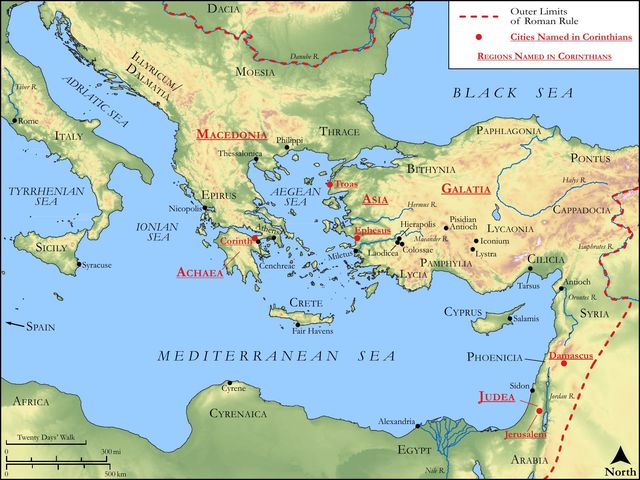
See on the biblical-era maps

Study this verse
Public-domain commentary
Matthew Henry
From his Commentary on the Whole Bible. Henry comments on passages, not single verses — this entry covers 1 Corinthians 12:1–11. His two-level outline is real structure in the source text, so it is rendered as structure.
The apostle comes now to treat of spiritual gifts, which abounded in the church of Corinth, but were greatly abused. What these gifts were is at large told us in the body of the chapter; namely, extraordinary offices and powers, bestowed on ministers and Christians in the first ages, for conviction of unbelievers, and propagation of the gospel. Gifts and graces, charismata and charis, greatly differ. Both indeed were freely given of God. But where grace is given it is for the salvation of those who have it. Gifts are bestowed for the advantage and salvation of others. And there may be great gifts where there is not a dram of grace, but persons possessed of them are utterly out of the divine favour. They are great instances of divine benignity to men, but do not by themselves prove those who have them to be the objects of divine complacency. This church was rich in gifts, but there were many things scandalously out of order in it. Now concerning these spiritual gifts, that is, the extraordinary powers they had received from the Spirit,
I.The apostle tells them he would not have them ignorant either of their original or use.
They came from God, and were to be used for him. It would lead them far astray if they were ignorant of one or the other of these. Note, Right information is of great use as to all religious practice. It is wretched work which gifted men make who either do not know or do not advert to the nature and right use of the gifts with which they are endowed.
II.He puts them in the mind of the sad state out of which they had been recovered:
You were Gentiles, carried away to dumb idols, even as you were led, Co1 12:2. While they were so, they could have no pretensions to be spiritual men, nor to have spiritual gifts. While they were under the conduct of the spirit of Gentilism, they could not be influenced by the Spirit of Christ. If they well understood their former condition, they could not but know that all true spiritual gifts were from God. Now concerning this observe,
1.Their former character: they were Gentiles. Not God's peculiar people, but of the nations whom he had in a manner abandoned. The Jews were, before, his chosen people, distinguished from the rest of the world by his favour. To them the knowledge and worship of the true God were in a manner confined. The rest of the world were strangers to the covenant of promise, aliens from the commonwealth of Israel, and in a manner without God, Eph 2:12. Such Gentiles were the body of the Corinthians, before their conversion to Christianity. What a change was here! Christian Corinthians were once Gentiles. Note, It is of great use to the Christian, and a proper consideration to stir him up both to duty and thankfulness, to think what once he was: You were Gentiles.
2.The conduct they were under: Carried away to these dumb idols, even as you were led. They were hurried upon the grossest idolatry, the worship even of stocks and stones, through the force of a vain imagination, and the fraud of their priests practising on their ignorance, for, whatever were the sentiments of their philosophers, this was the practice of the herd. The body of the people paid their homage and worship to dumb idols, that had ears but could not hear, and mouths but could not speak, Psa 115:5, Psa 115:6. Miserable abjectness of mind! And those who despised these gross conceptions of the vulgar yet countenanced them by their practice. O dismal state of Gentilism! Could the Spirit of God be among such stupid idolators, or they be influenced by it? How did the prince of this world triumph in the blindness of mankind! How thick a mist had he cast over their minds!
III.He shows them how they might discern those gifts that were from the Spirit of God, true spiritual gifts:
No man, speaking by the Spirit, calls Jesus accursed. Thus did both Jews and Gentiles: they blasphemed him as an impostor, and execrated his name, and deemed it abominable. And yet many Jews, who were exorcists and magicians, went about, pretending to work wonders by the Spirit of God (vid. Lightfoot's Horae in loc.), and many among the Gentiles pretended to inspiration. Now the apostle tells them none could act under the influence, nor by the power, of the Spirit of God, who disowned and blasphemed Christ: for the Spirit of God bore uncontrollable witness to Christ by prophecy, miracles, his resurrection from the dead, the success of his doctrine among men, and its effect upon them; and could never so far contradict itself as to declare him accursed. And on the other hand no man could say Jesus was the Lord (that is, live by this faith, and work miracles to prove it), but it must be by the Holy Ghost. To own this truth before men, and maintain it to the death, and live under the influence of it, could not be done without the sanctification of the Holy Ghost. No man can call Christ Lord, with a believing subjection to him and dependence upon him, unless that faith be wrought by the Holy Ghost. No man can confess this truth in the day of trial but by the Holy Ghost animating and encouraging him. Note, We have as necessary a dependence on the Spirit's operation and influence for our sanctification and perseverance as on the mediation of Christ for our reconciliation and acceptance with God: and no man could confirm this truth with a miracle but by the Holy Ghost. No evil spirit would lend assistance, if it were in his power, to spread a doctrine and religion so ruinous to the devil's kingdom. The substance of what the apostle asserts and argues here is that whatever pretences there were to inspiration or miracles, among those who were enemies to Christianity, they could not be from the Spirit of God; but no man could believe this with his heart, nor prove with a miracle that Jesus was Christ, but by the Holy Ghost: so that the extraordinary operations and powers among them did all proceed from the Spirit of God. He adds,
IV.These spiritual gifts, though proceeding from the same Spirit, are yet various.
They have one author and original, but are themselves of various kinds. A free cause may produce variety of effects; and the same giver may bestow various gifts, Co1 12:4. There are diversities of gifts, such as revelations, tongues, prophecy, interpretations of tongues; but the same Spirit. There are differences of administrations, or different offices, and officers to discharge them, different ordinances and institutions (see Co1 12:28-30), but the same Lord, who appointed all, Co1 12:6. There are diversities of operations, or miraculous powers, called energēmata dunameōn (Co1 12:10), as here energēmata, but it is the same God that worketh all in all. There are various gifts, administrations, and operations, but all proceed from one God, one Lord, one Spirit; that is, from Father, Son, and Holy Ghost, the spring and origin of all spiritual blessings and bequests: all issue from the same fountain; all have the same author. However different they may be in themselves, in this they agree; all are from God. And several of the kinds are here specified, Co1 12:8-10. Several persons had their several gifts, some one, some another, all from and by the same Spirit. To one was given the word of wisdom; that is, say some, a knowledge of the mysteries of the gospel, and ability to explain them, an exact understanding of the design, nature, and doctrines, of the Christian religion. Others say an uttering of grave sentences, like Solomon's proverbs. Some confine this word of wisdom to the revelations made to and by the apostles. - To another the word of knowledge, by the same Spirit; that is, say some, the knowledge of mysteries (Co1 2:13): wrapped up in the prophecies, types, and histories of the Old Testament: say others, a skill and readiness to give advice and counsel in perplexed cases. - To another faith, by the same Spirit; that is, the faith of miracles, or a faith in the divine power and promise, whereby they were enabled to trust God in any emergency, and go on in the way of their duty, and own and profess the truths of Christ, whatever was the difficulty or danger. - To another the gift of healing, by the same Spirit; that is, healing the sick, either by laying on of hands, or anointing with oil, or with a bare word. - To another the working of miracles; the efficacies of powers, energēmata dunameōn, such as raising the dead, restoring the blind to sight, giving speech to the dumb, hearing to the deaf, and the use of limbs to the lame. - To another prophecy, that is, ability to foretel future events, which is the more usual sense of prophecy; or to explain scripture by a peculiar gift of the Spirit. See Co1 14:24. - To another the discerning of Spirits, power to distinguish between true and false prophets, or to discern the real and internal qualifications of any person for an office, or to discover the inward workings of the mind by the Holy Ghost, as Peter did those of Ananias, Act 5:3. - To another divers kinds of tongues, or ability to speak languages by inspiration. - To another the interpretation of tongues, or ability to render foreign languages readily and properly into their own. With such variety of spiritual gifts were the first ministers and churches blessed.
V.The end for which these gifts were bestowed:
The manifestation of the Spirit is given to every man to profit withal, Co1 12:7. The Spirit was manifested by the exercise of these gifts; his influence and interest appeared in them. But they were not distributed for the mere honour and advantage of those who had them, but for the benefit of the church, to edify the body, and spread and advance the gospel. Note, Whatever gifts God confers on any man, he confers them that he may do good with them, whether they be common or spiritual. The outward gifts of his bounty are to be improved for his glory, and employed in doing good to others. No man has them merely for himself. They are a trust put into his hands, to profit withal; and the more he profits others with them, the more abundantly will they turn to his account in the end, Phi 4:17. Spiritual gifts are bestowed, that men may with them profit the church and promote Christianity. They are not given for show, but for service; not for pomp and ostentation, but for edification; not to magnify those that have them, but to edify others.
VI.The measure and proportion in which they are given:
All these worketh one and the same Spirit, dividing to every man as he will. It is according to the sovereign pleasure of the donor. What more free than a gift? And shall not the Spirit of God do what he will with his own? May he not give to what persons he pleases, and in what proportion he pleases; one gift to one man, and another to another; to one more, and another fewer, as he thinks fit? Is he not the best judge how his own purpose shall be served, and his own donatives bestowed? It is not as men will, nor as they may think fit, but as the Spirit pleases. Note, The Holy Ghost is a divine person. He works divine effects and divides divine gifts a he will, by his own power, and according to his own pleasure, without dependence or control. But though he distributes these gifts freely and uncontrollably, they are intended by him, not for private honour and advantage, but for public benefit, for the edification of the body, the church.
Historical interpretation
Historical reception
4 surviving comments on this verse. Each one is dated, so this reads as a timeline rather than a list.
Select a marker to jump to its quote. Markers stagger vertically where authors wrote within a few decades of each other.
There is a fourfold meaning in the words that lie before us: There is the same Spirit in the varieties of the gifts. There is the same Lord in the varieties of ministries. There is the same God in these varieties. And there is a manifestation of the Spirit in the bestowal of what is profitable.
Let not, therefore, any one that works signs and wonders judge any one of the faithful who is not vouchsafed the same: for the gifts of God which are bestowed by Him through Christ are various; and one man receives one gift, and another another. For perhaps one has the word of wisdom, and another the word of knowledge; another, discerning of spirits; another, foreknowledge of things to come; another, the word of teaching; another, long-suffering; another, continence according to the law: for even Moses, the man of God, when he wrought signs in Egypt, did not exalt himself against his equals: and when he was called a god, he did not arrogantly despise his own prophet Aaron. Nor did Joshua the Son of Nun, who was the leader of the people after him, though in the war with the Jebusites he had made the sun stand still over against Gibeon, and the moon over against the valley of Ajalon, because the day was not long enough for their victory, insult over Phineas or Caleb. Nor did Samuel, who had done so many surprising things, disregard David the beloved of God: yet they were both prophets, and the one was high priest, and the other was king. And when there were only seven thousand holy men in Israel who had not bowed the knee to Baal, [1 Kings 19:18; Romans 11:4] Elijah alone among them, and his disciple Elisha, were workers of miracles. Yet neither did Elijah despise Obadiah the steward, who feared God, but wrought no signs...
Paul is emphatic in asserting that the distribution of gifts is not to be attributed to human causes as if they were achievable by men. The varied gifts of the Holy Spirit and the grace of the Lord Jesus are the work of one and the same God. The grace and the gift cannot be divided according to the persons of the Father, Son and Holy Spirit but must be understood as constituting the one work of the undivided unity and nature of the Three.
"And there are diversities of workings, but the same God who worketh all things in all."
"And what," saith one, "is a working?" and what "a gift?" and what "a ministration?" They are mere differences of names, since the things are the same. For what "a gift" is, that is "a ministration," that he calls "an operation" also. Thus fulfil thy ministry; and, "I magnify my ministration:" and writing to Timothy, he says, "Therefore I put thee in remembrance that thou stir up the gift of God, which is in thee." And again, writing to the Galatians, he said, "for he that wrought in Peter to the Apostleship, the same was mighty in me toward the Gentiles." Seest thou that he implies that there is no difference in the gifts of the Father, and the Son, and the Holy Ghost? Not confounding the Persons, God forbid! but declaring the equal honor of the Essence. For that which the Spirit bestows, this he saith that God also works; this, that the Son likewise ordains and grants. Yet surely if the one were inferior to the other, or the other to it, he would not have thus set it down nor would this have been his way of consoling the person who was vexed.
Continue studying 1 Corinthians 12:6 across the web’s major study libraries — every link below opens this exact verse, chapter, or book on the destination site.
Read & Compare
 BibleGatewayThis verse in more than 200 translations and 70 languages.
 Bible.comThe YouVersion reader — hundreds of translations, reading plans, and highlights.
 ESV.orgCrossway's official English Standard Version reader.
 NET BibleThe NET translation with 60,000+ translators' notes on every rendering decision.
 STEP BibleTyndale House's free study tool — original text, vocabulary, and scholarly resources.
 BibliaLogos Bible Software's free web reader.
 USCCBThe New American Bible (Revised Edition) with the U.S. bishops' study notes.
Commentaries
 BibleHub CommentariesDozens of classic commentaries on this verse, gathered on one page.
 StudyLightMore than 100 commentary sets — the largest collection on the web.
 BibleRefPlain-English commentary on what this verse means, verse by verse.
 Enduring WordDavid Guzik's free commentary on this chapter, widely used by Bible teachers.
 Bible Study ToolsVerse commentary alongside Greek and Hebrew study aids.
Original Language & Research
- BibleHub InterlinearThe verse word by word — original language, transliteration, and English.
- BibleHub LexiconEvery word's original-language definition and Strong's entry.
 Blue Letter BibleDeep-study tools — Strong's numbers, concordance, and word studies.
 CNTR CollationThe earliest Greek manuscripts of this verse, collated letter by letter.
Sermons, Hymns & Audio


TrulyRandomVerse is not affiliated with these sites and doesn’t control their content. They’re linked because they’re genuinely useful.
Summary
1 Corinthians 12:6 profoundly articulates the divine unity underlying the manifold expressions of God's power within the church. It asserts that while there are diverse "operations" or effective workings of the Holy Spirit through believers, the ultimate source, orchestrator, and empowering agent behind every spiritual manifestation is one and the same God. This verse serves as a foundational theological statement, emphasizing God's singular sovereignty and comprehensive activity in equipping and enabling His people for ministry, fostering both humility and harmony within the body of Christ.
Context
ShowHideLiterary Context
This verse is an integral part of Paul's extensive discourse on spiritual gifts in 1 Corinthians 12. The chapter opens with Paul's desire for the Corinthians to be properly informed about spiritual matters, specifically concerning the charismata, or grace-gifts (1 Corinthians 12:1). He immediately establishes a foundational principle of unity in diversity, stating that there are "diversities of gifts, but the same Spirit" (1 Corinthians 12:4), and "differences of administrations, but the same Lord" (1 Corinthians 12:5). Verse 6 completes this Trinitarian framework, attributing the "diversities of operations" to "the same God." This systematic progression from Spirit to Lord to God underscores the unified divine source behind all spiritual activity, setting the stage for Paul's subsequent analogy of the church as one body with many members, each indispensable (1 Corinthians 12:12-27).
Historical & Cultural Context
The Corinthian church was a vibrant but deeply fractured community, grappling with various issues including internal divisions, moral laxity, and theological misunderstandings. In the realm of spiritual gifts, it appears some members were elevating certain gifts (like speaking in tongues) above others, leading to pride, envy, and disorder in their corporate gatherings. This created a competitive atmosphere where individuals might boast in their spiritual manifestations or feel inferior if they lacked certain prominent gifts. Paul's letter, particularly this section, directly addresses these abuses by reminding them of the divine origin and purpose of all gifts. The Greeks and Romans also had various mystery religions and cultic practices that involved ecstatic experiences, which may have influenced the Corinthians' understanding and pursuit of spiritual phenomena, leading to a focus on outward manifestations rather than the underlying divine purpose and unity. Paul's teaching seeks to correct these misconceptions, emphasizing the communal good and the singular source of all spiritual power.
Key Themes
ShowHideThe overarching theme of 1 Corinthians 12 is Unity in Diversity within the body of Christ. Verse 6 specifically contributes to this by affirming that despite the varied ways God works through individuals, the ultimate power and direction come from one unified divine source. This combats the divisive tendencies prevalent in Corinth by highlighting that all spiritual activity serves a singular divine purpose, as each manifestation of the Spirit is given for the common good (1 Corinthians 12:7). Another crucial theme is Divine Sovereignty and Agency, as the verse explicitly states that it is "the same God which worketh all in all." This underscores God's active involvement and ultimate control over every spiritual operation, ensuring that His purposes are fulfilled through His people. This emphasis on God's comprehensive activity prevents human boasting and promotes humility, redirecting focus from the gifted individual to the gifting God.
Exposition and Analysis
ShowHideKey Word Analysis
ShowHideThis term (G1243) denotes a "distinction or variety." In the context of 1 Corinthians 12, it refers to the various kinds or categories of operations, implying a wide range of divine activities and effects. It highlights the multifaceted nature of God's work, which is not monolithic but expresses itself in numerous distinct ways.
Derived from energéō (G1754), this noun (G1755) signifies an "effect" or "working." It refers to the actual dynamic results, accomplishments, or manifestations of divine power. Unlike "gifts" (charismata) which are the endowments, or "administrations" (diakoniai) which are the services, "operations" point to the concrete, observable outcomes and effective workings that God produces through individuals.
This verb (G1754) means "to be active, efficient" or "to produce results." It emphasizes God's continuous, dynamic, and powerful action. The use of this verb, alongside the noun enérgēma, creates a powerful wordplay that underscores God's active and effective involvement in bringing about the "operations." It is not merely that God permits these workings, but that He is the active agent producing them.
Verse Breakdown
ShowHide"And there are diversities of operations"
This clause acknowledges the reality of varied divine activities and effects within the church. Just as there are different gifts and different ways of serving, there are also distinct ways God's power manifests and produces results. This diversity is not chaotic but divinely ordained, reflecting the richness and multifaceted nature of God's activity in the world and through His people. It sets up the contrast that follows, emphasizing that this variety does not imply multiple sources.
"but it is the same God"
The conjunction "but" (G1161, dé) introduces a crucial contrast, shifting the focus from the variety of operations to their singular divine origin. This phrase emphatically declares that despite the outward differences, the ultimate source and power behind all these operations is one unified God. This directly counters any potential for division or competition by grounding all spiritual activity in the singular, sovereign will of God the Father.
"which worketh all in all"
This concluding phrase powerfully asserts the comprehensive scope and pervasive nature of God's work. "Worketh" (G1754, energéō) reiterates God's active agency. "All in all" (G3956 pâs in G1722 en G3956 pâs) signifies that God is at work in every aspect, in every individual, and in every manifestation. He is not merely the initiator but the ongoing sustainer and perfecter of all spiritual operations, permeating every facet of the church's life and ministry to achieve His purposes.
Literary Devices
ShowHidePaul employs several powerful literary devices in this concise verse. The primary device is Antithesis, contrasting the "diversities of operations" with the singular "same God." This stark opposition highlights the central theological truth: variety in manifestation does not negate unity in source. Furthermore, there is a clear instance of Repetition through the use of cognate words: enérgēma (operations) and energéō (worketh). This Polyptoton emphasizes the active, dynamic, and effective nature of God's involvement, reinforcing that these "operations" are indeed God's "workings." Finally, the phrase "all in all" functions as a form of Merism or Totality, indicating the complete and exhaustive scope of God's pervasive activity. It suggests that God's work is not limited to certain individuals or specific manifestations but encompasses every single aspect and every single person within the spiritual realm.
Theological and Thematic Connections
ShowHide1 Corinthians 12:6 is a profound theological statement on the unity of the Godhead in the work of the Spirit, completing Paul's Trinitarian emphasis on spiritual gifts. It underscores the active sovereignty of God the Father as the ultimate source and orchestrator of all spiritual manifestations, gifts, and ministries. This verse ensures that all glory for spiritual effectiveness is directed to God, preventing human pride and fostering a corporate humility within the church. It teaches that the diverse ways God works through His people are not random or disparate, but are part of a unified, divine plan, all ultimately originating from and empowered by the same God for the building up of His body.
Reflection and Application
ShowHide1 Corinthians 12:6 offers profound practical implications for believers and the church today. In a world often characterized by individualism, competition, and a tendency to elevate human achievement, this verse reorients our perspective toward God's ultimate sovereignty. It calls us to humility, reminding us that any spiritual effectiveness or impact we might have is not due to our inherent abilities or superior gifts, but entirely to the empowering work of the "same God" who "worketh all in all." This truth should dismantle pride and envy, encouraging us to celebrate the diverse ways God manifests His power through others, rather than comparing ourselves or competing for prominence. It fosters genuine unity, recognizing that every "operation," no matter how seemingly small or grand, is part of God's singular, comprehensive plan to build His kingdom. Our focus shifts from "what I do" to "what God does through me," promoting a healthy interdependence within the body of Christ, where each member values the unique divine working in others.
Questions for Reflection
ShowHideFAQ
ShowHideWhat is the difference between "gifts," "administrations," and "operations" in 1 Corinthians 12?
ShowHidePaul uses these three terms to describe different facets of God's work through the Holy Spirit, each attributed to a distinct person of the Trinity, yet all flowing from the one God. "Gifts" (Greek: charismata) refer to the spiritual endowments or abilities themselves, given by the Holy Spirit (1 Corinthians 12:4). These are the innate capacities or manifestations of grace. "Administrations" or "ministries" (Greek: diakoniai) refer to the specific ways or spheres of service in which these gifts are exercised, overseen by the Lord Jesus Christ (1 Corinthians 12:5). This speaks to the practical application and organization of ministry. "Operations" (Greek: energēmata) refer to the actual effects, results, or powerful workings that God the Father produces through the exercise of these gifts in these administrations (1 Corinthians 12:6). It's the divine power that makes the gifts effective and productive. So, gifts are the abilities, administrations are the services, and operations are the divine power and results.
Christ-Centered Fulfillment
ShowHideWhile 1 Corinthians 12:6 explicitly names "God" (the Father) as the one who "worketh all in all," this truth finds its ultimate fulfillment and expression in the person and work of Jesus Christ. Christ is the very embodiment of God's active working in the world, the one through whom all things were created and through whom God reconciles the world to himself (Colossians 1:16-20). As the Head of the Church, Christ is the one who distributes the gifts of the Spirit to His body, equipping believers for ministry (Ephesians 4:7-12). The "operations" of God are ultimately aimed at conforming believers to the image of Christ (Romans 8:29) and building up His body, the church, until it reaches the measure of the stature of the fullness of Christ (Ephesians 4:13). Thus, the diverse workings of God are not arbitrary but serve the singular purpose of advancing Christ's kingdom and manifesting His glory through His empowered people, demonstrating that "it is no longer I who live, but Christ who lives in me" (Galatians 2:20).