


1 Corinthians 12:4
Bible text: King James Version (1769 Blayney text) · Public domain
Bible text: Berean Standard Bible · Public domain
Bible text: American Standard Version (1901) · Public domain
Bible text: World English Bible, Messianic edition · Public domain
Bible text: Geneva Bible (1599) · Public domain
Bible text: Young's Literal Translation · Public domain
- διαιρέσειςdiaireseisVarietiesG1243N-NPFNoun Nominative Plural Feminine
- δὲdenowG1161CONJConjunction
- χαρισμάτωνcharismatōnof giftsG5486N-GPNNoun Genitive Plural Neuter
- εἰσίνeisinthere areG1510V-PAI-3PVerb Present Active Indicative 3rd Plural
- τὸto<the>G3588T-NSNDefinite article Nominative Singular Neuter
- δὲdebutG1161CONJConjunction
- αὐτὸautothe sameG846P-NSNPersonal pronoun Nominative Singular Neuter
- πνεῦμα·pneumaSpiritG4151N-NSNNoun Nominative Singular Neuter
English is a literal word-by-word gloss of the Greek, not the KJV's wording. Why?
This is the original text the KJV's translators worked from — each Greek word with its own literal English meaning in this verse, prepared by scholars at Tyndale House, Cambridge. The KJV translates whole sentences, not word by word, so its wording differs: one Greek word can become several English words, and the KJV may choose “charity” where the gloss reads “love”. Both are faithful — they answer different questions. For the KJV's own rendering, switch to the KJV text.
Details
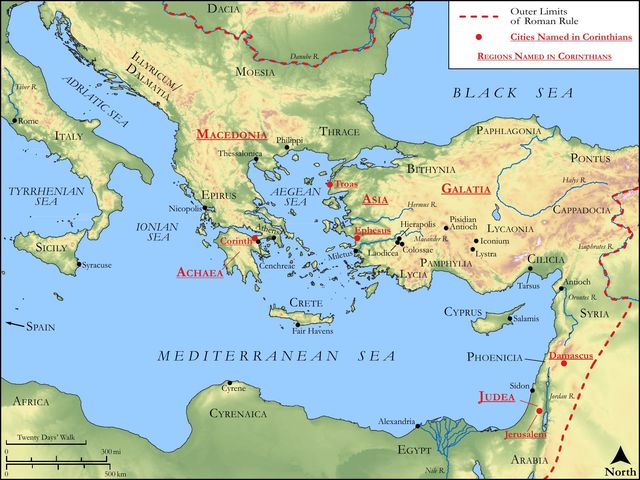
See on the biblical-era maps

Study this verse
Public-domain commentary
Matthew Henry
From his Commentary on the Whole Bible. Henry comments on passages, not single verses — this entry covers 1 Corinthians 12:1–11. His two-level outline is real structure in the source text, so it is rendered as structure.
The apostle comes now to treat of spiritual gifts, which abounded in the church of Corinth, but were greatly abused. What these gifts were is at large told us in the body of the chapter; namely, extraordinary offices and powers, bestowed on ministers and Christians in the first ages, for conviction of unbelievers, and propagation of the gospel. Gifts and graces, charismata and charis, greatly differ. Both indeed were freely given of God. But where grace is given it is for the salvation of those who have it. Gifts are bestowed for the advantage and salvation of others. And there may be great gifts where there is not a dram of grace, but persons possessed of them are utterly out of the divine favour. They are great instances of divine benignity to men, but do not by themselves prove those who have them to be the objects of divine complacency. This church was rich in gifts, but there were many things scandalously out of order in it. Now concerning these spiritual gifts, that is, the extraordinary powers they had received from the Spirit,
I.The apostle tells them he would not have them ignorant either of their original or use.
They came from God, and were to be used for him. It would lead them far astray if they were ignorant of one or the other of these. Note, Right information is of great use as to all religious practice. It is wretched work which gifted men make who either do not know or do not advert to the nature and right use of the gifts with which they are endowed.
II.He puts them in the mind of the sad state out of which they had been recovered:
You were Gentiles, carried away to dumb idols, even as you were led, Co1 12:2. While they were so, they could have no pretensions to be spiritual men, nor to have spiritual gifts. While they were under the conduct of the spirit of Gentilism, they could not be influenced by the Spirit of Christ. If they well understood their former condition, they could not but know that all true spiritual gifts were from God. Now concerning this observe,
1.Their former character: they were Gentiles. Not God's peculiar people, but of the nations whom he had in a manner abandoned. The Jews were, before, his chosen people, distinguished from the rest of the world by his favour. To them the knowledge and worship of the true God were in a manner confined. The rest of the world were strangers to the covenant of promise, aliens from the commonwealth of Israel, and in a manner without God, Eph 2:12. Such Gentiles were the body of the Corinthians, before their conversion to Christianity. What a change was here! Christian Corinthians were once Gentiles. Note, It is of great use to the Christian, and a proper consideration to stir him up both to duty and thankfulness, to think what once he was: You were Gentiles.
2.The conduct they were under: Carried away to these dumb idols, even as you were led. They were hurried upon the grossest idolatry, the worship even of stocks and stones, through the force of a vain imagination, and the fraud of their priests practising on their ignorance, for, whatever were the sentiments of their philosophers, this was the practice of the herd. The body of the people paid their homage and worship to dumb idols, that had ears but could not hear, and mouths but could not speak, Psa 115:5, Psa 115:6. Miserable abjectness of mind! And those who despised these gross conceptions of the vulgar yet countenanced them by their practice. O dismal state of Gentilism! Could the Spirit of God be among such stupid idolators, or they be influenced by it? How did the prince of this world triumph in the blindness of mankind! How thick a mist had he cast over their minds!
III.He shows them how they might discern those gifts that were from the Spirit of God, true spiritual gifts:
No man, speaking by the Spirit, calls Jesus accursed. Thus did both Jews and Gentiles: they blasphemed him as an impostor, and execrated his name, and deemed it abominable. And yet many Jews, who were exorcists and magicians, went about, pretending to work wonders by the Spirit of God (vid. Lightfoot's Horae in loc.), and many among the Gentiles pretended to inspiration. Now the apostle tells them none could act under the influence, nor by the power, of the Spirit of God, who disowned and blasphemed Christ: for the Spirit of God bore uncontrollable witness to Christ by prophecy, miracles, his resurrection from the dead, the success of his doctrine among men, and its effect upon them; and could never so far contradict itself as to declare him accursed. And on the other hand no man could say Jesus was the Lord (that is, live by this faith, and work miracles to prove it), but it must be by the Holy Ghost. To own this truth before men, and maintain it to the death, and live under the influence of it, could not be done without the sanctification of the Holy Ghost. No man can call Christ Lord, with a believing subjection to him and dependence upon him, unless that faith be wrought by the Holy Ghost. No man can confess this truth in the day of trial but by the Holy Ghost animating and encouraging him. Note, We have as necessary a dependence on the Spirit's operation and influence for our sanctification and perseverance as on the mediation of Christ for our reconciliation and acceptance with God: and no man could confirm this truth with a miracle but by the Holy Ghost. No evil spirit would lend assistance, if it were in his power, to spread a doctrine and religion so ruinous to the devil's kingdom. The substance of what the apostle asserts and argues here is that whatever pretences there were to inspiration or miracles, among those who were enemies to Christianity, they could not be from the Spirit of God; but no man could believe this with his heart, nor prove with a miracle that Jesus was Christ, but by the Holy Ghost: so that the extraordinary operations and powers among them did all proceed from the Spirit of God. He adds,
IV.These spiritual gifts, though proceeding from the same Spirit, are yet various.
They have one author and original, but are themselves of various kinds. A free cause may produce variety of effects; and the same giver may bestow various gifts, Co1 12:4. There are diversities of gifts, such as revelations, tongues, prophecy, interpretations of tongues; but the same Spirit. There are differences of administrations, or different offices, and officers to discharge them, different ordinances and institutions (see Co1 12:28-30), but the same Lord, who appointed all, Co1 12:6. There are diversities of operations, or miraculous powers, called energēmata dunameōn (Co1 12:10), as here energēmata, but it is the same God that worketh all in all. There are various gifts, administrations, and operations, but all proceed from one God, one Lord, one Spirit; that is, from Father, Son, and Holy Ghost, the spring and origin of all spiritual blessings and bequests: all issue from the same fountain; all have the same author. However different they may be in themselves, in this they agree; all are from God. And several of the kinds are here specified, Co1 12:8-10. Several persons had their several gifts, some one, some another, all from and by the same Spirit. To one was given the word of wisdom; that is, say some, a knowledge of the mysteries of the gospel, and ability to explain them, an exact understanding of the design, nature, and doctrines, of the Christian religion. Others say an uttering of grave sentences, like Solomon's proverbs. Some confine this word of wisdom to the revelations made to and by the apostles. - To another the word of knowledge, by the same Spirit; that is, say some, the knowledge of mysteries (Co1 2:13): wrapped up in the prophecies, types, and histories of the Old Testament: say others, a skill and readiness to give advice and counsel in perplexed cases. - To another faith, by the same Spirit; that is, the faith of miracles, or a faith in the divine power and promise, whereby they were enabled to trust God in any emergency, and go on in the way of their duty, and own and profess the truths of Christ, whatever was the difficulty or danger. - To another the gift of healing, by the same Spirit; that is, healing the sick, either by laying on of hands, or anointing with oil, or with a bare word. - To another the working of miracles; the efficacies of powers, energēmata dunameōn, such as raising the dead, restoring the blind to sight, giving speech to the dumb, hearing to the deaf, and the use of limbs to the lame. - To another prophecy, that is, ability to foretel future events, which is the more usual sense of prophecy; or to explain scripture by a peculiar gift of the Spirit. See Co1 14:24. - To another the discerning of Spirits, power to distinguish between true and false prophets, or to discern the real and internal qualifications of any person for an office, or to discover the inward workings of the mind by the Holy Ghost, as Peter did those of Ananias, Act 5:3. - To another divers kinds of tongues, or ability to speak languages by inspiration. - To another the interpretation of tongues, or ability to render foreign languages readily and properly into their own. With such variety of spiritual gifts were the first ministers and churches blessed.
V.The end for which these gifts were bestowed:
The manifestation of the Spirit is given to every man to profit withal, Co1 12:7. The Spirit was manifested by the exercise of these gifts; his influence and interest appeared in them. But they were not distributed for the mere honour and advantage of those who had them, but for the benefit of the church, to edify the body, and spread and advance the gospel. Note, Whatever gifts God confers on any man, he confers them that he may do good with them, whether they be common or spiritual. The outward gifts of his bounty are to be improved for his glory, and employed in doing good to others. No man has them merely for himself. They are a trust put into his hands, to profit withal; and the more he profits others with them, the more abundantly will they turn to his account in the end, Phi 4:17. Spiritual gifts are bestowed, that men may with them profit the church and promote Christianity. They are not given for show, but for service; not for pomp and ostentation, but for edification; not to magnify those that have them, but to edify others.
VI.The measure and proportion in which they are given:
All these worketh one and the same Spirit, dividing to every man as he will. It is according to the sovereign pleasure of the donor. What more free than a gift? And shall not the Spirit of God do what he will with his own? May he not give to what persons he pleases, and in what proportion he pleases; one gift to one man, and another to another; to one more, and another fewer, as he thinks fit? Is he not the best judge how his own purpose shall be served, and his own donatives bestowed? It is not as men will, nor as they may think fit, but as the Spirit pleases. Note, The Holy Ghost is a divine person. He works divine effects and divides divine gifts a he will, by his own power, and according to his own pleasure, without dependence or control. But though he distributes these gifts freely and uncontrollably, they are intended by him, not for private honour and advantage, but for public benefit, for the edification of the body, the church.
Historical interpretation
Two Centuries of Reception
6 surviving comments on this verse. Each one is dated, so this reads as a timeline rather than a list.
Select a marker to jump to its quote. Markers stagger vertically where authors wrote within a few decades of each other.
Yet as to us "there are diversities of gifts, differences of administrations, and diversities of operations; ".
But the apostle expounded this very passage, when he said, "Now there are diversities of gifts, but the same Spirit; and there are differences of ministrations, but the same Lord; and there are diversities of operations, but it is the same God which worketh all in all. But the manifestation of the Spirit is given to every man to profit withal."
Therefore, blessed ones, whom the grace of God awaits, when you ascend from that most sacred font of your new birth, and spread your hands for the first time in the house of your mother, together with your brethren, ask from the Father, ask from the Lord, that His own specialties of grace and distributions of gifts may be supplied you.
"On high," that is, into heaven; "He led captivity captive," meaning death or slavery of man; "He gave gifts to the sons of men," that is, the gratuities, which we call charismata.
Let not, therefore, any one that works signs and wonders judge any one of the faithful who is not vouchsafed the same: for the gifts of God which are bestowed by Him through Christ are various; and one man receives one gift, and another another. For perhaps one has the word of wisdom, and another the word of knowledge; another, discerning of spirits; another, foreknowledge of things to come; another, the word of teaching; another, long-suffering; another, continence according to the law: for even Moses, the man of God, when he wrought signs in Egypt, did not exalt himself against his equals: and when he was called a god, he did not arrogantly despise his own prophet Aaron. Nor did Joshua the Son of Nun, who was the leader of the people after him, though in the war with the Jebusites he had made the sun stand still over against Gibeon, and the moon over against the valley of Ajalon, because the day was not long enough for their victory, insult over Phineas or Caleb. Nor did Samuel, who had done so many surprising things, disregard David the beloved of God: yet they were both prophets, and the one was high priest, and the other was king. And when there were only seven thousand holy men in Israel who had not bowed the knee to Baal, [1 Kings 19:18; Romans 11:4] Elijah alone among them, and his disciple Elisha, were workers of miracles. Yet neither did Elijah despise Obadiah the steward, who feared God, but wrought no signs...
Now this cannot pertain to the fulness, nor to the dividing of the Spirit; for neither does the mind of man grasp His fulness, nor is He divided into any portions of Himself; but He pours into the soul the gift of spiritual grace, in which God is worshipped as He is also worshipped in truth, for no one worships Him except he who drinks in the truth of His Godhead with pious affection.
Having therefore made manifest the soothsayers and the prophets both by the first sign and also by the second, he next discourses of the wonders; not passing without reason to this topic, but so as to remove the dissension which had thence arisen, and to persuade both those that had the less portion not to grieve and those who had the greater not to be elated. Wherefore also he thus began.
"Now there are diversities of gifts, but the same Spirit."
And first he attends on him that had the lesser gift, and was grieved on this account. "For wherefore," saith he, "art thou dejected? because thou hast not received as much as another? Still, consider that it is a free gift and not a debt, and thou wilt be able to soothe thy pain." For this cause he spake thus in the very beginning: "but there are diversities of gifts." And he said not "of signs," nor "of wonders," but of "gifts," by the name of free gifts prevailing on them not only not to grieve but even to be thankful. "And withal consider this also," saith he, "that even if thou art made inferior in the measure of what is given; in that it hath been vouchsafed thee to receive from the same source as the other who hath received more, thou hast equal honor. For certainly thou canst not say that the Spirit bestowed the gift on him, but an angel on thee: since the Spirit bestowed it both on thee and him. Wherefore he added, "but the same Spirit." So that even if there be a difference in the gift, yet is there no difference in the Giver. For from the same Fountain ye are drawing, both thou and he.
Continue studying 1 Corinthians 12:4 across the web’s major study libraries — every link below opens this exact verse, chapter, or book on the destination site.
Read & Compare
 BibleGatewayThis verse in more than 200 translations and 70 languages.
 Bible.comThe YouVersion reader — hundreds of translations, reading plans, and highlights.
 ESV.orgCrossway's official English Standard Version reader.
 NET BibleThe NET translation with 60,000+ translators' notes on every rendering decision.
 STEP BibleTyndale House's free study tool — original text, vocabulary, and scholarly resources.
 BibliaLogos Bible Software's free web reader.
 USCCBThe New American Bible (Revised Edition) with the U.S. bishops' study notes.
Commentaries
 BibleHub CommentariesDozens of classic commentaries on this verse, gathered on one page.
 StudyLightMore than 100 commentary sets — the largest collection on the web.
 BibleRefPlain-English commentary on what this verse means, verse by verse.
 Enduring WordDavid Guzik's free commentary on this chapter, widely used by Bible teachers.
 Bible Study ToolsVerse commentary alongside Greek and Hebrew study aids.
Original Language & Research
- BibleHub InterlinearThe verse word by word — original language, transliteration, and English.
- BibleHub LexiconEvery word's original-language definition and Strong's entry.
 Blue Letter BibleDeep-study tools — Strong's numbers, concordance, and word studies.
 CNTR CollationThe earliest Greek manuscripts of this verse, collated letter by letter.
Sermons, Hymns & Audio


TrulyRandomVerse is not affiliated with these sites and doesn’t control their content. They’re linked because they’re genuinely useful.
Summary
1 Corinthians 12:4 introduces the foundational truth that while spiritual gifts are diverse in their manifestation and function, they all originate from the singular, unifying source of the Holy Spirit. This verse initiates Paul's comprehensive instruction to the Corinthian church, addressing their misconceptions and divisions regarding these divine endowments by establishing the essential principle of variety undergirded by divine unity, setting the stage for understanding the church as a cohesive body empowered by God.
Context
ShowHideLiterary Context
This verse serves as the powerful opening statement to Paul's extensive discourse on spiritual gifts in 1 Corinthians 12 through 1 Corinthians 14. The Corinthian church was grappling with significant issues, including pride, factionalism, and a misunderstanding of the purpose and operation of spiritual gifts. It appears they were elevating certain, more outwardly impressive gifts (like speaking in tongues) while devaluing others, leading to disorder and disunity within their assemblies. Paul's aim in this section is to correct these errors, foster mutual appreciation, and guide the church toward exercising all gifts for the common good and the edification of the entire body of Christ, beginning with the crucial premise of the Spirit's singular origin for all gifts.
Historical & Cultural Context
Corinth was a bustling, wealthy Roman port city, known for its diverse population, philosophical schools, and rampant immorality, including various pagan cults. In such a syncretistic environment, ecstatic experiences, often associated with pagan deities, were common. This background likely influenced the Corinthian believers, leading some to seek dramatic spiritual manifestations or to equate spiritual power with outward displays, similar to pagan practices. Paul's emphasis on the source and purpose of gifts distinguishes Christian spiritual experiences from pagan ones, grounding them in the ethical and unifying work of the Holy Spirit, rather than individualistic or chaotic displays. The church's internal struggles mirrored the city's diverse and often competitive social structures.
Key Themes
ShowHide1 Corinthians 12:4 introduces several critical themes that Paul develops throughout the chapter and beyond. Foremost is the theme of Diversity in Unity, asserting that the multiplicity of gifts does not imply disunity but rather a unified purpose under a single divine agent. This directly counters the Corinthian tendency towards division. Another key theme is Divine Empowerment and Grace, highlighting that these abilities are not natural talents or human achievements but supernatural endowments, freely given by God's grace (as implied by "gifts," charismata). This underscores that the gifts are for service, not for personal glory. Finally, the verse subtly introduces the theme of the Sovereignty of the Spirit in distributing these gifts, a concept further elaborated in 1 Corinthians 12:11, where Paul states the Spirit "distributes to each one individually as He wills." This divine distribution ensures that each member contributes uniquely to the functioning of the body of Christ.
Exposition and Analysis
ShowHideKey Word Analysis
ShowHideMeaning "a distinction or (concretely) variety." This term emphasizes the manifold nature of spiritual gifts, indicating that they are distinct in their operation, manifestation, and effect. It points to a deliberate apportionment or distribution, highlighting the varied ways the Spirit works through believers.
Meaning "a (divine) gratuity, i.e. deliverance (from danger or passion); (specially), a (spiritual) endowment, i.e. (subjectively) religious qualification, or (objectively) miraculous faculty." This word is crucial as it links the spiritual abilities directly to God's grace (charis), emphasizing that they are unearned, freely given endowments, not human achievements or natural talents. They are specifically for the spiritual benefit and empowerment of the church.
Meaning "a current of air, i.e. breath (blast) or a breeze; by analogy or figuratively, a spirit, i.e. (human) the rational soul, (by implication) vital principle, mental disposition, etc., or (superhuman) an angel, demon, or (divine) God, Christ's spirit, the Holy Spirit." In this context, it unequivocally refers to the Holy Spirit, the third person of the Trinity, who is the divine source and distributor of all these diverse spiritual endowments.
Verse Breakdown
ShowHide"Now there are diversities of gifts"
This opening clause immediately establishes the reality of variety within the spiritual endowments given to believers. The term "diversities" (διαίρεσις, diaíresis) signifies distinct categories or distributions, implying that the Holy Spirit does not bestow a single gift upon all, but rather a wide array of different abilities and ministries. The "gifts" (χαρίσματα, charísmata) are explicitly "grace-gifts," underscoring their divine origin and gratuitous nature. They are not earned or merited but are sovereignly given by God's favor to equip believers for service within the church.
"but the same Spirit"
This contrasting clause, introduced by "but" (δὲ, dé), provides the essential counterpoint to the preceding statement. Despite the manifold variety of gifts, their ultimate source is singular and unified: the Holy Spirit. This emphasizes that the diversity of manifestations does not lead to fragmentation but is held together by the unified agency of the Spirit. This truth is foundational for promoting unity and preventing competition or division within the body of Christ, as it grounds all spiritual activity in the one divine Person.
Literary Devices
ShowHidePaul employs Juxtaposition and Antithesis in 1 Corinthians 12:4 to highlight a profound theological truth. The contrasting phrases "diversities of gifts" and "the same Spirit" are placed side-by-side to emphasize that variety and unity are not mutually exclusive but coexist under divine orchestration. This creates a powerful tension that immediately draws the reader's attention to the paradox of the Spirit's work. The use of the adversative particle "but" (G1161, dé) reinforces this contrast, setting up the central argument of the entire chapter: that the manifold expressions of God's grace are all rooted in a single, unified divine source. This rhetorical strategy effectively corrects the Corinthian misunderstanding by establishing unity as the underlying principle of all spiritual manifestations.
Theological and Thematic Connections
ShowHide1 Corinthians 12:4 lays the groundwork for understanding the Trinitarian nature of spiritual gifts, as Paul immediately follows this verse by attributing different aspects of spiritual service to "the same Lord" (Jesus Christ) and "the same God" (the Father) in verses 5-6. This reveals a profound theological truth: the diverse operations of God within the church are a unified work of the entire Godhead, with the Holy Spirit empowering, the Lord Jesus directing, and God the Father originating all spiritual activity. The verse also underscores the concept of divine grace, as "gifts" (charismata) are inherently expressions of God's unmerited favor, given not based on human merit but on divine sovereignty for the common good of the church. This truth promotes humility and interdependence among believers, reminding them that all spiritual effectiveness flows from God alone.
Reflection and Application
ShowHideFor believers today, 1 Corinthians 12:4 serves as a foundational reminder that the Holy Spirit is the singular, unifying source of all genuine spiritual gifts within the church. This understanding should profoundly shape our perspective on ourselves and others within the Christian community. It calls us to embrace the rich diversity of God's workings without succumbing to comparison, pride, or envy. Recognizing that all gifts flow from the same Spirit fosters a deep sense of unity, interdependence, and mutual appreciation. It encourages us to humbly discover and faithfully steward the unique grace-gifts God has bestowed upon us, not for personal glory, but for the edification and strengthening of the entire body of Christ. This verse challenges any tendency to elevate certain gifts over others and instead promotes a holistic view where every Spirit-empowered contribution is vital and valued for the church's health and mission.
Questions for Reflection
ShowHideFAQ
ShowHideWhat is the difference between spiritual gifts and natural talents?
ShowHideWhile both spiritual gifts and natural talents are ultimately from God, they differ in their origin, purpose, and nature. Natural talents are innate abilities or developed skills that are common to all humanity, regardless of faith (e.g., musical ability, athleticism, intelligence). They can be used for various purposes, including God's glory, but are not inherently spiritual. Spiritual gifts, on the other hand, are supernatural empowerments given only to believers by the Holy Spirit, typically at conversion or subsequent infilling, specifically for the building up of the church and the advancement of God's kingdom. They are "grace-gifts" (charismata), meaning they are freely given by divine grace. For example, a natural talent might be public speaking, but a spiritual gift could be prophecy or teaching, supernaturally enabled to communicate God's truth with divine authority and impact. 1 Peter 4:10 emphasizes that we are to use whatever gift we have received to serve others, as faithful stewards of God's grace.
Why is it important that the gifts come from "the same Spirit"?
ShowHideThe emphasis on "the same Spirit" is critically important for several reasons. Firstly, it ensures unity within the diverse body of believers. If gifts came from different sources, it could lead to fragmentation and competition, as was happening in Corinth. By highlighting the single divine source, Paul underscores that all gifts, regardless of their outward manifestation, serve a unified purpose: the glory of God and the edification of the church. Secondly, it prevents pride and self-exaltation, reminding believers that their abilities are not self-generated but divinely bestowed. No one gift is superior, as all are expressions of the same Spirit's work. Thirdly, it guarantees the authenticity and divine authority of the gifts, distinguishing them from human abilities or even deceptive spiritual manifestations. This foundational truth ensures that the church remains a cohesive and Spirit-empowered community, working together under the guidance of the one Holy Spirit to fulfill its mission as the body of Christ.
Christ-Centered Fulfillment
ShowHide1 Corinthians 12:4, by declaring the Holy Spirit as the singular source of diverse gifts, points profoundly to Christ's ongoing work in and through His church. The Holy Spirit, often referred to as the "Spirit of Christ" (Romans 8:9), was promised by Jesus Himself to empower His disciples after His ascension (John 14:16-17; Acts 1:8). Thus, the distribution of spiritual gifts by the Spirit is a direct continuation of Christ's ministry on earth, equipping His body—the church—to carry out His mission. These gifts enable believers to manifest Christ's presence, power, and character to the world, extending His healing, teaching, and prophetic voice. The unity emphasized in "the same Spirit" reflects the unity within the Godhead and ensures that all spiritual activity ultimately glorifies Christ, who is the head of the church. The Spirit's role is always to point to and exalt Jesus (John 16:14), ensuring that the diverse expressions of divine grace in the church serve to build up Christ's body and make His saving work known.