


1 Corinthians 3:7
Bible text: King James Version (1769 Blayney text) · Public domain
Bible text: Berean Standard Bible · Public domain
Bible text: American Standard Version (1901) · Public domain
Bible text: World English Bible, Messianic edition · Public domain
Bible text: Geneva Bible (1599) · Public domain
Bible text: Young's Literal Translation · Public domain
- ὥστεhōsteSoG5620CONJConjunction
- οὔτεouteneitherG3777CONJ-NConjunction Negative
- ὁhothe [one]G3588T-NSMDefinite article Nominative Singular Masculine
- φυτεύωνphuteuōnplantingG5452V-PAP-NSMVerb Present Active Participle Nominative Singular Masculine
- ἐστίνestinisG1510V-PAI-3SVerb Present Active Indicative 3rd Singular
- τιtianythingG5100X-NSNIndefinite pronoun Nominative Singular Neuter
- οὔτεoutenorG3777CONJ-NConjunction Negative
- ὁhothe [one]G3588T-NSMDefinite article Nominative Singular Masculine
- ποτίζωνpotizōnwateringG4222V-PAP-NSMVerb Present Active Participle Nominative Singular Masculine
- ἀλλ᾽all᾽but [only]G235CONJConjunction
- ὁhothe [One]G3588T-NSMDefinite article Nominative Singular Masculine
- αὐξάνωνauxanōngiving growth —G837V-PAP-NSMVerb Present Active Participle Nominative Singular Masculine
- θεός·theosGodG2316N-NSM-TNoun Nominative Singular Masculine Title
English is a literal word-by-word gloss of the Greek, not the KJV's wording. Why?
This is the original text the KJV's translators worked from — each Greek word with its own literal English meaning in this verse, prepared by scholars at Tyndale House, Cambridge. The KJV translates whole sentences, not word by word, so its wording differs: one Greek word can become several English words, and the KJV may choose “charity” where the gloss reads “love”. Both are faithful — they answer different questions. For the KJV's own rendering, switch to the KJV text.
Details
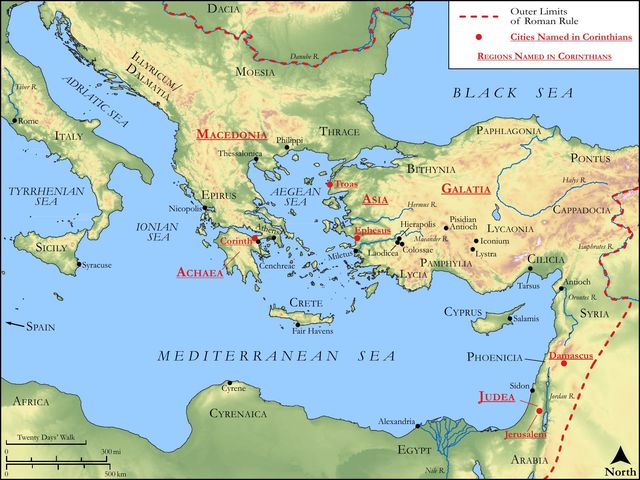
See on the biblical-era maps

Study this verse
Public-domain commentary
Matthew Henry
From his Commentary on the Whole Bible. Henry comments on passages, not single verses — this entry covers 1 Corinthians 3:5–10.
Here the apostle instructs them how to cure this humour, and rectify what was amiss among them upon this head,
I.By reminding them that the ministers about whom they contended were but ministers:
Who then is Paul, and who is Apollos, but ministers by whom you believed? Even as the Lord gave to every man, Co1 3:5. They are but ministers, mere instruments used by the God of all grace. Some of the factious people in Corinth seem to have made more of them, as if they were lords of their faith, authors of their religion. Note, We should take care not to deify ministers, nor put them into the place of God. Apostles were not the authors of our faith and religion, though they were authorized and qualified to reveal and propagate it. They acted in this office as God gave to every man. Observe, All the gifts and powers that even apostles discovered and exerted in the work of the ministry were from God. They were intended to manifest their mission and doctrine to be divine. It was perfectly wrong, upon their account, to transfer that regard to the apostles which was solely to be paid to the divine authority by which they acted, and to God, from whom they had their authority. Paul had planted and Apollos had watered, Co1 3:6. Both were useful, one for one purpose, the other for another. Note, God makes use of variety of instruments, and fits them to their several uses and intentions. Paul was fitted for planting work, and Apollos for watering work, but God gave the increase. Note, The success of the ministry must be derived from the divine blessing: Neither he that planteth is any thing, nor he that watereth, but God who giveth the increase, Co1 3:7. Even apostolical ministers are nothing of themselves, can do nothing with efficacy and success unless God give the increase. Note, The best qualified and most faithful ministers have a just sense of their own insufficiency, and are very desirous that God should have all the glory of their success. Paul and Apollos are nothing at all in their own account, but God is all in all.
II.By representing to them the unanimity of Christ's ministers:
He that planteth and he that watereth are one (Co1 3:8), employed by one Master, entrusted with the same revelation, busied in one work, and engaged in one design - in harmony with one another, however they may be set in opposition to each other by factious party-makers. They have their different gifts from one and the same Spirit, for the very same purposes; and they heartily carry on the same design. Planters and waterers are but fellow-labourers in the same work. Note, All the faithful ministers of Christ are one in the great business and intention of their ministry. They may have differences of sentiment in minor things; they may have their debates and contests; but they heartily concur in the great design of honouring God and saving souls, by promoting true Christianity in the world. All such may expect a glorious recompence of their fidelity, and in proportion to it: Every man shall receive his own reward, according to his own labour. Their business is one, but some may mind it more than others: their end or design is one, but some may pursue it more closely than others: their Master also is one, and yet this good and gracious Master may make a difference in the rewards he gives, according to the different service they do: Every one's own work shall have its own reward. Those that work hardest shall fare best. Those that are most faithful shall have the greatest reward; and glorious work it is in which all faithful ministers are employed. They are labourers with God, sunergoi - co-workers, fellow-labourers (Co1 3:9), not indeed in the same order and degree, but in subordination to him, as instruments in his hand. They are engaged in his business. They are working together with God, in promoting the purposes of his glory, and the salvation of precious souls; and he who knows their work will take care they do not labour in vain. Men may neglect and vilify one minister while they cry up another, and have no reason for either: they may condemn when they should commend, and applaud what they should neglect and avoid; but the judgment of God is according to truth. He never rewards but upon just reason, and he ever rewards in proportion to the diligence and faithfulness of his servants. Note, Faithful ministers, when they are ill used by men, should encourage themselves in God. And it is to God, the chief agent and director of the great work of the gospel, to whom those that labour with him should endeavour to approve themselves. They are always under his eye, employed in his husbandry and building; and therefore, to be sure, he will carefully look over them: "You are God's husbandry, you are God's building; and therefore are neither of Paul nor of Apollos; neither belong to one nor the other, but to God: they only plant and water you, but it is the divine blessing on his own husbandry that alone can make it yield fruit. You are not our husbandry, but God's. We work under him, and with him, and for him. It is all for God that we have been doing among you. You are God's husbandry and building." He had employed the former metaphor before, and now he goes on to the other of a building: According to the grace of God which is given unto me, as a wise master-builder, I have laid the foundation, and another buildeth thereon. Paul here calls himself a wise master-builder, a character doubly reflecting honour on him. It was honourable to be a master-builder in the edifice of God; but it added to his character to be a wise one. Persons may be in an office for which they are not qualified, or not so thoroughly qualified as this expression implies Paul was. But, though he gives himself such a character, it is not to gratify his own pride, but to magnify divine grace. He was a wise master-builder, but the grace of God made him such. Note, It is no crime in a Christian, but much to his commendation, to take notice of the good that is in him, to the praise of divine grace. Spiritual pride is abominable: it is making use of the greatest favours of God to feed our own vanity, and make idols of ourselves. But to take notice of the favours of God to promote our gratitude to him, and to speak of them to his honour (be they of what sort they will), is but a proper expression of the duty and regard we own him. Note, Ministers should not be proud of their gifts or graces; but the better qualified they are for their work, and the more success they have in it, the more thankful should they be to God for his distinguishing goodness: I have laid the foundation, and another buildeth thereon. As before he had said, I have planted, Apollos watered. It was Paul that laid the foundation of a church among them. He had begotten them through the gospel, Co1 4:15. Whatever instructors they had besides, they had not many fathers. He would derogate from none that had done service among them, nor would he be robbed of his own honour and respect. Note, Faithful ministers may and ought to have a concern for their own reputation. Their usefulness depends much upon it. But let every man take heed how he buildeth thereon. This is a proper caution; there may be very indifferent building on a good foundation. It is easy to err here; and great care should be used, not only to lay a sure and right foundation, but to erect a regular building upon it. Nothing must be laid upon it but what the foundation will bear, and what is of a piece with it. Gold and dirt must not be mingled together. Note, Ministers of Christ should take great care that they do not build their own fancies or false reasonings on the foundation of divine revelation. What they preach should be the plain doctrine of their Master, or what is perfectly agreeable with it.
Historical interpretation
Three Centuries of Reception
7 surviving comments on this verse. Each one is dated, so this reads as a timeline rather than a list.
Select a marker to jump to its quote. Markers stagger vertically where authors wrote within a few decades of each other.
For it was requisite that certain facts should be announced beforehand by the fathers in a paternal manner, and others prefigured by the prophets in a legal one, but others, described after the form of Christ, by those who have received the adoption; while in one God are all things shown forth. For although Abraham was one, he did in himself prefigure the two covenants, in which some indeed have sown, while others have reaped; for it is said, "In this is the saying true, that it is one 'people' who sows, but another who shall reap;" but it is one God who bestows things suitable upon both-seed to the sower, but bread for the reaper to eat. Just as it is one that planteth, and another who watereth, but one God who giveth the increase. For the patriarchs and prophets sowed the word [concerning] Christ, but the Church reaped, that is, received the fruit. For this reason, too, do these very men (the prophets) also pray to have a dwelling-place in it, as Jeremiah says, "Who will give me in the desert the last dwelling-place?" in order that both the sower and the reaper may rejoice together in the kingdom of Christ, who is present with all those who were from the beginning approved by God, who granted them His Word to be present with them.
The apostle certainly, after assigning the planting and watering to art and earth and water, conceded the growth to God alone, where he says, "Neither is he that planteth anything, neither he that watereth; but God that giveth the increase."
In relation to God’s honor, human honor is nothing. As far as the ministry is concerned, a man may be honored in the way that a servant is honored.
"So then, neither is he that planteth any thing, neither he that watereth, but God that giveth the increase."
Do you observe the manner in which he soothes them, so that they should not be too much irritated, on hearing, "Who is this person," and "Who is that?" "Nay, both are invidious, namely, both the saying, 'Who is this person? Who the other,'" and the saying, that "neither he that planteth nor he that watereth is any thing." How then does he soften these expressions? First, By attaching the contempt to his own person, "Who is Paul, and who Apollos?" and next, by referring the whole to God who gave all things. For after he had said, "Such a person planted," and added, "He that planteth is nothing," he subjoined, "but God that giveth the increase." Nor does he stop even here, but applies again another healing clause.
What doest thou, O man? Thou thinkest to pull down thy neighbor's; but before his thou pullest down thine own. Seest thou not them that are gardeners, that are husbandmen, how they all concur in one object? One hath dug the soil, another planted, a third carefully covered the roots, another watereth what is planted, another hedges it round and fortifies it, another drives off the cattle; and all look to one end, the safety of the plant. Here, however, it is not so: but I plant indeed myself, and another shakes and disturbs the plant. At least, allow it to get nicely fixed, that it may be strong enough to resist the assault. Thou destroyest not my work, but abandonest thine own. I planted, thou oughtest to have watered. If then thou shake it, thou hast torn it up by the roots, and hast not wherein to display thy watering. But thou seest the planter highly esteemed. Fear not: neither am I anything, nor thou. "For neither is he that planteth nor he that watereth any thing;" one's is the work, God's. So it is with Him thou fighteth and warrest, in plucking up what is planted.
Since the apostles would not have accomplished anything if God had not given the increase, how much more true is this of you or me, or anyone else of our time, who fancies himself as a teacher.
Our labor is in vain without the help of God.
Continue studying 1 Corinthians 3:7 across the web’s major study libraries — every link below opens this exact verse, chapter, or book on the destination site.
Read & Compare
 BibleGatewayThis verse in more than 200 translations and 70 languages.
 Bible.comThe YouVersion reader — hundreds of translations, reading plans, and highlights.
 ESV.orgCrossway's official English Standard Version reader.
 NET BibleThe NET translation with 60,000+ translators' notes on every rendering decision.
 STEP BibleTyndale House's free study tool — original text, vocabulary, and scholarly resources.
 BibliaLogos Bible Software's free web reader.
 USCCBThe New American Bible (Revised Edition) with the U.S. bishops' study notes.
Commentaries
 BibleHub CommentariesDozens of classic commentaries on this verse, gathered on one page.
 StudyLightMore than 100 commentary sets — the largest collection on the web.
 BibleRefPlain-English commentary on what this verse means, verse by verse.
 Enduring WordDavid Guzik's free commentary on this chapter, widely used by Bible teachers.
 Bible Study ToolsVerse commentary alongside Greek and Hebrew study aids.
Original Language & Research
- BibleHub InterlinearThe verse word by word — original language, transliteration, and English.
- BibleHub LexiconEvery word's original-language definition and Strong's entry.
 Blue Letter BibleDeep-study tools — Strong's numbers, concordance, and word studies.
 CNTR CollationThe earliest Greek manuscripts of this verse, collated letter by letter.
Sermons, Hymns & Audio


TrulyRandomVerse is not affiliated with these sites and doesn’t control their content. They’re linked because they’re genuinely useful.
Summary
1 Corinthians 3:7 delivers a profound theological statement on the nature of spiritual growth and ministry, asserting that while human efforts in planting and watering the seed of the Gospel are essential acts of obedience, they are ultimately secondary to God's sovereign power. This verse underscores that true spiritual increase—conversion, sanctification, and the expansion of the church—is a divine work, reminding believers and ministers alike to maintain humility and to attribute all fruitfulness to God alone.
Context
ShowHideLiterary Context
This verse is deeply embedded within Paul's initial arguments in his First Epistle to the Corinthian church, where he confronts severe divisions and spiritual immaturity. The Corinthians were factionalized, with some aligning themselves with Paul, others with Apollos, and still others with Cephas or Christ (1 Corinthians 1:12). Paul addresses this by challenging their worldly wisdom and carnal thinking, redirecting their focus from human personalities to God's ultimate authority and power. Immediately preceding this verse, 1 Corinthians 3:6 establishes the agricultural metaphor: "I have planted, Apollos watered; but God gave the increase." Verse 7 then draws the logical and theological conclusion from this premise, emphasizing the absolute insignificance of the human instruments in comparison to the divine source of growth. The subsequent verses continue to develop this theme, highlighting the unity of purpose among God's co-laborers and the ultimate judgment based on the quality of their work, not its perceived success based on human metrics (1 Corinthians 3:8-15).
Historical & Cultural Context
The city of Corinth was a major Roman provincial capital, a bustling commercial hub known for its wealth, diverse population, and a syncretistic religious environment. Its culture was heavily influenced by the philosophies of the Greeks, particularly rhetoric and intellectualism, which often led to an admiration of eloquent speakers and charismatic leaders. This cultural backdrop helps explain the Corinthian church's tendency to elevate human wisdom and personal allegiances, leading to the formation of cliques around prominent figures like Paul and Apollos. Paul's agricultural metaphor of planting and watering would have been readily understood by an ancient audience, as agriculture was a foundational aspect of their daily lives. By applying this common imagery to spiritual work, Paul subtly refutes the Corinthian overemphasis on human charisma and intellectual prowess, instead pointing to a divine, supernatural process that transcends human capabilities. His argument challenges the prevailing cultural values that prized human achievement and status, reorienting the church's perspective towards God's exclusive role in spiritual transformation.
Key Themes
ShowHide1 Corinthians 3:7 contributes significantly to several overarching themes in the epistle. Foremost is the theme of Divine Sovereignty in Spiritual Growth, asserting that God alone is the source of life and increase in the spiritual realm. This directly counters the Corinthian tendency to attribute success to human agents or methods. It also reinforces the theme of Humility in Ministry, as it strips away any basis for boasting in human accomplishment, reminding all believers that they are merely instruments in God's hands. Furthermore, by de-emphasizing individual contributions, the verse promotes Unity and Collaboration within the body of Christ, fostering a sense that all laborers are working together for God's glory, not their own (1 Corinthians 3:9). This passage also implicitly addresses the theme of True Wisdom versus Worldly Wisdom, contrasting the Corinthians' carnal reliance on human leaders and intellectualism with the divine wisdom that recognizes God as the ultimate giver of growth (1 Corinthians 1:18-25). Ultimately, the verse redirects the church's focus back to the Glory of God, ensuring that all praise for spiritual fruitfulness is directed to Him alone.
Exposition and Analysis
ShowHideKey Word Analysis
ShowHideThis verb signifies "to set out in the earth" or "to implant." Figuratively, as used here, it means "to instil doctrine" or "to initiate spiritual work." It refers to the initial act of evangelism or teaching, laying the groundwork for faith.
Meaning "to furnish drink" or "to irrigate," this word extends the agricultural metaphor to the ongoing nurture and discipleship of new believers. It speaks to the continuous effort of teaching, encouraging, and supporting spiritual development after the initial planting.
This term denotes "to grow," "to wax," or "to enlarge," encompassing both literal and figurative growth, active or passive. In this context, it powerfully conveys the idea of spiritual growth, numerical expansion, and the development of faith, all of which are divinely enabled and not merely the result of human effort.
Verse Breakdown
ShowHide"So then neither is he that planteth any thing"
Paul begins with a strong negation, emphasizing the utter insignificance of the human agent who initiates the spiritual work. The planter, despite their crucial role in sowing the seed of the Gospel, possesses no inherent power or merit to produce life or growth on their own. Their action, while necessary, is not the source of the outcome.
"neither he that watereth"
This clause extends the same principle of human insignificance to the one who nurtures and sustains the spiritual life. The waterer, who provides ongoing care and instruction, is equally powerless to bring about genuine spiritual increase. Both roles are vital but derive their efficacy not from themselves, but from a higher power.
"but God that giveth the increase"
This is the pivotal and climactic declaration of the verse. The conjunction "but" (Greek, allá') introduces a stark contrast, shifting the focus entirely to God. It is God, and God alone, who possesses the power to cause spiritual growth, to bring life from the planted seed, and to enlarge the kingdom. This phrase highlights divine sovereignty as the exclusive source of all true spiritual fruitfulness.
Literary Devices
ShowHideThe primary literary device employed in 1 Corinthians 3:7 is the Agricultural Metaphor. Paul consistently uses the imagery of planting, watering, and giving increase to explain spiritual work. This metaphor is highly effective because it draws on a universally understood natural process to illustrate a profound spiritual truth. Just as a farmer can plant and water but cannot force a seed to sprout or grow, so too human ministers can preach and teach, but only God can bring about conversion and spiritual maturity. The verse also employs Understatement (or Meiosis) by stating that the planter and waterer are "neither...any thing." This is not to say their work is valueless, but rather to minimize their independent significance in comparison to God's ultimate power, thereby preventing human boasting and redirecting all glory to the divine source. Finally, there is a strong Contrast between human effort and divine action, highlighted by the "neither...but God" construction, which serves to emphatically underscore God's exclusive role in producing spiritual results.
Theological and Thematic Connections
ShowHide1 Corinthians 3:7 serves as a foundational text for understanding the nature of divine sovereignty and human responsibility in the work of God's kingdom. It teaches that while God graciously involves human agents in His redemptive plan, He remains the ultimate and indispensable source of all spiritual life and growth. This truth guards against both human pride and despair; pride, by reminding us that our efforts are merely instruments, and despair, by assuring us that the effectiveness of our ministry does not depend on our own strength or wisdom, but on God's omnipotence. It aligns with the broader biblical narrative that God initiates, sustains, and completes His work, often through seemingly weak or insignificant means, so that all glory might redound to Him alone. This principle applies not only to evangelism and church growth but also to individual sanctification, reminding us that our spiritual maturity is a work of grace, not merely self-effort.
Reflection and Application
ShowHide1 Corinthians 3:7 offers profound liberation and a vital perspective for every believer engaged in God's work. It frees us from the crushing burden of feeling solely responsible for spiritual outcomes, whether in evangelism, discipleship, or simply living out our faith. Our call is to faithfulness in planting the seeds of the Gospel through our words and deeds, and to diligently water them through ongoing nurture and prayer. The pressure to "produce" results, often a source of anxiety and burnout in ministry, is alleviated by the clear declaration that "God that giveth the increase." This truth fosters deep humility, preventing us from taking undue credit for conversions or spiritual breakthroughs, and instead directing all praise to the One who truly performs the work. It also promotes a beautiful unity within the body of Christ, as we recognize that every person's contribution, no matter how seemingly small or behind the scenes, is valued by God, and all glory for the harvest belongs to Him. We are called to work diligently, with passion and skill, but always in humble reliance on His power, knowing that true spiritual fruit is a supernatural gift.
Questions for Reflection
ShowHideFAQ
ShowHideDoes this verse mean human effort is unimportant in ministry?
ShowHideNo, quite the opposite. While 1 Corinthians 3:7 emphasizes God's ultimate sovereignty in giving the increase, it presupposes and affirms the necessity of human effort. Paul explicitly states, "I have planted, Apollos watered" in 1 Corinthians 3:6, acknowledging the vital roles played by human ministers. The verse's point is not to diminish human responsibility or diligence, but to correctly attribute the source of spiritual fruitfulness. Our efforts are indispensable acts of obedience and participation in God's work, but they are instruments, not the cause, of spiritual growth. We are called to be faithful laborers, knowing that the power for transformation comes from God alone.
How does this verse relate to the concept of spiritual gifts?
ShowHideThis verse is intimately connected to the concept of spiritual gifts, which Paul discusses extensively later in 1 Corinthians 12. Just as planting and watering are specific functions in the agricultural metaphor, spiritual gifts are diverse manifestations of the Spirit given to believers for the common good (1 Corinthians 12:4-7). Whether one has the gift of evangelism (planting), teaching (watering), or any other gift, the effectiveness and "increase" of that gift's exercise ultimately depend on God's power working through the individual. The verse reinforces that while gifts are diverse and essential for ministry, the glory for any fruit produced belongs to God, who empowers and orchestrates their use for His purposes.
Christ-Centered Fulfillment
ShowHide1 Corinthians 3:7 finds its ultimate fulfillment and deepest meaning in the person and work of Jesus Christ. He is the divine "giver of the increase," not merely in a general sense, but as the very embodiment of God's life-giving power. Jesus Himself used agricultural parables, such as the parable of the sower (Matthew 13:1-23), to illustrate that the effectiveness of the seed (the Word of God) depends on the condition of the soil (the human heart) and, implicitly, on God's sovereign work to bring forth fruit. Christ is the "true vine" (John 15:1) from whom all spiritual life and fruitfulness flow; apart from Him, we can do nothing (John 15:5). His death and resurrection are the ultimate "planting" and "watering" that yielded the greatest increase—the salvation of humanity and the establishment of His church. The "increase" that God gives is fundamentally the growth of Christ's kingdom, the expansion of His body, and the spiritual transformation of individuals into His likeness. Therefore, when we plant and water, we do so in Christ's power, for His glory, and as participants in the harvest He Himself secured through His redemptive work on the cross. The increase is always His increase, manifesting His sovereign grace and power in the world.