


Daniel 4:35
Bible text: King James Version (1769 Blayney text) · Public domain
Bible text: King James Version with Strong's numbers · Public domain
Bible text: Berean Standard Bible · Public domain
Bible text: American Standard Version (1901) · Public domain
Bible text: World English Bible, Messianic edition · Public domain
Bible text: Geneva Bible (1599) · Public domain
Bible text: Young's Literal Translation · Public domain
- וְכָלve·kholand allH3606Conj-w ¦ N-cscNoun Singular common gender Constructוְandכָלall
- דָּיְרֵיda·'a·rei[the] inhabitants ofH1753V-Peal-Prtcpl-mpVerb Peal Participle Plural Masculine Construct
- אַרְעָא'ar·'A'earth theH772N-cs ¦ ArtNoun Singular common gender Definiteאַרְעָearthאthe
- כְּלָהke·Lah[are] as notH3809Prep-k ¦ NegParticle Negativeכְּ[are] asלָהnot
- חֲשִׁיבִיןcha·shi·VinconsideredH2804V-Peil-Prtcpl-mpVerb Peil Participle Plural Masculine Absolute
- וּכְמִצְבְּיֵהּu·khe·mitz·be·Yehand as he pleasesH6634Conj-w ¦ Prep-k ¦ V-Qal-Inf ¦ 3msVerb Qal Infinitive Constructוּandכְasמִצְבְּיֵpleasesהּhe
- עָבֵד'a·Ved[he is] doingH5648V-Peal-Prtcpl-msVerb Peal Participle Singular Masculine Absolute
- בְּחֵילbe·Cheilwith [the] army ofH2429Prep-b ¦ N-cscNoun Singular common gender Constructבְּwithחֵיל[the] army of
- שְׁמַיָּאshe·mai·Ya'heavens theH8065N-mp ¦ ArtNoun Plural Masculine Definiteשְׁמַיָּheavensאthe
- וְדָיְרֵיve·da·'a·reiand [the] inhabitants ofH1753Conj-w ¦ V-Qal-Prtcpl-mpVerb Qal Participle Plural Masculine Constructוְandדָיְרֵי[the] inhabitants of
- אַרְעָא'ar·'A'earth theH772N-cs ¦ ArtNoun Singular common gender Definiteאַרְעָearthאthe
- וְלָאve·La'and notH3809Conj-w ¦ NegParticle Negativeוְandלָאnot
- אִיתַי'i·TaithereH383N-csNoun Singular common gender Absolute
- דִּיdi[is] whoH1768ConjConjunction
- יְמַחֵאye·ma·Che'he will strikeH4223V-Pael-Imperf-3msVerb Pael Imperfect 3rd Singular Masculine
- בִידֵהּvi·Dehon his handH3028Prep-b ¦ N-csc ¦ 3msNoun Singular common gender Constructבִonידֵhandהּhis
- וְיֵאמַרve·Ye·marso he may sayH560Conj-w ¦ V-Qal-ConjImperf-3msVerb Qal Conjunction+Imperfect 3rd Singular Masculineוְsoיֵאמַרhe may say
- לֵהּlehto himPrep-l ¦ 3msSuffix Personal 3rd Singular Masculineלֵtoהּhim
- מָהmahwhat?H4101InterrogPronoun Interrogative
- עֲבַדְתְּ'a·Vadthave you doneH5648V-Peal-Perf-2msVerb Peal Perfect 2nd Singular Masculine
English is a literal word-by-word gloss of the Hebrew, not the KJV's wording. Why?
This is the original text the KJV's translators worked from — each Hebrew word with its own literal English meaning in this verse, prepared by scholars at Tyndale House, Cambridge. The KJV translates whole sentences, not word by word, so its wording differs: one Hebrew word can become several English words, and the KJV may choose “the LORD” where the gloss reads “Yahweh”. Both are faithful — they answer different questions. For the KJV's own rendering, switch to the KJV text.
Details
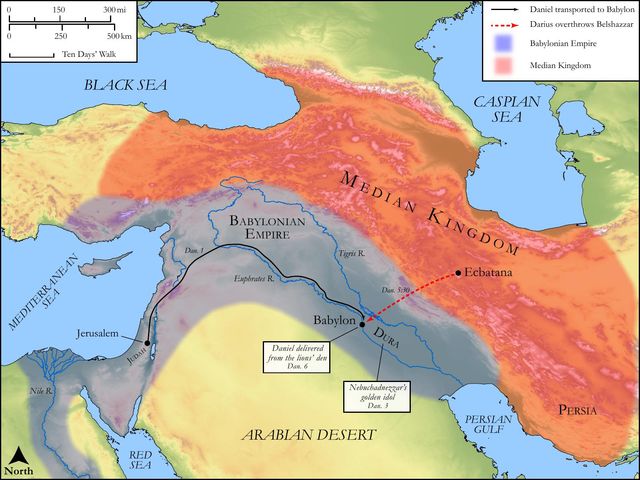
See on the biblical-era map
Study this verse
Public-domain commentary
Matthew Henry
From his Commentary on the Whole Bible. Henry comments on passages, not single verses — this entry covers Daniel 4:34–37. His two-level outline is real structure in the source text, so it is rendered as structure.
We have here Nebuchadnezzar's recovery from his distraction, and his return to his right mind, at the end of the days prefixed, that is, of the seven years. So long he continued a monument of God's justice and a trophy of his victory over the children of pride, and he was made more so by being struck mad than if he had been in an instant struck dead with a thunderbolt; yet it was a mercy to him that he was kept alive, for while there is life there is hope that we may yet praise God, as he did here: At the end of the days (says he), I lifted up my eyes unto heaven (Dan 4:34), looked no longer down towards the earth as a beast, but begun to look up as a man. Os homini sublime dedit - Heaven gave to man an erect countenance. But there was more in it than this; he looked up as a devout man, as a penitent, as a humble petitioner for mercy, being perhaps never till now made sensible of his own misery. And now,
I.He has the use of his reason so far restored to him that with it he glorifies God, and humbles himself under his mighty hand.
He was told that he should continue in that forlorn case till he should know that the Most High rules, and here we have him brought to the knowledge of this: My understanding returned to me, and I blessed the Most High. Note, Those may justly be reckoned void of understanding that do not bless and praise God; nor do men ever rightly use their reason till they begin to be religious, nor live as men till they live to the glory of God. As reason is the substratum or subject of religion (so that creatures which have no reason are not capable of religion), so religion is the crown and glory of reason, and we have our reason in vain, and shall one day wish we had never had it, if we do not glorify God with it. This was the first act of Nebuchadnezzar's returning reason; and, when this became the employment of it, he was then, and not till then, qualified for all the other enjoyments of it. And till he was for a great while disabled to exercise it in other things he never was brought to apply it to this, which is the great end for which our reason is given us. His folly was the means whereby he became wise; he was not recovered by his dream of this judgment (that was soon forgotten like a dream), but he is made to feel it, and then his ear is opened to discipline. To bring him to himself, he must first be beside himself. And by this it appears that what good thoughts there were in his mind, and what good work was wrought there, were not of himself (for he was not his own man), but it was the gift of God. Let us see what Nebuchadnezzar is now at length effectually brought to the acknowledgment of; and we may learn from it what to believe concerning God.
1.That the most high God lives for ever, and his being knows neither change nor period, for he has it of himself. His flatterers often complimented him with, O king! live for ever. But he is now convinced that no king lives for ever, but the God of Israel only, who is still the same.
2.That his kingdom is like himself, everlasting, and his dominion from generation to generation; there is no succession, no revolution, in his kingdom. As he lives, so he reigns, for ever, and of his government there is no end.
3.That all nations before him are as nothing. He has no need of them; he makes no account of them. The greatest of men, in comparison with him, are less than nothing. Those that think highly of God think meanly of themselves.
4.That his kingdom is universal, and both the armies of heaven and the inhabitants of the earth are his subjects, and under his check and control. Both angels and men are employed by him, and are accountable to him; the highest angel is not above his command, nor the meanest of the children of men beneath his cognizance. The angels of heaven are his armies, the inhabitants of the earth his tenants.
5.That his power is irresistible, and his sovereignty uncontrollable, for he does according to his will, according to his design and purpose, according to his decree and counsel; whatever he pleases that he does; whatever he appoints that he performs; and none can resist his will, change his counsel, nor stay his hand, nor say unto him, What doest thou? None can arraign his proceedings, enquire into the meaning of them, nor demand a reason for them. Woe to him that strives with his Maker, that says to him, What doest thou? Or, Why doest thou so?
6.That every thing which God does is well done: His works are truth, for they all agree with his word. His ways are judgment, both wise and righteous, exactly consonant to the rules both of prudence and equity, and no fault is to be found with them.
7.That he has power to humble the haughtiest of his enemies that act in contradiction to him or competition with him: Those that walk in pride he is able to abuse (Dan 4:37); he is able to deal with those that are most confident of their own sufficiency to contend with him.
II.He has the use of his reason so far restored to him as with it to re-enjoy himself, and the pleasures of his re-established prosperity (Dan 4:36): At the same time my reason returned to me; he had said before (Dan 4:34) that his understanding returned to him, and here he mentions it again, for the use of our reason is a mercy we can never be sufficiently thankful for. Now his lords sought to him; he did not need to seek to them, and they soon perceived, not only that he had recovered his reason and was fit to rule, but that he had recovered it with advantage, and was more fit to rule than ever. It is probable that the dream and the interpretation of it were well known, and much talked of, at court; and the former part of the prediction being fulfilled, that he should go distracted, they doubted not but that, according to the prediction, he should come to himself again at seven years' end, and, in confidence of that, when the time had expired they were ready to receive him; and then his honour and brightness returned to him, the same that he had before his madness seized him. He is now established in his kingdom as firmly as if there had been no interruption given him. He becomes a fool, that he may be wise, wiser than ever; and he that but the other day was in the depth of disgrace and ignominy has now excellent majesty added to him, beyond what he had when he went from kingdom to kingdom conquering and to conquer. Note,
1.When men are brought to honour God, particularly by a penitent confession of sin and a believing acknowledgment of his sovereignty, then, and not till then, they may expect that God will put honour upon them, will not only restore them to the dignity they lost by the sin of the first Adam, but add excellent majesty to them from the righteousness and grace of the second Adam.
2.Afflictions shall last no longer than till they have done the work for which they were sent. When this prince is brought to own God's dominion over himself.
3.All the accounts we take and give of God's dealing with us ought to conclude with praises to him. When Nebuchadnezzar is restored to his kingdom he praises, and extols, and honours the King of heaven (Dan 4:37), before he applies himself to his secular business. Therefore we have our reason, that we may be in a capacity of praising him, and therefore our prosperity, that we may have cause to praise him.
It was not long after this that Nebuchadnezzar ended his life and reign. Abydenus, quoted by Eusebius (Prap. Evang. 1.9), reports, from the tradition of the Chaldeans, that upon his death-bed he foretold the taking of Babylon by Cyrus. Whether he continued in the same good mind that here he seems to have been in we are not told, nor does any thing appear to the contrary but that he did: and, if so great a blasphemer and persecutor did find mercy, he was not the last. And, if our charity may reach so far as to hope he did, we must admire free grace, by which he lost his wits for a while that he might save his soul for ever.
Historical interpretation
Historical reception
3 surviving comments on this verse. Each one is dated, so this reads as a timeline rather than a list.
Select a marker to jump to its quote. Markers stagger vertically where authors wrote within a few decades of each other.
Verse 35. "'For He does according to His will, just as among the powers of heaven, so also among the inhabitants of the earth...'" This too Nebuchadnezzar expresses like a worldling. For God does not simply do what He wishes, but rather God wishes only that which is good. Nebuchadnezzar, however, expressed himself in this way, in order that even while he declared God's power, he might appear to impugn God's justice, on the ground that he had suffered unmerited punishment.
Up to the present I [Nebuchadnezzar] thought myself very great and elevated, whereas now I know clearly that all human nature is nothing compared with God. Having sought a term for insignificance and not found one suitable, he used “nothing,” which gives a sufficient clue to the instability and impermanence of nature; while calling God “Most High, Lord, living and eternal king,” he spoke of all human beings as “nothing.” In similar fashion also blessed Isaiah in comparing the divine nature with the idols focused on human nature: “If all the nations are like a drop from a bucket, and are accounted as a turn of the scale and will be accounted as spittle, while Lebanon is not sufficient for burning, and all its animals not sufficient for a burnt offering, and all the nations are nothing and were reckoned as nothing in comparison with him, to what will you compare the Lord? and with what analogy compare him?”
He says, “There is no one who will oppose his hand or say to him, ‘Why did you do that?’ ” to bring out the invincibility of God’s power. One must accept gladly what is done by him, whether it is pleasing or distressing: resisting or criticizing what is wisely ordained by him is a rash endeavor.
Continue studying Daniel 4:35 across the web’s major study libraries — every link below opens this exact verse, chapter, or book on the destination site.
Read & Compare
 BibleGatewayThis verse in more than 200 translations and 70 languages.
 Bible.comThe YouVersion reader — hundreds of translations, reading plans, and highlights.
 ESV.orgCrossway's official English Standard Version reader.
 NET BibleThe NET translation with 60,000+ translators' notes on every rendering decision.
 STEP BibleTyndale House's free study tool — original text, vocabulary, and scholarly resources.
 BibliaLogos Bible Software's free web reader.
 USCCBThe New American Bible (Revised Edition) with the U.S. bishops' study notes.
Commentaries
 BibleHub CommentariesDozens of classic commentaries on this verse, gathered on one page.
 StudyLightMore than 100 commentary sets — the largest collection on the web.
 BibleRefPlain-English commentary on what this verse means, verse by verse.
 Enduring WordDavid Guzik's free commentary on this chapter, widely used by Bible teachers.
 Bible Study ToolsVerse commentary alongside Greek and Hebrew study aids.
Original Language & Research
- BibleHub InterlinearThe verse word by word — original language, transliteration, and English.
- BibleHub LexiconEvery word's original-language definition and Strong's entry.
 Blue Letter BibleDeep-study tools — Strong's numbers, concordance, and word studies.
 SefariaThe Hebrew text with Rashi and centuries of Jewish commentary.
Sermons, Hymns & Audio


TrulyRandomVerse is not affiliated with these sites and doesn’t control their content. They’re linked because they’re genuinely useful.
Summary
Daniel 4:35 stands as a profound declaration of God's absolute and unchallengeable sovereignty, articulated by none other than King Nebuchadnezzar of Babylon after a period of divine humbling and restoration. This verse encapsulates the core message of the entire chapter: that the Most High God alone rules over both the celestial realm and all earthly inhabitants, executing His will without opposition or question, thereby rendering all human power and pretension as utterly insignificant in comparison to His supreme authority.
Context
ShowHideLiterary Context
This verse climaxes King Nebuchadnezzar's personal testimony in Daniel chapter 4, a unique chapter in the book written from the perspective of a pagan king. Following a dream that troubled him, Daniel interpreted it as a prophetic warning of divine judgment due to Nebuchadnezzar's pride. The dream foretold that the king would be driven from human society and live like a beast for "seven times" until he acknowledged that "the Most High ruleth in the kingdom of men, and giveth it to whomsoever he will" (Daniel 4:17). After the prophecy's fulfillment and Nebuchadnezzar's subsequent restoration to sanity and his throne, this verse represents his ultimate, humbled confession of God's universal dominion, serving as the theological capstone to his dramatic personal narrative and the culmination of his spiritual transformation.
Historical & Cultural Context
King Nebuchadnezzar ruled the Neo-Babylonian Empire, the dominant world power of his time, renowned for its military might, vast conquests, and architectural marvels like the Hanging Gardens. Among the nations, kings often considered themselves divine or divinely appointed, wielding absolute power and demanding worship. Nebuchadnezzar's initial pride, evident in his boasting about Babylon's grandeur (Daniel 4:30), was characteristic of such rulers who believed their success stemmed from their own might or the favor of their national deities. This context makes his confession in Daniel 4:35 all the more remarkable: the most powerful man on earth, from a polytheistic culture, publicly acknowledges the singular, supreme, and irresistible authority of the God of Israel, a stark contrast to the prevailing worldview and a powerful testament to Yahweh's unique nature as the true sovereign.
Key Themes
ShowHideThe overarching theme of Daniel chapter 4 and particularly this verse is the absolute divine sovereignty of God. It asserts that God's rule extends over all creation, both heavenly and earthly, and that His will is executed without hindrance. This directly challenges human pride and self-sufficiency, demonstrating that even the most powerful earthly rulers are utterly dependent on and subordinate to God. The verse also underscores the theme of God's unchallengeable authority, emphasizing that no one, whether human or angelic, can thwart His plans or question His actions. This divine prerogative is a recurring motif in Scripture, affirming God's ultimate control over history and destiny, as also seen in the interpretation of Nebuchadnezzar's first dream (Daniel 2:21) and the repeated declaration that "the Most High ruleth in the kingdom of men" (Daniel 4:25).
Exposition and Analysis
ShowHideKey Word Analysis
ShowHideCorresponding to the Hebrew chāshab, this Aramaic term means "to regard" or "to repute." In the context of Daniel 4:35, when applied to the "inhabitants of the earth," it conveys the idea that they are "accounted as nothing" or "considered utterly insignificant." This is not merely a statement of worthlessness but a declaration of their comparative non-existence or utter powerlessness when measured against the infinite might and majesty of God. It highlights the vast chasm between finite human capacity and infinite divine omnipotence.
This word, corresponding to the Hebrew chayil, typically means "strength" or "army." In the phrase "army of heaven," it refers to the celestial hosts, which can encompass both the angelic beings who serve God's purposes and, at times, the heavenly bodies (stars, planets) that operate under His command. The term emphasizes the organized, powerful, and obedient nature of God's heavenly forces, all of whom are instruments of His sovereign will, executing His decrees without question or hesitation.
Corresponding to the Hebrew yad, this term signifies "a hand," but more broadly represents "power," "means," or "direction." The phrase "stay his hand" (with mᵉchâʼ meaning "to strike in pieces" or "to arrest") powerfully communicates the impossibility of resisting, hindering, or striking back against God's actions. It highlights God's irresistible power and the futility of any attempt, by any being, to oppose His divine will or alter His course.
Verse Breakdown
ShowHide"And all the inhabitants of the earth [are] reputed as nothing"
This clause establishes a radical and humbling contrast between human existence and divine omnipotence. It declares that in the face of God's absolute sovereignty, all humanity, with its power, achievements, and aspirations, holds no intrinsic significance or independent authority. They are not merely small or weak, but "as nothing," utterly inconsequential in their capacity to influence or resist God's eternal plan. This serves as a powerful corrective to human pride and self-exaltation.
"and he doeth according to his will in the army of heaven, and [among] the inhabitants of the earth"
This is the central affirmation of God's universal dominion and active governance. It asserts that God's actions are not random or reactive but are meticulously executed "according to his will" (Aramaic tsᵉbâʼ, meaning "to please" or "will"). His sovereign will is implemented seamlessly across both the heavenly realm, where the angelic hosts and celestial bodies obey His every command, and the earthly realm, where human affairs, nations, and individuals are ultimately subject to His overarching purpose. This demonstrates His comprehensive and active control over all spheres of existence.
"and none can stay his hand, or say unto him, What doest thou?"
This concluding clause powerfully underscores the irresistibility and unquestionable nature of God's authority. "None can stay his hand" signifies that no one possesses the power or ability to hinder, resist, or thwart God's actions; His power is absolute and unopposable. Furthermore, "or say unto him, What doest thou?" emphasizes that no one has the right or standing to challenge, interrogate, or demand an account from God regarding His choices or methods. His actions are beyond human comprehension and accountability, rooted in His perfect wisdom and righteousness.
Literary Devices
ShowHideDaniel 4:35 is rich in Hyperbole, particularly in the phrase "all the inhabitants of the earth are reputed as nothing," which dramatically emphasizes human insignificance and powerlessness in comparison to God's infinite majesty and omnipotence. The verse employs Parallelism by stating God's dominion "in the army of heaven, and among the inhabitants of the earth," highlighting His comprehensive and consistent rule over both celestial and terrestrial spheres. Anthropomorphism is present in "none can stay his hand," attributing a human characteristic (a hand as an instrument of action and power) to God to convey His irresistible might and unhindered execution of His will in a relatable way. Finally, the verse utilizes an implicit Rhetorical Question in "or say unto him, What doest thou?", which is not an actual question seeking information but a powerful assertion that no one has the authority or standing to question God's actions or motives.
Theological and Thematic Connections
ShowHideThis verse profoundly articulates the doctrine of divine sovereignty, asserting that God's will is the ultimate governing principle of the universe. It teaches that God is not merely powerful, but His power is absolute, irresistible, and extends over all creation, both visible and invisible. This truth provides both comfort and challenge: comfort in knowing that a wise and benevolent God is ultimately in control, even amidst chaos and human folly, and challenge in reminding humanity of its finite nature and utter dependence on the Creator. It calls for humility, trust, and worship, recognizing that all authority, glory, and dominion belong to Him alone. This foundational truth undergirds all biblical theology, affirming God's active involvement and supreme rule over history, nations, and individuals.
Reflection and Application
ShowHideDaniel 4:35 offers timeless truths that deeply impact our understanding of God and our place in His world. It compels us to cultivate a profound sense of humility, recognizing that our lives, achievements, and even our very breath are gifts from His sovereign hand. In a world often characterized by human pride, self-reliance, and a pervasive desire for control, this verse serves as a powerful antidote, reminding us that true wisdom begins with acknowledging God's supreme authority and our utter dependence upon Him. Furthermore, it provides immense comfort and security, especially in times of uncertainty, suffering, or apparent injustice. Knowing that an all-wise, all-powerful, and all-loving God "doeth according to his will" means that nothing is outside of His providential care. We can rest in the assurance that His purposes will prevail, and His ultimate plan for good will unfold, even when we cannot discern it. This truth invites us to surrender our anxieties, trust His perfect timing, and align our wills with His, finding peace and purpose in His unshakeable dominion.
Questions for Reflection
ShowHideFAQ
ShowHideDoes God's absolute sovereignty negate human free will or responsibility?
ShowHideDaniel 4:35 emphasizes God's ultimate control and the fact that His will cannot be thwarted. However, the Bible consistently presents a tension between divine sovereignty and human responsibility, rather than a contradiction. While God's plan will ultimately prevail, He uses human choices, both good and bad, to accomplish His purposes. Nebuchadnezzar's humbling was a direct consequence of his pride, demonstrating that human actions have real consequences and that individuals are accountable for their choices, even within God's sovereign framework. The verse highlights God's ultimate authority and the irresistibility of His will, not necessarily a deterministic control over every minute human decision in a way that removes moral agency. Ultimately, God's sovereignty ensures His purposes are accomplished, while human responsibility means we are accountable for our responses to His will.
What is meant by the "army of heaven" in this context?
ShowHideThe "army of heaven" (Aramaic chayil shâmayin) most commonly refers to the angelic host – the vast multitude of spiritual beings who serve God and carry out His commands. They are His obedient agents in the spiritual realm and often intervene in earthly affairs according to His will, as seen throughout the book of Daniel (e.g., Daniel 10:13). While less common in this specific phrasing, it can also encompass the celestial bodies (stars, planets), which the ancients sometimes viewed as divine entities or forces, but which the biblical worldview asserts are merely creations under God's absolute command, serving His purposes. In either interpretation, the phrase underscores God's dominion over all spiritual powers and the heavenly bodies, demonstrating that every aspect of creation, visible and invisible, operates under His supreme authority.
If humans are "reputed as nothing," does that mean God doesn't care about us?
ShowHideAbsolutely not. The phrase "reputed as nothing" in Daniel 4:35 is a statement of comparative power and significance, not a declaration of God's disregard or lack of love for humanity. It emphasizes human insignificance in comparison to God's infinite majesty and power, particularly in our ability to resist or question His will. It is a humbling truth meant to curb human pride, not to devalue human life. The same God who humbles Nebuchadnezzar is the one who graciously restores him, demonstrating His redemptive care and patience. Throughout Scripture, God's sovereignty is often paired with His profound love and care for His creation, especially humanity, culminating in His redemptive plan for a fallen world. Our insignificance in power does not diminish our immense value and beloved status in His eyes.
Christ-Centered Fulfillment
ShowHideDaniel 4:35, with its resounding declaration of God's absolute sovereignty, finds its ultimate and most profound fulfillment in the person and work of Jesus Christ. The "Most High" who rules in the kingdom of men is none other than the Father, who has committed all authority to the Son. Jesus Himself declared, "All power is given unto me in heaven and in earth" (Matthew 28:18). The "army of heaven" and the "inhabitants of the earth" are now under the direct authority of the resurrected Christ, who is "far above all principality, and power, and might, and dominion, and every name that is named, not only in this world, but also in that which is to come" (Ephesians 1:21). No one can "stay His hand" because He is the Lamb of God who was slain, yet now reigns as King of kings and Lord of lords (Revelation 19:16), actively upholding the universe by the word of His power (Hebrews 1:3). His will, which perfectly aligns with the Father's, is sovereign over all creation, over sin and death, and over the destiny of every individual. In Christ, God's unchallengeable will is not an abstract force but a redemptive purpose, culminating in the reconciliation of all things to Himself through the cross (Colossians 1:19-20). Thus, Daniel's vision of an all-powerful God is fully realized in the reign over all things of the crucified and risen Lord, through whom God's sovereign plan of salvation is accomplished and all creation is brought into subjection to His glorious rule (Philippians 2:9-11).