


John 5:17
Bible text: King James Version (1769 Blayney text) · Public domain
Bible text: Berean Standard Bible · Public domain
Bible text: American Standard Version (1901) · Public domain
Bible text: World English Bible, Messianic edition · Public domain
Bible text: Geneva Bible (1599) · Public domain
Bible text: Young's Literal Translation · Public domain
- ὉHo<the>G3588T-NSMDefinite article Nominative Singular Masculine
- δὲdeButG1161CONJConjunction
- ἸησοῦςIēsousJesusG2424N-NSM-PNoun Nominative Singular Masculine Individual
- ἀπεκρίνατοapekrinatoansweredG611V-ADI-3SVerb Aorist Middle Deponent Indicative 3rd Singular
- αὐτοῖς·autoisthemG846P-DPMPersonal pronoun Dative Plural Masculine
- ὁhoTheG3588T-NSMDefinite article Nominative Singular Masculine
- πατήρpatērFatherG3962N-NSM-TNoun Nominative Singular Masculine Title
- μουmouof MineG3165P-1GSPersonal pronoun Genitive 1st Singular
- ἕωςhe'ōsuntilG2193PREPPreposition
- ἄρτιartinowG737ADVAdverb
- ἐργάζεταιergazetaiis workingG2038V-PNI-3SVerb Present Middle Or Passive Deponent Indicative 3rd Singular
- κἀγὼkagōand I myselfG2532P-1NS + G2532=CONJ
- ἐργάζομαιergazomaiam workingG2038V-PNI-1SVerb Present Middle Or Passive Deponent Indicative 1st Singular
English is a literal word-by-word gloss of the Greek, not the KJV's wording. Why?
This is the original text the KJV's translators worked from — each Greek word with its own literal English meaning in this verse, prepared by scholars at Tyndale House, Cambridge. The KJV translates whole sentences, not word by word, so its wording differs: one Greek word can become several English words, and the KJV may choose “charity” where the gloss reads “love”. Both are faithful — they answer different questions. For the KJV's own rendering, switch to the KJV text.
Details
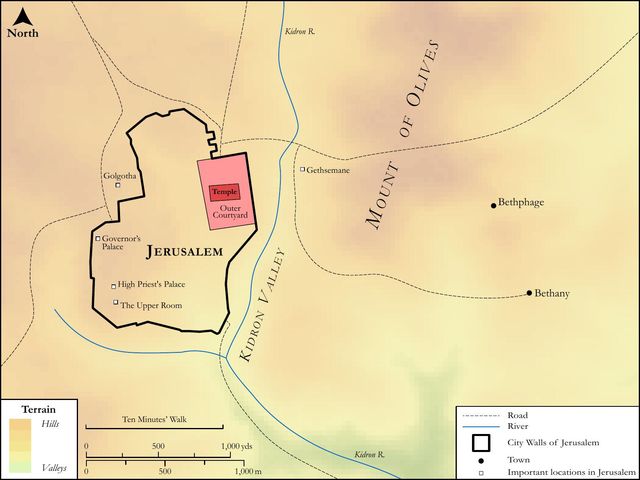
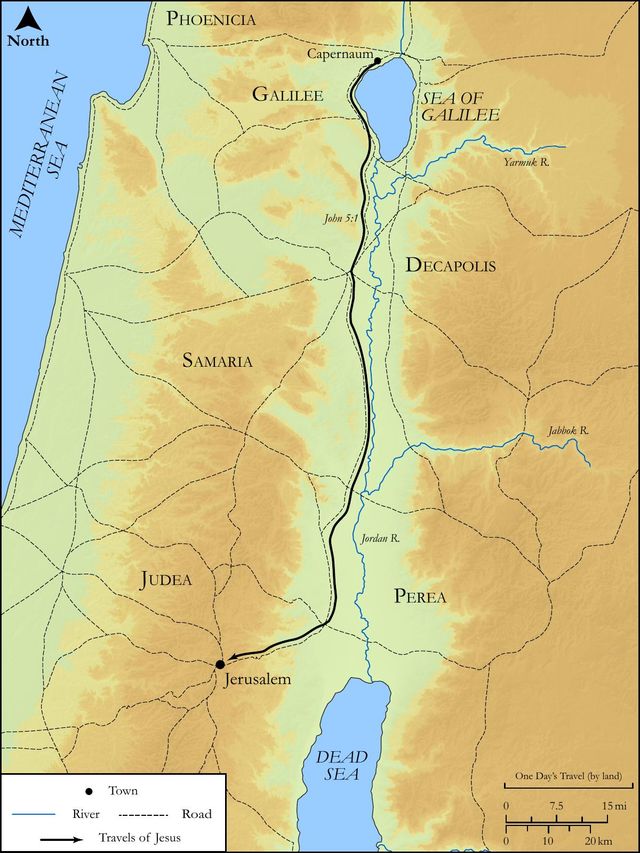
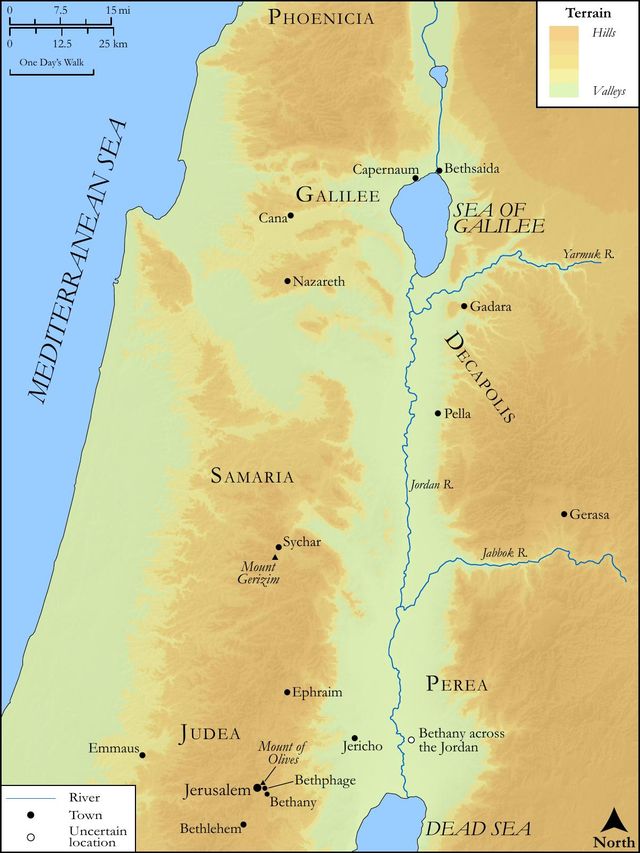
See on the biblical-era maps
Study this verse
Public-domain commentary
Matthew Henry
From his Commentary on the Whole Bible. Henry comments on passages, not single verses — this entry covers John 5:17–30. His four-level outline is real structure in the source text, so it is rendered as structure.
We have here Christ's discourse upon occasion of his being accused as a sabbath-breaker, and it seems to be his vindication of himself before the sanhedrim, when he was arraigned before them: whether on the same day, or two or three days after, does not appear; probably the same day. Observe,
I.The doctrine laid down, by which he justified what he did on the sabbath day (v.
17): He answered them. This supposes that he had something laid to his charge: or what they suggested one to another, when they sought to slay him (v. 16), he knew, and gave this reply to, My Father worketh hitherto, and I work. At other times, in answer to the like charge, he had pleaded the example of David's eating the show-bread, of the priests' slaying the sacrifices, and of the people's watering their cattle on the sabbath day; but here he goes higher and alleges the example of his Father and his divine authority; waiving all other pleas, he insists upon that which was instar omnium—equivalent to the whole, and abides by it, which he had mentioned, Matt. xii. 8. The Son of man is Lord even of the sabbath day; but he here enlarges on it. 1. He pleads that he was the Son of God, plainly intimated in his calling God his Father; and, if so, his holiness was unquestionable and his sovereignty incontestable; and he might make what alterations he pleased of the divine law. Surely they will reverence the Son, the heir of all things. 2. That he was a worker together with God. (1.) My Father worketh hitherto. The example of God's resting on the seventh day from all his work is, in the fourth commandment, made the ground of our observing it as a sabbath or day of rest. Now God rested only from such work as he had done the six days before; otherwise he worketh hitherto, he is every day working, sabbath days and week-days, upholding and governing all the creatures, and concurring by his common providence to all the motions and operations of nature, to his own glory; therefore, when we are appointed to rest on the sabbath day, yet we are not restrained from doing that which has a direct tendency to the glory of God, as the man's carrying his bed had. (2.) I work; not only therefore I may work, like him, in doing good on sabbath days as well as other days, but I also work with him. As God created all things by Christ, so he supports and governs all by him, Heb. i. 3. This sets what he does above all exception; he that is so great a worker must needs be an uncontrollable governor; he that does all is Lord of all, and therefore Lord of the sabbath, which particular branch of his authority he would now assert, because he was shortly to show it further, in the change of the day from the seventh to the first.
II.The offence that was taken at his doctrine (v.
18): The Jews sought the more to kill him. His defence was made his offence, as if by justifying himself he had made bad worse. Note, Those that will not be enlightened by the word of Christ will be enraged and exasperated by it, and nothing more vexes the enemies of Christ than his asserting his authority; see Ps. ii. 3-5. They sought to kill him,
1.Because he had broken the sabbath; for, let him say what he would in his own justification, they are resolved, right or wrong, to find him guilty of sabbath breaking. When malice and envy sit upon the bench, reason and justice may even be silent at the bar, for whatever they can say will undoubtedly be over-ruled.
2.Not only so, but he had said also that God was his Father. Now they pretend a jealousy for God's honour, as before for the sabbath day, and charge Christ with it as a heinous crime that he made himself equal with God; and a heinous crime it had been if he had not really been so. It was the sin of Lucifer, I will be like the Most High. Now,
(1.)This was justly inferred from what he said, that he was the Son of God, and that God was his Father, patera idion—his own Father; his, so as he was no one's else. He had said that he worked with his Father, by the same authority and power, and hereby he made himself equal with God. Ecce intelligunt Judæi, quod non intelligunt Ariani—Behold, the Jews understand what the Arians do not.
(2.)Yet it was unjustly imputed to him as an offence that he equalled himself with God, for he was and is God, equal with the Father (Phil. ii. 6); and therefore Christ, in answer to this charge, does not except against the innuendo as strained or forced, makes out his claim and proves that he is equal with God in power and glory.
III.Christ's discourse upon this occasion, which continues without interruption to the end of the chapter.
In these verses he explains, and afterwards confirms, his commission, as Mediator and plenipotentiary in the treaty between God and man. And, as the honours he is hereby entitled to are such as it is not fit for any creature to receive, so the work he is hereby entrusted with is such as it is not possible for any creature to go through with, and therefore he is God, equal with the Father.
1.In general. He is one with the Father in all he does as Mediator, and there was a perfectly good understanding between them in the whole matter. It is ushered in with a solemn preface (v. 19): Verily, verily, I say unto you; I the Amen, the Amen, say it. This intimates that the things declared are,
(1.)Very awful and great, and such as should command the most serious attention.
(2.)Very sure, and such as should command an unfeigned assent.
(3.)That they are matters purely of divine revelation; things which Christ has told us, and which we could not otherwise have come to the knowledge of. Two things he saith in general concerning the Son's oneness with the Father in working:—
[1.]That the Son conforms to the Father (v. 19): The Son can do nothing of himself but what he sees the Father do; for these things does the Son. The Lord Jesus, as Mediator, is First, Obedient to his Father's will; so entirely obedient that he can do nothing of himself, in the same sense as it is said, God cannot lie, cannot deny himself, which expresses the perfection of his truth, not any imperfection in his strength; so here, Christ was so entirely devoted to his Father's will that it was impossible for him in any thing to act separately. Secondly, He is observant of his Father's counsel; he can, he will, do nothing but what he sees the Father do. No man can find out the work of God, but the only-begotten Son, who lay in his bosom, sees what he does, is intimately acquainted with his purposes, and has the plan of them ever before him. What he did as Mediator, throughout his whole undertaking, was the exact transcript or counterpart of what the Father did; that is, what he designed, when he formed the plan of our redemption in his eternal counsels, and settled those measures in every thing which never could be broken, nor ever needed to be altered. It was the copy of that great original; it was Christ's faithfulness, as it was Moses's, that he did all according to the pattern shown him in the mount. This is expressed in the present tense, what he sees the Father do, for the same reason that, when he was here upon earth, it was said, He is in heaven (ch. iii. 13), and is in the bosom of the Father (ch. i. 18); as he was even then by his divine nature present in heaven, so the things done in heaven were present to his knowledge. What the Father did in his counsels, the Son had ever in his view, and still he had his eye upon it, as David in spirit spoke of him, I have set the Lord always before me, Ps. xvi. 8. Thirdly, Yet he is equal with the Father in working; for what things soever the Father does these also does the Son likewise; he did the same things, not such things, but tauta, the same things; and he did them in the same manner, homoios, likewise, with the same authority, and liberty, and wisdom, the same energy and efficacy. Does the Father enact, repeal, and alter, positive laws? Does he over-rule the course of nature, know men's hearts? So does the Son. The power of the Mediator is a divine power.
[2.]That the Father communicates to the Son, v. 20. Observe,
First, The inducement to it: The Father loveth the Son; he declared, This is my beloved Son. He had not only a good will to the undertaking, but an infinite complacency in the undertaker. Christ was now hated of men, one whom the nation abhorred (Isa. xlix. 7); but he comforted himself with this, that his Father loved him.
Secondly, The instances of it. He shows it, 1. In what he does communicate to him: He shows him all things that himself doth. The Father's measures in making and ruling the world are shown to the Son, that he may take the same measures in framing and governing the church, which work was to be a duplicate of the work of creation and providence, and it is therefore called the world to come. He shows him all things ha autos poiei—which he does, that is, which the Son does, so it might be construed; all that the Son does is by direction from the Father; he shows him. 2. In what he will communicate; he will show him, that is, will appoint and direct him to do greater works than these. (1.) Works of greater power than the curing of the impotent man; for he should raise the dead, and should himself rise from the dead. By the power of nature, with the use of means, a disease may possibly in time be cured; but nature can never, by the use of any means, in any time raise the dead. (2.) Works of greater authority than warranting the man to carry his bed on the sabbath day. They thought this a daring attempt; but what was this to his abrogating the whole ceremonial law, and instituting new ordinances, which he would shortly do, "that you may marvel!" Now they looked upon his works with contempt and indignation, but he will shortly do that which they will look upon with amazement, Luke vii. 16. Many are brought to marvel at Christ's works, whereby he has the honour of them, who are not brought to believe, by which they would have the benefit of them.
2.In particular. He proves his equality with the Father, by specifying some of those works which he does that are the peculiar works of God. This is enlarged upon, v. 21-30. He does, and shall do, that which is the peculiar work of God's sovereign dominion and jurisdiction—judging and executing judgment, v. 22-24, 27. These two are interwoven, as being nearly connected; and what is said once is repeated and inculcated; put both together, and they will prove that Christ said not amiss when he made himself equal with God.
(1.)Observe what is here said concerning the Mediator's power to raise the dead and give life. See [1.] His authority to do it (v. 21): As the Father raiseth up the dead, so the Son quickeneth whom he will. First, It is God's prerogative to raise the dead, and give life, even his who first breathed into man the breath of life, and so made him a living soul; see Deut. xxxii. 30; 1 Sam. ii. 6; Ps. lxviii. 20; Rom. iv. 17. This God had done by the prophets Elijah and Elisha, and it was a confirmation of their mission. A resurrection from the dead never lay in the common road of nature, nor ever fell within the thought of those that studied only the compass of nature's power, one of whose received axioms was point blank against it: A privatione ad habitum non datur regressus—Existence, when once extinguished, cannot be rekindled. It was therefore ridiculed at Athens as an absurd thing, Acts xvii. 32. It is purely the work of a divine power, and the knowledge of it purely by divine revelation. This the Jews would own. Secondly, The Mediator is invested with this prerogative: He quickens whom he will; raises to life whom he pleases, and when he pleases. He does not enliven things by natural necessity, as the sun does, whose beams revive of course; but he acts as a free agent, has the dispensing of his power in his own hand, and is never either constrained, or restrained, in the use of it. As he has the power, so he has the wisdom and sovereignty, of a God; has the key of the grave and of death (Rev. i. 18), not as a servant, to open and shut as he is bidden, for he has it as the key of David, which he is master of, Rev. iii. 7. An absolute prince is described by this (Dan. v. 19): Whom he would he slew or kept alive; it is true of Christ without hyperbole.
[2.]His ability to do it. Therefore he has power to quicken whom he will as the Father does, because he has life in himself, as the Father has, v. 26. First, It is certain that the Father has life in himself. Not only he is a self-existent Being, who does not derive from, or depend upon, any other (Exod. iii. 14), but he is a sovereign giver of life; he has the disposal of life in himself; and of all good (for so life sometimes signifies); it is all derived from him, and dependent on him. He is to his creatures the fountain of life, and all good; author of their being and well-being; the living God, and the God of all living. Secondly, It is as certain that he has given to the Son to have life in himself. As the Father is the original of all natural life and good, being the great Creator, so the Son, as Redeemer, is the original of all spiritual life and good; is that to the church which the Father is to the world; see 1 Cor. viii. 6; Col. i. 19. The kingdom of grace, and all the life in that kingdom, are as fully and absolutely in the hand of the Redeemer as the kingdom of providence is in the hand of the Creator; and as God, who gives being to all things, has his being of himself, so Christ, who gives life, raised himself to life by his own power, ch. x. 18.
[3.]His acting according to this authority and ability. Having life in himself, and being authorized to quicken whom he will, by virtue hereof there are, accordingly, two resurrections performed by his powerful word, both which are here spoken of:—
First, A resurrection that now is (v. 29), a resurrection from the death of sin to the life of righteousness, by the power of Christ's grace. The hour is coming, and now is. It is a resurrection begun already, and further to be carried on, when the dead shall hear the voice of the Son of God. This is plainly distinguished from that in v. 28, which speaks of the resurrection at the end of time. This says nothing, as that does, of the dead in their graces, and of all of them, and their coming forth. Now, 1. Some think this was fulfilled in those whom he miraculously raised to life, Jairus's daughter, the widow's son, and Lazarus; and it is observable that all whom Christ raised were spoken to, as, Damsel, arise; Young man, arise; Lazarus, come forth; whereas those raised under the Old Testament were raised, not by a word, but other applications, 1 Kings xvii. 21; 2 Kings iv. 34; xiii. 21. Some understand it of those saints that rose with Christ; but we do not read of the voice of the Son of God calling them. But, 2. I rather understand it of the power of the doctrine of Christ, for the recovering and quickening of those that were dead in trespasses and sins, Eph. ii. 1. The hour was coming when dead souls should be made alive by the preaching of the gospel, and a spirit of life from God accompanying it: nay, it then was, while Christ was upon earth. It may refer especially to the calling of the Gentiles, which is said to be as life from the dead, and, some think, was prefigured by Ezekiel's vision (ch. xxxvii. 1), and foretold, Isa. xxvi. 19. Thy dead men shall live. But it is to be applied to all the wonderful success of the gospel, among both Jews and Gentiles; an hour which still is, and is still coming, till all the elect be effectually called. Note, (1.) Sinners are spiritually dead, destitute of spiritual life, sense, strength, and motion, dead to God, miserable, but neither sensible of their misery nor able to help themselves out of it. (2.) The conversion of a soul to God is its resurrection from death to life; then it begins to live when it begins to live to God, to breathe after him, and move towards him. (3.) It is by the voice of the Son of God that souls are raised to spiritual life; it is wrought by his power, and that power conveyed and communicated by his word: The dead shall hear, shall be made to hear, to understand, receive, and believe, the voice of the Son of God, to hear it as his voice; then the Spirit by it gives life, otherwise the letter kills. (4.) The voice of Christ must be heard by us, that we may live by it. They that hear, and attend to what they hear, shall live. Hear and your soul shall live, Isa. lv. 3.
Secondly, A resurrection yet to come; this is spoken of, v. 28, 29, introduced with, "Marvel not at this, which I have said of the first resurrection, do not reject it as incredible and absurd, for at the end of time you shall all see a more sensible and amazing proof of the power and authority of the Son of man." As his own resurrection was reserved to be the final and concluding proof of his personal commission, so the resurrection of all men is reserved to be a like proof of his commission to be executed by his spirit. Now observe here,
a.When this resurrection shall be: The hour is coming; it is fixed to an hour, so very punctual is this great appointment. The judgment is not adjourned sine die—to some time not yet pitched upon; no, he hath appointed a day. The hour is coming. (a.) It is not yet come, it is not the hour spoken of at v. 25, that is coming, and now is. Those erred dangerously who said that the resurrection was past already, 2 Tim. ii. 18, But, (b.) It will certainly come, it is coming on, nearer every day than other; it is at the door. How far off it is we know not; but we know that it is infallibly designed and unalterably determined.
b.Who shall be raised: All that are in the graves, all that have died from the beginning of time, and all that shall die to the end of time. It was said (Dan. xii. 2), Many shall arise; Christ here tells us that those many shall be all; all must appear before the Judge, and therefore all must be raised; every person, and the whole of every person; every soul shall return to its body, and every bone to its bone. The grave is the prison of dead bodies, where they are detained; their furnace, where they are consumed (Job xxiv. 19); yet, in prospect of their resurrection, we may call it their bed, where they sleep to be awaked again; their treasury, where they are laid up to be used again. Even those that are not put into graves shall arise; but, because most are put into graves, Christ uses this expression, all that are in the graves. The Jews used the word sheol for the grave, which signifies the state of the dead; all that are in that state shall hear.
c.How they shall be raised. Two things are here told us:—(a.) The efficient of this resurrection: They shall hear his voice; that is, he shall cause them to hear it, as Lazarus was made to hear that word, Come forth; a divine power shall go along with the voice, to put life into them, and enable them to obey it. When Christ rose, there was no voice heard, not a word spoken, because he rose by his own power; but at the resurrection of the children of men we find three voices spoken of, 1 Thess. iv. 16. The Lord shall descend with a shout, the shout of a king, with the voice of the archangel; either Christ himself, the prince of the angels, or the commander-in-chief, under him, of the heavenly hosts; and with the trumpet of God: the soldier's trumpet sounding the alarm of war, the judge's trumpet publishing the summons to the court. (b.) The effect of it: They shall come forth out of their graves, as prisoners out of their prison-house; they shall arise out of the dust, and shake themselves from it; see Isa. lii. 1, 2, 11. But this is not all; they shall appear before Christ's tribunal, shall come forth as those that are to be tried, come forth to the bar, publicly to receive their doom.
d.To what they shall be raised; to a different state of happiness or misery, according to their different character; to a state of retribution, according to what they did in the state of probation.
(a.)They that have done good shall come forth to the resurrection of life; they shall live again, to live for ever. Note, [a.] Whatever name men are called by, or whatever plausible profession they make, it will be well in the great day with those only that have done good, have done that which is pleasing to God and profitable to others. [b.] The resurrection of the body will be a resurrection of life to all those, and those only, that have been sincere and constant in doing good. They shall not only be publicly acquitted, as a pardoned criminal, we say, has his life, but they shall be admitted into the presence of God, and that is life, it is better than life; they shall be attended with comforts in perfection. To live is to be happy, and they shall be advanced above the fear of death; that is life indeed in which mortality is for ever swallowed up.
(b.)They that have done evil to the resurrection of damnation; they shall live again, to be for ever dying. The Pharisees thought that the resurrection pertained only to the just, but Christ here rectifies that mistake. Note, [a.] Evil doers, whatever they pretend, will be treated in the day of judgment as evil men. [b.] The resurrection will be to evil doers, who did not by repentance undo what they had done amiss, a resurrection of damnation. They shall come forth to be publicly convicted of rebellion against God, and publicly condemned to everlasting punishment; to be sentenced to it, and immediately sent to it without reprieve. Such will the resurrection be.
(2.)Observe what is here said concerning the Mediator's authority to execute judgment, v. 22-24, 27. As he has an almighty power, so he has a sovereign jurisdiction; and who so fit to preside in the great affairs of the other life as he who is the Father and fountain of life? Here is,
[1.]Christ's commission or delegation to the office of a judge, which is twice spoken of here (v. 22): He hath committed all judgment to the Son; and again (v. 27): he hath given him authority.
First, The Father judges no man; not that the Father hath resigned the government, but he is pleased to govern by Jesus Christ; so that man is not under the terror of dealing with God immediately, but has the comfort of access to him by a Mediator. Having made us, he may do what he pleases with us, as the potter with the clay; yet he does not take advantage of this, but draws us with the cords of a man. 2. He does not determine our everlasting condition by the covenant of innocency, nor take the advantage he has against us for the violation of that covenant. The Mediator having undertaken to make a vicarious satisfaction, the matter is referred to him, and God is willing to enter upon a new treaty; not under the law of the Creator, but the grace of the Redeemer.
Secondly, He has committed all judgment to the Son, has constituted him Lord of all (Acts x. 36; Rom. xiv. 9), as Joseph in Egypt, Gen. xli. 40. This was prophesied of, Ps. lxxii. 1; Isa. xii. 3, 4; Jer. xxiii. 5; Mic. v. 1-4; Ps. lxvii. 4; xcvi. 13; xcviii. 9. All judgment is committed to our Lord Jesus; for 1. He is entrusted with the administration of the providential kingdom, is head over all things (Eph. i. 11), head of every man, 1 Cor. xii. 3. All things consist by him, Col. i. 17. 2. He is empowered to make laws immediately to bind conscience. I say unto you is now the form in which the statues of the kingdom of heaven run. Be it enacted by the Lord Jesus, and by his authority. All the acts now in force are touched with his sceptre. 3. He is authorized to appoint and settle the terms of the new covenant, and to draw up the articles of peace between God and man; it is God in Christ that reconciles the world, and to him he has given power to confer eternal life. The book of life is the Lamb's book; by his award we must stand or fall. 4. He is commissioned to carry on and complete the war with the powers of darkness; to cast out and give judgment against the prince of this world, ch. xii. 31. He is commissioned not only to judge, but to make war, Rev. xix. 11. All that will fight for God against Satan must enlist themselves under his banner. 5. He is constituted sole manager of the judgment of the great day. The ancients generally understood these words of that crowning act of his judicial power. The final and universal judgment is committed to the Son of man; the tribunal is his, it is the judgment-seat of Christ; the retinue is his, his mighty angels; he will try the causes, and pass the sentence. Acts xvii. 31.
Thirdly, He has given him authority to execute judgment also, v. 27. Observe, 1. What the authority is which our Redeemer is invested with: An authority to execute judgment; he has not only a legislative and judicial power, but an executive power too. The phrase here is used particularly for the judgment of condemnation, Jude 15. poiesai krisin—to execute judgment upon all; the same with his taking vengeance, 2 Thess. i. 8. The ruin of impenitent sinners comes from the hand of Christ; he that executes judgment upon them is the same that would have wrought salvation for them, which makes the sentence unexceptionable; and there is no relief against the sentence of the Redeemer; salvation itself cannot save those whom the Saviour condemns, which makes the ruin remediless. 2. Whence he has that authority: the Father gave it to him. Christ's authority as Mediator is delegated and derived; he acts as the Father's Viceregent, as the Lord's Anointed, the Lord's Christ. Now all this redounds very much to the honour of Christ, acquitting him from the guilt of blasphemy, in making himself equal with God; and very much to the comfort of all believers, who may with the greatest assurance venture their all in such hands.
[2.]Here are the reasons (reasons of state) for which this commission was given him. He has all judgment committed to him for two reasons:—
First, Because he is the Son of man; which denotes these three things:—1. His humiliation and gracious condescension. Man is a worm, the son of man a worm; yet this was the nature, this the character, which the Redeemer assumed, in pursuance of the counsels of love; to this low estate he stooped, and submitted to all the mortifications attending it, because it was his Father's will; in recompence therefore of this wonderful obedience, God did thus dignify him. Because he condescended to be the Son of man, his Father made him Lord of all, Phil. ii. 8, 9. 2. His affinity and alliance to us. The Father has committed the government of the children of men to him, because, being the Son of man, he is of the same nature with those whom he is set over, and therefore the more unexceptionable, and the more acceptable, as a Judge. Their governor shall proceed from the midst of them, Jer. xxx. 21. Of this that law was typical; One of thy brethren shalt thou set king over thee, Deut. xvii. 15. 3. His being the Messiah promised. In that famous vision of his kingdom and glory, Dan. vii. 13, 14, he is called the Son of man; and Ps. viii. 4-6. Thou has made the Son of man have dominion over the works of thy hands. He is the Messiah, and therefore is invested with all this power. The Jews usually called the Christ the Son of David; but Christ usually called himself the Son of man, which was the more humble title, and bespeaks him a prince and Saviour, not the Jewish nation only, but to the whole race of mankind.
Secondly, That all men should honour the Son, v. 23. The honouring of Jesus Christ is here spoken of as God's great design (the Son intended to glorify the Father, and therefore the Father intended to glorify the Son, ch. xii. 32); and as man's great duty, in compliance with that design. If God will have the Son honoured, it is the duty of all to whom he is made known to honour him. Observe here, 1. The respect that is to be paid to our Lord Jesus: We must honour the Son, must look upon him as one that is to be honoured, both on account of his transcendent excellences and perfections in himself, and of the relations he stands in to us, and must study to give him honour accordingly; must confess that he is Lord, and worship him; must honour him who was dishonoured for us. 2. The degree of it: Even as they honour the Father. This supposes it to be our duty to honour the Father; for revealed religion is founded on natural religion, and directs us to honour the Son, to honour him with divine honour; we must honour the Redeemer with the same honour with which we honour the Creator. So far was it from blasphemy for him to make himself equal with God that it is the highest injury that can be for us to make him otherwise. The truths and laws of the Christian religion, so far as they are revealed, are as sacred and honourable as those of natural religion, and to be equally had in estimation; for we lie under the same obligations to Christ, the Author of our being; and have as necessary a dependence upon the Redeemer's grace as upon the Creator's providence, which is a sufficient ground for this law—to honour the Son as we honour the Father. To enforce this law, it is added, He that honours not the Son honours not the Father who has sent him. Some pretend a reverence for the Creator, and speak honourably of him, who make light of the Redeemer, and speak contemptibly of him; but let such know that the honours and interests of the Father and Son are so inseparably twisted and interwoven that the Father never reckons himself honoured by any that dishonour the Son. Note, (1.) Indignities done to the Lord Jesus reflect upon God himself, and will so be construed and reckoned for in the court of heaven. The Son having so far espoused the Father's honour as to take to himself the reproaches cast on him (Rom. xv. 3), the Father does no less espouse the Son's honour, and counts himself struck at through him. (2.) The reason of this is because the Son is sent and commissioned by the Father; it is the Father who hath sent him. Affronts to an ambassador are justly resented by the prince that sends him. And by this rule those who truly honour the Son honour the Father also; see Phil. ii. 11.
[3.]Here is the rule by which the Son goes in executing this commission, so those words seem to come in (v. 24): He that heareth and believeth hath everlasting life. Here we have the substance of the whole gospel; the preface commands attention to a thing most weighty, and assent to a thing most certain: "Verily, verily, I say unto you, I, to whom you hear all judgment is committed, I, in whose lips is a divine sentence; take from me the Christian's character and charter."
First, The character of a Christian: He that heareth my word, and believeth on him that sent me. To be a Christian indeed is, 1. To hear the word of Christ. It is not enough to be within hearing of it, but we must attend on it, as scholars on the instructions of their teachers; and attend to it, as servants to the commands of their masters; we must hear and obey it, must abide by the gospel of Christ as the fixed rule of our faith and practice. 2. To believe on him that sent him; for Christ's design is to bring us to God; and, as he is the first original of all grace, so is he the last object of all faith. Christ is our way; God is our rest. We must believe on God as having sent Jesus Christ, and recommended himself to our faith and love, by manifesting his glory in the face of Jesus Christ (2 Cor. iv. 6), as his Father and our Father.
Secondly, The charter of a Christian, in which all that are Christians indeed are interested. See what we get by Christ. 1. A charter of pardon: He shall not come into condemnation. The grace of the gospel is a full discharge from the curse of the law. A believer shall not only not lie under condemnation eternally, but shall not come into condemnation now, not come into the danger of it (Rom. viii. 1), not come into judgment, not be so much as arraigned. 2. A charter of privileges: He is passed out of death to life, is invested in a present happiness in spiritual life and entitled to a future happiness in eternal life. The tenour of the first covenant was, Do this and live; the man that doeth them shall live in them. Now this proves Christ equal with the Father that he has power to propose the same benefit to the hearers of his word that had been proposed to the keepers of the old law, that is, life: Hear and live, believe and live, is what we may venture our souls upon, when we are disabled to do and live; see ch. xvii. 2.
[4.]Here is the righteousness of his proceedings pursuant to this commission, v. 30. All judgment being committed to him, we cannot but ask how he manages it. And here he answers, My judgment is just. All Christ's acts of government, both legislative and judicial, are exactly agreeable to the rules of equity; see Prov. viii. 8. There can lie no exceptions against any of the determinations of the Redeemer; and therefore, as there shall be no repeal of any of his statutes, so there shall be no appeal from any of his sentences. His judgments are certainly just, for they are directed,
First, By the Father's wisdom: I can of my ownself do nothing, nothing without the Father, but as I hear I judge, as he had said before (v. 19), The Son can do nothing but what he sees the Father do; so here, nothing but what he hears the Father say: As I hear, 1. From the secret eternal counsels of the Father, so I judge. Would we know what we may depend upon in our dealing with God? Hear the word of Christ. We need not dive into the divine counsels, those secret things which belong not to us, but attend to the revealed dictates of Christ's government and judgment, which will furnish us with an unerring guide; for what Christ has adjudged is an exact copy or counterpart of what the Father has decreed. 2. From the published records of the Old Testament. Christ, in all the execution of his undertaking, had an eye to the scripture, and made it his business to conform to this, and fulfil it: As it was written in the volume of the book. Thus he taught us to do nothing of ourselves, but, as we hear from the word of God, so to judge of things, and act accordingly.
Secondly, By the Father's will: My judgment is just, and cannot be otherwise, because I seek not my own will, but his who sent me. Not as if the will of Christ were contrary to the will of the Father, as the flesh is contrary to the spirit in us; but, 1. Christ had, as man, the natural and innocent affections of the human nature, sense of pain and pleasure, an inclination to life, an aversion to death: yet he pleased not himself, did not confer with these, nor consult these, when he was to go on his undertaking, but acquiesced entirely in the will of his Father. 2. What he did as Mediator was not the result of any peculiar or particular purpose and design of his own; what he did seek to do was not for his own mind's sake, but he was therein guided by his Father's will, and the purpose which he had purposed to himself. This our Saviour did upon all occasions refer himself to and govern himself by.
Historical interpretation
Two Centuries of Reception
22 surviving comments on this verse. Each one is dated, so this reads as a timeline rather than a list.
Select a marker to jump to its quote. Markers stagger vertically where authors wrote within a few decades of each other.
For what is the use of wisdom, if it makes not him who can hear it wise? For still the Saviour saves, "and always works, as He sees the Father."
He says, therefore," My meat is to do the will of Him that sent me, and to finish His work; " whilst to the Jews He remarks respecting the cure of the impotent man, "My Father worketh hitherto, and I work." "My Father and I"-these are the Son's words.
Me from day to day they seek, and to learn my ways they covet, as a people which hath done righteousness, and hath not forsaken the judgment of God," and so forth: that, moreover, He was to do acts of power from the Father: "Behold, our God will deal retributive judgment; Himself will come and save us: then shall the infirm be healed, and the eyes of the blind shall see, and the ears of the deaf shall hear, and the mutes' tongues shall be loosed, and the lame shall leap as an hart," and so on; which works not even you deny that Christ did, inasmuch as you were wont to say that, "on account of the works ye stoned Him not, but because He did them on the Sabbaths."
For this is quite manifest, that God, like a painter, is at this very time working at the world, as the Lord also taught, "My Father worketh hitherto."
For he knew that Wisdom, the first-born of God, the parent and artificer of all things, brings forth everything into the world; whom the ancients called Nature and Providence, because she, with constant provision and care, gives to all things birth and growth. "For "says the Wisdom of God, "my Father worketh hitherto, and I work."
He refers to the charge of violating the sabbath, brought against him. My Father works up to this time, and I work. He means that he had a precedent for claiming the right he did, and that what he did was in reality his Father’s doing who acted in the Son. And to quiet the jealousy that had been raised, because by the use of his Father’s name he had made himself equal with God, and to assert the excellence of his birth and nature, he says, “Truly, truly, I say to you, the Son can do nothing of himself, but what he sees the Father do.”
Their anger was so kindled against him that they wanted to kill him, because he did his works on the sabbath. But let us see also what the Lord answered: “My Father is still working, and I also am working.” … He speaks that we may recognize in him the power of the Father’s nature employing the nature that has that power to work on the sabbath. The Father works in him while he works. Without doubt, then, Jesus works along with the working of the Father.… We must regard Jesus as referring to that very work of the Father’s which he was then doing since it implies the working of the Father at the very time of his words.… If the Father works and the Son works, no union exists between them that merges them into a single person.
(vii. de Trin. c. 15) The Evangelist here explains why the Jews wished to kill Him.
The word still shows [the Son’s] eternal existence in the Father as the Word. For it is proper to the Word to do the Father’s works and not to be external to him.… He is either seen to be the efficient cause of things that he himself has brought about, or he has no power to cause anything at all.… For none of the things that are brought to be is an efficient cause, but all things were made through the Word who would not have brought anything into being if he himself were numbered among the creatures.… For by the Word, the things that were not have come into existence. And if through him [i.e., the Son] the [Father] creates and makes, [the Son] is not himself of things created and made. Rather, he is the Word of the Creator God and is known, from the Father’s works which he himself works, to be “in the Father and the Father in him” … because the Son’s essence is proper to the Father, and he is in all points like his Father.
"And wherefore did He not mention what took place at Jericho?" Because He wished to raise them up from earth that they might no longer attend to Him as to a man, but as to God, and as to one who ought to legislate: since had He not been The Very Son and of the same Essence, the defense would have been worse than the charge. For if a viceroy who had altered a royal law should, when charged with so doing, excuse himself in this manner, and say, "Yea, for the king also has annulled laws," he would not be able to escape, but would thus increase the weight of the charge. But in this instance, since the dignity is equal, the defense is made perfect on most secure grounds. "From the charges," saith He, "from which ye absolve God, absolve Me also." And therefore He said first, "My Father," that He might persuade them even against their will to allow to Him the same, through reverence of His clearly asserted Sonship.
And this one may see more clearly from what He had before said, for "My Father worketh, and I work," is the expression of One declaring Himself equal to God. For in these words He has marked no difference. He said not, "He worketh, and I minister," but, "As He worketh, so work I"; and hath declared absolute Equality.
"My Father worketh hitherto, and I work." When there was need to make excuse for the Disciples, He brought forward David their fellow-servant, saying, "Have ye not read what David did when he was an hungered?" (Matt. xii. 2.) But when excuse was to be made for Himself, He betook Himself to the Father, showing in two ways His Equality, by calling God His Father peculiarly, and by doing the same things which He did.
If any one say, "And how doth the Father 'work,' who ceased on the seventh day from all His works?" let him learn the manner in which He "worketh." What then is the manner of His working? He careth for, He holdeth together all that hath been made. Therefore when thou beholdest the sun rising and the moon running in her path, the lakes, and fountains, and rivers, and rains, the course of nature in the seeds and in our own bodies and those of irrational beings, and all the rest by means of which this universe is made up, then learn the ceaseless working of the Father.
Here he brings up his Father, who always acts according to his will and authority. He too does not abstain from those works on the sabbath that are beneficial to us. Christ, too, knew that any time is suitable for our salvation. He brings up the Father, he says, in order to show us that this same authority is also in him. As the Father always has the authority to do work without being subject to the law—even though he has decreed the law of rest on the sabbath—so the Son has the same privilege. And there is no precept or law that might prevent him from doing whatever he wants.
You need to be reminded whence this discourse arose, by reason of what precedes this passage, where the Lord had cured a certain man among those who were lying in the five porches of that pool of Solomon, and to whom He had said, "Take up thy bed, and go unto thy house." But this He had done on the Sabbath; and hence the Jews, being troubled, were falsely accusing Him as a destroyer and transgressor of the law. He then said to them, "My Father worketh even until now, and I work." For they, taking the observance of the Sabbath in a carnal sense, fancied that God had, as it were, slept after the labor of framing the world even to this day; and that therefore He had sanctified that day, from which He began to rest as from labor. Now, to our fathers of old there was ordained a sacrament of the Sabbath, which we Christians observe spiritually, in abstaining from every servile work, that is, from every sin (for the Lord saith, "Every one that committeth sin is the servant of sin"), and in having rest in our heart, that is, spiritual tranquillity. And although in this life we strive after this rest, yet not until we have departed this life shall we attain to that perfect rest. But the reason why God is said to have rested is, that He made no creature after all was finished. Moreover, the Scripture called it rest, to admonish us that after good works we shall rest. For thus we have it written in Genesis, "And God made all things very good, and God rested on the seventh day," in order that thou, O man, considering that God Himself is said to have rested after good works, shouldest not expect rest for thyself, until after thou hast wrought good works; and even as God after He made man in His own image and likeness, and in him finished all His works very good, rested on the seventh day, so mayest thou also not expect rest to thyself, except thou return to that likeness in which thou wast made, which likeness thou hast lost by sinning.
"My Father," saith He, "worketh hitherto, and I work." He sent a great commotion among them: the water is troubled by the coming of the Lord, but yet He that troubles is not seen. Yet one great sick one is to be healed by the troubled water, the whole world by the death of the Lord.
Let us see, then, the answer made by the Truth: "My Father worketh hitherto, and I work." Is it false, then, which the Scripture has said, that "God rested from all His works on the seventh day"? And does the Lord Jesus speak contrary to this Scripture ministered by Moses, whilst He Himself says to the Jews, "If ye believed Moses, ye would believe me; for He wrote of me"? See, then, whether Moses did not mean it to be significant of something that "God rested on the seventh day." For God had not become wearied in doing the work of His own creation, and needed rest as a man. How can He have been wearied, who made by a word? Yet is both that true, that "God rested from His works on the seventh day;" and this also is true that Jesus saith, "My Father worketh hitherto." But who can unfold it in words, man to men, weak to weak, unlearned to them that seek to learn; and if he chance to understand somewhat, unable to bring it forth and unfold it to men, who with difficulty, it may be, receive it, even if what is received can possibly be unfolded? Who, I say, my brethren, can unfold in words how God both works while at rest, and rests while working? I pray you to put this matter off while you are advancing on the way; for this seeing requires the temple of God, requires the holy place. Bear your neighbor, and walk. Ye shall see Him in that place where ye shall not require the words of men.
For, in reality, God cannot be said to have toiled, who "said, and they were done." If He commanded and some one resisted Him, if He commanded and it was not done, and labored that it might be done, then justly He should be said to have rested after labor. But when in that same book of Genesis we read, "God said, Let there be light, and there was light; God said, Let there be a firmament, and the firmament was made," and all the rest were made immediately at His word: to which also the psalm testifies, saying, "He spake, and they were made; He commanded, and they were created" - how could He require rest after the world was made, as if to enjoy leisure after toil, He who in commanding never toiled? Consequently these sayings are mystical, and are laid down in this wise that we may be looking for rest after this life, provided we have done good works. Accordingly, the Lord, restraining the impudence and refuting the error of the Jews, and showing them that they did not think rightly of God, says to them, when they were offended at His working men's healing on the Sabbath, "My Father worketh until now, and I work:" do not therefore suppose that my Father so rested on the Sabbath, that thenceforth He doth not work; but even as He now worketh, so I also work. But as the Father without toil, so too the Son without toil. God "said, and they were done;" Christ said to the impotent man, "Take up thy bed, and go unto thy house," and it was done.
(Tr. xvii. c. 13) This announcement enraged them, And therefore did the Jews persecute Jesus, because He had done these things on the sabbath day. A plain bodily work had been done before their eyes, distinct from the healing of the man's body, and which could not have been necessary, even if healing was; viz. the carrying of the bed. Wherefore our Lord openly says, that the sacrament of the Sabbath, the sign of observing one day out of seven, was only a temporary institution, which had attained its fulfilment in Him: But Jesus answered them, My Father worketh hitherto, and I work: as if He said, Do not suppose that My Father rested on the Sabbath in such a sense, as that from that time forth, He has ceased from working; for He worketh up to this time, though without labour, and so work I. God's resting means only that He made no other creature, after the creation. The Scripture calls it rest, to remind us of the rest we shall enjoy after a life of good works here. And as God only when He had made man in His own image and similitude, and finished all His works, and seen that they were very good, rested on the seventh day: so do thou expect no rest, except thou return to the likeness in which thou wert made, but which thou hast lost by sin; i. e. unless thou doest good works.
(iv. Super Gen. ad litteram [c. xi.]) It may be said then, that the observance of the sabbath was imposed on the Jews, as the shadow of something to come; viz. that spiritual rest, which God, by the figure of His own rest promised to all who should perform good works.
There will be a sabbath of the world, when the six ages, i. e. the six days, as it were, of the world, have passed: then will come that rest which is promised to the saints.
(iv. Gen. ad lit. c. xi.) The mystery of which rest the Lord Jesus Himself scaled by His burial: for He rested in His sepulchre on the sabbath, having on the sixth day finished all His work, inasmuch as He said, It is finished. (c. 19) What wonder then that God, to prefigure the day on which Christ was to rest in the grave, rested one day from His works, afterwards to carry on the work of governing the world. We may consider too that God, when He rested, rested from the work of creation simply, i. e. made no more new kinds of creatures: but that from that time till now, He has been carrying on the government of those creatures. For His power, as respects the government of heaven and earth, and all the things that He had made, did not cease on the seventh day: they would have perished immediately, without His government: because the power of the Creator is that on which the existence of every creature depends. If it ceased to govern, every species of creation would cease to exist: and all nature would go to nothing. For the world is not like a building, which stands after the architect has left it; it could not stand the twinkling of an eye, if God withdrew His governing hand. Therefore when our Lord says, My Father worketh hitherto, he means the continuation of the work; the holding together, and governing of the creation. It might have been different, had He said, Worketh even now. This would not have conveyed the sense of continuing. As it is we find it, Until now; i. e. from the time of the creation downwards.
(Tr. xvii. s. 15) He says then, as it were, to the Jews, Why think ye that I should not work on the sabbath? The sabbath day was instituted as a typed of Me. Ye observe the works of God: by Me all things were made. The Father made light, but He spoke, that it might be made. If He spoke, then He made it by the Word; and I am His Word. My Father worked when He made the world, and He worketh until now, governing the world: and as He made the world by Me, when He made it, so He governs it, by Me, now He governs it.
(Tr. xvii. s. 16) i. e. not in the secondary sense in which it is true of all of us, but as implying equality. For we all of us say to God, Our Father, Which art in heaven. (Matt. 6) And the Jews say, Thou art our Father. (Isaiah 63:16) They were not angry then because He called God His Father, but because He called Him so in a sense different from men.
(de Con. Ev. l. iv. c. x) The words, My Father worketh hitherto, and I work, suppose Him to be equal to the Father. This being understood, it followed from the Father's working, that the Son worked: inasmuch as the Father cloth nothing without the Son.
(Tr. xvii. s. 16) So, the Jews understood what the Arians do not. For the Arians say that the Son is not equal to the Father, and hence sprang up that heresy which afflicts the Church.
(Tr. xvii. s. 16) The Jews however did not understand from our Lord that He was the Son of God, but only that He was equal with God; though Christ gave this as the result of His being the Son of God. It is from not seeing this, while they saw at the same time that equality was asserted, that they charged Him with making Himself equal with God: the truth being, that He did not make Himself equal, but the Father had begotten Him equal.
How can both be true when it says that God rested on the seventh day from all his works which he had made, and what he himself through whom they were made says in the gospel, “My Father is working until now; and I myself am working.” … The Lord Jesus Christ, who suffered only at the precise time he willed, underlined the mystery of this [Genesis] rest by his burial. It was of course on the day of the Sabbath that he rested in the tomb, and he had the whole of that day as a kind of holy vacation, after he had finished all his works on the sixth day, that is, Preparation Day … when he said, “It is finished; and bowing his head he surrendered his spirit.” So why should we be surprised if God wished to point forward to this day on which Christ would rest in the grave, before proceeding from then on to work the unfolding of the ages, in order to verify these other words too, “My Father is working until now?”God can be understood to have rested from establishing different kinds of creatures, because he did not now establish any new kinds any more. But he rested like this in such a way as to continue from then on and up till now to operate the management of the things that were then set in place, not as though at least on that seventh day his power was withheld from the government of heaven and earth and of all the things he had established. If that had been done, they would immediately have collapsed into nothingness. It is the creator’s power, after all, and the virtuosity, the skill and tenacity of the almighty, that causes every created thing to subsist. If this tenacious virtuosity ceased for one moment to rule and direct the things that have been created, their various species would at once cease to exist, and every nature would collapse into nothingness. It is not, you see, like a mason building houses; when he has finished he goes away, and his work goes on standing when he has stopped working on it and gone away. No, the world will not be able to go on standing for a single moment if God withdraws from it his controlling hand.
Indeed, the very expression employed by the Lord, “My Father is working until now,” points to the continuousness of his work by which he holds together and manages the whole of creation. It could, you see, have been understood differently if he had said, “and is now working,” where we would not have to take the work as being continuous. But by saying “until now,” he forces us to understand it in the other sense as meaning, that is, from the time when he had worked at the original establishment of all things.
Here he has already indicated that he is equal to God. “My Father,” he says, “is working until now, and I too am working.” Their literal-minded understanding of the sabbath is disturbed. They imagined that it was because the Lord was tired that he rested, in order to do no more work. They hear, “My Father is working until now,” and they are disturbed. But then he adds, “And I too am working,” making himself equal to God, and again they are disturbed.
Perhaps we can more appropriately say this, that in the saying, "God rested on the seventh day," he signified by a great mystery the Lord and our Saviour Jesus Christ Himself, who spoke and said, "My Father worketh hitherto, and I work." For the Lord Jesus is, of course, God. For He is the Word of God, and you have heard that "in the beginning was the Word;" and not any word whatsoever, but "the Word was God, and all things were made by Him." He was perhaps signified as about to rest on the seventh day from all His works. For, read the Gospel, and see what great works Jesus wrought. He wrought our salvation on the cross, that all things foretold by the prophets might be fulfilled in Him. He was crowned with thorns; He hung on the tree; said, "I thirst," received vinegar on a sponge, that it might be fulfilled which was said, "And in my thirst they gave me vinegar to drink." And when all His works were completed, on the sixth day of the week, He bowed His head and gave up the ghost, and on the Sabbath-day He rested in the tomb from all His works. Therefore it is as if He said to the Jews, "Why do ye expect that I should not work on the Sabbath? The Sabbath-day was ordained for you for a sign of me. You observe the works of God: I was there when they were made, by me were they all made; I know them. 'My Father worketh hitherto.' The Father made the light, but He spoke that there should be light; if He spoke, it was by His Word He made it: His Word I was, I am; by me was the world made in those works, by me the world is ruled in these works. My Father worked when He made the world, and hitherto now worketh while He rules the world: therefore by me He made when He made, and by me He rules while He rules." This He said, but to whom? To men deaf, blind, lame, impotent, not acknowledging the physician, and as if in a frenzy they had lost their wits, wishing to slay Him.
Christ is speaking, as it were, on the sabbath day (for this the word Hitherto must necessarily signify, that the force of the idea may receive its own fitting meaning) but the Jews, who were untutored, and knew not Who the Only-Begotten is by Nature, but attributed to God the Father alone the appointing of the Law through Moses, and asserted that we ought to obey Him Alone; these He attempts to clearly convince, that He works all things together with the Father, and that, having the Nature of Him Who begat Him in Himself, by reason of His not being Other than He, as far as pertains to Sameness of Essence, He will never think ought else than as seemeth good to Him Who begat Him. But as being of the Same Essence He will also will the same things, yea rather being Himself the Living Will and Power of the Father, He worketh all things in all with the Father.
In order then that He might repel the vain murmuring of the Jews and might shame them who were persecuting Him on those grounds whereon they thought good |244 to be angry, as though the honour due to the sabbath were despised. He says, My Father worketh hitherto and I work. For He all but wisheth to signify some such thing as this, If thou believest, O man, that God, having created and compacted all things by His Command and Will ordereth the creation on the sabbath day also, so that the sun riseth, rain-giving fountains are let loose, and fruits spring from the earth, not refusing their increase by reason of the sabbath, the fire works its own work, ministering to the necessities of man unforbidden: confess and know of a surety that the Father worketh God-befitting operations on the sabbath also. Why then (saith He) dost thou uninstructedly accuse Him through Whom He works all things? for God the Father will work in no other way, save through His Power and Wisdom, the Son. Therefore says He, And I work. He shames then with arguments ad absurdum the unbridled mind of His persecutors, showing that they do not so much oppose Himself, as speak against the Father, to Whom Alone they were zealous to ascribe the honour of the Law, not yet knowing the Son Who is of Him and through Him by Nature. For this reason does He call God specially His own Father, leading them most skilfully to this most excellent and precious lesson.
Continue studying John 5:17 across the web’s major study libraries — every link below opens this exact verse, chapter, or book on the destination site.
Read & Compare
 BibleGatewayThis verse in more than 200 translations and 70 languages.
 Bible.comThe YouVersion reader — hundreds of translations, reading plans, and highlights.
 ESV.orgCrossway's official English Standard Version reader.
 NET BibleThe NET translation with 60,000+ translators' notes on every rendering decision.
 STEP BibleTyndale House's free study tool — original text, vocabulary, and scholarly resources.
 BibliaLogos Bible Software's free web reader.
 USCCBThe New American Bible (Revised Edition) with the U.S. bishops' study notes.
Commentaries
 BibleHub CommentariesDozens of classic commentaries on this verse, gathered on one page.
 StudyLightMore than 100 commentary sets — the largest collection on the web.
 BibleRefPlain-English commentary on what this verse means, verse by verse.
 Enduring WordDavid Guzik's free commentary on this chapter, widely used by Bible teachers.
 Bible Study ToolsVerse commentary alongside Greek and Hebrew study aids.
Original Language & Research
- BibleHub InterlinearThe verse word by word — original language, transliteration, and English.
- BibleHub LexiconEvery word's original-language definition and Strong's entry.
 Blue Letter BibleDeep-study tools — Strong's numbers, concordance, and word studies.
 CNTR CollationThe earliest Greek manuscripts of this verse, collated letter by letter.
Sermons, Hymns & Audio


TrulyRandomVerse is not affiliated with these sites and doesn’t control their content. They’re linked because they’re genuinely useful.
Summary
In John 5:17, Jesus boldly defends His Sabbath healing by asserting His divine prerogative and intimate relationship with God the Father. Faced with accusations of Sabbath-breaking and blasphemy, Jesus declares that just as His Father is continuously at work in sustaining creation and fulfilling His purposes, so too is He, the Son, actively engaged in divine work, particularly acts of mercy and redemption. This statement profoundly reveals Jesus' shared nature and authority with God, challenging the legalistic interpretations of His accusers and setting the stage for a deeper revelation of His identity.
Context
ShowHideLiterary Context
This pivotal verse immediately follows Jesus' miraculous healing of a man who had been infirm for thirty-eight years at the Pool of Bethesda, an event detailed in John 5:1-9. The controversy arises because Jesus instructed the healed man to pick up his mat and walk, an act the Jewish religious leaders considered a violation of the Sabbath law (John 5:10-12). Their opposition escalates to persecution, as noted in John 5:16, because Jesus not only performed the healing but also implicitly endorsed the "work" of carrying the mat. Jesus' declaration in John 5:17 is His direct, profound response to this escalating hostility, shifting the argument from a mere interpretation of the law to a revelation of His divine identity and authority.
Historical & Cultural Context
The Jewish understanding of the Sabbath, derived from the Old Testament commands (Exodus 20:8-11), had evolved into a complex system of oral traditions and rabbinic interpretations by the time of Jesus. The Mishnah, a compilation of Jewish oral laws, meticulously defined what constituted "work" (melakhah), prohibiting thirty-nine principal categories of labor. Healing, especially when not life-threatening, was often considered a violation. The religious leaders believed God "rested" on the seventh day after creation (Genesis 2:2-3), implying a complete cessation of activity. Jesus' statement directly challenges this rigid interpretation by appealing to a higher truth: God's continuous, providential activity in sustaining the universe and working out His purposes, even on the Sabbath.
Key Themes
ShowHideJohn 5:17 is central to several major themes woven throughout John's Gospel. Foremost is the theme of Jesus' Divine Authority and Identity, as He claims a prerogative that transcends human legalism, grounding His actions in the very nature of God. This leads directly to the theme of Jesus' Equality with the Father, a concept that deeply offends the Jewish leaders, as seen in John 5:18. The verse also contributes to the theme of the Ongoing Work of God, emphasizing that God is not a static deity but is actively involved in His creation, providentially caring for it and working out His will. Finally, it highlights the True Meaning of the Sabbath, challenging a rigid, legalistic interpretation and emphasizing that acts of compassion and God's redemptive work are not violations but expressions of its true spirit, as Jesus often demonstrated (e.g., Mark 2:27-28).
Exposition and Analysis
ShowHideKey Word Analysis
ShowHideThis verb signifies to toil, labor, or be engaged in an occupation. In the context of God, it refers to His continuous, active involvement in creation, providence, and redemption. For Jesus, it denotes His shared divine activity with the Father, particularly in acts of mercy and the unfolding of God's redemptive plan. It emphasizes ongoing, purposeful action rather than mere existence.
While a common term, Jesus' use of "My Father" (Ho Patēr mou) is deeply significant. It expresses an intimate, unique, and personal relationship, highlighting His divine Sonship. This claim of a singular relationship with God as "My Father" was understood by the Jewish leaders as an assertion of equality with God, which they considered blasphemous.
This compound pronoun, combining "and" (kai) with "I" (egō), strongly emphasizes Jesus' personal involvement and shared agency with the Father. It is not merely a statement of similarity but of identification in action and purpose, underscoring His co-working and co-equality with God.
Verse Breakdown
ShowHide"But Jesus answered them"
This phrase marks Jesus' direct and authoritative response to the Jewish leaders' accusations and persecution for His Sabbath healing. It signifies that Jesus is not merely defending Himself but is using the occasion to reveal a profound truth about His identity and relationship with God.
"My Father worketh hitherto"
Jesus asserts that God the Father has been continuously and actively engaged in His divine work from creation until the present moment. This "work" is not manual labor but the ongoing sustenance of the universe, the governance of human affairs, and the unfolding of His redemptive purposes. It challenges the rigid Jewish interpretation of God's "rest" after creation, implying that God is perpetually active in upholding and directing all things.
"and I work"
With this powerful declaration, Jesus claims to share in this continuous, divine activity of the Father. His "work" on the Sabbath, particularly acts of healing and mercy, is presented not as a violation of the law but as an expression of His inherent divine nature and His unity of purpose with God. This statement is a direct assertion of His equality with the Father in authority, power, and ongoing divine action.
Literary Devices
ShowHideJohn 5:17 is rich with literary devices that amplify its theological weight. The verse employs Assertion, as Jesus makes a definitive and unequivocal statement about His relationship with the Father and His divine activity. This assertion functions as a Claim of Deity, implicitly declaring His co-equality with God, which is further highlighted by the Jewish leaders' reaction in the subsequent verse (John 5:18). There is a clear Juxtaposition between the human, legalistic understanding of Sabbath rest and the divine, continuous work of God and Jesus. The use of Personal Pronouns ("My Father," "I") emphasizes the unique and intimate relationship between Jesus and God, underscoring Jesus' self-awareness of His divine Sonship and shared essence. The brevity and directness of the statement also contribute to its impact, making it a concise yet profound theological declaration.
Theological and Thematic Connections
ShowHideJohn 5:17 stands as a foundational theological statement, revealing the active nature of God and the divine identity of Jesus. It challenges the notion of a static, distant deity, portraying God as perpetually involved in the sustenance and governance of His creation. More profoundly, Jesus' claim to "work" just as His Father "works" is a direct assertion of His divine nature and co-equality with God. This statement is not merely a defense of His actions but a revelation of His very being, indicating a shared will, purpose, and authority with the Father. It redefines the Sabbath, shifting focus from rigid legalism to the compassionate, life-giving work of God, demonstrating that true rest is found in aligning with God's active redemptive purposes.
Reflection and Application
ShowHideJohn 5:17 offers profound insights for contemporary believers, reminding us that God is not a passive observer but is ceaselessly at work in the world and in our individual lives. This truth should instill confidence in His providential care, even when circumstances seem chaotic or His activity is not immediately apparent. For us, Jesus' example challenges any tendency towards rigid, legalistic interpretations of faith that might hinder compassion or the advancement of God's kingdom. We are called to discern and participate in God's ongoing work, aligning our lives, ministries, and acts of service with His active purposes, rather than being bound by traditions that might stifle genuine spiritual engagement. Understanding Jesus' divine authority and His intimate, co-working relationship with the Father deepens our worship and trust in Him as the sovereign Lord.
Questions for Reflection
ShowHideFAQ
ShowHideWhat does "worketh hitherto" mean in this context?
ShowHide"Worketh hitherto" (KJV) translates the Greek phrase héōs árti ergázetai, meaning "is working until now" or "has been working continually." In this context, Jesus is asserting that God the Father has been, and continues to be, actively involved in sustaining creation, governing the universe, and carrying out His divine purposes without interruption. While God "rested" on the seventh day from the work of creation (Genesis 2:2-3), He never ceased His providential work of upholding all things (Hebrews 1:3) and interacting with humanity. Jesus uses this truth to justify His own "work" on the Sabbath, implying that His actions are in harmony with the Father's continuous divine activity.
Why was Jesus' statement so offensive to the Jewish leaders?
ShowHideJesus' statement was offensive to the Jewish leaders for two primary reasons. First, it challenged their strict interpretation of the Sabbath law, which prohibited most forms of "work." By claiming His Father "worketh hitherto" and that He, too, "works," Jesus suggested that His healing on the Sabbath was not a violation but an extension of God's own ongoing, life-giving activity. Second, and more critically, His declaration "My Father worketh hitherto, and I work" implied an unparalleled and intimate relationship with God, suggesting equality in nature and authority. As John 5:18 clarifies, "Therefore the Jews sought the more to kill him, because he not only had broken the sabbath, but said also that God was his Father, making himself equal with God." This claim of divine equality was considered blasphemy, punishable by death under their law.
Christ-Centered Fulfillment
ShowHideJohn 5:17 profoundly reveals Jesus as the active, co-equal Son of God, whose "work" is intrinsically linked to the Father's eternal purposes, culminating in the grand narrative of redemption. From the very beginning, the Word was with God and was God, actively involved in creation and its ongoing sustenance. Jesus' declaration, "My Father worketh hitherto, and I work," foreshadows His entire redemptive mission. His work of healing, teaching, and ultimately, suffering and resurrection, is the Father's work being accomplished through the Son. This continuous divine activity reaches its apex in Christ's atoning sacrifice, where He perfectly fulfills the Father's will for salvation. The "work" Jesus refers to is not merely earthly miracles but the comprehensive work of bringing humanity back into fellowship with God, a work that began with creation, continued through the covenant, and was fully realized in His life, death, and resurrection. Indeed, His final cry on the cross, "It is finished," signifies the completion of this ultimate divine work, establishing a new covenant and ushering in an era where believers are invited to participate in the ongoing work of the Father and the Son, empowered by the Spirit. Just as Christ upholds all things by the word of His power, He continues to work, drawing all people to Himself and perfecting His saints.