


John 19:30
Bible text: King James Version (1769 Blayney text) · Public domain
Bible text: Berean Standard Bible · Public domain
Bible text: American Standard Version (1901) · Public domain
Bible text: World English Bible, Messianic edition · Public domain
Bible text: Geneva Bible (1599) · Public domain
Bible text: Young's Literal Translation · Public domain
- ὅτεhoteWhenG3753CONJConjunction
- οὖνounthenG3767CONJConjunction
- ἔλαβενelabentookG2983V-2AAI-3SVerb 2nd Aorist Active Indicative 3rd Singular
- τὸtotheG3588T-ASNDefinite article Accusative Singular Neuter
- ὄξοςoxossour wineG3690N-ASNNoun Accusative Singular Neuter
- ὁho<the>G3588T-NSMDefinite article Nominative Singular Masculine
- ἸησοῦςIēsousJesusG2424N-NSM-PNoun Nominative Singular Masculine Individual
- εἶπεν·eipenHe saidG2036V-2AAI-3SVerb 2nd Aorist Active Indicative 3rd Singular
- τετέλεσταιtetelestaiIt has been finishedG5055V-RPI-3SVerb Perfect Passive Indicative 3rd Singular
- καὶkaiAndG2532CONJConjunction
- κλίναςklinashaving bowedG2827V-AAP-NSMVerb Aorist Active Participle Nominative Singular Masculine
- τὴνtēntheG3588T-ASFDefinite article Accusative Singular Feminine
- κεφαλὴνkephalēnheadG2776N-ASFNoun Accusative Singular Feminine
- παρέδωκενparedōkenHe yielded upG3860V-AAI-3SVerb Aorist Active Indicative 3rd Singular
- τὸtotheG3588T-ASNDefinite article Accusative Singular Neuter
- πνεῦμαpneumaspiritG4151N-ASNNoun Accusative Singular Neuter
English is a literal word-by-word gloss of the Greek, not the KJV's wording. Why?
This is the original text the KJV's translators worked from — each Greek word with its own literal English meaning in this verse, prepared by scholars at Tyndale House, Cambridge. The KJV translates whole sentences, not word by word, so its wording differs: one Greek word can become several English words, and the KJV may choose “charity” where the gloss reads “love”. Both are faithful — they answer different questions. For the KJV's own rendering, switch to the KJV text.
Details
See on the biblical-era maps
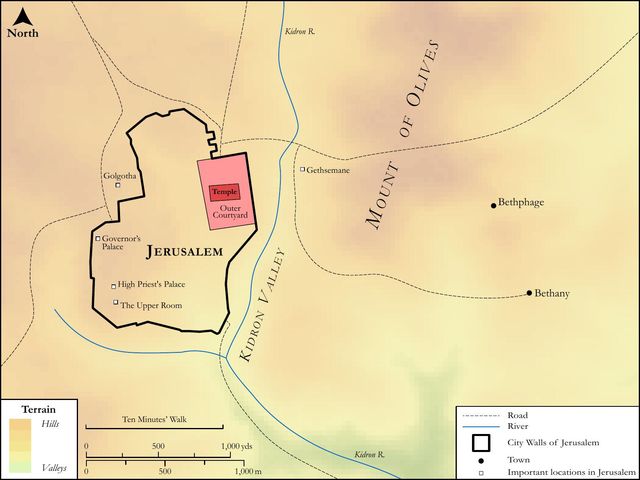
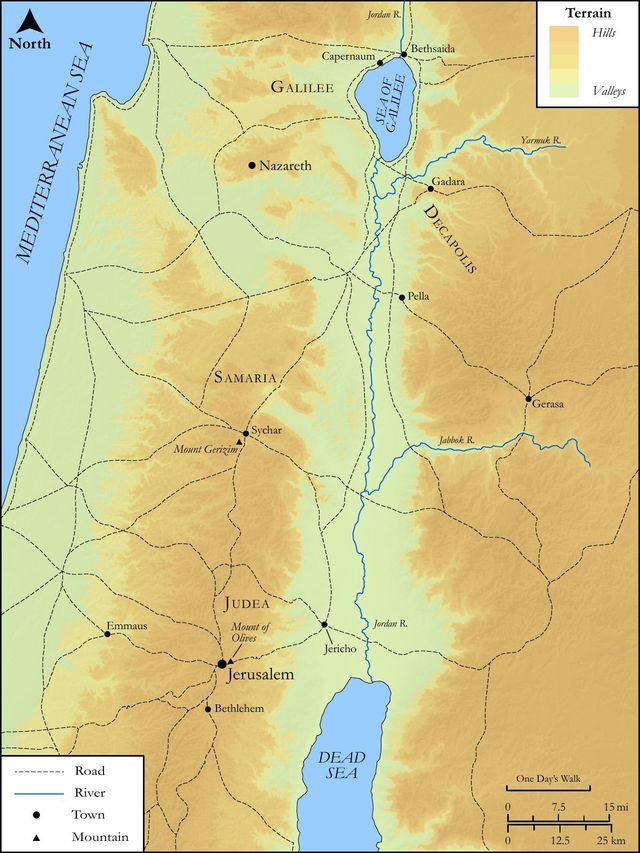
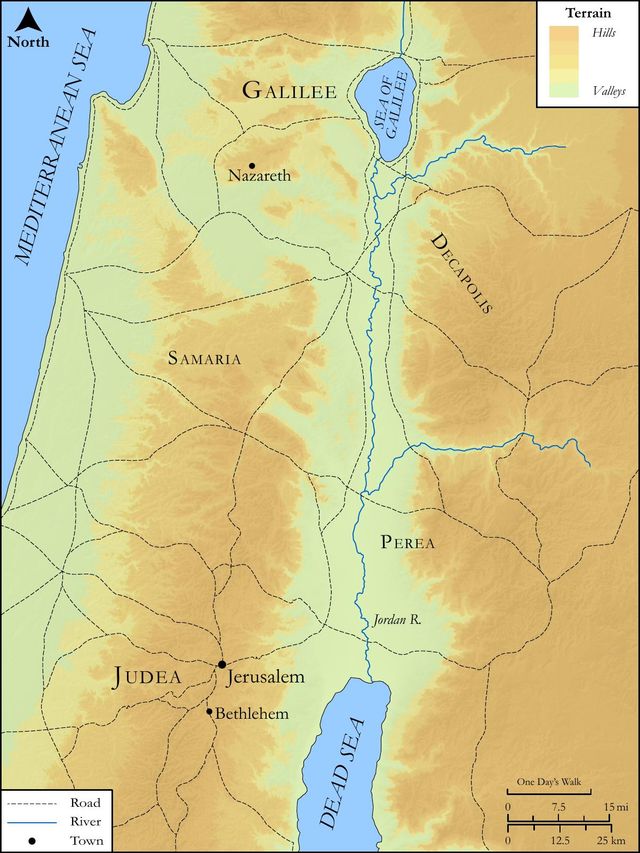
Study this verse
Public-domain commentary
Matthew Henry
From his Commentary on the Whole Bible. Henry comments on passages, not single verses — this entry covers John 19:19–30. His four-level outline is real structure in the source text, so it is rendered as structure.
Here are some remarkable circumstances of Christ's dying more fully related than before, which those will take special notice of who covet to know Christ and him crucified.
I.The title set up over his head. Observe,
1.The inscription itself which Pilate wrote, and ordered to be fixed to the top of the cross, declaring the cause for which he was crucified, Joh 19:19. Matthew called it, aitia - the accusation; Mark and Luke called it epigraphē - the inscription; John calls it by the proper Latin name, titlos - the title: and it was this, Jesus of Nazareth, the King of the Jews, Pilate intended this for his reproach, that he, being Jesus of Nazareth, should pretend to be king of the Jews, and set up in competition with Caesar, to whom Pilate would thus recommend himself, as very jealous for his honour and interest, when he would treat but a titular king, a king in metaphor, as the worst of malefactors; but God overruled this matter,
(1.)That it might be a further testimony to the innocency of our Lord Jesus; for here was an accusation which, as it was worded, contained no crime. If this be all they have to lay to his charge, surely he has done nothing worthy of death or of bonds.
(2.)That it might show forth his dignity and honour. This is Jesus a Saviour, Nazōraios, the blessed Nazarite, sanctified to God; this is the king of the Jews, Messiah the prince, the sceptre that should rise out of Israel, as Balaam had foretold; dying for the good of his people, as Caiaphas had foretold. Thus all these three bad men witnessed to Christ, though they meant not so.
2.The notice taken of this inscription (Joh 19:20): Many of the Jews read it, not only those of Jerusalem, but those out of the country, and from other countries, strangers and proselytes, that came up to worship at the feast. Multitudes read it, and it occasioned a great variety of reflections and speculations, as men stood affected. Christ himself was set for a sign, a title. Here are two reasons why the title was so much read: - (1.) Because the place where Jesus was crucified, though without the gate, was yet nigh the city, which intimates that if it had been any great distance off they would not have been led, no not by their curiosity, to go and see it, and read it. It is an advantage to have the means of knowing Christ brought to our doors. (2.) Because it was written in Hebrew, and Greek, and Latin, which made it legible by all; they all understood one or other of these languages, and none were more careful to bring up their children to read than the Jews generally were. It likewise made it the more considerable; everyone would be curious to enquire what it was which was so industriously published in the three most known languages. In the Hebrew the oracles of God were recorded; in Greek the learning of the philosophers; and in Latin the laws of the empire. In each of these Christ is proclaimed king, in whom are hid all the treasures of revelation, wisdom, and power. God so ordering it that this should be written in the three then most known tongues, it was intimated thereby that Jesus Christ should be a Saviour to all nations, and not to the Jews only; and also that every nation should hear in their own tongue the wonderful works of the Redeemer. Hebrew, Greek, and Latin, were the vulgar languages at that time in this part of the world; so that this is so far from intimating (as the Papists would have it) that the scripture is still to be retained in these three languages, that on the contrary it teaches us that the knowledge of Christ ought to be diffused throughout every nation in their own tongue, as the proper vehicle of it, that people may converse as freely with the scriptures as they do with their neighbours.
3.The offence which the prosecutors took at it, Joh 19:21. They would not have it written, the king of the Jews; but that he said of himself, I am the king of the Jews. Here they show themselves,
(1.)Very spiteful and malicious against Christ. It was not enough to have him crucified, but they must have his name crucified too. To justify themselves in giving him such bad treatment, they thought themselves concerned to give him a bad character, and to represent him as a usurper of honours and powers that he was not entitled to.
(2.)Foolishly jealous of the honour of their nation. Though they were a conquered and enslaved people, yet they stood so much upon the punctilio of their reputation that they scorned to have it said that this was their king.
(3.)Very impertinent and troublesome to Pilate. They could not but be sensible that they had forced him, against his mind, to condemn Christ, and yet, in such a trivial thing as this, they continue to tease him; and it was so much the worse in that, though they had charged him with pretending to be the king of the Jews, yet they had not proved it, nor had he ever said so.
4.The judge's resolution to adhere to it: "What I have written I have written, and will not alter it to humour them."
(1.)Hereby an affront was put upon the chief priests, who would still be dictating. It seems, by Pilate's manner of speaking, that he was uneasy in himself for yielding to them, and vexed at them for forcing him to it, and therefore he was resolved to be cross with them; and by this inscription he insinuates,
[1.]That, notwithstanding their pretences, they were not sincere in their affections to Caesar and his government; they were willing enough to have a king of the Jews, if they could have one to their mind.
[2.]That such a king as this, so mean and despicable, was good enough to be the king of the Jews; and this would be the fate of all that should dare to oppose the Roman power.
[3.]That they had been very unjust and unreasonable in prosecuting this Jesus, when there was no fault to be found in him.
(2.)Hereby honour was done to the Lord Jesus. Pilate stuck to it with resolution, that he was the king of the Jews. What he had written was what God had first written, and therefore he could not alter it; for thus it was written, that Messiah the prince should be cut off, Dan 9:26. This therefore is the true cause of his death; he dies because the king of Israel must die, must thus die. When the Jews reject Christ, and will not have him for their king, Pilate, a Gentile, sticks to it that he is a king, which was an earnest of what came to pass soon after, when the Gentiles submitted to the kingdom of the Messiah, which the unbelieving Jews had rebelled against.
II.The dividing of his garments among the executioners, Joh 19:23, Joh 19:24.
Four soldiers were employed, who, when they had crucified Jesus, had nailed him to the cross, and lifted it up, and him upon it, and nothing more was to be done than to wait his expiring through the extremity of pain, as, with us, when the prisoner is turned off, then they went to make a dividend of his clothes, each claiming an equal share, and so they made four parts, as nearly of the same value as they could, to every soldier a part; but his coat, or upper garment whether cloak or gown, being a pretty piece of curiosity, without seam, woven from the top throughout, they agreed to cast lots for it. Here observe,
1.The shame they put upon our Lord Jesus, in stripping him of his garments before they crucified him. The shame of nakedness came in with sin. He therefore who was made sin for us bore that shame, to roll away our reproach. He was stripped, that we might be clothed with white raiment (Rev 3:18), and that when we are unclothed we may not be found naked.
2.The wages with which these soldiers paid themselves for crucifying Christ. They were willing to do it for his old clothes. Nothing is to be done so bad, but there will be found men bad enough to do it for a trifle. Probably they hoped to make more than ordinary advantage of his clothes, having heard of cures wrought by the touch of the hem of his garment, or expecting that his admirers would give any money for them.
3.The sport they made about his seamless coat. We read not of any thing about him valuable or remarkable but this, and this not for the richness, but only the variety of it, for it was woven from the top throughout; there was no curiosity therefore in the shape, but a designed plainness. Tradition says, his mother wove it for him, and adds this further, that it was made for him when he was a child, and, like the Israelites' clothes in the wilderness, waxed not old; but this is a groundless fancy. The soldiers thought it a pity to rend it, for then it would unravel, and a piece of it would be good for nothing; they would therefore cast lots for it. While Christ was in his dying agonies, they were merrily dividing his spoils. The preserving of Christ's seamless coat is commonly alluded to to show the care all Christians ought to take that they rend not the church of Christ with strifes and divisions; yet some have observed that the reason why the soldiers would not rend Christ's coat was not out of any respect to Christ, but because each of them hoped to have it entire for himself. And so many cry out against schism, only that they may engross all the wealth and power to themselves. Those who opposed Luther's separation from the church of Rome urged much the tunica inconsutilis - the seamless coat; and some of them laid so much stress upon it that they were called the Inconsutilistae - The seamless.
4.The fulfilling of the scripture in this. David, in spirit, foretold this very circumstance of Christ's sufferings, in that passage, Psa 22:18. The event so exactly answering the prediction proves,
(1.)That the scripture is the word of God, which foretold contingent events concerning Christ so long before, and they came to pass according to the prediction.
(2.)That Jesus is the true Messiah; for in him all the Old Testament prophecies concerning the Messiah had, and have, their full accomplishment. These things therefore the soldiers did.
III.The care that he took of his poor mother.
1.His mother attends him to his death (Joh 19:25): There stood by the cross, as near as they could get, his mother, and some of his relations and friends with her. At first, they stood near, as it is said here; but afterwards, it is probable, the soldiers forced them to stand afar off, as it is said in Matthew and Mark: or they themselves removed out of the ground.
(1.)See here the tender affection of these pious women to our Lord Jesus in his sufferings. When all his disciples, except John, has forsaken him, they continued their attendance on him. Thus the feeble were as David (Zac 12:8): they were not deterred by the fury of the enemy nor the horror of the sight; they could not rescue him nor relieve him, yet they attended him, to show their good-will. It is an impious and blasphemous construction which some of the popish writers put upon the virgin Mary standing by the cross, that thereby she contributed to the satisfaction he made for sin no less than he did, and so became a joint-mediatrix and co-adjutrix in our salvation.
(2.)We may easily suppose what an affliction it was to these poor women to see him thus abused, especially to the blessed virgin. Now was fulfilled Simeon's word, A sword shall pierce through thy own soul, Luk 2:35. His torments were her tortures; she was upon the rack, while he was upon the cross; and her heart bled with his wounds; and the reproaches wherewith they reproached him fell on those that attended him.
(3.)We may justly admire the power of divine grace in supporting these women, especially the virgin Mary, under this heavy trial. We do not find his mother wringing her hands, or tearing her hair, or rending her clothes, or making an outcry; but, with a wonderful composure, standing by the cross, and her friends with her. Surely she and they were strengthened by a divine power to this degree of patience; and surely the virgin Mary had a fuller expectation of his resurrection than the rest had, which supported her thus. We know not what we can bear till we are tried, and then we know who has said, My grace is sufficient for thee.
2.He tenderly provides for his mother at his death. It is probable that Joseph, her husband, was long since dead, and that her son Jesus had supported her, and her relation to him had been her maintenance; and now that he was dying what would become of her? He saw her standing by, and knew her cares and griefs; and he saw John standing not far off, and so he settled a new relation between his beloved mother and his beloved disciple; for he said to her, "Woman, behold thy son, for whom henceforward thou must have a motherly affection;" and to him, "Behold thy mother, to whom thou must pay a filial duty." And so from that hour, that hour never to be forgotten, that disciple took her to his own home. See here,
(1.)The care Christ took of his dear mother. He was not so much taken up with a sense of his sufferings as to forget his friends, all whose concerns he bore upon his heart. His mother, perhaps, was so taken up with his sufferings that she thought not of what would become of her; but he admitted that thought. Silver and gold he had none to leave, no estate, real or personal; his clothes the soldiers had seized, and we hear no more of the bag since Judas, who had carried it, hanged himself. He had therefore no other way to provide for his mother than by his interest in a friend, which he does here.
[1.]He calls her woman, not mother, not out of any disrespect to her, but because mother would have been a cutting word to her that was already wounded to the heart with grief; like Isaac saying to Abraham, My father. He speaks as one that was now no more in this world, but was already dead to those in it that were dearest to him. His speaking in this seemingly slight manner to his mother, as he had done formerly, was designed to obviate and give a check to the undue honours which he foresaw would be given to her in the Romish church, as if she were a joint purchaser with him in the honours of the Redeemer.
[2.]He directs her to look upon John as her son: "Behold him as thy son, who stands there by thee, and be as a mother to him." See here, First, An instance of divine goodness, to be observed for our encouragement. Sometimes, when God removes one comfort from us, he raises up another for us, perhaps where we looked not for it. We read of children which the church shall have after she has lost the other, Isa 49:21. Let none therefore reckon all gone with one cistern dried up, for from the same fountain another may be filled. Secondly, An instance of filial duty, to be observed for our imitation. Christ has here taught children to provide, to the utmost of their power, for the comfort of their aged parents. When David was in distress, he took care of his parents, and found out a shelter for them (Sa1 22:3); so the Son of David here. Children at their death, according to their ability, should provide for their parents, if they survive them, and need their kindness.
(2.)The confidence he reposed in the beloved disciple. It is to him he says, Behold thy mother, that is, I recommend her to thy care, be thou as a son to her to guide her (Isa 51:18); and forsake her not when she is old, Pro 23:22. Now,
[1.]This was an honour put upon John, and a testimony both to his prudence and to his fidelity. If he who knows all things had not known that John loved him, he would not have made him his mother's guardian. It is a great honour to be employed for Christ, and to be entrusted with any of his interest in the world. But,
[2.]It would be a care and some charge to John; but he cheerfully accepted it, and took her to his own home, not objecting the trouble nor expense, nor his obligations to his own family, nor the ill-will he might contract by it. Note, Those that truly love Christ, and are beloved of him, will be glad of an opportunity to do any service to him or his. Nicephoras's Eccl. Hist. lib. 2 cap. 3, saith that the virgin Mary lived with John at Jerusalem eleven years, and then died. Others, that she lived to remove with him to Ephesus.
IV.The fulfilling of the scripture, in the giving of him vinegar to drink, Joh 19:28, Joh 19:29. Observe,
1.How much respect Christ showed to the scripture (Joh 19:28): Knowing that all things hitherto were accomplished, that the scripture might be fulfilled, which spoke of his drinking in his sufferings, he saith, I thirst, that is, he called for drink.
(1.)It was not at all strange that he was thirsty; we find him thirsty in a journey (Joh 4:6, Joh 4:7), and now thirsty when he was just at his journey's end. Well might he thirst after all the toil and hurry which he had undergone, and being now in the agonies of death, ready to expire purely by the loss of blood and extremity of pain. The torments of hell are represented by a violent thirst in the complaint of the rich man that begged for a drop of water to cool his tongue. To that everlasting thirst we had been condemned, had not Christ suffered for us.
(2.)But the reason of his complaining of it is somewhat surprising; it is the only word he spoke that looked like complaint of his outward sufferings. When they scourged him, and crowned him with thorns, he did not cry, O my head! or, My back! But now he cried, I thirst. For,
[1.]He would thus express the travail of his soul, Isa 53:11. He thirsted after the glorifying of God, and the accomplishment of the work of our redemption, and the happy issue of his undertaking.
[2.]He would thus take care to see the scripture fulfilled. Hitherto, all had been accomplished, and he knew it, for this was the thing he had carefully observed all along; and now he called to mind one thing more, which this was the proper season for the performance of. By this it appears that he was the Messiah, in that not only the scripture was punctually fulfilled in him, but it was strictly eyed by him. By this it appears that God was with him of a truth - that in all he did he went exactly according to the word of God, taking care not to destroy, but to fulfil, the law and the prophets. Now, First, The scripture had foretold his thirst, and therefore he himself related it, because it could not otherwise be known, saying, I thirst; it was foretold that his tongue should cleave to his jaws, Psa 22:15. Samson, an eminent type of Christ, when he was laying the Philistines heaps upon heaps, was himself sore athirst (Jdg 15:18); so was Christ, when he was upon the cross, spoiling principalities and powers. Secondly, The scripture had foretold that in his thirst he should have vinegar given him to drink, Psa 69:21. They had given him vinegar to drink before they crucified him (Mat 27:34), but the prophecy was not exactly fulfilled in that, because that was not in his thirst; therefore now he said, I thirst, and called for it again: then he would not drink, but now he received it Christ would rather court an affront than see any prophecy unfulfilled. This should satisfy us under all our trials, that the will of God is done, and the word of God accomplished.
2.See how little respect his persecutors showed to him (Joh 19:29): There was set a vessel full of vinegar, probably according to the custom at all executions of this nature; or, as others think, it was now set designedly for an abuse to Christ, instead of the cup of wine which they used to give to those that were ready to perish; with this they filled a sponge, for they would not allow him a cup, and they put it upon hyssop, a hyssop-stalk, and with this heaved it to his mouth; hussōpō perithentes - they stuck it round with hyssop; so it may be taken; or, as others, they mingled it with hyssop-water, and this they gave him to drink when he was thirsty; a drop of water would have cooled his tongue better than a draught of vinegar: yet this he submitted to for us. We had taken the sour grapes, and thus his teeth were set on edge; we had forfeited all comforts and refreshments, and therefore they were withheld from him. When heaven denied him a beam of light earth denied him a drop of water, and put vinegar in the room of it.
V.The dying word wherewith he breathed out his soul (Joh 19:30):
When he had received the vinegar, as much of it as he thought fit, he said, It is finished; and, with that, bowed his head, and gave up the ghost. Observe,
1.What he said, and we may suppose him to say it with triumph and exultation, Tetelestai - It is finished, a comprehensive word, and a comfortable one. (1.) It is finished, that is, the malice and enmity of his persecutors had now done their worst; when he had received that last indignity in the vinegar they gave him, he said, "This is the last; I am now going out of their reach, where the wicked cease from troubling." (2.) It is finished, that is, the counsel and commandment of his Father concerning his sufferings were now fulfilled; it was a determinate counsel, and he took care to see every iota and tittle of it exactly answered, Act 2:23. He had said, when he entered upon his sufferings, Father, thy will be done; and now he saith with pleasure, It is done. It was his meat and drink to finish his work (Joh 4:34), and the meat and drink refreshed him, when they gave him gall and vinegar. (3.) It is finished, that is, all the types and prophecies of the Old Testament, which pointed at the sufferings of the Messiah, were accomplished and answered. He speaks as if, now that they had given him the vinegar, he could not bethink himself of any word in the Old Testament that was to be fulfilled between him and his death but it had its accomplishment; such as, his being sold for thirty pieces of silver, his hands and feet being pierced, his garments divided, etc.; and now that this is done. It is finished. (4.) It is finished, that is, the ceremonial law is abolished, and a period put to the obligation of it. The substance is now come, and all the shadows are done away. Just now the veil is rent, the wall of partition is taken down, even the law of commandments contained in ordinances, Eph 2:14, Eph 2:15. The Mosaic economy is dissolved, to make way for a better hope. (5.) It is finished, that is, sin is finished, and an end made of transgression, by the bringing in of an everlasting righteousness. It seems to refer to Dan 9:24. The Lamb of God was sacrificed to take away the sin of the world, and it is done, Heb 9:26. (6.) It is finished, that is, his sufferings were now finished, both those of his soul and those of his body. The storm is over, the worst is past; all his pains and agonies are at an end, and he is just going to paradise, entering upon the joy set before him. Let all that suffer for Christ, and with Christ, comfort themselves with this, that yet a little while and they also shall say, It is finished. (7.) It is finished, that is, his life was now finished, he was just ready to breathe his last, and now he is no more in this world, Joh 17:11. This is like that of blessed Paul (Ti2 4:7), I have finished my course, my race is run, my glass is out, mene, mene - numbered and finished. This we must all come to shortly. (8.) It is finished, that is, the work of man's redemption and salvation is now completed, at least the hardest part of the undertaking is over; a full satisfaction is made to the justice of God, a fatal blow given to the power of Satan, a fountain of grace opened that shall ever flow, a foundation of peace and happiness laid that shall never fail. Christ had now gone through with his work, and finished it, Joh 17:4. For, as for God, his work is perfect; when I begin, saith he, I will also make an end. And, as in the purchase, so in the application of the redemption, he that has begun a good work will perform it; the mystery of God shall be finished.
2.What he did: He bowed his head, and gave up the ghost. He was voluntary in dying; for he was not only the sacrifice, but the priest and the offerer; and the animus offerentis - the mind of the offerer, was all in all in the sacrifice. Christ showed his will in his sufferings, by which will we are sanctified.
(1.)He gave up the ghost. His life was not forcibly extorted from him, but freely resigned. He had said, Father, into thy hands I commit my spirit, thereby expressing the intention of this act. I give up myself as a ransom for many; and, accordingly, he did give up his spirit, paid down the price of pardon and life at his Father's hands. Father, glorify thy name.
(2.)He bowed his head. Those that were crucified, in dying stretched up their heads to gasp for breath, and did not drop their heads till they had breathed their last; but Christ, to show himself active in dying, bowed his head first, composing himself, as it were, to fall asleep. God had laid upon him the iniquity of us all, putting it upon the head of this great sacrifice; and some think that by this bowing of his head he would intimate his sense of the weight upon him. See Psa 38:4; Psa 40:12. The bowing of his head shows his submission to his Father's will, and his obedience to death. He accommodated himself to his dying work, as Jacob, who gathered up his feet into the bed, and then yielded up the ghost.
Historical interpretation
Nine Centuries of Reception
19 surviving comments on this verse. Each one is dated, so this reads as a timeline rather than a list.
Select a marker to jump to its quote. Markers stagger vertically where authors wrote within a few decades of each other.
Nailed upon the cross, he exhibited many notable signs by which his death was distinguished from all others. By his own free will, he dismissed from him his spirit with a word, anticipating the executioner’s work.
He cried out with a loud voice to the Father, “I commend my spirit” and freely departed from the body. He did not wait for death, which was lagging behind as it were in fear to come to him. Instead, he pursued it from behind and drove it on and trampled it under his feet as it was fleeing. He burst the eternal gates of death’s dark realms and made a road of return back again to life for the dead bound there with the bonds of death.
The only-begotten God had the power of laying down his life and of taking it up again. After the drought of vinegar, when he had shown that his work of human suffering was finished and in order to accomplish in himself the mystery of death, he bowed his head and gave up his spirit. If it has been granted to our mortal nature of its own will to breathe its last breath and seek rest in death—if the buffeted soul may depart without the breaking up of the body and the spirit burst forth and flee away without being as it were violated in its own home by the breaking and piercing and crushing of limbs—then fear of death might have seized the Lord of life. This is true if, that is, when he gave up the ghost and died, his death was not an exercise of his own free will. But if he died of his own will and through his own will gave back his spirit, death had no terror, because it was in his own power.
When he had drunk the wine mingled with myrrh and vinegar, he said, “It is finished.” For the mystery has been fulfilled. The things that are written have been accomplished. Sins are forgiven.
It was not in appearance only that he died. It was a true death.… The spirit did not expire since it was eternal and incorruptible. But there was one who had the spirit who indeed expired who, while expiring, commended the spirit to the Father. He is the one whom Joseph wrapped in the linen cloth and buried. He did not wrap up and bury a shadow but him who was nailed to the tree.
"After this, Jesus knowing that all things were now accomplished." That is, "that nothing was wanting to the Dispensation." For He was everywhere desirous to show, that this Death was of a new kind, if indeed the whole lay in the power of the Person dying, and death came not on the Body before He willed it; and He willed it after He had fulfilled all things. Therefore also He said, "I have power to lay down My life; and I have power to take it again." (c. x. 18.) Knowing therefore that all things were fulfilled, He saith, "I thirst." Here again fulfilling a prophecy. But consider, I pray, the accursed nature of the bystanders. Though we have ten thousand enemies, and have suffered intolerable things at their hands, yet when we see them perishing, we relent; but they did not even so make peace with Him, nor were tamed by what they saw, but rather became more savage, and increased their irony; and having brought to Him vinegar on a sponge, as men bring it to the condemned, thus they gave Him to drink; since it is on this account that the hyssop is added.
"Having therefore received it, He saith, It is finished." Seest thou how He doth all things calmly, and with power? And what follows shows this. For when all had been completed, "He bowed His head, (this had not been nailed,) and gave up the ghost." That is, "died." Yet to expire does not come after the bowing the head; but here, on the contrary, it doth. For He did not, when He had expired, bow His head, as happens with us, but when He had bent His head, then He expired. By all which things the Evangelist hath shown, that He was Lord of all.
And they gave Him gall to drink, and this to insult Him, but He would not. But another saith, that having tasted it, He said, "It is finished." And what meaneth, "It is finished?" The prophecy was fulfilled concerning Him. "For they gave me," it is said, "gall for my meat, and for my thirst they gave me vinegar to drink." But neither doth that evangelist indicate that He drank, for merely to taste differs not from not drinking, but hath one and the same signification.
(Hom. lxxxv) They were not softened at all by what they saw, but were the more enraged, and gave Him the cup to drink, as they did to criminals, i. e. with a hyssop.
(Hom. lxxxv) He did not bow His head because He gave up the ghost, but He gave up the ghost because at that moment He bowed His head. Whereby the Evangelist intimates that He was Lord of all.
He then adds: "After this, Jesus knowing that all things were now accomplished, that the scripture might be fulfilled, saith, I thirst. Now there was set a vessel full of vinegar: and they filled a sponge with vinegar, and fixed it upon hyssop, and put it to His mouth. When Jesus therefore had received the vinegar, He said, It is finished: and He bowed His head, and gave up the ghost." Who has the power of so adjusting what he does, as this Man had of arranging all that He suffered? But this Man was the Mediator between God and men; the Man of whom we read in prophecy, He is man also, and who shall acknowledge Him? for the men who did such things acknowledged not this Man as God. For He who was manifest as man, was hid as God: He who was manifest suffered all these things, and He Himself also, who was hid, arranged them all. He saw, therefore, that all was accomplished that required to be done before He received the vinegar, and gave up the ghost; and that this also might be accomplished which the scripture had foretold, "And in my thirst they gave me vinegar to drink," He said, "I thirst:" as if it were, One thing still you have failed to do, give me what you are. For the Jews were themselves the vinegar, degenerated as they were from the wine of the patriarchs and prophets; and filled like a full vessel with the wickedness of this world, with hearts like a sponge, deceitful in the formation of its cavernous and tortuous recesses. But the hyssop, whereon they placed the sponge filled with vinegar, being a lowly herb, and purging the heart, we fitly take for the humility of Christ Himself; which they thus enclosed, and imagined they had completely ensnared. Hence we have it said in the psalm, "Thou shalt purge me with hyssop, and I shall be cleansed." For it is by Christ's humility that we are cleansed; because, had He not humbled Himself, and became obedient unto the death of the cross, His blood certainly would not have been shed for the remission of sins, or, in other words, for our cleansing.
(Tr. cxix.) He who appeared man, suffered all these things; He who was God, ordered them: After this Jesus knowing that all things were now accomplished; i. e. knowing the prophecy in the Psalms, And when I was thirsty, they gave me vinegar to drink, (Ps. 68) said, I thirst:As if to say, ye have not done all (minus): give me yourselves: for the Jews were themselves vinegar, having degenerated from the wine of the Patriarchs and the Prophets. Now there was a vessel full of vinegar: they had drunk from the wickedness of the world, as from a full vessel, and their heart was deceitful, as it were, a spunge full of caves and crooked hiding places: And they filled a spunge with vinegar, and put it upon hyssop, and put it to his mouth.
The hyssop around which they put the spunge full of vinegar, being a mean herb, taken to purge the breast, represents the humility of Christ, which they hemmed in and thought they had circumvented. (ὑσσώπῳ περιθέντες) For we are made clean by Christ's humility. Nor let it perplex you that they were able to reach His mouth when He was such a height above the ground: for we read in the other Evangelists, what John omits to mention, that the spunge was put upon a reed.
(Tr. cxix) viz. what prophecy had foretold so long before.
(Tr. cxix) Then as there was nothing left Him to do before He died, it follows, And He bowed His head, and gave up the ghost, only dying when He had nothing more to do, like Him who had to lay down His life, and to take it up again.
(Tr. cxix) For who ever had such power to sleep when he wished, as our Lord had to die when He wished? What power must He have, for our good or evil, Who had such power dying?
He had the authority to lay down his life, as he himself had declared. And he gave up the spirit in humility, that is, with a bowed head. He would receive it back again by rising again with a raised head. This death and bowing of the head were acts of great power, as was shown by that ancestor Jacob when he blessed Judah and said, "You have gone up lying down; you have slept like a lion." By "going up" he signified his death; by "like a lion" he signified his power.
The spirit is to be preferred to the body. The death of the spirit means that God has abandoned it, but the death of the body means that the spirit has abandoned it. The punishment in the death of the body lies in this, that the spirit abandons the body unwillingly because it has willingly abandoned God. Therefore, the spirit must abandon the body, even though it does not want to, because by its will it has abandoned God. Nor may it abandon the body when it wants to, unless it inflicts some form of violence on itself by which the body itself is destroyed. The spirit of the Mediator has shown how it was not any punishment for sin that brought about the death of his flesh because he did not abandon it unwillingly. Rather, the spirit left because he willed it to, and it left at the time in the manner that he wanted it to leave. For since he is so commingled with the flesh by the Word of God as to be one with it, he says, “I have the power to lay down my life, and I have the power to take it up again. No one takes it from me, but I therefore lay it down of myself, and I take it up again.”
"When Jesus therefore had received the vinegar, He said, It is finished." What, but all that prophecy had foretold so long before? And then, because nothing now remained that still required to be done before He died, as if He, who had power to lay down His life and to take it up again, had at length completed all for whose completion He was waiting, "He bowed His head, and gave up the ghost." Who can thus sleep when he pleases, as Jesus died when He pleased? Who is there that thus puts off his garment when he pleases, as He put off His flesh at His pleasure? Who is there that thus departs when he pleases, as He departed this life at His pleasure? How great the power, to be hoped for or dreaded, that must be His as judge, if such was the power He exhibited as a dying man!
When this indignity had been added to the rest, the Saviour exclaimed, It is finished; meaning that the measure of the iniquity of the Jews, and of their furious rage against Him, was completed. For what had the Jews left untried, and what extremity of atrocity had they not practised against Him? For what kind of insult was omitted, and what crowning act of outrage do they seem to have left undone? Therefore rightly did He exclaim, It is finished, the hour already summoning Him to preach to the spirits in hell. For He |638 visited them, that He might be Lord both of the living and the dead; and for our sake encountered death itself, and underwent the common lot of all humanity, that is, according to the flesh, though being as God by Nature Life, that He might despoil hell, and render return to life possible to human nature; being thus proved the firstfruits of them that are asleep, and the firstborn from the dead, according to the Scriptures. He bowed His head, therefore; for as this generally befalls the dying, through the slackening of the sinews of the flesh, when the spirit or soul that united and sustained it is fled, the Evangelist made use of this expression. The expression also, He gave up His Spirit, does not differ from language usually employed, for the vulgar use it as equivalent to "his life was extinguished, and he died." But it is probable that it was of set purpose, and advisedly, that the holy Evangelist, instead of saying simply, He died, said, He gave up His Spirit; gave it up, that is, into the hands of God the Father, according to the saying that He spake: Father, into Thy hands I commend My Spirit; and for us, also, the meaning of the expression lays down a beginning and foundation of firm hope. For, I think, we ought to believe, and for this belief there is much ground, that the souls of Saints, when they quit their earthly bodies, are, by the bountiful mercy of God, almost, as it were, consigned into the hands of a most loving Father, and do not, as some infidels have pretended, haunt their sepulchres, waiting for funeral libations; nor yet are they, like the souls of sinful men, conveyed to the place of endless torment, that is, to hell. Rather, do they hasten into the hands of the Father of all, by the new way which our Saviour Christ has prepared for us; for He consigned His Soul into the hands of His Father, that we also, making it our anchor, and being firmly rooted and grounded in this belief, might entertain the bright hope that when we undergo the death of the body, we shall be in God's hands; yea, in a far better condition than when we |639 were in the flesh. Therefore, also, the wise Paul assures us that it is better to depart, and be with Christ.
And when He gave up the ghost, the veil of the temple was rent in twain, from the top to the bottom. The veil of the temple was of fine linen, let down to the floor of the centre of the temple, and shrouding the inner portion thereof, and allowing only the high priest to enter into the innermost shrine. For it was not in the power of any one at will to penetrate into the interior with unwashen feet, and carelessly to gaze upon the Holy of holies. How very necessary it was that this curtain should make this division, Paul shows us by his words in the Epistle to the Hebrews: For there was a tabernacle prepared; the first, which is called the Holy place. And after the second veil, the tabernacle, which is called the Holy of holies, having a golden censer, and the ark of the covenant overlaid round about with gold, wherein was the golden pot holding the manna, and the tables of the covenant, and Aaron's rod that budded. But into the first tabernacle, he says, the priests go in, accomplishing the services; but into the second, the high priest alone, once in the year, not without blood, which he offereth for himself, and for the errors of the people: the Holy Ghost this signifying, that the way into the Holy place hath not yet been made manifest, while as the first tabernacle is yet standing. For there can be no question, that a veil was let down at the very entrance of the temple. And so there came into his mind the first tabernacle, which he called holy; for no one could affirm that any part of the temple was not holy, or, if he did so, he would lie, for it was all holy. And after the first tabernacle came the veil which was betwixt, which is the second veil, separating the innermost portion, that is, the Holy of holies. But, as the blessed Paul said, the Spirit signified, by figures and types, that the more fitting way in which the Saints should tread had not yet been made manifest; for the people were still kept at a distance, and the |640 first tabernacle was yet standing. For there had not, as yet, in fact, appeared unto men the manner of the life that Christ gave unto those who were called by the Spirit unto sanctification; and not yet had the mystery concerning Him been made manifest, for the written commandment of the Law was still in force. Therefore, also, the Law placed the Jews in the outer court. For the dispensation of the Law was, as it were, a porch and vestibule leading unto the teaching and life of the Gospel. For the one is but a type, the other is the truth itself. The first tabernacle was, indeed, holy, for the Law is holy, and the commandment righteous and good; but the innermost portion of the temple was the Holy of holies, for though the men who partook of the righteousness of the Law were holy, they became yet holier when they accepted the faith that is in Christ, and were anointed with the Holy Spirit of God. The righteousness of faith, therefore, is greater than the righteousness of the Law; and by faith we are far more abundantly sanctified. Therefore, also, the wise Paul says, that he gladly and readily endured the loss of the righteousness that is of the Law, that he might gain Christ, and might be found in Him, not having a righteousness of mine own, even that which is of the Law, but that which is through faith in Jesus Christ. And some fell backwards, and, after running well for a time, were bewitched; and the Galatians were of this class: after pursuing the righteousness which is of faith, turning back to the commandment of the Law, and recurring to the state of life shadowed forth by types and figures; and to these Paul administered the well-merited reproof: If ye receive circumcision, Christ will profit you nothing. Ye are severed from Christ, ye who would be justified by the Law; ye are fallen away from grace. But (to bring our explanation of the passage to a good and proper conclusion) we will simply repeat, that the veil of the temple was rent in twain, from the top to the bottom; to signify, as it were, that God was in the very act of revealing the Holy of holies, and making the way into the inmost shrine open henceforth to those who believe on Christ. For the knowledge of the Divine mysteries is now laid bare before us; no longer shrouded in the obscurity of the letter of the Law, as it were a curtain, nor hidden by any covering from our quest, nor defended against the intrusion of the eye of the mind by types through which we could see but dimly. Rather are these mysteries now seen in simplicity of faith; yea, but few words suffice to explain them. For the word is nigh thee, says Paul, in thy mouth, and in thy heart; that is, the word of faith, which we preach: because, if thou shalt say with thy mouth, Jesus is Lord, and shalt believe in thy heart that God raised Him from the dead, thou shalt be saved: for with the heart man believeth unto righteousness; and with the mouth confession is made unto salvation. Herein is seen in its completeness the mystery of piety towards God. But, while Christ had not as yet waged the conflict for our salvation, nor undergone the death of the flesh, the veil was still spread out, for the power of the commandment of the Law still prevailed. But when the iniquitous Jews, in their presumption, had wreaked to the utmost their malice upon Christ, and He had given up the ghost for our sake, and the sufferings of Emmanuel were accomplished, the time had then come that the broad veil, that had so long been spread out, should from henceforth be rent asunder----that is, the protection of the letter of the Law----and that the fair vision of the truth should lie bare and open before those who had been sanctified in Christ by faith. The veil was torn throughout; for what other meaning can be put upon the words: From the top to the bottom? And why was this? It was because the revelation of the message of salvation was not partial, but our enlightenment concerning the Divine mysteries was perfected thereby. Therefore, also, the Psalmist said unto God, in the person of His new people: The hidden secrets of Thy wisdom hast Thou, revealed unto me; and, furthermore, the inspired Paul thus addresses believers on Christ: I thank my God always concerning you, for the grace which was given you in Christ Jesus; that in every thing ye were enriched in Him, in all utterance, and all wisdom, and all knowledge. The rending of the veil, then, not in part, but entirely throughout, signified then, that the worshippers of the Saviour were about to be enriched in all wisdom, and in all knowledge, and in all utterance, manifestly receiving the knowledge of the mystery concerning Him, undefiled and unclouded by blot or shadow. For this is what is meant by the words: From the top to the bottom. We say, then, that the most appropriate and fitting time for the revelation of the Divine mysteries was the occasion on which the Saviour laid down His life for us, when Israel spurned His grace, and wholly started aside from the love of God, in his frenzy against Him, and headstrong impiety. For any one may see that the measure of their iniquities was complete, when he learns that they persecuted, even unto death, the Giver of Life.
I think, therefore, that we have said enough on this subject, and that our explanation of the Divine purpose does not fall short of the mark. But, as we find the inspired Evangelist is very diligent to say: When He gave up the ghost, the veil of the temple was rent, thereby almost signifying as essential for us to know the occasion of that event, let us supplement our remarks by a further consideration, which savours, I think, of the spirit of pious research. For it is a thought which will be found in no way abhorrent to those fundamental doctrines, which are at once a blessing and a necessity to us. To proceed, then: the following custom was in vogue, both among the people and the rulers of the Jews. When they saw anything being done which they thought would especially offend the Giver of the Law, or when they heard any outrageous or blasphemous utterance, they tore their garments, and put on the appearance of mourners; thereby, in a manner, taking up the defence of God, and by the intolerance they displayed of such offences, passing sentence of condemnation on the madness of the transgressors, and acquitting themselves of complicity therein. Moreover, the disciples of the Saviour, Barnabas and Paul, when certain of those who had not yet received the faith, thinking them to be gods (for they called Barnabas, Jupiter; and Paul, Mercury), brought sacrifices and garlands, in company with the priests, and attempted to make sacrifices in their honour, leapt down from the platform on which they stood, because of the outrage that would be inflicted upon the glory of God, if any sacrifice were offered to men, and rent their garments, as is recorded, and by fitting words prevented the ignorant endeavour of the worshippers of idols. Also, when our Saviour Christ was on His trial before the rulers of the Jews, and was required to say Who He was, and whence He came, and said plainly in reply: Verily, I say unto you, henceforth ye shall see the Son of Man sitting at the right hand of power, and coming on the clouds of heaven, Caiaphas leapt up out of his seat, and rent his garments, saying, He hath spoken blasphemy. The temple of God, then, followed, so to say, the custom that prevailed among the Jews, and rent its veil, as it had been clothes, at the moment when our Saviour gave up the ghost. For it condemned the impiety of the Jews as an insult against itself. And the accomplishment of this was God's work, that He might show unto us the temple itself bewailing Israel's guilt.
But what do the sheep gain from the death of their shepherd? We can see from Christ’s own death that it leaves the beloved flock a prey to wild beasts, exposed to depredation and slaughter, as indeed the apostles experienced after Jesus had laid down his life for his sheep, consenting to his own murder, and they found themselves uprooted and scattered abroad. The same story is told by the blood of martyrs shed throughout the world, the bodies of Christians thrown to wild beasts, burned at the stake or flung into rivers: all this suffering was brought about by the death of their shepherd, and his life could have prevented it.But it is by dying that your shepherd proved his love for you. When danger threatens his sheep and he sees himself unable to protect them, he chooses to die rather than to see calamity overtake his flock. What am I saying? Could Life himself die unless he chose to? Could anyone take life from its author against his will? He himself declared, “I have power to lay down my life, and I have power to take it up again; no one takes it from me.” To die, therefore, was his own choice. Immortal though he was, he allowed himself to be put to death.
By allowing himself to be taken captive, he overpowered his opponent. By submitting, he overcame him. By his own execution, he penalized his enemy, and by dying he opened the door to the conquest of death for his whole flock. And so the good Shepherd lost none of his sheep when he laid down his life for them. He did not desert them but kept them safe. He did not abandon them but called them to follow him, leading them by the way of death through the lowlands of this passing world to the pastures of life.
Having now tasted the vinegar, the produce of that vineyard that had degenerated in spite of its divine planter and had turned to the sourness of a foreign vine, the Lord says, “It is finished,” that is, the Scriptures are fulfilled. There is nothing more to endure from these raging people. I have endured all that I foretold I should suffer. The mysteries of weakness are completed. Let the proofs of power be produced. And so he bowed the head and yielded up his spirit and gave that body that would be raised again on the third day the rest of peaceful slumber.
(xi. Mor. iii.) Ghost is put here for soul: for had the Evangelist meant any thing else by it, though the ghost departed, the soul might still have remained.
It may be asked here, why it is said, When Jesus had received the vinegar, when another Evangelists says, He would not drink. (Mat. 27:34) But this is easily settled. He did not receive the vinegar, to drink it, but fulfil the prophecy.
When Jesus therefore had received the vinegar, He said, It is finished.
Our Lord gave up His ghost to God the Father, showing that the souls of the saints do not remain in the tomb, but go into the hand of the Father of all; while sinners are reserved for the place of punishment, i. e. hell.
Continue studying John 19:30 across the web’s major study libraries — every link below opens this exact verse, chapter, or book on the destination site.
Read & Compare
 BibleGatewayThis verse in more than 200 translations and 70 languages.
 Bible.comThe YouVersion reader — hundreds of translations, reading plans, and highlights.
 ESV.orgCrossway's official English Standard Version reader.
 NET BibleThe NET translation with 60,000+ translators' notes on every rendering decision.
 STEP BibleTyndale House's free study tool — original text, vocabulary, and scholarly resources.
 BibliaLogos Bible Software's free web reader.
 USCCBThe New American Bible (Revised Edition) with the U.S. bishops' study notes.
Commentaries
 BibleHub CommentariesDozens of classic commentaries on this verse, gathered on one page.
 StudyLightMore than 100 commentary sets — the largest collection on the web.
 BibleRefPlain-English commentary on what this verse means, verse by verse.
 Enduring WordDavid Guzik's free commentary on this chapter, widely used by Bible teachers.
 Bible Study ToolsVerse commentary alongside Greek and Hebrew study aids.
Original Language & Research
- BibleHub InterlinearThe verse word by word — original language, transliteration, and English.
- BibleHub LexiconEvery word's original-language definition and Strong's entry.
 Blue Letter BibleDeep-study tools — Strong's numbers, concordance, and word studies.
 CNTR CollationThe earliest Greek manuscripts of this verse, collated letter by letter.
Sermons, Hymns & Audio


TrulyRandomVerse is not affiliated with these sites and doesn’t control their content. They’re linked because they’re genuinely useful.
Summary
John 19:30 captures the climactic moment of Jesus' crucifixion, where, having received the sour wine, He declares, "It is finished." This powerful utterance, far from a cry of defeat, signifies the triumphant completion of His redemptive work—the perfect atonement for humanity's sin. Immediately following this declaration, Jesus deliberately bows His head and voluntarily surrenders His spirit, underscoring His sovereignty even in death and the fulfillment of the Father's divine plan for salvation.
Context
ShowHideLiterary Context
This verse is situated at the apex of John's crucifixion narrative, immediately following Jesus' declaration of thirst and the soldiers' offering of sour wine on a hyssop branch. John explicitly frames these events as the fulfillment of Scripture, particularly referencing Psalm 69:21 in John 19:28-29. The declaration "It is finished" serves as the final, definitive statement from Jesus on the cross in John's Gospel, preceding His physical death. It marks the culmination of His earthly ministry and the completion of the mission for which He was sent, setting the stage for the subsequent events of His burial and resurrection.
Historical & Cultural Context
Crucifixion was a brutal form of execution designed to inflict maximum suffering, humiliation, and a slow, agonizing death. The offering of sour wine (Latin: posca) was a common practice; it was a cheap, diluted wine often consumed by Roman soldiers and laborers, sometimes offered to the crucified to prolong life or, less commonly, to alleviate suffering. In this context, Jesus' acceptance of the wine fulfills prophecy and precedes His final, authoritative statement. His death was not merely a physical cessation of life but a public, historical event witnessed by many, carrying profound implications within the Jewish understanding of sacrifice and the Roman system of justice.
Key Themes
ShowHideThis verse encapsulates several pivotal themes central to John's Gospel and the broader Christian narrative. Foremost is the Completion of Redemption, as Jesus' declaration "It is finished" (Greek: Tetelestai) powerfully signifies that the work of atonement and salvation is fully accomplished, leaving nothing more to be added. This leads directly to the theme of Fulfillment of Scripture, where John meticulously highlights how Jesus' actions, even in His final moments, align with Old Testament prophecies, affirming His identity as the Messiah. The Victory Over Sin and Death is another crucial theme; Jesus' death is not a defeat but a triumphant act that disarms the powers of darkness and provides forgiveness and eternal life. Finally, the Voluntary Sacrifice of Jesus is emphasized by the phrase "gave up the ghost," highlighting His divine sovereignty and authority over His own life, as He Himself declared in John 10:18, demonstrating His obedience to the Father's will.
Exposition and Analysis
ShowHideKey Word Analysis
ShowHideThis verb, G2036, indicates a direct, authoritative utterance. It signifies that Jesus' declaration was not a mere gasp or whisper, but a deliberate statement made with full consciousness and intentionality, underscoring the weight and finality of His words.
The word G5055, used here in the perfect passive indicative form (Tetelestai), means "to end, i.e., complete, execute, conclude, discharge (a debt)." This single word carries immense theological weight, signifying that the entire redemptive plan, the debt of sin, and the prophetic requirements for the Messiah's work have been perfectly and completely accomplished. It is a cry of triumph, not resignation.
This verb, G3860, means "to surrender, i.e., yield up, intrust, transmit." In this context, it highlights the voluntary nature of Jesus' death. Unlike other crucifixion victims who succumbed to exhaustion or suffocation, Jesus actively "gave up" or "handed over" His spirit, demonstrating His divine control over the moment of His death, rather than being overcome by it.
Verse Breakdown
ShowHide"When Jesus therefore had received the vinegar,"
This clause sets the immediate context, emphasizing Jesus' physical suffering (thirst) and His conscious decision to accept the sour wine. This act, as noted by John, was a deliberate fulfillment of Old Testament prophecy, ensuring that every detail of the Messiah's suffering aligned with the divine blueprint. His reception of the vinegar signifies the completion of the necessary conditions for His final declaration.
"he said, 'It is finished:'"
This is the pivotal moment. The Greek Tetelestai (from teléō) is a perfect passive verb, indicating a completed action with lasting results. It was a common term used in various contexts: for a debt "paid in full," for a task "completed perfectly," or for an oath "fulfilled." Jesus' use of this word proclaims that the entire work of salvation—from the prophecies concerning Him, to His sinless life, His atoning sacrifice, and the defeat of sin and death—has been brought to its perfect and definitive conclusion. There is nothing left to be done for humanity's redemption.
"and he bowed his head,"
This action is significant. Rather than His head falling limply in death, Jesus bowed His head. This implies a deliberate, conscious act of submission and completion, a final gesture of His sovereign authority even in the face of death. It is not a sign of collapse, but of conscious yielding.
"and gave up the ghost."
This phrase further underscores the voluntary nature of Jesus' death. The term "ghost" here (Greek: pneûma) refers to His spirit or vital breath. Jesus did not simply die; He actively "handed over" or "yielded up" His spirit. This contrasts sharply with typical crucifixion deaths where victims slowly succumbed. Jesus retained control, choosing the moment of His death, thereby demonstrating His unique divine power and authority even over life itself.
Literary Devices
ShowHideJohn's account of John 19:30 is rich with literary devices that amplify its theological significance. The most prominent is Fulfillment Language, as John consistently frames the events leading to Jesus' death, including the offering of vinegar, as the direct culmination of Old Testament prophecy, thereby validating Jesus' messianic claims. The declaration "It is finished" itself serves as profound Symbolism, representing not merely the end of Jesus' life, but the triumphant completion of His redemptive mission, akin to a victorious general's cry or a debt collector's stamp of "paid in full." There is also a powerful element of Dramatic Irony present, as the Roman soldiers and Jewish leaders likely perceived Jesus' death as their victory and His defeat, yet His final words proclaim the ultimate triumph over sin and death, a truth hidden from their understanding. Furthermore, the deliberate actions of Jesus—bowing His head and giving up His spirit—demonstrate a profound Contrast to the typical, involuntary death of a crucified victim, highlighting His divine sovereignty and control even in His final moments.
Theological and Thematic Connections
ShowHideThe declaration "It is finished" in John 19:30 stands as the theological cornerstone of the Christian faith, signifying the complete and perfect accomplishment of God's plan of salvation through Christ's atoning sacrifice. This single phrase encapsulates the sufficiency of Jesus' work on the cross, meaning that the debt of sin has been fully paid, the requirements of God's justice have been met, and reconciliation between God and humanity has been achieved. It underscores that salvation is not earned through human effort or ritual, but is a free gift received by grace through faith in Christ's finished work. This truth liberates believers from the burden of striving for righteousness and provides absolute assurance of forgiveness and eternal life, establishing the New Covenant where access to God is no longer mediated by animal sacrifices but by the one, perfect sacrifice of Jesus.
Reflection and Application
ShowHideJesus' declaration "It is finished" is not merely a historical statement but a living truth that profoundly impacts every aspect of a believer's life. It means that the greatest work—our redemption from sin and death—has been perfectly accomplished by Christ, removing the burden of earning God's favor or striving for righteousness through our own efforts. This truth invites us to rest in His completed work, finding peace and assurance in the sufficiency of His sacrifice. It frees us from guilt, shame, and the endless cycle of trying to prove ourselves worthy. Instead, we are called to live from a place of grace, responding to His love with joyful obedience, knowing that our salvation is secure. This finished work empowers us for mission, as we proclaim a gospel of hope and liberation to a world still striving in vain. It also calls us to examine areas in our lives where we might still be operating as if something is unfinished, whether it's in our pursuit of legalism, our struggle with unforgiveness, or our fear of inadequacy.
Questions for Reflection
ShowHideFAQ
ShowHideWhat does "It is finished" truly mean in its original context?
ShowHideThe phrase "It is finished" translates the single Greek word Tetelestai (τετέλεσται), which is the perfect passive indicative form of the verb teléō (τελέω, G5055). This word carries profound meaning in its original context. It was commonly used in ancient times in several significant ways:
Therefore, Tetelestai is a triumphant cry, announcing the decisive victory of God's redemptive plan, ensuring that salvation is complete and available to all who believe, as highlighted in Hebrews 10:14, "For by one offering he hath perfected for ever them that are sanctified."
Was Jesus' death voluntary?
ShowHideYes, Jesus' death was profoundly voluntary, a truth powerfully underscored by John 19:30. Unlike other victims of crucifixion who would typically succumb to exhaustion, suffocation, or shock, Jesus actively "gave up the ghost" (or "yielded up His spirit"). This is not merely a passive description of His death but an active verb (G3860, paradídōmi, "to surrender, yield up"). This deliberate act demonstrates His divine sovereignty and control even over His own life and death. Jesus Himself stated in John 10:18, "No man taketh it from me, but I lay it down of myself. I have power to lay it down, and I have power to take it again. This commandment have I received of my Father." His death was not a forced end but a willing sacrifice, an obedient act within the Father's divine plan for redemption.
Christ-Centered Fulfillment
ShowHideJohn 19:30, with Jesus' climactic declaration "It is finished" and His voluntary surrender of His spirit, stands as the pinnacle of Christ's redemptive work and the ultimate fulfillment of God's eternal plan. This moment is the very heart of the gospel, where the obedient Son of God perfectly accomplishes the mission given to Him by the Father. The "finished" work on the cross means the complete payment for sin, the cancellation of the debt that stood against humanity (Colossians 2:14), and the establishment of a new covenant of grace. Jesus, as the perfect Lamb of God, offered Himself as the final and sufficient sacrifice, making a way for humanity to be reconciled to God. His death was not a defeat but a strategic triumph over sin, death, and the powers of darkness (Colossians 2:15). This finished work laid the foundation for His glorious resurrection (1 Corinthians 15:3-4), His ascension to the Father's right hand, and the subsequent outpouring of the Holy Spirit (John 16:7), ensuring that the benefits of His sacrifice—redemption, forgiveness, and eternal life—are applied to all who believe. Thus, John 19:30 is not merely the end of a life, but the glorious beginning of a new creation made possible by the perfect obedience and completed work of Jesus Christ (Romans 5:19).