


The Shroud of TurinEvery Other Explanation Falls Short
The Linen Joseph Bought
All four Gospels record that the body of Jesus was wrapped in linen. Joseph of Arimathea, a rich man and a secret disciple, asked Pilate for the body, bought a fine linen cloth1, took Jesus down from the cross and wrapped him in it. Nicodemus brought about a hundred pound weight of myrrh and aloes, and the two men bound the body in linen with the spices, as the manner of the Jews was to bury.
And he bought fine linen, and took him down, and wrapped him in the linen, and laid him in a sepulchre which was hewn out of a rock, and rolled a stone unto the door of the sepulchre.
Mark 15:46
KJV
Then took they the body of Jesus, and wound it in linen clothes with the spices, as the manner of the Jews is to bury.
John 19:40
KJV
On the third day the tomb was empty, but the cloths were not gone. John records what he and Peter found when they ran to the sepulchre: the linen clothes2 lying where the body had been, and the napkin3 that had been about his head wrapped together in a place by itself.
Then cometh Simon Peter following him, and went into the sepulchre, and seeth the linen clothes lie, And the napkin, that was about his head, not lying with the linen clothes, but wrapped together in a place by itself. Then went in also that other disciple, which came first to the sepulchre, and he saw, and believed.
John 20:6-8
KJV
The church has always read those cloths as evidence. John Chrysostom (407) pointed out that the myrrh "glues linen to the body not less firmly than lead," so that no thief would have stopped to unwrap the body before carrying it off. Eusebius of Caesarea (339) wrote that the risen Lord "left the linen cloths as superfluous and foreign to the nature of the body." Matthew Henry made the same point plainly: robbers of tombs have taken the clothes and left the body, "but none … ever took away the body and left the clothes." The cross-reference from this verse leads to Lazarus, who came out of his grave still bound in his graveclothes because he would need them again. Christ left his behind.
And he that was dead came forth, bound hand and foot with graveclothes: and his face was bound about with a napkin. Jesus saith unto them, Loose him, and let him go.
John 11:44
KJV
Scripture does not say what became of those cloths. A single sheet of linen kept today in the cathedral of Turin, in northern Italy, has been claimed for centuries to be the one Joseph bought. This article sets out what is known about it, what has been tried as an explanation for it, and why every explanation except one has failed.
The Cloth in Turin
The Shroud of Turin is a single piece of linen about 4.4 metres long and 1.1 metres wide (roughly fourteen and a half feet by three and a half), woven in a three-to-one herringbone twill. Along its length runs the faint, straw-coloured image of a naked man, seen from the front and from the back, the two images meeting head to head. It is what a body would leave on a cloth laid under it lengthwise and then folded over the head to cover the front.
The man is bearded, with long hair, and covered in wounds. Beside the image run two lines of scorch marks and patched holes. These are from a fire at Chambéry in December 1532, when molten silver from the reliquary burned through the folded cloth; Poor Clare nuns later sewed patches over the holes.
The cloth's documented history begins in the 1350s, in the small French town of Lirey, where the knight Geoffroi de Charny had founded a church. A lead pilgrim's badge from those years, now in the Musée de Cluny in Paris, shows clergy holding up a long cloth with a body image on it, above the coats of arms of Geoffroi and his wife. In 1453 his granddaughter passed the cloth to the House of Savoy, who moved it to their new capital, Turin, in 1578. When the last king of Italy, Umberto II of Savoy, died in 1983, he left it to the pope.
A Photograph Taken in 1898
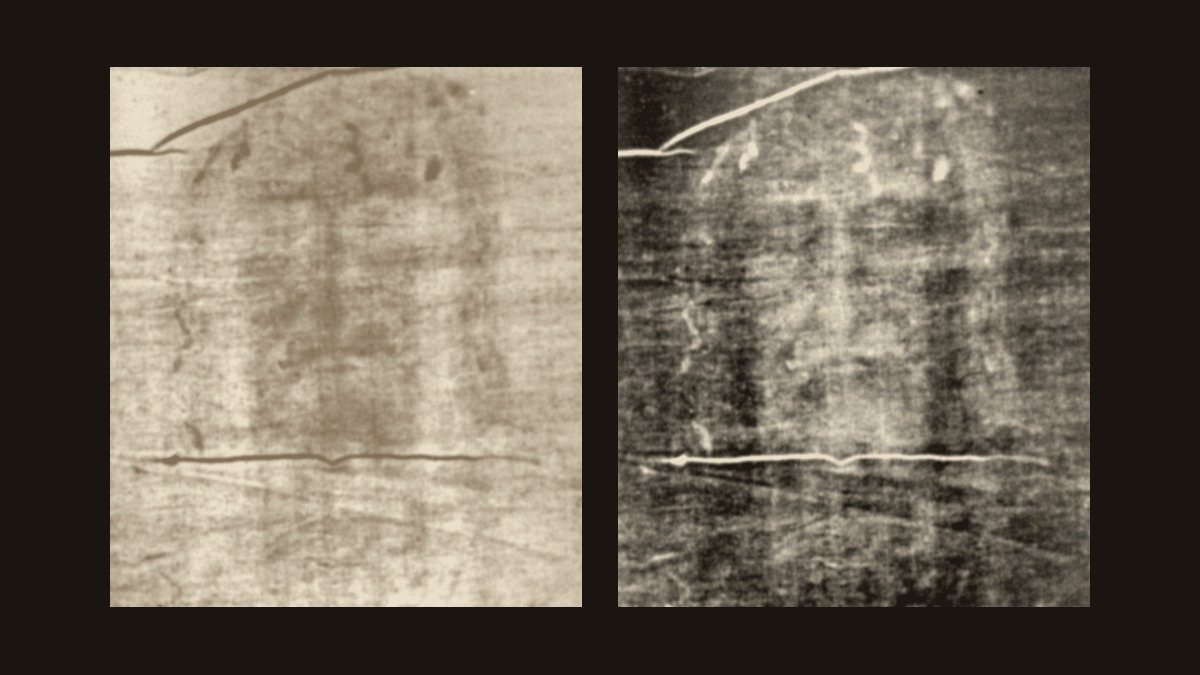
To the naked eye the image is faint, and it is easiest to see from a distance. On 28 May 1898 an Italian lawyer and amateur photographer, Secondo Pia, was allowed to photograph the cloth during a public exhibition. That night, as he developed his glass plates, he saw something no one had seen before. On the negative, where light and dark are reversed, the vague stains became the face of a man, with natural shading, a clear nose, closed eyes and a beard.
The reason is that the image on the cloth is itself a negative. Its light and dark are the reverse of what a viewer would expect, so a photographic negative turns it the right way round. No one could have known this until photography was invented, and no painter in the fourteenth century had any reason to paint a face in reverse, or any way of checking the result.
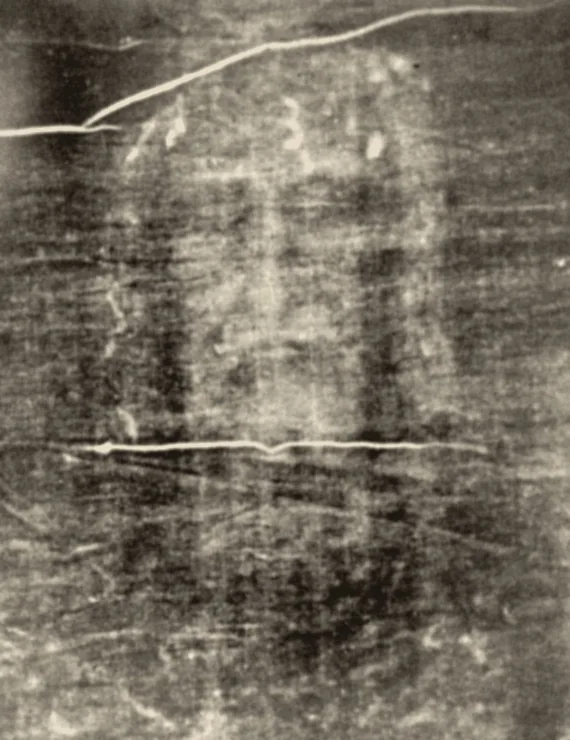
Giuseppe Enrie photographed the cloth again in 1931 with better equipment, and his plates confirmed what Pia had seen. Those photographs began the modern study of the Shroud.
What the Scientists Found
In October 1978 a team of American scientists, the Shroud of Turin Research Project (STURP), was given five days and nights with the cloth. They photographed it in visible, ultraviolet and X-ray light, measured it, and lifted fibres from its surface with sticky tape for chemical study. Their final report of 1981 concluded that the image is that of a real human form of a scourged and crucified man, and said of it: "It is not the product of an artist." The same report admitted that how the image was formed remained a mystery. More than forty years later, it still is.
An image one fibre deep
The image is not soaked into the cloth, as paint or dye would be. It lies only on the topmost fibres of the threads, and where a thread passes under another, the image stops. A 2010 study by Giulio Fanti and colleagues measured the coloured layer on each fibre at about 200 nanometres, a few hundred times thinner than a human hair; the inside of the fibre is untouched. The STURP chemists found no paint, no binding medium and no brush strokes in the image areas, and the image fibres can be cleaned of their colour chemically to leave colourless, undamaged linen. The microscopist Walter McCrone argued from the tape samples that the image was painted in iron oxide; the STURP chemists answered that the iron was spread across the whole cloth, not concentrated in the image, and was far too little to form it.
Distance written in light and dark
In 1976 two of the scientists who later founded STURP, the physicist John Jackson and the aerospace engineer Eric Jumper, put one of Enrie's photographs into a VP-8 Image Analyzer, a device that turns the brightness of an image into height. Ordinary photographs and paintings come out distorted, because their light and dark record how light fell on a subject, not how far away it was. The Shroud came out as a natural relief of a human body. The darkness of the image at each point follows the distance between the cloth and the body beneath it: darker where they touched, fainter where they were farther apart.
Blood first, then the image
The bloodstains are a different thing from the image. STURP's John Heller and Alan Adler found that they contain haemoglobin and give a positive test for serum albumin: they are real blood. Where the blood lies, there is no body image underneath it. When the blood was dissolved away from image areas, the fibres below were clean. The blood was on the cloth before the image formed. A forger would have had to paint the body first and add the blood after; on the Shroud it happened the other way round.
The wounds of a Roman crucifixion
The wounds match what the Gospels record and what is known of Roman crucifixion, in details a medieval artist would not have known. The back, chest and legs carry more than a hundred small dumbbell-shaped marks in groups, the pattern of the Roman flagrum, a whip with weighted tips on its thongs. Blood runs from small punctures all over the scalp, not from a ring around the brow as painters drew a crown of thorns. A large wound in the side has bled. The nail wound that can be seen is at the wrist, where a nail can bear a body's weight, not in the palm, where medieval art placed it. For how crucifixion was carried out, see The Practice of Crucifixion in the Roman Empire.
Then Pilate therefore took Jesus, and scourged him. And the soldiers platted a crown of thorns, and put it on his head, and they put on him a purple robe,
John 19:1-2
KJV
But one of the soldiers with a spear pierced his side, and forthwith came there out blood and water.
John 19:34
KJV
Power No Human Source Has Ever Produced
Since no one has found how the image was made, several teams have tried to make one. The most careful attempt was at ENEA, Italy's national agency for new technologies, where Paolo Di Lazzaro's group spent five years firing ultraviolet laser pulses at linen. In 2011 they reported that very short, very intense bursts of ultraviolet light could give linen a straw-yellow colour confined to the outermost fibres, close to the colour of the Shroud, on patches a few square centimetres across.
Then they calculated what it would take to colour a whole body's outline that way at once. Their answer was about 2,000 megawatts on every square centimetre, over some 17,000 square centimetres: roughly thirty-four thousand billion watts, delivered in a pulse shorter than a billionth of a second. No ultraviolet source ever built can produce that, today or at any time before. If the image was made by light, it was made by a light no human being has ever been able to produce.
The Carbon Date of 1988
The strongest argument against the Shroud is a radiocarbon test. On 21 April 1988 a strip was cut from one corner of the cloth and divided among laboratories at Oxford, Arizona and Zurich. Their joint report in the journal Nature the next February gave a date of AD 1260 to 1390, at 95 per cent confidence. For many people that settled the matter.
It has not stood unchallenged. The whole test rested on one sample from one place: the corner by which the cloth had been held up at exhibitions for centuries, next to the area repaired after the fire. In 2005 Raymond Rogers, a chemist who had led the chemical work for STURP, published a study of threads from that corner. He reported cotton mixed into the linen and a dye found nowhere else on the cloth, and concluded that the sample was not representative of the Shroud. In 2019 Tristan Casabianca and colleagues obtained the laboratories' raw data and found that the measurements were not uniform across the sample, as they should have been if it were one homogeneous piece. The authors were careful to say this does not by itself prove the medieval date wrong, only that the sample cannot be taken as representative of the whole cloth.
In 2022 Liberato De Caro's team in Italy dated a single thread from near the 1988 sample by a different method, measuring the natural breakdown of the linen's cellulose with X-rays. Their result matched a linen sample from the siege of Masada, dated to AD 55–74. One thread is not enough to overturn a carbon date, and the team said more samples are needed. But it shows that the 1988 result is not the only measurement, and the Turin custodians have allowed no new radiocarbon test since. The date stands on a single corner of a cloth that has been burned, handled and repaired for six hundred years.
The Medieval Record
The other pillar of the case against the Shroud is a letter. In 1389 Pierre d'Arcis, Bishop of Troyes, drafted a memorandum to Clement VII, the pope at Avignon, asking him to stop the exhibitions at Lirey. In it he claimed that one of his predecessors had investigated the cloth some thirty years earlier and found the artist who painted it, and that the artist had confessed.
The memorandum survives only as unsigned, undated drafts. The painter is never named, no record of the earlier inquiry survives, and nothing suggests that the bishop or the pope ever saw the cloth. Clement VII allowed the exhibitions to continue, on condition that the cloth be announced as a figure or representation of the burial cloth of Christ. And no confessed painter could have made what STURP found: an image with no paint in it, one fibre deep, encoding distance, laid down after the blood.
Some evidence points earlier than Lirey. A Hungarian manuscript of about 1192–1195, the Pray Codex, shows the burial of Christ and a cloth marked with a pattern of small holes that some researchers match to a set of old burn holes on the Shroud; others read the drawing as an ordinary medieval tomb lid. In the cathedral of Oviedo in Spain, where it has been kept since at least 1075, is a bloodstained cloth called the Sudarium, held to be the napkin of John 20:7. Researchers who have compared the two cloths report that the bloodstains on the Sudarium line up with the face on the Shroud.
The Explanations That Fail
If the Shroud is not the burial cloth of Christ, it has to be something else, and every alternative ever proposed must explain all of the evidence at once: the date, the chemistry, the photography and the wounds. Here are the serious attempts, each in its strongest form.
A medieval work of art
This is the view most skeptics hold. Around 1350, an artist in France makes a burial cloth for devotion or for pilgrims at Lirey, perhaps by draping linen over a low-relief carving and transferring an image with powder or heat. The carbon date fits, and so does the bishop's claim of a confession. A 2025 study by the Brazilian 3D designer Cicero Moraes modelled cloth laid over a full body and over a shallow relief, and found the Shroud's proportions closer to the relief. The International Center of Sindonology in Turin answered that this was known as early as 1902. The image does not wrap around the body as a simple contact print would: its strength follows the straight-line distance from cloth to body, which is itself part of the puzzle.
In outline the theory is plausible. In practice no one has managed it. In 2009 the Italian chemist Luigi Garlaschelli made a life-size copy with red ochre rubbed over linen laid on a volunteer and a bas-relief, then aged with heat and acid. It looks like the Shroud at a glance, but its image is made of pigment, which is exactly what the STURP chemists did not find on the Shroud. After more than a century of trying, with every tool modern science can offer, no one has reproduced the Shroud's image. The theory requires an unnamed fourteenth-century artist to have done what no one since has been able to do, and to have built in a negative that would stay invisible for five hundred years.
Another man crucified in the first century
The Romans crucified thousands, so perhaps the cloth wrapped someone else. But crucified criminals were seldom given a costly linen burial; many were left on the cross or thrown into a common grave. The crown of thorns was not a Roman punishment: it was the soldiers' mockery of one man, who had been called the King of the Jews. This man was scourged, crowned with thorns, nailed, pierced in the side, buried in fine linen and taken out of it within a few days, for the cloth shows no stains of decomposition. Each detail might belong to someone; together they describe one burial in history.
And when they had platted a crown of thorns, they put it upon his head, and a reed in his right hand: and they bowed the knee before him, and mocked him, saying, Hail, King of the Jews!
Matthew 27:29
KJV
Jacques de Molay, the last Grand Master of the Templars
A 1997 book by Christopher Knight and Robert Lomas proposed that the Shroud is the image of Jacques de Molay, tortured by the Inquisition in Paris in 1307, perhaps nailed up in mockery of Christ and then wrapped in a cloth. This fits the carbon date. But no record says he was crucified, and he was burned at the stake in 1314, so there was no body left to bury in a sheet. It also leaves the image exactly as unexplained as before.
Leonardo da Vinci
A 1994 book by Lynn Picknett and Clive Prince proposed that Leonardo da Vinci made the Shroud with an early form of photography, using his own face. Leonardo was born in 1452. The Shroud was being shown to pilgrims at Lirey a century before.
What the Evidence Leaves
Laid side by side, the alternatives sort themselves. Two fall apart as soon as their dates are checked. A different crucified man would have to have suffered, one detail at a time, exactly what the Gospels record of Jesus. The medieval-art theory survives only on the strength of the carbon date and an anonymous confession, and asks us to believe in a forgery that no one in six hundred years has been able to repeat. Each alternative is harder to believe than the one explanation it was meant to replace: that this is the cloth of a man crucified as the Gospels describe, wrapped in linen as the Gospels describe, whose body left on it an image that no human means has been able to make.
The Catholic Church, which owns the cloth, has never declared it authentic. Pope John Paul II called it "a mirror of the Gospel" and left the question of its origin to science. Christians of every tradition may weigh the evidence for themselves.
Blessed Are They That Have Not Seen
The Christian faith has never rested on a cloth. It rests on the testimony of those who saw the risen Christ, and Paul gives their names and their number, more than five hundred at once, most of them still alive when he wrote. If the Shroud were lost tomorrow, the resurrection would stand where it has always stood. For the evidence of the witnesses, see The Resurrection: Its Importance and Evidence.
For I delivered unto you first of all that which I also received, how that Christ died for our sins according to the scriptures; And that he was buried, and that he rose again the third day according to the scriptures: And that he was seen of Cephas, then of the twelve: After that, he was seen of above five hundred brethren at once; of whom the greater part remain unto this present, but some are fallen asleep. After that, he was seen of James; then of all the apostles. And last of all he was seen of me also, as of one born out of due time.
Yet the grave clothes were the first evidence the apostles were given. John saw the linen lying in the empty tomb, and he believed, before he had seen the Lord. If the Shroud of Turin is that linen, it has been doing the same work ever since, silently, for anyone who will look. And the Lord who left it behind has already spoken a blessing over everyone who believes without it.
Jesus saith unto him, Thomas, because thou hast seen me, thou hast believed: blessed are they that have not seen, and yet have believed.
John 20:29
KJV