


John 19:31
Bible text: King James Version (1769 Blayney text) · Public domain
Bible text: King James Version with Strong's numbers · Public domain
Bible text: Berean Standard Bible · Public domain
Bible text: American Standard Version (1901) · Public domain
Bible text: World English Bible, Messianic edition · Public domain
Bible text: Geneva Bible (1599) · Public domain
Bible text: Young's Literal Translation · Public domain
- ΟἱHoi<the>G3588T-NPMDefinite article Nominative Plural Masculine
- οὖνounThereforeG3767CONJConjunction
- ἸουδαῖοιIoudaioithe JewsG2453N-NPM-PGNoun Nominative Plural Masculine Person Gentilic
- ἐπεὶepeisinceG1893CONJConjunction
- παρασκευὴparaskeuē[the] PreparationG3904N-NSFNoun Nominative Singular Feminine
- ἦνēnwasG1510V-IAI-3SVerb Imperfect Active Indicative 3rd Singular
- ἵναinaso thatG2443CONJConjunction
- μὴmēnotG3361PRT-NNegative Particle Negative
- μείνῃmeinēmay remainG3306V-AAS-3SVerb Aorist Active Subjunctive 3rd Singular
- ἐπὶepionG1909PREPPreposition
- τοῦtoutheG3588T-GSMDefinite article Genitive Singular Masculine
- σταυροῦstauroucrossG4716N-GSMNoun Genitive Singular Masculine
- τὰtatheG3588T-NPNDefinite article Nominative Plural Neuter
- σώματαsōmatabodiesG4983N-NPNNoun Nominative Plural Neuter
- ἐνenonG1722PREPPreposition
- τῷtōtheG3588T-DSNDefinite article Dative Singular Neuter
- σαββάτῳsabbatōSabbath —G4521N-DSNNoun Dative Singular Neuter
- ἦνēnwasG1510V-IAI-3SVerb Imperfect Active Indicative 3rd Singular
- γὰρgarforG1063CONJConjunction
- μεγάληmegalēa highG3173A-NSFAdjective Nominative Singular Feminine
- ἡhē<the>G3588T-NSFDefinite article Nominative Singular Feminine
- ἡμέραhēmeradayG2250N-NSFNoun Nominative Singular Feminine
- ἐκείνουekeinouof thatG1565D-GSNDemonstrative pronoun Genitive Singular Neuter
- τοῦtou<the>G3588T-GSNDefinite article Genitive Singular Neuter
- σαββάτουsabbatouSabbath —G4521N-GSNNoun Genitive Singular Neuter
- ἠρώτησανērōtēsanaskedG2065V-AAI-3PVerb Aorist Active Indicative 3rd Plural
- τὸνton<the>G3588T-ASMDefinite article Accusative Singular Masculine
- ΠιλᾶτονPilatonPilateG4091N-ASM-PNoun Accusative Singular Masculine Individual
- ἵναinathatG2443CONJConjunction
- κατεαγῶσινkateagōsinmay be brokenG2608V-2APS-3PVerb 2nd Aorist Passive Subjunctive 3rd Plural
- αὐτῶνautōntheirG846P-GPMPersonal pronoun Genitive Plural Masculine
- τὰta<the>G3588T-APNDefinite article Accusative Plural Neuter
- σκέληskelēlegsG4628N-APNNoun Accusative Plural Neuter
- καὶkaiandG2532CONJConjunction
- ἀρθῶσινarthōsinthey may be taken awayG142V-APS-3PVerb Aorist Passive Subjunctive 3rd Plural
English is a literal word-by-word gloss of the Greek, not the KJV's wording. Why?
This is the original text the KJV's translators worked from — each Greek word with its own literal English meaning in this verse, prepared by scholars at Tyndale House, Cambridge. The KJV translates whole sentences, not word by word, so its wording differs: one Greek word can become several English words, and the KJV may choose “charity” where the gloss reads “love”. Both are faithful — they answer different questions. For the KJV's own rendering, switch to the KJV text.
Details
See on the biblical-era maps
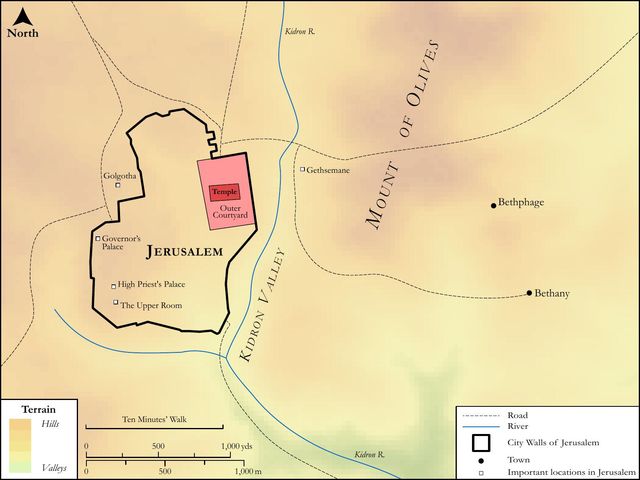
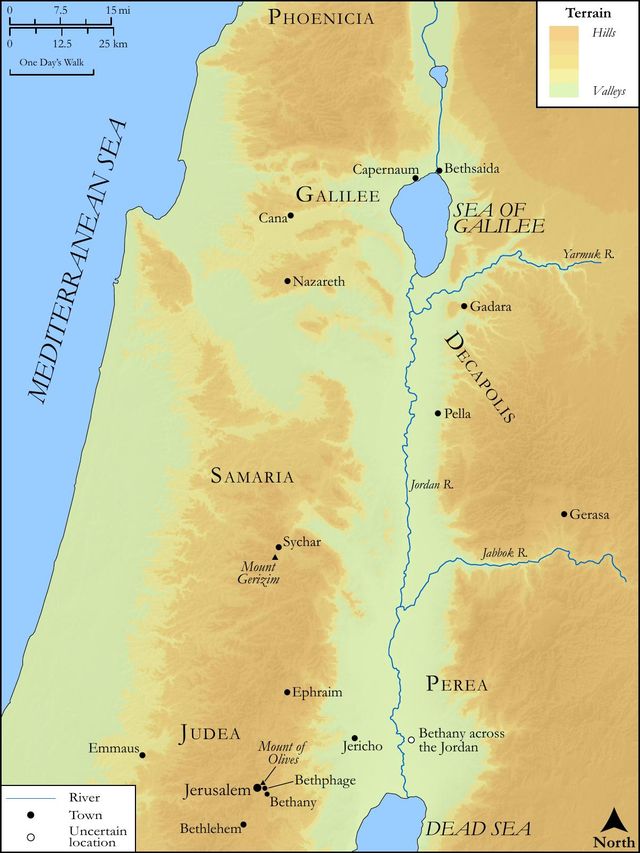
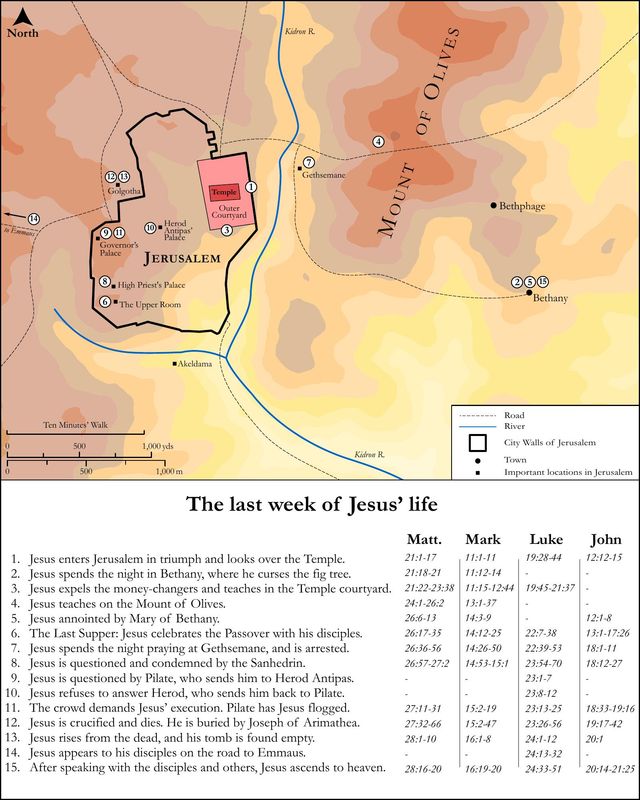
Study this verse
Public-domain commentary
Matthew Henry
From his Commentary on the Whole Bible. Henry comments on passages, not single verses — this entry covers John 19:31–37. His four-level outline is real structure in the source text, so it is rendered as structure.
This passage concerning the piercing of Christ's side after his death is recorded only by this evangelist.
I.Observe the superstition of the Jews, which occasioned it (Joh 19:31):
Because it was the preparation for the sabbath, and that sabbath day, because it fell in the passover-week, was a high day, that they might show a veneration for the sabbath, they would not have the dead bodies to remain on the crosses on the sabbath-day, but besought Pilate that their legs might be broken, which would be a certain, but cruel dispatch, and that then they might be buried out of sight. Note here,
1.The esteem they would be thought to have for the approaching sabbath, because it was one of the days of unleavened bread, and (some reckon) the day of the offering of the first-fruits. Every sabbath day is a holy day, and a good day, but this was a high day, megalē hēmera - a great day. Passover sabbaths are high days; sacrament-days, supper-days, communion-days are high days, and there ought to be more than ordinary preparation for them, that these may be high days indeed to us, as the days of heaven.
2.The reproach which they reckoned it would be to that day if the dead bodies should be left hanging on the crosses. Dead bodies were not to be left at any time (Deu 21:23); yet, in this case, the Jews would have left the Roman custom to take place, had it not been an extraordinary day; and, many strangers from all parts being then at Jerusalem, it would have been an offence to them; nor could they well bear the sight of Christ's crucified body, for, unless their consciences were quite seared, when the heat of their rage was a little over, they would upbraid them.
3.Their petition to Pilate, that their bodies, now as good as dead, might be dispatched; not by strangling or beheading them, which would have been a compassionate hastening of them out of their misery, like the coup de grace (as the French call it) to those that are broken upon the wheel, the stroke of mercy, but by the breaking of their legs, which would carry them off in the most exquisite pain. Note,
(1.)The tender mercies of the wicked are cruel.
(2.)The pretended sanctity of hypocrites is abominable. These Jews would be thought to bear a great regard for the sabbath, and yet had not regard to justice and righteousness; they made no conscience of bringing an innocent and excellent person to the cross, and yet scrupled letting a dead body hang upon the cross.
II.The dispatching of the two thieves that were crucified with him, Joh 19:32.
Pilate was still gratifying the Jews, and gave orders as they desired; and the soldiers came, hardened against all impressions of pity, and broke the legs of the two thieves, which, no doubt, extorted from them hideous outcries, and made them die according to the bloody disposition of Nero, so as to feel themselves die. One of these thieves was a penitent, and had received from Christ an assurance that he should shortly be with him in paradise, and yet died in the same pain and misery that the other thief did; for all things come alike to all. Many go to heaven that have bands in their death, and die in the bitterness of their soul. The extremity of dying agonies is no obstruction to the living comforts that wait for holy souls on the other side death. Christ died, and went to paradise, but appointed a guard to convey him thither. This is the order of going to heaven - Christ, the first-fruits and forerunner, afterwards those that are Christ's.
III.The trial that was made whether Christ was dead or no, and the putting of it out of doubt.
1.They supposed him to be dead, and therefore did not break his legs, Joh 19:33. Observe here,
(1.)That Jesus died in less time than persons crucified ordinarily did. The structure of his body, perhaps, being extraordinarily fine and tender, was the sooner broken by pain; or, rather, it was to show that he laid down his life of himself, and could die when he pleased, though his hands were nailed. Though he yielded to death, yet he was not conquered.
(2.)That his enemies were satisfied he was really dead. The Jews, who stood by to see the execution effectually done, would not have omitted this piece of cruelty, if they had not been sure he was got out of the reach of it.
(3.)Whatever devices are in men's hearts, the counsel of the Lord shall stand. It was fully designed to break his legs, but, God's counsel being otherwise, see how it was prevented.
2.Because they would be sure he was dead they made such an experiment as would put it past dispute. One of the soldiers with a spear pierced his side, aiming at his heart, and forthwith came thereout blood and water, Joh 19:34.
(1.)The soldier hereby designed to decide the question whether he was dead or no, and by this honourable wound in his side to supersede the ignominious method of dispatch they took with the other two. Tradition says that this soldier's name was Longinus, and that, having some distemper in his eyes, he was immediately cured of it, by some drops of blood that flowed out of Christ's side falling on them: significant enough, if we had any good authority for the story.
(2.)But God had a further design herein, which was,
[1.]To give an evidence of the truth of his death, in order to the proof of his resurrection. If he was only in a trance or swoon, his resurrection was a sham; but, by this experiment, he was certainly dead, for this spear broke up the very fountains of life, and, according to all the law and course of nature, it was impossible a human body should survive such a wound as this in the vitals, and such an evacuation thence.
[2.]To give an illustration of the design of his death. There was much of mystery in it, and its being solemnly attested (Joh 19:35) intimates there was something miraculous in it, that the blood and water should come out distinct and separate from the same wound; at least it was very significant; this same apostle refers to it as a very considerable thing, Jo1 5:6, Jo1 5:8.
First, the opening of his side was significant. When we would protest our sincerity, we wish there were a window in our hearts, that the thoughts and intents of them might be visible to all. Through this window, opened in Christ's side, you may look into his heart, and see love flaming there, love strong as death; see our names written there. Some make it an allusion to the opening of Adam's side in innocency. When Christ, the second Adam, was fallen into a deep sleep upon the cross, then was his side opened, and out of it was his church taken, which he espoused to himself. See Eph 5:30, Eph 5:32. Our devout poet, Mr. George Herbert, in his poem called The Bag, very affectingly brings in our Saviour, when his side was pierced, thus speaking to his disciples: -
If ye have any thing to send, or write
(I have no bag, but here is room),
Unto my Father's hands and sight
(Believe me) it shall safely come.
That I shall mind what you impart,
Look, you may put it very near my heart;
Or, if hereafter any of my friends
Will use me in this kind, the door
Shall still be open; what he sends
I will present, and somewhat more,
Not to his hurt. Sighs will convey
Any thing to me. Hark, Despair, away.
Secondly, The blood and water that flowed out of it were significant. 1. They signified the two great benefits which all believers partake of through Christ - justification and sanctification; blood for remission, water for regeneration; blood for atonement, water for purification. Blood and water were used very much under the law. Guilt contracted must be expiated by blood; stains contracted must be done away by the water of purification. These two must always go together. You are sanctified, you are justified, Co1 6:11. Christ has joined them together, and we must not think to put them asunder. They both flowed from the pierced side of our Redeemer. To Christ crucified we owe both merit for our justification, and Spirit and grace for our sanctification; and we have as much need of the latter as of the former, Co1 1:30. 2. They signified the two great ordinances of baptism and the Lord's supper, by which those benefits are represented, sealed, and applied, to believers; they both owe their institution and efficacy to Christ. It is not the water in the font that will be to us the washing of regeneration, but the water out of the side of Christ; not the blood of the grape that will pacify the conscience and refresh the soul, but the blood out of the side of Christ. Now was the rock smitten (Co1 10:4), now was the fountain opened (Zac 13:1), now were the wells of salvation digged, Isa 12:3. Here is the river, the streams whereof make glad the city of our God.
IV.The attestation of the truth of this by an eye-witness (Joh 19:35), the evangelist himself. Observe,
1.What a competent witness he was of the matters of fact.
(1.)What he bore record of he saw; he had it not by hearsay, nor was it only his own conjecture, but he was an eyewitness of it; it is what we have seen and looked upon (Jo1 1:1; Pe2 1:16), and had perfect understanding of, Luk 1:3.
(2.)What he saw he faithfully bore record of; as a faithful witness, he told not only the truth, but the whole truth; and did not only attest it by word of mouth, but left it upon record in writing, in perpetuam rei memoriam - for a perpetual memorial.
(3.)His record is undoubtedly true; for he wrote not only from his own personal knowledge and observation, but from the dictates of the Spirit of truth, that leads into all truth.
(4.)He had himself a full assurance of the truth of what he wrote, and did not persuade others to believe that which he did not believe himself: He knows that he saith true.
(5.)He therefore witnessed these things, that we might believe; he did not record them merely for his own satisfaction or the private use of his friends, but made them public to the world; not to please the curious nor entertain the ingenious, but to draw men to believe the gospel in order to their eternal welfare.
2.What care he showed in this particular instance. That we may be well assured of the truth of Christ's death, he saw his heart's blood, his life's blood, let out; and also of the benefits that flow to us from his death, signified by the blood and water which came out of his side. Let this silence the fears of weak Christians, and encourage their hopes, iniquity shall not be their ruin, for there came both water and blood out of Christ's pierced side, both to justify and sanctify them; and if you ask, How can we be sure of this? You may be sure, for he that saw it bore record.
V.The accomplishment of the scripture in all this (Joh 19:36):
That the scripture might be fulfilled, and so both the honour of the Old Testament preserved and the truth of the New Testament confirmed. Here are two instances of it together: -
1.The scripture was fulfilled in the preserving of his legs from being broken; therein that word was fulfilled, A bone of him shall not be broken.
(1.)There was a promise of this made indeed to all the righteous, but principally pointing at Jesus Christ the righteous (Psa 34:20): He keepeth all his bones, not one of them is broken. And David, in spirit, says, All my bones shall say, Lord, who is like unto thee? Psa 35:10.
(2.)There was a type of this in the paschal lamb, which seems to be specially referred to here (Exo 12:46): Neither shall you break a bone thereof; and it is repeated (Num 9:12), You shall not break any bone of it; for which law the will of the law-maker is the reason, but the antitype must answer the type. Christ our Passover is sacrificed for us, Co1 5:7. He is the Lamb of God (Joh 1:29), and, as the true passover, his bones were kept unbroken. This commandment was given concerning his bones, when dead, as of Joseph's, Heb 11:22.
(3.)There was a significancy in it; the strength of the body is in the bones. The Hebrew word for the bones signifies the strength, and therefore not a bone of Christ must be broken, to show that though he be crucified in weakness his strength to save is not at all broken. Sin breaks our bones, as it broke David's (Psa 51:8); but it did not break Christ's bones; he stood firm under the burden, mighty to save.
2.The scripture was fulfilled in the piercing of his side (Joh 19:37): They shall look on me whom they had pierced; so it is written, Zac 12:10. And there the same that pours out the Spirit of grace, and can be no less than the God of the holy prophets, says, They shall look upon me, which is here applied to Christ, They shall look upon him.
(1.)It is here implied that the Messiah shall be pierced; and here it had a more full accomplishment than in the piercing of his hands and feet; he was pierced by the house of David and the inhabitants of Jerusalem, wounded in the house of his friends, as it follows, Zac 13:6.
(2.)It is promised that when the Spirit is poured out they shall look on him and mourn. This was in part fulfilled when many of those that were his betrayers and murderers were pricked to the heart, and brought to believe in him; it will be further fulfilled, in mercy, when all Israel shall be saved; and, in wrath, when those who persisted in their infidelity shall see him whom they have pierced, and wail because of him, Rev 1:7. But it is applicable to us all. We have all been guilty of piercing the Lord Jesus, and are all concerned with suitable affections to look on him.
Historical interpretation
Nine Centuries of Reception
10 surviving comments on this verse. Each one is dated, so this reads as a timeline rather than a list.
Select a marker to jump to its quote. Markers stagger vertically where authors wrote within a few decades of each other.
He tells us himself clearly enough what he means by "elements," even the rudiments of the law: "Ye observe days, and months, and times, and years" -the sabbaths, I suppose, and "the preparations," and the fasts, and the "high days." For the cessation of even these, no less than of circumcision, was appointed by the Creator's decrees, who had said by Isaiah, "Your new moons, and your sabbaths, and your high days I cannot bear; your fasting, and feasts, and ceremonies my soul hateth; " also by Amos, "I hate, I despise your feast-days, and I will not smell in your solemn assemblies; " and again by Hosea, "I will cause to cease all her mirth, and her feast-days, and her sabbaths, and her new moons, and all her solemn assemblies.
What do they [i.e., the Jews] take it to mean when it says, “For six consecutive days you shall gather. On the sixth day, however, you shall gather double”? It appears that that day that is placed before the sabbath is called the sixth day, which we call the Day of Preparation.
But the Jews, on the other hand, who swallowed the camel and strained at the gnat, having wrought so atrocious a deed, are very precise concerning the day. "Because it was the Preparation, that the bodies should not remain upon the cross - they besought Pilate that their legs might be broken." Seest thou how strong a thing is truth? By means of the very things which are the objects of their zeal, prophecy is fulfilled, for by occasion of those things, this plain prediction, unconnected with them, receives its accomplishment. For the soldiers when they came, brake the legs of the others, but not those of Christ. Yet these to gratify the Jews pierced His side with a spear, and now insulted the dead body. O abominable and accursed purpose! Yet, beloved, be not thou confounded, be not thou desponding; for the things which these men did from a wicked will, fought on the side of the truth. Since there was a prophecy, saying, (from this circumstance, "They shall look on Him whom they pierced." (Zech. xii. 10.) And not this only, but the deed then dared was a demonstration of the faith, to those who should afterwards disbelieve; as to Thomas, and those like him. With this too an ineffable mystery was accomplished. For "there came forth water and blood." Not without a purpose, or by chance, did those founts come forth, but because by means of these two together the Church consisteth. And the initiated know it, being by water indeed regenerate, and nourished by the Blood and the Flesh. Hence the Mysteries take their beginning; that when thou approachest to that awful cup, thou mayest so approach, as drinking from the very side.
"And he that saw it bare record, and his record is true." That is, "I heard it not from others, but was myself present and saw it, and the testimony is true." As may be supposed. For he relates an insult done; he relates not anything great and admirable, that thou shouldest suspect his narrative; but securing the mouths of heretics, and loudly proclaiming beforehand the Mysteries that should be, and beholding the treasure laid up in them, he is very exact concerning what took place. And that prophecy also is fulfilled, "A bone of Him shall not be broken." (Ex. xii. 46; Num. ix. 12.) For even if this was said with reference to the lamb of the Jews, still it was for the sake of the reality that the type preceded, and in Him the prophecy was more fully accomplished. On this account the Evangelist brought forward the Prophet. For since by continually producing himself as witness he would have seemed unworthy of credit, he brings Moses to help him, and saith, that neither did this come to pass without a purpose, but was written before of old. And this is the meaning of the words, "A bone of Him shall not be broken." Again he confirms the Prophet's words by his own witness. "These things," saith he, "I have told you, that ye might learn that great is the connection of the type with the reality." Seest thou what pains he takes to make that believed which seemed to be matter of reproach, and bringing shame? For that the soldier should insult even the dead body, was far worse than being crucified. "But still, even these things," he saith, "I have told, and told with much earnestness, 'that ye might believe.' Let none then be unbelieving, nor through shame injure our cause. For the things which appear to be most shameful, are the very venerable records of our good things."
(Hom. lxxxv) The Jews who strained at a gnat and swallowed a camel, after their audacious wickedness, reason scrupulously about the day: The Jews therefore because it was the preparation, that the bodies should not remain upon the cross on the sabbath.
(Hom. lxxxv. 3) How forcible is truth: their own devices it is that accomplish the fulfilment of prophecy: Then came the soldiers and brake the legs of the first, and of the other which was crucified with Him. But when they came to Jesus, and saw that He was dead already, they brake not His legs: but one of the soldiers with a spear pierced His side.
(Hom. lxxxv) This being the source whence the holy mysteries are derived, when thou approachest the awful cup, approach it as if thou wert about to drink out of Christ's side.
(Hom. lxxxv. 3) As if to say, I did not hear it from others, but saw it with mine own eyes. And his record is true, he adds, not as if he had mentioned something so wonderful that his account would be suspected, but to stop the mouths of heretics, and in contemplation of the deep value of those mysteries which he announces.
And he knoweth that he saith true, that ye might believe.
After that the Lord Jesus had accomplished all that He foreknew required accomplishment before His death, and had, when it pleased Himself, given up the ghost, what followed thereafter, as related by the evangelist, let us now consider. "The Jews therefore," he says, "because it was the preparation (parasceve), that the bodies should not remain upon the cross on the Sabbath-day (for that Sabbath-day was an high day), besought Pilate that their legs might be broken, and that they might be taken away." Not that their legs might be taken away, but the persons themselves whose legs were broken for the purpose of effecting their death, and permitting them to be detached from the tree, lest their continuing to hang on the crosses should defile the great festal day by the horrible spectacle of their day-long torments.
(Tr. cxx) Not in order to take away the legs, but to cause death, that they might be taken down from the cross, and the feast clay not be defiled by the sight of such horrid torments.
It is not with the motive of testifying to the reverence for holy days felt by men inured to shed blood with brutal ferocity, and found guilty of so monstrous an iniquity, that the blessed Evangelist says this; but rather from the wish to show that, in their gross stupidity, they committed that folly of which Christ spoke. For they strained out the gnat while they swallowed the camel; for they are found to reckon as of no account at all the most outrageous and awful of all crimes against God, while they exercised the greatest diligence with reference to the most paltry and insignificant matters, showing their folly in either case. The proof of this is not far to seek. For, behold, in the very act of putting Christ to death, they put great store on the respect due to the Sabbath; and, while they insulted the Lawgiver by outrages which surpass description, they parade their reverence of the Law; and, as that Sabbath was a high day, they affect to pay honour to it----the very men who destroyed the Lord of the high day; and they ask a favour, which well suited their cruel spirit. For they besought Pilate that their legs might be broken, wishing to embitter, by this last intolerable outrage, the pangs of approaching death, to those who were already in agony.
Parasceve is interpreted as preparation.… They called it this as the day when it was necessary that they prepare for the sabbath according to the command they had received concerning the manna, “On the sixth day you shall gather double, etc.” … Therefore, because it was on the sixth day that human beings were made and the whole creation of the world completed, but on the seventh day it was required that he rested from his work and this is the sabbath, that is, rest—so it is only right to call that the day on which our Lord was crucified the sixth day fulfilling the reparation of humanity back to what it was at the beginning. [And we read], “And when he received the strong drink, he said ‘It is finished,’ ” that is, the work of the sixth day is perfect as I have totally accomplished the restoration of the world. But on the sabbath he rests in the sepulcher awaiting the event of the resurrection, which will occur on the eight day.
Parasceue, i. e. preparation: the sixth day was so called because the children of Israel prepared twice the number of loaves on that day. For that sabbath day was an high day, i. e. on account of the feast of the passover.
Besought Pilate that their legs might be broken.
Our Lord gave up His ghost to God the Father, showing that the souls of the saints do not remain in the tomb, but go into the hand of the Father of all; while sinners are reserved for the place of punishment, i. e. hell.
For it was commanded in the Law that the sun should not set on the punishment of any one; or they were unwilling to appear tormentors and homicides on a feast day.
Continue studying John 19:31 across the web’s major study libraries — every link below opens this exact verse, chapter, or book on the destination site.
Read & Compare
 BibleGatewayThis verse in more than 200 translations and 70 languages.
 Bible.comThe YouVersion reader — hundreds of translations, reading plans, and highlights.
 ESV.orgCrossway's official English Standard Version reader.
 NET BibleThe NET translation with 60,000+ translators' notes on every rendering decision.
 STEP BibleTyndale House's free study tool — original text, vocabulary, and scholarly resources.
 BibliaLogos Bible Software's free web reader.
 USCCBThe New American Bible (Revised Edition) with the U.S. bishops' study notes.
Commentaries
 BibleHub CommentariesDozens of classic commentaries on this verse, gathered on one page.
 StudyLightMore than 100 commentary sets — the largest collection on the web.
 BibleRefPlain-English commentary on what this verse means, verse by verse.
 Enduring WordDavid Guzik's free commentary on this chapter, widely used by Bible teachers.
 Bible Study ToolsVerse commentary alongside Greek and Hebrew study aids.
Original Language & Research
- BibleHub InterlinearThe verse word by word — original language, transliteration, and English.
- BibleHub LexiconEvery word's original-language definition and Strong's entry.
 Blue Letter BibleDeep-study tools — Strong's numbers, concordance, and word studies.
 CNTR CollationThe earliest Greek manuscripts of this verse, collated letter by letter.
Sermons, Hymns & Audio


TrulyRandomVerse is not affiliated with these sites and doesn’t control their content. They’re linked because they’re genuinely useful.
Summary
John 19:31 meticulously details the urgent request made by the Jewish leaders to Pontius Pilate, seeking to expedite the deaths of the crucified individuals, including Jesus, and remove their bodies from the crosses before the impending Sabbath. This urgency stemmed from the fact that the Sabbath approaching was not merely a regular weekly day of rest but a "high day," a particularly sacred occasion coinciding with the Passover feast, which necessitated strict adherence to the Mosaic Law regarding defilement and burial.
Context
ShowHideLiterary Context
This verse immediately follows Jesus' declaration, "It is finished!, and His subsequent death on the cross (John 19:30). The narrative flow in John's Gospel emphasizes the precise timing and fulfillment of prophecy surrounding Jesus' crucifixion. The request to Pilate in John 19:31 sets the stage for the soldiers' actions in John 19:32-37, particularly the piercing of Jesus' side and the notable fact that His legs were not broken, which is crucial for understanding the theological implications discussed later. The preceding verses (John 19:28-29) highlight Jesus' conscious control over His final moments, indicating His death was not merely a consequence of Roman brutality but a divinely orchestrated event.
Historical & Cultural Context
The "preparation" (Greek: paraskeuē) refers to Friday, the day before the weekly Sabbath, during which all necessary work and preparations for the Sabbath were completed. In this specific instance, the Sabbath was an "high day" (Greek: megale hemera), signifying its extraordinary importance. This was because it was not only the regular weekly Sabbath but also the first day of the Feast of Unleavened Bread, which immediately followed the Passover meal, making it a uniquely solemn and sacred occasion in the Jewish calendar. Jewish law, particularly as stipulated in Deuteronomy 21:22-23, explicitly forbade a body from remaining exposed overnight on a tree or cross, as it was considered a defilement of the land, especially on a holy day. The Roman practice of crucifixion often involved victims lingering for days, so the request to "break their legs" (Latin: crurifragium) was a common, albeit brutal, method to hasten death by preventing the victim from pushing up to breathe, leading to asphyxiation.
Key Themes
ShowHideThis verse powerfully contributes to several overarching themes within John's Gospel and the broader biblical narrative. Firstly, it underscores the legalism and hypocrisy of the Jewish leaders, who meticulously adhered to ceremonial purity laws (avoiding Sabbath defilement) while simultaneously having just orchestrated the profound injustice of condemning and crucifying an innocent man, the Son of God. Their concern for ritual cleanliness overshadowed any moral or spiritual discernment regarding Jesus' identity or mission. Secondly, the verse highlights divine sovereignty and the fulfillment of prophecy. Despite human intentions (to avoid defiling the Sabbath), the timing of Jesus' death and the subsequent actions of the soldiers unwittingly served to fulfill Old Testament prophecies concerning the Messiah, particularly that "not one of his bones will be broken" (Psalm 34:20). The urgency of the "high day" thus became an instrument in God's precise plan for redemption.
Exposition and Analysis
ShowHideKey Word Analysis
ShowHideDerived from a verb meaning "to prepare," this term specifically refers to the day before the Sabbath, Friday, when all necessary work was completed to observe the Sabbath rest. In this context, it emphasizes the Jewish religious calendar's strictures and the urgency it imposed on the crucifixion events.
This adjective, meaning "great" or "large," when applied to "day" (Greek, hēméra), signifies a Sabbath of exceptional importance. It indicates that this particular Sabbath was more than just a weekly day of rest; it was a festival Sabbath, specifically the first day of the Feast of Unleavened Bread, which immediately followed the Passover. This heightened sanctity intensified the imperative to remove the bodies.
This verb means "to break in pieces" or "to shatter." In the context of crucifixion, crurifragium (leg-breaking) was a Roman method used to accelerate death. By shattering the legs, the crucified person could no longer push themselves up to alleviate the strain on their diaphragm, leading to rapid asphyxiation. The request reflects the desire to ensure death before the Sabbath began.
Verse Breakdown
ShowHide"The Jews therefore, because it was the preparation"
This clause establishes the identity of those making the request to Pilate—the Jewish leaders—and the immediate temporal context. The "preparation" day (Friday) was the critical factor driving their actions, as it preceded the holy Sabbath.
"that the bodies should not remain upon the cross on the sabbath day"
This explains the primary motivation behind their request. According to Jewish law (Deuteronomy 21:22-23), bodies of executed criminals were not to remain exposed overnight, especially not on a Sabbath, as this would defile the land and the holy day.
"(for that sabbath day was an high day)"
This parenthetical explanation underscores the extraordinary sanctity of this particular Sabbath. It was not just a weekly Sabbath but a "high day," signifying its convergence with a major feast (Passover/Unleavened Bread), which amplified the urgency and religious imperative for the bodies' removal.
"besought Pilate that their legs might be broken, and that they might be taken away"
This details the specific request made to the Roman governor. "Breaking their legs" (crurifragium) was a brutal but effective method to hasten death, ensuring the victims would expire before sundown. "Taken away" refers to the subsequent removal of the bodies for burial, preventing the defilement of the Sabbath.
Literary Devices
ShowHideThe passage employs several significant literary devices. Irony is prominent, as the Jewish leaders, who meticulously observe the ceremonial law to avoid defiling a "high day," are simultaneously deeply implicated in the unjust execution of the Messiah, the very embodiment of holiness. Their concern for external purity starkly contrasts with their profound moral and spiritual blindness. There is also a strong element of foreshadowing and divine orchestration. Although the leaders' request is driven by their adherence to the law, their actions inadvertently set the stage for the fulfillment of Old Testament prophecy regarding Jesus' bones not being broken (Psalm 34:20), which is revealed in the subsequent verses. This highlights God's sovereign control over even the seemingly mundane or malevolent actions of humanity, turning them to His redemptive purposes.
Theological and Thematic Connections
ShowHideJohn 19:31 serves as a poignant illustration of the tension between legalistic adherence to the letter of the law and the spirit of true righteousness and mercy. The Jewish leaders' scrupulous concern for ceremonial purity regarding the Sabbath, even in the midst of orchestrating the crucifixion of an innocent man, exposes a profound spiritual blindness and hypocrisy. Their focus was on external ritual and avoiding defilement, rather than on the profound moral and theological implications of their actions against Jesus. This passage also powerfully underscores God's meticulous sovereignty, demonstrating how human intentions, even those driven by religious custom or malice, are ultimately woven into the fabric of His divine plan for redemption, leading to the precise fulfillment of prophecy concerning the Messiah.
Reflection and Application
ShowHideThis verse offers a profound opportunity for self-reflection on our own spiritual priorities. The Jewish leaders, in their zealous adherence to the law, tragically missed the very heart of God's redemptive plan standing before them. They were so focused on avoiding ceremonial defilement that they committed the ultimate spiritual defilement by rejecting and crucifying the Son of God. This serves as a powerful caution against prioritizing external rituals, traditions, or even legalistic interpretations of scripture over genuine love for God, compassion for others, and a true understanding of God's character and mission. For believers today, it challenges us to examine whether our religious practices are truly flowing from a transformed heart or if they risk becoming a superficial performance that blinds us to deeper spiritual truths and the needs of those around us. Furthermore, the divine orchestration evident in this passage reminds us that even in the darkest moments of human sin and injustice, God remains sovereign, working all things together for His ultimate purposes.
Questions for Reflection
ShowHideFAQ
ShowHideWhy was this Sabbath considered a "high day," and what was its significance?
ShowHideThis Sabbath was considered a "high day" (Greek: megale hemera) because it was not merely the regular weekly Sabbath but also coincided with the first day of the Feast of Unleavened Bread, which immediately followed the Passover meal. This convergence made it an exceptionally sacred and solemn day in the Jewish calendar, necessitating stricter adherence to the Mosaic Law, particularly the command in Deuteronomy 21:22-23 that bodies of executed criminals should not remain exposed overnight, as it would defile the land and the holy day. The urgency to remove the bodies before sundown, when the Sabbath officially began, was therefore paramount for the Jewish leaders.
Christ-Centered Fulfillment
ShowHideJohn 19:31, though seemingly focused on Jewish legal customs, profoundly points to Christ and His redemptive work. The urgency of the "high day" Sabbath and the subsequent request to break the legs of the crucified, while driven by human religious law, became an unwitting instrument in God's sovereign plan to fulfill Old Testament prophecies concerning the Messiah. The fact that Jesus had already voluntarily yielded His spirit (John 19:30) meant that when the soldiers arrived to break legs, they found Him already dead (John 19:33). This preserved Jesus' body from having any bones broken, directly fulfilling the prophecy in Psalm 34:20 and echoing the Passover lamb, of which no bone was to be broken (Exodus 12:46). Thus, the very legalistic concerns of the Jewish leaders inadvertently ensured the precise fulfillment of messianic prophecy, underscoring that Jesus' death was not an accidental tragedy but a divinely orchestrated sacrifice, the ultimate Passover Lamb whose blood cleanses from all sin (1 Peter 1:18-19).