


John 19:36
Bible text: King James Version (1769 Blayney text) · Public domain
Bible text: Berean Standard Bible · Public domain
Bible text: American Standard Version (1901) · Public domain
Bible text: World English Bible, Messianic edition · Public domain
Bible text: Geneva Bible (1599) · Public domain
Bible text: Young's Literal Translation · Public domain
- ἐγένετοegenetoTook placeG1096V-2ADI-3SVerb 2nd Aorist Middle Deponent Indicative 3rd Singular
- γὰρgarforG1063CONJConjunction
- ταῦταtautathese thingsG3778D-NPNDemonstrative pronoun Nominative Plural Neuter
- ἵναinaso thatG2443CONJConjunction
- ἡhētheG3588T-NSFDefinite article Nominative Singular Feminine
- γραφὴgraphēScriptureG1124N-NSFNoun Nominative Singular Feminine
- πληρωθῇ·plērōthēamay be fulfilledG4137V-APS-3SVerb Aorist Passive Subjunctive 3rd Singular
- ὀστοῦνostounBoneG3747N-NSNNoun Nominative Singular Neuter
- οὐounot oneG3756PRT-NNegative Particle Negative
- συντριβήσεταιsuntribēsetaiwill be brokenG4937V-2FPI-3SVerb 2nd Future Passive Indicative 3rd Singular
- αὐτοῦautouof HimG846P-GSMPersonal pronoun Genitive Singular Masculine
English is a literal word-by-word gloss of the Greek, not the KJV's wording. Why?
This is the original text the KJV's translators worked from — each Greek word with its own literal English meaning in this verse, prepared by scholars at Tyndale House, Cambridge. The KJV translates whole sentences, not word by word, so its wording differs: one Greek word can become several English words, and the KJV may choose “charity” where the gloss reads “love”. Both are faithful — they answer different questions. For the KJV's own rendering, switch to the KJV text.
Details
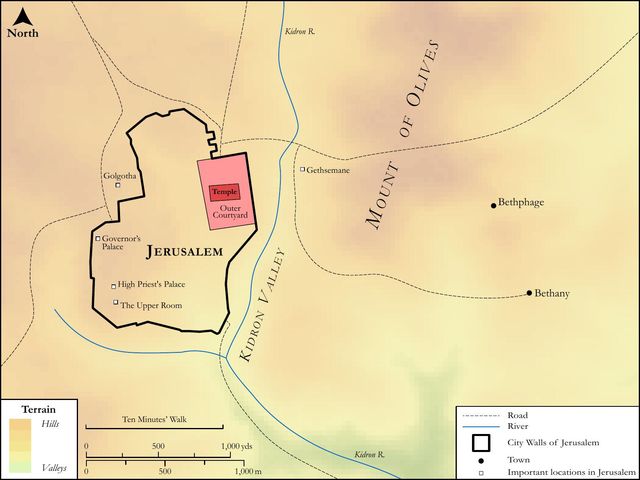
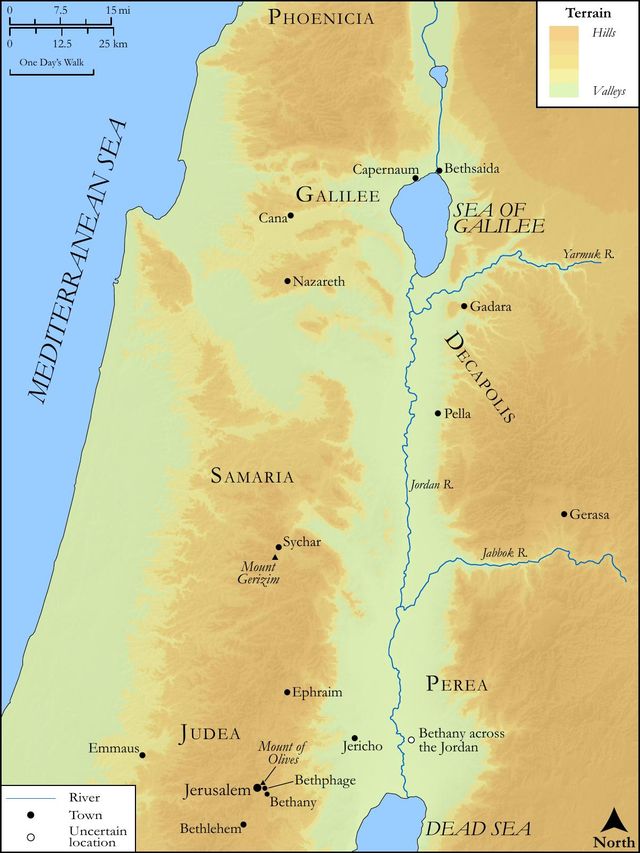
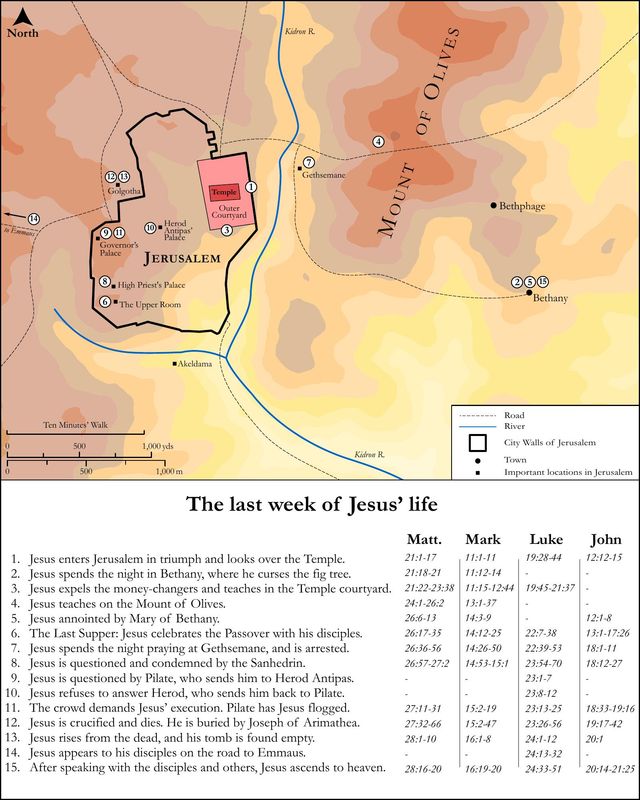
See on the biblical-era maps
Study this verse
Public-domain commentary
Matthew Henry
From his Commentary on the Whole Bible. Henry comments on passages, not single verses — this entry covers John 19:31–37. His four-level outline is real structure in the source text, so it is rendered as structure.
This passage concerning the piercing of Christ's side after his death is recorded only by this evangelist.
I.Observe the superstition of the Jews, which occasioned it (Joh 19:31):
Because it was the preparation for the sabbath, and that sabbath day, because it fell in the passover-week, was a high day, that they might show a veneration for the sabbath, they would not have the dead bodies to remain on the crosses on the sabbath-day, but besought Pilate that their legs might be broken, which would be a certain, but cruel dispatch, and that then they might be buried out of sight. Note here,
1.The esteem they would be thought to have for the approaching sabbath, because it was one of the days of unleavened bread, and (some reckon) the day of the offering of the first-fruits. Every sabbath day is a holy day, and a good day, but this was a high day, megalē hēmera - a great day. Passover sabbaths are high days; sacrament-days, supper-days, communion-days are high days, and there ought to be more than ordinary preparation for them, that these may be high days indeed to us, as the days of heaven.
2.The reproach which they reckoned it would be to that day if the dead bodies should be left hanging on the crosses. Dead bodies were not to be left at any time (Deu 21:23); yet, in this case, the Jews would have left the Roman custom to take place, had it not been an extraordinary day; and, many strangers from all parts being then at Jerusalem, it would have been an offence to them; nor could they well bear the sight of Christ's crucified body, for, unless their consciences were quite seared, when the heat of their rage was a little over, they would upbraid them.
3.Their petition to Pilate, that their bodies, now as good as dead, might be dispatched; not by strangling or beheading them, which would have been a compassionate hastening of them out of their misery, like the coup de grace (as the French call it) to those that are broken upon the wheel, the stroke of mercy, but by the breaking of their legs, which would carry them off in the most exquisite pain. Note,
(1.)The tender mercies of the wicked are cruel.
(2.)The pretended sanctity of hypocrites is abominable. These Jews would be thought to bear a great regard for the sabbath, and yet had not regard to justice and righteousness; they made no conscience of bringing an innocent and excellent person to the cross, and yet scrupled letting a dead body hang upon the cross.
II.The dispatching of the two thieves that were crucified with him, Joh 19:32.
Pilate was still gratifying the Jews, and gave orders as they desired; and the soldiers came, hardened against all impressions of pity, and broke the legs of the two thieves, which, no doubt, extorted from them hideous outcries, and made them die according to the bloody disposition of Nero, so as to feel themselves die. One of these thieves was a penitent, and had received from Christ an assurance that he should shortly be with him in paradise, and yet died in the same pain and misery that the other thief did; for all things come alike to all. Many go to heaven that have bands in their death, and die in the bitterness of their soul. The extremity of dying agonies is no obstruction to the living comforts that wait for holy souls on the other side death. Christ died, and went to paradise, but appointed a guard to convey him thither. This is the order of going to heaven - Christ, the first-fruits and forerunner, afterwards those that are Christ's.
III.The trial that was made whether Christ was dead or no, and the putting of it out of doubt.
1.They supposed him to be dead, and therefore did not break his legs, Joh 19:33. Observe here,
(1.)That Jesus died in less time than persons crucified ordinarily did. The structure of his body, perhaps, being extraordinarily fine and tender, was the sooner broken by pain; or, rather, it was to show that he laid down his life of himself, and could die when he pleased, though his hands were nailed. Though he yielded to death, yet he was not conquered.
(2.)That his enemies were satisfied he was really dead. The Jews, who stood by to see the execution effectually done, would not have omitted this piece of cruelty, if they had not been sure he was got out of the reach of it.
(3.)Whatever devices are in men's hearts, the counsel of the Lord shall stand. It was fully designed to break his legs, but, God's counsel being otherwise, see how it was prevented.
2.Because they would be sure he was dead they made such an experiment as would put it past dispute. One of the soldiers with a spear pierced his side, aiming at his heart, and forthwith came thereout blood and water, Joh 19:34.
(1.)The soldier hereby designed to decide the question whether he was dead or no, and by this honourable wound in his side to supersede the ignominious method of dispatch they took with the other two. Tradition says that this soldier's name was Longinus, and that, having some distemper in his eyes, he was immediately cured of it, by some drops of blood that flowed out of Christ's side falling on them: significant enough, if we had any good authority for the story.
(2.)But God had a further design herein, which was,
[1.]To give an evidence of the truth of his death, in order to the proof of his resurrection. If he was only in a trance or swoon, his resurrection was a sham; but, by this experiment, he was certainly dead, for this spear broke up the very fountains of life, and, according to all the law and course of nature, it was impossible a human body should survive such a wound as this in the vitals, and such an evacuation thence.
[2.]To give an illustration of the design of his death. There was much of mystery in it, and its being solemnly attested (Joh 19:35) intimates there was something miraculous in it, that the blood and water should come out distinct and separate from the same wound; at least it was very significant; this same apostle refers to it as a very considerable thing, Jo1 5:6, Jo1 5:8.
First, the opening of his side was significant. When we would protest our sincerity, we wish there were a window in our hearts, that the thoughts and intents of them might be visible to all. Through this window, opened in Christ's side, you may look into his heart, and see love flaming there, love strong as death; see our names written there. Some make it an allusion to the opening of Adam's side in innocency. When Christ, the second Adam, was fallen into a deep sleep upon the cross, then was his side opened, and out of it was his church taken, which he espoused to himself. See Eph 5:30, Eph 5:32. Our devout poet, Mr. George Herbert, in his poem called The Bag, very affectingly brings in our Saviour, when his side was pierced, thus speaking to his disciples: -
If ye have any thing to send, or write
(I have no bag, but here is room),
Unto my Father's hands and sight
(Believe me) it shall safely come.
That I shall mind what you impart,
Look, you may put it very near my heart;
Or, if hereafter any of my friends
Will use me in this kind, the door
Shall still be open; what he sends
I will present, and somewhat more,
Not to his hurt. Sighs will convey
Any thing to me. Hark, Despair, away.
Secondly, The blood and water that flowed out of it were significant. 1. They signified the two great benefits which all believers partake of through Christ - justification and sanctification; blood for remission, water for regeneration; blood for atonement, water for purification. Blood and water were used very much under the law. Guilt contracted must be expiated by blood; stains contracted must be done away by the water of purification. These two must always go together. You are sanctified, you are justified, Co1 6:11. Christ has joined them together, and we must not think to put them asunder. They both flowed from the pierced side of our Redeemer. To Christ crucified we owe both merit for our justification, and Spirit and grace for our sanctification; and we have as much need of the latter as of the former, Co1 1:30. 2. They signified the two great ordinances of baptism and the Lord's supper, by which those benefits are represented, sealed, and applied, to believers; they both owe their institution and efficacy to Christ. It is not the water in the font that will be to us the washing of regeneration, but the water out of the side of Christ; not the blood of the grape that will pacify the conscience and refresh the soul, but the blood out of the side of Christ. Now was the rock smitten (Co1 10:4), now was the fountain opened (Zac 13:1), now were the wells of salvation digged, Isa 12:3. Here is the river, the streams whereof make glad the city of our God.
IV.The attestation of the truth of this by an eye-witness (Joh 19:35), the evangelist himself. Observe,
1.What a competent witness he was of the matters of fact.
(1.)What he bore record of he saw; he had it not by hearsay, nor was it only his own conjecture, but he was an eyewitness of it; it is what we have seen and looked upon (Jo1 1:1; Pe2 1:16), and had perfect understanding of, Luk 1:3.
(2.)What he saw he faithfully bore record of; as a faithful witness, he told not only the truth, but the whole truth; and did not only attest it by word of mouth, but left it upon record in writing, in perpetuam rei memoriam - for a perpetual memorial.
(3.)His record is undoubtedly true; for he wrote not only from his own personal knowledge and observation, but from the dictates of the Spirit of truth, that leads into all truth.
(4.)He had himself a full assurance of the truth of what he wrote, and did not persuade others to believe that which he did not believe himself: He knows that he saith true.
(5.)He therefore witnessed these things, that we might believe; he did not record them merely for his own satisfaction or the private use of his friends, but made them public to the world; not to please the curious nor entertain the ingenious, but to draw men to believe the gospel in order to their eternal welfare.
2.What care he showed in this particular instance. That we may be well assured of the truth of Christ's death, he saw his heart's blood, his life's blood, let out; and also of the benefits that flow to us from his death, signified by the blood and water which came out of his side. Let this silence the fears of weak Christians, and encourage their hopes, iniquity shall not be their ruin, for there came both water and blood out of Christ's pierced side, both to justify and sanctify them; and if you ask, How can we be sure of this? You may be sure, for he that saw it bore record.
V.The accomplishment of the scripture in all this (Joh 19:36):
That the scripture might be fulfilled, and so both the honour of the Old Testament preserved and the truth of the New Testament confirmed. Here are two instances of it together: -
1.The scripture was fulfilled in the preserving of his legs from being broken; therein that word was fulfilled, A bone of him shall not be broken.
(1.)There was a promise of this made indeed to all the righteous, but principally pointing at Jesus Christ the righteous (Psa 34:20): He keepeth all his bones, not one of them is broken. And David, in spirit, says, All my bones shall say, Lord, who is like unto thee? Psa 35:10.
(2.)There was a type of this in the paschal lamb, which seems to be specially referred to here (Exo 12:46): Neither shall you break a bone thereof; and it is repeated (Num 9:12), You shall not break any bone of it; for which law the will of the law-maker is the reason, but the antitype must answer the type. Christ our Passover is sacrificed for us, Co1 5:7. He is the Lamb of God (Joh 1:29), and, as the true passover, his bones were kept unbroken. This commandment was given concerning his bones, when dead, as of Joseph's, Heb 11:22.
(3.)There was a significancy in it; the strength of the body is in the bones. The Hebrew word for the bones signifies the strength, and therefore not a bone of Christ must be broken, to show that though he be crucified in weakness his strength to save is not at all broken. Sin breaks our bones, as it broke David's (Psa 51:8); but it did not break Christ's bones; he stood firm under the burden, mighty to save.
2.The scripture was fulfilled in the piercing of his side (Joh 19:37): They shall look on me whom they had pierced; so it is written, Zac 12:10. And there the same that pours out the Spirit of grace, and can be no less than the God of the holy prophets, says, They shall look upon me, which is here applied to Christ, They shall look upon him.
(1.)It is here implied that the Messiah shall be pierced; and here it had a more full accomplishment than in the piercing of his hands and feet; he was pierced by the house of David and the inhabitants of Jerusalem, wounded in the house of his friends, as it follows, Zac 13:6.
(2.)It is promised that when the Spirit is poured out they shall look on him and mourn. This was in part fulfilled when many of those that were his betrayers and murderers were pricked to the heart, and brought to believe in him; it will be further fulfilled, in mercy, when all Israel shall be saved; and, in wrath, when those who persisted in their infidelity shall see him whom they have pierced, and wail because of him, Rev 1:7. But it is applicable to us all. We have all been guilty of piercing the Lord Jesus, and are all concerned with suitable affections to look on him.
Historical interpretation
Historical reception
7 surviving comments on this verse. Each one is dated, so this reads as a timeline rather than a list.
Select a marker to jump to its quote. Markers stagger vertically where authors wrote within a few decades of each other.
Therefore, because He had laid down His life while fastened to the cross, His executioners did not think it necessary to break His bones (as was their prevailing custom), but they only pierced His side. Thus His unbroken body was taken down from the cross, and carefully enclosed in a tomb. Now all these things were done lest His body, being injured and broken, should be rendered unsuitable for rising again. That also was a principal cause why God chose the cross, because it was necessary that He should be lifted up on it, and the passion of God become known to all nations. For since he who is suspended upon a cross is both conspicuous to all and higher than others, the cross was especially chosen, which might signify that He would be so conspicuous, and so raised on high, that all nations from the whole world should meet together at once to know and worship Him.
But the Jews, on the other hand, who swallowed the camel and strained at the gnat, having wrought so atrocious a deed, are very precise concerning the day. "Because it was the Preparation, that the bodies should not remain upon the cross - they besought Pilate that their legs might be broken." Seest thou how strong a thing is truth? By means of the very things which are the objects of their zeal, prophecy is fulfilled, for by occasion of those things, this plain prediction, unconnected with them, receives its accomplishment. For the soldiers when they came, brake the legs of the others, but not those of Christ. Yet these to gratify the Jews pierced His side with a spear, and now insulted the dead body. O abominable and accursed purpose! Yet, beloved, be not thou confounded, be not thou desponding; for the things which these men did from a wicked will, fought on the side of the truth. Since there was a prophecy, saying, (from this circumstance, "They shall look on Him whom they pierced." (Zech. xii. 10.) And not this only, but the deed then dared was a demonstration of the faith, to those who should afterwards disbelieve; as to Thomas, and those like him. With this too an ineffable mystery was accomplished. For "there came forth water and blood." Not without a purpose, or by chance, did those founts come forth, but because by means of these two together the Church consisteth. And the initiated know it, being by water indeed regenerate, and nourished by the Blood and the Flesh. Hence the Mysteries take their beginning; that when thou approachest to that awful cup, thou mayest so approach, as drinking from the very side.
"And he that saw it bare record, and his record is true." That is, "I heard it not from others, but was myself present and saw it, and the testimony is true." As may be supposed. For he relates an insult done; he relates not anything great and admirable, that thou shouldest suspect his narrative; but securing the mouths of heretics, and loudly proclaiming beforehand the Mysteries that should be, and beholding the treasure laid up in them, he is very exact concerning what took place. And that prophecy also is fulfilled, "A bone of Him shall not be broken." (Ex. xii. 46; Num. ix. 12.) For even if this was said with reference to the lamb of the Jews, still it was for the sake of the reality that the type preceded, and in Him the prophecy was more fully accomplished. On this account the Evangelist brought forward the Prophet. For since by continually producing himself as witness he would have seemed unworthy of credit, he brings Moses to help him, and saith, that neither did this come to pass without a purpose, but was written before of old. And this is the meaning of the words, "A bone of Him shall not be broken." Again he confirms the Prophet's words by his own witness. "These things," saith he, "I have told you, that ye might learn that great is the connection of the type with the reality." Seest thou what pains he takes to make that believed which seemed to be matter of reproach, and bringing shame? For that the soldier should insult even the dead body, was far worse than being crucified. "But still, even these things," he saith, "I have told, and told with much earnestness, 'that ye might believe.' Let none then be unbelieving, nor through shame injure our cause. For the things which appear to be most shameful, are the very venerable records of our good things."
(Hom. lxxxv) The Jews who strained at a gnat and swallowed a camel, after their audacious wickedness, reason scrupulously about the day: The Jews therefore because it was the preparation, that the bodies should not remain upon the cross on the sabbath.
(Hom. lxxxv. 3) How forcible is truth: their own devices it is that accomplish the fulfilment of prophecy: Then came the soldiers and brake the legs of the first, and of the other which was crucified with Him. But when they came to Jesus, and saw that He was dead already, they brake not His legs: but one of the soldiers with a spear pierced His side.
(Hom. lxxxv) This being the source whence the holy mysteries are derived, when thou approachest the awful cup, approach it as if thou wert about to drink out of Christ's side.
(Hom. lxxxv. 3) As if to say, I did not hear it from others, but saw it with mine own eyes. And his record is true, he adds, not as if he had mentioned something so wonderful that his account would be suspected, but to stop the mouths of heretics, and in contemplation of the deep value of those mysteries which he announces.
And he knoweth that he saith true, that ye might believe.
(Tr. cxx) He gives testimonies from the Scriptures to each of these two things he relates. After, they brake not His legs, He adds, For these things were done, that the Scripture should be fulfilled, A bone of Him shall not be broken, a commandment which applied to the sacrifice of the paschal lamb under the old law, which sacrifice foreshadowed our Lord's.
"For these things were done," he adds, "that the scripture should be fulfilled, A bone of Him ye shall not break." He has furnished two testimonies from the Scriptures for each of the things which he has recorded as having been done. For to the words, "But when they came to Jesus, and saw that He was dead already, they brake not His legs," belongeth the testimony, "A bone of Him ye shall not break:" an injunction which was laid upon those who were commanded to celebrate the passover by the sacrifice of a sheep in the old law, which went before as a shadow of the passion of Christ. Whence "our passover has been offered, even Christ," of whom the prophet Isaiah also had predicted, "He shall be led as a lamb to the slaughter."
In the Passover a lamb is killed, representing Christ of whom it is said in the Gospel, "Behold the Lamb of God, who takes away the sin of the world!" In the Passover the bones of the lamb were not to be broken. And on the cross the bones of the Lord were not broken. The Evangelist, in reference to this, quotes the words "a bone of him shall not be broken." The posts were marked with blood to keep away destruction, as people are marked on their foreheads with the sign of the Lord's passion for their salvation.
By his account of what took place, the wise Evangelist confirms his hearers in the belief that He was the Christ long ago foretold by Holy Writ; for the events of His life harmonised with what was written concerning Him. For not a bone of Him was broken, and He was pierced with the spear of the soldier, according to the Scripture. He says himself, that the disciple that bare record of these things was a spectator and eye-witness of what took place, and knew, in fact, that his testimony was true; and the disciple to whom he thus alludes is none other than himself. For he shrank from speaking more openly, putting away from himself the assumption of love of glory, as an unholy thing, and as a grievous infirmity.
Continue studying John 19:36 across the web’s major study libraries — every link below opens this exact verse, chapter, or book on the destination site.
Read & Compare
 BibleGatewayThis verse in more than 200 translations and 70 languages.
 Bible.comThe YouVersion reader — hundreds of translations, reading plans, and highlights.
 ESV.orgCrossway's official English Standard Version reader.
 NET BibleThe NET translation with 60,000+ translators' notes on every rendering decision.
 STEP BibleTyndale House's free study tool — original text, vocabulary, and scholarly resources.
 BibliaLogos Bible Software's free web reader.
 USCCBThe New American Bible (Revised Edition) with the U.S. bishops' study notes.
Commentaries
 BibleHub CommentariesDozens of classic commentaries on this verse, gathered on one page.
 StudyLightMore than 100 commentary sets — the largest collection on the web.
 BibleRefPlain-English commentary on what this verse means, verse by verse.
 Enduring WordDavid Guzik's free commentary on this chapter, widely used by Bible teachers.
 Bible Study ToolsVerse commentary alongside Greek and Hebrew study aids.
Original Language & Research
- BibleHub InterlinearThe verse word by word — original language, transliteration, and English.
- BibleHub LexiconEvery word's original-language definition and Strong's entry.
 Blue Letter BibleDeep-study tools — Strong's numbers, concordance, and word studies.
 CNTR CollationThe earliest Greek manuscripts of this verse, collated letter by letter.
Sermons, Hymns & Audio


TrulyRandomVerse is not affiliated with these sites and doesn’t control their content. They’re linked because they’re genuinely useful.
Summary
John 19:36 highlights the meticulous fulfillment of Old Testament prophecy during Jesus' crucifixion, specifically the detail that none of His bones were broken. This seemingly minor event is presented by the Apostle John as a divinely orchestrated act, demonstrating God's sovereign control over every aspect of Christ's passion and death, thereby confirming Jesus' identity as the promised Messiah and the perfect Passover Lamb.
Context
ShowHideLiterary Context
This verse is situated within the climactic narrative of Jesus' crucifixion and death in John's Gospel. Immediately preceding it, Jesus has just declared "It is finished" and yielded up His spirit (John 19:30). The Roman soldiers then arrive to break the legs of the crucified individuals to hasten their death, a common practice known as crurifragium, ensuring the bodies would not remain on the cross into the Sabbath, which was a high holy day (John 19:31). However, upon reaching Jesus, they find Him already dead and thus do not break His legs, a detail John emphasizes as profoundly significant, contrasting it with the breaking of the legs of the two criminals crucified alongside Him (John 19:32-33). This particular action (or inaction) sets the stage for the prophetic declaration in verse 36.
Historical & Cultural Context
Roman crucifixion was a brutal form of execution designed to inflict maximum suffering and public humiliation. Crurifragium, the breaking of the legs, was employed to prevent the condemned from pushing themselves up to breathe, leading to suffocation and a quicker death. For the Jews, it was imperative that bodies not remain on the cross overnight, especially not on the Sabbath, due to the command in Deuteronomy 21:22-23. The proximity of the Passover Sabbath (a "high day") made this even more urgent. This cultural and religious pressure directly influenced the soldiers' actions, which, in turn, inadvertently fulfilled prophecy.
Key Themes
ShowHideJohn 19:36 powerfully contributes to several overarching themes in John's Gospel and the broader biblical narrative. The most prominent is Prophetic Fulfillment, as John explicitly states that "these things were done, that the scripture should be fulfilled." This highlights God's meticulous plan for the Messiah, demonstrating that Jesus' life and death were not random events but the precise culmination of divine promises. Another crucial theme is Jesus as the True Passover Lamb. The specific detail of unbroken bones directly echoes the regulations for the Passover lamb in Exodus 12:46, thereby identifying Jesus as the ultimate, unblemished sacrifice whose blood atones for sin. Finally, the verse underscores Divine Sovereignty, revealing God's absolute control over all circumstances, even the seemingly mundane or cruel actions of human agents, to bring about His perfect will.
Exposition and Analysis
ShowHideKey Word Analysis
ShowHideThis word, derived from plērēs (full), signifies to "make replete," "to complete," or "to bring to pass." In this context, it emphasizes that God's prophecies are not vague predictions but are precisely and completely brought to fruition. The use of plēróō here underscores the exactness and completeness of the divine plan for the Messiah, leaving no detail undone.
This term refers to any bone of the body. Its specific mention here is critical because it directly references the Old Testament regulations concerning the Passover lamb and the psalmist's description of the righteous, drawing a direct parallel between Jesus and these prophetic types. The integrity of the bone structure is central to the fulfillment being emphasized.
This verb means "to crush completely" or "to shatter." Its application here highlights the physical integrity of Jesus' body, contrasting with the common practice of crurifragium. The fact that His bones were "not broken" indicates a miraculous preservation, directly aligning with the prophetic word and distinguishing His death from that of the other crucified individuals.
Verse Breakdown
ShowHide"For these things were done"
This introductory phrase serves to connect the preceding narrative events—the soldiers' decision not to break Jesus' legs because He was already dead—with the divine purpose behind them. It implies that these events were not accidental or coincidental but were part of a larger, intentional design.
"that the scripture should be fulfilled"
This clause explicitly states the teleological purpose of the events. The Greek conjunction hína ("in order that") clearly indicates that the entire sequence of events, particularly the preservation of Jesus' bones, occurred for the express purpose of bringing Old Testament prophecy to its complete and precise realization. This highlights God's active hand in orchestrating history.
"A bone of him shall not be broken"
This is the direct quotation of the specific prophecy being fulfilled. While often linked to Psalm 34:20, which speaks of God preserving the bones of the righteous, its primary and most direct allusion is to the Passover regulations in Exodus 12:46 and Numbers 9:12, which explicitly forbid breaking a bone of the Passover lamb. This connection is vital for understanding the theological significance of Jesus' sacrifice.
Literary Devices
ShowHideJohn's Gospel masterfully employs several literary devices in this verse. The most prominent is the Fulfillment Narrative, where John consistently presents events in Jesus' life and death as direct actualizations of Old Testament prophecies. This serves to authenticate Jesus' messianic claims and demonstrate the continuity of God's redemptive plan. Closely related is Symbolism, particularly the profound symbolism of Jesus as the Passover Lamb. By explicitly referencing the "unbroken bone" prophecy, John draws a direct parallel between Jesus and the sacrificial lamb whose blood averted judgment in Egypt, thereby presenting Jesus as the ultimate atoning sacrifice. Furthermore, there is an element of Divine Irony: the Roman soldiers, acting according to their custom and Jewish law, inadvertently become instruments of God's perfect plan. Their decision not to break Jesus' legs, based on His apparent death, unknowingly fulfills a centuries-old prophecy, underscoring God's sovereign control even over the actions of those unaware of His purposes.
Theological and Thematic Connections
ShowHideJohn 19:36 stands as a powerful testament to the precision and reliability of God's Word, demonstrating that the minutiae of Jesus' crucifixion were not accidental but meticulously predetermined by divine decree. The theological weight of this verse lies in its dual fulfillment: first, it confirms Jesus' identity as the promised Messiah, whose life perfectly aligns with the prophetic blueprint laid out in the Old Testament. Second, and perhaps more profoundly, it solidifies His role as the ultimate Passover Lamb. Just as the lamb sacrificed in Egypt had to be without blemish and its bones unbroken, Jesus' physical integrity on the cross signifies His perfection and suitability as the sinless sacrifice. This unbrokenness underscores the completeness and efficacy of His atonement, emphasizing that His sacrifice was whole and sufficient to cover the sins of the world.
Reflection and Application
ShowHideThe profound truth embedded in John 19:36 offers immense assurance and spiritual nourishment for believers today. It reminds us that God's plan is not haphazard but meticulously detailed, even down to the unbroken bones of His Son. This should instill in us a deep confidence in the trustworthiness of Scripture and the sovereign control of God over all circumstances, even the darkest and most chaotic. In a world often characterized by uncertainty and brokenness, this verse points to a divine architect who orchestrates every detail for His redemptive purposes. It calls us to trust that if God was so precise in fulfilling ancient prophecies concerning His Son, He is equally precise and faithful in working out His purposes in our lives. We are invited to rest in the completeness of Christ's sacrifice, knowing that His perfect, unblemished offering has fully accomplished our redemption.
Questions for Reflection
ShowHideFAQ
ShowHideWhy was it so important that Jesus' bones were not broken?
ShowHideThe importance of Jesus' bones not being broken lies primarily in its fulfillment of Old Testament prophecy, which serves to authenticate His identity as the Messiah and the perfect sacrifice. First, it directly fulfills the command concerning the Passover lamb in Exodus 12:46 and Numbers 9:12, which stated that "neither shall ye break a bone thereof." By identifying Jesus with the Passover lamb, John emphasizes that Jesus is the ultimate, unblemished sacrifice whose blood atones for sin, just as the Passover lamb's blood protected Israel from the angel of death. Second, it aligns with Psalm 34:20, which declares concerning the righteous, "He keepeth all his bones: not one of them is broken." This highlights Jesus' perfect righteousness and God's divine preservation of His Son. Therefore, the unbroken bones are not a mere detail but a profound theological statement about Jesus' identity, the nature of His sacrifice, and the meticulous fulfillment of God's redemptive plan.
Christ-Centered Fulfillment
ShowHideJohn 19:36 is a powerful testament to the Christ-centered nature of all Scripture, revealing Jesus as the ultimate fulfillment of God's redemptive plan. The seemingly minor detail of His unbroken bones on the cross profoundly connects Him to the Old Testament sacrificial system, specifically identifying Him as the quintessential Passover Lamb. Just as the original Passover lamb's unblemished nature and unbroken bones were prerequisites for its efficacy in averting judgment (Exodus 12:46), so too Jesus' physical integrity on the cross underscores His sinless perfection (Hebrews 4:15) and the completeness of His atoning work. His death, therefore, was not a defeat but the precise execution of God's eternal purpose, a sacrifice "once for all" that perfectly satisfied divine justice (Hebrews 9:26-28). This fulfillment narrative in John serves to authenticate Jesus as the promised Messiah, demonstrating that every detail of His life and death, even those orchestrated by human hands, was under the sovereign control of God to bring about salvation for humanity (Acts 2:23).