


Joshua 8:29
Bible text: King James Version (1769 Blayney text) · Public domain
Bible text: King James Version with Strong's numbers · Public domain
Bible text: Berean Standard Bible · Public domain
Bible text: American Standard Version (1901) · Public domain
Bible text: World English Bible, Messianic edition · Public domain
Bible text: Geneva Bible (1599) · Public domain
Bible text: Young's Literal Translation · Public domain
- וְאֶתve·'Etand <obj.>H853Conj-w ¦ DirObjMParticle Object Indicatorוְandאֶת<obj.>
- מֶלֶךְMe·lekh[the] king ofH4428N-mscNoun Singular Masculine Construct
- הָעַיha·'Ai<the> AiH5857Art ¦ N-properNoun Proper Locationהָ<the>עַיAi
- תָּלָהta·Lahhe hangedH8518V-Qal-Perf-3msVerb Qal Perfect 3rd Singular Masculine
- עַל'alonH5921PrepPreposition
- הָעֵץha·'Etzthe treeH6086Art ¦ N-msNoun Singular Masculine Absoluteהָtheעֵץtree
- עַד'aduntilH5704PrepPreposition
- עֵת'et[the] time ofH6256N-cscNoun Singular common gender Construct
- הָעָרֶבha·'A·revthe eveningH6153Art ¦ N-msNoun Singular Masculine Absoluteהָtheעָרֶבevening
- וּכְבוֹאu·khe·Vo'and just as wentH935Conj-w ¦ Prep-k ¦ V-Qal-InfVerb Qal Infinitive Constructוּandכְjust asבוֹאwent
- הַשֶּׁמֶשׁha·she·Meshthe sunH8121Art ¦ N-csNoun Singular common gender Absoluteהַtheשֶּׁמֶשׁsun
- צִוָּהtzi·Vahhe commandedH6680V-Piel-Perf-3msVerb Piel Perfect 3rd Singular Masculine
- יְהוֹשֻׁעַye·ho·Shu·a'JoshuaH3091N-proper-mNoun Proper Masculine
- וַיֹּרִידוּvai·yo·Ri·duand they took downH3381Conj-w ¦ V-Hiphil-ConsecImperf-3mpVerb Hiphil Consecutive Imperfect 3rd Plural Masculineוַandיֹּרִידוּthey took down
- אֶת'et<obj.>H853DirObjMParticle Object Indicator
- נִבְלָתוֹniv·la·Tohis corpseH5038N-fsc ¦ 3msNoun Singular Feminine Constructנִבְלָתcorpseוֹhis
- מִןminfromH4480PrepPreposition
- הָעֵץha·'Etzthe treeH6086Art ¦ N-msNoun Singular Masculine Absoluteהָtheעֵץtree
- וַיַּשְׁלִיכוּvai·yash·Li·khuand they threwH7993Conj-w ¦ V-Hiphil-ConsecImperf-3mpVerb Hiphil Consecutive Imperfect 3rd Plural Masculineוַandיַּשְׁלִיכוּthey threw
- אוֹתָהּ'o·Tah<obj.> itH853DirObjM ¦ 3fsParticle Object Indicatorאוֹתָ<obj.>הּit
- אֶל'eltoH413PrepPreposition
- פֶּתַחpe·tach[the] entrance ofH6607N-mscNoun Singular Masculine Construct
- שַׁעַרSha·'ar[the] gate ofH8179N-mscNoun Singular Masculine Construct
- הָעִירha·'Irthe cityH5892Art ¦ N-fsNoun Singular Feminine Absoluteהָtheעִירcity
- וַיָּקִימוּvai·ya·Ki·muand they set upH6965Conj-w ¦ V-Hiphil-ConsecImperf-3mpVerb Hiphil Consecutive Imperfect 3rd Plural Masculineוַandיָּקִימוּthey set up
- עָלָיו'a·Lavover himH5921Prep ¦ 3msPreposition Definiteעָלָיoverוhim
- גַּלgala heap ofH1530N-mscNoun Singular Masculine Construct
- אֲבָנִים'a·va·NimstonesH68N-fpNoun Plural Feminine Absolute
- גָּדוֹלga·DolgreatH1419Adj-msAdjective Singular Masculine Absolute
- עַד'aduntilH5704PrepPreposition
- הַיּוֹםhai·Yomthe dayH3117Art ¦ N-msNoun Singular Masculine Absoluteהַtheיּוֹםday
- הַזֶּהha·Zeh<the> thisH2088Art ¦ PrtParticle Demonstrativeהַ<the>זֶּהthis
English is a literal word-by-word gloss of the Hebrew, not the KJV's wording. Why?
This is the original text the KJV's translators worked from — each Hebrew word with its own literal English meaning in this verse, prepared by scholars at Tyndale House, Cambridge. The KJV translates whole sentences, not word by word, so its wording differs: one Hebrew word can become several English words, and the KJV may choose “the LORD” where the gloss reads “Yahweh”. Both are faithful — they answer different questions. For the KJV's own rendering, switch to the KJV text.
Details
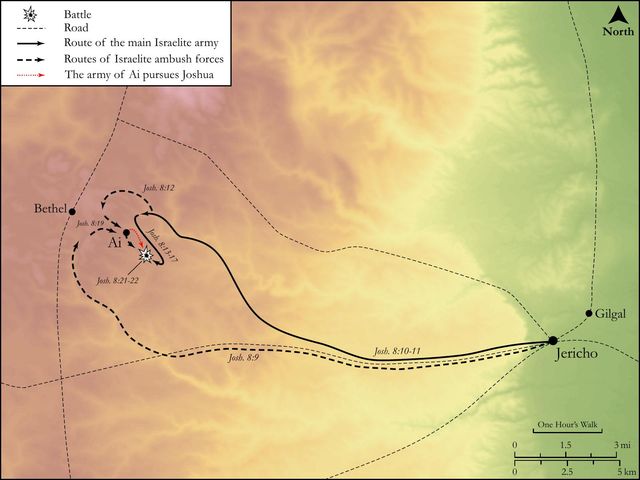
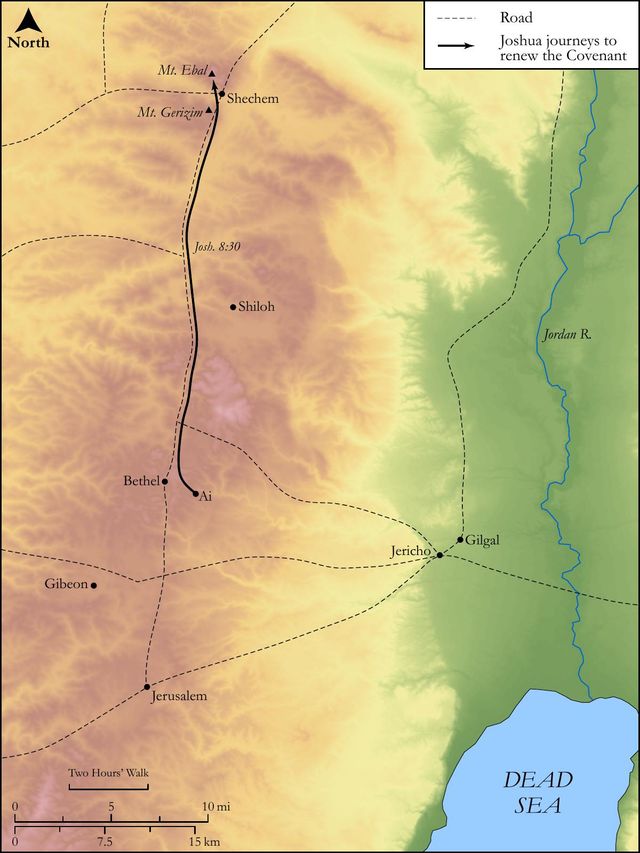
See on the biblical-era maps
Study this verse
Public-domain commentary
Matthew Henry
From his Commentary on the Whole Bible. Henry comments on passages, not single verses — this entry covers Joshua 8:23–29.
We have here an account of the improvement which the Israelites made of their victory over Ai. 1. They put all to the sword, not only in the field, but in the city, man, woman, and child, none of them remained, Jos 8:24. God, the righteous Judge, had passed this sentence upon them for their wickedness, so that the Israelites were only the ministers of his justice and the executioners of his doom. Once in this story, and but once, mention is made of the men of Beth-el, as confederates with the men of Ai, Jos 8:17. Though they had a king of their own, and were not subjects to the king of Ai (for the king of Beth-el is reckoned among the thirty-one kings that Joshua destroyed, Jos 12:16), yet Ai being a stronger place they threw themselves into that, for their own safety, and the strengthening of their neighbours' hands, and so (we may presume) were all cut off with them; thus that by which they hoped to prevent their own ruin hastened it. The whole number of the slain, it seems, was but 12,000, and inconsiderable body to make head against all the thousands of Israel; but those whom God will destroy he infatuates. Here it is said (Jos 8:26) that Joshua drew not his hand back wherewith he stretched out the spear (Jos 8:18) till the slaughter was completed. Some think the spear he stretched out was not to slay the enemies, but to animate and encourage his own soldiers, some flag or ensign being hung out at the end of this spear; and they observe it as an instance of his self-denial that though the fire of courage wherewith his breast was filled would have pushed him forward, sword in hand, into the hottest of the action, yet, in obedience to God, he kept the inferior post of a standard-bearer, and did not quit it till the work was done. By the spear stretched out, he directed the people to expect their help from God, and to him to give the praise. 2. They plundered the city and took all the spoil to themselves, Jos 8:27. Thus the wealth of the sinner is laid up for the just; the spoil they brought out of Egypt, by borrowing of their neighbours, was much of it expended upon the tabernacle they had reared in the wilderness, for which they are now reimbursed with interest. The spoil here taken, it is probable, was all brought together, and distributed by Joshua in due proportions, as that of the Midianites was, Num 31:26, etc. It was not seized with irregularity or violence, for God is the God or order and equity, and not of confusion. 3. They laid the city in ashes, and left it to remain so, Jos 8:28. Israel must yet dwell in tents, and therefore this city, as well as Jericho, must be burnt. And, though there was no curse entailed upon him that should rebuild it, yet, it seems, it was not rebuilt unless it be the same with Aijah, which we read of, long after, Neh 11:31. Some think it was not rebuilt because Israel had received a defeat before it, the remembrance of which should be buried in the ruins of the city. 4. The king of Ai was taken prisoner and cut off, not by the sword of war as a soldier, but by the sword of justice as a malefactor. Joshua ordered him to be hanged, and his dead body thrown at the gate of his own city, under a heap of stone, Jos 8:23, Jos 8:29. Some particular reason, no doubt, there was for this severity against the king of Ai; it is likely he had been notoriously wicked and vile, and a blasphemer of the God of Israel, perhaps upon occasion of the repulse he had given to the forces of Israel in their first onset. Some observe that his dead body was thrown at the gate where he had been wont to sit in judgment that so much the greater contempt might thereby be poured upon the dignity he had been proud of, and he might be punished for the unrighteous decrees he had made in the very place where he had made them. Thus the Lord is known by the judgments which he executes.
Continue studying Joshua 8:29 across the web’s major study libraries — every link below opens this exact verse, chapter, or book on the destination site.
Read & Compare
 BibleGatewayThis verse in more than 200 translations and 70 languages.
 Bible.comThe YouVersion reader — hundreds of translations, reading plans, and highlights.
 ESV.orgCrossway's official English Standard Version reader.
 NET BibleThe NET translation with 60,000+ translators' notes on every rendering decision.
 STEP BibleTyndale House's free study tool — original text, vocabulary, and scholarly resources.
 BibliaLogos Bible Software's free web reader.
 USCCBThe New American Bible (Revised Edition) with the U.S. bishops' study notes.
Commentaries
 BibleHub CommentariesDozens of classic commentaries on this verse, gathered on one page.
 StudyLightMore than 100 commentary sets — the largest collection on the web.
 BibleRefPlain-English commentary on what this verse means, verse by verse.
 Enduring WordDavid Guzik's free commentary on this chapter, widely used by Bible teachers.
 Bible Study ToolsVerse commentary alongside Greek and Hebrew study aids.
Original Language & Research
- BibleHub InterlinearThe verse word by word — original language, transliteration, and English.
- BibleHub LexiconEvery word's original-language definition and Strong's entry.
 Blue Letter BibleDeep-study tools — Strong's numbers, concordance, and word studies.
 SefariaThe Hebrew text with Rashi and centuries of Jewish commentary.
Sermons, Hymns & Audio


TrulyRandomVerse is not affiliated with these sites and doesn’t control their content. They’re linked because they’re genuinely useful.
Summary
Joshua 8:29 culminates Israel's strategic conquest of Ai, vividly detailing the execution and public display of Ai's king. This act served as a stark demonstration of divine judgment against Canaanite wickedness, a public declaration of Israel's decisive victory, and a profound testament to Joshua's meticulous obedience to the Mosaic Law regarding the treatment of a hanged body, ensuring the land remained undefiled. The subsequent erection of a great heap of stones established a lasting memorial, signifying the permanence of God's justice and Israel's triumph for generations.
Context
ShowHideLiterary Context
Joshua 8:29 provides the definitive concluding act of the narrative detailing Israel's second, successful campaign against the city of Ai. This victory stands in stark contrast to Israel's humiliating initial defeat in Joshua 7, which was attributed to Achan's disobedience and subsequent judgment. Following Achan's punishment and the restoration of covenant favor, God provided Joshua with a precise military strategy for Ai in Joshua 8:1-28. The execution of Ai's king and the public disposal of his body, as described in this verse, signifies the complete and irreversible triumph over Ai, fulfilling God's promise of victory when His people are obedient. It also serves as a critical transition point, setting the immediate stage for the covenant renewal ceremony at Mount Ebal and Mount Gerizim in Joshua 8:30-35, emphasizing the paramount importance of law and obedience immediately after a major military success.
Historical & Cultural Context
The practices described in Joshua 8:29 were deeply rooted in the usages of war in that day. The public display of a defeated enemy's body, often by hanging or impalement, as the Philistines fastened the body of Saul to the wall of Beth-shan, was a common method of humiliation, asserting dominance, and serving as a deterrent to other potential adversaries. City gates, where the king's body was cast, were central public spaces—venues for legal proceedings, commercial transactions, and public announcements—making them ideal locations for such a stark display of judgment. Crucially, Joshua's command to remove the body "as soon as the sun was down" demonstrates strict adherence to the specific Mosaic Law found in Deuteronomy 21:22-23, which stipulated that a body hanged on a tree should not remain overnight, lest it defile the land. This highlights Israel's unique covenant relationship with Yahweh and their commitment to His statutes, even in the brutal context of warfare, distinguishing them from surrounding nations. The raising of a "great heap of stones" was also a widespread ancient practice, serving as a permanent memorial or witness to significant events, whether of judgment, covenant, or burial.
Key Themes
ShowHideThis verse powerfully contributes to several overarching themes within the book of Joshua and the broader Old Testament narrative. Firstly, it underscores the theme of Divine Justice and Judgment, illustrating the severe consequences for those who oppose God's purposes and the judgment enacted upon the wicked Canaanite nations whose iniquity had reached its full measure (Genesis 15:16). Secondly, it highlights the paramount importance of Obedience to Covenant Law. Joshua's precise adherence to the Deuteronomic instruction regarding the hanged body, even amidst the chaos of war, exemplifies Israel's commitment to God's commands, which was directly linked to their success and God's favor (Joshua 1:7-8). This obedience ensures the land's purity and Israel's distinctiveness. Thirdly, the public nature of the act and the lasting memorial of stones emphasize the theme of Public Witness and Remembrance, serving as a perpetual reminder of God's power, His faithfulness to His promises, and the consequences of rebellion, echoing the memorial over Achan in Joshua 7:26).
Exposition and Analysis
ShowHideKey Word Analysis
ShowHideThe verb תָּלָה (tâlâh') means "to suspend (especially to gibbet); hang (up)." In this context, it refers to the public display of a body, typically after execution, by hanging it on a tree or pole. While not necessarily crucifixion in the Roman sense, it was a form of public humiliation and a sign of utter disgrace and divine curse in ancient Israelite thought, as explicitly linked in Deuteronomy 21:22-23.
The noun נִבְלָה (nᵉbêlâh') refers to "a flabby thing, i.e. a carcase or carrion (human or bestial, often collectively); figuratively, an idol; (dead) body, (dead) carcase, dead of itself, which died, (beast) that (which) dieth of itself." The use of this term, rather than a more neutral word for "body," emphasizes the indignity, lifelessness, and defilement associated with the king's remains. It underscores his complete defeat and the contempt with which his body was treated, consistent with the judgment enacted upon him.
The noun גַּל (gal') means "something rolled, i.e. a heap of stone or dung (plural ruins), by analogy, a spring of water (plural waves)." Here, it specifically refers to a pile of stones. This "heap" serves as a durable, visible marker, a common practice in Israel to commemorate significant events, burials, or judgments. Its presence signifies the permanence of the event and its consequences.
Verse Breakdown
ShowHide"And the king of Ai he hanged on a tree until eventide"
This clause describes the initial act of judgment and public display. The king of Ai, as the leader and symbol of the city's resistance, suffered the ultimate humiliation and degradation. His body was displayed on a tree, a common practice in the wars of that day, as when Joshua later hanged the five kings of the Amorites on five trees, to signify absolute victory and to deter others. The phrase "until eventide" specifies the duration of this public display, indicating that it was not intended to be permanent, but rather for a set period, leading directly into the next command.
"and as soon as the sun was down, Joshua commanded that they should take his carcase down from the tree"
This clause highlights Joshua's strict and immediate adherence to the Mosaic Law. Deuteronomy 21:22-23 explicitly forbade leaving a hanged body on a tree overnight, stating that "his body shall not remain all night upon the tree, but you shall surely bury him the same day; for he who is hanged is accursed of God." Joshua's immediate command to remove the body at sundown demonstrates Israel's commitment to holiness and preventing the defilement of the land, even in the aftermath of a brutal conquest.
"and cast it at the entering of the gate of the city"
This action further emphasizes the indignity and public nature of the judgment. The city gate was a prominent public space, the hub of civic life, commerce, and judicial proceedings. Casting the king's body there, rather than burying it honorably, ensured that his defeat and the judgment upon him were visible to all, underscoring the completeness of Israel's victory and the ignominious end of Ai's ruler.
"and raise thereon a great heap of stones, [that remaineth] unto this day"
This final action establishes a permanent memorial. The "great heap of stones" served as a lasting witness to the event, a common practice in ancient Israel to mark significant places or events (Joshua 7:26 for Achan's burial). It served as a perpetual reminder of God's judgment against rebellion, the consequences of opposing His people, and the definitive victory granted to Israel, enduring as a tangible testament for future generations and affirming the historical veracity of the account.
Literary Devices
ShowHideThe narrative of Joshua 8:29 employs several potent literary devices to convey its profound message. Symbolism is prominent, with the "tree" representing not only a means of public display but also a place of curse and public shame, directly referencing the Deuteronomic law. The "gate of the city" functions as a powerful symbol of public authority, communal life, and the seat of justice, making it the ideal, most visible location for the ultimate public humiliation and declaration of defeat. The "great heap of stones" is a potent symbol of a lasting memorial, a permanent witness to God's judgment and Israel's victory, echoing the heap of stones over Achan in Joshua 7:26, thereby creating a thematic link between the consequences of internal sin and the judgment of external enemies. The phrase "[that remaineth] unto this day" serves as an authorial aside or narrative marker, affirming the historical veracity and enduring impact of the event for the original audience, emphasizing the tangible evidence of God's work. The entire passage functions as a form of narrative closure for the Ai campaign, definitively marking the end of the conflict and the complete subjugation of the city and its king.
Theological and Thematic Connections
ShowHideJoshua 8:29 is rich with theological significance, primarily underscoring the unwavering nature of God's justice and the critical importance of obedience to His covenant commands. The execution of the king of Ai, a representative of the wicked Canaanite nations, demonstrates God's righteous judgment against sin and idolatry. This act was not merely a military tactic but a divinely ordained consequence for a people whose iniquity had reached its full measure, fulfilling God's earlier pronouncements regarding the land's inhabitants. Furthermore, Joshua's meticulous adherence to the law concerning the hanged body, even in the heat of battle, highlights that God's commands are not arbitrary but are foundational to Israel's identity as a holy nation, ensuring the purity of the land and the integrity of their covenant relationship. The "heap of stones" stands as a permanent theological marker, a tangible reminder of God's power to execute judgment and grant victory, serving as a warning to those who defy Him and an encouragement to those who obey.
Reflection and Application
ShowHideJoshua 8:29, though describing a harsh act of ancient warfare, offers profound and enduring truths for contemporary reflection and application. It reminds us that God is a God of perfect justice, and while His patience is immense, there are ultimate and certain consequences for persistent rebellion against His will and moral order. This passage challenges us to consider the seriousness of sin and the certainty of divine judgment, even if delayed in our temporal experience. Moreover, Joshua's unwavering obedience to the specific, seemingly minor detail of taking the body down before sundown underscores the profound importance of holistic obedience to God's commands. It teaches us that true faithfulness is not selective but embraces all of God's instructions, recognizing that even small acts of obedience contribute to the purity and blessing of our lives and communities, reflecting our commitment to His covenant. The "heap of stones" serves as a powerful call to remember God's past dealings—His judgments and His deliverances—and to establish our own "memorials" of remembrance, ensuring that we and future generations do not forget His unchanging character, His faithfulness, and the lessons learned from both triumph and consequence.
Questions for Reflection
ShowHideFAQ
ShowHideWhy was the king of Ai hanged on a tree?
ShowHideThe hanging of the king of Ai on a tree served multiple purposes common in the wars of that day. Primarily, it was an act of extreme public humiliation and degradation for a defeated enemy. It asserted Israel's dominance and served as a stark deterrent to other cities or kings who might consider resisting God's people. The act also carried a profound theological significance, as being "hanged on a tree" was associated with being "accursed of God" according to Deuteronomy 21:22-23, signifying a divine curse upon the king and, by extension, the idolatrous city he represented. This public display communicated a powerful message of judgment to both Israel and the surrounding nations.
Why was the body taken down at sundown, and what is the significance of this detail?
ShowHideJoshua's command to take the body down at sundown demonstrates strict and immediate obedience to the Mosaic Law, specifically Deuteronomy 21:22-23. This law stipulated that if a person was executed and displayed on a tree, their body "shall not remain all night upon the tree, but you shall surely bury him the same day; for he who is hanged is accursed of God." The profound significance lies in preventing the defilement of the land. Leaving a body exposed overnight, especially one considered "accursed" by God, would render the land ceremonially unclean and bring a curse upon it. This detail highlights Israel's commitment to maintaining ritual purity and holiness, even in the context of warfare and judgment, underscoring the paramount importance of God's covenant commands for the nation's well-being and their unique relationship with Yahweh.
What is the significance of the "great heap of stones" raised over the king's body?
ShowHideThe "great heap of stones" served as a permanent memorial or witness marker, a common practice in Israel to commemorate significant events. In this context, it had several layers of profound significance: it marked the place of the king's ignominious end, serving as a perpetual reminder of the decisive defeat of Ai and the judgment enacted upon its king. It was a visible testament to God's power and faithfulness in granting victory to Israel, and a solemn warning to any who would oppose His will or His people. This heap of stones echoes the one raised over Achan in Joshua 7:26, creating a powerful thematic link between the consequences of internal sin within Israel and external rebellion against God by the Canaanites. It served as a tangible, enduring historical record for future generations.
Christ-Centered Fulfillment
ShowHideWhile Joshua 8:29 describes an act of temporal judgment and military victory in the Old Testament, it contains profound echoes that resonate with the ultimate triumph and redemptive work of Jesus Christ. The king of Ai, "hanged on a tree," represents the cursed fate of those under God's righteous judgment, a vivid Old Testament image of the consequences of rebellion against a holy God. This foreshadows, though not directly prophesies, the profound theological truth that Christ himself, though innocent, became "a curse for us" when He was "hanged on a tree" (as Galatians 3:13 powerfully states, directly referencing Deuteronomy 21:23). Unlike the king of Ai, whose death was a consequence of his own wickedness, Jesus willingly bore the curse of humanity's sin, absorbing divine wrath on the cross so that we might be redeemed from the curse of the law and receive the blessing of Abraham. Joshua's victory over Ai, marked by the public display and subsequent burial of the king, points to the infinitely greater victory of Christ over sin, death, and the powers of darkness, culminating in His glorious resurrection and ascension (Colossians 2:15). The "heap of stones" at Ai served as a lasting memorial of a decisive judgment and victory; similarly, the empty tomb and the resurrected Christ stand as the ultimate and eternal monument to God's final triumph over all evil, ensuring that the ultimate "curse" of sin is forever removed for those who believe in the Lamb of God who takes away the sin of the world (John 1:29).