


John 19:42
Bible text: King James Version (1769 Blayney text) · Public domain
Bible text: Berean Standard Bible · Public domain
Bible text: American Standard Version (1901) · Public domain
Bible text: World English Bible, Messianic edition · Public domain
Bible text: Geneva Bible (1599) · Public domain
Bible text: Young's Literal Translation · Public domain
- ἐκεῖekeiThereG1563ADVAdverb
- οὖνounthereforeG3767CONJConjunction
- διὰdiaon account ofG1223PREPPreposition
- τὴνtēntheG3588T-ASFDefinite article Accusative Singular Feminine
- παρασκευὴνparaskeuēnPreparationG3904N-ASFNoun Accusative Singular Feminine
- τῶνtōnof theG3588T-GPMDefinite article Genitive Plural Masculine
- ἸουδαίωνIoudaiōnJewsG2453N-GPM-PGNoun Genitive Plural Masculine Person Gentilic
- ὅτιhotibecauseG3754CONJConjunction
- ἐγγὺςengusnearG1451PREPPreposition
- ἦνēnwasG1510V-IAI-3SVerb Imperfect Active Indicative 3rd Singular
- τὸtotheG3588T-NSNDefinite article Nominative Singular Neuter
- μνημεῖονmnēmeiontombG3419N-NSNNoun Nominative Singular Neuter
- ἔθηκανethēkanthey laidG5087V-AAI-3PVerb Aorist Active Indicative 3rd Plural
- τὸνton<the>G3588T-ASMDefinite article Accusative Singular Masculine
- ἸησοῦνIēsounJesusG2424N-ASM-PNoun Accusative Singular Masculine Individual
English is a literal word-by-word gloss of the Greek, not the KJV's wording. Why?
This is the original text the KJV's translators worked from — each Greek word with its own literal English meaning in this verse, prepared by scholars at Tyndale House, Cambridge. The KJV translates whole sentences, not word by word, so its wording differs: one Greek word can become several English words, and the KJV may choose “charity” where the gloss reads “love”. Both are faithful — they answer different questions. For the KJV's own rendering, switch to the KJV text.
Details
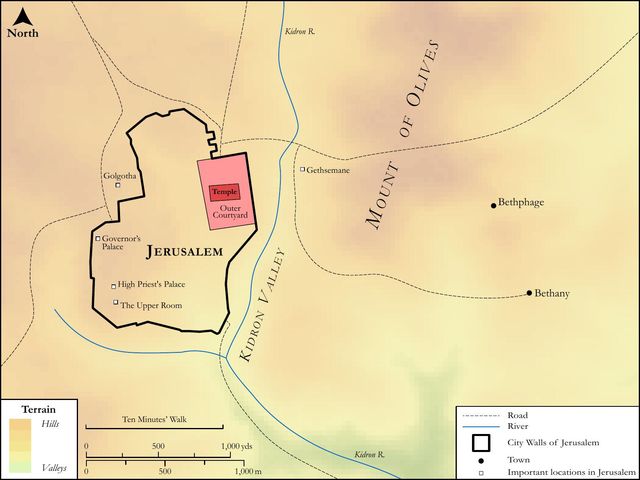
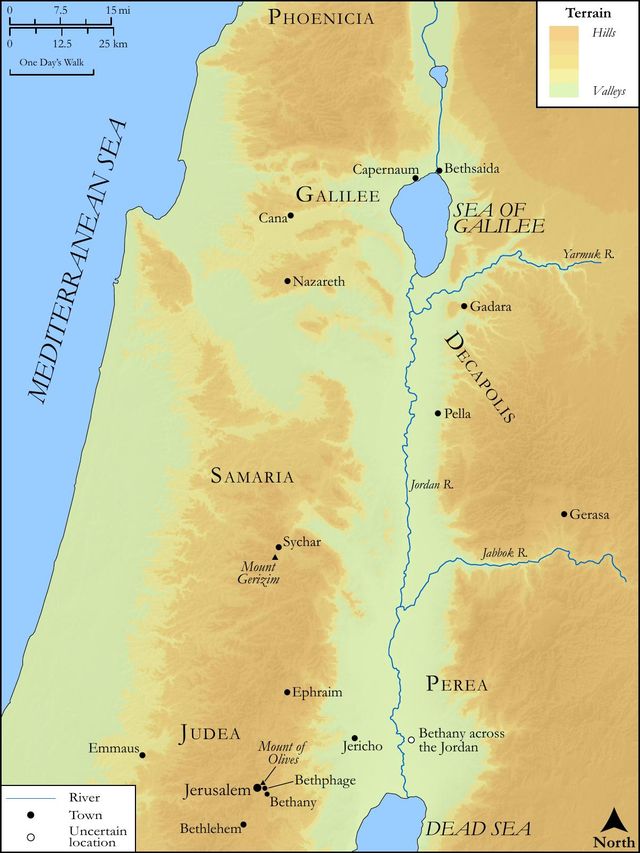
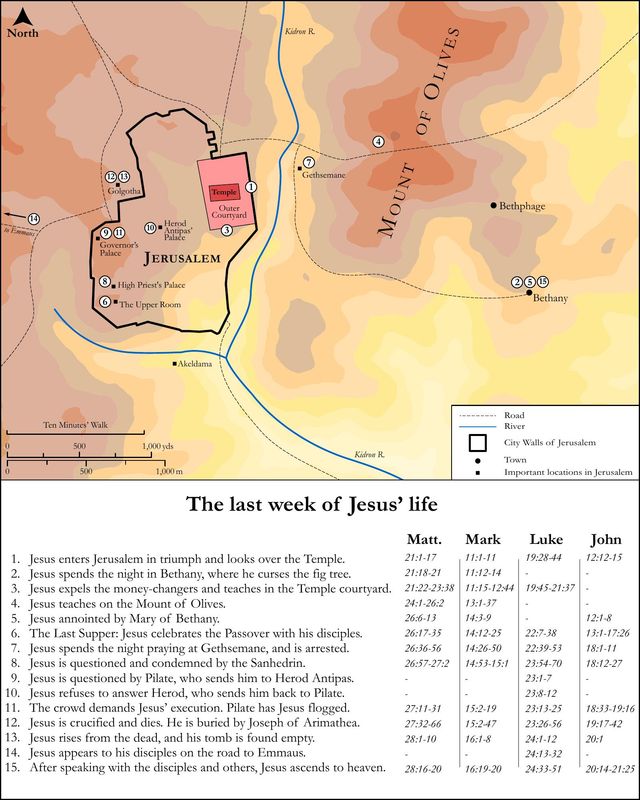
See on the biblical-era maps
Study this verse
Public-domain commentary
Matthew Henry
From his Commentary on the Whole Bible. Henry comments on passages, not single verses — this entry covers John 19:38–42. His four-level outline is real structure in the source text, so it is rendered as structure.
We have here an account of the burial of the blessed body of our Lord Jesus. The solemn funerals of great men are usually looked at with curiosity; the mournful funerals of dear friends are attended with concern. Come and see an extraordinary funeral; never was the like! Come and see a burial that conquered the grave, and buried it, a burial that beautified the grave and softened it for all believers. Let us turn aside now, and see this great sight. Here is,
I.The body begged, Joh 19:38.
This was done by the interest of Joseph of Ramah, or Arimathea, of whom no mention is made in all the New Testament story, but only in the narrative which each of the evangelists gives us of Christ's burial, wherein he was chiefly concerned. Observe,
1.The character of this Joseph. He was a disciple of Christ incognito - in secret, a better friend to Christ than he would willingly be known to be. It was his honour that he was a disciple of Christ; and some such there are, that are themselves great men, and unavoidably linked with bad men. But it was his weakness that he was so secretly, when he should have confessed Christ before men, yea, though he had lost his preferment by it. Disciples should openly own themselves, yet Christ may have many that are his disciples sincerely, though secretly; better secretly than not at all, especially if, like Joseph here, they grow stronger and stronger. Some who in less trials have been timorous, yet in greater have been very courageous; so Joseph here. He concealed his affection to Christ for fear of the Jews, lest they should put him out of the synagogue, at least out of the sanhedrim, which was all they could do. To Pilate the governor he went boldly, and yet feared the Jews. The impotent malice of those that can but censure, and revile, and clamour, is sometimes more formidable even to wise and good men than one would think.
2.The part he bore in this affair. He, having by his place access to Pilate, desired leave of him to dispose of the body. His mother and dear relations had neither spirit nor interest to attempt such a thing. His disciples were gone; if nobody appeared, the Jews or soldiers would bury him with the thieves; therefore God raised up this gentleman to interpose in it, that the scripture might be fulfilled, and the decorum owing to his approaching resurrection maintained. Note, When God has work to do he can find out such as are proper to do it, and embolden them for it. Observe it as an instance of the humiliation of Christ, that his dead body lay at the mercy of a heathen judge, and must be begged before it could be buried, and also that Joseph would not take the body of Christ till he had asked and obtained leave of the governor; for in those things wherein the power of the magistrate is concerned we must ever pay a deference to that power, and peaceably submit to it.
II.The embalming prepared, Joh 19:39.
This was done by Nicodemus, another person of quality, and in a public post. He brought a mixture of myrrh and aloes, which some think were bitter ingredients, to preserve the body, others fragrant ones, to perfume it. Here is.
1.The character of Nicodemus, which is much the same with that of Joseph; he was a secret friend to Christ, though not his constant follower. He at first came to Jesus by night, but now owned him publicly, as before, Joh 7:50, Joh 7:51. That grace which at first is like a bruised reed may afterwards become like a strong cedar, and the trembling lamb bold as a lion. See Rom 14:4. It is a wonder that Joseph and Nicodemus, men of such interest, did not appear sooner, and solicit Pilate not to condemn Christ, especially seeing him so loth to do it. Begging his life would have been a nobler piece of service than begging his body. But Christ would have none of his friends to endeavour to prevent his death when his hour was come. While his persecutors were forwarding the accomplishment of the scriptures, his followers must not obstruct it.
2.The kindness of Nicodemus, which was considerable, though of a different nature. Joseph served Christ with his interest, Nicodemus with his purse. Probably, they agreed it between them, that, while one was procuring the grant, the other should be preparing the spices; and this for expedition, because they were straitened in time. But why did they make this ado about Christ's dead body?
(1.)Some think we may see in it the weakness of their faith. A firm belief of the resurrection of Christ on the third day would have saved them this care and cost, and have been more acceptable than all spices. Those bodies indeed to whom the grave is a long home need to be clad accordingly; but what need of such furniture of the grave for one that, like a way-faring man, did but turn aside into it, to tarry for a night or two?
(2.)However, we may plainly see in it the strength of their love. Hereby they showed the value they had for his person and doctrine, and that it was not lessened by the reproach of the cross. Those that had been so industrious to profane his crown, and lay his honour in the dust, might already see that they had imagined a vain thing; for, as God had done him honour in his sufferings, so did men too, even great men. They showed not only the charitable respect of committing his body to the earth, but the honourable respect shown to great men. This they might do, and yet believe and look for his resurrection; nay, this they might do in the belief and expectation of it. Since God designed honour for this body, they would put honour upon it. However, we must do our duty according as the present day and opportunity are, and leave it to God to fulfil his promises in his own way and time.
III.The body got ready, Joh 19:40.
They took it into some house adjoining, and, having washed it from blood and dust, wound it in linen clothes very decently, with the spices melted down, it is likely, into an ointment, as the manner of the Jews is to bury, or to embalm (so Dr. Hammond), as we sear dead bodies.
1.Here was care taken of Christ's body: It was wound in linen clothes. Among clothing that belongs to us, Christ put on even the grave-clothes, to make them easy to us, and to enable us to call them our wedding-clothes. They wound the body with the spices, for all his garments, his grave-clothes not excepted, smell of myrrh and aloes (the spices here mentioned) out of the ivory palaces (Psa 45:8), and an ivory palace the sepulchre hewn out of a rock was to Christ. Dead bodies and graves are noisome and offensive; hence sin is compared to a body of death and an open sepulchre; but Christ's sacrifice, being to God as a sweet-smelling savour, hath taken away our pollution. No ointment or perfume can rejoice the heart so as the grave of our Redeemer does, where there is faith to perceive the fragrant odours of it.
2.In conformity to this example, we ought to have regard to the dead bodies of Christians; not to enshrine and adore their relics, no, not those of the most eminent saints and martyrs (nothing like that was done to the dead body of Christ himself), but carefully to deposit them, the dust in the dust, as those who believe that the dead bodies of the saints are still united to Christ and designed for glory and immortality at the last day. The resurrection of the saints will be in virtue of Christ's resurrection, and therefore in burying them we should have an eye to Christ's burial, for he, being dead, thus speaketh. Thy dead men shall live, Isa 26:19. In burying our dead it is not necessary that in all circumstances we imitate the burial of Christ, as if we must be buried in linen, and in a garden, and be embalmed as he was; but his being buried after the manner of the Jews teaches us that in things of this nature we should conform to the usages of the country where we live, except in those that are superstitious.
IV.The grave pitched upon, in a garden which belonged to Joseph of Arimathea, very near the place where he was crucified.
There was a sepulchre, or vault, prepared for the first occasion, but not yet used. Observe,
1.That Christ was buried without the city, for thus the manner of the Jews was to bury, not in their cities, much less in their synagogues, which some have thought better than our way of burying: yet there was then a peculiar reason for it, which does not hold now, because the touching of a grave contracted a ceremonial pollution: but now that the resurrection of Christ has altered the property of the grave, and done away its pollution for all believers, we need not keep at such a distance from it; nor is it incapable of a good improvement, to have the congregation of the dead in the church-yard, encompassing the congregation of the living in the church, since they also are dying, and in the midst of life we are in death. Those that would not superstitiously, but by faith, visit the holy sepulchre, must go forth out of the noise of this world.
2.That Christ was buried in a garden. Observe,
(1.)That Joseph had his sepulchre in his garden; so he contrived it, that it might be a memento,
[1.]To himself while living; when he was taking the pleasure of his garden, and reaping the products of it, let him think of dying, and be quickened to prepare for it. The garden is a proper place for meditation, and a sepulchre there may furnish us with a proper subject for meditation, and such a one as we are loth to admit in the midst of our pleasures.
[2.]To his heirs and successors when he was gone. It is good to acquaint ourselves with the place of our fathers' sepulchres; and perhaps we might make our own less formidable if we made theirs more familiar.
(2.)That in a sepulchre in a garden Christ's body was laid. In the garden of Eden death and the grave first received their power, and now in a garden they are conquered, disarmed, and triumphed over. In a garden Christ began his passion, and from a garden he would rise, and begin his exaltation. Christ fell to the ground as a corn of wheat (Joh 12:24), and therefore was sown in a garden among the seeds, for his dew is as the dew of herbs, Isa 26:19. He is the fountain of gardens, Sol 4:15.
3.That he was buried in a new sepulchre. This was so ordered (1.) For the honour of Christ; he was not a common person, and therefore must not mix with common dust He that was born from a virgin-womb must rise from a virgin-tomb. (2.) For the confirming of the truth of his resurrection, that it might not be suggested that it was not he, but some other that rose now, when many bodies of saints arose; or, that he rose by the power of some other, as the man that was raised by the touch of Elisha's bones, and not by his own power. He that has made all things new has new-made the grave for us.
V.The funeral solemnized (Joh 19:42):
There laid they Jesus, that is, the dead body of Jesus. Some think the calling of this Jesus intimates the inseparable union between the divine and human nature. Even this dead body was Jesus - a Saviour, for his death is our life; Jesus is still the same, Heb 13:8. There they laid him because it was the preparation day.
1.Observe here the deference which the Jews paid to the sabbath, and to the day of preparation. Before the passover-sabbath they had a solemn day of preparation. This day had been ill kept by the chief priests, who called themselves the church, but was well kept by the disciples of Christ, who were branded as dangerous to the church; and it is often so.
(1.)They would not put off the funeral till the sabbath day, because the sabbath is to be a day of holy rest and joy, with which the business and sorrow of a funeral do not well agree.
(2.)They would not drive it too late on the day of preparation for the sabbath. What is to be done the evening before the sabbath should be so contrived that it may neither intrench upon sabbath time, nor indispose us for sabbath work.
2.Observe the convenience they took of an adjoining sepulchre; the sepulchre they made use of was nigh at hand. Perhaps, if they had had time, they would have carried him to Bethany, and buried him among his friends there. And I am sure he had more right to have been buried in the chief of the sepulchres of the sons of David than any of the kings of Judah had; but it was so ordered that he should be laid in a sepulchre nigh at hand,
(1.)Because he was to lie there but awhile, as in an inn, and therefore he took the first that offered itself.
(2.)Because this was a new sepulchre. Those that prepared it little thought who should handsel it; but the wisdom of God has reaches infinitely beyond ours, and he makes what use he pleases of us and all we have.
(3.)We are hereby taught not to be over-curious in the place of our burial. Where the tree falls, why should it not lie? For Christ was buried in the sepulchre that was next at hand. It was faith in the promise of Canaan that directed the Patriarch's desires to be carried thither for a burying-place; but now, since that promise is superseded by a better, that care is over.
Thus without pomp or solemnity is the body of Jesus laid in the cold and silent grave. Here lies our surety under arrest for our debts, so that if he be released his discharge will be ours. Here is the Sun of righteousness set for awhile, to rise again in greater glory, and set no more. Here lies a seeming captive to death, but a real conqueror over death; for here lies death itself slain, and the grave conquered. Thanks be to God, who giveth us the victory.
Historical interpretation
Nine Centuries of Reception
7 surviving comments on this verse. Each one is dated, so this reads as a timeline rather than a list.
Select a marker to jump to its quote. Markers stagger vertically where authors wrote within a few decades of each other.
Surely if no one had as yet been laid there, men and women were afterward laid there. For this is the meaning for those who consider carefully.… He who said, “We have been buried with Christ through baptism and have risen with him,” has himself been after Christ buried together with Christ in a new and spiritual tomb hewn in the rock. It is the same for all who have been buried together with Christ in baptism so that they may rise with him from the new tomb of the Firstborn from the dead who holds the preeminence in all things.
"After this came Joseph of Arimathaea, being a disciple." Not one of the twelve, but perhaps one of the seventy. For now deeming that the anger of the Jews was quenched by the Cross, they approached without fear, and took charge of His funeral. Joseph therefore came and asked the favor from Pilate, which he granted; why should he not? Nicodemus also assists him, and furnishes a costly burial. For they were still disposed to think of Him as a mere man. And they brought those spices whose especial nature is to preserve the body for a long time, and not to allow it quickly to yield to corruption, which was an act of men imagining nothing great respecting Him; but anyhow, they exhibited very loving affection. But how did no one of the twelve come, neither John, nor Peter, nor any other of the more distinguished disciples? Nor doth the writer conceal this point. If any one say that it was from fear of the Jews, these men also were occupied by the same fear; for Joseph too was, it saith, "A secret (disciple) for fear of the Jews." And not one can say that Joseph acted thus because he greatly despised them, but though himself afraid, still he came. But John who was present, and had seen Him expire, did nothing of the kind. It seems to me that Joseph was a man of high rank, (as is clear from the funeral,) and known to Pilate, on which account also he obtained the favor; and then he buried Him, not as a criminal, but magnificently, after the Jewish fashion, as some great and admirable one.
And because they were straitened by the time, (since the Death took place at the ninth hour, and it is probable, that what with going to Pilate and what with taking down the body, evening would come upon them when it was not lawful to work,) they laid Him in the tomb that was near. And it is providentially ordered, that He should be placed in a new tomb, wherein no one had been placed before, that His Resurrection might not be deemed to be that of some other who lay there with Him; and that the disciples might be able easily to come and be spectators of what came to pass, because the place was near; and that not they alone should be witnesses of His burial, but His enemies also, for the placing seals on the tomb, and the sitting by of the soldiers to watch it, were the actions of men testifying to the burial. For Christ earnestly desired that this should be confessed, no less than the Resurrection. Wherefore also the disciples are very earnest about this, the showing that He died. For the Resurrection all succeeding time would confirm, but the Death, if at that time it had been partially concealed, or not made very manifest, was likely to harm the account of the Resurrection. Nor was it for these reasons only that He was laid near, but also that the story about the stealing might be proved false.
(Hom. lxxxv) Joseph thinking that the hatred of the Jews would be appeased by His crucifixion, went with confidence to ask permission to take charge of His burial: And after this, Joseph of Arimathea besought Pilate.
(Hom. lxxxv. 3) He was not of the twelve, but of the seventy, for none of the twelve came near. Not that their fear kept them back, for Joseph was a disciple, secretly for fear of the Jews. But Joseph was a person of rank, and known to Pilate; so he went to him, and the favour was granted, and afterwards believed Him, not as a condemned man, but as a great and wonderful Person: He came therefore, and took the body of Jesus.
(Hom. lxxxv) They bring the spices most efficacious for preserving the body from corruption, treating Him as a mere man. Yet this shows great love.
(Hom. lxxxv. 4) But as they were pressed for time, for Christ died at the ninth hour, and after that they had gone to Pilate, and taken away the body, so that the evening was now near, they lay Him in the nearest tomb: Now in the place where He was crucified there was a garden; and in the garden a new sepulchre, wherein was never man yet laid. A providential design, to make it certain that it was His resurrection, and not any other person's that lay with Him.
(Hom. lxxxv) The sepulchre was near, that the disciples might approach it more easily, and be better witnesses of what took place there, and that even enemies might be made the witnesses of the burial, being placed there as guards, and the story of His being stolen away showed to be false.
"There laid they Jesus therefore, because of the Jews' preparation; for the sepulchre was nigh at hand." He would have us to understand that the burial was hurried, lest the evening should overtake them; when it was no longer permitted to do any such thing, because of the preparation, which the Jews among us are more in the habit of calling in Latin, coena pura (the pure meal).
(Tr. cxx. 5) Implying that the burial was hastened, in order to finish it before the evening, when, on account of the preparation, which the Jews with us call more commonly in the Latin, Caena pura, it was unlawful to do any such thing.
He not only says plainly that Christ's Body was dressed for burial, and that there was a garden nigh unto the cross, and that there was a new sepulchre in it, but he also explains that He was laid therein, not leaving the least of the things which were done untold. For most essential truly to any creed or system of the mystery of our faith is the confession and the knowledge that Christ died. Therefore, also, the wise Paul, defining our rule of faith, speaks as follows: The word is nigh thee, in thy mouth, and in thy heart; that is, the word of faith, which preach: because, if thou shalt say with thy mouth, Jesus is Lord, and shalt believe in thy heart that God raised Him from the dead, thou shalt be saved: for with the heart man believeth unto righteousness; and with the mouth confession is made unto salvation. And in another passage also: For I delivered unto you first of all that which also I received, how that Christ died for our sins, according to the Scriptures; and that He was buried; and that He hath been raised on the third day, according to the Scriptures. Very essential, then, for us is the narrative which the writer of the book gives us on these points. For it was our bounden duty to believe that He died and was buried; after that will easily follow the true belief, that He burst asunder the bonds of death, and returned as God to the life that was His own. For it was not possible that He should be holden of death. For, being by Nature Life, how could He have undergone corruption? And how could He in Whom we live, and move, and have our being, have been subjected to the laws to which our human nature is subject? Could He not rather, as God, have easily quickened that which lacked life?
In that it was a new sepulchre, we are given to understand, that we are all renewed by Christ's death, and death and corruption destroyed. Mark too the exceeding poverty that He took up for our sakes. He had no house in His lifetime, and now He is laid in another's sepulchre at His death, and His nakedness covered by Joseph. There laid they Jesus therefore because of the Jews' preparation day; for the sepulchre was nigh at hand.
Even now in a certain sense Christ is put to death by the avaritious, in the person of the poor man suffering famine. Be therefore a Joseph, and cover Christ's nakedness, and, not once, but continually by contemplation, embalm Him in thy spiritual tomb, cover Him, and mix myrrh and bitter aloes; considering that bitterest sentence of all, Depart, ye cursed, into everlasting fire. (Matt. 25:41)
Continue studying John 19:42 across the web’s major study libraries — every link below opens this exact verse, chapter, or book on the destination site.
Read & Compare
 BibleGatewayThis verse in more than 200 translations and 70 languages.
 Bible.comThe YouVersion reader — hundreds of translations, reading plans, and highlights.
 ESV.orgCrossway's official English Standard Version reader.
 NET BibleThe NET translation with 60,000+ translators' notes on every rendering decision.
 STEP BibleTyndale House's free study tool — original text, vocabulary, and scholarly resources.
 BibliaLogos Bible Software's free web reader.
 USCCBThe New American Bible (Revised Edition) with the U.S. bishops' study notes.
Commentaries
 BibleHub CommentariesDozens of classic commentaries on this verse, gathered on one page.
 StudyLightMore than 100 commentary sets — the largest collection on the web.
 BibleRefPlain-English commentary on what this verse means, verse by verse.
 Enduring WordDavid Guzik's free commentary on this chapter, widely used by Bible teachers.
 Bible Study ToolsVerse commentary alongside Greek and Hebrew study aids.
Original Language & Research
- BibleHub InterlinearThe verse word by word — original language, transliteration, and English.
- BibleHub LexiconEvery word's original-language definition and Strong's entry.
 Blue Letter BibleDeep-study tools — Strong's numbers, concordance, and word studies.
 CNTR CollationThe earliest Greek manuscripts of this verse, collated letter by letter.
Sermons, Hymns & Audio


TrulyRandomVerse is not affiliated with these sites and doesn’t control their content. They’re linked because they’re genuinely useful.
Summary
Succinctly details the immediate circumstances of Jesus' burial, emphasizing the urgency driven by Jewish custom and the providential proximity of the tomb. This verse serves as a critical bridge between the crucifixion and the resurrection, underscoring the historical reality of Jesus' death and interment while subtly highlighting the meticulous unfolding of God's sovereign plan, even amidst the haste and sorrow of the moment.
Context
ShowHideLiterary Context
This verse concludes the narrative of Jesus' crucifixion and death in John's Gospel, immediately following the account of His death on the cross (John 19:30). It describes the swift actions taken by Joseph of Arimathea and Nicodemus to bury Jesus' body before the Sabbath began. Their courageous intervention, detailed in John 19:38-40, stands in stark contrast to the flight of most other disciples, highlighting their quiet devotion at a critical juncture. The placement of this verse sets the stage for the empty tomb narrative in John 20.
Historical & Cultural Context
The phrase "Jews' preparation day" (Greek: paraskeuē) refers to Friday, the day before the Sabbath. In this specific instance, it was the day before a "high Sabbath," which was both the weekly Sabbath and the first day of the Feast of Unleavened Bread, coinciding with Passover (John 19:31). Jewish law, particularly as derived from Deuteronomy 21:22-23, mandated that bodies of those executed should not remain exposed overnight but must be buried before sunset. This strict adherence to the law meant that Jesus' body had to be interred quickly, as the Sabbath began at sunset on Friday, prohibiting any work, including burials. The proximity of the tomb was thus a practical necessity driven by this cultural and religious imperative.
Key Themes
ShowHideJohn 19:42 contributes to several overarching themes in John's Gospel. It reinforces the historical veracity of Jesus' death and burial, a foundational truth for the Christian faith (1 Corinthians 15:3-4). The verse also subtly alludes to divine providence, as the convenient location of the tomb and the timing of the burial were not accidental but part of God's preordained plan, ensuring the proper handling of Jesus' body and setting the stage for the resurrection. Furthermore, it highlights the theme of fulfillment of prophecy, as Jesus' burial "with the rich" (Isaiah 53:9) is implicitly fulfilled through Joseph of Arimathea, a wealthy and respected member of the Sanhedrin, providing his own new tomb.
Exposition and Analysis
ShowHideKey Word Analysis
ShowHideThis term denotes "readiness" or "preparation." In Jewish custom, it specifically referred to the day before the Sabbath (Friday), when all necessary tasks, including cooking, cleaning, and burials, had to be completed before the Sabbath rest began at sunset. Its use here underscores the urgency and the legal necessity of burying Jesus before the start of the "high Sabbath."
Meaning "a remembrance, i.e., cenotaph (place of interment); grave, sepulchre, tomb." This word emphasizes the nature of the place where Jesus was laid—a tomb, specifically a new one belonging to Joseph of Arimathea, indicating a formal and respectful burial, not a hasty, dishonorable disposal.
Meaning "near (literally or figuratively, of place or time); from, at hand, near, nigh (at hand, unto), ready." This term highlights the immediate proximity of the tomb to the crucifixion site, a crucial detail that enabled the quick burial required by the "preparation day" customs. It underscores the practical convenience that facilitated the fulfillment of the law.
Verse Breakdown
ShowHide"There laid they Jesus therefore"
This clause describes the action of placing Jesus' body into the tomb. "They" refers to Joseph of Arimathea and Nicodemus, who took responsibility for the burial. The adverb "therefore" (G3767, oûn) indicates a logical consequence, connecting this action to the preceding events of Jesus' death and the subsequent need for His interment.
"because of the Jews' preparation [day]"
This phrase provides the primary reason for the haste and location of the burial. The "preparation day" (Friday) necessitated the completion of all tasks, including burials, before sunset when the Sabbath began. This was particularly critical as it was also the eve of a high Passover Sabbath, making the observance even more stringent.
"for the sepulchre was nigh at hand"
This final clause offers the practical explanation for the swift and convenient burial. The tomb's close proximity to the crucifixion site allowed Joseph and Nicodemus to inter Jesus' body quickly, thereby fulfilling the requirements of the "preparation day" without violating the Sabbath.
Literary Devices
ShowHideThe verse employs Conciseness to convey a significant event with remarkable brevity, focusing on the essential details of location and timing. There is an element of Irony in the fact that the religious authorities, who condemned Jesus, inadvertently ensured the proper, legal burial of His body by their strict adherence to the "preparation day" laws, which prevented His body from remaining on the cross overnight. This also subtly points to Divine Providence, where seemingly mundane or circumstantial details (like the tomb's proximity) are revealed to be part of God's sovereign plan, facilitating the necessary steps in the redemptive narrative. The mention of the "sepulchre" also carries Symbolism, representing not merely a burial place but the temporary resting place from which Christ would victoriously emerge, transforming the symbol of death into a prelude to life.
Theological and Thematic Connections
ShowHideJohn 19:42 is foundational to Christian theology, affirming the historical reality of Jesus' death and burial, which are indispensable components of the Gospel message. The meticulous detail about the timing and location, driven by Jewish custom, paradoxically underscores the divine orchestration of events. God's plan unfolded precisely, even in the somber act of burial, ensuring that Jesus' body was laid in a tomb, a necessary precursor to the glorious resurrection. This seemingly practical detail reinforces the truth that every aspect of Christ's passion, from His death to His burial, was part of a predetermined divine purpose, fulfilling prophecy and setting the stage for the ultimate victory over death.
Reflection and Application
ShowHideJohn 19:42, though brief, carries profound implications for faith and life. It solidifies the historical fact of Jesus' death and burial, which is a non-negotiable truth for the Christian faith, making the subsequent resurrection even more miraculous and powerful. In moments of profound sorrow or apparent defeat, this verse reminds believers that God's meticulous plan is always unfolding, ensuring that every detail, no matter how small or seemingly inconvenient, serves His ultimate purpose. It also highlights the significance of faithful acts, even those performed in quiet, seemingly insignificant ways, by individuals like Joseph of Arimathea and Nicodemus. Their courageous devotion, emerging when others had fled, provides an enduring example of costly love and commitment to Christ, even in the face of immense risk. We are called to consider how our own quiet acts of obedience and service might be part of God's larger, unseen plan, contributing to His redemptive work in ways we may not fully comprehend.
Questions for Reflection
ShowHideFAQ
ShowHideWhy was Jesus buried so quickly, and what is the significance of the "preparation day"?
ShowHideJesus was buried quickly due to strict Jewish law and custom, particularly concerning the Sabbath. The "preparation day" (Greek: paraskeuḗ) was Friday, the day before the Sabbath, when all necessary work, including burials, had to be completed before sunset. According to Deuteronomy 21:22-23, bodies of those executed could not remain exposed overnight. Since the Sabbath began at sunset on Friday, and this particular Sabbath was also a high holy day (Passover Sabbath), it was imperative to inter Jesus' body immediately. The proximity of the tomb, as mentioned in John 19:42, facilitated this rapid burial, ensuring compliance with the law. This haste, ironically, also served God's providential plan, affirming the historical reality of Jesus' death before His resurrection.
Christ-Centered Fulfillment
ShowHideJohn 19:42, while describing a seemingly mundane logistical detail, profoundly contributes to the Christ-centered narrative of redemption. The burial of Jesus, necessitated by Jewish law and the approaching Sabbath, is not merely an end to His earthly life but a crucial, prophesied step in His redemptive work. As Paul emphasizes in 1 Corinthians 15:3-4, Christ "died for our sins according to the Scriptures, and that He was buried, and that He was raised on the third day according to the Scriptures." The fact of His burial, in a specific tomb, at a specific time, confirms the reality of His death, making His subsequent resurrection not a resuscitation but a true victory over death. Jesus' descent into the grave, though brief, demonstrates His full identification with humanity, even in death, and foreshadows His ultimate triumph over its power. The "nigh at hand" sepulchre, provided by a rich man, also fulfills the prophecy of Isaiah 53:9, showing that even in His ignominious death, Jesus' divine plan was meticulously unfolding, culminating in the empty tomb and the new life offered to all who believe in Him (Romans 6:4).