


1 Corinthians 15:4
Bible text: King James Version (1769 Blayney text) · Public domain
Bible text: Berean Standard Bible · Public domain
Bible text: American Standard Version (1901) · Public domain
Bible text: World English Bible, Messianic edition · Public domain
Bible text: Geneva Bible (1599) · Public domain
Bible text: Young's Literal Translation · Public domain
- καὶkaiandG2532CONJConjunction
- ὅτιhotithatG3754CONJConjunction
- ἐτάφηetaphēHe was buriedG2290V-2API-3SVerb 2nd Aorist Passive Indicative 3rd Singular
- καὶkaiandG2532CONJConjunction
- ὅτιhotithatG3754CONJConjunction
- ἐγήγερταιegēgertaiHe has been raisedG1453V-RPI-3SVerb Perfect Passive Indicative 3rd Singular
- τῇtēaon theG3588T-DSFDefinite article Dative Singular Feminine
- ἡμέρᾳhēmeradayG2250N-DSFNoun Dative Singular Feminine
- τῇtēatheG3588T-DSFDefinite article Dative Singular Feminine
- τρίτῃtritēthirdG5154A-DSFAdjective Dative Singular Feminine
- κατὰkataaccording toG2596PREPPreposition
- τὰςtastheG3588T-APFDefinite article Accusative Plural Feminine
- γραφὰςgraphasScripturesG1124N-APFNoun Accusative Plural Feminine
English is a literal word-by-word gloss of the Greek, not the KJV's wording. Why?
This is the original text the KJV's translators worked from — each Greek word with its own literal English meaning in this verse, prepared by scholars at Tyndale House, Cambridge. The KJV translates whole sentences, not word by word, so its wording differs: one Greek word can become several English words, and the KJV may choose “charity” where the gloss reads “love”. Both are faithful — they answer different questions. For the KJV's own rendering, switch to the KJV text.
Details
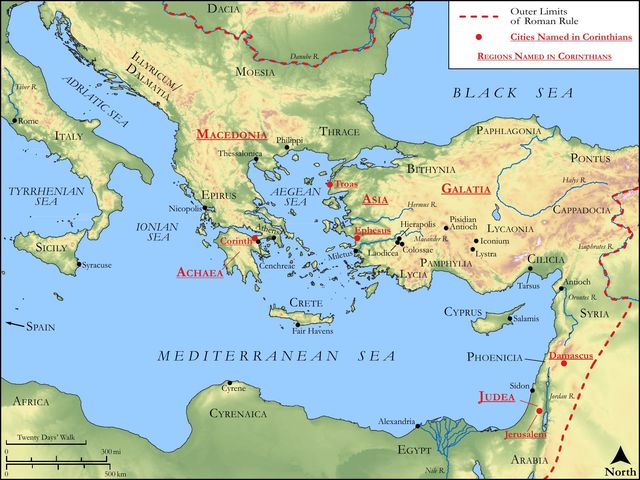
See on the biblical-era maps

Study this verse
Public-domain commentary
Matthew Henry
From his Commentary on the Whole Bible. Henry comments on passages, not single verses — this entry covers 1 Corinthians 15:1–11. His three-level outline is real structure in the source text, so it is rendered as structure.
It is the apostle's business in this chapter to assert and establish the doctrine of the resurrection of the dead, which some of the Corinthians flatly denied, Co1 15:12. Whether they turned this doctrine into allegory, as did Hymeneus and Philetus, by saying it was already past (Ti2 2:17, Ti2 2:18), and several of the ancient heretics, by making it mean no more than a changing of their course of life; or whether they rejected it as absurd, upon principles of reason and science; it seems they denied it in the proper sense. And they disowned a future state of recompences, by denying the resurrection of the dead. Now that heathens and infidels should deny this truth does not seem so strange; but that Christians, who had their religion by revelation, should deny a truth so plainly discovered is surprising, especially when it is a truth of such importance. It was time for the apostle to confirm them in this truth, when the staggering of their faith in this point was likely to shake their Christianity; and they were yet in great danger of having their faith staggered. He begins with an epitome or summary of the gospel, what he had preached among them, namely, the death and resurrection of Christ. Upon this foundation the doctrine of the resurrection of the dead is built. Note, Divine truths appear with greatest evidence when they are looked upon in their mutual connection. The foundation may be strengthened, that the superstructure may be secured. Now concerning the gospel observe,
I.What a stress he lays upon it (Co1 15:1, Co1 15:2): Moreover, brethren, I declare unto you the gospel which I preached to you.
1.It was what he constantly preached. His word was not yea and nay: he always preached the same gospel, and taught the same truth. He could appeal to his hearers for this. Truth is in its own nature invariable; and the infallible teachers of divine truth could never be at variance with themselves or one another. The doctrine which Paul had heretofore taught, he still taught.
2.It was what they had received; they had been convinced of the faith, believed it in their hearts, or at least made profession of doing so with their mouths. It was no strange doctrine. It was that very gospel in which, or by which, they had hitherto stood, and must continue to stand. If they gave up this truth, they left themselves no ground to stand upon, no footing in religion. Note, The doctrine of Christ's death and resurrection is at the foundation of Christianity. Remove this foundation, and the whole fabric falls, all our hopes for eternity sink at once. And it is by holding this truth firmly that Christians are made to stand in a day of trial, and kept faithful to God.
3.It was that alone by which they could hope for salvation (Co1 15:2), for there is no salvation in any other name; no name given under heaven by which we may be saved, but by the name of Christ. And there is no salvation in his name, but upon supposition of his death and resurrection. These are the saving truths of our holy religion. The crucifixion of our Redeemer and his conquest over death are the very source of our spiritual life and hopes. Now concerning these saving truths observe,
(1.)They must be retained in mind, they must be held fast (so the word is translated, Heb 10:23): Let us hold fast the profession of our faith. Note, The saving truths of the gospel must be fixed in our mind, revolved much in our thoughts, and maintained and held fast to the end, if we would be saved. They will not save us, if we do not attend to them, and yield to their power, and continue to do so to the end. He only that endureth to the end shall be saved, Mat 10:22.
(2.)We believe in vain, unless we continue and persevere in the faith of the gospel. We shall be never the better for a temporary faith; nay, we shall aggravate our guilt by relapsing into infidelity. And in vain is it to profess Christianity, or our faith in Christ, if we deny the resurrection; for this must imply and involve the denial of his resurrection; and, take away this, you make nothing of Christianity, you leave nothing for faith or hope to fix upon.
II.Observe what this gospel is, on which the apostle lays such stress.
It was that doctrine which he had received, and delivered to them, en prōtois - among the first, the principal. It was a doctrine of the first rank, a most necessary truth, That Christ died for our sins, and was buried, and rose again: or, in other words, that he was delivered for our offences and rose again for our justification (Rom 4:25), that he was offered in sacrifice for our sins, and rose again, to show that he had procured forgiveness for them, and was accepted of God in this offering. Note, Christ's death and resurrection are the very sum and substance of evangelical truth. Hence we derive our spiritual life now, and here we must found our hopes of everlasting life hereafter.
III.Observe how this truth is confirmed,
1.By Old Testament predictions. He died for our sins, according to the scriptures; he was buried, and rose from the dead, according to the scriptures, according to the scripture-prophecies, and scripture-types. Such prophecies as Psa 16:10; Isa 53:4-6; Dan 9:26, Dan 9:27; Hos 6:2. Such scripture-types as Jonah (Mat 12:4), as Isaac, who is expressly said by the apostle to have been received from the dead in a figure, Heb 11:19. Note, It is a great confirmation of our faith of the gospel to see how it corresponds with ancient types and prophecies.
2.By the testimony of many eye-witnesses, who saw Christ after he had risen from the dead. He reckons up five several appearances, beside that to himself. He was seen of Cephas, or Peter, then of the twelve, called so, though Judas was no longer among them, because this was their usual number; then he was seen of above five hundred brethren at once, many of whom were living when the apostle wrote this epistle, though some had fallen asleep. This was in Galilee, Mat 28:10. After that, he was seen of James singly, and then by all the apostles when he was taken up into heaven. This was on mount Olivet, Luk 24:50. Compare Act 1:2, Act 1:5-7. Note, How uncontrollably evident was Christ's resurrection from the dead, when so many eyes saw him at so many different times alive, and when he indulged the weakness of one disciple so far as to let him handle him, to put his resurrection out of doubt! And what reason have we to believe those who were so steady in maintaining this truth, though they hazarded all that was dear to them in this world, by endeavouring to assert and propagate it! Even Paul himself was last of all favoured with the sight of him. It was one of the peculiar offices of an apostle to be a witness of our Saviour's resurrection (Luk 24:48); and, when Paul was called to the apostolical office, he was made an evidence of this sort; the Lord Jesus appeared to him by the way to Damascus, Act 9:17. Having mentioned this favour, Paul takes occasion from it to make a humble digression concerning himself. He was highly favoured of God, but he always endeavoured to keep up a mean opinion of himself, and to express it. So he does here, by observing,
(1.)That he was one born out of due time (Co1 15:8), an abortive, ektrōma, a child dead born, and out of time. Paul resembled such a birth, in the suddenness of his new birth, in that he was not matured for the apostolic function, as the others were, who had personal converse with our Lord. He was called to the office when such conversation was not to be had, he was out of time for it. He had not known nor followed the Lord, nor been formed in his family, as the others were, for this high and honourable function. This was in Paul's account a very humbling circumstance.
(2.)By owning himself inferior to the other apostles: Not meet to be called an apostle. The least, because the last of them; called latest to the office, and not worthy to be called an apostle, to have either the office or the title, because he had been a persecutor of the church of God, Co1 15:9. Indeed, he tells us elsewhere that he was not a whit behind the very chief apostles (Co2 11:5) - for gifts, graces, service, and sufferings, inferior to none of them. Yet some circumstances in his case made him think more meanly of himself than of any of them. Note, A humble spirit, in the midst of high attainments, is a great ornament to any man; it sets his good qualities off to much greater advantage. What kept Paul low in an especial manner was the remembrance of his former wickedness, his raging and destructive zeal against Christ and him members. Note, How easily God can bring a good out of the greatest evil! When sinners are by divine grace turned into saints, he makes the remembrance of their former sins very serviceable, to make them humble, and diligent, and faithful.
(3.)By ascribing all that was valuable in him to divine grace: But by the grace of God I am what I am, Co1 15:10. It is God's prerogative to say, I am that I am; it is our privilege to be able to say, "By God's grace we are what we are." We are nothing but what God makes us, nothing in religion but what his grace makes us. All that is good in us is a stream from this fountain. Paul was sensible of this, and kept humble and thankful by this conviction; so should we. Nay, though he was conscious of his own diligence, and zeal, and service, so that he could say of himself, the grace of God was not given him in vain, but he laboured more abundantly than they all: he thought himself so much more the debtor to divine grace. Yet not I, but the grace of God which was with me. Note, Those who have the grace of God bestowed on them should take care that it be not in vain. They should cherish, and exercise, and exert, this heavenly principle. So did Paul, and therefore laboured with so much heart and so much success. And yet the more he laboured, and the more good he did, the more humble he was in his opinion of himself, and the more disposed to own and magnify the favour of God towards him, his free and unmerited favour. Note, A humble spirit will be very apt to own and magnify the grace of God. A humble spirit is commonly a gracious one. Where pride is subdued there it is reasonable to believe grace reigns.
After this digression, the apostle returns to his argument, and tells them (Co1 15:11) that he not only preached the same gospel himself at all times, and in all places, but that all the apostles preached the same: Whether it were they or I, so we preached, and so you believed. Whether Peter, or Paul, or any other apostle, had converted them to Christianity, all maintained the same truth, told the same story, preached the same doctrine, and confirmed it by the same evidence. All agreed in this that Jesus Christ, and him crucified and slain, and then rising from the dead, was the very sum and substance of Christianity; and this all true Christians believe. All the apostles agreed in this testimony; all Christians agree in the belief of it. By this faith they live. In this faith they die.
Historical interpretation
Two Centuries of Reception
4 surviving comments on this verse. Each one is dated, so this reads as a timeline rather than a list.
Select a marker to jump to its quote. Markers stagger vertically where authors wrote within a few decades of each other.
After these points, Celsus proceeds to bring against the Gospel narrative a charge which is not to be lightly passed over, saying that "if Jesus desired to show that his power was really divine, he ought to have appeared to those who had ill-treated him, and to him who had condemned him, and to all men universally." For it appears to us also to be true, according to the Gospel account, that He was not seen after His resurrection in the same manner as He used formerly to show Himself — publicly, and to all men. But it is recorded in the Acts, that "being seen during forty days," He expounded to His disciples "the things pertaining to the kingdom of God." [Acts 1:3] And in the Gospels it is not stated that He was always with them; but that on one occasion He appeared in their midst, after eight days, when the doors were shut [John 20:26], and on another in some similar fashion. And Paul also, in the concluding portions of the first Epistle to the Corinthians, in reference to His not having publicly appeared as He did in the period before He suffered, writes as follows: "For I delivered unto you first of all that which I also received, how that Christ died for our sins according to the Scriptures; and that He was seen of Cephas, then of the twelve: after that He was seen of above five hundred brethren at once, of whom the greater part remain unto the present time, but some are fallen asleep. After that He was seen of James, then of all the apostles. And last of all He was seen of me also, as of one born out of due time." [1 Corinthians 15:3-8] I am of opinion now that the statements in this passage contain some great and wonderful mysteries, which are beyond the grasp not merely of the great multitude of ordinary believers, but even of those who are far advanced (in Christian knowledge), and that in them the reason would be explained why He did not show Himself, after His resurrection from the dead, in the same manner as before that event.
Paul reminded us that we are to confess the manner of the death and resurrection not so much by literally naming these things but strictly according to the testimony of the Scriptures, so that our understanding of his death might be in accord with the apostles.… He did this in order that we might not become helpless or to be tossed about by the winds of useless disputes or hampered by the absurd subtleties of unsound opinions.
"And that he was buried."
And this also confirms the former topics, for that which is buried is doubtless a body. And here he no longer adds, "according to the Scriptures." He had wherewithal, nevertheless he adds it not. For what cause? Either because the burial was evident unto all, both then and now, or because the expression, "according to the Scriptures," is set down of both in common. Wherefore then doth he add, "according to the Scriptures," in this place, "and that He rose on the third day according to the Scriptures," and is not content with the former clause, so spoken in common? Because this also was to most men obscure: wherefore here again he brings in "the Scriptures" by inspiration, having so conceived this thought so wise and divine.
How is it then that he doth the same in regard of His death? Because in that case too, although the cross was evident unto all and in the sight of all He was stretched upon it; yet the cause was no longer equally so. The fact indeed of his death all knew, but that He suffered this for the sins of the world was no longer equally known to the multitude. Wherefore he brings in the testimony from the Scriptures.
This however hath been sufficiently proved by what we have said. But where have the Scriptures said that He was buried, and on the third day shall rise again? By the type of Jonah which also Himself alleges, saying, "As Jonah was three days and three nights in the whale's belly, so shall also the Son of Man be three days and three nights in the heart of the earth." By the bush in the desert. For even as that burned, yet was not consumed, so also that body died indeed, but was not holden of death continually. And the dragon also in Daniel shadows out this. For as the dragon having taken the food which the prophet gave, burst asunder in the midst; even so Hades having swallowed down that Body, was rent asunder, the Body of itself cutting asunder its womb and rising again.
Now if thou desirest to hear also in words those things which thou hast seen in types, listen to Isaiah, saying, "His life is taken from the earth," and, "it pleaseth the Lord to cleanse Him from His wound...to show unto Him light:" and David before him, "Thou wilt not leave My soul to Hades, nor wilt Thou suffer Thy Holy One to see corruption."
Therefore Paul also sends thee on to the Scriptures, that thou mayest learn that not without cause nor at random were these things done. For how could they, when so many prophets are describing and proclaiming them beforehand? And no where doth the Scripture mean the death of sin, when it makes mention of our Lord's death, but that of the body, and a burial and resurrection of the same kind.
Hosea [6:2] says: “He will revive us after two days; he will raise us up on the third day.”
Continue studying 1 Corinthians 15:4 across the web’s major study libraries — every link below opens this exact verse, chapter, or book on the destination site.
Read & Compare
 BibleGatewayThis verse in more than 200 translations and 70 languages.
 Bible.comThe YouVersion reader — hundreds of translations, reading plans, and highlights.
 ESV.orgCrossway's official English Standard Version reader.
 NET BibleThe NET translation with 60,000+ translators' notes on every rendering decision.
 STEP BibleTyndale House's free study tool — original text, vocabulary, and scholarly resources.
 BibliaLogos Bible Software's free web reader.
 USCCBThe New American Bible (Revised Edition) with the U.S. bishops' study notes.
Commentaries
 BibleHub CommentariesDozens of classic commentaries on this verse, gathered on one page.
 StudyLightMore than 100 commentary sets — the largest collection on the web.
 BibleRefPlain-English commentary on what this verse means, verse by verse.
 Enduring WordDavid Guzik's free commentary on this chapter, widely used by Bible teachers.
 Bible Study ToolsVerse commentary alongside Greek and Hebrew study aids.
Original Language & Research
- BibleHub InterlinearThe verse word by word — original language, transliteration, and English.
- BibleHub LexiconEvery word's original-language definition and Strong's entry.
 Blue Letter BibleDeep-study tools — Strong's numbers, concordance, and word studies.
 CNTR CollationThe earliest Greek manuscripts of this verse, collated letter by letter.
Sermons, Hymns & Audio


TrulyRandomVerse is not affiliated with these sites and doesn’t control their content. They’re linked because they’re genuinely useful.
Summary
First Corinthians 15:4 stands as a foundational declaration within the Christian gospel, articulating the historical reality and theological significance of Jesus Christ's burial and resurrection on the third day, all in fulfillment of divine prophecy. This verse, presented by Paul as part of the essential truths he received and delivered, underscores the indispensable nature of Christ's triumph over death for the validity of Christian faith and the hope of believers.
Context
ShowHideLiterary Context
This verse is situated at the very heart of 1 Corinthians chapter 15, often reverently referred to as the "Resurrection Chapter." Paul meticulously constructs his argument to address profound theological confusion and outright denial of the resurrection of the dead within the Corinthian church. Having established the core gospel message in 1 Corinthians 15:1-3, which includes Christ's death for sins, Paul immediately follows with His burial and resurrection, emphasizing these as non-negotiable historical facts. The entire chapter then systematically builds upon this foundation, arguing that if Christ has not been raised, then the faith of believers is futile, their sins remain, and those who have died in Christ have perished (1 Corinthians 15:17-18). Thus, 1 Corinthians 15:4 serves as a critical linchpin in Paul's defense of both Christ's resurrection and the future resurrection of all believers.
Historical & Cultural Context
The city of Corinth was a bustling, cosmopolitan hub, renowned for its diverse philosophical schools, including Stoicism and Epicureanism, which often held skeptical views regarding bodily resurrection. Greek thought, influenced by Platonic dualism, frequently viewed the physical body as inferior or even a prison for the soul, making the concept of a bodily resurrection unappealing or even absurd. This cultural milieu likely contributed to the doubts and false teachings Paul was confronting. Furthermore, the Jewish background of some believers would have understood "according to the scriptures" as a powerful validation, connecting Christ's actions directly to the prophetic narrative of the Old Testament. The public nature of burial and the subsequent discovery of an empty tomb would have been culturally significant markers of a completed death and a supernatural event, respectively.
Key Themes
ShowHideThe themes radiating from 1 Corinthians 15:4 are manifold and foundational to Christian theology. Firstly, it powerfully asserts the historicity of the gospel events, emphasizing that Christ's death, burial, and resurrection were not mythical tales but verifiable occurrences witnessed by many, as Paul details later in 1 Corinthians 15:5-8. Secondly, it highlights the divine orchestration of salvation history, with the repeated phrase "according to the scriptures" underscoring that these events were not random but the fulfillment of God's predetermined plan, foretold in the Old Testament (e.g., Isaiah 53:9-12 and Psalm 16:10). Thirdly, and most crucially, it establishes the centrality of the resurrection as the ultimate validation of Christ's identity, His atoning work, and the believer's hope for eternal life. Without the resurrection, the Christian message collapses (1 Corinthians 15:14).
Exposition and Analysis
ShowHideKey Word Analysis
ShowHideA primary verb meaning "to celebrate funeral rites, i.e., inter." This word emphasizes the undeniable reality of Jesus' physical death. Burial was the customary and public act that confirmed a person's demise, removing any doubt that Jesus merely fainted or swooned. It signifies the completion of His death, making His subsequent resurrection all the more miraculous and verifiable.
Meaning "to waken (transitively or intransitively), i.e., rouse (literally, from sleep, from sitting or lying, from disease, from death; or figuratively, from obscurity, inactivity, ruins, nonexistence)." This verb powerfully conveys the act of being raised from the dead. In the context of Christ, it signifies His victory over death, not merely a revival, but a transformation into a new, glorified state. The perfect tense (implied by Paul's usage elsewhere in this chapter, though here aorist for historical fact) emphasizes a completed action with ongoing results: Jesus was raised, and He remains risen.
Meaning "a document, i.e., holy Writ (or its contents or a statement in it)." This term refers specifically to the Old Testament. The phrase "according to the scriptures" asserts that Christ's death, burial, and resurrection were not random or unexpected events but were part of God's predetermined plan, foretold and foreshadowed throughout the Hebrew Bible. This divine foreknowledge authenticates Jesus as the promised Messiah and demonstrates God's sovereign control over history and salvation.
Verse Breakdown
ShowHide"And that he was buried,"
This clause emphasizes the undeniable reality and finality of Jesus' death. His burial in a tomb, witnessed by various individuals, served as conclusive proof that He had truly died. This detail is crucial because a genuine resurrection requires a genuine death; it counters any notion that Jesus merely collapsed or was removed from the cross alive. It also sets the stage for the empty tomb, which would later become a key piece of evidence for His resurrection.
"and that he rose again the third day"
This is the pivotal declaration, forming the heart of the Christian gospel. It proclaims Jesus' miraculous triumph over death, signifying His divine power and authority. The specific mention of "the third day" is significant, not only as a historical marker but also as a fulfillment of various Old Testament types and prophecies (e.g., Jonah's three days in the fish, Hosea's prophecy of being raised on the third day). This event validates all of Jesus' claims, confirms His atoning sacrifice, and establishes Him as the living Lord.
"according to the scriptures:"
This crucial phrase, repeated from the previous verse, underscores the divine intentionality and prophetic fulfillment inherent in Christ's burial and resurrection. It asserts that these events were not accidental but precisely aligned with God's pre-revealed plan as recorded in the Old Testament. While no single verse explicitly states "He will rise on the third day," the concept is understood through various prophetic types, shadows, and Messianic prophecies concerning His suffering, death, and subsequent vindication and exaltation (e.g., Jonah 1:17, Hosea 6:2, Psalm 16:10, Isaiah 53:10-12). This connection to the scriptures provides a powerful theological validation for the gospel message.
Literary Devices
ShowHidePaul's concise yet profound statement in 1 Corinthians 15:4 employs several effective literary devices. The most prominent is Repetition, specifically of the phrase "according to the scriptures," which appears in both 1 Corinthians 15:3 and 1 Corinthians 15:4. This repetition serves to emphasize the divine authority and prophetic fulfillment underlying the core gospel events. It acts as a theological anchor, grounding the historical facts in God's eternal plan. Furthermore, there is a clear Parallelism and Chiasm in Paul's presentation of the gospel in verses 3-4. He moves from Christ's death (verse 3a) to His burial (verse 4a), then to His resurrection (verse 4b), effectively framing the central event with its necessary preceding acts. This structured presentation provides a logical and memorable summary of the gospel's essential components. The use of simple, declarative statements also lends an air of Authority and Factuality to Paul's proclamation, reinforcing the non-negotiable nature of these truths.
Theological and Thematic Connections
ShowHideThe theological implications of 1 Corinthians 15:4 are vast and foundational to Christian doctrine. Christ's burial confirms the reality of His death, essential for the efficacy of His atonement, while His resurrection on the third day is God's ultimate vindication of Jesus and His saving work. It signifies His victory over sin, death, and the grave, providing the bedrock for the justification of believers and the promise of their own future resurrection. This verse encapsulates the power of God manifested in history, demonstrating that God is sovereign over life and death, and that His promises, foretold in the Old Testament, are faithfully fulfilled in Christ.
Reflection and Application
ShowHideFirst Corinthians 15:4 calls believers to ground their faith not in abstract ideas or wishful thinking, but in the historical, verifiable facts of Christ's death, burial, and resurrection. The reality of Jesus' burial ensures the finality of His death, making His subsequent resurrection all the more astounding and miraculous. This truth provides unwavering assurance that our sins have been fully atoned for, as God's raising of Jesus from the dead serves as His divine "Amen" to Christ's sacrifice. Furthermore, the resurrection of Christ is the firstfruits of a greater harvest, guaranteeing our own future resurrection and transformation. Living in light of this victorious reality means embracing a hope that transcends death, finding strength to overcome present trials, and confidently proclaiming the good news to a world still bound by sin and mortality.
Questions for Reflection
ShowHideFAQ
ShowHideWhy is Christ's burial specifically mentioned alongside His death and resurrection?
ShowHideChrist's burial is crucial because it provides undeniable proof of His physical death, countering any claims that He merely swooned or was not truly deceased. It confirms the finality of His earthly life and sets the stage for the miraculous event of the empty tomb and His resurrection. The burial also fulfills Old Testament prophecies, such as Isaiah 53:9, which speaks of the Messiah being "with the rich in his death." It underscores the reality of the human experience of Jesus and the depth of His descent for our salvation.
What does "according to the scriptures" refer to in this context?
ShowHide"According to the scriptures" refers to the Old Testament prophecies and types that foreshadowed or explicitly predicted the Messiah's suffering, death, and resurrection. While no single verse states "He will rise on the third day," the concept is woven throughout the Hebrew Bible. Examples include Jonah 1:17 (interpreted by Jesus Himself as a sign of His resurrection in Matthew 12:40), Hosea 6:2, Psalm 16:10, and the broader themes of the suffering servant in Isaiah 53. This phrase emphasizes that Christ's actions were not random but were part of God's predetermined, revealed plan for salvation.
Christ-Centered Fulfillment
ShowHideFirst Corinthians 15:4 finds its profound Christ-centered fulfillment in establishing Jesus as the triumphant Lord over sin and death, thereby securing the believer's hope and justification. His burial confirms the reality of His substitutionary death, where He truly bore the penalty for our sins, as articulated in 2 Corinthians 5:21. The resurrection on the third day is the divine seal of approval on His atoning work, demonstrating that the Father accepted His sacrifice and that He possesses all authority in heaven and on earth (Matthew 28:18). This pivotal event inaugurates the new creation and serves as the "firstfruits" of all who will be raised to new life in Him (1 Corinthians 15:20-23). Because Christ was raised, believers are declared righteous (Romans 4:25), are united with Him in a new spiritual life (Romans 6:4-5), and are guaranteed a future bodily resurrection into eternal glory (Philippians 3:20-21). Thus, Christ's resurrection, "according to the scriptures," is not merely a historical fact but the living power that transforms lives and assures the ultimate triumph of God's redemptive plan.