


1 Corinthians 15:14
Bible text: King James Version (1769 Blayney text) · Public domain
Bible text: Berean Standard Bible · Public domain
Bible text: American Standard Version (1901) · Public domain
Bible text: World English Bible, Messianic edition · Public domain
Bible text: Geneva Bible (1599) · Public domain
Bible text: Young's Literal Translation · Public domain
- εἰeiifG1487CONDConjunction
- δὲdethenG1161CONJConjunction
- ΧριστὸςChristosChristG5547N-NSM-TNoun Nominative Singular Masculine Title
- οὐκouknotG3756PRT-NNegative Particle Negative
- ἐγήγερταιegēgertaihas been raisedG1453V-RPI-3SVerb Perfect Passive Indicative 3rd Singular
- κενὸνkenon[is] voidG2756A-NSNAdjective Nominative Singular Neuter
- ἄραarathenG686CONJConjunction
- τὸtotheG3588T-NSNDefinite article Nominative Singular Neuter
- κήρυγμαkērugmapreachingG2782N-NSNNoun Nominative Singular Neuter
- ἡμῶνhēmōnof usG3165P-1GPPersonal pronoun Genitive 1st Plural
- κενὴkenēvoidG2756A-NSFAdjective Nominative Singular Feminine
- δὲdenowG1161CONJConjunction
- καὶkaialsoG2532CONJConjunction
- ἡhētheG3588T-NSFDefinite article Nominative Singular Feminine
- πίστιςpistisfaithG4102N-NSFNoun Nominative Singular Feminine
- ὑμῶνhumōnof youG4771P-2GPPersonal pronoun Genitive 2nd Plural
English is a literal word-by-word gloss of the Greek, not the KJV's wording. Why?
This is the original text the KJV's translators worked from — each Greek word with its own literal English meaning in this verse, prepared by scholars at Tyndale House, Cambridge. The KJV translates whole sentences, not word by word, so its wording differs: one Greek word can become several English words, and the KJV may choose “charity” where the gloss reads “love”. Both are faithful — they answer different questions. For the KJV's own rendering, switch to the KJV text.
Details
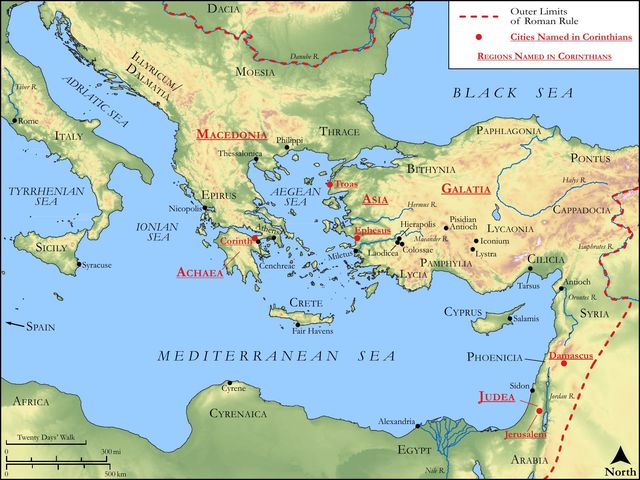
See on the biblical-era maps

Study this verse
Public-domain commentary
Matthew Henry
From his Commentary on the Whole Bible. Henry comments on passages, not single verses — this entry covers 1 Corinthians 15:12–19.
Having confirmed the truth of our Saviour's resurrection, the apostle goes on to refute those among the Corinthians who said there would be none: If Christ be preached that he rose from the dead, how say some among you that there is no resurrection of the dead? Co1 15:12. It seems from this passage, and the course of the argument, there were some among the Corinthians who thought the resurrection an impossibility. This was a common sentiment among the heathens. But against this the apostle produces an incontestable fact, namely, the resurrection of Christ; and he goes on to argue against them from the absurdities that must follow from their principle. As,
I.If there be (can be) no resurrection of the dead, then Christ has not risen (Co1 15:13); and again, "If the dead rise not, cannot be raised or recovered to life, then is Christ not raised, Co1 15:16. And yet it was foretold in ancient prophecies that he should rise; and it has been proved by multitudes of eye-witnesses that he had risen. And will you say, will any among you dare to say, that is not, cannot be, which God long ago said should be, and which is now undoubted matter of fact?"
II.It would follow hereupon that the preaching and faith of the gospel would be vain:
If Christ be not risen, then is our preaching vain, and your faith vain, Co1 15:14. This supposition admitted, would destroy the principal evidence of Christianity; and so, 1. Make preaching vain. "We apostles should be found false witnesses of God; we pretend to be God's witnesses for truth, and to work miracles by his power in confirmation of it, and are all the while deceivers, liars for God, if in his name, and by power received from him, we go forth, and publish and assert a thing false in fact, and impossible to be true. And does not this make us the vainest men in the world, and our office and ministry the vainest and most useless thing in the world? What end could we propose to ourselves in undertaking this hard and hazardous service, if we knew our religion stood on no better foundation, nay, if we were not well assured of the contrary? What should we preach for? Would not our labour be wholly in vain? We can have no very favourable expectations in this life; and we could have none beyond it. If Christ be not raised, the gospel is a jest; it is chaff and emptiness." 2. This supposition would make the faith of Christians vain, as well as the labours of ministers: If Christ be not raised, your faith is vain; you are yet in your sins (Co1 15:17), yet under the guilt and condemnation of sin, because it is through his death and sacrifice for sin alone that forgiveness is to be had. We have redemption through his blood, the forgiveness of sins, Eph 1:7. No remission of sins is to be had but through the shedding of his blood. And had his blood been shed, and his life taken away, without ever being restored, what evidence could we have had that through him we should have justification and eternal life? Had he remained under the power of death, how could he have delivered us from its power? And how vain a thing is faith in him, upon this supposition! He must rise for our justification who was delivered for our sins, or in vain we look for any such benefit by him. There had been no justification nor salvation if Christ had not risen. And must not faith in Christ be vain, and of no signification, if he be still among the dead?
III.Another absurdity following from this supposition is that those who have fallen asleep in Christ have perished.
if there be no resurrection, they cannot rise, and therefore are lost, even those who have died in the Christian faith, and for it. It is plain from this that those among the Corinthians who denied the resurrection meant thereby a state of future retribution, and not merely the revival of the flesh; they took death to be the destruction and extinction of the man, and not merely of the bodily life; for otherwise the apostle could not infer the utter loss of those who slept in Jesus, from the supposition that they would never rise more or that they had no hopes in Christ after life; for they might have hope of happiness for their minds if these survived their bodies, and this would prevent the limiting of their hopes in Christ to this life only. "Upon supposition there is no resurrection in your sense, no after-state and life, then dead Christians are quite lost. How vain a thing were our faith and religion upon this supposition!" And this,
IV.Would infer that Christ's ministers and servants were of all men most miserable, as having hope in him in this life only (Co1 15:19), which is another absurdity that would follow from asserting no resurrection. Their condition who hope in Christ would be worse than that of other men. Who hope in Christ. Note, All who believe in Christ have hope in him; all who believe in him as a Redeemer hope for redemption and salvation by him; but if there be no resurrection, or state of future recompence (which was intended by those who denied the resurrection at Corinth), their hope in him must be limited to this life: and, if all their hopes in Christ lie within the compass of this life, they are in a much worse condition than the rest of mankind, especially at that time, and under those circumstances, in which the apostles wrote; for then they had no countenance nor protection from the rulers of the world, but were hated and persecuted by all men. Preachers and private Christians therefore had a hard lot if in this life only they had hope in Christ. Better be any thing than a Christian upon these terms; for in this world they are hated, and hunted, and abused, stripped of all worldly comforts and exposed to all manner of sufferings: they fare much harder than other men in this life, and yet have no further nor better hopes. And is it not absurd for one who believes in Christ to admit a principle that involves so absurd an inference? Can that man have faith in Christ who can believe concerning him that he will leave his faithful servants, whether ministers or others, in a worse state than his enemies? Note, It were a gross absurdity in a Christian to admit the supposition of no resurrection or future state. It would leave no hope beyond this world, and would frequently make his condition the worst in the world. Indeed, the Christian is by his religion crucified to this world, and taught to live upon the hope of another. Carnal pleasures are insipid to him in a great degree; and spiritual and heavenly pleasures are those which he affects and pants after. How sad is his case indeed, if he must be dead to worldly pleasures and yet never hope for any better!
Historical interpretation
Historical reception
3 surviving comments on this verse. Each one is dated, so this reads as a timeline rather than a list.
Select a marker to jump to its quote. Markers stagger vertically where authors wrote within a few decades of each other.
"And if Christ hath not been raised, then is our preaching vain, your faith also is vain."
Although what followed in due course would have been, "but if Christ be not risen, ye fight against things evident, and against so many prophets, and the truth of facts;" nevertheless he states what is much more fearful to them: "then is our preaching vain, your faith also is vain." For he wishes to shake thoroughly their mind: "we have lost all," saith he, "all is over, if He be not risen." Seest thou how great is the mystery of the oeconomy? As thus: if after death He could not rise again, neither is sin loosed nor death taken away nor the curse removed. Yea, and not only have we preached in vain, but ye also have believed in vain.
Some heretics claim that there is a resurrection of the soul but not of the body, though this makes no sense. How can there be a resurrection of something which has not fallen into the ground and died?
Forgiveness of sins comes through the resurrection.
Continue studying 1 Corinthians 15:14 across the web’s major study libraries — every link below opens this exact verse, chapter, or book on the destination site.
Read & Compare
 BibleGatewayThis verse in more than 200 translations and 70 languages.
 Bible.comThe YouVersion reader — hundreds of translations, reading plans, and highlights.
 ESV.orgCrossway's official English Standard Version reader.
 NET BibleThe NET translation with 60,000+ translators' notes on every rendering decision.
 STEP BibleTyndale House's free study tool — original text, vocabulary, and scholarly resources.
 BibliaLogos Bible Software's free web reader.
 USCCBThe New American Bible (Revised Edition) with the U.S. bishops' study notes.
Commentaries
 BibleHub CommentariesDozens of classic commentaries on this verse, gathered on one page.
 StudyLightMore than 100 commentary sets — the largest collection on the web.
 BibleRefPlain-English commentary on what this verse means, verse by verse.
 Enduring WordDavid Guzik's free commentary on this chapter, widely used by Bible teachers.
 Bible Study ToolsVerse commentary alongside Greek and Hebrew study aids.
Original Language & Research
- BibleHub InterlinearThe verse word by word — original language, transliteration, and English.
- BibleHub LexiconEvery word's original-language definition and Strong's entry.
 Blue Letter BibleDeep-study tools — Strong's numbers, concordance, and word studies.
 CNTR CollationThe earliest Greek manuscripts of this verse, collated letter by letter.
Sermons, Hymns & Audio


TrulyRandomVerse is not affiliated with these sites and doesn’t control their content. They’re linked because they’re genuinely useful.
Summary
First Corinthians 15:14 stands as a foundational declaration in Paul's comprehensive defense of the resurrection of Jesus Christ, asserting that the entire edifice of Christian proclamation and personal faith is rendered utterly meaningless and without effect if Christ has not been physically raised from the dead. This verse encapsulates the absolute centrality of the resurrection as the historical and theological linchpin of the gospel message and the believer's hope, underscoring its non-negotiable status for the validity of Christianity itself.
Context
ShowHideLiterary Context
This verse is strategically placed within 1 Corinthians 15, often referred to as the "Resurrection Chapter," where the Apostle Paul provides an exhaustive argument for the bodily resurrection of Jesus Christ and its implications for the resurrection of believers. Paul begins by reiterating the core gospel message, including Christ's death, burial, and resurrection, supported by numerous eyewitness accounts (1 Corinthians 15:3-8). He then addresses the specific error prevalent in Corinthian circles – the denial of the resurrection of the dead (1 Corinthians 15:12). Verse 14 serves as a crucial logical step in Paul's reductio ad absurdum argument, demonstrating the catastrophic consequences if the resurrection were false, leading into further dire implications in subsequent verses (1 Corinthians 15:15-19).
Historical & Cultural Context
The city of Corinth was a bustling, cosmopolitan hub, deeply influenced by Greek philosophy and Roman culture. Many prevailing philosophical schools, such as Platonism and Stoicism, often viewed the body as a prison or an inferior vessel, holding a low regard for physical existence and thus making the concept of a bodily resurrection seem absurd or undesirable. The idea of a spirit surviving death was acceptable, but a physical reanimation was largely foreign and often ridiculed (Acts 17:32). Furthermore, the Corinthian church itself was plagued by various internal divisions and moral issues, suggesting a potential lack of firm theological grounding among some members. Paul's robust defense of the resurrection was therefore not merely an abstract theological discourse but a direct challenge to deeply ingrained cultural assumptions and a necessary corrective for a church struggling with fundamental truths.
Key Themes
ShowHideThe verse directly contributes to several major themes within 1 Corinthians and the broader New Testament. Foremost is The Centrality of Christ's Resurrection, establishing it as the absolute, non-negotiable foundation of the Christian faith. It highlights The Inseparability of Preaching and Reality, asserting that the apostolic message is only powerful and true if its central claim – Christ's resurrection – is a historical fact. Conversely, it underscores The Futility of Faith Without Resurrection, demonstrating that without a risen Christ, both the gospel proclamation and the individual's belief are empty, offering no salvation, no hope, and no victory over sin and death. This theme is further developed as Paul explains that if Christ is not risen, believers are still in their sins (1 Corinthians 15:17), and those who have died in Christ have perished (1 Corinthians 15:18).
Exposition and Analysis
ShowHideKey Word Analysis
ShowHideThis verb means "to waken (transitively or intransitively), i.e., rouse (literally, from sleep, from sitting or lying, from disease, from death; or figuratively, from obscurity, inactivity, ruins, nonexistence)." In the context of 1 Corinthians 15, its primary meaning is a literal, physical raising from death, emphasizing the bodily resurrection of Jesus. It implies a powerful act of God, bringing Christ back to life from the grave, not merely a spiritual awakening or metaphorical rising.
Derived from the verb "to proclaim" (kērússō), kḗrygma refers to "a proclamation (especially of the gospel; by implication, the gospel itself)." It denotes the authoritative, public declaration of the good news of salvation, particularly as delivered by the apostles. Paul here emphasizes that the very content and power of this proclamation are entirely dependent on the historical reality of Christ's resurrection. If the resurrection is false, the message itself is a hollow echo.
This word signifies something that is "empty (literally or figuratively)," "useless," or "futile." It's not merely "incorrect" but utterly devoid of content, purpose, power, or beneficial outcome. If Christ did not rise, then the apostolic message and the believer's faith are not just mistaken; they are fundamentally hollow, without substance, and incapable of achieving their intended purpose of salvation and eternal life.
Verse Breakdown
ShowHide"And if Christ be not risen,"
This opening clause establishes a hypothetical condition, serving as the premise for Paul's logical argument. The "if" (G1487, ei) introduces a real possibility that some in Corinth were entertaining, even though Paul considers it unthinkable. The phrase "be not risen" directly challenges the historical and theological fact of Jesus' physical resurrection.
"then is our preaching vain,"
This is the first dire consequence of the hypothetical premise. "Our preaching" refers specifically to the apostolic proclamation of the gospel, the core message delivered by Paul and other apostles. If Christ has not been raised, then this proclamation is "vain" (kenós), meaning it is empty, without substance, power, or truth. It becomes a mere human fabrication, devoid of divine authority or saving efficacy.
"and your faith is also vain."
This is the second, equally devastating consequence, shifting from the apostles' message to the believers' personal response. "Your faith" refers to the trust and belief placed in Christ and the gospel message by the Corinthian Christians. If the resurrection is false, then this faith is also "vain" (kenós). It means their belief is groundless, futile, and ultimately incapable of delivering salvation, forgiveness of sins, or eternal hope. Their entire spiritual foundation collapses.
Literary Devices
ShowHidePaul employs several powerful literary devices in this concise verse to convey the absolute necessity of the resurrection. The primary device is a Hypothetical Syllogism (or conditional statement), structured as "If A, then B and C." This logical framework allows Paul to lay out the devastating consequences that necessarily follow if the premise (Christ not risen) were true. The Repetition of the word "vain" (Greek, kenós) for both "preaching" and "faith" creates a strong sense of emphasis, underscoring the complete emptiness and futility that would characterize Christianity without a risen Christ. This repetition functions almost as a Rhetorical Device, driving home the point that the entire Christian enterprise hinges on this one historical event. The verse also demonstrates powerful Juxtaposition between the life-giving truth of the resurrection (implied by the negative conditional) and the utter emptiness that would result from its absence.
Theological and Thematic Connections
ShowHideThe theological implications of 1 Corinthians 15:14 are profound, asserting that the resurrection of Jesus Christ is not merely one doctrine among many, but the indispensable foundation upon which the entire Christian faith rests. Without it, the gospel message loses its power, the apostles become false witnesses, and believers remain unforgiven and without hope of eternal life. The resurrection validates Christ's claims to divinity, His victory over sin and death, and the efficacy of His atoning sacrifice. It transforms Christianity from a philosophical system or moral code into a living relationship with a conquering Lord, providing assurance of future resurrection for all who believe. It is the ultimate demonstration of God's power and faithfulness, confirming the truth of His promises and the reality of eternal life.
Reflection and Application
ShowHideFirst Corinthians 15:14 calls every believer to a profound reflection on the bedrock of their faith. In a world often skeptical of supernatural claims, this verse reminds us that Christianity is not founded on a myth or a mere ethical teaching, but on a verifiable historical event: the bodily resurrection of Jesus Christ. This truth should anchor our hope, giving us an unshakeable confidence in God's power to overcome sin, death, and all evil. It empowers our witness, knowing that the message we proclaim is not empty but carries the life-transforming power of a living Savior. Furthermore, it gives profound purpose to our daily lives, our struggles, and our service, knowing that our labor in the Lord is not "vain" (as Paul explicitly states in 1 Corinthians 15:58) because we serve a risen King who guarantees our future resurrection and eternal glory. Our faith is not a blind leap, but a confident trust in the One who conquered the grave.
Questions for Reflection
ShowHideFAQ
ShowHideWhy is the resurrection of Jesus Christ so central to the Christian faith, as implied by this verse?
ShowHideThe resurrection of Jesus Christ is central because it is the ultimate proof of His divine identity and power, validating His claims to be the Son of God and the Messiah. It confirms that His atoning death on the cross was accepted by God as a complete payment for sin, demonstrating His victory over sin and death. Without the resurrection, Christ's death would merely be that of a martyr, not a conquering Savior. As Paul argues in 1 Corinthians 15:17, if Christ is not risen, believers are still in their sins, meaning His sacrifice would be insufficient. The resurrection also guarantees the future resurrection of believers, offering hope beyond the grave (1 Corinthians 15:20-23).
What does Paul mean by "vain" when he applies it to preaching and faith?
ShowHideWhen Paul uses the word "vain" (Greek, kenós), he means empty, useless, futile, or without substance and effect. If Christ is not risen, then "our preaching" (the apostolic proclamation of the gospel) is empty because its central message—that Christ died for our sins and rose again—is false. It would be a message without power or truth, incapable of saving anyone. Similarly, "your faith" (the personal trust and belief of believers) would also be empty and futile. It would be faith placed in a dead savior, offering no forgiveness, no new life, and no hope of eternal salvation. The entire enterprise of Christianity would be a grand deception, completely lacking any beneficial outcome or divine reality.
Christ-Centered Fulfillment
ShowHide1 Corinthians 15:14 is a powerful declaration of the Christ-centered nature of the gospel, asserting that Jesus' resurrection is the very heart and soul of our faith. It is through His triumph over death that He is revealed as the living Lord, the "firstfruits of them that slept" (1 Corinthians 15:20), guaranteeing the resurrection of all who are "in Christ" (1 Corinthians 15:22). His resurrection is not merely a historical event but the ongoing source of our spiritual life, for it is the same Spirit who raised Jesus from the dead who now dwells in believers, giving life to our mortal bodies (Romans 8:11). Because Christ is risen, our hope is not in a dead prophet or a set of moral teachings, but in a victorious King who holds "the keys of hell and of death" (Revelation 1:18). He is the Head of the Church, "the beginning, the firstborn from the dead" (Colossians 1:18), and His resurrection ensures that our faith is not vain, but firmly grounded in the power of God, leading to eternal life and an imperishable inheritance (1 Peter 1:3-4).