


1 Corinthians 15:17
Bible text: King James Version (1769 Blayney text) · Public domain
Bible text: Berean Standard Bible · Public domain
Bible text: American Standard Version (1901) · Public domain
Bible text: World English Bible, Messianic edition · Public domain
Bible text: Geneva Bible (1599) · Public domain
Bible text: Young's Literal Translation · Public domain
- εἰeiifG1487CONDConjunction
- δὲdethenG1161CONJConjunction
- ΧριστὸςChristosChristG5547N-NSM-TNoun Nominative Singular Masculine Title
- οὐκouknotG3756PRT-NNegative Particle Negative
- ἐγήγερταιegēgertaihas been raisedG1453V-RPI-3SVerb Perfect Passive Indicative 3rd Singular
- ματαίαmataia[is] futileG3152A-NSFAdjective Nominative Singular Feminine
- ἡhētheG3588T-NSFDefinite article Nominative Singular Feminine
- πίστιςpistisfaithG4102N-NSFNoun Nominative Singular Feminine
- ὑμῶνhumōnof youG4771P-2GPPersonal pronoun Genitive 2nd Plural
- ἔτιetistillG2089ADVAdverb
- ἐστὲesteyou areG1510V-PAI-2PVerb Present Active Indicative 2nd Plural
- ἐνeninG1722PREPPreposition
- ταῖςtaistheG3588T-DPFDefinite article Dative Plural Feminine
- ἁμαρτίαιςhamartiaissinsG266N-DPFNoun Dative Plural Feminine
- ὑμῶν·humōnof youG4771P-2GPPersonal pronoun Genitive 2nd Plural
English is a literal word-by-word gloss of the Greek, not the KJV's wording. Why?
This is the original text the KJV's translators worked from — each Greek word with its own literal English meaning in this verse, prepared by scholars at Tyndale House, Cambridge. The KJV translates whole sentences, not word by word, so its wording differs: one Greek word can become several English words, and the KJV may choose “charity” where the gloss reads “love”. Both are faithful — they answer different questions. For the KJV's own rendering, switch to the KJV text.
Details
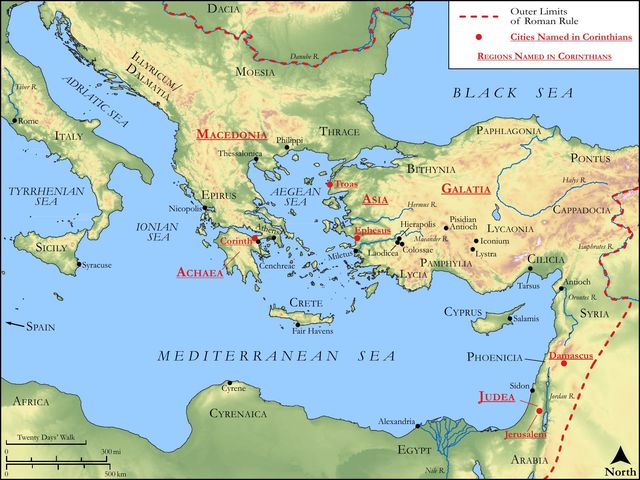
See on the biblical-era maps

Study this verse
Public-domain commentary
Matthew Henry
From his Commentary on the Whole Bible. Henry comments on passages, not single verses — this entry covers 1 Corinthians 15:12–19.
Having confirmed the truth of our Saviour's resurrection, the apostle goes on to refute those among the Corinthians who said there would be none: If Christ be preached that he rose from the dead, how say some among you that there is no resurrection of the dead? Co1 15:12. It seems from this passage, and the course of the argument, there were some among the Corinthians who thought the resurrection an impossibility. This was a common sentiment among the heathens. But against this the apostle produces an incontestable fact, namely, the resurrection of Christ; and he goes on to argue against them from the absurdities that must follow from their principle. As,
I.If there be (can be) no resurrection of the dead, then Christ has not risen (Co1 15:13); and again, "If the dead rise not, cannot be raised or recovered to life, then is Christ not raised, Co1 15:16. And yet it was foretold in ancient prophecies that he should rise; and it has been proved by multitudes of eye-witnesses that he had risen. And will you say, will any among you dare to say, that is not, cannot be, which God long ago said should be, and which is now undoubted matter of fact?"
II.It would follow hereupon that the preaching and faith of the gospel would be vain:
If Christ be not risen, then is our preaching vain, and your faith vain, Co1 15:14. This supposition admitted, would destroy the principal evidence of Christianity; and so, 1. Make preaching vain. "We apostles should be found false witnesses of God; we pretend to be God's witnesses for truth, and to work miracles by his power in confirmation of it, and are all the while deceivers, liars for God, if in his name, and by power received from him, we go forth, and publish and assert a thing false in fact, and impossible to be true. And does not this make us the vainest men in the world, and our office and ministry the vainest and most useless thing in the world? What end could we propose to ourselves in undertaking this hard and hazardous service, if we knew our religion stood on no better foundation, nay, if we were not well assured of the contrary? What should we preach for? Would not our labour be wholly in vain? We can have no very favourable expectations in this life; and we could have none beyond it. If Christ be not raised, the gospel is a jest; it is chaff and emptiness." 2. This supposition would make the faith of Christians vain, as well as the labours of ministers: If Christ be not raised, your faith is vain; you are yet in your sins (Co1 15:17), yet under the guilt and condemnation of sin, because it is through his death and sacrifice for sin alone that forgiveness is to be had. We have redemption through his blood, the forgiveness of sins, Eph 1:7. No remission of sins is to be had but through the shedding of his blood. And had his blood been shed, and his life taken away, without ever being restored, what evidence could we have had that through him we should have justification and eternal life? Had he remained under the power of death, how could he have delivered us from its power? And how vain a thing is faith in him, upon this supposition! He must rise for our justification who was delivered for our sins, or in vain we look for any such benefit by him. There had been no justification nor salvation if Christ had not risen. And must not faith in Christ be vain, and of no signification, if he be still among the dead?
III.Another absurdity following from this supposition is that those who have fallen asleep in Christ have perished.
if there be no resurrection, they cannot rise, and therefore are lost, even those who have died in the Christian faith, and for it. It is plain from this that those among the Corinthians who denied the resurrection meant thereby a state of future retribution, and not merely the revival of the flesh; they took death to be the destruction and extinction of the man, and not merely of the bodily life; for otherwise the apostle could not infer the utter loss of those who slept in Jesus, from the supposition that they would never rise more or that they had no hopes in Christ after life; for they might have hope of happiness for their minds if these survived their bodies, and this would prevent the limiting of their hopes in Christ to this life only. "Upon supposition there is no resurrection in your sense, no after-state and life, then dead Christians are quite lost. How vain a thing were our faith and religion upon this supposition!" And this,
IV.Would infer that Christ's ministers and servants were of all men most miserable, as having hope in him in this life only (Co1 15:19), which is another absurdity that would follow from asserting no resurrection. Their condition who hope in Christ would be worse than that of other men. Who hope in Christ. Note, All who believe in Christ have hope in him; all who believe in him as a Redeemer hope for redemption and salvation by him; but if there be no resurrection, or state of future recompence (which was intended by those who denied the resurrection at Corinth), their hope in him must be limited to this life: and, if all their hopes in Christ lie within the compass of this life, they are in a much worse condition than the rest of mankind, especially at that time, and under those circumstances, in which the apostles wrote; for then they had no countenance nor protection from the rulers of the world, but were hated and persecuted by all men. Preachers and private Christians therefore had a hard lot if in this life only they had hope in Christ. Better be any thing than a Christian upon these terms; for in this world they are hated, and hunted, and abused, stripped of all worldly comforts and exposed to all manner of sufferings: they fare much harder than other men in this life, and yet have no further nor better hopes. And is it not absurd for one who believes in Christ to admit a principle that involves so absurd an inference? Can that man have faith in Christ who can believe concerning him that he will leave his faithful servants, whether ministers or others, in a worse state than his enemies? Note, It were a gross absurdity in a Christian to admit the supposition of no resurrection or future state. It would leave no hope beyond this world, and would frequently make his condition the worst in the world. Indeed, the Christian is by his religion crucified to this world, and taught to live upon the hope of another. Carnal pleasures are insipid to him in a great degree; and spiritual and heavenly pleasures are those which he affects and pants after. How sad is his case indeed, if he must be dead to worldly pleasures and yet never hope for any better!
Historical interpretation
Historical reception
3 surviving comments on this verse. Each one is dated, so this reads as a timeline rather than a list.
Select a marker to jump to its quote. Markers stagger vertically where authors wrote within a few decades of each other.
If the cross is an illusion, the resurrection is an illusion also, and “if Christ has not risen, we are still in our sins.” If the cross is an illusion, the ascension is also an illusion, and everything, finally, becomes unsubstantial.
"And if Christ hath not been raised, your faith is vain."
With whatever is clear and confessed, he keeps on surrounding the resurrection of Christ, by means of the stronger point making even that which seems to be weak and doubtful, strong and clear.
"Ye are yet in your sins." For if He was not raised, neither did He die; and if He died not, neither did He take away sin: His death being the taking away of sin. "For behold," saith one, "the Lamb of God, which taketh away the sin of the world." But how "taketh away?" By His death. Wherefore also he called him a Lamb, as one slain. But if He rose not again, neither was He slain: and if He was not slain, neither was sin taken away: and if it was not taken away, ye are in it: and if ye are in it, we have preached in vain: and if we have preached in vain, ye have believed in vain that ye were reconciled. And besides, death remains immortal, if He did not arise. For if He too was holden of death and loosed not its pains, how released He all others, being as yet Himself holden of it?
If Christ lied about his resurrection, then he lied about his claim to forgive our sins also.
Continue studying 1 Corinthians 15:17 across the web’s major study libraries — every link below opens this exact verse, chapter, or book on the destination site.
Read & Compare
 BibleGatewayThis verse in more than 200 translations and 70 languages.
 Bible.comThe YouVersion reader — hundreds of translations, reading plans, and highlights.
 ESV.orgCrossway's official English Standard Version reader.
 NET BibleThe NET translation with 60,000+ translators' notes on every rendering decision.
 STEP BibleTyndale House's free study tool — original text, vocabulary, and scholarly resources.
 BibliaLogos Bible Software's free web reader.
 USCCBThe New American Bible (Revised Edition) with the U.S. bishops' study notes.
Commentaries
 BibleHub CommentariesDozens of classic commentaries on this verse, gathered on one page.
 StudyLightMore than 100 commentary sets — the largest collection on the web.
 BibleRefPlain-English commentary on what this verse means, verse by verse.
 Enduring WordDavid Guzik's free commentary on this chapter, widely used by Bible teachers.
 Bible Study ToolsVerse commentary alongside Greek and Hebrew study aids.
Original Language & Research
- BibleHub InterlinearThe verse word by word — original language, transliteration, and English.
- BibleHub LexiconEvery word's original-language definition and Strong's entry.
 Blue Letter BibleDeep-study tools — Strong's numbers, concordance, and word studies.
 CNTR CollationThe earliest Greek manuscripts of this verse, collated letter by letter.
Sermons, Hymns & Audio


TrulyRandomVerse is not affiliated with these sites and doesn’t control their content. They’re linked because they’re genuinely useful.
Summary
The Apostle Paul, in 1 Corinthians 15:17, delivers a profound and non-negotiable truth: if Christ has not been raised from the dead, then the very foundation of Christian faith crumbles, rendering it utterly without substance or saving power, leaving believers still enslaved to the guilt and dominion of their sins. This verse serves as a stark declaration of the resurrection's absolute centrality to the gospel and its indispensable role in the believer's justification and liberation.
Context
ShowHideLiterary Context
This verse is a critical juncture within Paul's extensive and passionate defense of the resurrection in 1 Corinthians 15. Having established the historical reality of Christ's resurrection through numerous eyewitness accounts (e.g., 1 Corinthians 15:3-8), Paul then proceeds to argue its theological necessity. He employs a series of "if...then" statements, building a logical case for why the resurrection of Christ is not merely an important doctrine but the very bedrock of Christian hope and salvation. Preceding 1 Corinthians 15:17, Paul has already asserted that if Christ has not been raised, then their preaching is "empty" and their faith is "futile" (1 Corinthians 15:14), and that the apostles themselves would be found to be "false witnesses about God" (1 Corinthians 15:15). Verse 17 escalates the personal consequences, directly addressing the individual believer's standing before God.
Historical & Cultural Context
The Corinthian church, situated in a bustling, cosmopolitan Greek city, was heavily influenced by prevailing Hellenistic philosophical currents. Many Greek philosophies, particularly Platonism, held a dualistic view of reality, often despising the material body as inferior or even evil, while exalting the spirit. The idea of a bodily resurrection, therefore, was often met with skepticism, ridicule, or outright denial, as seen in Athens when Paul preached the resurrection and some "scoffed" (Acts 17:32). Within the Corinthian congregation, some members, perhaps swayed by these cultural biases, were denying the future resurrection of believers, which inevitably led to questions about Christ's own resurrection. Paul's forceful arguments in 1 Corinthians 15 directly confront this intellectual and theological challenge, re-establishing the foundational truth of bodily resurrection for a church struggling with a distorted understanding of the gospel.
Key Themes
ShowHide1 Corinthians 15:17 contributes significantly to several major theological themes within 1 Corinthians and broader Pauline theology. Firstly, it underscores the indispensability of Christ's resurrection as the cornerstone of Christian faith. Paul argues that without this historical event, the entire edifice of salvation collapses. Secondly, it highlights the theme of justification and forgiveness of sins. The resurrection is presented as the divine seal of approval on Christ's atoning work on the cross; without it, the payment for sin would be considered insufficient or unaccepted, leaving humanity "yet in your sins." This ties directly into the concept of salvation by grace through faith, emphasizing that faith is not a blind leap but a confident trust in a resurrected Savior. Finally, the verse implicitly touches on the theme of the power of God, demonstrating that God's power is uniquely manifested in raising the dead, conquering sin and death, and offering new life to those who believe, as elaborated throughout 1 Corinthians 15.
Exposition and Analysis
ShowHideKey Word Analysis
ShowHideThis particle introduces a conditional clause, posing a hypothetical scenario. In this context, it sets up a logical argument, not necessarily implying doubt about the resurrection's reality, but rather exploring the catastrophic implications if it were not true. It functions as a powerful rhetorical device to highlight the absolute necessity of the resurrection.
This verb signifies to "awaken," "lift up," or "raise (from death)." In the context of Christ, it specifically refers to His bodily resurrection from the grave. The Greek perfect passive indicative tense ("be not raised" - ἐγήγερται) emphasizes a completed action with continuing results. If Christ has not been raised (a completed action), then He remains dead (continuing result), which would render all faith futile.
Derived from a root meaning "empty" or "futile," this word describes something that is without purpose, power, or substance. If Christ is not raised, then faith in Him is not merely mistaken, but utterly useless, having no power to achieve its intended goal of salvation or transformation. It is an empty hope, a hollow belief.
This term refers to "missing the mark," "falling short," or "transgression against God's law." It encompasses both the act of sin and the state of being under sin's power and guilt. Paul's stark declaration that believers would "yet be in your sins" underscores that the resurrection is the divine validation of Christ's atoning sacrifice, without which the penalty for sin remains unpaid and its dominion unbroken.
Verse Breakdown
ShowHide"And if Christ be not raised"
This opening clause sets the crucial premise of Paul's argument. It posits a hypothetical condition, emphasizing that the entire edifice of Christian faith rests upon the historical and theological reality of Christ's resurrection. The Greek perfect passive tense of "raised" (ἐγήγερται) highlights a completed action with ongoing consequences: if He was not raised, He remains dead, and the implications are dire.
"your faith [is] vain"
This is the first devastating consequence. If Christ is not resurrected, then the very object of their faith—a living, victorious Savior—is non-existent. Their belief, no matter how sincere, would be directed towards an empty promise, rendering it futile, powerless, and without any real effect or benefit. It would be a faith in a dead man, incapable of delivering life.
"ye are yet in your sins"
This is the ultimate and most dire consequence. The resurrection of Jesus is God's divine affirmation that Christ's sacrifice on the cross was fully accepted as the complete payment for humanity's sins. If Christ was not raised, it would imply that His death was insufficient or that God did not accept it as atonement. Consequently, believers would remain unforgiven, still under the condemnation and power of sin, with no hope of justification or liberation from its bondage.
Literary Devices
ShowHidePaul's argument in 1 Corinthians 15:17 is a masterful example of Conditional Logic and A Fortiori Argumentation. He uses a series of "if...then" statements throughout 1 Corinthians 15 to build an undeniable case. By positing the unthinkable (Christ not raised), he demonstrates the catastrophic and illogical conclusions that necessarily follow, thereby underscoring the absolute truth and necessity of the resurrection. The phrase "your faith is vain; ye are yet in your sins" also employs powerful Parallelism and Climax. The two clauses are structurally similar, reinforcing each other, with the second clause ("ye are yet in your sins") serving as a climactic and most severe consequence, highlighting the ultimate spiritual peril. The language is direct and stark, employing Understatement to convey the utter hopelessness of a faith without resurrection, making the implications even more impactful.
Theological and Thematic Connections
ShowHide1 Corinthians 15:17 is a theological linchpin, connecting the historical event of Christ's resurrection directly to the core doctrines of justification, atonement, and the believer's standing before God. It unequivocally states that the resurrection is not merely an add-on to the gospel but its indispensable validation. Without Christ's triumph over death, His crucifixion, though a profound act of love, would lack the divine seal of acceptance, leaving humanity without a true propitiation for sin. The resurrection proves that Christ's sacrifice was sufficient and accepted, thereby securing the forgiveness of sins and opening the way for reconciliation with God. This verse therefore serves as a powerful reminder that our salvation is not based on a philosophical idea or a moral code, but on the historical reality of a living Savior who conquered sin and death.
Reflection and Application
ShowHide1 Corinthians 15:17 serves as a profound anchor for Christian conviction and a powerful antidote to doubt. In a world that often seeks to reduce faith to mere sentiment or a set of moral principles, this verse forcefully reminds us that our hope is grounded in a historical, supernatural event: the bodily resurrection of Jesus Christ. Because He was raised, our faith is not "vain" or empty; it is filled with substance, power, and eternal promise. This means our forgiveness is real, our reconciliation with God is complete, and our future resurrection is assured. This truth should ignite a deep sense of gratitude, bolster our confidence in the gospel, and empower us to live lives transformed by the reality of Christ's victory. It compels us to share this life-giving message with boldness, knowing that we proclaim not a dead philosophy, but a living Savior who has conquered the grave and secured our eternal hope.
Questions for Reflection
ShowHideFAQ
ShowHideWhy is the resurrection of Christ so absolutely essential for Christian faith?
ShowHideThe resurrection of Christ is essential because it is God's ultimate validation of Jesus' identity, His claims, and His atoning work on the cross. 1 Corinthians 15:17 explicitly states that if Christ was not raised, our faith is "vain" and we are "yet in our sins." This means that without the resurrection, Jesus' death would merely be that of a martyr, not a victorious Savior who conquered sin and death. The resurrection proves that God accepted Christ's sacrifice as sufficient payment for sin, thereby securing our justification and forgiveness. It transforms a historical tragedy into a triumphant victory, making salvation possible and giving substance to our hope. As Romans 4:25 states, Jesus "was delivered up for our transgressions and raised for our justification."
Christ-Centered Fulfillment
ShowHide1 Corinthians 15:17 finds its profound Christ-centered fulfillment in the person and work of Jesus, who embodies the victory over sin and death. The New Testament consistently presents Christ's resurrection as the pivotal event that validates His messianic claims, confirms His divine Sonship, and seals the efficacy of His atoning sacrifice. Without His resurrection, Jesus would not be the triumphant King, but merely a crucified prophet, and His death would not have secured our redemption. However, because He was raised, He is declared to be the Son of God in power (Romans 1:4), and His resurrection is the guarantee of our own justification and new life (Romans 6:4). He is the "firstfruits" of those who have fallen asleep (1 Corinthians 15:20), assuring us that because He lives, we too shall live. Our freedom from the dominion of sin and the promise of eternal life are inextricably linked to Christ's resurrection, making Him the living hope and the very foundation of our faith. He is not merely a historical figure, but the living Lord, whose resurrection power is at work in believers, enabling them to walk in newness of life (Ephesians 1:19-20).