


1 Peter 1:21
Bible text: King James Version (1769 Blayney text) · Public domain
Bible text: King James Version with Strong's numbers · Public domain
Bible text: Berean Standard Bible · Public domain
Bible text: American Standard Version (1901) · Public domain
Bible text: World English Bible, Messianic edition · Public domain
Bible text: Geneva Bible (1599) · Public domain
Bible text: Young's Literal Translation · Public domain
- τοὺςtouswhoG3588T-APMDefinite article Accusative Plural Masculine
- δι᾽di᾽throughG1223PREPPreposition
- αὐτοῦautouHimG846P-GSMPersonal pronoun Genitive Singular Masculine
- πιστοὺςpistousbelievingG4103A-APMAdjective Accusative Plural Masculine
- εἰςeisinG1519PREPPreposition
- θεόνtheonGodG2316N-ASM-TNoun Accusative Singular Masculine Title
- τὸνtonthe [one]G3588T-ASMDefinite article Accusative Singular Masculine
- ἐγείρανταegeirantahaving raised upG1453V-AAP-ASMVerb Aorist Active Participle Accusative Singular Masculine
- αὐτὸνautonHimG846P-ASMPersonal pronoun Accusative Singular Masculine
- ἐκekout fromG1537PREPPreposition
- νεκρῶνnekrōn[the] deadG3498A-GPMAdjective Genitive Plural Masculine
- καὶkaiandG2532CONJConjunction
- δόξανdoxangloryG1391N-ASFNoun Accusative Singular Feminine
- αὐτῷautōHimG846P-DSMPersonal pronoun Dative Singular Masculine
- δόνταdontahaving givenG1325V-2AAP-ASMVerb 2nd Aorist Active Participle Accusative Singular Masculine
- ὥστεhōsteso as forG5620CONJConjunction
- τὴνtēntheG3588T-ASFDefinite article Accusative Singular Feminine
- πίστινpistinfaithG4102N-ASFNoun Accusative Singular Feminine
- ὑμῶνhumōnof youG4771P-2GPPersonal pronoun Genitive 2nd Plural
- καὶkaiandG2532CONJConjunction
- ἐλπίδαelpidahopeG1680N-ASFNoun Accusative Singular Feminine
- εἶναιeinaito beG1511V-PANVerb Present Active Infinitive
- εἰςeisinG1519PREPPreposition
- θεόνtheonGodG2316N-ASM-TNoun Accusative Singular Masculine Title
English is a literal word-by-word gloss of the Greek, not the KJV's wording. Why?
This is the original text the KJV's translators worked from — each Greek word with its own literal English meaning in this verse, prepared by scholars at Tyndale House, Cambridge. The KJV translates whole sentences, not word by word, so its wording differs: one Greek word can become several English words, and the KJV may choose “charity” where the gloss reads “love”. Both are faithful — they answer different questions. For the KJV's own rendering, switch to the KJV text.
Details
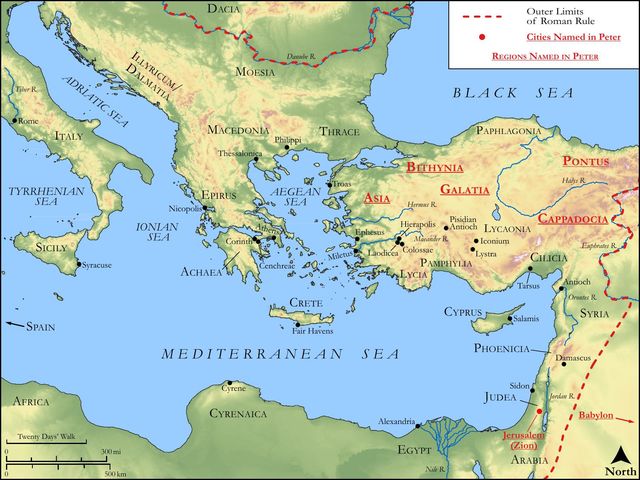
See on the biblical-era maps

Study this verse
Public-domain commentary
Matthew Henry
From his Commentary on the Whole Bible. Henry comments on passages, not single verses — this entry covers 1 Peter 1:13–23. His four-level outline is real structure in the source text, so it is rendered as structure.
Here the apostle begins his exhortations to those whose glorious state he had before described, thereby instructing us that Christianity is a doctrine according to godliness, designed to make us not only wiser, but better.
I.He exhorts them to sobriety and holiness.
1.Wherefore gird up the loins of your mind, etc., Pe1 1:13. As if he had said, "Wherefore, since you are so honoured and distinguished, as above, Gird up the loins of your mind. You have a journey to go, a race to run, a warfare to accomplish, and a great work to do; as the traveller, the racer, the warrior, and the labourer, gather in, and gird up, their long and loose garments, that they may be more ready, prompt, and expeditious in their business, so do you by your minds, your inner man, and affections seated there: gird them, gather them in, let them not hang loose and neglected about you; restrain their extravagances, and let the loins or strength and vigour of your minds be exerted in your duty; disengage yourselves from all that would hinder you, and go on resolutely in your obedience. Be sober, be vigilant against all your spiritual dangers and enemies, and be temperate and modest in eating, drinking, apparel, recreation, business, and in the whole of your behaviour. Be sober-mined also in opinion, as well as in practice, and humble in your judgment of yourselves." And hope to the end, for the grace that is to be brought to you at the revelation of Jesus Christ. Some refer this to the last judgment, as if the apostle directed their hope to the final revelation of Jesus Christ; but it seems more natural to take it, as it might be rendered, "Hope perfectly, or thoroughly, for the grace that is brought to you in or by the revelation of Jesus Christ; that is, by the gospel, which brings life and immortality to light. Hope perfectly, trust without doubting to that grace which is now offered to you by the gospel." Learn,
(1.)The main work of a Christian lies in the right management of his heart and mind; the apostle's first direction is to gird up the loins of the mind.
(2.)The best Christians have need to be exhorted to sobriety. These excellent Christians are put in mind of it; it is required of a bishop (Ti1 3:2), of aged men (Tit 2:2), the young women are to be taught it, and the young men are directed to be sober-minded, Tit 2:4, Tit 2:6.
(3.)A Christian's work is not over as soon as he has got into a state of grace; he must still hope and strive for more grace. When he has entered the strait gate, he must still walk in the narrow way, and gird up the loins of his mind for that purpose.
(4.)A strong and perfect trust in God's grace is very consistent with our best endeavours in our duty; we must hope perfectly, and yet gird up our loins, and address ourselves vigorously to the work we have to do, encouraging ourselves from the grace of Jesus Christ.
2.As obedient children, etc., Pe1 1:14. These words may be taken as a rule of holy living, which is both positive - "You ought to live as obedient children, as those whom God hath adopted into his family, and regenerated by his grace;" and negative - "You must not fashion yourselves according to the former lusts, in your ignorance." Or the words may be taken as an argument to press them to holiness from the consideration of what they now are, children of obedience, and what they were when they lived in lust and ignorance. Learn,
(1.)The children of God ought to prove themselves to be such by their obedience to God, by their present, constant, universal obedience.
(2.)The best of God's children have had their times of lust and ignorance; the time has been when the whole scheme of their lives, their way and fashion, was to accommodate and gratify their unlawful desires and vicious appetites, being grossly ignorant of God and themselves, of Christ and the gospel.
(3.)Persons, when converted, differ exceedingly from what they were formerly. They are people of another fashion and manner from what they were before; their inward frame, behaviour, speech, and conversation, are much altered from what they were in times past.
(4.)The lusts and extravagances of sinners are both the fruits and the signs of their ignorance.
3.But as he who hath called you, etc., Pe1 1:15, Pe1 1:16. Here is a noble rule enforced by strong arguments: Be you holy in all manner of conversation. Who is sufficient for this? And yet it is required in strong terms, and enforced by three reasons, taken from the grace of God in calling us, - from his command, it is written, - and from his example. Be you holy, for I am holy. Learn,
(1.)The grace of God in calling a sinner is a powerful engagement to holiness. It is a great favour to be called effectually by divine grace out of a state of sin and misery into the possession of all the blessings of the new covenant; and great favours are strong obligations; they enable as well as oblige to be holy.
(2.)Complete holiness is the desire and duty of every Christian. Here is a two-fold rule of holiness:
[1.]It must, for the extent of it, be universal. We must be holy, and be so in all manner of conversation; in all civil and religious affairs, in every condition, prosperous or reverse; towards all people, friends and enemies; in all our intercourse and business still we must be holy.
[2.]For the pattern of it. We must be holy, as God is holy: we must imitate him, though we can never equal him. He is perfectly, unchangeably, and eternally holy; and we should aspire after such a state. The consideration of the holiness of God should oblige as to the highest degree of holiness we can attain unto.
(3.)The written word of God is the surest rule of a Christian's life, and by this rule we are commanded to be holy every way.
(4.)The Old Testament commands are to be studied and obeyed in the times of the New Testament; the apostle, by virtue of a command delivered several times by Moses, requires holiness in all Christians.
4.If you call on the Father, etc., Pe1 1:17. The apostle does not there express any doubt at all whether these Christians would call upon their heavenly Father, but supposes they would certainly do it, and from this argues with them to pass the time of their sojourning here in fear: "If you own the great God as a Father and a Judge, you ought to live the time of your sojourning here in his fear." Learn,
(1.)All good Christians look upon themselves in this world as pilgrims and strangers, as strangers in a distant country, passing to another, to which they properly belong, Psa 39:12; Heb 11:13.
(2.)The whole time of our sojourning here is to be passed in the fear of God.
(3.)The consideration of God as a Judge is not improper for those who can truly call him Father. Holy confidence in God as a Father, an awful fear of him as a Judge, are very consistent; to regard God as a Judge is a singular means to endear him to us as a Father.
(4.)The judgment of God will be without respect of persons: According to every man's work. No external relation to him will protect any; the Jew may call God Father and Abraham father, but God will not respect persons, nor favour their cause, from personal considerations, but judge them according to their work. The works of men will in the great day discover their persons; God will make all the world to know who are his by their works. We are obliged to faith, holiness, and obedience, and our works will be an evidence whether we have complied with our obligations or not.
5.The apostle having extorted them to pass the time of their sojourning in the fear of God from this consideration, that they called on the Father, he adds (Pe1 1:18) a second argument: Because or forasmuch as you were not redeemed with corruptible things, etc. Herein he puts them in mind,
(1.)That they were redeemed, or bought back again, by a ransom paid to the Father.
(2.)What the price paid for their redemption was: Not with corruptible things, as silver and gold, but with the precious blood of Christ.
(3.)From what they were redeemed: From a vain conversation received by tradition.
(4.)They knew this: Forasmuch as you know, and cannot pretend ignorance of this great affair. Learn,
[1.]The consideration of our redemption ought to be a constant and powerful inducement to holiness, and the fear of God.
[2.]God expects that a Christian should live answerably to what he knows, and therefore we have great need to be put in mind of what we already know, Psa 39:4.
[3.]Neither silver nor gold, nor any of the corruptible things of this world, can redeem so much as one soul. They are often snares, temptations, and hindrances to man's salvation, but they can by no means purchase or procure it; they are corruptible, and therefore cannot redeem an incorruptible and immortal soul.
[4.]The blood of Jesus Christ is the only price of man's redemption. The redemption of man is real, not metaphorical. We are bought with a price, and the price is equal to the purchase, for it is the precious blood of Christ; it is the blood of an innocent person, a lamb without blemish and without spot, whom the paschal lamb represented, and of an infinite person, being the Son of God, and therefore it is called the blood of God, Act 20:28.
[5.]The design of Christ in shedding his most precious blood was to redeem us, not only from eternal misery hereafter, but from a vain conversation in this world. That conversation is vain which is empty, frivolous, trifling, and unserviceable to the honour of God, the credit of religion, the conviction of unbelievers, and the comfort and satisfaction of a man's own conscience. Not only the open wickedness, but the vanity and unprofitableness of our conversation are highly dangerous.
[6.]A man's conversation may carry an appearance of devotion, and may plead antiquity, custom, and tradition, in its defence, and yet after all be a most vain conversation. The Jews had a deal to say from these heads, for all their formalities; and yet their conversation was so vain that only the blood of Christ could redeem them from it. Antiquity is no certain rule of verity, nor is it a wise resolution, "I will live and die in such a way, because my forefathers did so."
6.Having mentioned the price of redemption, the apostle goes on to speak of some things relating both to the Redeemer and the redeemed, Pe1 1:20, Pe1 1:21.
(1.)The Redeemer is further described, not only as a Lamb without spot, but as one,
[1.]That was fore-ordained before the foundation of the world, fore-ordained or foreknown. When prescience is ascribed to God, it implies more than bare prospect or speculation. It imports an act of the will, a resolution that the thing shall be, Act 2:23. God did not only foreknow, but determine and decree, that his Son should die for man, and this decree was before the foundation of the world. Time and the world began together; before the commencement of time there was nothing but eternity.
[2.]That was manifested in these last days for them. He was manifested or demonstrated to be that Redeemer whom God had fore-ordained. He was manifested by his birth, by his Father's testimony, and by his own works, especially by his resurrection from the dead, Rom 1:4. "This was done in these last times of the New Testament and of the gospel, for you, you Jews, you sinners, you afflicted ones; you have the comfort of the manifestation and appearance of Christ, if you believe on him." [3.] That was raised from the dead by the Father, who gave him glory. The resurrection of Christ, considered as an act of power, is common to all the three persons, but as an act of judgment it is peculiar to the Father, who as a Judge released Christ, raised him from the grave, and gave him glory, proclaimed him to all the world to be his Son by his resurrection from the dead, advanced him to heaven, crowned him with glory and honour, invested him with all power in heaven and earth, and glorified him with that glory which he had with God before the world was.
(2.)The redeemed are also described here by their faith and hope, the cause of which is Jesus Christ: "You do by him believe in God - by him as the author, encourager, support, and finisher of your faith; your faith and hope now may be in God, as reconciled to you by Christ the Mediator."
(3.)From all this we learn,
[1.]The decree of God to send Christ to be a Mediator was from everlasting, and was a just and merciful decree, which yet does not at all excuse man's sin in crucifying him, Act 2:23. God had purposes of special favour towards his people long before he made any manifestations of such grace to them.
[2.]Great is the happiness of the last times in comparison with what the former ages of the world enjoyed. The clearness of light, the supports of faith, the efficacy of ordinances, and the proportion of comforts - these are all much greater since the manifestation of Christ than they were before. Our gratitude and services should be suitable to such favours.
[3.]The redemption of Christ belongs to none but true believers. A general impetration is asserted by some and denied by others, but none pretend to a general application of Christ's death for the salvation of all. Hypocrites and unbelievers will be ruined for ever, notwithstanding the death of Christ.
[4.]God in Christ is the ultimate object of a Christian's faith, which is strongly supported by the resurrection of Christ, and the glory that did follow.
II.He exhorts them to brotherly love.
1.He supposes that the gospel had already had such an effect upon them as to purify their souls while they obeyed it through the Spirit, and that it had produced at least an unfeigned love of the brethren; and thence he argues with them to proceed to a higher degree of affection, to love one another with a pure heart fervently, Pe1 1:22. Learn,
(1.)It is not to be doubted but that every sincere Christian purifies his soul. The apostle takes this for granted: Seeing you have, etc. To purify the soul supposes some great uncleanness and defilement which had polluted it, and that this defilement is removed. Neither the Levitical purifications under the law, nor the hypocritical purifications of the outward man, can effect this.
(2.)The word of God is the great instrument of a sinner's purification: Seeing you have purified your souls in obeying the truth. The gospel is called truth, in opposition to types and shadows, to error and falsehood. This truth is effectual to purify the soul, if it be obeyed, Joh 17:17. Many hear the truth, but are never purified by it, because they will not submit to it nor obey it.
(3.)The Spirit of God is the great agent in the purification of man's soul. The Spirit convinces the soul of its impurities, furnishes those virtues and graces that both adorn and purify, such as faith (Act 15:9), hope (Jo1 3:3), the fear of God (Psa 34:9), and the love of Jesus Christ. The Spirit excites our endeavours, and makes them successful. The aid of the Spirit does not supersede our own industry; these people purified their own souls, but it was through the Spirit.
(4.)The souls of Christians must be purified before they can so much as love one another unfeignedly. There are such lusts and partialities in man's nature that without divine grace we can neither love God nor one another as we ought to do; there is no charity but out of a pure heart.
(5.)It is the duty of all Christians sincerely and fervently to love one another. Our affection to one another must be sincere and real, and it must be fervent, constant, and extensive.
2.He further presses upon Christians the duty of loving one another with a pure heart fervently from the consideration of their spiritual relation; they are all born again, not of corruptible seed, but incorruptible, etc. Hence we may learn,
(1.)That all Christians are born again. The apostle speaks of it as what is common to all serious Christians, and by this they are brought into a new and a near relation to one another, they become brethren by their new birth.
(2.)The word of God is the great means of regeneration, Jam 1:18. The grace of regeneration is conveyed by the gospel.
(3.)This new and second birth is much more desirable and excellent than the first. This the apostle teaches by preferring the incorruptible to the corruptible seed. By the one we become the children of men, by the other the sons and daughters of the Most High. The word of God being compared to seed teaches us that though it is little in appearance, yet it is wonderful in operation, though it lies hid awhile, yet it grows up and produces excellent fruit at last.
(4.)Those that are regenerate should love one another with a pure heart fervently. Brethren by nature are bound to love one another; but the obligation is double where there is a spiritual relation: they are under the same government, partake of the same privileges, and have embarked in the same interest.
(5.)The word of God lives and abides for ever. This word is a living word, or a lively word, Heb 4:12. It is a means of spiritual life, to begin it and preserve in it, animating and exciting us in our duty, till it brings us to eternal life: and it is abiding; it remains eternally true, and abides in the hearts of the regenerate for ever.
Historical interpretation
Eight Centuries of Reception
3 surviving comments on this verse. Each one is dated, so this reads as a timeline rather than a list.
Select a marker to jump to its quote. Markers stagger vertically where authors wrote within a few decades of each other.
"Wherefore, girding up your loins," "serve the Lord in fear" and truth, as those who have forsaken the vain, empty talk and error of the multitude, and "believed in Him who raised up our Lord Jesus Christ from the dead, and gave Him glory," and a throne at His right hand. To Him all things in heaven and on earth are subject. Him every spirit serves. He comes as the Judge of the living and the dead. His blood will God require of those who do not believe in Him. But He who raised Him up from the dead will raise up us also, if we do His will, and walk in His commandments, and love what He loved, keeping ourselves from all unrighteousness, covetousness, love of money, evil speaking, false witness; "not rendering evil for evil, or railing for railing," or blow for blow, or cursing for cursing, but being mindful of what the Lord said in His teaching: "Judge not, that ye be not judged; forgive, and it shall be forgiven unto you; be merciful, that ye may obtain mercy; with what measure ye mete, it shall be measured to you again;" and once more, "Blessed are the poor, and those that are persecuted for righteousness' sake, for theirs is the kingdom of God."
Peter did not stop at Christ’s death but went on immediately to remember his resurrection as well. Just because you hear that the Father has raised the Son, do not retort that the Son cannot raise himself. For listen to what Christ says: “Destroy this temple and in three days I shall raise it up again” and again: “I have power to lay down my life, and I have power to take it up again.” The apostle says these things in order to teach us that the Father and the Son hold everything in common.
He was indeed predetermined before the foundation of the world, but was revealed in these last times for you, who through him believe in God who raised him from the dead and gave him glory, so that your faith and hope are in God.
Peter connected the death of Christ with the resurrection. For he fears the easy change of beginners in faith to skepticism, due to the disgrace of Christ's afflictions, but he says there is no recent mystery about Christ: since this also disturbs the foolish; but in former times and before the foundation of the world, it had been hidden by divine providence until the opportune time, indeed it was revealed to the prophets who inquired about these things, as he had said a little earlier, now, however, he says, it is more manifest, because what had been foreknown before the foundation of the world, namely by God, is now revealed, whether completed or perfected. And he adds because of whom it may be perfect, namely because of you. For because of you, he says, he raised him from the dead. But why because of you? So that when you have purified yourselves by obeying the truth through the Spirit, you may have faith and hope in God. And how have you purified yourselves? Because by believing in Him who has proclaimed to you the resurrection from the dead to an incorruptible life, you are debtors to Him who, being incorruptible, called you to walk in newness of life.
But if both Peter and Paul say that the Father raised the Lord from the dead, do not be disturbed: for now they are using introductory teachings to say these things. For listen to Christ saying that he raised himself, when he says: "Destroy this temple, and in three days I will raise it up." (Jn. 2:19) But also Luke: "To whom he also showed himself alive, after he had suffered." (Acts 1:3) And again Christ himself: "I have power to lay down my life, and I have power to take it again." (Jn. 10:18) Therefore, in a certain dispensation, the Son's resurrection is sometimes referred to the Father, to show the unity of the operation of the Father and the Son.
The sequence of the letters is as follows: He was indeed predetermined before the foundation of the world, but was revealed in these last times for you, who through him believe in God who raised him from the dead and gave him glory: so that you may purify your souls (in fact, ὥστε is taken for 'so that') in obeying the truth, having faith and hope in God. For it is accepted that εἶναι means "to have", because of the preceding. For if ὥστε is left in its meaning as stated, the sentence will be incoherent and unintelligible.
Continue studying 1 Peter 1:21 across the web’s major study libraries — every link below opens this exact verse, chapter, or book on the destination site.
Read & Compare
 BibleGatewayThis verse in more than 200 translations and 70 languages.
 Bible.comThe YouVersion reader — hundreds of translations, reading plans, and highlights.
 ESV.orgCrossway's official English Standard Version reader.
 NET BibleThe NET translation with 60,000+ translators' notes on every rendering decision.
 STEP BibleTyndale House's free study tool — original text, vocabulary, and scholarly resources.
 BibliaLogos Bible Software's free web reader.
 USCCBThe New American Bible (Revised Edition) with the U.S. bishops' study notes.
Commentaries
 BibleHub CommentariesDozens of classic commentaries on this verse, gathered on one page.
 StudyLightMore than 100 commentary sets — the largest collection on the web.
 BibleRefPlain-English commentary on what this verse means, verse by verse.
 Enduring WordDavid Guzik's free commentary on this chapter, widely used by Bible teachers.
 Bible Study ToolsVerse commentary alongside Greek and Hebrew study aids.
Original Language & Research
- BibleHub InterlinearThe verse word by word — original language, transliteration, and English.
- BibleHub LexiconEvery word's original-language definition and Strong's entry.
 Blue Letter BibleDeep-study tools — Strong's numbers, concordance, and word studies.
 CNTR CollationThe earliest Greek manuscripts of this verse, collated letter by letter.
Sermons, Hymns & Audio


TrulyRandomVerse is not affiliated with these sites and doesn’t control their content. They’re linked because they’re genuinely useful.
Summary
First Peter 1:21 profoundly articulates the theological bedrock of Christian faith and hope, establishing them firmly in God's sovereign actions. It reveals that believers are enabled to trust God through Christ, whose resurrection from the dead and subsequent glorification by the Father serve as the irrefutable evidence and ultimate ground for their confident expectation and unwavering trust in the divine. This verse thus encapsulates the Trinitarian dynamic of salvation, where the Father's power, the Son's redemptive work, and the Spirit's enabling grace converge to secure the believer's spiritual assurance.
Context
ShowHideLiterary Context
This verse serves as the culmination of a powerful theological argument Peter has been building since the opening of his epistle. Having established the believers' "lively hope" through the resurrection of Jesus Christ in 1 Peter 1:3, and having exhorted them to holy living in light of their redemption, Peter then emphasizes the immense cost of their salvation—not perishable things, but the precious blood of Christ. Verse 21 directly follows this declaration, providing the divine rationale and ultimate purpose behind Christ's sacrifice and God's subsequent actions. It links the past redemptive work to the present reality of the believer's faith and future hope, thus grounding their spiritual life in concrete divine acts rather than human effort or fleeting circumstances.
Historical & Cultural Context
Peter writes to "elect exiles of the Dispersion" (1 Peter 1:1), Christians scattered across various Roman provinces in Asia Minor. These believers were likely facing social ostracism, persecution, and various trials, making it difficult to maintain their faith and hope. In such a climate, Peter's emphasis on God's active involvement in their salvation—specifically the resurrection and glorification of Jesus—would have been profoundly encouraging. The Roman world valued power, glory, and visible triumph, and Peter's declaration that God had raised Jesus from the dead and given Him glory would have countered any perception of Christ as a defeated figure, instead presenting Him as the victorious Lord. This message provided a robust theological framework for enduring suffering with a steadfast, God-centered hope.
Key Themes
ShowHideFirst Peter 1:21 contributes significantly to several overarching themes in the epistle. It reinforces the theme of God's Sovereignty and Power, particularly through His act of raising Christ from the dead, demonstrating His ultimate control over life and death. This divine power is the basis for the believers' living hope. The verse also highlights Christ's Mediatorial Role, as it is "by him" that believers come to God, underscoring Jesus' indispensable position as the means of access to the Father, a truth echoed throughout the New Testament, such as in John 14:6. Furthermore, it emphasizes the Foundation of Christian Assurance, linking faith and hope directly to the historical realities of Christ's resurrection and glorification. This provides a tangible, verifiable basis for their spiritual confidence, rather than subjective feelings, aligning with the broader New Testament emphasis on the resurrection as the cornerstone of the gospel message, as seen in 1 Corinthians 15:14.
Exposition and Analysis
ShowHideKey Word Analysis
ShowHideThis verb signifies "to waken," "rouse," or "lift up," often from sleep, a lying position, or death. In the context of the resurrection, it powerfully conveys God's active, life-giving power over death and non-existence. It is not merely a passive recovery but a divine intervention that brings forth new life and validates Christ's identity and mission.
Derived from a root meaning "to appear" or "to seem," dóxa refers to "glory as very apparent," encompassing dignity, honor, praise, and worship. When applied to Christ, it signifies His exaltation, majestic status, and inherent divine radiance, particularly after His resurrection and ascension. It speaks of His rightful place of honor and authority at the Father's right hand.
This term denotes "persuasion," "credence," or "moral conviction," specifically "reliance upon Christ for salvation." It is an active trust and belief in the truthfulness of God and His promises, leading to a personal commitment and assurance. In this verse, it is the direct result of God's actions in Christ, grounded in the objective reality of the resurrection and glorification.
Verse Breakdown
ShowHide"Who by him do believe in God"
This clause establishes the essential mediatorial role of Jesus Christ. It is through Christ, by His person and work, that believers are enabled to place their trust and confidence in God the Father. This highlights the Trinitarian nature of salvation, where access to the Father is granted solely through the Son.
"that raised him up from the dead"
This phrase identifies God the Father as the active agent in the resurrection of Jesus. The resurrection is presented as a divine act, demonstrating God's ultimate power over death and validating Christ's atoning sacrifice. It is the historical, verifiable event that underpins all Christian hope.
"and gave him glory"
Following the resurrection, God the Father further exalted Jesus by bestowing upon Him divine "glory." This refers to Christ's ascension into heaven and His enthronement at God's right hand, signifying His supreme authority, honor, and completion of His redemptive work. This glorification assures believers of Christ's present reign and power.
"that your faith and hope might be in God"
This final clause articulates the ultimate purpose and result of God's actions concerning Christ. The resurrection and glorification of Jesus are not ends in themselves, but are divinely purposed to establish and secure the faith and hope of believers. Knowing that God has powerfully acted to raise and glorify His Son provides an immovable foundation for their trust and confident expectation in God Himself.
Literary Devices
ShowHideFirst Peter 1:21 employs several literary devices to convey its profound theological message. The most prominent is the Purpose Clause, indicated by the repeated use of "that" (Greek hṓste or implied purpose) in relation to God's actions: God raised Christ and gave Him glory that believers' faith and hope might be in God. This structure clearly links divine action to human spiritual outcome, emphasizing God's intentionality in salvation. There is also a strong element of Theological Emphasis on God's omnipotence and faithfulness. By explicitly stating that God "raised him up from the dead, and gave him glory," Peter underscores the absolute power and authority of the Father as the ultimate source of salvation and the guarantor of the believer's assurance. This serves to bolster the confidence of a persecuted audience, reminding them that their faith is grounded in an all-powerful God.
Theological and Thematic Connections
ShowHideFirst Peter 1:21 is a concise theological statement on the Triune God's work in salvation, emphasizing the Father's sovereign plan, the Son's completed work, and the Spirit's enabling of belief. It underscores that Christian faith and hope are not based on human sentiment or philosophical speculation, but on the objective, historical acts of God in Christ. The resurrection and glorification of Jesus are presented as the definitive proofs of God's power and faithfulness, providing an unshakeable foundation for trust. This divine sequence—God raising Christ and glorifying Him—is the very reason believers can confidently direct their faith and hope towards God, knowing He is both able and willing to fulfill His promises.
Reflection and Application
ShowHideFor believers navigating the complexities and challenges of life, 1 Peter 1:21 offers a profound anchor for the soul. It redirects our gaze from fleeting circumstances or personal inadequacies to the immutable power and faithfulness of God. When doubts arise, or when the world's pressures threaten to overwhelm, this verse reminds us that our faith is not in a fallible human system or a vague spiritual feeling, but in the God who conquered death itself through His Son. This truth empowers us to live with a confident, "lively hope," knowing that the same God who raised Christ from the dead is actively working in our lives and will bring His ultimate purposes to fruition. It calls us to place our full, unwavering trust and expectation in Him, allowing this divine reality to shape our perspectives, priorities, and responses to every situation.
Questions for Reflection
ShowHideFAQ
ShowHideWhat is the significance of God "raising him up from the dead" in this verse?
ShowHideThe act of God "raising him up from the dead" is the cornerstone of Christian theology and the central event validating Jesus' identity and mission. It signifies God the Father's ultimate approval of Christ's atoning sacrifice, His victory over sin and death, and His power to bring new life. Without the resurrection, Christian faith would be futile, as Paul argues in 1 Corinthians 15:14. It provides the irrefutable historical and theological basis for the believer's hope and assurance, demonstrating God's faithfulness and omnipotence.
How do "faith" and "hope" relate to each other in this verse?
ShowHideIn 1 Peter 1:21, faith and hope are presented as inextricably linked and divinely grounded. Faith is the present trust and conviction in God's character and His past actions (raising and glorifying Christ), while hope is the confident expectation and anticipation of God's future promises and ultimate triumph. Both are directed "in God," meaning they find their object and security in His person and power. The resurrection and glorification of Christ provide the objective basis for both: because God has demonstrated His power and faithfulness in these acts, believers can have firm faith now and a confident hope for the future. This dynamic is a recurring theme in the New Testament, as seen in Hebrews 11:1 and Romans 5:1-5.
Christ-Centered Fulfillment
ShowHideFirst Peter 1:21 powerfully articulates the Christ-centered nature of Christian faith and hope. It is "by him" (Christ) that believers come to trust in God, underscoring Jesus' indispensable role as the sole mediator between God and humanity, as affirmed in 1 Timothy 2:5. The verse highlights two pivotal events in Christ's redemptive work: His resurrection and His glorification. God the Father's act of raising Jesus from the dead is the ultimate validation of Christ's victory over sin and death, fulfilling Old Testament prophecies of a resurrected Messiah (e.g., Psalm 16:10). Furthermore, God "gave him glory," referring to Christ's ascension and exaltation to the Father's right hand, where He now reigns as Lord of all (Ephesians 1:20-22). These divine actions concerning Christ are the very foundation "that your faith and hope might be in God." Thus, Christ is not merely the object of our faith but also the means and the guarantee of our faith and hope in God, securing our spiritual assurance through His completed work and ongoing reign (Colossians 1:27).