


Acts 2:24
- ὃνhonwhomG3739R-ASMRelative pronoun Accusative Singular Masculine
- ὁho<the>G3588T-NSMDefinite article Nominative Singular Masculine
- θεὸςtheosGodG2316N-NSM-TNoun Nominative Singular Masculine Title
- ἀνέστησενanestēsenraised upG450V-AAI-3SVerb Aorist Active Indicative 3rd Singular
- λύσαςlusashaving loosedG3089V-AAP-NSMVerb Aorist Active Participle Nominative Singular Masculine
- τὰςtastheG3588T-APFDefinite article Accusative Plural Feminine
- ὠδῖναςōdinasagonyG5604N-APFNoun Accusative Plural Feminine
- τοῦtou<the>G3588T-GSMDefinite article Genitive Singular Masculine
- θανάτουthanatouof deathG2288N-GSMNoun Genitive Singular Masculine
- καθότιkathotiinasmuch asG2530CONJConjunction
- οὐκouknotG3756PRT-NNegative Particle Negative
- ἦνēnit wasG1510V-IAI-3SVerb Imperfect Active Indicative 3rd Singular
- δυνατὸνdunatonpossibleG1415A-NSNAdjective Nominative Singular Neuter
- κρατεῖσθαιkrateisthai[for] to be heldG2902V-PPNVerb Present Passive Infinitive
- αὐτὸνautonHimG846P-ASMPersonal pronoun Accusative Singular Masculine
- ὑπ᾽hup᾽byG5259PREPPreposition
- αὐτοῦautouitG846P-GSMPersonal pronoun Genitive Singular Masculine
English is a literal word-by-word gloss of the Greek, not the KJV's wording. Why?
This is the original text the KJV's translators worked from — each Greek word with its own literal English meaning in this verse, prepared by scholars at Tyndale House, Cambridge. The KJV translates whole sentences, not word by word, so its wording differs: one Greek word can become several English words, and the KJV may choose “charity” where the gloss reads “love”. Both are faithful — they answer different questions. For the KJV's own rendering, switch to the KJV text.
Details
See on the biblical-era map
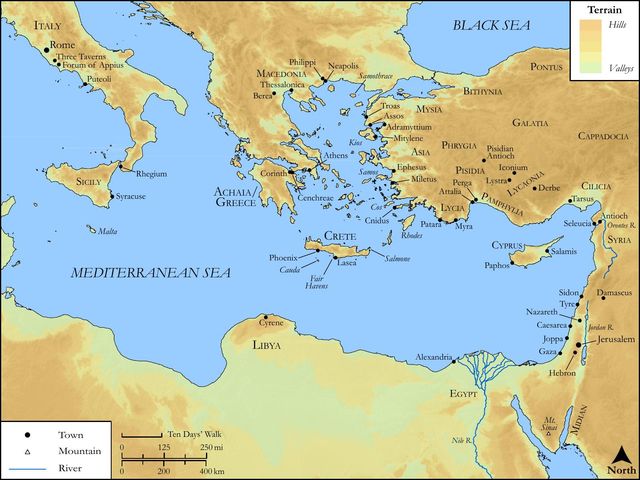
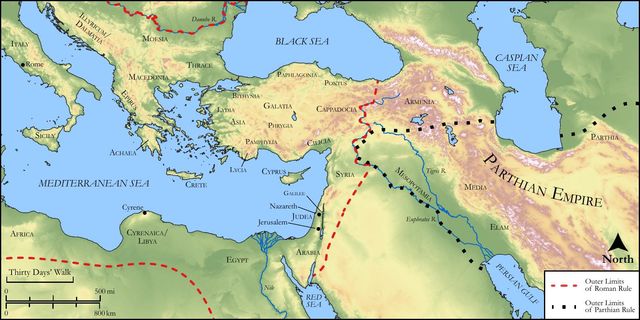
Study this verse
Public-domain commentary
Matthew Henry
From his Commentary on the Whole Bible. Henry comments on passages, not single verses — this entry covers Acts 2:14–36. His four-level outline is real structure in the source text, so it is rendered as structure.
We have here the first-fruits of the Spirit in the sermon which Peter preached immediately, directed, not to those of other nations in a strange language (we are not told what answer he gave to those that were amazed, and said, What meaneth this?) but to the Jews in the vulgar language, even to those that mocked; for he begins with the notice of that (v. 15), and addresses his discourse (v. 14) to the men of Judea and the inhabitants of Jerusalem; but we have reason enough to think that the other disciples continued to speak to those who understood them (and therefore flocked about them), in the languages of their respective countries, the wonderful works of God. And it was not by Peter's preaching only, but that of all, or most, of the rest of the hundred and twenty, that three thousand souls were that day converted, and added to the church; but Peter's sermon only is recorded, to be an evidence for him that he was thoroughly recovered from his fall, and thoroughly restored to the divine favour. He that had sneakingly denied Christ now as courageously confesses him. Observe,
I.His introduction or preface, wherein he craves the attention of the auditory, or demands it rather:
Peter stood up (v. 14), to show that he was not drunk, with the eleven, who concurred with him in what he said, and probably in their turns spoke likewise to the same purport; those that were of greatest authority stood up to speak to the scoffing Jews, and to confront those who contradicted and blasphemed, but left the seventy disciples to speak to the willing proselytes from other nations, who were not so prejudiced, in their own language. Thus among Christ's ministers, some of greater gifts are called out to instruct those that oppose themselves, to take hold of sword and spear; others of meaner abilities are employed in instructing those that resign themselves, and to be vine-dressers and husband-men. Peter lifted up his voice, as one that was both well assured of and much affected with what he said, and was neither afraid nor ashamed to own it. He applied himself to the men of Judea, andres Ioudaioi—the men that were Jews; so it should be read; "and you especially that dwell at Jerusalem, who were accessory to the death of Jesus, be this known unto you, which you did not know before, and which you are concerned to know now, and hearken to my words, who would draw you to Christ, and not to the words of the scribes and Pharisees, that would draw you from him. My Master is gone, whose words you have often heard in vain, and shall hear no more as you have done, but he speaks to you by us; hearken now to our words."
II.His answer to their blasphemous calumny (v.
15): "These men are not drunken, as you suppose. These disciples of Christ, that now speak with other tongues, speak good sense, and know what they say, and so do those they speak to, who are led by their discourses into the knowledge of the wonderful works of God. You cannot think they are drunk, for it is but the third hour of the day," nine of the clock in the morning; and before this time, on the sabbaths and solemn feasts, the Jews did not eat nor drink: nay, ordinarily, those that are drunk are drunk in the night, and not in the morning; those are besotted drunkards indeed who, when they awake, immediately seek it yet again, Prov. xxiii. 35.
III.His account of the miraculous effusion of the Spirit, which is designed to awaken them all to embrace the faith of Christ, and to join themselves to his church. Two things he resolves it into:—that it was the fulfilling of the scripture, and the fruit of Christ's resurrection and ascension, and consequently the proof of both.
1.That it was the accomplishment of the prophecies of the Old Testament which related to the kingdom of the Messiah, and therefore an evidence that this kingdom is come, and the other predictions of it are fulfilled. He specifies one, that of the prophet Joel, ch. ii. 28. It is observable that though Peter was filled with the Holy Ghost, and spoke with tongues as the Spirit gave him utterance, yet he did not set aside the scriptures, nor think himself above them; nay, much of his discourse is quotation out of the Old Testament, to which he appeals, and with which he proves what he says. Christ's scholars never learn above their Bible; and the Spirit is given not to supersede the scriptures, but to enable us to understand and improve the scriptures. Observe,
(1.)The text itself that Peter quotes, v. 17-21. It refers to the last days, the times of the gospel, which are called the last days because the dispensation of God's kingdom among men, which the gospel sets up, is the last dispensation of divine grace, and we are to look for no other than the continuation of this to the end of time. Or, in the last days, that is, a great while after the ceasing of prophecy in the Old-Testament church. Or, in the days immediately preceding the destruction of the Jewish nation, in the last days of that people, just before that great and notable day of the Lord spoken of, v. 20. "It was prophesied of and promised, and therefore you ought to expect it, and not to be surprised at it; to desire it, and bid it welcome, and not to dispute it, as not worth taking notice of." The apostle quotes the whole paragraph, for it is good to take scripture entire; now it was foretold,
[1.]That there should be a more plentiful and extensive effusion of the Spirit of grace from on high than had ever yet been. The prophets of the Old Testament had been filled with the Holy Ghost, and it was said of the people of Israel that God gave them his good Spirit to instruct them, Neh. ix. 20. But now the Spirit shall be poured out, not only upon the Jews, but upon all flesh, Gentiles as well as Jews, though yet Peter himself did not understand it so, as appears, ch. xi. 17. Or, upon all flesh, that is, upon some of all ranks and conditions of men. The Jewish doctors taught that the Spirit came only upon wise and rich men, and such as were of the seed of Israel; but God will not tie himself to their rules.
[2.]That the Spirit should be in them a Spirit of prophecy; by the Spirit they should be enabled to foretel things to come, and to preach the gospel to every creature. This power shall be given without distinction of sex—now only your sons, but your daughters shall prophesy; without distinction of age—both your young men and your old men shall see visions, and dream dreams, and in them receive divine revelations, to be communicated to the church; and without distinction of outward condition—even the servants and handmaids shall receive of the Spirit, and shall prophesy (v. 18); or, in general, men and women, whom God calls his servants and his handmaids. In the beginning of the age of prophecy in the Old Testament there were schools of the prophets, and, before that, the Spirit of prophecy came upon the elders of Israel that were appointed to the government; but now the Spirit shall be poured out upon persons of inferior rank, and such as were not brought up in the schools of the prophets, for the kingdom of the Messiah is to be purely spiritual. The mention of the daughters (v. 17) and the handmaidens (v. 18) would make one think that the women who were taken notice of (ch. i. 14) received the extraordinary gifts of the Holy Ghost, as well as the men. Philip, the evangelist, had four daughters who did prophesy (ch. xxi. 9), and St. Paul, finding abundance of the gifts both of tongues and prophecy in the church of Corinth, saw it needful to prohibit women's use of those gifts in public, 1 Cor. xiv. 26, 34.
[3.]That one great thing which they should prophesy of should be the judgment that was coming upon the Jewish nation, for this was the chief thing that Christ himself had foretold (Matt. xxiv.) at his entrance into Jerusalem (Luke xix. 41); and when he was going to die (Luke xxiii. 29); and these judgments were to be brought upon them to punish for their contempt of the gospel, and their opposition to it, though it came to them thus proved. Those that would not submit to the power of God's grace, in this wonderful effusion of his Spirit, should fall and lie under the pourings out of the vials of his wrath. Those shall break that will not bend. First, The destruction of Jerusalem, which was about forty years after Christ's death, is here called that great and notable day of the Lord, because it put a final period to the Mosaic economy; the Levitical priesthood and the ceremonial law were thereby for ever abolished and done away. The desolation itself was such as was never brought upon any place or nation, either before or since. It was the day of the Lord, for it was the day of his vengeance upon that people for crucifying Christ, and persecuting his ministers; it was the year of recompences for that controversy; yea, and for all the blood of the saints and martyrs, from the blood of righteous Abel, Matt. xxiii. 35. It was a little day of judgment; it was a notable day: in Joel it is called a terrible day, for so it was to men on earth; but here epiphane (after the Septuagint), a glorious, illustrious day, for so it was to Christ in heaven; it was the epiphany, his appearing, so he himself spoke of it, Matt. xxiv. 30. The destruction of the Jews was the deliverance of the Christians, who were hated and persecuted by them; and therefore that day was often spoken of by the prophets of that time, for the encouragement of suffering Christians, that the Lord was at hand, the coming of the Lord drew nigh, the Judge stood before the door, James v. 8, 9. Secondly, The terrible presages of that destruction are here foretold: There shall be wonders in heaven above, the sun turned into darkness and the moon into blood; and signs too in the earth beneath, blood and fire. Josephus, in his preface to his history of the wars of the Jews, speaks of the signs and prodigies that preceded them, terrible thunders, lightnings, and earthquakes; there was a fiery comet that hung over the city for a year, and a flaming sword was seen pointing down upon it; a light shone upon the temple and the altar at midnight, as if it had been noon-day. Dr. Lightfoot gives another sense of these presages: The blood of the Son of God, the fire of the Holy Ghost now appearing, the vapour of the smoke in which Christ ascended, the sun darkened, and the moon made blood, at the time of Christ's passion, were all loud warnings given to that unbelieving people to prepare for the judgments coming upon them. Or, it may be applied, and very fitly, to the previous judgments themselves by which that desolation was brought on. The blood points at the wars of the Jews with the neighbouring nations, with the Samaritans, Syrians, and Greeks, in which abundance of blood was shed, as there was also in their civil wars, and the struggles of the seditious (as they called them), which were very bloody; there was no peace to him that went out nor to him that came in. The fire and vapour of smoke, here foretold, literally came to pass in the burning of their cities, and towns, and synagogues, and temple at last. And this turning of the sun into darkness, and the moon into blood, bespeaks the dissolution of their government, civil and sacred, and the extinguishing of all their lights. Thirdly, The signal preservation of the Lord's people is here promised (v. 21): Whosoever shall call upon the name of the Lord Jesus (which is the description of a true Christian, 1 Cor. i. 2) shall be saved, shall escape that judgment which shall be a type and earnest of everlasting salvation. In the destruction of Jerusalem by the Chaldeans, there was a remnant sealed to be hid in the day of the Lord's anger; and in the destruction by the Romans not one Christian perished. Those that distinguish themselves by singular piety shall be distinguished by special preservation. And observe, the saved remnant are described by this, that they are a praying people: they call on the name of the Lord, which intimates that they are not saved by any merit or righteousness of their own, but purely by the favour of God, which must be sued out by prayer. It is the name of the Lord which they call upon that is their strong tower.
(2.)The application of this prophecy to the present event (v. 16): This is that which was spoken by the prophet Joel; it is the accomplishment of that, it is the full accomplishment of it. This is that effusion of the Spirit upon all flesh which should come, and we are to look for no other, no more than we are to look for another Messiah; for as our Messiah ever lives in heaven, reigning and interceding for his church on earth, so this Spirit of grace, the Advocate, or Comforter, that was given now, according to the promise, will, according to the same promise, continue with the church on earth to the end, and will work all its works in it and for it, and every member of it, ordinary and extraordinary, by means of the scriptures and the ministry.
2.That it was the gift of Christ, and the product and proof of his resurrection and ascension. From this gift of the Holy Ghost, he takes occasion to preach unto them Jesus; and this part of his sermon he introduces with another solemn preface (v. 22): "You men of Israel, hear these words. It is a mercy that you are within hearing of them, and it is your duty to give heed to them." Words concerning Christ should be acceptable words to the men of Israel. Here is,
(1.)An abstract of the history of the life of Christ, v. 22. He calls him Jesus of Nazareth, because by that name he was generally known, but (which was sufficient to roll away that reproach) he was a man approved of God among you, censured and condemned by men, but approved of God: God testified his approbation of his doctrine by the power he gave him to work miracles: a man marked out by God, so Dr. Hammond reads it; "signalized and made remarkable among you that now hear me. He was sent to you, set up, a glorious light in your land; you yourselves are witnesses how he became famous by miracles, wonders, and signs, works above the power of nature, out of its ordinary course, and contrary to it, which God did by him; that is, which he did by that divine power with which he was clothed, and in which God plainly went along with him; for no man could do such works unless God were with him." See what a stress Peter lays upon Christ's miracles. [1.] The matter of fact was not to be denied: "They were done in the midst of you, in the midst of your country, your city, your solemn assemblies, as you yourselves also know. You have been eyewitnesses of his miracles; I appeal to yourselves whether you have any thing to object against them or can offer any thing to disprove them." [2.] The inference from them cannot be disputed; the reasoning is as strong as the evidence; if he did those miracles, certainly God approved him, declared him to be, what he declared himself to be, the Son of God and the Saviour of the world; for the God of truth would never set his seal to a lie.
(2.)An account of his death and sufferings which they were witness of also but a few weeks ago; and this was the greatest miracle of all, that a man approved of God should thus seem to be abandoned of him; and a man thus approved among the people, and in the midst of them, should be thus abandoned by them too. But both these mysteries are here explained (v. 23), and his death considered,
[1.]As God's act; and in him it was an act of wonderful grace and wisdom. He delivered him to death; not only permitted him to be put to death, but gave him up, devoted him: this is explained Rom. viii. 32, He delivered him up for us all. And yet he was approved of God, and there was nothing in this that signified the disapproving of him; for it was done by the determinate counsel and foreknowledge of God, in infinite wisdom, and for holy ends, which Christ himself concurred in, and in the means leading to them. Thus divine justice must be satisfied, sinners saved, God and man brought together again, and Christ himself glorified. It was not only according to the will of God, but according to the counsel of his will, that he suffered and died; according to an eternal counsel, which could not be altered. This reconciled him to the cross: Father, thy will be done; and Father, glorify thy name; let thy purpose take effect, and let the great end of it be attained.
[2.]As the people's act; and in them it was an act of prodigious sin and folly; it was fighting against God to persecute one whom he approved as the darling of heaven; and fighting against their own mercies to persecute one that was the greatest blessing of this earth. Neither God's designing it from eternity, nor his bringing good out of it to eternity, would in the least excuse their sin; for it was their voluntary act and deed, from a principle morally evil, and therefore "they were wicked hands with which you have crucified and slain him." It is probable that some of those were here present who had cried, Crucify him, crucify him, or had been otherwise aiding and abetting in the murder; and Peter knew it. However, it was justly looked upon as a national act, because done both by the vote of the great council and by the voice of the great crowd. It is a rule, Refertur ad universos quod publice fit per majorem paretm—That which is done publicly by the greater part we attribute to all. He charges it particularly on them as parts of the nation on which it would be visited, the more effectually to bring them to faith and repentance, because that was the only way to distinguish themselves from the guilty and discharge themselves from the guilt.
(3.)An attestation of his resurrection, which effectually wiped away the reproach of his death (v. 24): Whom God raised up; the same that delivered him to death delivers him from death, and thereby gave a higher approbation of him than he had done by any other of the signs and wonders wrought by him, or by all put together. This therefore he insists most largely upon.
[1.]He describes his resurrection: God loosed the pains of death, because it was impossible that he should be holden of it; odinas—the sorrows of death; the word is used for travailing pains, and some think it signifies the trouble and agony of his soul, in which it was exceedingly sorrowful, even to the death; from these pains and sorrows of soul, this travail of soul, the Father loosed him when at his death he said, It is finished. Thus Dr. Godwin understands it: "Those terrors which made Heman's soul lie like the slain (Ps. lxxxviii. 5, 15) had hold of Christ; but he was too strong for them, and broke through them; this was the resurrection of his soul (and it is a great thing to bring a soul out of the depths of spiritual agonies); this was not leaving his soul in hell; as that which follows, that he should not see corruption, speaks of the resurrection of his body; and both together make up the great resurrection." Dr. Lightfoot gives another sense of this: "Having dissolved the pains of death, in reference to all that believe in him, God raised up Christ, and by his resurrection broke all the power of death, and destroyed its pangs upon his own people. He has abolished death, has altered the property of it, and, because it was not possible that he should be long holden of it, it is not possible that they should be for ever holden." But most refer this to the resurrection of Christ's body. And death (says Mr. Baxter) is by privation a penal state, though not dolorous by positive evil. But Dr. Hammond shows that the Septuagint, and from them the apostle here, uses the word for cords and bands (as Ps. xviii. 4), to which the metaphor of loosing and being held best agrees. Christ was imprisoned for our debt, was thrown into the bands of death; but, divine justice being satisfied, it was not possible he should be detained there, either by right or by force; for he had life in himself, and in his own power, and had conquered the prince of death.
[2.]He attests the truth of his resurrection (v. 32): God hath raised him up, whereof we all are witnesses—we apostles, and others our companions, that were intimately acquainted with him before his death, were intimately conversant with him after his resurrection, did eat and drink with him. They received power, by the descent of the Holy Ghost upon them, on purpose that they might be skilful, faithful, and courageous witnesses of this thing, notwithstanding their being charged by his enemies as having stolen him away.
[3.]He showed it to be the fulfilling of the scripture, and, because the scripture had said that he must rise again before he saw corruption, therefore it was impossible that he should be holden by death and the grave; for David speaks of his being raised, so it comes in, v. 25. The scripture he refers to is that of David (Ps. xvi. 8-11), which, though in part applicable to David as a saint, yet refers chiefly to Jesus Christ, of whom David was a type. Here is,
First, The text quoted at large (v. 25-28), for it was all fulfilled in him, and shows us, 1. The constant regard that our Lord Jesus had to his Father in his whole undertaking: I foresaw the Lord before me continually. He set before him his Father's glory as his end in all—for he saw that his sufferings would redound abundantly to the honour of God, and would issue in his own joy; these were set before him, and these he had an eye to, in all he did and suffered; and with the prospect of these he was borne up and carried on, John xiii. 31, 32; xvii. 4, 5. 2. The assurance he had of his Father's presence and power going along with him: "He is on my right hand, the hand of action, strengthening, guiding, and upholding that, that I should not be moved, nor driven off from my undertaking, notwithstanding the hardships I must undergo." This was an article of the covenant of redemption (Ps. lxxxix. 21), With him my hand shall be established, my arm also shall strengthen him; and therefore he is confident the work shall not miscarry in his hand. If God be at our right hand we shall not be moved. 3. The cheerfulness with which our Lord Jesus went on in his work, notwithstanding the sorrows he was to pass through: "Being satisfied that I shall not be moved, but the good pleasure of the Lord shall prosper in my hand, therefore doth my heart rejoice, and my tongue is glad, and the thought of my sorrow is as nothing to me." Note, It was a constant pleasure to our Lord Jesus to look to the end of his work, and to be sure that the issue would be glorious; so well pleased is he with his undertaking that it does his heart good to think how the issue would answer the design. He rejoiced in spirit, Luke x. 21. My tongue was glad. In the psalm it is, My glory rejoiceth; which intimates that our tongue is our glory, the faculty of speaking is an honour to us, and never more so than when it is employed in praising God. Christ's tongue was glad, for when he was just entering upon his sufferings, in the close of his last supper, he sang a hymn. 4. The pleasing prospect he had of the happy issue of his death and sufferings; it was this that carried him, not only with courage, but with cheerfulness, through them; he was putting off the body, but my flesh shall rest; the grave shall be to the body, while it lies there, a bed of repose, and hope shall give it a sweet repose; it shall rest in hope, hoti, that thou wilt not leave my soul in hell; what follows is the matter of his hope, or assurance rather, (1.) That the soul shall not continue in a state of separation from the body; for, besides that this is some uneasiness to a human soul made for its body, it would be the continuance of death's triumph over him who was in truth a conqueror over death: "Thou wilt not leave my soul in hell" (in hades, in the invisible state, so hades properly signifies); "but, though thou suffer it for a time to remove thither, and to remain there, yet thou wilt remand it; thou wilt not leave it there, as thou dost the souls of other men." (2.) That the body shall lie but a little while in the grave: Thou wilt not suffer thy Holy One to see corruption; the body shall not continue dead so long as to begin to putrefy or become noisome; and therefore it must return to life on or before the third day after its death. Christ was God's Holy One, sanctified and set apart to his service in the work of redemption; he must die, for he must be consecrated by his own blood; but he must not see corruption, for his death was to be unto God of a sweet smelling savour. This was typified by the law concerning the sacrifice, that no part of the flesh of the sacrifice which was to be eaten should be kept till the third day, for fear it should see corruption and begin to putrefy, Lev. vii. 15-18. (3.) That his death and sufferings should be, not to him only, but to all his, an inlet to a blessed immortality: "Thou has made known to me the ways of life, and by me made them known to the world, and laid them open." When the Father gave to the Son to have life in himself, a power to lay down his life and to take it again, then he showed him the way of life, both to and fro; the gates of death were open to him and the doors of the shadow of death (Job xxxviii. 17), to pass and repass through them, as his occasion led him, for man's redemption. (4.) That all his sorrows and sufferings should end in perfect and perpetual felicity: Thou shalt make me full of joy with thy countenance. The reward set before him was joy, a fulness of joy, and that in God's countenance, in the countenance he gave to his undertaking, and to all those, for his sake, that should believe in him. The smiles with which the Father received him, when, at his ascension, he was brought to the Ancient of days, filled him with joy unspeakable, and that is the joy of our Lord, into which all his shall enter, and in which they shall be for ever happy.
Secondly, The comment upon this text, especially so much of it as relates to the resurrection of Christ. He addresses himself to them with a title of respect, Men and brethren, v. 29. "You are men, and therefore should be ruled by reason; you are brethren, and therefore should take kindly what is said to you by one who, being nearly related to you, is heartily concerned for you, and wishes you well. Now, give me leave freely to speak to you concerning the patriarch David, and let it be no offence to you if I tell you that David cannot be understood here as speaking of himself, but of the Christ to come." David is here called a patriarch, because he was the father of the royal family, and a man of great note and eminency in his generation, and whose name and memory were justly very precious. Now when we read that psalm of his, we must consider, 1. That he could not say that of himself, for he died, and was buried, and his sepulchre remained in Jerusalem till now, when Peter spoke this, and his bones and ashes in it. Nobody ever pretended that he had risen, and therefore he could never say of himself that he should not see corruption; for it was plain he did see corruption. St. Paul urges this, ch. xiii. 35-37. Though he was a man after God's own heart, yet he went the way of all the earth, as he saith himself (1 Kings ii. 2), both in death and burial. 2. Therefore certainly he spoke it as a prophet, with an eye to the Messiah, whose sufferings the prophets testified beforehand, and with them the glory that should follow; so did David in that psalm, as Peter here plainly shows. (1.) David knew that the Messiah should descend from his loins (v. 30), that God had sworn to him, that of the fruit of his loins, according to the flesh, he would raise up Christ to sit on his throne. He promised him a Son, the throne of whose kingdom should be established for ever, 2 Sam. vii. 12. And it is said (Ps. cxxxii. 11), God swore it in truth unto David. When our Lord Jesus was born, it was promised that the Lord God would give him the throne of his father David, Luke i. 32. And all Israel knew that the Messiah was to be the Son of David, that is, that, according to the flesh, he should be so by his human nature; for otherwise, according to the spirit, and by his divine nature, he was to be David's Lord, not his son. God having sworn to David that the Messiah, promised to his fathers, should be his son and successor, the fruit of his loins, and heir to his throne, he kept this in view, in penning his psalms. (2.) Christ being the fruit of his loins, and consequently in his loins when he penned that psalm (as Levi is said to be in Abraham's loins when he paid tithes to Melchizedek), if what he says, as in his own person, be not applicable to himself (as it is plain that it is not), we must conclude it points to that son of his that was then in his loins, in whom his family and kingdom were to have their perfection and perpetuity; and therefore, when he says that his soul should not be left in its separate state, nor his flesh see corruption, without doubt he must be understood to speak of the resurrection of Christ, v. 31. And as Christ died, so he rose again, according to the scriptures; and that he did so we are witnesses. (3.) Here is a glance at his ascension too. As David did not rise from the dead, so neither did he ascend into the heavens, bodily, as Christ did, v. 34. And further, to prove that when he spoke of the resurrection he meant it of Christ, he observes that when in another psalm he speaks of the next step of his exaltation he plainly shows that he spoke of another person, and such another as was his Lord (Ps. cx. 1): "The Lord said unto my Lord, when he had raised him from the dead, Sit thou at my right hand, in the highest dignity and dominion there; be thou entrusted with the administration of the kingdom both of providence and grace; sit there as king, until I make thy foes either thy friends or thy footstool," v. 35. Christ rose from the grave to rise higher, and therefore it must be of his resurrection that David spoke, and not his own, in the 16th Psalm; for there was no occasion for him to rise out of his grave who was not to ascend to heaven.
(4.)The application of this discourse concerning the death, resurrection, and ascension of Christ.
[1.]This explains the meaning of the present wonderful effusion of the Spirit in those extraordinary gifts. Some of the people had asked (v. 12), What meaneth this? I will tell you the meaning of it, says Peter. This Jesus being exalted to the right hand of God, so some read it, to sit there; exalted by the right hand of God, so we read it, by his power and authority—it comes all to one; and having received of the Father, to whom he has ascended, the promise of the Holy Ghost, he hath given what he received (Ps. lxviii. 18), and hath shed forth this which you now see and hear; for the Holy Ghost was to be given when Jesus was glorified, and not before, John vii. 39. You see and hear us speak with tongues that we never learned; probably there was an observable change in the air of their countenances, which they saw, as well as heard the change of their voice and language; now this is from the Holy Ghost, whose coming is an evidence that Jesus is exalted, and he has received this gift from the Father, to confer it upon the church, which plainly bespeaks him to be the Mediator, or middle person between God and the church. The gift of the Holy Ghost was, First, A performance of divine promises already made; here it is called the promise of the Holy Ghost; many exceedingly great and precious promises the divine power has given us, but this is the promise, by way of eminency, as that of the Messiah had been, and this is the promise that includes all the rest; hence God's giving the Holy Spirit to those that ask him (Luke xi. 13) is his giving them all good things, Matt. vii. 11. Christ received the promise of the Holy Ghost, that is, the promised gift of the Holy Ghost, and has given it to us; for all the promises are yea and amen in him. Secondly, It was a pledge of all divine favours further intended; what you now see and hear is but an earnest of greater things.
[2.]This proves what you are all bound to believe, that Christ Jesus is the true Messiah and Saviour of the world; this he closes his sermon with, as the conclusion of the whole matter, the quod erat demonstrandum—the truth to be demonstrated (v. 36): Therefore let all the house of Israel know assuredly that this truth has now received its full confirmation, and we our full commission to publish it, That God has made that same Jesus whom you have crucified both Lord and Christ. They were charged to tell no man that he was Jesus the Christ till after his resurrection (Matt. xvi. 20; xvii. 9); but now it must be proclaimed on the housetops, to all the house of Israel; he that hath ears to hear, let him hear it. It is not proposed as probable, but deposed as certain: Let them know it assuredly, and know that it is their duty to receive it as a faithful saying, First, That God has glorified him whom they have crucified. This aggravates their wickedness, that they crucified one whom God designed to glorify, and put him to death as a deceiver who had given such pregnant proofs of his divine mission; and it magnifies the wisdom and power of God that though they crucified him, and thought thereby to have put him under an indelible mark of infamy, yet God had glorified him, and the indignities they had done him served as a foil to his lustre. Secondly, That he has glorified him to such a degree as to make him both Lord and Christ: these signify the same; he is Lord of all, and he is not a usurper, but is Christ, anointed to be so. He is one Lord to the Gentiles, who had had lords many; and to the Jews he is Messiah, which includes all his offices. He is the king Messiah, as the Chaldee paraphrast calls him; or, as the angel to Daniel, Messiah the prince, Dan. ix. 25. This is the great truth of the gospel which we are to believe, that that same Jesus, the very same that was crucified at Jerusalem, is he to whom we owe allegiance, and from whom we are to expect protection, as Lord and Christ.
Historical interpretation
Seventeen Centuries of Reception
18 surviving comments on this verse. Each one is dated, so this reads as a timeline rather than a list.
Select a marker to jump to its quote. Markers stagger vertically where authors wrote within a few decades of each other.
Sheol saw me and was shattered, and Death ejected me and many with me.
I have been vinegar and bitterness to it, and I went down with it as far as its depth.
Then the feet and the head it released, because it was not able to endure my face.
And I made a congregation of living among his dead; and I spoke with them by living lips; in order that my word may not be unprofitable.
And those who had died ran towards me; and they cried out and said, Son of God, have pity on us.
And deal with us according to Your kindness, and bring us out from the bonds of darkness.
And open for us the door by which we may come out to You; for we perceive that our death does not touch You.
May we also be saved with You, because You are our Savior.
Then I heard their voice, and placed their faith in my heart.
And I placed my name upon their head, because they are free and they are mine.
I have greatly rejoiced with you in our Lord Jesus Christ, because ye have followed the example of true love [as displayed by God], and have accompanied, as became you, those who were bound in chains, the fitting ornaments of saints, and which are indeed the diadems of the true elect of God and our Lord; and because the strong root of your faith, spoken of in days long gone by, endureth even until now, and bringeth forth fruit to our Lord Jesus Christ, who for our sins suffered even unto death, [but] "whom God raised froth the dead, having loosed the bands of the grave." "In whom, though now ye see Him not, ye believe, and believing, rejoice with joy unspeakable and full of glory;" into which joy many desire to enter, knowing that "by grace ye are saved, not of works," but by the will of God through Jesus Christ.
But he says it is not sufficient that the Perfect Man, the Word, has entered into the womb of a virgin, and loosed the pangs
If, on the other hand, as it reads in some manuscripts, "even in those who did not sin in the likeness of Adam's transgression," this death, namely that which was keeping souls bound in the underworld, is said to exercise dominion, then we shall understand it to mean that even the saints had fallen prey to that death certainly under the law of dying, even if not under the punishment of sin. But it was on this account that Christ descended into the underworld, not only because he would not be held by death [Acts 2:24], but also in order that he might release those who were held there, as we said, not so much through the crime of transgression as much as by the condition of dying. As it is written, "Many bodies of saints who were sleeping were resurrected with him and entered into the holy city." [Matthew 27:52-53] In this as well the prophet's sayings were fulfilled, in which he said of Christ, "In ascending on high he led captivity captive." [Ephesians 4:8-9] Thus by his own resurrection he has already destroyed the dominions of death, which is also why it is written that he set captivity free.
But tomorrow assemble for me all your citizens, and I will preach in their presence and sow among them the word of God, concerning the coming of Jesus, how he was born; and concerning his mission, for what purpose he was sent by the Father; and concerning the power of his works, and the mysteries which he proclaimed in the world, and by what power he did these things; and concerning his new preaching, and his abasement and humiliation, and how he humbled himself, and died and debased his divinity and was crucified, and descended into Hades, and burst the bars which from eternity had not been broken, and raised the dead; for he descended alone, but rose with many, and thus ascended to his Father.
To man it was not possible to succeed in this; for death belongs to man; wherefore, the Word, being God, became flesh, that, being put to death in the flesh, He might quicken all men by His own power.
He cried to the Father, saying, Father, into Your hands I commend My spirit [Luke 23:46]; I commend it, that I may take it again. And having said these things, He gave up the ghost [Matthew 27:50]; but not for any long time, for He quickly rose again from the dead.
The Sun was darkened, because of the Sun of Righteousness [Malachi 4:2]. Rocks were rent, because of the spiritual Rock. Tombs were opened, and the dead arose, because of Him who was free among the dead; He sent forth His prisoners out of the pit wherein is no water [Zechariah 9:11].
for certainly it was impossible for him to be held by it:
so that His new birth from the dead was made a way for us also, since the pains of death, wherein we were held, were loosed by the resurrection of the Lord.
But since it was also fitting that he should implant in our nature the power of rising again from the dead, he becomes the “firstfruits of them that slept” and the “firstborn from the dead,” in that he first by his own act loosed the pains of death, so that his new birth from the dead was made a way for us also, since the pains of death, wherein we were held, were loosed by the resurrection of the Lord.
Light's glittering morn bedecks the sky,
heaven thunders forth its victor cry,
the glad earth shouts its triumph high,
and groaning hell makes wild reply:
While he, the King of glorious might,
treads down death's strength in death's despite,
and trampling hell by victor's right,
brings forth his sleeping Saints to light.
Fast barred beneath the stone of late
in watch and ward where soldiers wait,
now shining in triumphant state,
He rises Victor from death's gate.
Hell's pains are loosed, and tears are fled;
captivity is captive led;
the Angel, crowned with light, hath said,
'The Lord is risen from the dead.'
And observe how everywhere they make it of great importance that the Passion should first be confessed. "Whom God Raised Up," says he. This was the great thing; and observe how he sets it in the middle of his discourse: for the former matters had been confessed; both the miracles and the signs and the slaying. "Whom God," says he, "raised up, having loosed the pains of death, because it was not possible that He should be kept in its power." It is something great and sublime that he has hinted at here. For the expression, "It was not possible," even itself is that of one assigning something. It shows that death itself in holding Him had pangs as in travail, and was sore bestead: whereas, by pains, or, travail-pangs, of death, the Old Testament means danger and disaster: and that He so rose as never more to die. For the assertion, "Seeing that it was not possible that He should be holden of it," means this, that His rising was not common to the rest.
"Having loosed the pangs of death." He that gives Death trouble, may much more give trouble to them that crucified Him: however, nothing of the kind is here said, as that He had power to slay you. For one that is in pain like a woman in travail, does not hold the thing held, and is not active but passive; and makes haste to cast it off. For it is always a point of great importance with them to show that He was once dead. Though ye should deny it, says he, those present will bear witness to the fact.
After having said that "Christ was put to death in the flesh, and quickened in the spirit," the apostle immediately went on to say: "in which also He went and preached unto the spirits in prison; which sometime were unbelieving, when once the long-suffering of God waited in the days of Noah, while the ark was a preparing, wherein few, that is, eight souls were saved by water;" thereafter he added the words: "which baptism also now by a like figure has saved you." [1 Peter 3:18-21] This, therefore, is felt by me to be difficult. If the Lord when He died preached in hell to spirits in prison, why were those who continued unbelieving while the ark was a preparing the only ones counted worthy of this favour, namely, the Lord's descending into hell? For in the ages between the time of Noah and the passion of Christ, there died many thousands of so many nations whom He might have found in hell. I do not, of course, speak here of those who in that period of time had believed in God, as, e.g. the prophets and patriarchs of Abraham's line, or, going farther back, Noah himself and his house, who had been saved by water (excepting perhaps the one son, who afterwards was rejected), and, in addition to these, all others outside of the posterity of Jacob who were believers in God, such as Job, the citizens of Nineveh, and any others, whether mentioned in Scripture or existing unknown to us in the vast human family at any time. I speak only of those many thousands of men who, ignorant of God and devoted to the worship of devils or of idols, had passed out of this life from the time of Noah to the passion of Christ. How was it that Christ, finding these in hell, did not preach to them, but preached only to those who were unbelieving in the days of Noah when the ark was a preparing? Or if he preached to all, why has Peter mentioned only these, and passed over the innumerable multitude of others?
It is established beyond question that the Lord, after He had been put to death in the flesh, "descended into hell;" for it is impossible to gainsay either that utterance of prophecy, "You will not leave my soul in hell," — an utterance which Peter himself expounds in the Acts of the Apostles, lest any one should venture to put upon it another interpretation — or the words of the same apostle, in which he affirms that the Lord "loosed the pains of hell, in which it was not possible for Him to be holden." Who, therefore, except an infidel, will deny that Christ was in hell? As to the difficulty which is found in reconciling the statement that the pains of hell were loosed by Him, with the fact that He had never begun to be in these pains as in bonds, and did not so loose them as if He had broken off chains by which He had been bound, this is easily removed when we understand that they were loosed in the same way as the snares of huntsmen may be loosed to prevent their holding, not because they have taken hold. It may also be understood as teaching us to believe Him to have loosed those pains which could not possibly hold Him, but which were holding those to whom He had resolved to grant deliverance...
As to the first man, the father of mankind, it is agreed by almost the entire Church that the Lord loosed him from that prison; a tenet which must be believed to have been accepted not without reason, — from whatever source it was handed down to the Church — although the authority of the canonical Scriptures cannot be brought forward as speaking expressly in its support, though this seems to be the opinion which is more than any other borne out by these words in the book of Wisdom. [Wisdom 10:1-2] Some add to this [tradition] that the same favour was bestowed on the holy men of antiquity — on Abel, Seth, Noah and his house, Abraham, Isaac, Jacob, and the other patriarchs and prophets, they also being loosed from those pains at the time when the Lord descended into hell...
But seeing that plain scriptural testimonies make mention of hell and its pains, no reason can be alleged for believing that He who is the Saviour went there, except that He might save from its pains; but whether He did save all whom He found held in them, or some whom He judged worthy of that favour, I still ask: that He was, however, in hell, and that He conferred this benefit on persons subjected to these pains, I do not doubt...
You perceive, therefore, how intricate is the question why Peter chose to mention, as persons to whom, when shut up in prison, the gospel was preached, those only who were unbelieving in the days of Noah when the ark was a preparing — and also the difficulties which prevent me from pronouncing any definite opinion on the subject.
Peter said, “God has made this Jesus both Lord and Christ” and said too, “This Jesus whom you crucified God has raised up.” Now it was the humanity, not the Godhead, that became a corpse, and he who raised it was the Word, the power of God, who said in the Gospel, “Destroy this temple, and in three days I will raise it up.” So when it is said that God has made him who became a corpse and rose from the dead both Lord and Christ, what is meant is the flesh, and not the Godhead of the Son.
Whom God raised up, having loosed the pains, just as it was impossible for Him to be held by it. The sense of this sentence seems to be that the pains of punishment were loosened when the Lord descended to the lower regions, that is, they were not able to touch Him at all. But if we look at the Greek authority, where it is written: Whom God raised up on the third day, loosening the pains of death through Him, just as it was not possible for Him to be held by it, it is clear indeed that He says that the pains of the underworld were loosened by the Lord, or of death, that is, through His descent to the lower regions the saints were freed from the places of the underworld, who, although they were in Abraham's bosom, that is, in the consolation of quiet rest, nevertheless were not entirely free from the pain of death or of the underworld. They did not yet deserve to see and enter the heavenly joys, until what was said through the prophet to the Lord was done: You also, by the blood of your covenant, have brought forth your prisoners from the pit where there is no water (Zech. IX). For if the saints in the pit of the infernal regions were utterly free from the pain of death, why does he say they were prisoners until they were brought forth by the blood of Christ? He therefore loosed the pains of death through Him, just as it was impossible for Him to be held by it. For just as He Himself was immune from the power of death, so He was also powerful enough to rescue whomever He wanted from the dominion of death.
Peter says (Acts 2:24): "Whom God hath raised up, having loosed the sorrows of hell, as it was impossible that He should be held by it." Therefore it seems that He remained in hell until the hour of the Resurrection.
And he whom God has raised up:
The Divine power is the same thing as the operation of the Father and the Son; accordingly these two things are mutually consequent, that Christ was raised up by the Divine power of the Father, and by His own power.
Having loosed the sorrows: Having overcome the grievous pains of death and all the power of hell.
Continue studying Acts 2:24 across the web’s major study libraries — every link below opens this exact verse, chapter, or book on the destination site.
Read & Compare
 BibleGatewayThis verse in more than 200 translations and 70 languages.
 Bible.comThe YouVersion reader — hundreds of translations, reading plans, and highlights.
 ESV.orgCrossway's official English Standard Version reader.
 NET BibleThe NET translation with 60,000+ translators' notes on every rendering decision.
 STEP BibleTyndale House's free study tool — original text, vocabulary, and scholarly resources.
 BibliaLogos Bible Software's free web reader.
 USCCBThe New American Bible (Revised Edition) with the U.S. bishops' study notes.
Commentaries
 BibleHub CommentariesDozens of classic commentaries on this verse, gathered on one page.
 StudyLightMore than 100 commentary sets — the largest collection on the web.
 BibleRefPlain-English commentary on what this verse means, verse by verse.
 Enduring WordDavid Guzik's free commentary on this chapter, widely used by Bible teachers.
 Bible Study ToolsVerse commentary alongside Greek and Hebrew study aids.
Original Language & Research
- BibleHub InterlinearThe verse word by word — original language, transliteration, and English.
- BibleHub LexiconEvery word's original-language definition and Strong's entry.
 Blue Letter BibleDeep-study tools — Strong's numbers, concordance, and word studies.
 CNTR CollationThe earliest Greek manuscripts of this verse, collated letter by letter.
Sermons, Hymns & Audio


TrulyRandomVerse is not affiliated with these sites and doesn’t control their content. They’re linked because they’re genuinely useful.
Summary
Acts 2:24 stands as a powerful declaration within Peter's Pentecost sermon, asserting the miraculous resurrection of Jesus Christ by God. This pivotal verse proclaims that God raised Jesus, effectively severing the binding power of death, because it was divinely impossible for death to retain its hold on Him. It underscores both God's sovereign power and Christ's unique, sinless nature, which rendered Him immune to death's ultimate dominion.
Context
ShowHideLiterary Context
Acts 2:24 is embedded within Peter's inaugural sermon on the Day of Pentecost, delivered to a diverse Jewish crowd in Jerusalem. This sermon immediately follows the outpouring of the Holy Spirit upon the apostles, an event that had caused a stir and led some to mock the disciples. Peter, empowered by the Spirit, rises to explain these miraculous events, framing them as the fulfillment of Old Testament prophecy and directly connecting them to the recent crucifixion and resurrection of Jesus of Nazareth. The verse serves as a climactic theological statement, affirming Jesus' triumph over death, which is foundational to Peter's subsequent call to repentance and faith. It builds upon the earlier declaration of the Spirit's arrival and sets the stage for the rapid growth of the early church.
Historical & Cultural Context
The sermon takes place during the Jewish Feast of Pentecost (Shavuot), one of the three major pilgrimage festivals, which meant Jerusalem was teeming with Jews from across the Roman Empire. This provided a unique opportunity for the gospel to be proclaimed to a wide, religiously devout audience. The audience would have been deeply familiar with the Old Testament prophecies concerning the Messiah, and many would have been eyewitnesses or heard accounts of Jesus' crucifixion, which occurred just weeks prior. Peter's message directly confronts their understanding of the Messiah, asserting that the crucified Jesus was indeed the promised Christ, whose resurrection was not an unexpected turn of events but a divinely orchestrated necessity, fulfilling prophecies like those found in Psalm 16. The cultural understanding of death as a finality, and the Roman Empire's power, make God's act of raising Jesus even more astounding.
Key Themes
ShowHideThis verse powerfully contributes to several overarching themes in Acts and the broader New Testament. Foremost is The Resurrection of Jesus Christ, presented not merely as an event but as the definitive act of God that validates Jesus' messianic claims and His victory over sin and death. This truth is the bedrock of Christian faith, as Paul later emphasizes in 1 Corinthians 15:14. Another key theme is God's Sovereign Power, highlighted by the declaration that "God hath raised up" Jesus and that death could not possibly hold Him. This demonstrates God's ultimate authority over all creation, including the forces of death. Furthermore, the verse underscores The Fulfillment of Prophecy, as Peter directly links Jesus' resurrection to Old Testament scriptures, particularly Psalm 16:10, proving that Jesus' life, death, and resurrection were part of God's predetermined plan. Finally, it subtly introduces the theme of Christ's Unique Nature and Sinlessness, implying that death, the consequence of sin, had no legitimate claim on the perfectly righteous Son of God, a concept further explored in Romans 6:9.
Exposition and Analysis
ShowHideKey Word Analysis
ShowHideFrom ἀνά and ἵστημι; to stand up (literal or figurative, transitive or intransitive):--arise, lift up, raise up (again), rise (again), stand up(-right). This word emphasizes the active, divine agency in Jesus' resurrection. It was not a natural reanimation or resuscitation, but a powerful, supernatural act of God lifting Jesus from the realm of the dead. The passive voice ("hath raised up") further underscores that God was the subject, the one performing the action.
A primary verb; to "loosen" (literally or figuratively):--break (up), destroy, dissolve, (un-)loose, melt, put off. This term vividly portrays the breaking of death's power. It suggests that death had a binding, imprisoning grip, and God actively "unbound" or "unfastened" Jesus from its hold. It implies a complete nullification of death's authority over Him.
Akin to ὀδύνη; a pang or throe, especially of childbirth:--pain, sorrow, travail. While "pains" might suggest suffering, in this context, ōdín often refers to the "cords" or "bands" that bind, or even the intense "birth pangs" that precede new life. Peter, quoting from the Septuagint version of Psalm 16:10, uses this word to convey the idea of death's inescapable grip or binding power. God "loosed" these binding cords, effectively dismantling death's prison.
From κράτος; to use strength, i.e. seize or retain (literally or figuratively):--hold (by, fast), keep, lay hand (hold) on, obtain, retain, take (by). This word reinforces the idea of death's attempt to maintain its grip. The declaration that it was "not possible" for Jesus to be kratéō by death highlights the absolute impotence of death's power when confronted with God's divine purpose and Christ's sinless nature.
Verse Breakdown
ShowHide"Whom God hath raised up"
This opening clause immediately attributes the resurrection of Jesus directly to God the Father. It emphasizes divine agency, making it clear that Jesus' return to life was not a natural occurrence, a human effort, or a mere resuscitation, but a miraculous, supernatural act of God's omnipotent power. This divine action validates Jesus' identity as the Son of God and the Messiah.
"having loosed the pains of death"
This phrase describes the manner in which God raised Jesus. The "pains of death" (Greek ōdinas tou thanatou) refers to the binding cords or grip of death. God "loosed" or "unbound" these restraints, signifying that He broke death's power and dominion over Jesus. It's a powerful image of liberation, where death's chains are shattered, and its prison doors are thrown open by divine intervention.
"because it was not possible that he should be holden of it."
This concluding clause provides the theological rationale for Jesus' resurrection. It was an absolute impossibility for death to retain its hold on Jesus. This impossibility stems from several factors: Jesus' unique divine-human nature, His perfect sinlessness (death's wages are sin, and He had none), and God's predetermined plan for salvation. Death, which is the consequence of sin, had no legitimate claim over the sinless Son of God, and therefore, its power was ultimately broken by His resurrection.
Literary Devices
ShowHideActs 2:24 employs several powerful Literary Devices to convey its profound theological truth. The phrase "having loosed the pains of death" uses Metaphor, portraying death not as an abstract state but as a tangible entity with "pains" or "cords" that bind. This vivid imagery helps the audience grasp the idea of death's oppressive power being actively broken by God. The entire statement "Whom God hath raised up" is an example of the Divine Passive, where the action is performed by God, even if not explicitly stated as the grammatical subject of the verb "raised up" in some translations. This device subtly but powerfully attributes the resurrection solely to God's initiative and power. Furthermore, the emphatic declaration "it was not possible that he should be holden of it" utilizes Hyperbole (or strong assertion) to underscore the absolute certainty and divine necessity of Christ's resurrection. It highlights the inherent weakness of death when confronted by the unique nature and divine purpose of Jesus, making His resurrection not just an event, but an inevitable triumph.
Theological and Thematic Connections
ShowHideThe resurrection of Jesus Christ, as proclaimed in Acts 2:24, is the cornerstone of Christian theology, transforming the meaning of His crucifixion from a tragic end into a triumphant victory. It validates Jesus' claims to divinity, His identity as the Messiah, and the efficacy of His atoning sacrifice. The resurrection demonstrates God's ultimate power over sin and death, offering humanity the hope of new life and eternal salvation. It signifies that Christ's work on the cross was fully accepted by the Father, and that He now reigns as Lord, interceding for His people and preparing a place for them. This event is not merely a historical fact but a living reality that empowers believers, assures them of their own future resurrection, and calls them to live lives transformed by the power of the risen Christ.
Reflection and Application
ShowHideActs 2:24 offers profound spiritual nourishment and practical implications for believers today. The truth that God raised Jesus from the dead, and that death could not hold Him, provides an unshakeable foundation for our faith and hope. In a world often defined by suffering, loss, and the inevitability of death, this verse reminds us that death is not the final word. Christ's resurrection assures us of God's ultimate victory over all evil, including our greatest enemy, death itself. This should inspire a confident trust in God's power to overcome any obstacle in our lives, knowing that the same power that raised Christ from the dead is at work within us (Ephesians 1:19-20). It calls us to live with a resurrection mindset, embracing new life in Christ, pursuing holiness, and living with the hope of eternal life, knowing that our future is secure in the hands of the resurrected Lord.
Questions for Reflection
ShowHideFAQ
ShowHideWhat does "having loosed the pains of death" truly mean?
ShowHideThis phrase, "having loosed the pains of death," translates the Greek ōdinas tou thanatou. While "pains" might suggest suffering, the Greek word ōdín (G5604) more broadly refers to the "cords," "bands," or "birth pangs." In this context, drawing from the Septuagint translation of Psalm 18:4, it vividly describes death as a powerful entity that binds or holds its captives. Therefore, "loosed the pains of death" means God actively broke or unbound the powerful, inescapable grip that death had. It signifies that death's power to hold Jesus captive was completely nullified, much like chains being broken or a prison door being unlocked. It emphasizes God's absolute power to free Jesus from death's dominion.
Why was "it not possible that he should be holden of it"?
ShowHideThe impossibility of death holding Jesus captive stems from several profound theological truths. Firstly, Jesus was the sinless Son of God. Death is the wage of sin (Romans 6:23), and since Jesus committed no sin, death had no legitimate claim or lasting power over Him. Secondly, it was part of God's sovereign, eternal plan for salvation. God had predetermined that His Messiah would conquer death, as prophesied in the Old Testament (e.g., Psalm 16:10). God's purpose for Jesus was not to remain in the grave but to be resurrected, exalted, and to reign. Therefore, death's inability to hold Him was a divine necessity, demonstrating both Christ's unique nature and God's unwavering faithfulness to His redemptive plan.
Christ-Centered Fulfillment
ShowHideActs 2:24 stands as a profound Christ-centered declaration, revealing the very essence of God's redemptive plan centered on Jesus. The resurrection of Jesus is not merely a historical event; it is the definitive act that validates His identity as the promised Messiah, the Son of God, and the triumphant Lord over sin and death. His resurrection is the ultimate proof that His atoning sacrifice on the cross was fully accepted by the Father, providing complete justification for all who believe (Romans 4:25). Because it was "not possible that he should be holden" by death, Christ is now alive forevermore, seated at the right hand of God, interceding for us (Hebrews 7:25) and reigning as King of kings (Revelation 1:18). His resurrection is the "firstfruits" of those who have fallen asleep (1 Corinthians 15:20), guaranteeing our own future resurrection and eternal life with Him. Through His victory over death, Christ has disarmed the powers of darkness (Colossians 2:15), offering new life and spiritual freedom to all who trust in Him, enabling them to walk in newness of life (Romans 6:4).