


Joshua 10:24
Bible text: King James Version (1769 Blayney text) · Public domain
Bible text: King James Version with Strong's numbers · Public domain
Bible text: Berean Standard Bible · Public domain
Bible text: American Standard Version (1901) · Public domain
Bible text: World English Bible, Messianic edition · Public domain
Bible text: Geneva Bible (1599) · Public domain
Bible text: Young's Literal Translation · Public domain
- וַיְהִיVay·hiand it wasH1961Conj-w ¦ V-Qal-ConsecImperf-3msVerb Qal Consecutive Imperfect 3rd Singular Masculineוַandיְהִיit was
- כְּהוֹצִיאָםke·ho·tzi·'Amwhen they brought outH3318Prep-k ¦ V-Hiphil-Inf ¦ 3mpVerb Hiphil Infinitive Constructכְּwhenהוֹצִיאָbrought outםthey
- אֶת'et<obj.>H853DirObjMParticle Object Indicator
- הַמְּלָכִיםha·me·la·Khimthe kingsH4428Art ¦ N-mpNoun Plural Masculine Absoluteהַtheמְּלָכִיםkings
- הָאֵלֶּהha·'e·Leh<the> theseH428Art ¦ PrtParticle Demonstrativeהָ<the>אֵלֶּהthese
- אֶל'eltoH413PrepPreposition
- יְהוֹשֻׁעַye·ho·shu·a'JoshuaH3091N-proper-mNoun Proper Masculine
- וַיִּקְרָאvai·yik·Ra'and he summonedH7121Conj-w ¦ V-Qal-ConsecImperf-3msVerb Qal Consecutive Imperfect 3rd Singular Masculineוַandיִּקְרָאhe summoned
- יְהוֹשֻׁעַye·ho·Shu·a'JoshuaH3091N-proper-mNoun Proper Masculine
- אֶל'el<to>H413PrepPreposition
- כָּלkoleveryH3605N-mscNoun Singular Masculine Construct
- אִישׁ'ish<the> man ofH376N-mscNoun Singular Masculine Construct
- יִשְׂרָאֵלYis·ra·'ElIsraelH3478N-properNoun Proper Location
- וַיֹּאמֶרVai·yo·merand he saidH559Conj-w ¦ V-Qal-ConsecImperf-3msVerb Qal Consecutive Imperfect 3rd Singular Masculineוַandיֹּאמֶרhe said
- אֶל'eltoH413PrepPreposition
- קְצִינֵיke·tzi·Nei[the] commanders ofH7101N-mpcNoun Plural Masculine Construct
- אַנְשֵׁי'an·Shei[the] men ofH582N-mpcNoun Plural Masculine Construct
- הַמִּלְחָמָהha·mil·cha·Mah<the> warH4421Art ¦ N-fsNoun Singular Feminine Absoluteהַ<the>מִּלְחָמָהwar
- הֶהָלְכוּאhe·ha·le·Khu'who had goneH1980Art ¦ V-Qal-Perf-3cpVerb Qal Perfect 3rd Plural common genderהֶwhoהָלְכוּאhad gone
- אִתּוֹ'i·Towith himH854Prep ¦ 3msPreposition Definiteאִתּwithוֹhim
- קִרְבוּkir·Vudraw nearH7126V-Qal-Imp-2mpVerb Qal Imperative 2nd Plural Masculine
- שִׂימוּSi·muputH7760V-Qal-Imp-2mpVerb Qal Imperative 2nd Plural Masculine
- אֶת'et<obj.>H853DirObjMParticle Object Indicator
- רַגְלֵיכֶםrag·lei·Khemyour feetH7272N-fdc ¦ 2mpNoun Dual Feminine Constructרַגְלֵיfeetכֶםyour
- עַל'alonH5921PrepPreposition
- צַוְּארֵיtza·ve·Rei[the] necks ofH6677N-mpcNoun Plural Masculine Construct
- הַמְּלָכִיםha·me·la·Khimthe kingsH4428Art ¦ N-mpNoun Plural Masculine Absoluteהַtheמְּלָכִיםkings
- הָאֵלֶּהha·'E·leh<the> theseH428Art ¦ PrtParticle Demonstrativeהָ<the>אֵלֶּהthese
- וַיִּקְרְבוּvai·yik·re·Vuand they drew nearH7126Conj-w ¦ V-Qal-ConsecImperf-3mpVerb Qal Consecutive Imperfect 3rd Plural Masculineוַandיִּקְרְבוּthey drew near
- וַיָּשִׂימוּvai·ya·Si·muand they putH7760Conj-w ¦ V-Qal-ConsecImperf-3mpVerb Qal Consecutive Imperfect 3rd Plural Masculineוַandיָּשִׂימוּthey put
- אֶת'et<obj.>H853DirObjMParticle Object Indicator
- רַגְלֵיהֶםrag·lei·Hemtheir feetH7272N-fdc ¦ 3mpNoun Dual Feminine Constructרַגְלֵיfeetהֶםtheir
- עַל'alonH5921PrepPreposition
- צַוְּארֵיהֶםtza·ve·rei·Hemtheir necksH6677N-mpc ¦ 3mpNoun Plural Masculine Constructצַוְּארֵיnecksהֶםtheir
English is a literal word-by-word gloss of the Hebrew, not the KJV's wording. Why?
This is the original text the KJV's translators worked from — each Hebrew word with its own literal English meaning in this verse, prepared by scholars at Tyndale House, Cambridge. The KJV translates whole sentences, not word by word, so its wording differs: one Hebrew word can become several English words, and the KJV may choose “the LORD” where the gloss reads “Yahweh”. Both are faithful — they answer different questions. For the KJV's own rendering, switch to the KJV text.
Details
See on the biblical-era maps
Study this verse
Public-domain commentary
Matthew Henry
From his Commentary on the Whole Bible. Henry comments on passages, not single verses — this entry covers Joshua 10:15–27. His three-level outline is real structure in the source text, so it is rendered as structure.
It was a brave appearance, no doubt, which the five kings made when they took the field for the reducing of Gibeon, and a brave army they had following them; but they were all routed, put into disorder first, and then brought to destruction by the hail-stones. And now Joshua thought, his work being done, he might go with his army into quarters of refreshment. Accordingly it was resolved, perhaps in a council of war, that they should presently return to the camp at Gilgal (Jos 10:15), till they should receive orders from God to take possession of the country they had now conquered; but he soon finds he has more work cut out for him. The victory must be pursued, that the spoils might be divided. Accordingly he applies himself to it with renewed vigour.
I.The forces that had dispersed themselves must be followed and smitten.
When tidings were brought to Joshua where the kings were he ordered a guard to be set upon them for the present (Jos 10:18), reserving them for another day of destruction, and to be brought forth to a day of wrath, Job 21:30. He directs his men to pursue the common soldiers, as much as might be, to prevent their escaping to the garrisons, which would strengthen them, and make the reduction of them the more difficult, Jos 10:19. Like a prudent general, he does that first which is most needful, and defers his triumphs till he has completed his conquests; nor was he in such haste to insult over the captive kings but that he would first prevent the rallying again of their scattered forces. The result of this vigorous pursuit was,
1.That a very great slaughter was made of the enemies of God and Israel. And,
2.The field was cleared of them, so that none remained but such as got into fenced cities, where they would not long be safe themselves, nor were they capable of doing any service to the cities that sheltered them, unless they could have left their fears behind them.
3.None moved his tongue against any of the children of Israel, Jos 10:21. This expression intimates,
(1.)Their perfect safety and tranquillity; some think it should be read (from Exo 11:7), Against any of the children of Israel did not a dog move his tongue; no, not against any one man of them. They were not threatened by any danger at all after their victory, no, not so much as the barking of a dog. Not one single Israelite (for the original makes it so particular) was brought into any distress, either in the battle or in the pursuit.
(2.)Their honour and reputation; no man had any reproach to cast upon them, nor an ill word to give them. God not only tied the hands, but stopped the mouths, of their enraged enemies, and put lying lips to silence.
(3.)The Chaldee paraphrase makes it an expression of their unalloyed joy for this victory, reading it, There was no hurt nor loss to the children of Israel, for which any man should afflict his soul. When the army came to be reviewed after the battle, there was none slain, none wounded, none missing. Not one Israelite had occasion to lament either the loss of a friend or the loss of a limb, so cheap, so easy, so glorious, was this victory.
II.The kings that had hidden themselves must now be called to an account, as rebels against the Israel of God, to whom, by the divine promise and grant, this land did of right belong and should have been surrendered upon demand. See here,
1.How they were secured. The cave which they fled to, and trusted in for a refuge, became their prison, in which they were clapped up, till Joshua sat in judgment on them, Jos 10:18. It seems they all escaped both the hail-stones and the sword, God so ordering it, not in kindness to them, but that they might be reserved for a more solemn and terrible execution; as, for this cause, Pharaoh survived the plagues of Egypt, and was made to stand, that God might in him show his power, Exo 9:16. They all fled, and met at the same place, Providence directing them; and now those who were lately consulting against Israel were put upon new counsels to preserve themselves and agreed to take shelter in the same cave. The information brought to Joshua of this is an evidence that there were those of the country, who knew the holes and fastnesses of it, that were in his interests. And the care Joshua took to keep them there when they were there, as it is an instance of his policy and presence of mind, even in the heat of action, so, in the result of their project, it shows how those not only deceive themselves, but destroy themselves, who think to hide themselves from God. Their refuge of lies will but bind them over to God's judgment.
2.How they were triumphed over. Joshua ordered them to be brought forth out of the cave, set before him as at the bar, and their names called over, Jos 10:22, Jos 10:23. And when they either were bound and cast upon the ground unable to help themselves, or threw themselves upon the ground, humbly to beg for their lives, he called for the general officers and great men, and commanded them to trample upon these kings, and set their feet upon their necks, not in sport and to make themselves and the company merry, but with the gravity and decorum that became the ministers of the divine justice who were not herein to gratify any pride or passion of their own, but to give glory to the God of Israel as higher than the highest, who treads upon princes as mortar (Isa 41:25), and is terrible to the kings of the earth, Psa 76:12. The thing does indeed look barbarous, thus to insult over men in misery, who had suddenly fallen from the highest pitch of honour into this disgrace. It was hard for crowned heads to be thus trodden upon, not by Joshua himself (that might better have been borne), at least not by him only, but by all the captains of the army. Certainly it ought not to be drawn into a precedent, for the case was extraordinary, and we have reason to think it was by divine direction and impulse that Joshua did this.
(1.)God would hereby punish the abominable wickedness of these kings, the measure of whose iniquity was now full. And, by this public act of justice done upon these ringleaders of the Canaanites in sin, he would possess his people with the greater dread and detestation of those sins of the nations that God cast out from before them, which they would be tempted to imitate.
(2.)He would hereby have the promise by Moses made good (Deu 33:29), Thou shalt tread upon their high places, that is, their great men, which should the rather be speedily fulfilled in the letter because they are the very last words of Moses that we find upon record.
(3.)He would hereby encourage the faith and hope of his people Israel in reference to the wars that were yet before them. Therefore Joshua said (Jos 10:25): Fear not, nor be dismayed. [1.] "Fear not these kings, nor any of theirs, as if there were any danger of having this affront now put upon them in after-time revenged upon yourselves, a consideration which keeps many from being insolent towards those they have at their mercy, because they know not how soon the uncertain fate of war may turn the same wheel upon themselves; but you need not fear that any should rise up ever to revenge this quarrel." [2.] "Fear not any other kings, who may at any time be in confederacy against you, for you see these brought down, whom you thought formidable. Thus shall the Lord do to all your enemies; now that they begin to fall, to fall so low that you may set your feet on their necks, you may be confident that they shall not prevail, but shall surely fall before you," Est 6:13.
(4.)He would hereby give a type and figure of Christ's victories over the powers of darkness, and believers' victories through him. All the enemies of the Redeemer shall be made his footstool, Psa 110:1. And see Psa 18:40. The kings of the earth set themselves against him (Psa 2:2), but sooner or later we shall see all things put under Him (Heb 2:8), and principalities and powers made a show of, Col 2:15. And in these triumphs we are more than conquerors, may tread upon the lion and adder (Psa 91:13), may ride on the high places of the earth (Isa 58:14), and may be confident that the God of peace shall tread Satan under our feet, shall do it shortly and do it effectually, Rom 16:20. See Psa 149:8, Psa 149:9.
3.How they were put to death. Perhaps, when they had undergone that terrible mortification of being trodden upon by the captains of Israel, they were ready to say, as Agag, Surely the bitterness of death is past, and that sufficient unto them was this punishment which was inflicted by many; but their honours cannot excuse their lives, their forfeited devoted lives. Joshua smote them with the sword, and then hanged up their bodies till evening, when they were taken down, and thrown into the cave in which they had hidden themselves, Jos 10:26, Jos 10:27. That which they thought would have been their shelter was made their prison first and then their grave; so shall we be disappointed in that which we flee to from God: yet to good people the grave is still a hiding-place, Job 14:13. If these five kings had humbled themselves in time, and had begged peace instead of waging war, they might have saved their lives; but now the decree had gone forth, and they found no place for repentance, or the reversal of the judgment; it was too late to expect it, though perhaps they sought it carefully with tears.
Historical interpretation
Historical reception
1 surviving comment on this verse from the historical church.
But meanwhile Jesus [Joshua] destroyed the enemies, not teaching cruelty through this, as the heretics think, but representing the future sacraments in these affairs, so that when Jesus destroys those kings who maintain a reign of sin in us, we can fulfill that which the apostle said, “Just as we presented our members to serve iniquity for iniquity, so now let us present our members to serve righteousness for sanctification.”What is it then that is condemned by them in this place as cruelty? It is this, it says, that is written, “Set your feet upon their necks and slay them.” But this is discovered to be humaneness and kindness, not cruelty, is it not?
Would that you might be the sort of person who can “set your feet upon serpents and scorpions and upon every hostile power” and “tread underfoot the dragon and the lizard,” the petty king who once reigned in you and maintained in you a kingdom of sin. Thus, with all those destroyed who used to rule in you by the work of sin, Christ Jesus our Lord alone will reign in you, “to whom is the glory and the dominion forever and ever. Amen!”
Continue studying Joshua 10:24 across the web’s major study libraries — every link below opens this exact verse, chapter, or book on the destination site.
Read & Compare
 BibleGatewayThis verse in more than 200 translations and 70 languages.
 Bible.comThe YouVersion reader — hundreds of translations, reading plans, and highlights.
 ESV.orgCrossway's official English Standard Version reader.
 NET BibleThe NET translation with 60,000+ translators' notes on every rendering decision.
 STEP BibleTyndale House's free study tool — original text, vocabulary, and scholarly resources.
 BibliaLogos Bible Software's free web reader.
 USCCBThe New American Bible (Revised Edition) with the U.S. bishops' study notes.
Commentaries
 BibleHub CommentariesDozens of classic commentaries on this verse, gathered on one page.
 StudyLightMore than 100 commentary sets — the largest collection on the web.
 BibleRefPlain-English commentary on what this verse means, verse by verse.
 Enduring WordDavid Guzik's free commentary on this chapter, widely used by Bible teachers.
 Bible Study ToolsVerse commentary alongside Greek and Hebrew study aids.
Original Language & Research
- BibleHub InterlinearThe verse word by word — original language, transliteration, and English.
- BibleHub LexiconEvery word's original-language definition and Strong's entry.
 Blue Letter BibleDeep-study tools — Strong's numbers, concordance, and word studies.
 SefariaThe Hebrew text with Rashi and centuries of Jewish commentary.
Sermons, Hymns & Audio


TrulyRandomVerse is not affiliated with these sites and doesn’t control their content. They’re linked because they’re genuinely useful.
Summary
Joshua 10:24 records a profoundly symbolic and pivotal moment in Israel's conquest of Canaan, where the five defeated Amorite kings, brought forth from their hiding place, are publicly humiliated and utterly subjugated. Under Joshua's command, the Israelite captains place their feet upon the necks of these vanquished rulers. This dramatic act served as a powerful, visible declaration of God's absolute dominion over all earthly powers, His righteous judgment against the Canaanite nations, and a profound assurance to the Israelite army of His unfailing faithfulness to deliver the Promised Land into their hands.
Context
ShowHideLiterary Context
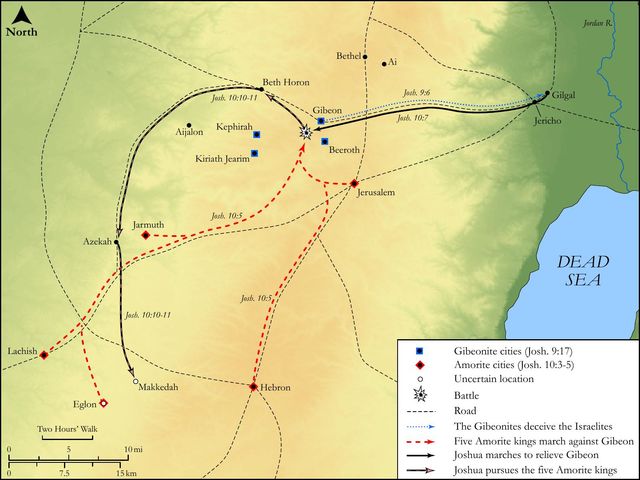
This verse immediately follows the climactic and divinely orchestrated Battle of Gibeon, a miraculous victory where the Lord Himself intervened by casting hailstones and causing the sun and moon to stand still, enabling Israel to decisively rout a confederation of five Amorite kings (Jerusalem, Hebron, Jarmuth, Lachish, and Eglon). After their armies were scattered, these kings fled and sought refuge in a cave at Makkedah, as detailed in Joshua 10:16. Joshua's initial strategic command was to seal the cave entrance while the pursuit of the fleeing Amorite forces continued, preventing their escape and ensuring their complete destruction (Joshua 10:17-20). Once the pursuit was complete and the enemy largely annihilated, Joshua ordered the capture and public presentation of the kings from the cave. The symbolic act of subjugation in Joshua 10:24 serves as a powerful visual culmination of this divine victory, directly preceding Joshua's words of encouragement and assurance to the Israelite army in Joshua 10:25, reinforcing their confidence in God's ongoing commitment to the conquest.
Historical & Cultural Context
The act of placing one's foot upon the neck of a defeated enemy was a deeply ingrained and universally understood symbol of absolute conquest, total subjugation, and profound humiliation among the nations of that day. Scripture uses the same figure when the LORD says, "Sit thou at my right hand, until I make thine enemies thy footstool." The act was far more than a mere physical gesture; it constituted a powerful political, psychological, and religious statement. This public display signified the complete stripping of power, dignity, and authority from the vanquished, unequivocally asserting the victor's supreme dominion and ownership. For the Israelites, this act was a public declaration that the gods and kings of Canaan were utterly defeated by Yahweh, the God of Israel, and that their land and people were now irrevocably subject to His covenant people, fulfilling divine promises of conquest.
Key Themes
ShowHideJoshua 10:24 powerfully contributes to several overarching themes central to the book of Joshua and the broader Old Testament narrative. Firstly, it vividly illustrates the theme of Divine Victory and Judgment, demonstrating God's active and direct involvement in delivering Israel's enemies into their hands. This event is a clear manifestation of God's righteous justice against those who opposed His people and His divine plan for the Promised Land, echoing prior promises of total victory found in Deuteronomy 7:24. Secondly, it underscores the theme of Total Subjugation and Humiliation, as the literal act of placing feet on the necks of the kings visually declared Israel's absolute triumph and the complete stripping of power from the Amorite rulers. This was a public, undeniable sign of their utter defeat and the transfer of authority. Thirdly, the verse emphasizes Empowerment and Assurance for the Israelite army. By having the military captains perform this act, Joshua was not only humiliating the enemy but also empowering his military leaders and assuring the entire army that the Lord would enable them to overcome all future adversaries, thereby building courage and faith for the continued conquest of Canaan (Joshua 10:25).
Exposition and Analysis
ShowHideKey Word Analysis
ShowHideAs defined by H4428, a "king" (מֶלֶךְ) refers to a monarch or royal ruler. In this context, these five kings embodied the political, military, and even religious authority of their respective city-states. Their public humiliation and subjugation symbolized the complete overthrow of their kingdoms, their pagan deities, and their collective resistance to Israel's God and His people. Their defeat represented the foundational collapse of Canaanite sovereignty in the region.
"feet" (רֶגֶל) refer to the physical extremities used in walking, but biblically and culturally, they often symbolize authority, dominion, and possession. The act of placing one's foot upon a defeated foe signifies complete conquest, the establishment of control, and the utter subjugation of the enemy. Here, the feet of the Israelite captains represent the delegated authority and power of God, exercised through His covenant people, to utterly defeat and dominate their enemies.
Derived from H6677, the "neck" (צַוָּאר) refers to the back of the neck, often associated with strength, pride, and resistance (as in being "stiff-necked"). To place a foot upon the neck of a foe is the ultimate act of breaking their will, crushing their strength, and forcing complete submission. It signifies the utter humiliation and complete incapacitation of the enemy, rendering them powerless and subservient.
Verse Breakdown
ShowHide"And it came to pass, when they brought out those kings unto Joshua"
This introductory clause sets the critical scene, marking the culmination of the pursuit and capture of the five Amorite kings. Their being "brought out" from their hiding place in the cave at Makkedah signifies their complete capture and the definitive end of their resistance, marking the successful completion of the initial phase of the battle and pursuit.
"that Joshua called for all the men of Israel, and said unto the captains of the men of war which went with him"
This highlights the deliberate and public nature of the ensuing symbolic act. Joshua specifically summons "all the men of Israel," indicating that this was intended as a grand public spectacle for the entire army to witness. His direct address to the "captains of the men of war"—the military leaders who had "walked" (H1980, hâlak') with him in battle—underscores their role in physically carrying out this symbolic act, thereby empowering them and solidifying their authority within the army.
"Come near, put your feet upon the necks of these kings"
This is Joshua's direct, imperative command, forming the core of the verse. It is a directive for an immediate, physical, and highly symbolic action. The instruction to "put" (H7760, sûwm') their "feet upon the necks" is a visceral command for the captains to physically demonstrate their complete dominion over these defeated rulers, embodying the total victory God had granted them.
"And they came near, and put their feet upon the necks of them"
This final clause confirms the immediate, obedient, and successful execution of Joshua's command. The captains' swift action underscores their faith in Joshua's leadership and, by extension, in God's power and promises. It signifies the successful completion of the symbolic act, publicly cementing the defeat of the Amorite kings and the undeniable triumph of Israel.
Literary Devices
ShowHideJoshua 10:24 is profoundly rich in Symbolism and Imagery. The act of placing feet upon the necks of the defeated kings is a powerful visual symbol of complete and utter subjugation, dominion, and humiliation. It serves as a non-verbal declaration of victory that transcends mere words, communicating absolute conquest in a way that would have been immediately understood and deeply impactful to all present. This Imagery is vivid and visceral, designed to instill both fear in the vanquished and unwavering confidence in the victorious. Furthermore, the event functions as a Public Spectacle, deliberately enacted before "all the men of Israel." This public performance serves not only to humiliate the enemy but also to embolden the Israelite army, reinforcing their trust in God's power and their own authority as His chosen instruments. The dramatic nature of the scene contributes significantly to the overall narrative of divine intervention and Israel's divinely-granted triumph throughout the book of Joshua.
Theological and Thematic Connections
ShowHideThis powerful scene in Joshua 10:24 serves as a profound theological statement about God's absolute sovereignty, His covenant faithfulness, and His righteous judgment. It demonstrates that the Lord is actively and directly involved in the affairs of His people, fighting their battles and meticulously fulfilling His promises to give them the land. The public humiliation of these kings underscores the biblical truth that no earthly power, no matter how formidable, can ultimately stand against the sovereign will of God. Those who oppose His divine plan and His covenant people will ultimately face His decisive judgment. This event is a tangible manifestation of God's power to subdue all enemies before His people, providing a foundational assurance that His purposes will prevail. It also serves as a potent foreshadowing of a greater, ultimate victory over all forms of evil, rebellion, and spiritual opposition.
Reflection and Application
ShowHideWhile believers today are not called to engage in literal physical warfare against human enemies or to replicate the ancient act of placing feet on necks, the spiritual principles embedded in Joshua 10:24 remain profoundly relevant for the Christian life. This passage serves as a potent reminder that God grants victory over spiritual adversaries. Just as the Amorite kings were utterly defeated and publicly humiliated, so too can believers, through Christ, find strength and triumph over the forces of darkness, the persistent grip of sin, and the spiritual opposition that seeks to undermine their faith. It encourages us to walk confidently in the authority given to us in Christ, knowing that our true battle is not against "flesh and blood, but against principalities, against powers, against the rulers of the darkness of this world, against spiritual wickedness in high places" (Ephesians 6:12). This narrative builds profound faith, assuring us that God is actively with us in our spiritual struggles and that ultimate victory is guaranteed through Him. It calls us to confidently stand on the promises of God, knowing that He has already disarmed and triumphed over the powers that seek to enslave and defeat us.
Questions for Reflection
ShowHideFAQ
ShowHideWhy was this act of putting feet on necks considered appropriate or necessary in ancient times?
ShowHideAmong the nations of that day, this act was a common, universally understood, and highly potent symbol of absolute conquest, total subjugation, and the victor's complete dominion over the vanquished. It was a powerful, non-verbal declaration of political, military, and even divine supremacy. For the Israelites, it was not merely an act of human vengeance but a public demonstration of God's righteous judgment against the idolatrous and wicked nations of Canaan, fulfilling His explicit promise to deliver them into Israel's hands (Deuteronomy 7:1-2). It served to instill profound fear in remaining enemy populations and bolster unwavering confidence in the Israelite army, reinforcing their belief that their God was indeed fighting for them and securing their promised inheritance.
Does this verse have any direct application for Christians today, given its violent context?
ShowHideWhile Christians are certainly not called to literal physical warfare against human enemies or to replicate this specific ancient act, the profound theological principles embedded in the passage remain profoundly applicable. The scene symbolizes God's ultimate and decisive victory over all opposing powers. For believers, this translates powerfully into the realm of spiritual warfare, where Christ has already secured the ultimate triumph over sin, death, and the devil (Colossians 2:15). We are called to stand firm in the victory Christ has already secured, recognizing that through Him, we have been granted authority over spiritual enemies. The promise that "the God of peace will soon crush Satan under your feet" (Romans 16:20) is a direct New Testament fulfillment and spiritual extension of this very principle, assuring believers of their ultimate triumph over evil through Christ's indwelling power.
Christ-Centered Fulfillment
ShowHideThe dramatic scene in Joshua 10:24, where the Israelite captains place their feet upon the necks of the defeated Amorite kings, finds its ultimate and most profound fulfillment in the person and redemptive work of Jesus Christ. Joshua's temporary, earthly victory over human kings foreshadows Christ's eternal and decisive triumph over all spiritual powers and authorities. The kings subdued by Joshua represent the forces of darkness—sin, death, and the devil—that hold humanity captive and oppose God's reign. Just as Joshua's victory was a public demonstration of God's power and faithfulness, so too Christ's resurrection and glorious ascension are the ultimate public declaration that He has "spoiled principalities and powers," and "made a shew of them openly, triumphing over them in it" (Colossians 2:15). He is the true King who, according to prophetic scripture, must reign "till he hath put all enemies under his feet" (1 Corinthians 15:25). The powerful imagery of God crushing Satan under the feet of believers (Romans 16:20) is a direct extension of Christ's finished work, empowering His church to live in the reality of His decisive victory. Therefore, Joshua 10:24 points us unmistakably to the Lamb of God, who not only takes away the sin of the world (John 1:29) but also reigns supreme, with all things subjected to His glorious and eternal dominion (Ephesians 1:22).