


Revelation 2:27
Bible text: King James Version (1769 Blayney text) · Public domain
Bible text: King James Version with Strong's numbers · Public domain
Bible text: Berean Standard Bible · Public domain
Bible text: American Standard Version (1901) · Public domain
Bible text: World English Bible, Messianic edition · Public domain
Bible text: Geneva Bible (1599) · Public domain
Bible text: Young's Literal Translation · Public domain
- καὶkaiandG2532CONJConjunction
- ποιμανεῖpoimaneihe will shepherdG4165V-FAI-3SVerb Future Active Indicative 3rd Singular
- αὐτοὺςautousthemG846P-APMPersonal pronoun Accusative Plural Masculine
- ἐνenwithG1722PREPPreposition
- ῥάβδῳrhabdōa rodG4464N-DSFNoun Dative Singular Feminine
- σιδηρᾷsidēraof ironG4603A-DSFAdjective Dative Singular Feminine
- ὡςhōsasG5613PRTParticle or Disjunctive
- τὰtatheG3588T-NPNDefinite article Nominative Plural Neuter
- σκεύηskeuēvessels [of]G4632N-NPNNoun Nominative Plural Neuter
- τὰtatheG3588T-NPNDefinite article Nominative Plural Neuter
- κεραμικὰkeramikapotterG2764A-NPNAdjective Nominative Plural Neuter
- συντρίβεταιsuntribetaiare broken in piecesG4937V-PPI-3SVerb Present Passive Indicative 3rd Singular
- ὡςhōsjust asG5613PRTParticle or Disjunctive
- κἀγὼkagōI myself alsoG2532P-1NS + G2532=CONJ
- εἴληφαeilēphahave receivedG2983V-2RAI-1SVerb 2nd Perfect Active Indicative 1st Singular
- παρὰparafromG3844PREPPreposition
- τοῦtoutheG3588T-GSMDefinite article Genitive Singular Masculine
- πατρόςpatrosFatherG3962N-GSM-TNoun Genitive Singular Masculine Title
- μουmouof MineG3165P-1GSPersonal pronoun Genitive 1st Singular
English is a literal word-by-word gloss of the Greek, not the KJV's wording. Why?
This is the original text the KJV's translators worked from — each Greek word with its own literal English meaning in this verse, prepared by scholars at Tyndale House, Cambridge. The KJV translates whole sentences, not word by word, so its wording differs: one Greek word can become several English words, and the KJV may choose “charity” where the gloss reads “love”. Both are faithful — they answer different questions. For the KJV's own rendering, switch to the KJV text.
Details
See on the biblical-era maps

Study this verse
Public-domain commentary
Matthew Henry
From his Commentary on the Whole Bible. Henry comments on passages, not single verses — this entry covers Revelation 2:18–29. His three-level outline is real structure in the source text, so it is rendered as structure.
The form of each epistle is very much the same; and in this, as the rest, we have to consider the inscription, contents, and conclusion.
I.The inscription, telling us,
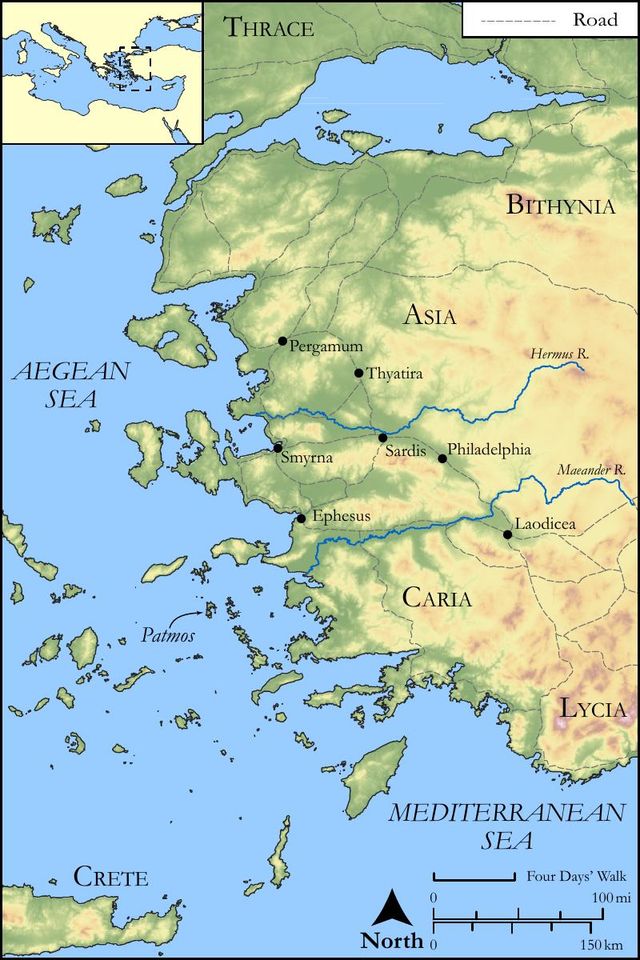
1.To whom it is directed: To the angel of the church of Thyatira, a city of the proconsular Asia, bordering upon Mysia on the north and Lydia on the south, a town of trade, whence came the woman named Lydia, a seller of purple, who, being at Philippi in Macedonia, probably about the business of her calling, heard Paul preach there, and God opened her heart, that she attended to the things that were spoken, and believed, and was baptized, and entertained Paul and Silas there. Whether it was by her means that the gospel was brought into her own city, Thyatira, is not certain; but that it was there, and successful to the forming of a gospel church, this epistle assures us.
2.By whom it was sent: by the Son of God, who is here described as having eyes like a flame of fire, and feet like as fine brass. His general title is here, the Son of God, that is, the eternal and only-begotten Son of God, which denotes that he has the same nature with the Father, but with a distinct and subordinate manner of subsistence. The description we have here of him is in two characters: - (1.) That his eyes are like a flame of fire, signifying his piercing, penetrating, perfect knowledge, a thorough insight into all persons and all things, one who searches the hearts and tries the reins of the children of men (Rev 2:23), and will make all the churches to know he does so. (2.) That his feet are like fine brass, that the outgoings of his providence are steady, awful, and all pure and holy. As he judges with perfect wisdom, so he acts with perfect strength and steadiness.
II.The contents or subject-matter of this epistle, which, as the rest, includes,
1.The honourable character and commendation Christ gives of this church, ministry, and people; and this given by one who was no stranger to them, but well acquainted with them and with the principles from which they acted. Now in this church Christ makes honourable mention,
(1.)Of their charity, either more general, a disposition to do good to all men, or more special, to the household of faith: there is no religion where there is no charity.
(2.)Their service, their ministration; this respects chiefly the officers of the church, who had laboured in the word and doctrine.
(3.)Their faith, which was the grace that actuated all the rest, both their charity and their service.
(4.)Their patience; for those that are most charitable to others, most diligent in their places, and most faithful, must yet expect to meet with that which will exercise their patience.
(5.)Their growing fruitfulness: their last works were better than the first. This is an excellent character; when others had left their first love, and lost their first zeal, these were growing wiser and better. It should be the ambition and earnest desire of all Christians that their last works may be their best works, that they may be better and better every day, and best at last.
2.A faithful reproof for what was amiss. This is not so directly charged upon the church itself as upon some wicked seducers who were among them; the church's fault was that she connived too much at them.
(1.)These wicked seducers were compared to Jezebel, and called by her name. Jezebel was a persecutor of the prophets of the Lord, and a great patroness of idolaters and false prophets. The sin of these seducers was that they attempted to draw the servants of God into fornication, and to offer sacrifices to idols; they called themselves prophets, and so would claim a superior authority and regard to the ministers of the church. Two things aggravated the sin of these seducers, who, being one in their spirit and design, are spoken of as one person: - [1.] They made use of the name of God to oppose the truth of his doctrine and worship; this very much aggravated their sin. [2.] They abused the patience of God to harden themselves in their wickedness. God gave them space for repentance, but they repented not. Observe, First, Repentance is necessary to prevent a sinner's ruin. Secondly, Repentance requires time, a course of time, and time convenient; it is a great work, and a work of time. Thirdly, Where God gives space for repentance, he expects fruits meet for repentance. Fourthly, Where the space for repentance is lost, the sinner perishes with a double destruction.
(2.)Now why should the wickedness of this Jezebel be charged upon the church of Thyatira? Because that church suffered her to seduce the people of that city. But how could the church help it? They had not, as a church, civil power to banish or imprison her; but they had ministerial power to censure and to excommunicate her: and it is probable that neglecting to use the power they had made them sharers in her sin.
3.The punishment of this seducer, this Jezebel, Rev 2:22, Rev 2:23, in which is couched a prediction of the fall of Babylon.
(1.)I will cast her into a bed, into a bed of pain, not of pleasure, into a bed of flames; and those who have sinned with her shall suffer with her; but this may yet be prevented by their repentance.
(2.)I will kill her children with death; that is, the second death, which does the work effectually, and leaves no hope of future life, no resurrection for those that are killed by the second death, but only to shame and everlasting contempt.
4.The design of Christ in the destruction of these wicked seducers, and this was the instruction of others, especially of his churches: All the churches shall know that I am he that searcheth the reins and the hearts; and I will give to every one of you according to your works. God is known by the judgments that he executes; and, by this revenge taken upon seducers, he would make known,
(1.)His infallible knowledge of the hearts of men, of their principles, designs, frame, and temper, their formality, their indifference, their secret inclinations to symbolize with idolaters.
(2.)His impartial justice, in giving every one according to his work, that the name of Christians should be no protection, their churches should be no sanctuaries for sin and sinners.
5.The encouragement given to those who keep themselves pure and undefiled: But to you I say, and unto the rest, etc., Rev 2:24. Observe,
(1.)What these seducers called their doctrines - depths, profound mysteries, amusing the people, and endeavouring to persuade them that they had a deeper insight into religion than their own ministers had attained to.
(2.)What Christ called them - depths of Satan, Satanical delusions and devices, diabolical mysteries; for there is a mystery of iniquity, as well and the great mystery of godliness. It is a dangerous thing to despise the mystery of God, and it is as dangerous to receive the mysteries of Satan.
(3.)How tender Christ is of his faithful servants: "I will lay upon you no other burden; but that which you have already hold fast till I come, Rev 2:24, Rev 2:25. I will not overburden your faith with any new mysteries, nor your consciences with any new laws. I only require your attention to what you have received. Hold that fast till I come, and I desire no more." Christ is coming to put an end to all the temptations of his people; and, if they hold fast faith and a good conscience till he come, all the difficulty and danger will be over.
III.We now come to the conclusion of this message, Rev 2:26-29. Here we have,
1.The promise of an ample reward to the persevering victorious believer, in two parts: - (1.) Very great power and dominion over the rest of the world: Power over the nations, which may refer either to the time when the empire should turn Christian, and the world be under the government of the Christian emperor, as in Constantine's time; or to the other world, when believers shall sit down with Christ on his throne of judgment, and join with him in trying, and condemning, and consigning over to punishment the enemies of Christ and the church. The upright shall have dominion in the morning. (2.) Knowledge and wisdom, suitable to such power and dominion: I will give him the morning-star. Christ is the morning-star. He brings day with him into the soul, the light of grace and of glory; and he will give his people that perfection of light and wisdom which is requisite to the state of dignity and dominion that they shall have in the morning of the resurrection.
2.This epistle ends with the usual demand of attention: He that hath an ear let him hear what the Spirit saith unto the churches. In the foregoing epistles, this demand of attention comes before the concluding promise; but in this, and all that follow, it comes after, and tells us that we should all attend to the promises as well as to the precepts that Christ delivers to the churches.
Historical interpretation
Eight Centuries of Reception
8 surviving comments on this verse. Each one is dated, so this reads as a timeline rather than a list.
Select a marker to jump to its quote. Markers stagger vertically where authors wrote within a few decades of each other.
Seize the opportunity of unexpected felicity: that you, who sometime were in God's sight nothing but "a drop of a bucket," and "dust of the threshing-floor," and "a potter's vessel," may thenceforward become that "tree which is sown beside the waters, is perennial in leaves, bears fruit at its own time," and shall not see fire," nor "axe.
The fourth class intimates the nobility of the faithful, who labour daily, and do greater works. But even among them also He shows that there are men of an easy disposition to grant unlawful peace, and to listen to new forms of prophesying; and He reproves and warns the others to whom this is not pleasing, who know the wickedness opposed to them: for which evils He purposes to bring upon the head of the faithful both sorrows and dangers; and therefore He says:-
"I will not put upon you any other burden." That is, I have not given you laws, observances, and duties, which is another burden.
"But that which ye have, hold fast until I come; and he that overcometh, to him will I give power over all peoples." That is, him I will appoint as judge among the rest of the saints.
"And I will give him the morning star." To wit, the first resurrection. He promised the morning star, which drives away the night, and announces the light, that is, the beginning of day.
The church has this power in Christ. Whoever holds fast to his body will be co-heir with the Lord and will have whatever the Son of man received, for “he has given us all things with him.”
God promises that he will give to him power over the nations and kingdoms, so that he might reign over them with an iron rod and destroy them as though they were a clay pot. He refers to the apostate angels who abandoned their own dominion, for they are going to be judged by the saints on the day of judgment and damned and thrown into eternal destruction, as the apostle says.
“To him who does my works,” the Lord says, “I will give authority over five or ten cities,” as he said in the Gospel. Or, this passage refers to the judgment of the unfaithful, through which the deceived will be crushed, as though beaten with a rod of iron, and will be judged by those who have believed in Christ. “The men of Nineveh will rise and condemn this generation.” The words “as I myself received from the Father” refer to his human nature, which he assumed through the flesh.
And he shall rule them with a rod of iron. He governs the meek with inflexible justice, so that they may bear more fruit; but he destroys the obstinate, so that they either perish eternally, or the earthly desires and muddy affairs of the old man are crushed in them, whatever has been contracted and ingrained from the mire of sins.
And he that shall overcome, and keep my works unto the end, I will give him power over the nations. And he shall rule them with a rod of iron, and as the vessel of a potter they shall be broken, as I also have received of my Father. The Son did not receive this power from the Father in his divinity, but in his humanity, in which he is inferior to the Father; whence this: All power is given to me in heaven and in earth; [Matt. 28:18] and since the elect are his limbs, they also receive this power in their Head, according to this: Whatsoever you shall bind upon earth, shall be bound also in heaven, etc. [Matt. 18:18] By the rod of iron is represented the authority of preachers; for a rod of iron has straightness without weakness: so are the holy preachers capable neither of sparing themselves nor others when it comes to fighting vices, but they only strive to build the path of justice in themselves and others; whence it is said to Christ: The rod of thy kingdom is a straight rod. [Variant of Ps. 44:7] It is appropriate for believers to be compared to earthen vessels, for they are vessels in that they bear the treasure hidden from eternity, and they are earthen because they are burdened by the decay of the flesh; whence the apostle: We have this treasure in earthen vessels. [2 Cor. 4:7] As for the fact that these vessels are said to be broken when touched by the rod, we should understand here a part of the vessels that is still being destroyed in order to be remoulded for the better. Hence it is said to the potter of mankind: Turn the wicked, and they shall not be, [Prov. 12:7] implying “they shall not be wicked, but good.” Now what is meant by the first words, he that shall overcome, and keep my works unto the end? Is no one ruling believers until he triumphs over the Devil by reaching the end? Or maybe he will rule afterwards? Therefore one should know that the Lord, using the future instead of the past, is indicating that those to whom he proclaims he will give power over the nations, have already overcome by the grace of predestination, and have already kept his works unto the end; as if he were saying, “I will rightly give the duty of ruling to the one who I find out for certain is victorious and will continue my works unto the end.” This is because for him the future is the present. And I will give him the morning star. In the sacred Scripture, the morning star in the singular signifies Christ (whence he says later, I am the morning star) [Rev. 22:16] and in the plural it signifies angels. So the Lord will give the morning star to those who overcome, when he remoulds the body of our humility, that is, when all those who are in the graves hear the voice of the Lord and come forth: [John 5:28-29] he will bring them to the perfect day [Prov. 4:18] when he shows them the brightness of his divinity.
And to the one who overcomes the evil one, I will give authority over the nations, and he will rule them with a rod of iron, as when earthen pots are broken in pieces, even as I myself have received authority from my Father. This is what is spoken of in the Gospels by those who have well managed the trusts and the talents entrusted to them. "Be in charge of ten cities"; and there will "be another in charge of five cities." (see Luke 19:17,19) And to Daniel, "and the kingdom shall be given to the saints of God." (Dan. 7:22) For it indicates a certain beginning and authority given to the saints over those who are inferior and in need of guidance. Therefore, he says that he shepherds them with strict authority, but the disobedient he will crush like earthenware vessels.
Continue studying Revelation 2:27 across the web’s major study libraries — every link below opens this exact verse, chapter, or book on the destination site.
Read & Compare
 BibleGatewayThis verse in more than 200 translations and 70 languages.
 Bible.comThe YouVersion reader — hundreds of translations, reading plans, and highlights.
 ESV.orgCrossway's official English Standard Version reader.
 NET BibleThe NET translation with 60,000+ translators' notes on every rendering decision.
 STEP BibleTyndale House's free study tool — original text, vocabulary, and scholarly resources.
 BibliaLogos Bible Software's free web reader.
 USCCBThe New American Bible (Revised Edition) with the U.S. bishops' study notes.
Commentaries
 BibleHub CommentariesDozens of classic commentaries on this verse, gathered on one page.
 StudyLightMore than 100 commentary sets — the largest collection on the web.
 BibleRefPlain-English commentary on what this verse means, verse by verse.
 Enduring WordDavid Guzik's free commentary on this chapter, widely used by Bible teachers.
 Bible Study ToolsVerse commentary alongside Greek and Hebrew study aids.
Original Language & Research
- BibleHub InterlinearThe verse word by word — original language, transliteration, and English.
- BibleHub LexiconEvery word's original-language definition and Strong's entry.
 Blue Letter BibleDeep-study tools — Strong's numbers, concordance, and word studies.
 CNTR CollationThe earliest Greek manuscripts of this verse, collated letter by letter.
Sermons, Hymns & Audio


TrulyRandomVerse is not affiliated with these sites and doesn’t control their content. They’re linked because they’re genuinely useful.
Summary
Revelation 2:27 delivers a profound promise from Jesus Christ to the faithful "overcomer" within the church at Thyatira, assuring a future participation in His sovereign rule and a share in the decisive judgment of the nations. This powerful declaration echoes ancient prophetic themes, underscoring the ultimate, unchallengeable authority of Christ and the glorious rewards awaiting those who remain steadfast in their allegiance and obedience amidst spiritual compromise.
Context
ShowHideLiterary Context
This verse concludes Jesus' specific message to the church in Thyatira, one of the seven churches in Asia Minor addressed in Revelation chapters 2-3. Following commendation for their love, faith, service, and patience, Jesus issues a stern rebuke for their toleration of the false prophetess "Jezebel" and her destructive teachings, which led some to idolatry and immorality. Verse 27, however, shifts from condemnation to a magnificent promise, specifically directed to those who “overcometh, and keepeth my works unto the end”. It serves as a powerful incentive for steadfast loyalty and obedience, offering a glorious future to those who resist the prevailing spiritual compromise and remain faithful to Christ's truth. This promise is intrinsically linked to the broader theme of overcoming found throughout Revelation and forms a significant part of the concluding promises to each of the seven churches.
Historical & Cultural Context
Thyatira was a prosperous commercial city known for its trade guilds, particularly those involved in dyeing and textiles, including the famous purple dye. Membership in these guilds often required participation in pagan feasts and rituals, which frequently involved idolatry and sexual immorality. This presented a significant challenge for Christians, as refusing to participate could lead to economic ostracization. The "Jezebel" figure likely represents a charismatic teacher or group promoting compromise with these pagan practices, perhaps arguing for a pragmatic approach to avoid persecution or economic hardship. The imagery of the "rod of iron" and "potter's vessels" would have resonated with the Roman imperial context, where rulers wielded absolute power and could crush rebellion decisively. The promise of shared rule would have been particularly striking in a society accustomed to hierarchical, absolute authority.
Key Themes
ShowHideRevelation 2:27 contributes significantly to several major theological and narrative themes within Revelation and the broader biblical narrative. Firstly, it highlights Divine Authority and Righteous Rule, drawing directly from Psalm 2:9, a foundational messianic prophecy. This reinforces the absolute, unyielding, and righteous dominion of Christ over all nations, a theme that culminates in His final victory described in Revelation 19:15. Secondly, the verse emphasizes Decisive Judgment, vividly portraying the complete and irreversible destruction of all opposition to God's reign, much like a shattered clay vessel. This imagery underscores the certainty of God's justice and the ultimate triumph of His kingdom over all earthly powers. Finally, and perhaps most astonishingly, the promise of Shared Authority with Christ reveals the profound intimacy and privilege granted to the faithful. The phrase "even as I received of my Father" indicates that the authority promised to the overcomer is a participation in Christ's own supreme authority, which He Himself received from the Father. This theme of co-reigning with Christ is a recurring motif for believers, seen in passages such as Revelation 3:21 and 2 Timothy 2:12.
Exposition and Analysis
ShowHideKey Word Analysis
ShowHideMeaning "to tend as a shepherd of (figuratively, superviser)." While often denoting tender care and guidance, its pairing with "a rod of iron" here signifies a forceful, authoritative, and unyielding governance. It implies a rule that brings order through strict justice and decisive action, thereby highlighting Christ's multifaceted role as both caring Shepherd and sovereign King.
Meaning "a vessel, implement, equipment or apparatus." In this context, it refers to clay pots or earthenware, common in ancient households. The fragility of these vessels emphasizes the ease with which they can be shattered, serving as a powerful metaphor for the utter vulnerability and inevitable destruction of those who oppose God's rule.
Meaning "to crush completely, i.e. to shatter (literally or figuratively)." This verb conveys a sense of total and irreversible destruction. Unlike something merely broken that might be repaired, "broken to shivers" implies a complete pulverization, leaving no hope of restoration, vividly illustrating the finality of God's judgment against His enemies.
Verse Breakdown
ShowHide"And he shall rule them with a rod of iron;"
This clause directly alludes to Psalm 2:9, a key messianic prophecy. The "he" refers to the "overcomer" mentioned in the preceding verse, who will share in Christ's authority. The "rod of iron" (Greek: rhábdos sidḗreos) symbolizes absolute, unbreakable, and righteous authority, signifying a reign of justice that will decisively overcome all opposition. It is not a gentle rule but one characterized by unyielding strength and judgment against rebellion.
"as the vessels of a potter shall they be broken to shivers:"
This powerful simile continues the imagery from Psalm 2:9. The "vessels of a potter" represent the nations or those who rebel against God's authority, depicted as fragile and easily destroyed. The act of being "broken to shivers" (Greek: syntríbō) emphasizes the complete, irreversible, and utterly devastating nature of the judgment that will befall those who stand against Christ's rule. It signifies total subjugation and annihilation of opposition.
"even as I received of my Father."
This crucial phrase clarifies the source and nature of the authority promised to the overcomer. The "I" refers to Jesus Christ, who states that His own authority to rule and judge was "received" (Greek: lambánō) from God the Father. This means the overcomer's future shared reign is not an independent power but a delegated authority, a participation in Christ's own divinely given dominion. It underscores the Trinitarian basis of this ultimate authority and the profound privilege granted to faithful believers.
Literary Devices
ShowHideRevelation 2:27 is rich with literary devices that amplify its message. Allusion is central, as the verse directly quotes and recontextualizes Psalm 2:9, a foundational Old Testament messianic prophecy. This connection immediately imbues the text with profound theological depth, linking the promised authority of the overcomer to the ultimate dominion of the Messiah. The phrase "rod of iron" functions as a potent Symbolism for absolute, unbreakable, and righteous authority, signifying the unyielding nature of Christ's rule and, by extension, the shared rule of the faithful. The comparison "as the vessels of a potter shall they be broken to shivers" is a vivid Simile, illustrating the fragility and inevitable destruction of those who oppose divine authority. This imagery also carries strong Metaphorical weight, depicting rebellious nations or individuals as common, easily shattered clay pots, highlighting their ultimate powerlessness before God's sovereign might. These devices collectively create a powerful and unforgettable image of divine judgment and the shared triumph of Christ and His faithful followers.
Theological and Thematic Connections
ShowHideRevelation 2:27 stands as a profound testament to the ultimate sovereignty of God and the eschatological hope of the church. It reveals that the authority to rule and judge the nations is inherently Christ's, having been received directly from the Father, and astonishingly, this authority is promised to be shared with those who demonstrate unwavering faithfulness. This promise underscores the active participation of believers in Christ's future kingdom, not merely as subjects but as co-regents in His righteous administration of justice. It speaks to the ultimate vindication of God's people and the final defeat of all evil, establishing a clear trajectory from present struggle to future glory and demonstrating the profound intimacy of the relationship between Christ and His faithful ones.
Reflection and Application
ShowHideRevelation 2:27 offers a powerful vision that transcends mere future hope, providing profound implications for present-day living. The promise of sharing in Christ's rule with a "rod of iron" is not an invitation to earthly power or harshness, but a call to live now with the character of those who will one day administer divine justice. It encourages believers to cultivate righteousness, integrity, and unwavering commitment to Christ's teachings, even when facing opposition or temptation to compromise, as the church in Thyatira did. Understanding that our future authority is derived from Christ's own authority, received from the Father, should inspire humility, faithfulness, and a deep reliance on His strength. This verse reminds us that our endurance in faith is not in vain; it leads to a glorious participation in God's ultimate triumph, motivating us to overcome spiritual challenges and to live as ambassadors of His coming kingdom, embodying His justice and truth in a world that desperately needs it.
Questions for Reflection
ShowHideFAQ
ShowHideDoes "rule them with a rod of iron" imply a harsh or unloving reign by Christ and believers?
ShowHideWhile the imagery of a "rod of iron" (from Psalm 2:9) signifies absolute, unbreakable authority and decisive judgment, it does not imply an arbitrary or unloving reign. Instead, it speaks to a rule that is perfectly righteous, just, and unwavering. In the context of Christ's character, this iron rod represents His unyielding commitment to justice and truth, which will ultimately bring perfect order and peace to a fallen world. For believers sharing in this rule, it means participating in the administration of God's perfect justice, which is always rooted in His holy and loving character, ensuring that all wrongs are righted and His kingdom is established in perfect equity. It's a rule that crushes rebellion, not the innocent.
What does it mean for believers to "receive" authority "even as I received of my Father"?
ShowHideThis phrase highlights the source and nature of the authority promised to the overcomer. Jesus states that His own authority to rule and judge was "received" from God the Father, indicating a divinely delegated and legitimate power. When believers are promised to share in this, it means their future authority is not inherent to them but is a gracious participation in Christ's own supreme, God-given dominion. It signifies a profound spiritual union and co-heirship with Christ, where the faithful are entrusted with a share in His kingly and judicial functions, always under His ultimate headship and in perfect alignment with His will. This promise underscores the incredible privilege and high calling of those who remain faithful to Christ.
Christ-Centered Fulfillment
ShowHideRevelation 2:27 finds its ultimate Christ-centered fulfillment in the person and work of Jesus Christ, who is the true and only King of Kings and Lord of Lords. The "rod of iron" is fundamentally His, representing His inherent, divinely ordained authority as the Messiah, as prophesied in Psalm 2:9. He is the one who will ultimately "rule all nations with a rod of iron" (Revelation 19:15). His receiving authority "of my Father" points to His unique Sonship and divine commission, through which He accomplished redemption on the cross, disarming the powers of darkness (Colossians 2:15). The promise that the overcomer will share in this rule is a testament to Christ's redemptive work, which not only saves believers but also incorporates them into His glorious destiny. Through His death and resurrection, Christ has conquered sin and death, establishing His kingdom, and He graciously invites His faithful followers to participate in the final administration of His righteous reign, fulfilling the promise that "if we endure, we will also reign with him" (2 Timothy 2:12). Thus, the verse is a powerful declaration of Christ's supreme dominion and His gracious inclusion of His redeemed people in His eternal triumph.