


Hosea 1:2
Bible text: King James Version (1769 Blayney text) · Public domain
Bible text: King James Version with Strong's numbers · Public domain
Bible text: Berean Standard Bible · Public domain
Bible text: American Standard Version (1901) · Public domain
Bible text: World English Bible, Messianic edition · Public domain
Bible text: Geneva Bible (1599) · Public domain
Bible text: Young's Literal Translation · Public domain
- תְּחִלַּתte·chi·Lat[the] beginningH8462N-fscNoun Singular Feminine Construct
- דִּבֶּרdi·ber<of> [when] he spokeH1696V-Piel-Perf-3msVerb Piel Perfect 3rd Singular Masculine
- יְהוָהYah·wehYahwehH3068N-properNoun Proper Title
- בְּהוֹשֵׁעַbe·ho·She·a'by HoseaH1954Prep-b ¦ N-proper-mNoun Proper MasculineבְּbyהוֹשֵׁעַHosea
- וַיֹּאמֶרvai·Yo·merand he saidH559Conj-w ¦ V-Qal-ConsecImperf-3msVerb Qal Consecutive Imperfect 3rd Singular Masculineוַandיֹּאמֶרhe said
- יְהוָהYah·wehYahwehH3068N-properNoun Proper Title
- אֶל'eltoH413PrepPreposition
- הוֹשֵׁעַho·She·a'HoseaH1954N-proper-mNoun Proper Masculine
- לֵךְlekhgoH1980V-Qal-Imp-2msVerb Qal Imperative 2nd Singular Masculine
- קַחkachtakeH3947V-Qal-Imp-2msVerb Qal Imperative 2nd Singular Masculine
- לְךָle·Khafor yourselfPrep-l ¦ 2msSuffix Personal 2nd Singular Masculineלְforךָyourself
- אֵשֶׁת'E·sheta wife ofH802N-fscNoun Singular Feminine Construct
- זְנוּנִיםze·nu·Nimprostitution<s>H2183N-mpNoun Plural Masculine Absolute
- וְיַלְדֵיve·yal·Deiand children ofH3206Conj-w ¦ N-mpcNoun Plural Masculine Constructוְandיַלְדֵיchildren of
- זְנוּנִיםze·nu·Nimprostitution<s>H2183N-mpNoun Plural Masculine Absolute
- כִּיkiforH3588PrtParticle Conditional
- זָנֹהza·Nohcontinually <prostitute itself>H2181V-Qal-InfAbsVerb Qal Infinitive Absolute
- תִזְנֶהtiz·Nehit prostitutes itselfH2181V-Qal-Imperf-3fsVerb Qal Imperfect 3rd Singular Feminine
- הָאָרֶץha·'A·retzthe landH776Art ¦ N-fsNoun Singular Feminine Absoluteהָtheאָרֶץland
- מֵאַחֲרֵיme·'a·cha·Reifrom afterH310Prep-m ¦ Adj-mpcAdjective Numerical Plural Masculine Constructמֵfromאַחֲרֵיafter
- יְהוָהYah·wehYahwehH3068N-properNoun Proper Title
English is a literal word-by-word gloss of the Hebrew, not the KJV's wording. Why?
This is the original text the KJV's translators worked from — each Hebrew word with its own literal English meaning in this verse, prepared by scholars at Tyndale House, Cambridge. The KJV translates whole sentences, not word by word, so its wording differs: one Hebrew word can become several English words, and the KJV may choose “the LORD” where the gloss reads “Yahweh”. Both are faithful — they answer different questions. For the KJV's own rendering, switch to the KJV text.
Details
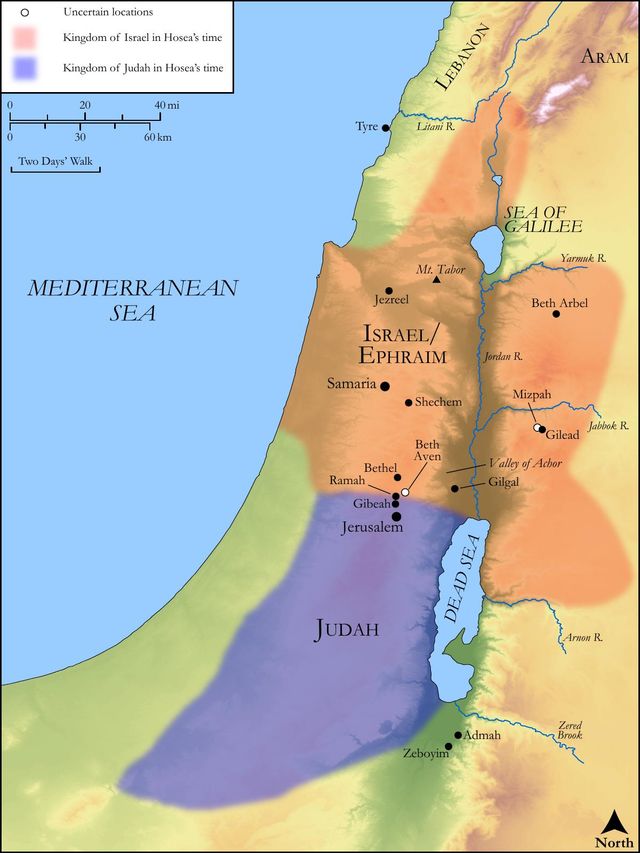
See on the biblical-era map
Study this verse
Public-domain commentary
Matthew Henry
From his Commentary on the Whole Bible. Henry comments on passages, not single verses — this entry covers Hosea 1:2–7. His three-level outline is real structure in the source text, so it is rendered as structure.
These words, The beginning of the word of the Lord by Hosea, may refer either, 1. To that glorious set of prophets which was raised up about this time. About this time there lived and prophesied Joel, Amos, Micah, Jonah, Obadiah, and Isaiah; but Hosea was the first of them that foretold the destruction of Israel; the beginning of this word of the Lord was by him. We read in the history of this Jeroboam here named (Kg2 14:27) that the Lord had not yet said he would blot out the name of Israel, but soon after he said he would, and Hosea was the man that began to say it, which made it so much the harder task to him, to be the first that should carry an unpleasing message and some time before any were raised up to second him. Or, rather, 2. To Hosea's own prophecies. This was the first message God sent him upon to this people, to tell them that they were an evil and an adulterous generation. He might have desired to be excused from dealing so roughly with them till he had gained authority and reputation, and some interest in their affections. No; he must begin with this, that they might know what to expect from a prophet of the Lord. Nay, he must not only preach this to them, but he must write it, and publish it, and leave it upon record as a witness against them. Now here,
I.The prophet must, as it were in a looking-glass, show them their sin, and show it to be exceedingly sinful, exceedingly hateful.
The prophet is ordered to take unto him a wife of whoredoms and children of whoredoms, Hos 1:2. And he did so, Hos 1:3. He married a woman of ill fame, Gomer the daughter of Diblaim, not one that had been married and had committed adultery, for then she must have been put to death, but one that had lived scandalously in the single state. To marry such a one was not malum in se - evil in itself, but only malum per accidens - incidentally an evil, not prudent, decent, or expedient, and therefore forbidden to the priests, and which, if it were really done, would be an affliction to the prophet (it is threatened as a curse on Amaziah that his wife should be a harlot, Amo 7:17), but not a sin when God commanded it for a holy end; nay, if commanded, it was his duty, and he must trust God with his reputation. But most commentators think that it was done in vision, or that it is no more than a parable; and that was a way of teaching commonly used among the ancients, particularly prophets; what they meant of others they transferred to themselves in a figure, as St. Paul speaks, Co1 4:6. He must take a wife of whoredoms, and have such children by her as every one would suspect, though born in wedlock, to be children of whoredoms, begotten in adultery, because it is too common for those who have lived lewdly in the single state to live no better in the married state. "Now" (saith God) "Hosea, this people is to me such a dishonour, and such a grief and vexation, as a wife of whoredoms and children of whoredoms would be to thee. For the land has committed great whoredoms." In all instances of wickedness they had departed from the Lord; but their idolatry especially is the whoredom they are here charged with. Giving that glory to any creature which is due to God alone is such an injury and affront to God as for a wife to embrace the bosom of a stranger is to her husband. It is especially so in those that have made a profession of religion, and have been taken into covenant with God; it is breaking the marriage-bond; it is a heinous odious sin, and, as much as any thing, besots the mind and takes away the heart. Idolatry is great whoredom, worse than any other; it is departing from the Lord, to whom we lie under greater obligations than any wife does or can do to her husband. The land has committed whoredom; it is not here and there a particular person that is guilty of idolatry, but the whole land is polluted with it; the sin has become national, the disease epidemical. What an odious thing would it be for the prophet, a holy man, to have a whorish wife, and children whorish like her! What an exercise would it be of his patience, and, if she persisted in it, what could be expected but that he should give her a bill of divorce! And is it not then much more offensive to the holy God to have such a people as this to be called by his name and have a place in his house? How great is his patience with them! And how justly may he cast them off! It was as if he should have married Gomer the daughter of Diblaim, who probably was at that time a noted harlot. The land of Israel was like Gomer the daughter of Diblaim. Gomer signifies corruption; Diblaim signifies two cakes, or lumps of figs; this denotes that Israel was near to ruin, and that their luxury and sensuality were the cause of it. They were as the evil figs that could not be eaten, they were so evil. It intimates sin to be the daughter of plenty and destruction the daughter of the abuse of plenty. Some give this sense of the command here given to the prophet: "Go, take thee a wife of whoredoms, for, if thou shouldst go to seek for an honest modest woman, thou wouldst not find any such, for the whole land, and all the people of it, are given to whoredom, the usual concomitant of idolatry."
II.The prophet must, as it were through a perspective glass, show them their ruin; and this he does in the names given to the children born of this adulteress; for as lust, when it has conceived, brings forth sin, so sin, when it is finished, brings forth death.
1.He foretels the fall of the royal family in the name he is appointed to give to his first child, which was a son: Call his name Jezreel, Hos 1:4. We find that the prophet Isaiah gave prophetical names to his children (Isa 7:3; Isa 7:3), so this prophet here. Jezreel signifies the seed of God (so they should have been); but it signifies also the scattered of God; they shall be as sheep on the mountains that have no shepherds. Call them not Israel, which signifies dominion, they have lost all the honour of that name; but call them Jezreel, which signifies dispersion, for those that have departed from the Lord will wander endlessly. Hitherto they have been scattered as seek; let them now be scattered as chaff. Jezreel was the name of one of the royal seats of the kings of Israel; it was a beautiful city, seated in a pleasant valley, and it is with allusion to that city that this child is called Jezreel, for yet a little while and I will avenge the blood of Jezreel upon the house of Jehu, from whom the present king, Jeroboam, was lineally descended. The house of Jehu smarted for the sins of Jehu, for God often lays up men's iniquity for their children and visits it upon them. It is the kingdom of the house of Israel, which may be meant either of the present royal family, that of Jehu, which God did quickly cause to cease (for the son of this Jeroboam, Zechariah, reigned but six months, and he was the last of Jehu's race), or of the whole kingdom in general, which continued corrupt and wicked, and which was made to cease in the reign of Hoshea, about seventy years after; and with God that is but a little while. Note, Note, Neither the pomp of kings nor the power of kingdoms can secure them from God's destroying judgments, if they continue to rebel against him. (2.) What is the ground of this controversy: I will revenge the blood of Jezreel upon the house of Jehu, the blood which Jehu shed at Jezreel, when by commission from God and in obedience to his command, he utterly destroyed the house of Ahab, and all that were in alliance with it, with all the worshippers of Baal. God approved of what he did (Kg2 10:30): Thou has done well in executing that which is right in my eyes; and yet here God will avenge that blood upon the house of Jehu, when the time has expired during which it was promised that his family should reign, even to the fourth generation. But how comes the same action to be both rewarded and punished? Very justly; the matter of it was good; it was the execution of a righteous sentence passed upon the house of Ahab, and, as such, it was rewarded; but Jehu did it not in a right manner; he aimed at his own advancement, not at the glory of God, and mingled his own resentments with the execution of God's justice. He did it with a malice against the sinners, but not with any antipathy to the sin; for he kept up the worship of the golden calves, and took no heed to walk in the law of God, Kg2 10:31. And therefore when the measure of the iniquity of his house was full, and God came to reckon with them, the first article in the account is (and, being first, it is put for all the rest) for the blood of the house of Ahab, here called the blood of Jezreel. Thus when the house of Baasha was rooted out it was because he did like the house of Jeroboam, and because he killed him, Kg1 16:7. Note, Those that are entrusted with the administration of justice are concerned to see to it that they do it from a right principle and with a right intention, and that they do not themselves live in those sins which they punish in others, lest even their just executions should be reckoned for, another day, as little less than murders. (3.) How far the controversy shall proceed; it shall be not a correction, but a destruction. Some make those words, I will visit, or appoint, the blood of Jezreel upon the house of Jehu, to signify, not as we read it the revenging of that bloodshed, but the repeating of that bloodshed: "I will punish the house of Jehu, as I punished the house of Ahab, because Jehu did not take warning by the punishment of his predecessors, but trod in the steps of their idolatry. And after the house of Jehu is destroyed I will cause to cease the kingdom of the house of Israel; I will begin to bring it down, though now it flourish." After the death of Zechariah, the last of the house of Jehu, the kingdom of the ten tribes went to decay, and dwindled sensibly. And, in order to the ruin of it, it is threatened (Hos 1:5), I will break the bow of Israel in the valley of Jezreel; the strength of the warriors of Israel, so the Chaldee. God will disable them either to defend themselves or to resist their enemies. And the bow abiding in strength, and being renewed in the hand, intimates a growing power, so the breaking of the bow intimates a sinking ruined power. The bow shall be broken in the valley of Jezreel, where, probably, the armoury was; or, it may be, in that valley some battle was fought, wherein the kingdom of Israel was very much weakened. Note, There is no fence against God's controversy; when he comes forth against a people their strong bows are soon broken and their strong-holds broken down. In the valley of Jezreel they shed that blood which the righteous God would in that very place avenge upon them; as some notorious malefactors are hanged in chains just where the villainy they suffer for was perpetrated, that the punishment may answer the sin.
2.He foretels God's abandoning the whole nation in the name he gives to the second child. This was a daughter, as the former was a son, to intimate that both sons and daughters had corrupted their way. Some make to signify that Israel grew effeminate, and was thereby enfeebled and made weak. Call the name of this daughter Lo-ruhamah - not beloved (so it is translated Rom 9:25), or not having obtained mercy, so it is translated Pe1 2:10. It comes all to one. This reads the doom of the house of Israel: I will no more have mercy upon them. It intimates that God had shown them great mercy, but they had abused his favours, and forfeited them, and now he would show them favour no more. Note, Those that forsake their own mercies for lying vanities have reason to expect that their own mercies should forsake them, and that they should be left to their lying vanities, Jon 2:8. Sin turns away the mercy of God even from the house of Israel, his own professing people, whose case is sad indeed when God says that he will no more have mercy upon them. And then it follows, I will utterly take them away, will utterly remove them (so some), will utterly pluck them up, so others. Note, When the streams of mercy are stopped we can expect no other than that the vials of wrath should be opened. Those whom God will no more have mercy upon shall be utterly taken away, as dross and dung. The word for taking away sometimes signifies to forgive sin; and some take it in that sense here: I will no more have mercy upon them, though in pardoning I have pardoned them heretofore. Though God has borne long, he will not bear always, with a people that hate to be reformed. Or, I will no more have mercy upon them, that I should in any wise pardon them, or (as our margin reads it) that I should altogether pardon them. If pardoning mercy is denied, no other mercy can be expected, for that opens the door to all the rest. Some make this to speak comfort: I will no more have mercy upon them till in pardoning I shall pardon them, that is, till the Redeemer comes to Zion to turn away ungodliness from Jacob. The Chaldee reads it, But, if they repent, in pardoning I will pardon them. Even the greatest sinners, if in time they bethink themselves and return, will find that there is forgiveness with God.
III.He must show them what mercy God had in store for the house of Judah, at the same time that he was thus contending with the house of Israel (Hos 1:7): But I will have mercy upon the house of Judah. Note, Though some are justly cast off for their disobedience, yet God will always secure to himself a remnant that shall be the vessels and monuments of mercy. When divine justice is glorified in some, yet there are others in whom free grace is glorified. And, though some through unbelief are broken off, yet God will have a church in this world till the end of time. It aggravates the rejection of Israel that God will have mercy on Judah, and not on them, and magnifies God's mercy to Judah that, though they also have done wickedly, yet God did not reject them, as he rejected Israel: I will have mercy upon them and will save them. Note, Our salvation is owing purely to God's mercy, and not to any merit of our own. Now,
1.This, without doubt, refers to the temporal salvations which God wrought for Judah in a distinguishing way, the favours shown to them and not to Israel. When the Assyrian armies had destroyed Samaria, and carried the ten tribes away into captivity, they proceeded to besiege Jerusalem; but God had mercy on the house of Judah, and saved them by the vast slaughter which an angel made, in one night, in the camp of the Assyrians; then they were saved by the Lord their God immediately, and not by sword or bow. When the ten tribes were continued in their captivity, and their land was possessed by others, they being utterly taken away, God had mercy on the house of Judah and saved them, and, after seventy years, brought them back, not by might or power, but by the Spirit of the Lord of hosts, Zac 4:6. I will save them by the Lord their God, that is, by myself. God will be exalted in his own strength, will take the work into his own hands. That salvation is sure which he undertakes to be the author of; for, if he will work, none shall hinder. And that salvation is most acceptable which he does by himself. So the Lord alone did lead him. The less there is of man in any salvation, and the more of God, the brighter it shines and the sweeter it tastes. I will save them in the word of the Lord (so the Chaldee), for the sake of Christ, the eternal word, and by his power. I will save them not by bow nor by sword, that is,
(1.)They shall be saved when they are reduced to so low an ebb that they have neither bow nor sword to defend themselves with, Jdg 5:8; Sa1 13:22.
(2.)They shall be saved by the Lord when they are brought off from trusting to their own strength and their weapons of war, Psa 44:6.
(3.)They shall be saved easily, without the trouble of sword and bow, Hos 1:7. Isa 9:5, I will save them by the Lord their God. In the calling him their God, he upbraids the ten tribes who had cast him off from being theirs, for which reason he had cast them off, and intimates what was the true reason why he had mercy, distinguishing mercy, for the house of Judah, and saved them: it was in pursuance of his covenant with them as the Lord their God, and in recompence for their faithful adherence to him and to his word and worship. But,
2.This may refer also to the salvation of Judah from idolatry, which qualified and prepared them for their other salvations. And this is indeed a salvation by the Lord their God; it is wrought only by the power of his grace, and can never be wrought by sword or bow. Just at the time that the kingdom of Israel was utterly taken away, under Hoshea, the kingdom of Judah was gloriously reformed, under Hezekiah, and was therefore preserved; and in Babylon God saved them from their idolatry first, and then from their captivity.
3.Some make this promise to look forward to the great salvation which, in the fulness of time, was to be wrought out by the Lord our God, Jesus Christ, who came into the world to save his people from their sins.
Historical interpretation
Fourteen Centuries of Reception
6 surviving comments on this verse. Each one is dated, so this reads as a timeline rather than a list.
Select a marker to jump to its quote. Markers stagger vertically where authors wrote within a few decades of each other.
We should not blame the prophet if he converted a prostitute to virtue, but we should rather praise him because he turned a bad woman into a good one.… Hence we understand that it was not the prophet who lost virtue by joining with a prostitute, but rather the latter gained virtue that she never had before.
The beginning of the speech of the Lord (in Greek "Domini" and in the Vulgate "Domino") is in Hosea. LXX: "The beginning of the word of the Lord to Hosea." As we said above, they are preferred to other prophets in the title, Ozias, Joatham, Achaz, and Ezechias, to whom they prophesied while ruling. Therefore, he now says that among all these, the Lord spoke first in Hosea, and later to the others. But to speak of the Lord in Hosea is one thing, and to speak to Hosea is another. In Hosea, Hosea himself does not speak, but through Hosea to others; but speaking to Hosea, it is meant to bring the discourse to him. Others do not want Hosea to have been the first of all the prophets, from the fact that it is said: "The beginning of the Lord's speaking in Hosea." But it is shown that these which follow, the Lord first spoke to Hosea.
"And the Lord said to Hosea: Go, take to thee a wife of fornications." LXX: "And the Lord said to Hosea: Go, take to thee a wife of fornication." The Hebrew word Zanunim does not mean "a harlot" or "fornication", as many believe, but rather means "many fornications". From which it is shown that the woman whom the prophet takes as wife has not committed fornication once, but many times, so that the more sordid she is, the more patient the prophet will be who has taken such a wife. And what is added is:
"And ((Vulg. "And make for yourself")) children of fornication: for the land which fornicated shall fornicate with the Lord." LXX: "And the children of fornication: for the land which fornicated shall fornicate with the Lord after." By common consent is understood: Take a wife of fornications for yourself, and take children of fornications for yourself. Both can be understood, that the former harlots receive as their sons those begotten of fornication, and he himself begets sons from a harlot, who are called sons of fornication, because they were begotten of a harlot. The prophet is not to be blamed, as we can see from the narrative, if he converts a harlot to chastity, but rather is to be praised for making good out of evil. For he who is good does not himself become defiled by joining with evil, but he who is evil is transformed into good if he follows the example of the good. From this we understand that the prophet did not lose his chastity by having sexual relations with a whore, but it was rather the harlot who gained chastity she did not have before. Especially since the blessed Hosea did not do this for the sake of lust or pleasure or by his own choice, but rather obeyed God's command, so that we may approve what we read in a carnal sense as having been done spiritually in God. He who received the Synagogue, that is, the people of the Jews serving fornication and lust. To which the Lord speaks through Ezekiel: 'And you, harlot, hear the word of the Lord: For her breasts were broken in Egypt' (Ezech. XXIII, 3); and she dallied in blood, and had been defiled even to the crown, so that there was no part of her body and limbs that did not have a stain of deformity. The Lord covered such a one with a mantle, and joined her to His embrace, giving her honey and oil and meal to eat, and clothed her in the most precious garments, put jewel ornaments on her neck, adorned her ears with gold and precious stones, also provided bracelets for her arms to use in good works. Nevertheless, despite the contempt for the generosity and kindness of the man, who forgot his previous wickedness, the lovers of Chaldeans, Assyrians, and Egyptians, who are of great flesh, followed him. We have spoken in the preface about the type of the Savior and the Church, that he took for himself a fornicating wife who had previously served idols. But if anyone, especially among the contentious gentiles, refuses to receive the figurative saying and mocks the prophet joined to a fornicator, let us oppose him with what Greece often praises and the schools of the philosophers sing. By what reasoning do they praise the highly educated man Xenocrates, who made the most luxurious young Polemon obey wisdom among female musicians and flute players and shameless women, and transformed the most disgraceful young man into the wisest of philosophers? Why should they raise Socrates to heaven, who led Phaedo, from whom Plato's book is named, from the brothel, serving the lust of many because of the cruelty and greed of his master, to the Academy? And whatever they may have replied concerning the teachers of philosophy, we refer to the defense of the Prophet. We have said these things against the pagans and those like them. However, let us briefly explain to our own, who still wish to accept the truth, from the fact that it is said: 'Because the land sinned, it will be fornicating with the Lord,' that not so much the prophet was joined to a harlot as the whole race of men turned away from the society of the Lord. It is also possible from that which is unadded, "all the earth," to now accept Judaea, or properly Samaria and Israel, that is, the ten tribes, which at the time when these things were said, had departed from the Lord.
By the law the prophet was allowed to take a woman into the marriage relationship, and on marrying her he probably brought her to chaste ways. In fact, while everyone could not but be surprised that a man who was very conscious of propriety should pass over women who enjoyed a good reputation and choose to take a prostitute into the marriage relationship, the novelty of the event provided the prophet with the occasion of telling them their duty. In addition [Hosea’s marriage demonstrated] the greater marvel of God’s condescending to choose such ungrateful people for special attention by the powerful example—namely, the remarkable prophet’s doing his duty by entering into association with a prostitute.
Likewise the Lord of all had bade Hosea also, therefore, marry a loose woman so as by the event to charge the people with impiety and give evidence of his characteristic longsuffering. If the God of all put up with the loose and adulterous synagogue, however, and the fount of holiness was not defiled by that loathsome and abominable thing, neither did the prophet incur any defilement from that licentious woman. Without being in thrall to lust, and instead carrying out a command from on high, he put up with that awful relationship. Now one must realize how judgment is made between good and bad by the purpose involved: on that basis marriage is distinguished from adultery, and though intercourse involves no difference, the difference emerges in the purpose and the law, and on the same basis what is lawful is distinguished from what is lawless.
A wife of fornications: That is, a wife that has been given to fornication. This was to represent the Lord's proceedings with his people Israel, who, by spiritual fornication, were continually offending him.-- Ibid.
Children of fornications: So called from the character of their mother, if not also from their own wicked dispositions.
Continue studying Hosea 1:2 across the web’s major study libraries — every link below opens this exact verse, chapter, or book on the destination site.
Read & Compare
 BibleGatewayThis verse in more than 200 translations and 70 languages.
 Bible.comThe YouVersion reader — hundreds of translations, reading plans, and highlights.
 ESV.orgCrossway's official English Standard Version reader.
 NET BibleThe NET translation with 60,000+ translators' notes on every rendering decision.
 STEP BibleTyndale House's free study tool — original text, vocabulary, and scholarly resources.
 BibliaLogos Bible Software's free web reader.
 USCCBThe New American Bible (Revised Edition) with the U.S. bishops' study notes.
Commentaries
 BibleHub CommentariesDozens of classic commentaries on this verse, gathered on one page.
 StudyLightMore than 100 commentary sets — the largest collection on the web.
 BibleRefPlain-English commentary on what this verse means, verse by verse.
 Enduring WordDavid Guzik's free commentary on this chapter, widely used by Bible teachers.
 Bible Study ToolsVerse commentary alongside Greek and Hebrew study aids.
Original Language & Research
- BibleHub InterlinearThe verse word by word — original language, transliteration, and English.
- BibleHub LexiconEvery word's original-language definition and Strong's entry.
 Blue Letter BibleDeep-study tools — Strong's numbers, concordance, and word studies.
 SefariaThe Hebrew text with Rashi and centuries of Jewish commentary.
Sermons, Hymns & Audio


TrulyRandomVerse is not affiliated with these sites and doesn’t control their content. They’re linked because they’re genuinely useful.
Summary
Hosea 1:2 initiates the prophetic ministry of Hosea with a stark and profoundly symbolic divine command, setting the stage for the entire book's message. The LORD instructs Hosea to marry a woman characterized by "whoredoms" and to have "children of whoredoms," a shocking directive that immediately illustrates Israel's spiritual infidelity. This living parable serves to expose the nation's profound departure from their covenant relationship with God, portraying their idolatry and unfaithfulness as spiritual adultery against their divine Husband.
Context
ShowHideLiterary Context
This verse serves as the immediate introduction to the book of Hosea, following only the superscription in Hosea 1:1. It immediately plunges the reader into the central, unsettling metaphor that will define Hosea's prophetic message. The subsequent verses, Hosea 1:3-9, detail the fulfillment of this command, naming Gomer as the "wife of whoredoms" and describing the birth of their three children, each given a symbolic name that further pronounces God's judgment and future restoration for Israel. This opening act is not merely a spoken word but a lived, embodied prophecy, making Hosea's personal life a direct reflection of Israel's spiritual condition.
Historical & Cultural Context
Hosea prophesied during the turbulent final decades of the Northern Kingdom of Israel (Ephraim), specifically under the reigns of Uzziah, Jotham, Ahaz, and Hezekiah in Judah, and Jeroboam II and his successors in Israel. While Jeroboam II's reign (c. 793-753 BC) saw a period of relative economic prosperity and territorial expansion, this outward success masked deep internal decay. Religiously, Israel had embraced syncretism, blending the worship of Yahweh with the Canaanite fertility god Baal, particularly at cultic sites like Bethel and Dan. Culturally, this involved ritual prostitution and other immoral practices associated with Baal worship, which the prophets consistently condemned as spiritual "whoredom." Politically, Israel was unstable, marked by assassinations and rapid succession of kings, and increasingly sought alliances with foreign powers like Assyria and Egypt rather than trusting in the LORD, further exacerbating their spiritual infidelity.
Key Themes
ShowHideHosea 1:2 introduces several foundational themes that permeate the entire book. The most prominent is Israel's Spiritual Adultery, where the nation's idolatry and covenant breaking are vividly portrayed as marital infidelity against the LORD, their divine husband. This theme is central to understanding God's grief and righteous anger, as seen throughout the book, particularly in passages like Hosea 2:5 and Hosea 4:12. Another key theme is Divine Command and Prophetic Symbolism, where God's message is communicated not just through words but through the prophet's personal life and actions, transforming Hosea's marriage into a poignant, public parable of God's relationship with Israel. This highlights the Personal Cost of Prophecy, as Hosea's own suffering mirrors God's pain over His people's unfaithfulness. Finally, the verse subtly introduces the theme of God's Enduring Love and Pursuit, even amidst judgment, foreshadowing the eventual restoration and reconciliation that God desires for His wayward people, a hope beautifully expressed in Hosea 11:8-9.
Exposition and Analysis
ShowHideKey Word Analysis
ShowHideThis term, translated as "word" and "said," is a primitive root meaning "to arrange" or "to speak." In this context, it signifies not merely verbal communication but a divine decree, a purposeful utterance that carries authority and demands action. The "word of the LORD" is a dynamic, active force that initiates Hosea's prophetic ministry, making his life a living embodiment of God's message.
Derived from the root zânâh, this noun refers to "adultery" or "idolatry." When applied to the "wife of whoredoms" and "children of whoredoms," it denotes a state or practice of habitual unfaithfulness. In the prophetic context, it primarily signifies spiritual infidelity, specifically Israel's persistent turning away from the LORD to worship other gods and trust in foreign alliances. It emphasizes the pervasive nature of their spiritual corruption.
This is the verbal form of the root, meaning "to commit fornication" or "to be a harlot." Its use here describes the active, ongoing, and widespread spiritual adultery of the land of Israel. The intensity is heightened by the adjective "great," indicating the profound depth and breadth of Israel's unfaithfulness, which is explicitly defined as "departing from the LORD." This verb underscores the deliberate and repeated nature of their betrayal of the covenant.
This term refers to "the earth" generally, or "a land" specifically. In this verse, "the land" signifies the entire nation of Israel, its people, and its territory. The phrase "the land hath committed great whoredom" collectivizes the sin, indicating that the spiritual adultery is not isolated to a few individuals but permeates the very fabric of the Israelite society and its institutions, making the entire nation culpable.
Verse Breakdown
ShowHide"The beginning of the word of the LORD by Hosea."
This opening phrase serves as a formal introduction to Hosea's prophetic book, establishing divine authority for the message that follows. It signifies that what is about to be revealed is not merely human opinion but a direct, divinely initiated communication from Yahweh through His chosen prophet, marking the commencement of Hosea's unique ministry.
"And the LORD said to Hosea,"
This clause reinforces the directness and personal nature of the divine command. It highlights that the subsequent instruction is a specific, verbal directive from God to Hosea, underscoring the prophet's role as a faithful recipient and executor of the divine will, however difficult or unconventional it may be.
"Go, take unto thee a wife of whoredoms and children of whoredoms:"
This is the shocking and central command. "Go" implies an immediate and active obedience. The instruction to marry a "wife of whoredoms" (Hebrew: ʼishshâh zânûwn) and have "children of whoredoms" (Hebrew: yᵉled zânûwn) is a profound symbolic act. It means marrying a woman who is either a literal prostitute or, more likely in the prophetic context, one who embodies the spiritual harlotry of Israel. The "children of whoredoms" would then be those born into such a context, reflecting the nation's spiritual lineage. This command transforms Hosea's personal life into a living parable, making his family a tangible representation of Israel's unfaithfulness.
"for the land hath committed great whoredom, [departing] from the LORD."
This concluding clause provides the divine rationale for the shocking command. The "for" (Hebrew: kî) introduces the reason: the pervasive and profound spiritual infidelity of the entire nation. "The land" (Hebrew: ʼerets) represents the collective people of Israel. Their "great whoredom" (Hebrew: zânâh zânâh) refers to their widespread idolatry, their pursuit of other gods, and their reliance on foreign powers, all of which constitute a betrayal of their covenant relationship with Yahweh. The phrase "[departing] from the LORD" (Hebrew: ʼachar Yᵉhôvâh) explicitly defines this "whoredom" as a turning away from the one true God, emphasizing the deliberate nature of their rebellion and the violation of their unique covenant.
Literary Devices
ShowHideHosea 1:2 is rich in literary devices that amplify its dramatic and theological impact. The most prominent is Symbolism, where Hosea's marriage and family life are not merely personal events but serve as a profound symbol of God's relationship with Israel. His wife, Gomer, and their children become living representations of Israel's spiritual unfaithfulness and the consequences thereof. This extends into a powerful Metaphor, where Israel's idolatry and covenant breaking are consistently depicted as "whoredom" or "spiritual adultery," likening their relationship with God to a marriage covenant that has been betrayed. This metaphor highlights the intimacy of the relationship and the depth of the betrayal. Furthermore, the entire command is a Prophetic Act or Sign-Act, where the prophet's personal life becomes a performative message, making the divine word tangible and inescapable for the audience. This goes beyond mere verbal proclamation, embedding the message within the very fabric of Hosea's existence. The verse also employs Anthropomorphism by portraying God as a deeply wounded husband, experiencing the pain and betrayal of His unfaithful spouse, Israel, thereby making God's emotional response relatable to human experience.
Theological and Thematic Connections
ShowHideHosea 1:2 lays the theological groundwork for understanding God's profound grief and righteous anger over Israel's spiritual infidelity, while simultaneously hinting at His enduring covenant love. The command for Hosea to marry a "wife of whoredoms" underscores the seriousness of idolatry, portraying it not merely as a ritual deviation but as a deeply personal betrayal of the divine-human covenant, akin to marital infidelity. This act of "whoredom" is explicitly defined as "departing from the LORD," highlighting the fundamental nature of Israel's sin: a rejection of their exclusive relationship with the one true God. Theologically, this sets up the dynamic tension throughout Hosea between God's justice in condemning sin and His steadfast love (hesed) that compels Him to pursue and ultimately redeem His wayward people, even at great personal cost.
Reflection and Application
ShowHideHosea 1:2 presents a challenging and uncomfortable truth about the nature of spiritual unfaithfulness. For contemporary believers, this verse serves as a powerful mirror, prompting us to examine the allegiances of our own hearts. Just as Israel was called to an exclusive covenant relationship with the LORD, so too are we called to singular devotion to God. Anything that competes for our ultimate loyalty, time, affection, or trust—whether it be wealth, career, relationships, entertainment, or even self-righteousness—can become a form of "whoredom," drawing our hearts away from the Lord. This verse reminds us that God views such divided loyalties with profound pain, not because He is insecure, but because He knows that true life and flourishing are found only in Him. It calls us to a radical self-assessment, asking where our true treasures lie and whether our lives genuinely reflect an undivided heart for God. Furthermore, Hosea's obedience to such a difficult command challenges us to consider the cost of discipleship and the lengths to which God might call us to embody His truth in a broken world.
Questions for Reflection
ShowHideFAQ
ShowHideWas Hosea's marriage to Gomer a literal marriage to a physical prostitute, or was it purely symbolic?
ShowHideScholars have debated this question, but the prevailing view is that Hosea's marriage to Gomer was a literal, historical event. The text describes it as a real marriage, and the subsequent birth of their children with specific names strengthens the argument for its historicity. While the marriage was undeniably symbolic, serving as a powerful living parable for Israel's spiritual adultery, it was also a tangible reality for Hosea. The phrase "wife of whoredoms" likely refers to a woman who was either already engaged in prostitution or had a reputation for promiscuity, or perhaps one who would become unfaithful after marriage, embodying Israel's tendency towards spiritual infidelity. The shock and personal pain of this literal marriage would have profoundly underscored God's own grief over Israel's unfaithfulness.
What does "whoredom" mean in the context of Israel's relationship with the LORD?
ShowHideIn the prophetic books, "whoredom" (Hebrew: zânâh or zânûwn) is a powerful metaphor for Israel's spiritual unfaithfulness to the LORD. It refers primarily to idolatry—the worship of other gods, particularly the Canaanite fertility deities like Baal—and to reliance on foreign alliances instead of trusting in God alone. Just as a wife's infidelity breaks the sacred covenant of marriage, Israel's turning away from Yahweh to pursue other deities or political powers was seen as a profound betrayal of their covenant relationship with Him, whom they were uniquely bound to as His "bride." This spiritual "whoredom" was not just a religious error but a deep personal affront to God's exclusive love and sovereignty, as highlighted by the explicit phrase "[departing] from the LORD" in Hosea 1:2.
Christ-Centered Fulfillment
ShowHideHosea 1:2, with its stark depiction of Israel's spiritual "whoredom" and God's painful command to Hosea, finds profound Christ-centered fulfillment in the New Testament's narrative of God's unwavering pursuit of a faithful people through His Son. Israel's unfaithfulness, symbolized by Gomer, foreshadows humanity's universal sin and rebellion against God, a pervasive spiritual adultery that separates us from our Creator. Yet, just as God commanded Hosea to take back his unfaithful wife (as seen in Hosea 3:1), so too does God, in Christ, relentlessly pursue His wayward people, demonstrating a love that goes to the uttermost. Jesus Christ, the faithful bridegroom, came not to condemn the world for its spiritual whoredom but to redeem it, offering Himself as the ultimate sacrifice to cleanse and reconcile His "bride"—the Church—to God. His death on the cross, as the Lamb of God who takes away the sin of the world, is the ultimate act of divine love that pays the price for our spiritual infidelity. Through His atoning work, those who were once "children of whoredoms" (spiritually alienated) are now, by grace through faith, adopted as children of God, brought into a new covenant relationship where Christ is the faithful husband and the Church, His redeemed people, is the pure and devoted bride, eagerly awaiting His return (Revelation 21:2).