


Hosea 1:3
Bible text: King James Version (1769 Blayney text) · Public domain
Bible text: Berean Standard Bible · Public domain
Bible text: American Standard Version (1901) · Public domain
Bible text: World English Bible, Messianic edition · Public domain
Bible text: Geneva Bible (1599) · Public domain
Bible text: Young's Literal Translation · Public domain
- וַיֵּלֶךְvai·Ye·lekhand he wentH1980Conj-w ¦ V-Qal-ConsecImperf-3msVerb Qal Consecutive Imperfect 3rd Singular Masculineוַandיֵּלֶךְhe went
- וַיִּקַּחvai·yi·Kachand he tookH3947Conj-w ¦ V-Qal-ConsecImperf-3msVerb Qal Consecutive Imperfect 3rd Singular Masculineוַandיִּקַּחhe took
- אֶת'et<obj.>H853DirObjMParticle Object Indicator
- גֹּמֶרGo·merGomerH1586N-proper-fNoun Proper Feminine
- בַּתbat[the] daughter ofH1323N-fscNoun Singular Feminine Construct
- דִּבְלָיִםdiv·La·yimDiblaimH1691N-proper-mNoun Proper Masculine
- וַתַּהַרva·Ta·harand she conceivedH2029Conj-w ¦ V-Qal-ConsecImperf-3fsVerb Qal Consecutive Imperfect 3rd Singular Feminineוַandתַּהַרshe conceived
- וַתֵּלֶדva·te·ledand she boreH3205Conj-w ¦ V-Qal-ConsecImperf-3fsVerb Qal Consecutive Imperfect 3rd Singular Feminineוַandתֵּלֶדshe bore
- לוֹloto himPrep-l ¦ 3msSuffix Personal 3rd Singular Masculineלtoוֹhim
- בֵּןBena sonH1121N-msNoun Singular Masculine Absolute
English is a literal word-by-word gloss of the Hebrew, not the KJV's wording. Why?
This is the original text the KJV's translators worked from — each Hebrew word with its own literal English meaning in this verse, prepared by scholars at Tyndale House, Cambridge. The KJV translates whole sentences, not word by word, so its wording differs: one Hebrew word can become several English words, and the KJV may choose “the LORD” where the gloss reads “Yahweh”. Both are faithful — they answer different questions. For the KJV's own rendering, switch to the KJV text.
Details
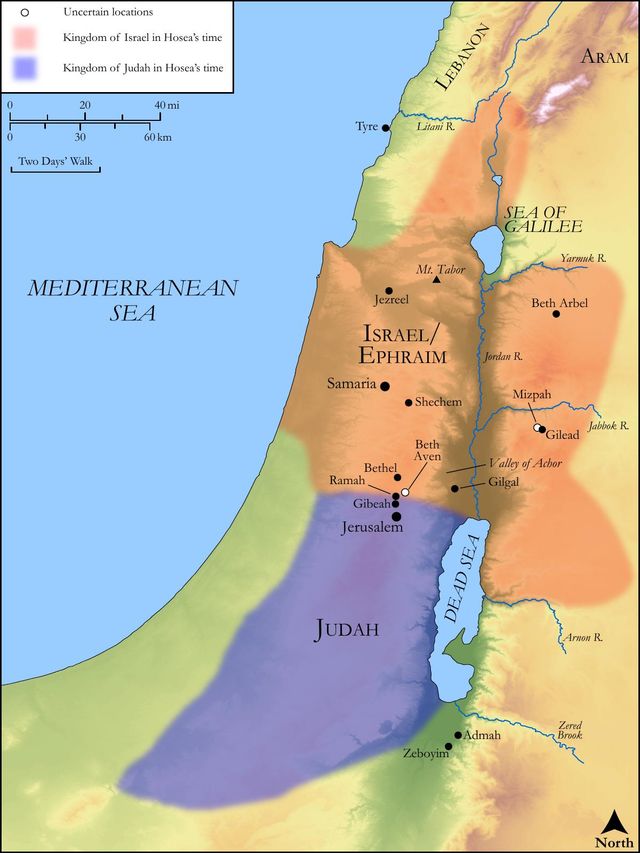
See on the biblical-era map
Study this verse
Public-domain commentary
Matthew Henry
From his Commentary on the Whole Bible. Henry comments on passages, not single verses — this entry covers Hosea 1:2–7. His three-level outline is real structure in the source text, so it is rendered as structure.
These words, The beginning of the word of the Lord by Hosea, may refer either, 1. To that glorious set of prophets which was raised up about this time. About this time there lived and prophesied Joel, Amos, Micah, Jonah, Obadiah, and Isaiah; but Hosea was the first of them that foretold the destruction of Israel; the beginning of this word of the Lord was by him. We read in the history of this Jeroboam here named (Kg2 14:27) that the Lord had not yet said he would blot out the name of Israel, but soon after he said he would, and Hosea was the man that began to say it, which made it so much the harder task to him, to be the first that should carry an unpleasing message and some time before any were raised up to second him. Or, rather, 2. To Hosea's own prophecies. This was the first message God sent him upon to this people, to tell them that they were an evil and an adulterous generation. He might have desired to be excused from dealing so roughly with them till he had gained authority and reputation, and some interest in their affections. No; he must begin with this, that they might know what to expect from a prophet of the Lord. Nay, he must not only preach this to them, but he must write it, and publish it, and leave it upon record as a witness against them. Now here,
I.The prophet must, as it were in a looking-glass, show them their sin, and show it to be exceedingly sinful, exceedingly hateful.
The prophet is ordered to take unto him a wife of whoredoms and children of whoredoms, Hos 1:2. And he did so, Hos 1:3. He married a woman of ill fame, Gomer the daughter of Diblaim, not one that had been married and had committed adultery, for then she must have been put to death, but one that had lived scandalously in the single state. To marry such a one was not malum in se - evil in itself, but only malum per accidens - incidentally an evil, not prudent, decent, or expedient, and therefore forbidden to the priests, and which, if it were really done, would be an affliction to the prophet (it is threatened as a curse on Amaziah that his wife should be a harlot, Amo 7:17), but not a sin when God commanded it for a holy end; nay, if commanded, it was his duty, and he must trust God with his reputation. But most commentators think that it was done in vision, or that it is no more than a parable; and that was a way of teaching commonly used among the ancients, particularly prophets; what they meant of others they transferred to themselves in a figure, as St. Paul speaks, Co1 4:6. He must take a wife of whoredoms, and have such children by her as every one would suspect, though born in wedlock, to be children of whoredoms, begotten in adultery, because it is too common for those who have lived lewdly in the single state to live no better in the married state. "Now" (saith God) "Hosea, this people is to me such a dishonour, and such a grief and vexation, as a wife of whoredoms and children of whoredoms would be to thee. For the land has committed great whoredoms." In all instances of wickedness they had departed from the Lord; but their idolatry especially is the whoredom they are here charged with. Giving that glory to any creature which is due to God alone is such an injury and affront to God as for a wife to embrace the bosom of a stranger is to her husband. It is especially so in those that have made a profession of religion, and have been taken into covenant with God; it is breaking the marriage-bond; it is a heinous odious sin, and, as much as any thing, besots the mind and takes away the heart. Idolatry is great whoredom, worse than any other; it is departing from the Lord, to whom we lie under greater obligations than any wife does or can do to her husband. The land has committed whoredom; it is not here and there a particular person that is guilty of idolatry, but the whole land is polluted with it; the sin has become national, the disease epidemical. What an odious thing would it be for the prophet, a holy man, to have a whorish wife, and children whorish like her! What an exercise would it be of his patience, and, if she persisted in it, what could be expected but that he should give her a bill of divorce! And is it not then much more offensive to the holy God to have such a people as this to be called by his name and have a place in his house? How great is his patience with them! And how justly may he cast them off! It was as if he should have married Gomer the daughter of Diblaim, who probably was at that time a noted harlot. The land of Israel was like Gomer the daughter of Diblaim. Gomer signifies corruption; Diblaim signifies two cakes, or lumps of figs; this denotes that Israel was near to ruin, and that their luxury and sensuality were the cause of it. They were as the evil figs that could not be eaten, they were so evil. It intimates sin to be the daughter of plenty and destruction the daughter of the abuse of plenty. Some give this sense of the command here given to the prophet: "Go, take thee a wife of whoredoms, for, if thou shouldst go to seek for an honest modest woman, thou wouldst not find any such, for the whole land, and all the people of it, are given to whoredom, the usual concomitant of idolatry."
II.The prophet must, as it were through a perspective glass, show them their ruin; and this he does in the names given to the children born of this adulteress; for as lust, when it has conceived, brings forth sin, so sin, when it is finished, brings forth death.
1.He foretels the fall of the royal family in the name he is appointed to give to his first child, which was a son: Call his name Jezreel, Hos 1:4. We find that the prophet Isaiah gave prophetical names to his children (Isa 7:3; Isa 7:3), so this prophet here. Jezreel signifies the seed of God (so they should have been); but it signifies also the scattered of God; they shall be as sheep on the mountains that have no shepherds. Call them not Israel, which signifies dominion, they have lost all the honour of that name; but call them Jezreel, which signifies dispersion, for those that have departed from the Lord will wander endlessly. Hitherto they have been scattered as seek; let them now be scattered as chaff. Jezreel was the name of one of the royal seats of the kings of Israel; it was a beautiful city, seated in a pleasant valley, and it is with allusion to that city that this child is called Jezreel, for yet a little while and I will avenge the blood of Jezreel upon the house of Jehu, from whom the present king, Jeroboam, was lineally descended. The house of Jehu smarted for the sins of Jehu, for God often lays up men's iniquity for their children and visits it upon them. It is the kingdom of the house of Israel, which may be meant either of the present royal family, that of Jehu, which God did quickly cause to cease (for the son of this Jeroboam, Zechariah, reigned but six months, and he was the last of Jehu's race), or of the whole kingdom in general, which continued corrupt and wicked, and which was made to cease in the reign of Hoshea, about seventy years after; and with God that is but a little while. Note, Note, Neither the pomp of kings nor the power of kingdoms can secure them from God's destroying judgments, if they continue to rebel against him. (2.) What is the ground of this controversy: I will revenge the blood of Jezreel upon the house of Jehu, the blood which Jehu shed at Jezreel, when by commission from God and in obedience to his command, he utterly destroyed the house of Ahab, and all that were in alliance with it, with all the worshippers of Baal. God approved of what he did (Kg2 10:30): Thou has done well in executing that which is right in my eyes; and yet here God will avenge that blood upon the house of Jehu, when the time has expired during which it was promised that his family should reign, even to the fourth generation. But how comes the same action to be both rewarded and punished? Very justly; the matter of it was good; it was the execution of a righteous sentence passed upon the house of Ahab, and, as such, it was rewarded; but Jehu did it not in a right manner; he aimed at his own advancement, not at the glory of God, and mingled his own resentments with the execution of God's justice. He did it with a malice against the sinners, but not with any antipathy to the sin; for he kept up the worship of the golden calves, and took no heed to walk in the law of God, Kg2 10:31. And therefore when the measure of the iniquity of his house was full, and God came to reckon with them, the first article in the account is (and, being first, it is put for all the rest) for the blood of the house of Ahab, here called the blood of Jezreel. Thus when the house of Baasha was rooted out it was because he did like the house of Jeroboam, and because he killed him, Kg1 16:7. Note, Those that are entrusted with the administration of justice are concerned to see to it that they do it from a right principle and with a right intention, and that they do not themselves live in those sins which they punish in others, lest even their just executions should be reckoned for, another day, as little less than murders. (3.) How far the controversy shall proceed; it shall be not a correction, but a destruction. Some make those words, I will visit, or appoint, the blood of Jezreel upon the house of Jehu, to signify, not as we read it the revenging of that bloodshed, but the repeating of that bloodshed: "I will punish the house of Jehu, as I punished the house of Ahab, because Jehu did not take warning by the punishment of his predecessors, but trod in the steps of their idolatry. And after the house of Jehu is destroyed I will cause to cease the kingdom of the house of Israel; I will begin to bring it down, though now it flourish." After the death of Zechariah, the last of the house of Jehu, the kingdom of the ten tribes went to decay, and dwindled sensibly. And, in order to the ruin of it, it is threatened (Hos 1:5), I will break the bow of Israel in the valley of Jezreel; the strength of the warriors of Israel, so the Chaldee. God will disable them either to defend themselves or to resist their enemies. And the bow abiding in strength, and being renewed in the hand, intimates a growing power, so the breaking of the bow intimates a sinking ruined power. The bow shall be broken in the valley of Jezreel, where, probably, the armoury was; or, it may be, in that valley some battle was fought, wherein the kingdom of Israel was very much weakened. Note, There is no fence against God's controversy; when he comes forth against a people their strong bows are soon broken and their strong-holds broken down. In the valley of Jezreel they shed that blood which the righteous God would in that very place avenge upon them; as some notorious malefactors are hanged in chains just where the villainy they suffer for was perpetrated, that the punishment may answer the sin.
2.He foretels God's abandoning the whole nation in the name he gives to the second child. This was a daughter, as the former was a son, to intimate that both sons and daughters had corrupted their way. Some make to signify that Israel grew effeminate, and was thereby enfeebled and made weak. Call the name of this daughter Lo-ruhamah - not beloved (so it is translated Rom 9:25), or not having obtained mercy, so it is translated Pe1 2:10. It comes all to one. This reads the doom of the house of Israel: I will no more have mercy upon them. It intimates that God had shown them great mercy, but they had abused his favours, and forfeited them, and now he would show them favour no more. Note, Those that forsake their own mercies for lying vanities have reason to expect that their own mercies should forsake them, and that they should be left to their lying vanities, Jon 2:8. Sin turns away the mercy of God even from the house of Israel, his own professing people, whose case is sad indeed when God says that he will no more have mercy upon them. And then it follows, I will utterly take them away, will utterly remove them (so some), will utterly pluck them up, so others. Note, When the streams of mercy are stopped we can expect no other than that the vials of wrath should be opened. Those whom God will no more have mercy upon shall be utterly taken away, as dross and dung. The word for taking away sometimes signifies to forgive sin; and some take it in that sense here: I will no more have mercy upon them, though in pardoning I have pardoned them heretofore. Though God has borne long, he will not bear always, with a people that hate to be reformed. Or, I will no more have mercy upon them, that I should in any wise pardon them, or (as our margin reads it) that I should altogether pardon them. If pardoning mercy is denied, no other mercy can be expected, for that opens the door to all the rest. Some make this to speak comfort: I will no more have mercy upon them till in pardoning I shall pardon them, that is, till the Redeemer comes to Zion to turn away ungodliness from Jacob. The Chaldee reads it, But, if they repent, in pardoning I will pardon them. Even the greatest sinners, if in time they bethink themselves and return, will find that there is forgiveness with God.
III.He must show them what mercy God had in store for the house of Judah, at the same time that he was thus contending with the house of Israel (Hos 1:7): But I will have mercy upon the house of Judah. Note, Though some are justly cast off for their disobedience, yet God will always secure to himself a remnant that shall be the vessels and monuments of mercy. When divine justice is glorified in some, yet there are others in whom free grace is glorified. And, though some through unbelief are broken off, yet God will have a church in this world till the end of time. It aggravates the rejection of Israel that God will have mercy on Judah, and not on them, and magnifies God's mercy to Judah that, though they also have done wickedly, yet God did not reject them, as he rejected Israel: I will have mercy upon them and will save them. Note, Our salvation is owing purely to God's mercy, and not to any merit of our own. Now,
1.This, without doubt, refers to the temporal salvations which God wrought for Judah in a distinguishing way, the favours shown to them and not to Israel. When the Assyrian armies had destroyed Samaria, and carried the ten tribes away into captivity, they proceeded to besiege Jerusalem; but God had mercy on the house of Judah, and saved them by the vast slaughter which an angel made, in one night, in the camp of the Assyrians; then they were saved by the Lord their God immediately, and not by sword or bow. When the ten tribes were continued in their captivity, and their land was possessed by others, they being utterly taken away, God had mercy on the house of Judah and saved them, and, after seventy years, brought them back, not by might or power, but by the Spirit of the Lord of hosts, Zac 4:6. I will save them by the Lord their God, that is, by myself. God will be exalted in his own strength, will take the work into his own hands. That salvation is sure which he undertakes to be the author of; for, if he will work, none shall hinder. And that salvation is most acceptable which he does by himself. So the Lord alone did lead him. The less there is of man in any salvation, and the more of God, the brighter it shines and the sweeter it tastes. I will save them in the word of the Lord (so the Chaldee), for the sake of Christ, the eternal word, and by his power. I will save them not by bow nor by sword, that is,
(1.)They shall be saved when they are reduced to so low an ebb that they have neither bow nor sword to defend themselves with, Jdg 5:8; Sa1 13:22.
(2.)They shall be saved by the Lord when they are brought off from trusting to their own strength and their weapons of war, Psa 44:6.
(3.)They shall be saved easily, without the trouble of sword and bow, Hos 1:7. Isa 9:5, I will save them by the Lord their God. In the calling him their God, he upbraids the ten tribes who had cast him off from being theirs, for which reason he had cast them off, and intimates what was the true reason why he had mercy, distinguishing mercy, for the house of Judah, and saved them: it was in pursuance of his covenant with them as the Lord their God, and in recompence for their faithful adherence to him and to his word and worship. But,
2.This may refer also to the salvation of Judah from idolatry, which qualified and prepared them for their other salvations. And this is indeed a salvation by the Lord their God; it is wrought only by the power of his grace, and can never be wrought by sword or bow. Just at the time that the kingdom of Israel was utterly taken away, under Hoshea, the kingdom of Judah was gloriously reformed, under Hezekiah, and was therefore preserved; and in Babylon God saved them from their idolatry first, and then from their captivity.
3.Some make this promise to look forward to the great salvation which, in the fulness of time, was to be wrought out by the Lord our God, Jesus Christ, who came into the world to save his people from their sins.
Historical interpretation
Historical reception
4 surviving comments on this verse. Each one is dated, so this reads as a timeline rather than a list.
Select a marker to jump to its quote. Markers stagger vertically where authors wrote within a few decades of each other.
"And he went and took Gomer the daughter of Debelaim: and she conceived and bare him a son. And the Lord said unto him, Call his name Jezreel; for yet a little while, and I will avenge the blood of Jezreel upon the house of Jehu, and will cause to cease the kingdom of the house of Israel." LXX: "And he went and took Gomer the daughter of Diblaim, and she conceived and bore him a son. And the Lord said to him: Call his name Jezreel: for yet a little while and I will avenge the blood of Jezreel upon the house of Judah, and will cause the kingdom of the house of Israel to cease." The prophets promised so many things about the coming of Christ and the calling of the Gentiles in the centuries that followed, that they may not neglect the present time, lest they seem to play with uncertain and future things and not to teach about those things which are pressing, even when the sermon is called for another purpose. Therefore, Gomer, the daughter of Diblaim, who is taken as wife by Hosea, conceives by him and bears him a son named "Jezreel," which means "God sows," and Jehu, or, as the bad mistake has it, "Judah," overthrows the kingdom in vengeance for his blood. And referring to the calling of the nations, it should be attributed to the time under which he is remembered as having begotten a son. And lest I delay the reader's avidity with a long discourse, these two women, of whom one is called Homer and is a whore and bears three children, first Jezreel, the second a girl named Without Mercy, and the third a male who is also called "Not My People." And the other woman, who is hired for fifteen silver shekels, a homer of barley and half a homer of barley, and is called an adulteress, is referred to Israel and Judah, that is, to the ten tribes that were in Samaria under King Jeroboam, who was of Ephraim, and to Judah, who reigned in Jerusalem of the line of David. These are two women, who are said to have wings of a Zachariah hen, or a vulture, or a heron, and to go to the land of Sennaar, where Babylon was founded. These women are signified under the name of two sisters, Oola and Ooliba: they are represented by two rods, which Ezekiel joins into one rod. And because we write commentaries, not lengthy books, reserving proper explanations for each chapter in its proper place, let us now only discuss the present chapter. "Gomer" means "completed," that is, "consummated," and "perfect." Some believe it signifies "breastplates." There are those who suspect it means "measure," or "bitterness," who would say rightly, if it did not have the letter Gimel. "Debelaim" means "palaces," of which there is a great abundance in Palestine, and which the prophet Isaiah orders to be applied to the ulcer of King Hezekiah (2 Kings 20 and Isaiah 38). But it is a mass of fat figs, which are shaped like sides, so that they remain uninjured for a long time, trampled and squeezed. Therefore, Israel, consummated in fornication and perfected as a daughter of pleasure, seems sweet and pleasant to those who enjoy her, and is received as a type of the Lord and Saviour's wife by Hosea; and from her is born the first son of God, that is, "Jezreel"; but it is also the metropolis of ten tribes, in which Naboth was killed ("Al." Nabutha), for whose blood Jehu was raised up, who destroyed the house of Ahab and Jezebel. But Jehu himself, the avenger of the blood of the righteous, entered by the ways of Jeroboam the son of Nabath, who made Israel fornicate and set up golden calves in Dan and in Bethel (III Kings 12), and his kingdom was said to be overthrown; of which Jeroboam's great-grandson, Hosea, began to prophesy: and when he died, his son Zacharias succeeded to the throne; whom Shallum, generated from another family, killed in the sixth month of his reign (IV Kings 15). For what reason it is now said: "Still a little while, and I will visit the blood of Jezrael," that is, the slaughter of my people, on the royal house of Jehu, who at that time ruled over Israel. It is not surprising if the house of Jehu is overturned when even the kingdom of the house of Israel, that is, the ten tribes, will be completely destroyed not many years after. From Zachariah, the son of Jeroboam, whose ancestor was Jehu, to the ninth year of Hosea, under whom the ten tribes were taken captive, forty-nine years are reckoned. And with the killing of Zachariah, who was the last of the line of Jehu, the kings of Assyria immediately captured Reuben, Gad, and half the tribe of Manasseh, which were beyond Jordan; and then many cities of Samaria, and then all of Naphtali, and finally all the remaining tribes. In the Vulgate Edition, "Jehu" is read as "Judah": but this seems to me not the fault of the seventy interpreters, but the ignorance of the scribes who, not knowing the more familiar term "Jehu:", wrote "Judah." However, the type of God's seed and the revenge of His blood is related to the Lord's passion, because of which both the house of Judah and the kingdom of all Israel are said to be overthrown.
We should not blame the prophet if he converted a prostitute to virtue, but we should rather praise him because he turned a bad woman into a good one.… Hence we understand that it was not the prophet who lost virtue by joining with a prostitute, but rather the latter gained virtue that she never had before.
By the law the prophet was allowed to take a woman into the marriage relationship, and on marrying her he probably brought her to chaste ways. In fact, while everyone could not but be surprised that a man who was very conscious of propriety should pass over women who enjoyed a good reputation and choose to take a prostitute into the marriage relationship, the novelty of the event provided the prophet with the occasion of telling them their duty. In addition [Hosea’s marriage demonstrated] the greater marvel of God’s condescending to choose such ungrateful people for special attention by the powerful example—namely, the remarkable prophet’s doing his duty by entering into association with a prostitute.
Likewise the Lord of all had bade Hosea also, therefore, marry a loose woman so as by the event to charge the people with impiety and give evidence of his characteristic longsuffering. If the God of all put up with the loose and adulterous synagogue, however, and the fount of holiness was not defiled by that loathsome and abominable thing, neither did the prophet incur any defilement from that licentious woman. Without being in thrall to lust, and instead carrying out a command from on high, he put up with that awful relationship. Now one must realize how judgment is made between good and bad by the purpose involved: on that basis marriage is distinguished from adultery, and though intercourse involves no difference, the difference emerges in the purpose and the law, and on the same basis what is lawful is distinguished from what is lawless.
Continue studying Hosea 1:3 across the web’s major study libraries — every link below opens this exact verse, chapter, or book on the destination site.
Read & Compare
 BibleGatewayThis verse in more than 200 translations and 70 languages.
 Bible.comThe YouVersion reader — hundreds of translations, reading plans, and highlights.
 ESV.orgCrossway's official English Standard Version reader.
 NET BibleThe NET translation with 60,000+ translators' notes on every rendering decision.
 STEP BibleTyndale House's free study tool — original text, vocabulary, and scholarly resources.
 BibliaLogos Bible Software's free web reader.
 USCCBThe New American Bible (Revised Edition) with the U.S. bishops' study notes.
Commentaries
 BibleHub CommentariesDozens of classic commentaries on this verse, gathered on one page.
 StudyLightMore than 100 commentary sets — the largest collection on the web.
 BibleRefPlain-English commentary on what this verse means, verse by verse.
 Enduring WordDavid Guzik's free commentary on this chapter, widely used by Bible teachers.
 Bible Study ToolsVerse commentary alongside Greek and Hebrew study aids.
Original Language & Research
- BibleHub InterlinearThe verse word by word — original language, transliteration, and English.
- BibleHub LexiconEvery word's original-language definition and Strong's entry.
 Blue Letter BibleDeep-study tools — Strong's numbers, concordance, and word studies.
 SefariaThe Hebrew text with Rashi and centuries of Jewish commentary.
Sermons, Hymns & Audio


TrulyRandomVerse is not affiliated with these sites and doesn’t control their content. They’re linked because they’re genuinely useful.
Summary
Hosea 1:3 records the prophet Hosea's immediate and obedient response to God's extraordinary command to marry a "wife of whoredoms." This verse marks the pivotal initiation of Hosea's prophetic ministry, establishing his personal life as a living parable that would powerfully illustrate the spiritual adultery of Israel against the Lord and foreshadowing the unfolding narrative of divine judgment and ultimate redemption.
Context
ShowHideLiterary Context
This verse immediately follows the divine directive given to Hosea in Hosea 1:2. The preceding verse lays the theological foundation for the entire book, declaring that the land of Israel has committed "great whoredom, departing from the LORD." Hosea 1:3 then details the prophet's swift and unquestioning obedience to this difficult and unconventional command, setting the stage for the deeply personal and symbolic drama that will unfold throughout the book. His marriage to Gomer and the subsequent naming of their children serve as a continuous, tangible metaphor for God's covenant relationship with unfaithful Israel, providing a living commentary on the nation's spiritual apostasy and God's persistent love.
Historical & Cultural Context
Hosea prophesied during a tumultuous period in the northern kingdom of Israel, primarily under the reign of Jeroboam II and extending through the reigns of several short-lived, unstable kings, leading up to Israel's fall to Assyria in 722 BC. This era was characterized by political instability, oppression, and rampant religious syncretism, where the worship of Yahweh was mixed with Baal worship and other Canaanite fertility cults. The phrase "wife of whoredoms" in Hosea 1:2 and the description of Gomer as "daughter of Diblaim" in Hosea 1:3 would have immediately resonated with an audience familiar with the pervasive idolatry and ritual prostitution associated with these pagan practices. The cultural backdrop of a covenant marriage, which Israel had violated, provides a powerful framework for understanding God's indictment.
Key Themes
ShowHideHosea 1:3 is foundational to several key themes woven throughout the book of Hosea. Firstly, it powerfully introduces the theme of Divine Command and Prophetic Obedience, highlighting Hosea's willingness to submit to God's difficult instruction, no matter the personal cost. Secondly, it establishes the central theme of Israel's Spiritual Adultery and Idolatry, with Gomer's unfaithfulness serving as a vivid metaphor for Israel's covenant breaking. Thirdly, this verse carries forward the Narrative of Judgment and Redemption, as the subsequent births and names of Hosea's children will embody God's impending judgment upon Israel, yet the overarching story of Hosea and Gomer ultimately points to God's enduring love and his persistent desire to restore his people, as seen later in Hosea 3.
Exposition and Analysis
ShowHideKey Word Analysis
ShowHideFrom the root meaning "completion" or "cessation," Gomer is the name of the woman Hosea is commanded to marry. Her name carries symbolic weight, potentially alluding to the "completion" of Israel's apostasy, the "cessation" of God's patience, or even the "fulfillment" of God's prophetic judgment. Her identity as "daughter of Diblaim" further contextualizes her, as Diblaim is associated with "two fig cakes," which could metaphorically link her to fertility cults or the sweet, yet corrupt, offerings of idolatry.
A dual form meaning "two cakes," likely referring to fig cakes. In that day, fig cakes were common food items, but they also held associations with fertility rites and idolatrous practices. The mention of Gomer as "daughter of Diblaim" subtly reinforces the context of spiritual harlotry and the pervasive nature of Israel's unfaithfulness, suggesting a background or character prone to the very "whoredom" God condemns.
A primitive root meaning "to be (or become) pregnant." This word marks the literal fulfillment of the marital act and the beginning of the family that will serve as a living parable. The act of conception and subsequent birth of children (beginning with a son in this verse) is crucial to the prophetic message, as the names of these children—Jezreel, Lo-Ruhamah, and Lo-Ammi—will directly communicate God's escalating judgment and eventual promise of restoration to Israel.
Verse Breakdown
ShowHide"So he went and took Gomer the daughter of Diblaim;"
This clause describes Hosea's immediate and direct obedience to God's command in Hosea 1:2. The simple, declarative verbs "went" (וַיֵּלֶךְ, wayyēleḵ) and "took" (וַיִּקַּח, wayyiqqaḥ) emphasize the promptness and completeness of his compliance. The identification of Gomer as "the daughter of Diblaim" is significant, as discussed in the Key Word Analysis, subtly connecting her background to the very spiritual harlotry Israel is committing. This act of marriage is not merely a personal event but a divinely orchestrated prophetic sign.
"which conceived, and bare him a son."
This clause records the first fruit of the union, the conception and birth of a son. This event is crucial because the subsequent verses will reveal that the Lord instructs Hosea to name this son "Jezreel," a name laden with historical and prophetic significance, foreshadowing divine judgment upon the house of Jehu and the nation of Israel. The birth of this son initiates the unfolding drama of Hosea's family life as a living, tangible metaphor for God's relationship with Israel, where the children's names become prophetic pronouncements of judgment and hope.
Literary Devices
ShowHideHosea 1:3, though seemingly a straightforward narrative statement, is rich in Symbolism and functions as a Prophetic Action. Hosea's marriage to Gomer is not merely a biographical detail but a profound symbolic act, embodying God's own covenant relationship with Israel. Gomer, a "wife of whoredoms" (as described in the preceding verse), becomes a Metaphor for Israel's spiritual unfaithfulness, her pursuit of other gods, and her breaking of the covenant with Yahweh. The very act of the prophet entering into such a painful and publicly humiliating marriage serves as a Living Parable, demonstrating the depth of God's anguish over Israel's apostasy and the extraordinary nature of His persistent love. The naming of Gomer's father, Diblaim, also carries symbolic weight, subtly hinting at the idolatrous context of Israel's "whoredom."
Theological and Thematic Connections
ShowHideHosea 1:3 establishes the foundational theological premise of the entire book: God's relationship with Israel is akin to a marriage covenant, and Israel's idolatry is spiritual adultery. This verse highlights God's sovereignty in commanding such a difficult prophetic act and Hosea's immediate obedience, underscoring the divine initiative in revealing truth through human experience. The painful reality of Hosea's marriage becomes a powerful illustration of God's heartache over His chosen people's unfaithfulness, yet it simultaneously sets the stage for the demonstration of His unwavering, redemptive love that pursues the unfaithful. It is a testament to God's willingness to enter into the messiness of human sin to accomplish His purposes of judgment and restoration.
Reflection and Application
ShowHideHosea's immediate and costly obedience in marrying Gomer provides a profound challenge to believers today. It compels us to examine the depth of our own commitment to God's commands, especially when they are counter-cultural, personally uncomfortable, or seem illogical from a human perspective. Just as Gomer's unfaithfulness mirrored Israel's spiritual adultery, our own lives can reflect a similar tendency to pursue "other lovers"—idols of comfort, success, pleasure, or self-reliance—that draw our affections away from God. The narrative initiated in Hosea 1:3 reminds us that God often uses our personal circumstances, even our pain and brokenness, as object lessons to reveal His truth and character to a watching world. It calls us to a radical faithfulness, trusting that God's purposes are always good, even when His path is difficult, and to recognize the profound, persistent love of God that pursues us even in our unfaithfulness.
Questions for Reflection
ShowHideFAQ
ShowHideWas Gomer already a prostitute when Hosea married her, or did she become one later?
ShowHideThe text of Hosea 1:2 states, "Go, take unto thee a wife of whoredoms and children of whoredoms." This phrase, "wife of whoredoms" (אֵשֶׁת זְנוּנִים, ʾēšet zĕnûnîm), can be interpreted in a few ways. Some scholars believe it indicates that Gomer was already a prostitute or had a reputation for promiscuity at the time of their marriage. Others suggest it refers to her propensity for unfaithfulness that would manifest after the marriage, or that she came from a family (implied by "daughter of Diblaim") or cultural background deeply entrenched in the idolatrous practices that constituted "spiritual whoredom" against God. The subsequent narrative, particularly Hosea's redemption of her in Hosea 3:1-3, strongly suggests that her unfaithfulness was an ongoing issue, making her a perfect living metaphor for Israel's chronic spiritual adultery.
Christ-Centered Fulfillment
ShowHideHosea's marriage to Gomer, initiated in Hosea 1:3, is a profound shadow of Christ's relationship with His church. Just as Hosea was commanded to take an unfaithful wife to illustrate Israel's spiritual harlotry, Christ, the divine Bridegroom, chose to enter into a covenant relationship with humanity, a people inherently unfaithful and prone to spiritual idolatry. The Old Testament's depiction of Israel as an unfaithful bride (Jeremiah 3:20) finds its ultimate resolution in the New Testament, where Christ gives Himself for the Church, not because she is pure, but to make her so (Ephesians 5:25-27). Hosea's enduring love and eventual redemption of Gomer (Hosea 3:1) powerfully prefigure Christ's sacrificial love on the cross, where He paid the ultimate price to redeem His unfaithful bride, the Church, from the slavery of sin. This act of divine condescension and redemptive pursuit highlights the steadfast love of God, who, in Christ, remains faithful even when we are faithless (2 Timothy 2:13). The covenant initiated in Hosea's marriage finds its perfect and eternal fulfillment in the new covenant established through the blood of Jesus, where God's people are truly reconciled and made His own forever (Hebrews 8:10-12).