


Revelation 17:2
Bible text: King James Version (1769 Blayney text) · Public domain
Bible text: King James Version with Strong's numbers · Public domain
Bible text: Berean Standard Bible · Public domain
Bible text: American Standard Version (1901) · Public domain
Bible text: World English Bible, Messianic edition · Public domain
Bible text: Geneva Bible (1599) · Public domain
Bible text: Young's Literal Translation · Public domain
- μεθ᾽meth᾽withG3326PREPPreposition
- ἧςhēswhomG3739R-GSFRelative pronoun Genitive Singular Feminine
- ἐπόρνευσανeporneusancommitted sexual immoralityG4203V-AAI-3PVerb Aorist Active Indicative 3rd Plural
- οἱhoitheG3588T-NPMDefinite article Nominative Plural Masculine
- βασιλεῖςbasileiskingsG935N-NPMNoun Nominative Plural Masculine
- τῆςtēsof theG3588T-GSFDefinite article Genitive Singular Feminine
- γῆςgēsearthG1093N-GSFNoun Genitive Singular Feminine
- καὶkaiandG2532CONJConjunction
- ἐμεθύσθησανemethusthēsanwere made drunkG3182V-API-3PVerb Aorist Passive Indicative 3rd Plural
- οἱhoithose thatG3588T-NPMDefinite article Nominative Plural Masculine
- κατοικοῦντεςkatoikountesdwellingG2730V-PAP-NPMVerb Present Active Participle Nominative Plural Masculine
- τὴνtēnon theG3588T-ASFDefinite article Accusative Singular Feminine
- γῆνgēnearthG1093N-ASFNoun Accusative Singular Feminine
- ἐκekwithG1537PREPPreposition
- τοῦtoutheG3588T-GSMDefinite article Genitive Singular Masculine
- οἴνουoinouwineG3631N-GSMNoun Genitive Singular Masculine
- τῆςtēsof theG3588T-GSFDefinite article Genitive Singular Feminine
- πορνείαςporneiassexual immoralityG4202N-GSFNoun Genitive Singular Feminine
- αὐτῆςautēsof herG846P-GSFPersonal pronoun Genitive Singular Feminine
English is a literal word-by-word gloss of the Greek, not the KJV's wording. Why?
This is the original text the KJV's translators worked from — each Greek word with its own literal English meaning in this verse, prepared by scholars at Tyndale House, Cambridge. The KJV translates whole sentences, not word by word, so its wording differs: one Greek word can become several English words, and the KJV may choose “charity” where the gloss reads “love”. Both are faithful — they answer different questions. For the KJV's own rendering, switch to the KJV text.
Details
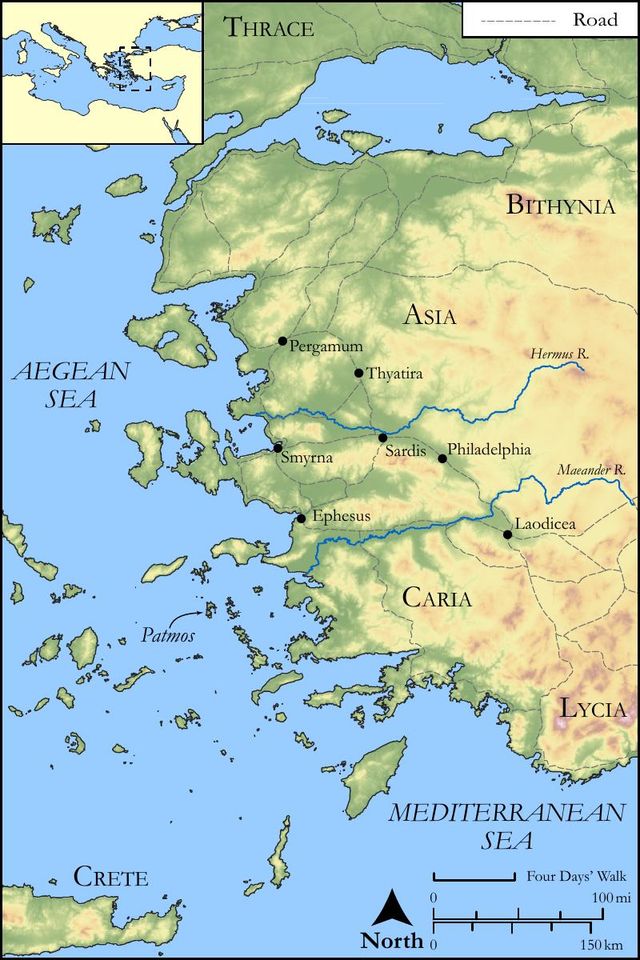
See on the biblical-era maps

Study this verse
Public-domain commentary
Matthew Henry
From his Commentary on the Whole Bible. Henry comments on passages, not single verses — this entry covers Revelation 17:1–6.
Here we have a new vision, not as to the matter of it, for that is contemporary with what came under the three last vials; but as to the manner of description, etc. Observe, 1. The invitation given to the apostle to take a view of what was here to be represented: Come hither, and I will show thee the judgment of the great whore, etc., Rev 17:1. This is a name of great infamy. A whore [in this passage] is one that is married, and has been false to her husband's bed, has forsaken the guide of her youth, and broken the covenant of God. She had been a prostitute to the kings of the earth, whom she had intoxicated with the wine of her fornication. 2. The appearance she made: it was gay and gaudy, like such sort of creatures: She was arrayed in purple, and scarlet colour, and decked with gold, and precious stones, and pearls, Rev 17:4. Here were all the allurements of worldly honour and riches, pomp and pride, suited to sensual and worldly minds. 3. Her principal seat and residence - upon the beast that had seven heads and ten horns; that is to say, Rome, the city on seven hills, infamous for idolatry, tyranny, and blasphemy. 4. Her name, which was written on her forehead. It was the custom of impudent harlots to hang out signs, with their names, that all might know what they were. Now in this observe, (1.) She is named from her place of residence - Babylon the great. But, that we might not take it for the old Babylon literally so called, we are told there is a mystery in the name; it is some other great city resembling the old Babylon. (2.) She is named from her infamous way and practice; not only a harlot, but a mother of harlots, breeding up harlots, and nursing and training them up to idolatry, and all sorts of lewdness and wickedness - the parent and nurse of all false religion and filthy conversation. 5. Her diet: she satiated herself with the blood of the saints and martyrs of Jesus. She drank their blood with such greediness that she intoxicated herself with it; it was so pleasant to her that she could not tell when she had had enough of it: she was satiated, but never satisfied.
Historical interpretation
Seven Centuries of Reception
5 surviving comments on this verse. Each one is dated, so this reads as a timeline rather than a list.
Select a marker to jump to its quote. Markers stagger vertically where authors wrote within a few decades of each other.
"There came one of the seven angels, which have the seven bowls, and spake with me, saying, Come, I will show thee the judgment of that great whore who sitteth upon many waters. And I saw the woman drunk with the blood of the saints, and with the blood of the martyrs." The decrees of that senate are always accomplished against all, contrary to the preaching of the true faith; and now already mercy being cast aside, itself here gave the decree among all nations.
Isaiah speaks of the devil in a similar manner when he foretells the fall [of the devil] under the figure of the leader of Babylon. “How you are fallen from heaven, O Lucifer, who has risen in the morning.” Speaking of the body of all the lost, which he often calls by various yet suitable names, the Holy Spirit considers that it always moves to a greater variety of excesses and is corrupted by its wickedness and is hooked on its errors and is made mad by such a level of impiety that it is opposed by the gentle. And so [the Holy Spirit] depicts this body which is perishing with a suitable description, calling it a “harlot.” For being forsaken by the Creator, she has given herself over to prostitution, allowing herself to be ravished by demons. She is called “great” because of the enormity of her transgressions through which she has offended the saints for a long time. She sits upon many waters, that is, upon many nations.
Some consider this harlot to be old Rome, since she sits on seven hills, and the seven heads of the beast that carries [the harlot] to be the more ungodly kings from Domitian to Diocletian who persecuted the church. However, we are guided as much as possible by the sequence of events and think that she is either the earthly kingdom generally, depicted as in one body, or that city that is ruled until the arrival of the antichrist. For old Rome lost the power of dominion a long time ago, and we do not suppose that the ancient status will again return to it. But should we grant this, the power that governs today will have been destroyed beforehand. For the Revelation says, “The woman that you saw is the great city that has dominion over the kings of the earth.”
With whom the kings of the earth committed fornication, etc. The universality prevails over the parts. For the kings and inhabitants of the earth are each individually those arrogantly seeking earthly things, whom the allurements of the world, with the lust of vices, defile and intoxicate with the madness of mind.
With them he says "the kings of the earth committed fornication." And these are the ones who reigned over them; for these are the kings of the earth who have shared in her fornication and idolatry.
"And", he says, "the inhabitants of the earth were made drunk with the wine of her fornication"; and indeed the rest, over whom she was mistress, have also apostatized from God, some controlled by her, others led by her.
Continue studying Revelation 17:2 across the web’s major study libraries — every link below opens this exact verse, chapter, or book on the destination site.
Read & Compare
 BibleGatewayThis verse in more than 200 translations and 70 languages.
 Bible.comThe YouVersion reader — hundreds of translations, reading plans, and highlights.
 ESV.orgCrossway's official English Standard Version reader.
 NET BibleThe NET translation with 60,000+ translators' notes on every rendering decision.
 STEP BibleTyndale House's free study tool — original text, vocabulary, and scholarly resources.
 BibliaLogos Bible Software's free web reader.
 USCCBThe New American Bible (Revised Edition) with the U.S. bishops' study notes.
Commentaries
 BibleHub CommentariesDozens of classic commentaries on this verse, gathered on one page.
 StudyLightMore than 100 commentary sets — the largest collection on the web.
 BibleRefPlain-English commentary on what this verse means, verse by verse.
 Enduring WordDavid Guzik's free commentary on this chapter, widely used by Bible teachers.
 Bible Study ToolsVerse commentary alongside Greek and Hebrew study aids.
Original Language & Research
- BibleHub InterlinearThe verse word by word — original language, transliteration, and English.
- BibleHub LexiconEvery word's original-language definition and Strong's entry.
 Blue Letter BibleDeep-study tools — Strong's numbers, concordance, and word studies.
 CNTR CollationThe earliest Greek manuscripts of this verse, collated letter by letter.
Sermons, Hymns & Audio


TrulyRandomVerse is not affiliated with these sites and doesn’t control their content. They’re linked because they’re genuinely useful.
Summary
Revelation 17:2 vividly portrays the pervasive spiritual corruption emanating from the symbolic entity identified as "Babylon the Great." This verse underscores how both the world's governing authorities and its general populace have become deeply enmesnared in, and intoxicated by, the deceptive allure and idolatrous practices propagated by this powerful system. It highlights a widespread spiritual unfaithfulness that impacts all levels of society, leading to a profound moral and spiritual stupor.
Context
ShowHideLiterary Context
Revelation 17:2 is an integral part of a detailed vision given to the Apostle John by an angel, specifically concerning the judgment of "the great whore that sitteth upon many waters" (Revelation 17:1). This chapter introduces a new symbolic figure, "Babylon the Great, the Mother of Harlots and Abominations of the Earth" (Revelation 17:5), who is depicted as a powerful, seductive force. Verse 2 specifically elaborates on the extent of her corrupting influence, detailing how "the kings of the earth" and "the inhabitants of the earth" have succumbed to her spiritual "fornication" and "wine," thereby setting the stage for her impending judgment later in the chapter and in Revelation 18. This imagery stands in stark contrast to the purity and faithfulness of the Bride of Christ and the true worshipers of God.
Historical & Cultural Context
The imagery of a "harlot" and "fornication" in prophetic literature often refers to spiritual unfaithfulness, idolatry, and covenant breaking, drawing heavily from Old Testament prophetic condemnations of Israel's idolatry (e.g., Ezekiel 16 and Hosea 1-3). In John's day, "Babylon" was a common cryptic reference to Rome, the dominant imperial power, which was notorious for its idolatry, persecution of Christians, and pervasive moral corruption. The "kings of the earth" would represent the rulers and political powers aligned with or subservient to Rome, while "inhabitants of the earth" signifies the broader populace. The "wine of her fornication" alludes to the intoxicating allure of Rome's wealth, power, and pagan practices, which led people into spiritual stupor and moral compromise, blinding them to divine truth and justice.
Key Themes
ShowHideThis verse contributes significantly to several major themes within Revelation and broader biblical theology. Foremost is the theme of Spiritual Adultery and Idolatry, where "fornication" (Greek: porneia) is a potent metaphor for unfaithfulness to God, encompassing idolatry, the pursuit of worldly power and riches, and alliances with systems that oppose divine truth. The "kings of the earth" engaging in this "fornication" highlights the complicity of political and economic powers in this corrupt system, betraying their allegiance to the true King. Another crucial theme is Widespread Deception and Intoxication, illustrated by the "inhabitants of the earth" being "made drunk with the wine of her fornication." This signifies a profound spiritual stupor, a loss of clear judgment, and a willing embrace of deception, preventing discernment between truth and error. This "wine" symbolizes the seductive pleasures, false promises, and worldly ideologies that lead people astray from God's righteous path. Finally, the inclusion of both "kings of the earth" and "inhabitants of the earth" underscores the Global Influence and pervasive nature of Babylon's corrupting power, affecting all strata of human society.
Exposition and Analysis
ShowHideKey Word Analysis
ShowHideThe verb G4203 (porneúō) means "to act the harlot," indulging unlawful lust or, figuratively, practicing idolatry. The noun G4202 (porneía) refers to "harlotry," including adultery and incest, but most significantly in this context, "idolatry." In prophetic literature, this term consistently signifies spiritual unfaithfulness, a turning away from the exclusive covenant relationship with God to pursue other gods, worldly powers, or material gain. It represents a betrayal of divine allegiance.
G1093 (gē) refers to "soil," "a region," or "the solid part or the whole of the terrene globe." Crucially, it can also include "the occupants" in each application. In Revelation, "the earth" often refers to the ungodly world system and its inhabitants who oppose God, in contrast to those "who dwell in heaven" or "worship God." Its repetition here ("kings of the earth," "inhabitants of the earth") emphasizes the universal scope of Babylon's corrupting influence across the entire human realm.
G3184 (methýō) means "to drink to intoxication," or "to get drunk." This term vividly portrays a state of spiritual stupor, moral insensibility, and clouded judgment. It suggests an irrational and corrupt behavior driven by the intoxicating allurements of Babylon's system, where individuals are so overwhelmed by its pleasures, false doctrines, or worldly benefits that they lose their spiritual discernment and capacity for righteous action.
Verse Breakdown
ShowHide"With whom the kings of the earth have committed fornication"
This clause highlights the involvement of global political and economic powers in Babylon's spiritual harlotry. "Kings of the earth" signifies the rulers and authorities who, instead of serving God and promoting justice, align themselves with and benefit from the corrupt, idolatrous system of Babylon. Their "fornication" is not necessarily literal sexual immorality, but rather a profound spiritual unfaithfulness, a covenant-breaking act of idolatry where they give their allegiance, resources, and worship to worldly systems and false gods rather than to the one true God. This implies a symbiotic relationship where Babylon offers power, wealth, and influence in exchange for their spiritual compromise.
"and the inhabitants of the earth have been made drunk with the wine of her fornication"
This second clause extends the scope of Babylon's influence beyond the rulers to the general populace, the "inhabitants of the earth." The imagery of being "made drunk" with "the wine of her fornication" powerfully conveys the intoxicating, deluding, and incapacitating effect of Babylon's system. This "wine" represents the seductive pleasures, false ideologies, material prosperity, and spiritual deception that Babylon offers. It leads to a spiritual stupor, rendering people morally insensitive, unable to discern truth, and willingly complicit in her idolatrous practices. Their spiritual judgment is clouded, and they are led astray into ungodliness, losing their capacity for sober spiritual discernment.
Literary Devices
ShowHideRevelation 17:2 is rich in Symbolism and Metaphor. The figure of "Babylon the Great" is a powerful Personification of a global system of spiritual, political, and economic corruption, depicted as a "great whore" or harlot. This imagery is a Metaphor for spiritual unfaithfulness and idolatry, drawing on Old Testament prophetic traditions where Israel's turning away from God was often described as harlotry. The "fornication" committed by the "kings of the earth" is symbolic of their unholy alliances, their pursuit of worldly power and wealth over divine righteousness, and their idolatrous allegiance to systems opposed to God. Furthermore, the "wine of her fornication" serves as a potent Metaphor for the intoxicating, deluding influence of Babylon's allurements—false doctrines, material pleasures, and deceptive promises—that lead the "inhabitants of the earth" into a state of spiritual stupor and moral insensibility. The repetition of "earth" (kings of the earth, inhabitants of the earth) emphasizes the universal reach and pervasive nature of this corruption, employing a form of Anaphora to underscore its global impact.
Theological and Thematic Connections
ShowHideRevelation 17:2 profoundly illustrates the biblical theme of idolatry as spiritual adultery, a concept deeply rooted in the Old Testament where Israel's unfaithfulness to Yahweh was consistently depicted as harlotry. This verse extends that metaphor to a global scale, revealing how humanity, from its highest rulers to its common citizens, can be seduced by worldly systems that offer power, pleasure, or false security in place of genuine devotion to God. It highlights the insidious nature of spiritual deception, where the allure of worldly gain and false ideologies can intoxicate and blind individuals to divine truth, leading them into a state of spiritual stupor that culminates in judgment. The verse serves as a stark reminder of God's unwavering demand for exclusive worship and His ultimate judgment on all forms of spiritual unfaithfulness and rebellion against His sovereignty.
Reflection and Application
ShowHideRevelation 17:2 serves as a timeless warning against the seductive power of worldly systems and their capacity to lead both leaders and common people into spiritual compromise and moral decay. For believers today, this verse calls for vigilant spiritual discernment. We must critically evaluate the ideologies, values, and pursuits propagated by the world around us, recognizing that many can subtly compete with or corrupt our devotion to God. The "wine of her fornication" represents anything that intoxicates us, clouding our judgment and drawing us away from Christ—be it materialism, political power, entertainment, or even seemingly good causes that become ultimate concerns. This passage urges us to maintain spiritual sobriety, to be "sober-minded" (1 Peter 5:8), and to stand apart from systems that promote idolatry, greed, and ungodliness, even when such systems are widely accepted or appear beneficial. Our ultimate allegiance must be to God alone, resisting the intoxicating allurements that promise earthly satisfaction but lead to spiritual ruin and judgment.
Questions for Reflection
ShowHideFAQ
ShowHideWhat does "fornication" mean in this context?
ShowHideIn Revelation 17:2, "fornication" (Greek: porneia) is used metaphorically and theologically, not primarily to denote literal sexual immorality. It signifies spiritual unfaithfulness, idolatry, and a betrayal of one's covenant relationship with God. This imagery is deeply rooted in Old Testament prophetic language, where Israel's turning away from Yahweh to worship other gods or rely on worldly alliances was consistently described as harlotry or spiritual adultery (e.g., Hosea 4:12). Here, it refers to the unholy alliances and idolatrous practices of the world's rulers and inhabitants with the corrupt system of "Babylon the Great," prioritizing worldly power, wealth, and false worship over allegiance to the one true God.
Who are the "kings of the earth" and "inhabitants of the earth"?
ShowHideThe "kings of the earth" represent the political, economic, and ruling powers of the world. In John's original context, this would have likely included the Roman emperors and their subservient client kings and governors. The "inhabitants of the earth" refers to the general populace, the masses of humanity. The inclusion of both groups emphasizes the universal and pervasive nature of Babylon's corrupting influence, affecting all levels of human society, from the highest echelons of power to the common person. This highlights the comprehensive reach of spiritual deception and worldliness.
What is the "wine of her fornication"?
ShowHideThe "wine of her fornication" is a powerful metaphor for the intoxicating and deluding influence of Babylon's system. It symbolizes the seductive pleasures, false promises, worldly ideologies, material prosperity, and spiritual deceptions that Babylon offers. Just as literal wine can intoxicate and impair judgment, this "wine" causes spiritual stupor, moral insensibility, and a loss of discernment, leading people to embrace ungodliness and idolatry willingly. It represents anything that blinds individuals to divine truth and justice, drawing them into a state of spiritual drunkenness and complicity with the world's rebellion against God.
Christ-Centered Fulfillment
ShowHideRevelation 17:2, with its stark depiction of global spiritual fornication and intoxication, finds its ultimate fulfillment and counterpoint in Jesus Christ. While the world's kings and inhabitants are made drunk by Babylon's deceptive wine, Jesus offers the true "living water" (John 4:10) that satisfies spiritual thirst and brings clarity, not stupor. He is the faithful King, unlike the "kings of the earth" who commit spiritual harlotry; He is the one who remained perfectly faithful to God, even unto death (Philippians 2:8). Christ came to expose the darkness and deception of the world's systems (John 3:19), offering liberation from the spiritual bondage of sin and idolatry. His sacrifice on the cross purifies those who believe, cleansing them from the "fornication" of worldly allegiances and making them part of His pure and spotless Bride (Ephesians 5:25-27). Ultimately, the judgment poured out on Babylon signifies Christ's triumph over all ungodly systems, establishing His eternal kingdom where only righteousness and truth prevail, and calling His people to come out of Babylon and remain faithful to Him alone (Revelation 18:4).