


Revelation 14:8
- ΚαὶKaiAndG2532CONJConjunction
- ἄλλοςallosanotherG243A-NSMAdjective Nominative Singular Masculine
- ἄγγελοςangelosangelG32N-NSMNoun Nominative Singular Masculine
- ἠκολούθησενēkolouthēsenfollowedG190V-AAI-3SVerb Aorist Active Indicative 3rd Singular
- λέγων·legōnsayingG3004V-PAP-NSMVerb Present Active Participle Nominative Singular Masculine
- ἔπεσενepesenFallenG4098V-2AAI-3SVerb 2nd Aorist Active Indicative 3rd Singular
- ἔπεσενepesenFallen isG4098V-2AAI-3SVerb 2nd Aorist Active Indicative 3rd Singular
- ΒαβυλὼνBabulōnBabylonG897N-NSF-LNoun Nominative Singular Feminine Location
- ἡhētheG3588T-NSFDefinite article Nominative Singular Feminine
- πόλιςpoliscityG4172N-NSFNoun Nominative Singular Feminine
- ἡhētheG3588T-NSFDefinite article Nominative Singular Feminine
- μεγάληmegalēgreatG3173A-NSFAdjective Nominative Singular Feminine
- ἣhēwhoG3739R-NSFRelative pronoun Nominative Singular Feminine
- ἐκekofG1537PREPPreposition
- τοῦtoutheG3588T-GSMDefinite article Genitive Singular Masculine
- οἴνουoinouwineG3631N-GSMNoun Genitive Singular Masculine
- τοῦtou<the>G3588T-GSMDefinite article Genitive Singular Masculine
- θυμοῦthumouof wrathG2372N-GSMNoun Genitive Singular Masculine
- τῆςtēsfor theG3588T-GSFDefinite article Genitive Singular Feminine
- πορνείαςporneiasimmoralityG4202N-GSFNoun Genitive Singular Feminine
- αὐτῆςautēsof herG846P-GSFPersonal pronoun Genitive Singular Feminine
- πεπότικενpepotikenshe has given to drinkG4222V-RAI-3SVerb Perfect Active Indicative 3rd Singular
- πάνταpantaallG3956A-APNAdjective Accusative Plural Neuter
- τὰtatheG3588T-APNDefinite article Accusative Plural Neuter
- ἔθνηethnēGentilesG1484N-APNNoun Accusative Plural Neuter
English is a literal word-by-word gloss of the Greek, not the KJV's wording. Why?
This is the original text the KJV's translators worked from — each Greek word with its own literal English meaning in this verse, prepared by scholars at Tyndale House, Cambridge. The KJV translates whole sentences, not word by word, so its wording differs: one Greek word can become several English words, and the KJV may choose “charity” where the gloss reads “love”. Both are faithful — they answer different questions. For the KJV's own rendering, switch to the KJV text.
Details
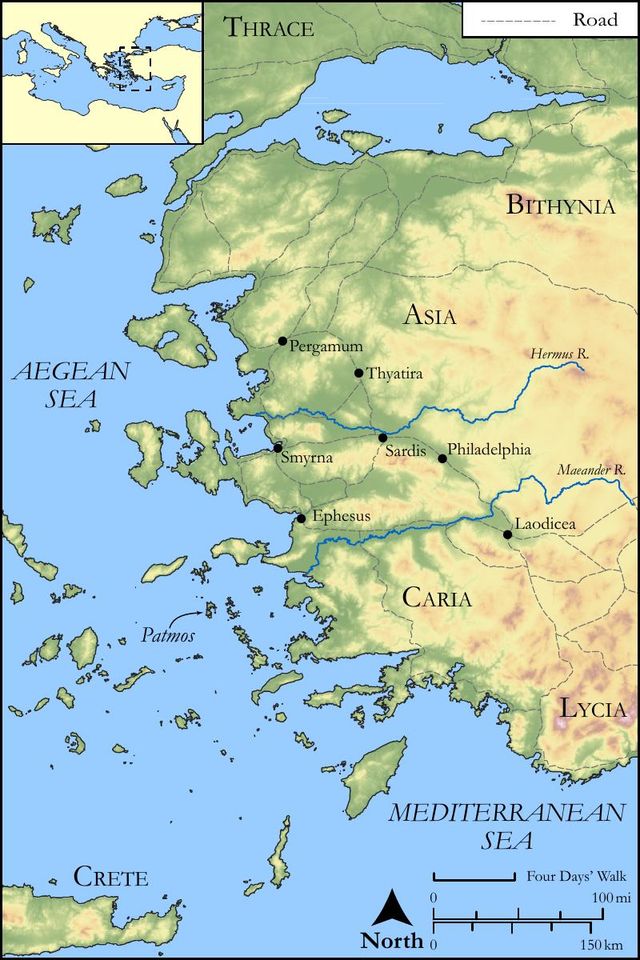
See on the biblical-era maps

Study this verse
Public-domain commentary
Matthew Henry
From his Commentary on the Whole Bible. Henry comments on passages, not single verses — this entry covers Revelation 14:6–12. His two-level outline is real structure in the source text, so it is rendered as structure.
In this part of the chapter we have three angels or messengers sent from heaven to give notice of the fall of Babylon, and of those things that were antecedent and consequent to that great event.
I.The first angel was sent on an errand antecedent to it, and that was to preach the everlasting gospel, Rev 14:6, Rev 14:7. Observe,
1.The gospel is an everlasting gospel; it is so in its nature, and it will be so in its consequences. Though all flesh be grass, the word of the Lord endureth for ever.
2.It is a work fit for an angel to preach this everlasting gospel; such is the dignity, and such is the difficulty of that work! And yet we have this treasure in earthen vessels.
3.The everlasting gospel is of great concern to all the world; and, as it is the concern of all, it is very much to be desired that it should be made known to all, even to every nation, and kindred, and tongue, and people.
4.The gospel is the great means whereby men are brought to fear God, and to give glory to him. Natural religion is not sufficient to keep up the fear of God, nor to secure to him glory from men; it is the gospel that revives the fear of God, and retrieves his glory in the world.
5.When idolatry creeps into the churches of God, it is by the preaching of the gospel, attended by the power of the Holy Spirit, that men are turned from idols to serve the living God, as the Creator of the heaven, and the earth, and the sea, and the fountains of waters, Rev 14:7. To worship any God besides him who created the world is idolatry.
II.The second angel follows the other, and proclaims the actual fall of Babylon.
The preaching of the everlasting gospel had shaken the foundations of antichristianism in the world, and hastened its downfall. By Babylon is generally understood Rome, which was before called Sodom and Egypt, for wickedness and cruelty, and is now first called Babylon, for pride and idolatry. Observe,
1.What God has fore-ordained and foretold shall be done as certainly as if it were done already.
2.The greatness of the papal Babylon will not be able to prevent her fall, but will make it more dreadful and remarkable.
3.The wickedness of Babylon, in corrupting, debauching, and intoxicating the nations round about her, will make her fall just and will declare the righteousness of God in her utter ruin, Rev 14:8. Her crimes are recited as the just cause of her destruction.
III.A third angel follows the other two, and gives warning to all of that divine vengeance which would overtake all those that obstinately adhered to the antichristian interest after God had thus proclaimed its downfall, Rev 14:9, Rev 14:10. If after this (this threatening denounced against Babylon, and in part already executed) any should persist in their idolatry, professing subjection to the beast and promoting his cause, they must expect to drink deep of the wind of the wrath of God; they shall be for ever miserable in soul and body; Jesus Christ will inflict this punishment upon them, and the holy angels will behold it and approve of it. Idolatry, both pagan and papal, is a damning sin in its own nature, and will prove fatal to those who persist in it, after fair warning given by the word of Providence; those who refuse to come out of Babylon, when thus called, and resolve to partake of her sins, must receive of her plagues; and the guilt and ruin of such incorrigible idolaters will serve to set forth the excellency of the patience and obedience of the saints. These graces shall be rewarded with salvation and glory. When the treachery and rebellion of others shall be punished with everlasting destruction, then it will be said, to the honour of the faithful (Rev 14:12): Here is the patience of the saints; you have before seen their patience exercised, now you see it rewarded.
Historical interpretation
Seven Centuries of Reception
6 surviving comments on this verse. Each one is dated, so this reads as a timeline rather than a list.
Select a marker to jump to its quote. Markers stagger vertically where authors wrote within a few decades of each other.
"And another angel following him." The other angel following, he speaks of as the same prophet who is the associate of his prophesying.
Babylon is interpreted as confusion. By it the city and the people of the devil are signified, as is also the entire seduction of the vices that it always exercises for its own ruin and for the ruin of the human race. It says that this city, which is hastening toward its fall, has already fallen. This is a common way of speaking in the Scripture, which often refers to events as past when they are yet in the future, especially when it knows that what it predicts will inevitably be fulfilled. Here is an example of this way of speaking: “They divided my clothes among themselves,” and other similar statements. However, it may also speak in this manner because it was already well known then that the haughty fall whenever they dare to become proud. Therefore the psalm says, “You have cast them down when they were lifted up,” for, to be sure, they were then thrown down when they were lifted up. According to this habit of speaking, then, the Scripture has said, “All nations have fallen because of the wine of their fornication,” because this city, which is drunk and is constructed from all nations that it gathers to itself, itself has drunk from the wine of fornication. For all the nations, made drunk by errors, constitute the city itself, but the Scripture, according to its style, talks only of the one [city].
He speaks of “Babylon,” which refers to the confusion of the world and the troubled disorder of this life, which in no way has abated. By “the wine of the wrath of her fornication” he means not only the frenzy that attends to idol worship and the ecstasy of their minds, but also to the drunkenness and derangement that attends all sin, by which everyone who whores against God is wholly destroyed, as the saying of the psalm goes. As it were, pulled up by its roots, such a Babylon falls completely at the appearance of the Jerusalem that is above, for those who have been workers of iniquity are sent to the everlasting fire.
She has made all nations drink of the wine of the wrath of her fornication. The city of the impious, gathered from all nations, inebriates the nations, that is, her members, with the wine of error. But the city of the Lord, exercising the vineyard of Sorec, does not want to be inebriated with the wine in which is debauchery (Eph. 5), lest it be deprived of the promised denarius of life.
And another angel followed, saying: Fallen, fallen is that great Babylon. He says that the ruined city of the devil has already fallen. Either in the manner of Scripture, which usually places the past for what it knows will inevitably be fulfilled. Or because the proud are then cast down by the Lord when they are puffed up by the devil, as the Psalmist says: You cast them down when they were lifted up (Ps. 73).
I suppose Babylon to mean the confusion of present life and the vain temptation; for Babylon is interpreted as confusion and the frenzy of idolaters. And it is made majestic by names, called by them enthusiasm. But if you even perceive Babylon as sensible, you would not stray from the present aim.
And the wine, he says, of the wrath of her fornication, apostasy from God according to the written word: "you have destroyed all who commit fornication from you," (Ps. 72:27) which fornication brings darkness to the nature of reason; for who of a sound mind would choose to worship with wood and stones, and to call the spirit away from God? About this matter was the wine spoken of, "the wine being the wrath of dragons; and the wrath of asps is incurable." (Deut. 32:33) This Babylon first drank of the deadly wine herself, and thereafter all the nations whom she ruled she compelled to drink.
Continue studying Revelation 14:8 across the web’s major study libraries — every link below opens this exact verse, chapter, or book on the destination site.
Read & Compare
 BibleGatewayThis verse in more than 200 translations and 70 languages.
 Bible.comThe YouVersion reader — hundreds of translations, reading plans, and highlights.
 ESV.orgCrossway's official English Standard Version reader.
 NET BibleThe NET translation with 60,000+ translators' notes on every rendering decision.
 STEP BibleTyndale House's free study tool — original text, vocabulary, and scholarly resources.
 BibliaLogos Bible Software's free web reader.
 USCCBThe New American Bible (Revised Edition) with the U.S. bishops' study notes.
Commentaries
 BibleHub CommentariesDozens of classic commentaries on this verse, gathered on one page.
 StudyLightMore than 100 commentary sets — the largest collection on the web.
 BibleRefPlain-English commentary on what this verse means, verse by verse.
 Enduring WordDavid Guzik's free commentary on this chapter, widely used by Bible teachers.
 Bible Study ToolsVerse commentary alongside Greek and Hebrew study aids.
Original Language & Research
- BibleHub InterlinearThe verse word by word — original language, transliteration, and English.
- BibleHub LexiconEvery word's original-language definition and Strong's entry.
 Blue Letter BibleDeep-study tools — Strong's numbers, concordance, and word studies.
 CNTR CollationThe earliest Greek manuscripts of this verse, collated letter by letter.
Sermons, Hymns & Audio


TrulyRandomVerse is not affiliated with these sites and doesn’t control their content. They’re linked because they’re genuinely useful.
Summary
Revelation 14:8 presents the solemn declaration of a second angel, announcing the definitive collapse of "Babylon, that great city." This pronouncement underscores the certainty of divine judgment against a powerful, symbolic entity that represents a global system of spiritual apostasy, economic exploitation, and moral corruption. The angel's message explicitly states the reason for Babylon's downfall: its pervasive influence in intoxicating and leading all nations into its spiritual fornication and rebellion against God.
Context
ShowHideLiterary Context
This angelic proclamation is strategically positioned within a series of urgent, end-time messages delivered by three angels in Revelation 14. It immediately follows the first angel's universal call to worship the Creator God and to fear Him, for the hour of His judgment has come (Revelation 14:6-7). The announcement of Babylon's fall thus serves as the initial fulfillment of that judgment, setting the stage for the subsequent warning against worshipping the beast and receiving its mark (Revelation 14:9-11). This sequence highlights the progression of divine judgment against the forces opposing God, culminating in the harvest of the earth (Revelation 14:14-20).
Historical & Cultural Context
The imagery of "Babylon" draws heavily from the historical city of Babylon, notorious in the Old Testament for its idolatry, pride, and its role as the oppressor of God's people, Israel (e.g., Jeremiah 50-51). In the first century, when Revelation was written, Rome was the dominant imperial power, known for its pagan worship, persecution of Christians, and immense wealth derived from global trade. While not directly named, "Babylon" in Revelation functions as a symbolic archetype for any and all oppressive, idolatrous, and anti-God systems—whether political, economic, or religious—that stand in rebellion against Christ and persecute His followers. The concept of nations "drinking" from a city's influence evokes ancient practices of alliances and cultural assimilation, often involving participation in pagan rituals or economic dependencies.
Key Themes
ShowHideThe declaration in Revelation 14:8 contributes significantly to several overarching themes in the book of Revelation. Foremost among these is Divine Judgment and Justice, emphasizing God's unwavering sovereignty and His righteous response to human wickedness and rebellion. The fall of Babylon signifies the ultimate Collapse of Worldly Systems that oppose God, demonstrating that no earthly power, however great or influential, can ultimately withstand His decree. Furthermore, the explicit reason for Babylon's fall—"the wine of the wrath of her fornication"—highlights the theme of Spiritual Fornication and Corruption. This refers to idolatry, spiritual unfaithfulness, and the seductive allurements of worldly power and pleasure that draw humanity away from true worship and loyalty to God, echoing prophetic condemnations found in books like Hosea and Ezekiel.
Exposition and Analysis
ShowHideKey Word Analysis
ShowHideMeaning "a messenger; especially an 'angel'; by implication, a pastor." In this context, the angel is a divine messenger, conveying God's authoritative decree. The presence of an angel underscores the divine origin and certainty of the pronouncement, not merely a human prediction but a heavenly declaration of what is already determined in God's eternal plan.
Meaning "to fall (literally or figuratively)." The repetition "is fallen, is fallen" is a prophetic perfect tense, indicating a completed action with ongoing results. It signifies the absolute certainty and finality of Babylon's destruction, as if it has already occurred in God's sight, even before its physical manifestation. This double declaration emphasizes the irreversible nature of its doom.
Meaning "harlotry (including adultery and incest); figuratively, idolatry." While encompassing physical immorality, in a prophetic context, porneía primarily denotes spiritual unfaithfulness to God, which is essentially idolatry. Babylon's "fornication" refers to its leading nations into false worship, allegiance to worldly powers over God, and participation in its corrupt systems, thereby committing spiritual adultery against the one true God.
Verse Breakdown
ShowHide"And there followed another angel, saying"
This introduces the second of three angelic messengers in Revelation 14. The sequence of angels emphasizes a progression in God's final judgments and warnings to humanity. This angel's message is distinct yet complementary to the first, focusing on the fate of God's ultimate adversary.
"Babylon is fallen, is fallen, that great city"
This is the core proclamation. "Babylon" is a symbolic name, representing not just a historical city but a global system of opposition to God, characterized by its power, wealth, and spiritual corruption. The repetition "is fallen, is fallen" is a powerful rhetorical device, conveying the absolute certainty, finality, and completeness of its destruction. It is a declaration of accomplished fact from God's perspective, despite its future physical manifestation. "That great city" highlights its immense influence and perceived invincibility, making its fall even more dramatic.
"because she made all nations drink of the wine of the wrath of her fornication"
This clause provides the divine justification for Babylon's judgment. "She made all nations drink" implies a seductive, intoxicating, and pervasive influence. The "wine of the wrath of her fornication" refers to the spiritual and moral corruption that Babylon propagated globally. This "fornication" is primarily spiritual harlotry—idolatry, false worship, and unfaithfulness to God—which leads to a state of spiritual drunkenness, blinding nations to truth and leading them into rebellion, thereby incurring God's righteous wrath.
Literary Devices
ShowHideRevelation 14:8 employs several potent literary devices. The most prominent is Repetition, specifically in the phrase "Babylon is fallen, is fallen." This doubling intensifies the declaration, emphasizing the absolute certainty and finality of Babylon's destruction, creating a sense of irreversible doom. Symbolism is central, with "Babylon" serving as a multifaceted symbol for all anti-God systems of power, wealth, and spiritual corruption throughout history, culminating in the ultimate global system of rebellion against God in the end times. The "wine of the wrath of her fornication" is a powerful Metaphor, portraying Babylon's seductive influence as an intoxicating drink that leads nations into spiritual harlotry and ultimately brings upon them God's judgment. This metaphor also implies Personification, as Babylon is depicted as a harlot who "made all nations drink," giving an abstract system human-like actions and moral culpability.
Theological and Thematic Connections
ShowHideThe declaration of Babylon's fall in Revelation 14:8 is a profound theological statement on divine justice and the ultimate triumph of God's kingdom. It reveals that God is not indifferent to the pervasive evil and spiritual corruption that worldly systems inflict upon humanity. Babylon, as the epitome of human rebellion and idolatry, represents all that stands against God's righteous rule. Its downfall signifies that all attempts to build a kingdom apart from God, founded on pride, materialism, and spiritual unfaithfulness, are ultimately destined for destruction. This truth offers immense encouragement to believers facing persecution or living in a world seemingly dominated by ungodly influences, assuring them that God's judgment is certain and His sovereignty absolute.
Reflection and Application
ShowHideRevelation 14:8 calls believers to a profound spiritual discernment and a steadfast commitment to Christ. In a world saturated with competing loyalties and seductive influences, we are urged to recognize the "Babylonian" systems that seek to draw us away from God. These systems can manifest as materialism, consumerism, secular ideologies, or even corrupt religious practices that prioritize human power or pleasure over divine truth. The call to come out of Babylon (Revelation 18:4) is an ongoing imperative for Christians to separate themselves from the spiritual compromises and moral depravity of the world. This verse offers both a warning against entanglement and a powerful assurance of God's ultimate victory. It reminds us that while evil may seem to triumph for a time, its end is certain and divinely ordained. Our hope is not in reforming worldly systems, but in faithfully enduring and proclaiming the truth of God's coming kingdom.
Questions for Reflection
ShowHideFAQ
ShowHideWhat does "Babylon" symbolize in Revelation?
ShowHideIn Revelation, "Babylon" is a highly symbolic entity, drawing its name from the ancient city of Babylon, which was a historical oppressor of God's people, Israel. In the New Testament context, it symbolizes a comprehensive, global system of opposition to God. This includes religious apostasy (spiritual idolatry and false worship), economic exploitation (luxury, greed, and oppression of the poor), and political power (persecution of God's people and rebellion against divine authority). It represents the epitome of human pride and rebellion against God, seeking to establish a kingdom apart from Him, and ultimately encompasses all that is contrary to the kingdom of Christ. Chapters like Revelation 17 and Revelation 18 further elaborate on its characteristics and ultimate destruction.
Christ-Centered Fulfillment
ShowHideThe declaration of Babylon's fall in Revelation 14:8 finds its ultimate Christ-centered fulfillment in the triumph of the Lamb of God over all forces of evil and rebellion. While Babylon represents the culmination of human sin and opposition to God, its fall is not merely an act of divine retribution but a necessary step in the establishment of Christ's eternal kingdom. Jesus, as the victorious King and Lamb who was slain, has already defeated sin and death through His cross and resurrection (Colossians 2:15). The prophetic announcement of Babylon's fall in Revelation anticipates the final outworking of Christ's victory, where every earthly system that exalts itself against God will be utterly dismantled. It foreshadows the day when Christ will fully exercise His righteous judgment, bringing to an end all spiritual fornication and global corruption, and ultimately ushering in the new heavens and new earth where He reigns supreme (Revelation 21:1-4). Thus, Babylon's fall is a testament to the Lamb's ultimate sovereignty and the certainty of His glorious reign.