


Revelation 18:9
Bible text: King James Version (1769 Blayney text) · Public domain
Bible text: King James Version with Strong's numbers · Public domain
Bible text: Berean Standard Bible · Public domain
Bible text: American Standard Version (1901) · Public domain
Bible text: World English Bible, Messianic edition · Public domain
Bible text: Geneva Bible (1599) · Public domain
Bible text: Young's Literal Translation · Public domain
- ΚαὶKaiAndG2532CONJConjunction
- κλαύσουσινklausousinthey will weepG2799V-FAI-3PVerb Future Active Indicative 3rd Plural
- αὐτὴνautēn[for] herG846P-ASFPersonal pronoun Accusative Singular Feminine
- καὶkaiandG2532CONJConjunction
- κόψονταιkopsontaithey will wailG2875V-FDI-3PVerb Future Middle Deponent Indicative 3rd Plural
- ἐπ᾽ep᾽forG1909PREPPreposition
- αὐτὴνautēnherG846P-ASFPersonal pronoun Accusative Singular Feminine
- οἱhoitheG3588T-NPMDefinite article Nominative Plural Masculine
- βασιλεῖςbasileiskingsG935N-NPMNoun Nominative Plural Masculine
- τῆςtēsof theG3588T-GSFDefinite article Genitive Singular Feminine
- γῆςgēsearthG1093N-GSFNoun Genitive Singular Feminine
- οἱhoithe [ones who]G3588T-NPMDefinite article Nominative Plural Masculine
- μετ᾽met᾽withG3326PREPPreposition
- αὐτῆςautēsherG846P-GSFPersonal pronoun Genitive Singular Feminine
- πορνεύσαντεςporneusanteshaving committed sexual immoralityG4203V-AAP-NPMVerb Aorist Active Participle Nominative Plural Masculine
- καὶkaiandG2532CONJConjunction
- στρηνιάσαντεςstrēniasanteshaving lived luxuriouslyG4763V-AAP-NPMVerb Aorist Active Participle Nominative Plural Masculine
- ὅτανhotanwhenG3752CONJConjunction
- βλέπωσινblepōsinthey may seeG991V-PAS-3PVerb Present Active Subjunctive 3rd Plural
- τὸνtontheG3588T-ASMDefinite article Accusative Singular Masculine
- καπνὸνkapnonsmokeG2586N-ASMNoun Accusative Singular Masculine
- τῆςtēsof theG3588T-GSFDefinite article Genitive Singular Feminine
- πυρώσεωςpurōseōsburningG4451N-GSFNoun Genitive Singular Feminine
- αὐτῆςautēsof herG846P-GSFPersonal pronoun Genitive Singular Feminine
English is a literal word-by-word gloss of the Greek, not the KJV's wording. Why?
This is the original text the KJV's translators worked from — each Greek word with its own literal English meaning in this verse, prepared by scholars at Tyndale House, Cambridge. The KJV translates whole sentences, not word by word, so its wording differs: one Greek word can become several English words, and the KJV may choose “charity” where the gloss reads “love”. Both are faithful — they answer different questions. For the KJV's own rendering, switch to the KJV text.
Details
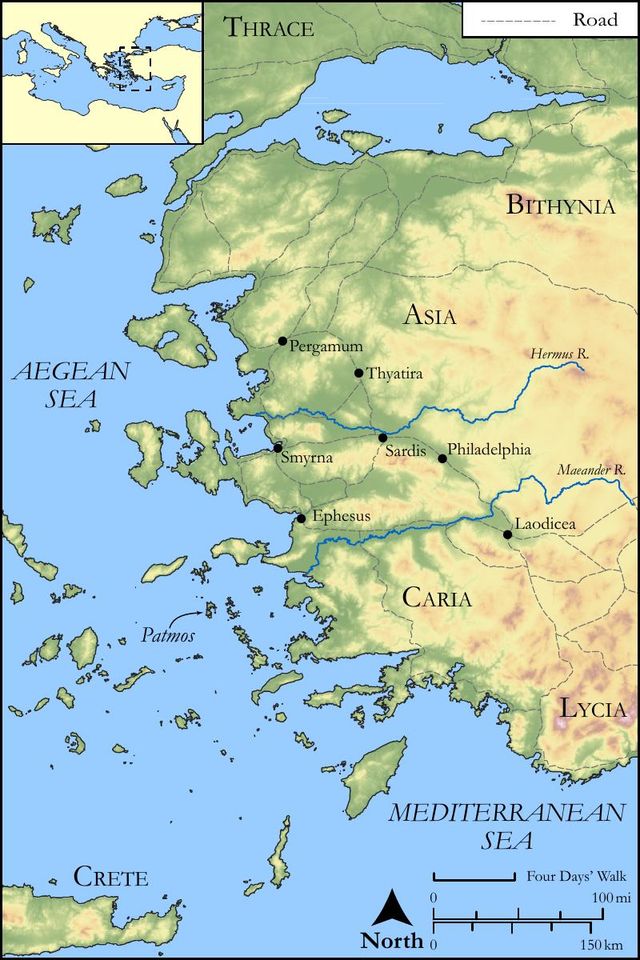
See on the biblical-era maps

Study this verse
Public-domain commentary
Matthew Henry
From his Commentary on the Whole Bible. Henry comments on passages, not single verses — this entry covers Revelation 18:9–24. His three-level outline is real structure in the source text, so it is rendered as structure.
Here we have,
I.A doleful lamentation made by Babylon's friends for her fall; and here observe,
1.Who are the mourners, namely, those who had been bewitched by her fornication, those who had been sharers in her sensual pleasures, and those who had been gainers by her wealth and trade - the kings and the merchants of the earth: the kings of the earth, whom she had flattered into idolatry by allowing them to be arbitrary and tyrannical over their subjects, while they were obsequious to her; and the merchants, that is, those who trafficked with her for indulgences, pardons, dispensations, and preferments; these will mourn, because by this craft they got their wealth.
2.What was the manner of their mourning.
(1.)They stood afar off, they durst not come nigh her. Even Babylon's friends will stand at a distance from her fall. Though they had been partakers with her in her sins, and in her sinful pleasures and profits, they were not willing to bear a share in her plagues.
(2.)They made a grievous outcry: Alas! alas! that great city, Babylon, that mighty city!
(3.)They wept, and cast dust upon their heads, Rev 18:19. The pleasures of sin are but for a season, and they will end in dismal sorrow. All those who rejoice in the success of the church's enemies will share with them in their downfall; and those who have most indulged themselves in pride and pleasure are the least able to bear calamities; their sorrows will be as excessive as their pleasure and jollity were before.
3.What was the cause of their mourning; not their sin, but their punishment. They did not lament their fall into idolatry, and luxury, and persecution, but their fall into ruin - the loss of their traffic and of their wealth and power. The spirit of antichrist is a worldly spirit, and their sorrow is a mere worldly sorrow; they did not lament for the anger of God, that had now fallen upon them, but for the loss of their outward comfort. We have a large schedule and inventory of the wealth and merchandise of this city, all which was suddenly lost (Rev 18:12, Rev 18:13), and lost irrecoverably (Rev 18:14): All things which were dainty and goodly have departed from thee, and thou shalt find them no more at all. The church of God may fall for a time, but she shall rise again; but the fall of Babylon will be an utter overthrow, like that of Sodom and Gomorrah. Godly sorrow is some support under affliction, but mere worldly sorrow adds to the calamity.
II.An account of the joy and triumph there was both in heaven and earth at the irrecoverable fall of Babylon:
while her own people were bewailing her, the servants of God were called to rejoice over her, Rev 18:20. Here observe,
1.How universal this joy would be: heaven and earth, angels and saints, would join in it; that which is matter of rejoicing to the servants of God in this world is matter of rejoicing to the angels in heaven.
2.How just and reasonable; and that,
(1.)Because the fall of Babylon was an act of God's vindictive justice. God was then avenging his people's cause. They had committed their cause to him to whom vengeance belongs, and now the year of recompence had come for the controversies of Zion; and, though they did not take pleasure in the miseries of any, yet they had reason to rejoice in the discoveries of the glorious justice of God.
(2.)Because it was an irrecoverable ruin. This enemy should never molest them any more, and of this they were assured by a remarkable token (Rev 18:21): An angel from heaven took up a stone like a great millstone, and cast it into the sea, saying, "Thus shall Babylon be thrown down with violence, and be found no more at all; the place shall be no longer habitable by man, no work shall be done there, no comfort enjoyed, no light seen there, but utter darkness and desolation, as the reward of her great wickedness, first in deceiving the nations with her sorceries, and secondly in destroying and murdering those whom she could not deceive," Rev 18:24. Such abominable sins deserved so great a ruin.
Historical interpretation
Four Centuries of Reception
5 surviving comments on this verse. Each one is dated, so this reads as a timeline rather than a list.
Select a marker to jump to its quote. Markers stagger vertically where authors wrote within a few decades of each other.
With this repentance, the kings are not bewailing the evil of wealth, because they sinned with [the harlot]. Rather, they recognize that they are losing the prosperity of the world through which they became subject to its pleasures. Or, since those things in it were beginning to come to an end that because of their luxury were previously pleasing to them, these profligates fight and consume one another.… They are said to stand afar off, not physically but in their souls, since each one will fear for himself when he sees what another suffers through the maliciousness and power of the haughty. “They say, ‘Alas, alas, thou great city, Babylon!’ ” … The Spirit speaks the name of the city. Indeed, they lament the world, which is overtaken by punishment in such a short time and all of whose industry has come to an end so violently.
We think that in this passage the “kings” refer to the rulers, as the psalmist said concerning Jerusalem, “Behold, her kings have assembled.” It says that those who committed fornication in her against the divine commandments will weep, since they see or hear of her burning and her desolation, and they are thoroughly terrified at the sudden change that had taken place in such a short time.
And the kings of the earth will weep and lament for her, etc. The weeping of the kings, merchants, and sailors of Babylon can be understood in two ways: either in the day of judgment, when all the glory of the world perishes, and the wicked are left only with the memories of their past life, saying: What has our pride profited us? Or what advantage has the boast of riches brought us? All those things have passed away like a shadow (Wis. 5). Or in the present, when the abundance of things ceases, and the destruction of various nations ensues, the opportunity for the wicked to indulge in carnal delights is taken away.
When they see the smoke of her burning. That is, the sign of destruction, because smoke precedes fire. For what is this rampage and destruction of the world other than the smoke of impending hell?
How in various ways and vividly he wove the lament over it and the height of mourning. And since almost everything is clear, if anything alone seems difficult, having noted it in passing let us proceed to the rest.
Continue studying Revelation 18:9 across the web’s major study libraries — every link below opens this exact verse, chapter, or book on the destination site.
Read & Compare
 BibleGatewayThis verse in more than 200 translations and 70 languages.
 Bible.comThe YouVersion reader — hundreds of translations, reading plans, and highlights.
 ESV.orgCrossway's official English Standard Version reader.
 NET BibleThe NET translation with 60,000+ translators' notes on every rendering decision.
 STEP BibleTyndale House's free study tool — original text, vocabulary, and scholarly resources.
 BibliaLogos Bible Software's free web reader.
 USCCBThe New American Bible (Revised Edition) with the U.S. bishops' study notes.
Commentaries
 BibleHub CommentariesDozens of classic commentaries on this verse, gathered on one page.
 StudyLightMore than 100 commentary sets — the largest collection on the web.
 BibleRefPlain-English commentary on what this verse means, verse by verse.
 Enduring WordDavid Guzik's free commentary on this chapter, widely used by Bible teachers.
 Bible Study ToolsVerse commentary alongside Greek and Hebrew study aids.
Original Language & Research
- BibleHub InterlinearThe verse word by word — original language, transliteration, and English.
- BibleHub LexiconEvery word's original-language definition and Strong's entry.
 Blue Letter BibleDeep-study tools — Strong's numbers, concordance, and word studies.
 CNTR CollationThe earliest Greek manuscripts of this verse, collated letter by letter.
Sermons, Hymns & Audio


TrulyRandomVerse is not affiliated with these sites and doesn’t control their content. They’re linked because they’re genuinely useful.
Summary
Revelation 18:9 vividly portrays the self-serving grief of the world's rulers as they witness the catastrophic demise of Babylon the Great, the symbolic embodiment of global systems of apostasy, corruption, and economic exploitation. These kings, who had forged illicit alliances and indulged in lavish living through their partnership with Babylon, now bewail and lament her destruction, not out of repentance for their sins, but from the profound loss of their source of power, wealth, and luxurious indulgence, as they observe the inescapable evidence of her fiery judgment.
Context
ShowHideLiterary Context
Revelation 18:9 is strategically placed within the climactic narrative of Babylon's fall, immediately following the pronouncement of her swift and utter destruction in Revelation 18:8. Chapters Revelation 17 and Revelation 18 together detail the identity and judgment of "Babylon the Great," depicted first as a harlot riding a beast, symbolizing spiritual and political corruption, and then as a vast commercial city. This verse initiates a series of laments from various worldly factions—kings, merchants, and mariners—who mourn Babylon's collapse, highlighting their deep entanglement with her system. Their sorrow stands in stark contrast to the heavenly rejoicing over God's righteous judgment, which is celebrated in Revelation 19:1-3.
Historical & Cultural Context
While "Babylon the Great" is primarily a symbolic entity, its imagery draws heavily on the historical and cultural realities of the Roman Empire, particularly its economic power, imperial dominance, and pervasive idolatry. The "kings of the earth" would have been understood by John's original audience as rulers of client kingdoms or provinces who benefited from Rome's Pax Romana and extensive trade networks, often at the cost of moral compromise and oppression. The concept of "fornication" (G4203, porneúō) and "living deliciously" (G4763, strēniáō) reflects the opulent and often immoral lifestyles associated with imperial power and wealth, where luxury was often intertwined with pagan worship and exploitation. The "smoke of her burning" (G2586, kapnós) is a common Old Testament motif for divine judgment and irreversible destruction, echoing the fates of Sodom and Gomorrah or ancient Babylon itself, serving as a powerful visual of finality.
Key Themes
ShowHideThis verse powerfully contributes to several key themes woven throughout Revelation. Firstly, it underscores the theme of Unholy Alliances and Their Consequences, illustrating the corrupt partnership between worldly powers and the spiritual-economic system of Babylon. Their "fornication" (G4203, porneúō) symbolizes not merely sexual sin but profound spiritual idolatry and illicit political and economic entanglements that betray allegiance to God, as seen in Revelation 17:2. Secondly, it highlights Self-Serving Sorrow, as the kings' lament is not born of repentance for their sins or Babylon's wickedness, but purely from the devastating loss of their source of power, luxury, and economic gain. Their grief is a stark demonstration of worldly attachment and the absence of spiritual discernment. Finally, the verse reinforces the theme of Divine Judgment and Retribution, affirming God's sovereign control over history and the certainty of His justice against all systems that oppose His righteousness and lead humanity astray, a judgment that comes "in one hour," as stated in Revelation 18:10.
Exposition and Analysis
ShowHideKey Word Analysis
ShowHideDerived from porne (harlot), this verb signifies acting the harlot, which literally means indulging in unlawful sexual lust. However, in the prophetic context of Revelation, it carries a profound figurative meaning of spiritual adultery, idolatry, and engaging in illicit alliances that compromise one's devotion and faithfulness to God. It represents a departure from divine purity and covenant fidelity, often linked to the worship of false gods or the pursuit of worldly power and wealth over divine principles.
This term describes a state of being luxurious, wanton, and unrestrained in indulgence. It conveys a lifestyle characterized by excessive opulence, self-gratification, and sumptuous living, often acquired through unjust or unholy means. It implies a sense of arrogance and defiance born from material prosperity, where worldly comforts and pleasures are prioritized above all else.
This verb means to sob or wail aloud, indicating a public and demonstrative expression of grief or sorrow. It points to a deep, visceral emotional reaction, distinct from a silent cry. In this context, the kings' loud weeping signifies their profound distress and despair over the irreparable loss of their source of power and pleasure, emphasizing the magnitude of their worldly attachment.
Verse Breakdown
ShowHide"And the kings of the earth, who have committed fornication and lived deliciously with her"
This phrase identifies the subjects of the lament: the world's rulers. Their actions—"committed fornication" and "lived deliciously"—describe their deep, corrupt entanglement with Babylon. "Fornication" here is spiritual and political harlotry, signifying illicit alliances and idolatrous devotion to worldly power and wealth, while "lived deliciously" speaks to the extravagant, self-indulgent lifestyle enabled by this unholy partnership. "Her" refers directly to Babylon the Great, the symbolic entity representing the global system of corruption.
"shall bewail her, and lament for her"
This clause describes the kings' emotional response to Babylon's downfall. "Bewail" (G2799, klaíō) denotes loud, public weeping, and "lament" (G2875, kóptō) refers to beating one's breast in grief, a traditional sign of deep mourning. Their sorrow is intense and demonstrative, yet it is rooted in self-interest rather than genuine repentance or empathy for Babylon's wickedness. They mourn the loss of their own benefits, not the injustice or sin that Babylon embodied.
"when they shall see the smoke of her burning"
This final clause provides the catalyst and visual evidence for their lamentation. The "smoke of her burning" (G2586, kapnós, G4451, pýrōsis) signifies the complete and irreversible destruction of Babylon by fire, a common biblical image for divine judgment. Witnessing this undeniable sign of finality confirms the end of their profitable alliance and the collapse of the system that sustained their luxurious lives, provoking their desperate, self-centered grief.
Literary Devices
ShowHideRevelation 18:9 employs powerful Symbolism to convey its message. "Babylon the Great" is a potent symbol, representing not a literal city but a global system of spiritual apostasy, political corruption, and economic exploitation that opposes God. The "kings of the earth" symbolize the worldly powers and rulers who align themselves with and benefit from this corrupt system. Their "fornication" is symbolic of spiritual adultery and illicit alliances, while "living deliciously" symbolizes the excessive luxury and self-indulgence derived from such partnerships. The "smoke of her burning" is vivid Imagery, a common biblical motif for complete and irreversible divine judgment, echoing the destruction of Sodom and Gomorrah. There is also a strong element of Irony present: the kings' profound grief is not for the wickedness of Babylon or their own complicity in sin, but solely for the loss of their material gains and luxurious lifestyle. This self-serving lament highlights the spiritual blindness and moral bankruptcy of those deeply entrenched in worldly systems.
Theological and Thematic Connections
ShowHideRevelation 18:9 powerfully underscores the theological principle that all systems and individuals that stand in opposition to God's righteousness will ultimately face His just and decisive judgment. The "fornication" of the kings with Babylon highlights the pervasive biblical theme of idolatry, where devotion is given to created things—power, wealth, pleasure—rather than to the Creator. This verse serves as a stark warning against the dangers of worldly entanglement and the futility of placing trust in transient earthly powers. It reveals that worldly alliances, though seemingly profitable in the short term, lead to ultimate ruin and a sorrow rooted in loss rather than repentance. The lament of the kings is a poignant reminder that true security and lasting joy are found only in allegiance to God's eternal kingdom, not in the fleeting pleasures and corrupt systems of this world.
Reflection and Application
ShowHideRevelation 18:9 serves as a profound call to introspection for believers in every age. It challenges us to critically examine our own allegiances and dependencies: where do we derive our security, pleasure, and sense of identity? Are we, perhaps subtly, committing "fornication" by prioritizing worldly systems, values, or comforts over our unwavering devotion to God? The kings' self-serving lament is a sobering reminder that earthly gains, power, and luxury are fleeting and will ultimately perish. True and lasting security, satisfaction, and joy are found only in Christ and His eternal kingdom. This verse compels us to heed the call to "come out of her" (Revelation 18:4), disentangling ourselves from corrupting influences and aligning our lives fully with God's righteous purposes, ensuring that our sorrow, when it comes, is for sin and not for lost worldly comforts.
Questions for Reflection
ShowHideFAQ
ShowHideIs "Babylon the Great" a literal city that will be destroyed?
ShowHideWhile some interpretations suggest a literal future city, the predominant scholarly view understands "Babylon the Great" in Revelation as a symbolic representation. It embodies a global system of spiritual apostasy, political corruption, and economic exploitation that opposes God and seduces humanity. This symbolic interpretation is supported by the highly metaphorical language used throughout Revelation chapters 17 and 18, where Babylon is depicted as both a harlot and a commercial city, encompassing the spiritual, political, and economic dimensions of rebellion against God. Its destruction signifies God's ultimate judgment on all such systems throughout history and at the end of time.
Why do the kings "bewail and lament" Babylon's destruction?
ShowHideThe kings' lamentation, as described in Revelation 18:9, is not born of repentance for their sins or sorrow for Babylon's wickedness. Instead, it is a purely self-serving grief stemming from the loss of their source of power, wealth, and luxurious living. They had "committed fornication and lived deliciously" with Babylon, meaning they benefited immensely from their illicit alliances and the corrupt economic system she represented. Her sudden destruction means the end of their lavish lifestyle and the collapse of the system that enabled their prosperity. Their sorrow is for what they have lost, not for what they have done.
Christ-Centered Fulfillment
ShowHideRevelation 18:9, though depicting the judgment of worldly powers, points powerfully to the ultimate triumph of Christ. The kings' lament over Babylon's destruction underscores the transient nature of all earthly kingdoms and the futility of placing trust in anything other than God's eternal reign. This stands in stark contrast to the unshakable kingdom established by Christ, as prophesied in Daniel 2:44. The "fornication" and "delicious living" of the kings with Babylon highlight humanity's pervasive tendency towards idolatry and self-indulgence, a condition that only Christ can redeem. He is the true King, who did not live deliciously but "humbled himself and became obedient to the point of death" (Philippians 2:8), offering Himself as the perfect sacrifice to liberate humanity from the bondage of sin and worldly systems. The smoke of Babylon's burning foreshadows the final, decisive judgment that Christ will execute upon all evil and rebellion, culminating in His glorious return as the "King of kings and Lord of lords" (Revelation 19:16). Ultimately, this verse serves as a powerful reminder that while earthly powers and their corrupt alliances will inevitably fall, Christ's kingdom endures forever, offering true and lasting peace, justice, and prosperity to all who pledge their allegiance to Him.