


Ezekiel 26:17
Bible text: King James Version (1769 Blayney text) · Public domain
Bible text: King James Version with Strong's numbers · Public domain
Bible text: Berean Standard Bible · Public domain
Bible text: American Standard Version (1901) · Public domain
Bible text: World English Bible, Messianic edition · Public domain
Bible text: Geneva Bible (1599) · Public domain
Bible text: Young's Literal Translation · Public domain
- וְנָשְׂאוּve·na·se·'Uand they will take upH5375Conj-w ¦ V-Qal-ConsecPerf-3cpVerb Qal Consecutive Perfect 3rd Plural common genderוְandנָשְׂאוּthey will take up
- עָלַיִךְ'a·La·yikhon youH5921Prep ¦ 2fsPrepositionעָלַיִonךְyou
- קִינָהki·Naha lamentationH7015N-fsNoun Singular Feminine Absolute
- וְאָמְרוּve·'A·me·ruand they will sayH559Conj-w ¦ V-Qal-ConsecPerf-3cpVerb Qal Consecutive Perfect 3rd Plural common genderוְandאָמְרוּthey will say
- לָךְLakhto youPrep-l ¦ 2fsSuffix Personal 2nd Singular Feminineלָtoךְyou
- אֵיךְ'eikhhow!H349InterrogParticle Interrogative
- אָבַדְתְּ'a·Vadtyou have perishedH6V-Qal-Perf-2fsVerb Qal Perfect 2nd Singular Feminine
- נוֹשֶׁבֶתno·She·vetO inhabited [city]H3427V-Niphal-Prtcpl-fsVerb Niphal Participle Singular Feminine Absolute
- מִיַּמִּיםmi·ya·Mimfrom [the] seasH3220Prep-m ¦ N-mpNoun Plural Masculine Absoluteמִfromיַּמִּים[the] seas
- הָעִירha·'IrO cityH5892Art ¦ N-fsNoun Singular Feminine AbsoluteהָOעִירcity
- הַהֻלָּלָהha·hu·La·lahthat <it> was praisedH1984Art ¦ V-Pual-Perf-3fsVerb Pual Perfect 3rd Singular Feminineהַthatהֻלָּלָה<it> was praised
- אֲשֶׁר'a·SherwhichH834RelParticle Relative
- הָיְתָהha·ye·Tahit wasH1961V-Qal-Perf-3fsVerb Qal Perfect 3rd Singular Feminine
- חֲזָקָהcha·za·KahmightyH2389Adj-fsAdjective Singular Feminine Absolute
- בַיָּםvai·Yamin the seaH3220Prep-b ¦ N-msNoun Singular Masculine Absoluteבַin theיָּםsea
- הִיאhi'itH1931Pro-3fsPronoun Personal 3rd Singular Feminine
- וְיֹשְׁבֶיהָve·yo·she·Vei·haand its inhabitantsH3427Conj-w ¦ V-Qal-Prtcpl-mp ¦ 3fsVerb Qal Participle Plural Masculine Constructוְandיֹשְׁבֶיinhabitantsהָits
- אֲשֶׁר'a·SherwhichH834RelParticle Relative
- נָתְנוּna·te·Nuthey gaveH5414V-Qal-Perf-3cpVerb Qal Perfect 3rd Plural common gender
- חִתִּיתָםchi·ti·Tamtheir terrorH2851N-fsc ¦ 3mpNoun Singular Feminine Constructחִתִּיתָterrorםtheir
- לְכָלle·kholto allH3605Prep-l ¦ N-mscNoun Singular Masculine Constructלְtoכָלall
- יוֹשְׁבֶיהָyo·she·Vei·haits inhabitantsH3427V-Qal-Prtcpl-mp ¦ 3fsVerb Qal Participle Plural Masculine Constructיוֹשְׁבֶיinhabitantsהָits
English is a literal word-by-word gloss of the Hebrew, not the KJV's wording. Why?
This is the original text the KJV's translators worked from — each Hebrew word with its own literal English meaning in this verse, prepared by scholars at Tyndale House, Cambridge. The KJV translates whole sentences, not word by word, so its wording differs: one Hebrew word can become several English words, and the KJV may choose “the LORD” where the gloss reads “Yahweh”. Both are faithful — they answer different questions. For the KJV's own rendering, switch to the KJV text.
Details
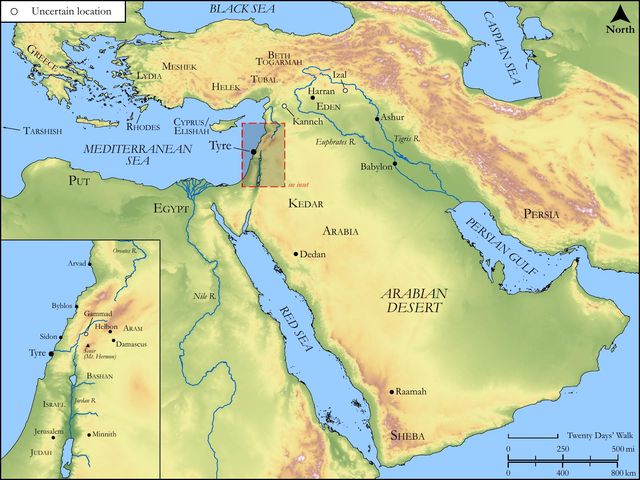
See on the biblical-era map
Study this verse
Public-domain commentary
Matthew Henry
From his Commentary on the Whole Bible. Henry comments on passages, not single verses — this entry covers Ezekiel 26:15–21. His three-level outline is real structure in the source text, so it is rendered as structure.
The utter ruin of Tyre is here represented in very strong and lively figures, which are exceedingly affecting.
1.See how high, how great, Tyre had been, how little likely ever to come to this. The remembrance of men's former grandeur and plenty is a great aggravation of their present disgrace and poverty. Tyre was a renowned city (Eze 26:17), famous among the nations, the crowning city (so she is called Isa 23:8), a city that had crowns in her gift, honoured all she smiled upon, crowned herself and all about her. She was inhabited of seas, that is, of those that trade at sea, of those who from all parts came thither by sea, bringing with them the abundance of the seas and the treasures hidden in the sand. She was strong in the sea, easy of access to her friends, but to her enemies inaccessible, fortified by a wall of water, which made her impregnable. So that she with her pomp, and her inhabitants with their pride, caused their terror to be on all that haunted that city, and upon any account frequented it. It was well fortified, and formidable in the eyes of all that acquainted themselves with it. Every body stood in awe of the Tyrians and was afraid of disobliging them. Note, Those who know their strength are too apt to cause terror, to pride themselves in frightening those they are an over-match for.
2.See how low, how little, Tyre is made, Eze 26:19, Eze 26:20. This renowned city is made a desolate city, is no more frequented as it has been; there is no more resort of merchants to it; it is like the cities not inhabited, which are no cities, and having none to keep them in repair, will go to decay of themselves. Tyre shall be like a city overflowed by an inundation of waters, which cover it, and upon which the deep is brought up. As the waves had formerly been its defence, so now they shall be its destruction. She shall be brought down with those that descend into the pit, with the cities of the old world that were under water, and with Sodom and Gomorrah, that lie in the bottom of the Dead Sea. Or, she shall be in the condition of those who have been long buried, of the people of old time, who are old inhabitants of the silent grace, who are quite rotted away under ground and quite forgotten above ground; such shall Tyre be, free among the dead, set in the lower parts of the earth, humbled, mortified, reduced. It shall be like the places desolate of old, as well as like persons dead of old; it shall be like other cities that have formerly been in like manner deserted and destroyed. It shall not be inhabited again; none shall have the courage to attempt the rebuilding of it upon that spot, so that it shall be no more; The Tyrians shall be lost among the nations, so that people will look in vain for Tyre in Tyre: Thou shalt be sought for, and never found again. New persons may build a new city upon a new spot of ground hard by, which they may call Tyre, but Tyre, as it is, shall never be any more. Note, The strongest cities in this world, the best-fortified and best-furnished, are subject to decay, and may in a little time be brought to nothing. In the history of our own island many cities are spoken of as in being when the Romans were here which now our antiquaries scarcely know where to look for, and of which there remains no more evidence than Roman urns and coins digged up there sometimes accidentally. But in the other world we look for a city that shall stand for ever and flourish in perfection through all the ages of eternity.
3.See what a distress the inhabitants of Tyre are in (Eze 26:15): There is a great slaughter made in the midst of thee, many slain, and great men. It is probable that, when the city was taken, the generality of the inhabitants were put to the sword. Then did the wounded cry, and they cried in vain, to the pitiless conquerors; they cried quarter, but it would not be given them; the wounded are slain without mercy, or, rather, that is the only mercy that is shown them, that the second blow shall rid them out of their pain.
4.See what a consternation all the neighbours are in upon the fall of Tyre. This is elegantly expressed here, to show how astonishing it should be. (1.) the islands shall shake at the sound of thy fall (Eze 26:15), as, when a great merchant breaks, all that he deals with are shocked by it, and begin to look about them; perhaps they had effects in his hands, which they are afraid they shall lose. Or, when they see one fail and become bankrupt of a sudden, in debt a great deal more than he is worth, it makes them afraid for themselves, lest they should do so too. Thus the isles, which thought themselves safe in the embraces of the sea, when they see Tyrus fall, shall tremble and be troubled, saying, "What will become of us?" And it is well if they make this good use of it, to take warning by it not to be secure, but to stand in awe of God and his judgments. The sudden fall of a great tower shakes the ground round about it; thus all the islands in the Mediterranean Sea shall feel themselves sensibly touched by the destruction of Tyre, it being a place they had so much knowledge of, such interests in, and such a constant correspondence with. (2.) The princes of the sea shall be affected with it, who ruled in those islands. Or the rich merchants, who live like princes (Isa 23:8), and the masters of ships, who command like princes, these shall condole the fall of Tyre in a most compassionate and pathetic manner (Eze 26:16): They shall come down from their thrones, as neglecting the business of their thrones and despising the pomp of them. They shall lay away their robes of state, their broidered garments, and shall clothe themselves all over with tremblings, with sackcloth that will make them shiver. Or they shall by their own act and deed make themselves to tremble upon this occasion; they shall sit upon the ground in shame and sorrow; they shall tremble every moment at the thought of what has happened to Tyre, and for fear of what may happen to themselves; for what island is safe if Tyre be not? They shall take up a lamentation for thee, shall have elegies and mournful poems penned upon the fall of Tyre, Eze 26:17. How art thou destroyed! [1.] It shall be a great surprise to them, and they shall be affected with wonder, that a place so well fortified by nature and art, so famed for politics and so full of money, which is the sinews of war, that held out so long and with so much bravery, should be taken at last (Eze 26:21): I make thee a terror. Note, It is just with God to make those a terror to their neighbours, by the suddenness and strangeness of their punishment, who make themselves a terror to their neighbours by the abuse of their power. Tyre had caused her terror (Eze 26:17) and now is made a terrible example. [2.] It shall be a great affliction to them, and they shall be affected with sorrow (Eze 26:17); they shall take up a lamentation for Tyre, as thinking it a thousand pities that such a rich and splendid city should be thus laid in ruins. When Jerusalem, the holy city, was destroyed, there were no such lamentations for it; it was nothing to those that passed by (Lam 1:12); but when Tyre, the trading city, fell, it was universally bemoaned. Note, Those who have the world in their hearts lament the loss of great men more than the loss of good men. [3.] It shall be a loud alarm to them: They shall tremble in the day of thy fall, because they shall have reason to think that their own turn will be next. If Tyre fall, who can stand? Howl, fir-trees, if such a cedar be shaken. Note, The fall of others should awaken us out of our security. The death or decay of others in the world is a check to us, when we dream that our mountain stands strongly and shall not be moved.
5.See how the irreparable ruin of Tyre is aggravated by the prospect of the restoration of Israel. Thus shall Tyre sink when I shall set glory in the land of the living, Eze 26:20. Note,
(1.)The holy land is the land of the living; for none but holy souls are properly living souls. Where living sacrifices are offered to the living God, and where the lively oracles are, there the land of the living is; there David hoped to see the goodness of the Lord, Psa 27:13. That was a type of heaven, which is indeed the land of the living.
(2.)Though this land of the living may for a time lie under disgrace, yet God will again set glory in it; the glory that had departed shall return, and the restoration of what they had been deprived of shall be so much more their glory. God will himself be the glory of the lands that are the lands of the living.
(3.)It will aggravate the misery of those that have their portion in the land of the dying, of those that are for ever dying, to behold the happiness of those, at the same time, that shall have their everlasting portion in the land of the living. When the rich man was himself in torment he saw Lazarus in the bosom of Abraham, and glory set for him in the land of the living.
Historical interpretation
Historical reception
3 surviving comments on this verse. Each one is dated, so this reads as a timeline rather than a list.
(Verse 35, 36, and following) And I will bring you into a desert of peoples, and there I will judge you face to face. Just as I contended with your fathers in the desert of the land of Egypt, so I will judge you, says the Lord. And I will subject you to my scepter, and I will bring you into the bonds of the covenant, and I will choose from among you the transgressors and the wicked: from their place of residence I will bring them out, and they will not enter the land of Israel, and you will know that I am the Lord. Thus says the Lord: I will do for you who are in Babylon, and now serve idols, what I did for your ancestors in Egypt. I will lead you into the desert of the peoples, and there I will judge you face to face, just as I contended with them in judgment when they came out of Egypt. And after I have judged you, I will subject you to my scepter and rule, and I will make a covenant with you and bring you into your land with the bonds of love, so that bound by my love, you will never be able to depart from me. But I will choose from among you the transgressors and the wicked, who persist in the hardness of their hearts in evil deeds, not for possession, but for rejection. And I will indeed bring them out of the land of their dwelling, so that when they are brought out, they will not enter the land of Israel; but they will perish in various regions. And by the distinction between good and evil, you shall know that I am the Lord, who judges all things. The rest of the discourse hastens, and we briefly go through each point, in order to provide only the meaning to the readers.
(Verse 15 and following) Thus says the Lord God to Tyre: Shall not the rumble of your downfall, and the groaning of your slain, when they are killed in your midst, shake the islands? And all the princes of the sea will come down from their thrones, and they will take off their robes and cast aside their embroidered garments; they will put on sackcloth and sit on the ground, and they will tremble with horror at you. They will raise a lament over you and say to you: How you have perished, you renowned city, you were mighty in the sea with your inhabitants, who were feared by all. Now the ships will be astonished on the day of your terror, and the islands in the sea will be troubled, because no one will go out from you. LXX: For thus says the Lord God, Sister. Will not your wounded ones groan at the sound of your downfall, when the sword is drawn in your midst? The islands will shake, and all the princes of the sea will come down from their thrones, and they will take off their crowns, and they will be stripped of their various garments. They will go insane with fury: they will sit on the ground, and they will fear their own destruction, and they will groan over you, and they will take up a lamentation for you, and they will say to you: How you have perished and been scattered in the sea, praised city, which was strong in the sea itself, and its inhabitants, who each gave their fear to all its inhabitants? And the islands will fear on the day of your downfall, and the islands will be troubled in the sea at your departure. First, let us unfold the words of the story itself, briefly opening the meaning of the statements. Thus says the Lord God to Tyre, which is called Sor in Hebrew: Will the islands not be moved on the day of your downfall, when Nebuchadnezzar attacks and you fall, and amid the groaning of the wounded or killed in your midst? And all the kings will descend from their seats or thrones, and the princes of the sea who govern various islands will take off their crowns from their heads, laying aside all the glory of ruling and their most precious garments shining with incredible variety, they will cast them away, and in the greatness of their astonishment they will turn into madness, and being humiliated, they will sit on the ground, and when they see you have fallen, they will fear the same fate for themselves; and they will consider nothing to be everlasting in the goods of the earth; but on the contrary, they will take up a mournful lament and sing a sorrowful song, saying: How you have perished, you who lived (or were praised) in the sea, illustrious city? For we read in the Greek, Latin, and Barbarian histories that Tyre was indeed an island, and that it had no entrance from the land. But later, according to some, it was thrown up with mounds by Nebuchadnezzar, the king of the Chaldeans, or as others affirm, by Alexander, the king of the Macedonians, and a place was prepared for its siege with machines and battering-rams, and the island became a peninsula. Therefore, oh Tyre, oh Sor, who once were the strongest of all islands, praised in the voices of all cities with your inhabitants, whom everyone feared, how suddenly have you fallen? Now the islands will be astonished, or will be afraid over you, and as it is better understood in Hebrew, the ships, on the day of your terror and ruin, and the islands will be troubled in the sea. From this it follows that it is advisable to read the lines above the ships, so that the islands are not placed in a second position; because no one will go out from you, or, as the Seventy translated, on the day of your departure: when you are led captive. These, in the meantime, may be considered as the foundations of a certain story: now let us strive to raise the spiritual pinnacle. Imagine someone, who for a long time preserved their modesty, flourished with many virtues, and then collapsed in some grave and mortal sin: will not all the islands be moved by the sound of their ruin and the destruction of their virtues? Indeed, those who are tossed by the salty and bitter waves of this world. And those who appeared as princes in the filth of this age will descend from their thrones of pride and, humbled, will remove the crowns from their heads, which seemed to possess good works, and they will cast off their various garments of virtue and be cloaked in astonishment or a kind of fear. They will sit on the ground and, astonished by their sudden fall, they will marvel. So much so that all will take up lamentation and mourning over the one who has fallen, and they will say: How have you perished, who were once saved? How you have fallen, you who once stood so tall, who were considered illustrious among all in the sea of this world, who were thought to be strong by everyone. And your inhabitants, that is, the most courageous thoughts, resisting all the fiery arrows of the devil, which were previously feared by all adversaries, have turned to astonishment. But even the ships, all the saints who cross the waves of this world, will be astonished when they see you fall. On the day of your terror and destruction, the islands will be troubled, lest they themselves suffer the same. For the ruins of others serve as examples for the righteous, as we all abide in this weak and feeble state, constantly wavering in this world, and victory is never certain and secure for us: for those who once stood will depart from you; or at your departure; at your end and completion. For we are judged not by the past, but by the present. And care must be taken, and always feared, that it may overthrow ancient glory and solid stability, the storms of a single hour.
(Verse 27, 29 onwards) Therefore speak to the house of Israel, son of man, and tell them: Thus says the Lord God: Moreover, your fathers have blasphemed against me and have treated me with contempt, even as they spurned me. And I brought them into the land that I had lifted my hand to give them ((Vulgate adds: that land)): they saw every high hill and every leafy tree, and there they offered their sacrifices and presented there the irritation of their offerings, and they placed there the fragrance of their sweetness, and they poured out their ((Vulgate is silent on this)) libations there. And I said to them, 'What is the high place to which you are going?' And its name was called the High Place until this day. Therefore speak to the house of Israel, son of man, and say to them, 'Thus says the Lord God: As for your fathers, they have provoked Me to anger by their iniquities, by the fact that they have fallen away from Me. So I brought them into the land that I had lifted My hand in an oath to give them.' They saw every high hill and every leafy tree, and there they offered their sacrifices. They also presented there the provocation of their gifts, and they set there their pleasing aroma, and they poured out there their drink offerings. And I said to them: What is abbana, because you enter there? And they called its name abbana until this day. I wanted, he said, to scatter them in the wilderness, and to give them not good precepts, so that they would sacrifice to idols what they should have offered to me, and consecrate all their first-fruits to them by fire, so that I might kill them and destroy them. But when he says, I wanted, he shows that he did not do what he wanted. And that which follows: 'And they shall know that I am the Lord,' is not found in the Septuagint. For it did not seem fitting to them to know after their destruction that he himself is the Lord. But you, son of man, speak again to them, that is, to the elders of the house of Israel, who have come to inquire of you: Your fathers, from whom you have descended, have also blasphemed against me and held me in contempt; after I brought them into the land which I had given them to possess, they turned against me to provoke me. For when they saw every high hill and leafy tree, they would sacrifice on the mountains and in the groves and thickets, and offer victims to the idols, and pour out libations. And when I saw this, I said to them: What is this, Bama? for it is called high: or why do you enter into such a place which you have chosen for yourselves in all the hills, so that even today these places are called Bamoth, and the ancient error retains its original name? Regarding Bama, which we translate as excelsum, there is an error in the Septuagint edition, where it is written as ἀββανὰ, which does not resonate in the Hebrew language. Bama can mean 'in which' if the two syllables are divided into two words, but in the present context, that sense does not fit. However, wherever it is written in the Books of Kings and Chronicles: 'The people still sacrificed and offered incense on the high places,' Bama in the singular and Bamoth in the plural mean 'high places.'
Continue studying Ezekiel 26:17 across the web’s major study libraries — every link below opens this exact verse, chapter, or book on the destination site.
Read & Compare
 BibleGatewayThis verse in more than 200 translations and 70 languages.
 Bible.comThe YouVersion reader — hundreds of translations, reading plans, and highlights.
 ESV.orgCrossway's official English Standard Version reader.
 NET BibleThe NET translation with 60,000+ translators' notes on every rendering decision.
 STEP BibleTyndale House's free study tool — original text, vocabulary, and scholarly resources.
 BibliaLogos Bible Software's free web reader.
 USCCBThe New American Bible (Revised Edition) with the U.S. bishops' study notes.
Commentaries
 BibleHub CommentariesDozens of classic commentaries on this verse, gathered on one page.
 StudyLightMore than 100 commentary sets — the largest collection on the web.
 BibleRefPlain-English commentary on what this verse means, verse by verse.
 Enduring WordDavid Guzik's free commentary on this chapter, widely used by Bible teachers.
 Bible Study ToolsVerse commentary alongside Greek and Hebrew study aids.
Original Language & Research
- BibleHub InterlinearThe verse word by word — original language, transliteration, and English.
- BibleHub LexiconEvery word's original-language definition and Strong's entry.
 Blue Letter BibleDeep-study tools — Strong's numbers, concordance, and word studies.
 SefariaThe Hebrew text with Rashi and centuries of Jewish commentary.
Sermons, Hymns & Audio


TrulyRandomVerse is not affiliated with these sites and doesn’t control their content. They’re linked because they’re genuinely useful.
Summary
Ezekiel 26:17 presents a poignant prophetic dirge, a lament sung by the surrounding nations and seafaring communities over the catastrophic and unexpected downfall of Tyre. This verse powerfully captures the profound shock, sorrow, and disbelief at the obliteration of what was once a globally renowned, formidable maritime city. It underscores Tyre's dramatic transition from a vibrant center of power, commerce, and pride to a desolate ruin, prompting astonishment among those who had previously admired or feared its seemingly invincible strength.
Context
ShowHideLiterary Context
This verse is intricately woven into a series of divine pronouncements against Tyre, spanning Ezekiel 26 through Ezekiel 28. Specifically, the preceding verses in Ezekiel 26:1-14 meticulously detail the impending siege and utter destruction of Tyre by Nebuchadnezzar, followed by vivid imagery of its complete desolation. Verses Ezekiel 26:15-18 then pivot to describe the visceral reaction of the surrounding nations, island dwellers, and maritime rulers, who are depicted as trembling with fear and taking up a mournful lament over Tyre's demise. This particular verse, Ezekiel 26:17, serves as the core articulation of that mournful song, expressing the profound shock and despair felt by those who witnessed the collapse of such a dominant and seemingly impregnable power. The lament itself is a common and effective prophetic device employed to emphasize the finality and severity of divine judgment.
Historical & Cultural Context
Ancient Tyre was a preeminent Phoenician city-state, strategically situated on an island off the coast of modern-day Lebanon. Its unparalleled prosperity stemmed from its extensive maritime trade networks, formidable naval strength, and immense wealth, establishing it as a dominant force among the isles of the sea. Its inhabitants, aptly described as "seafaring men," were master mariners, shrewd merchants, and skilled colonizers, establishing trading outposts and settlements across vast distances. Culturally, Tyre was characterized by its profound pride and self-sufficiency, often viewing itself as impervious to external threats due a combination of its island fortress status, formidable defenses, and vast economic resources. The prophet Ezekiel's pronouncements against Tyre were delivered during the Babylonian exile (6th century BCE), a period in which God was emphatically demonstrating His absolute sovereignty over all nations, not merely Israel. Tyre's eventual fall would have been an event of monumental significance, sending shockwaves among the nations and serving as a stark, undeniable warning to other proud and prosperous cities.
Key Themes
ShowHideThe lament over Tyre's destruction in Ezekiel 26:17 powerfully encapsulates several foundational themes prevalent throughout Ezekiel's prophecy and the broader Old Testament narrative. Firstly, it profoundly illustrates the theme of Divine Judgment and Sovereignty, unequivocally demonstrating that no earthly power, regardless of its strength, wealth, or renown, can ultimately withstand God's sovereign decree. Tyre's perceived invincibility is utterly shattered, proving the Lord's absolute control over human affairs, as He "brings princes to nothing and makes the rulers of the earth as emptiness" (Isaiah 40:23). Secondly, this lament underscores the inevitable Humbling of Pride. Tyre's arrogance, deeply rooted in its vast wealth and unassailable power, directly precipitated its downfall, echoing the timeless biblical principle that "pride goes before destruction, and a haughty spirit before a fall" (Proverbs 16:18). Finally, the verse speaks eloquently to the Transience of Earthly Power and Wealth. The mournful lament serves as a poignant and enduring reminder that all human achievements, empires, and material possessions are inherently fleeting and temporary, contrasting sharply with the eternal nature of God's kingdom and the enduring truth of His unchanging word.
Exposition and Analysis
ShowHideKey Word Analysis
ShowHideThis primitive root means "to be clear (orig. of sound, but usually of color); to shine; hence, to make a show, to boast; and thus to be (clamorously) foolish; to rave; causatively, to celebrate; also to stultify; (make) boast (self), celebrate, commend, (deal, make), fool(-ish, -ly), glory, give (light), be (make, feign self) mad (against), give in marriage, (sing, be worthy of) praise, rage, renowned, shine." In this context, "renowned" signifies Tyre's widespread fame, global glory, and the boastful reputation it had meticulously cultivated, often bordering on excessive arrogance. Its renown was inextricably linked to its immense commercial success and formidable naval might, rendering its catastrophic destruction all the more shocking and impactful to the nations round about.
Derived from חָזַק, this word means "strong (usu. in a bad sense, hard, bold, violent); harder, hottest, [phrase] impudent, loud, mighty, sore, stiff(-hearted), strong(-er)." Here, "strong" emphatically highlights Tyre's formidable defenses, its overwhelming naval power, and its deeply ingrained perception of invincibility, particularly its dominance "in the sea." This perceived strength was the very foundation of its security and its ability to project influence across the Mediterranean, making its utter destruction a profound testament to a power far greater than its own.
A primitive root, properly meaning "to sit down (specifically as judge. in ambush, in quiet); by implication, to dwell, to remain; causatively, to settle, to marry; (make to) abide(-ing), continue, (cause to, make to) dwell(-ing), ease self, endure, establish, [idiom] fail, habitation, haunt, (make to) inhabit(-ant), make to keep (house), lurking, [idiom] marry(-ing), (bring again to) place, remain, return, seat, set(-tle), (down-) sit(-down, still, -ting down, -ting (place) -uate), take, tarry." This word appears twice in the verse, first describing Tyre as "inhabited of seafaring men" and later referring to "all that haunt it." It speaks to the city's once vibrant, bustling population, particularly those intrinsically connected to its maritime identity, and subsequently, to the profound desolation that will leave it haunted by only the remnants of its former life or by wild creatures, rather than thriving human inhabitants.
Verse Breakdown
ShowHide"And they shall take up a lamentation for thee, and say to thee,"
This opening clause vividly sets the scene for a formal dirge or mournful elegy. "They" refers collectively to the kings, princes, and seafaring peoples mentioned in the preceding verses, who are depicted as witnessing Tyre's catastrophic destruction. The act of "taking up a lamentation" signifies a profound, public expression of grief, astonishment, and despair over the city's demise, acknowledging its finality and the overwhelming severity of its judgment.
"How art thou destroyed,"
This rhetorical question serves as a powerful expression of utter shock, disbelief, and bewilderment. It underscores the unexpected, complete, and irreversible nature of Tyre's destruction, as a city once considered impregnable and eternal has fallen. It is a cry of profound astonishment from those who had previously admired, feared, or depended upon Tyre's immense power and influence.
"[that wast] inhabited of seafaring men,"
This descriptive phrase emphatically highlights Tyre's core identity as a thriving, bustling port city, a global hub of maritime activity. Its entire population and economic life were inextricably defined by its deep connection to the sea, comprising expert merchants, intrepid sailors, and shrewd traders. The destruction prophesied here signifies the complete cessation of this vibrant, sea-dependent way of life.
"the renowned city, which wast strong in the sea,"
This clause further elaborates on Tyre's former glory and formidable status. "Renowned" speaks to its widespread fame, celebrated reputation, and influence among the isles and the nations, while "strong in the sea" refers to its formidable naval power, its unassailable island defenses, and its strategic advantage as a maritime empire. These attributes were the very source of its pride, security, and global dominance, now shown to be utterly vulnerable and transient.
"she and her inhabitants,"
This concise phrase reiterates the comprehensive and complete nature of the destruction, encompassing both the physical city itself and its entire, once-thriving population. The lament is not merely for the stones and structures of Tyre, but for the vibrant human life, culture, and commerce that once filled its streets and harbors.
"which cause their terror [to be] on all that haunt it!"
This final clause vividly describes the profound impact and awe-inspiring influence Tyre once wielded over its surroundings. Its power, wealth, and naval might inspired widespread fear, respect, and even submission among other nations and those who navigated its waters. The lament acknowledges this past dominance, making its current state of utter ruin and desolation even more tragically ironic and a stark testament to the reversal of its fortunes. The "terror" it once projected is now replaced by the terror of its own catastrophic destruction.
Literary Devices
ShowHideThe primary literary device employed in Ezekiel 26:17 is the Lament or Dirge (Hebrew: qinah). This is a distinct poetic form, often characterized by a mournful tone and a specific metrical rhythm (typically a 3+2 pattern in Hebrew poetry), traditionally used for mourning the dead or expressing profound sorrow over a national calamity. Its strategic use here elevates the destruction of Tyre from a mere historical event to a profound, universal tragedy, inviting the audience to share in the grief and shock of the onlookers. The verse also employs a powerful Rhetorical Question ("How art thou destroyed?") to convey the utter astonishment, disbelief, and bewilderment at Tyre's fall, emphatically emphasizing its unexpected and complete nature. Furthermore, Contrast is powerfully utilized, starkly juxtaposing Tyre's former glory as "the renowned city, which wast strong in the sea" and a source of "terror" with its present state of utter desolation and ruin. This stark contrast dramatically amplifies the sense of loss and the overwhelming magnitude of divine judgment. There is also a subtle element of Personification, as the city of Tyre is directly addressed as a fallen entity, capable of being lamented over, which further humanizes its tragic and irreversible end.
Theological and Thematic Connections
ShowHideEzekiel 26:17 serves as a profound theological statement regarding God's absolute sovereignty over all earthly powers and the inevitable, just consequences of human pride and self-reliance. Tyre, a quintessential symbol of human ingenuity, immense wealth, and formidable military might, erroneously believed itself to be invincible and beyond the reach of any external force. Its dramatic and complete fall unequivocally demonstrates that no human endeavor, however grand, secure, or prosperous, can ultimately stand against the righteous decree of the Almighty God. The lament voiced by the nations is a stark recognition that true security, lasting power, and enduring prosperity reside not in material possessions, strategic advantage, or military might, but solely in humble submission to the one true God. It serves as a timeless reminder that God is the one who "brings the princes to nothing and makes the rulers of the earth as emptiness" (Isaiah 40:23), and that those who exalt themselves in pride will ultimately be humbled. The transience and ultimate futility of all earthly glory and human achievement is a recurring biblical theme, powerfully and tragically illustrated by Tyre's comprehensive demise.
Reflection and Application
ShowHideThe mournful lament over Tyre in Ezekiel 26:17 offers profound and enduring lessons for believers in every generation. It compels us to deeply examine the objects of our ultimate trust and security. Do we, like ancient Tyre, place our reliance on our accumulated wealth, our societal influence, our personal accomplishments, or our perceived strengths and self-sufficiency? Or do we, with unwavering faith, anchor our hope in the unchanging, sovereign God, whose power transcends all earthly limitations? The dramatic and complete fall of this once-mighty city serves as a stark, sobering reminder that all earthly glories, human empires, and material possessions are inherently fleeting, temporary, and subject to decay. True and lasting security, enduring peace, and eternal prosperity are found only in Christ Jesus. This verse powerfully encourages a posture of profound humility, recognizing that every good and perfect gift comes from God (James 1:17) and that our ultimate strength is found in Him alone. It challenges us to live with an eternal perspective, diligently investing our lives in what truly lasts—God's eternal kingdom and His perfect righteousness—rather than accumulating perishable treasures on earth that are inevitably subject to moth, rust, and destruction (Matthew 6:19-21).
Questions for Reflection
ShowHideFAQ
ShowHideWhy is a lamentation sung for Tyre, and by whom?
ShowHideA lamentation, or dirge (Hebrew: qinah), is sung for Tyre to express profound sorrow, shock, and utter disbelief at its complete and irreversible destruction. It dramatically highlights the reversal of its fortunes from a powerful, globally renowned city to a desolate ruin. The lament is sung by "seafaring men" and other nations, particularly their kings and princes, who once engaged in extensive trade with Tyre or were significantly influenced by its immense power and commercial dominance. Their mournful song underscores the universal impact of Tyre's fall and acknowledges the overwhelming nature of the divine judgment against it, as described in Ezekiel 26:15-18. It serves as a stark recognition that even the most formidable and seemingly impregnable human strongholds can be brought to absolute nothingness by God's sovereign hand.
What does Tyre's destruction teach us about God's character?
ShowHideTyre's destruction powerfully and unequivocally reveals several core aspects of God's character: His absolute sovereignty, His unyielding justice, and His unfailing faithfulness to His prophetic word. It demonstrates that God is not limited or constrained by human power, strategic advantage, or perceived invincibility; He is fully able to bring down even the most "renowned" and "strong" of cities and empires. His perfect justice is clearly seen in His judgment against Tyre's pervasive pride, its commercial exploitation, and its malicious rejoicing over Jerusalem's fall (Ezekiel 26:2). Furthermore, it showcases His unwavering faithfulness in executing His declared judgment, proving that His word will always come to pass, regardless of how improbable or impossible it may seem from a human perspective.
Christ-Centered Fulfillment
ShowHideEzekiel 26:17, while a specific prophecy of judgment against an ancient city, finds its ultimate and profound Christ-centered fulfillment in the triumph of God's eternal kingdom over all temporal earthly powers and the glorious establishment of the new heaven and new earth. Tyre, with its immense wealth, pervasive pride, and deeply ingrained perception of invincibility, represents the very epitome of human glory, self-reliance, and worldly systems built apart from God. Its dramatic and complete fall prophetically foreshadows the ultimate dismantling and dissolution of all systems, empires, and ideologies that stand in opposition to God's righteous reign and His divine will. In Christ, we behold the true "renowned city"—not one meticulously built by human hands, but the New Jerusalem, the glorious bride of Christ, which is eternal, incorruptible, and descends from heaven. The "terror" Tyre once inflicted upon the nations is ultimately replaced by the profound awe and worship inspired by the Lamb of God, whose kingdom is emphatically "not of this world" (John 18:36) and will never be destroyed or given to another (Daniel 2:44). The lament over Tyre's destruction thus points forward to the final, triumphant lament over "Babylon the great" in Revelation 18, which symbolizes all anti-God systems and worldly power structures. Her fall is met not with sorrow, but with resounding rejoicing in heaven because of God's righteous and perfect judgment (Revelation 19:1-3). Therefore, Tyre's demise serves as a powerful prophetic type, reminding us that all earthly glory and human achievements will inevitably fade, but the eternal kingdom established by Christ will endure forever, and in Him alone is true and lasting security, peace, and hope found.