


2 Samuel 1:25
Bible text: King James Version (1769 Blayney text) · Public domain
Bible text: Berean Standard Bible · Public domain
Bible text: American Standard Version (1901) · Public domain
Bible text: World English Bible, Messianic edition · Public domain
Bible text: Geneva Bible (1599) · Public domain
Bible text: Young's Literal Translation · Public domain
- אֵיךְ'eikhhow!H349InterrogParticle Interrogative
- נָפְלוּna·fe·Luthey have fallenH5307V-Qal-Perf-3cpVerb Qal Perfect 3rd Plural common gender
- גִבֹּרִיםgi·bo·Rim[the] mighty [ones]H1368N-mpNoun Plural Masculine Absolute
- בְּתוֹךְbe·Tokhin [the] middle ofH8432Prep-b ¦ N-mscNoun Singular Masculine Constructבְּinתוֹךְ[the] middle of
- הַמִּלְחָמָהha·mil·cha·Mahthe battleH4421Art ¦ N-fsNoun Singular Feminine Absoluteהַtheמִּלְחָמָהbattle
- יְהוֹנָתָןye·Ho·na·TanJonathanH3083N-proper-mNoun Proper Masculine
- עַל'alonH5921PrepPreposition
- בָּמוֹתֶיךָba·mo·Tei·khayour high placesH1116N-fpc ¦ 2msNoun Plural Feminine Constructבָּמוֹתֶיhigh placesךָyour
- חָלָלcha·Lal[is] slainH2491Adj-msAdjective Singular Masculine Absolute
English is a literal word-by-word gloss of the Hebrew, not the KJV's wording. Why?
This is the original text the KJV's translators worked from — each Hebrew word with its own literal English meaning in this verse, prepared by scholars at Tyndale House, Cambridge. The KJV translates whole sentences, not word by word, so its wording differs: one Hebrew word can become several English words, and the KJV may choose “the LORD” where the gloss reads “Yahweh”. Both are faithful — they answer different questions. For the KJV's own rendering, switch to the KJV text.
Details
See on the biblical-era maps
Study this verse
Public-domain commentary
Matthew Henry
From his Commentary on the Whole Bible. Henry comments on passages, not single verses — this entry covers 2 Samuel 1:17–27. His four-level outline is real structure in the source text, so it is rendered as structure.
When David had rent his clothes, mourned, and wept, and fasted, for the death of Saul, and done justice upon him who made himself guilty of it, one would think he had made full payment of the debt of honour he owed to his memory; yet this is not all: we have here a poem he wrote on that occasion; for he was a great master of his pen as well as of his sword. By this elegy he designed both to express his own sorrow for this great calamity and to impress the like on the minds of others, who ought to lay it to heart. The putting of lamentations into poems made them, 1. The more moving and affecting. The passion of the poet, or singer, is, by this way, wonderfully communicated to the readers and hearers. 2. The more lasting. Thus they were made, not only to spread far, but to continue long, from generation to generation. Those might gain information by poems that would not read history. Here we have,
I.The orders David gave with this elegy (Sa2 1:18):
He bade them teach the children of Judah (his own tribe, whatever others did) the use of the bow, either.
1.The bow used in war. Not but that the children of Judah knew how to use the bow (it was so commonly used in war, long before this, that the sword and bow were put for all weapons of war, Gen 48:22), but perhaps they had of late made more use of slings, as David in killing Goliath, because cheaper, and David would have them now to see the inconvenience of these (for it was the archers of the Philistines that bore so hard upon Saul, Sa1 21:3), and to return more generally to the use of the bow, to exercise themselves in this weapon, that they might be in a capacity to avenge the death of their prince upon the Philistines, and to outdo them at their own weapon. It was a pity but those that had such good heads and hearts as the children of Judah should be well armed. David hereby showed his authority over and concern for the armies of Israel, and set himself to rectify the errors of the former reign. But we find that the companies which had now come to David to Ziklag were armed with bows (Ch1 12:2); therefore,
2.Some understand it either of some musical instrument called a bow (to which he would have the mournful ditties sung) or of the elegy itself: He bade them teach the children of Judah Kesheth, the bow, that is, this song, which was so entitled for the sake of Jonathan's bow, the achievements of which are here celebrated. Moses commanded Israel to learn his song (Deu 31:19), so David his. Probably he bade the Levites teach them. It is written in the book of Jasher, there it was kept upon record, and thence transcribed into this history. That book was probably a collection of state-poems; what is said to be written in that book (Jos 10:13) is also poetical, a fragment of an historical poem. Even songs would be forgotten and lost if they were not committed to writing, that best conservatory of knowledge.
II.The elegy itself.
It is not a divine hymn, nor given by inspiration of God to be used in divine service, nor is there any mention of God in it; but it is a human composition, and therefore was inserted, not in the book of Psalms (which, being of divine original, is preserved), but in the book of Jasher, which, being only a collection of common poems, is long since lost. This elegy proves David to have been,
1.A man of an excellent spirit, in four things: -
(1.)He was very generous to Saul, his sworn enemy. Saul was his father-in-law, his sovereign, and the anointed of the Lord; and therefore, though he had done him a great deal of wrong, David does not wreak his revenge upon his memory when he is in his grave; but like a good man, and a man of honour,
[1.]He conceals his faults; and, though there was no preventing their appearance in his history, yet they should not appear in this elegy. Charity teaches us to make the best we can of every body and to say nothing of those of whom we can say no good, especially when they are gone. De mortuis nil nisi bonum - Say nothing but good concerning the dead. We ought to deny ourselves the satisfaction of making personal reflections upon those who have been injurious to us, much more drawing their character thence, as if every man must of necessity be a bad man that has done ill by us. Let the corrupt part of the memory be buried with the corrupt part of the man - earth to earth, ashes to ashes; let the blemish be hidden and a veil drawn over the deformity.
[2.]He celebrates that which was praiseworthy in him. He does not commend him for that which he was not, says nothing of his piety or fidelity. Those funeral commendations which are gathered out of the spoils of truth are not at all to the praise of those on whom they are bestowed, but very much the dispraise of those who unjustly misplace them. But he has this to say in honour of Saul himself, First, That he was anointed with oil (Sa2 1:21), the sacred oil, which signified his elevation to, and qualification for, the government. Whatever he was otherwise, the crown of the anointing oil of his God was upon him, as is said of the high priest (Lev 21:12), and on that account he was to be honoured, because God, the fountain of honour, had honoured him. Secondly, That he was a man of war, a mighty man (Sa2 1:19-21), that he had often been victorious over the enemies of Israel and vexed them whithersoever he turned, Sa1 14:47. His sword returned not empty, but satiated with blood and spoil, Sa2 1:22. His disgrace and fall at last must not make his former successes and services to be forgotten. Though his sun set under a cloud, time was when it shone brightly. Thirdly, That take him with Jonathan he was a man of a very agreeable temper, that recommended himself to the affections of his subjects (Sa2 1:23): Saul and Jonathan were lovely and pleasant. Jonathan was always so, and Saul was so as long as he concurred with him. Take them together, and in the pursuit of the enemy, never were men more bold, more brave; they were swifter than eagles and stronger than lions. Observe, Those that were most fierce and fiery in the camp were no less sweet and lovely in the court, as amiable to the subject as they were formidable to the foe; a rare combination of softness and sharpness they had, which makes any man's temper very happy. It may be understood of the harmony and affection that for the most part subsisted between Saul and Jonathan: they were lovely and pleasant one to another, Jonathan a dutiful son, Saul an affectionate father; and therefore dear to each other in their lives, and in their death they were not divided, but kept close together in the stand they made against the Philistines, and fell together in the same cause. Fourthly, That he had enriched his country with the spoils of conquered nations, and introduced a more splendid attire. When they had a king like the nations, they must have clothes like the nations; and herein he was, in a particular manner, obliging to his female subjects, Sa2 1:24. The daughters of Israel he clothed in scarlet, which was their delight.
(2.)He was very grateful to Jonathan, his sworn friend. Besides the tears he shed over him, and the encomiums he gives of him in common with Saul, he mentions him with some marks of distinction (Sa2 1:25): O Jonathan! thou wast slain in thy high places! which (compared with Sa2 1:19) intimates that he meant him by the beauty of Israel, which, he there says, was slain upon the high places. He laments Jonathan as his particular friend (Sa2 1:26): My brother, Jonathan; not so much because of what he would have been to him if he had lived, very serviceable no doubt in his advancement to the throne and instrumental to prevent those long struggles which, for want of his assistance, he had with the house of Saul (had this been the only ground of his grief it would have been selfish), but he lamented him for what he had been: "Very pleasant hast thou been unto me; but that pleasantness is now over, and I am distressed for thee." He had reason to say that Jonathan's love to him was wonderful; surely never was the like, for a man to love one who he knew was to take the crown over his head, and to be so faithful to his rival: this far surpassed the highest degree of conjugal affection and constancy. See here,
[1.]That nothing is more delightful in this world than a true friend, that is wise and good, that kindly receives and returns our affection, and is faithful to us in all our true interests.
[2.]That nothing is more distressful than the loss of such a friend; it is parting with a piece of one's self. It is the vanity of this world that what is most pleasant to us we are most liable to be distressed in. The more we love the more we grieve.
(3.)He was deeply concerned for the honour of God; for this is what he has an eye to when he fears lest the daughters of the uncircumcised, that are out of covenant with God, should triumph over Israel, and the God of Israel, Sa2 1:20. Good men are touched in a very sensible part by the reproaches of those that reproach God.
(4.)He was deeply concerned for the public welfare. It was the beauty of Israel that was slain (Sa2 1:19) and the honour of the public that was disgraced: The mighty have fallen (this is three times lamented, Sa2 1:19, Sa2 1:25, Sa2 1:27), and so the strength of the people is weakened. Public losses are most laid to heart by men of public spirit. David hoped God would make him instrumental to repair those losses and yet laments them.
2.A man of a fine imagination, as well as a wise and holy man. The expressions are all excellent, and calculated to work upon the passions.
(1.)The embargo he would fain lay upon Fame is elegant (Sa2 1:20): Tell it not in Gath. It grieved him to the heart to think that it would be proclaimed in the cities of the Philistines, and that they would insult over Israel upon it, and the more in remembrance of the triumphs of Israel over them formerly, when they sang, Saul has slain his thousands; for this would now be retorted.
(2.)The curse he entails on the mountains of Gilboa, the theatre on which this tragedy was acted: Let there be no dew upon you, nor fields of offerings, Sa2 1:21. This is a poetical strain, like that of Job, Let the day perish wherein I was born. Not as if David wished that any part of the land of Israel might be barren, but, to express his sorrow for the thing, he speaks with a seeming indignation at the place. Observe,
[1.]How the fruitfulness of the earth depends upon heaven. The worst thing he could wish to the mountains of Gilboa was barrenness and unprofitableness to man: those are miserable that are useless. It was the curse Christ pronounced on the fig-tree, Never fruit grow on thee more, and that took effect - the fig-tree withered away: this, on the mountains of Gilboa, did not. But, when he wished them barren, he wished there might be no rain upon them; and, if the heavens be brass, the earth will soon be iron.
[2.]How the fruitfulness of the earth must therefore be devoted to heaven, which is intimated in his calling the fruitful fields fields of offerings. Those fruits of their land that were offered to God were the crown and glory of it: and therefore the failure of the offerings is the saddest consequent of the failure of the corn. See Joe 1:9. To want that wherewith we should honour God is worse than to want that wherewith we should sustain ourselves. This is the reproach David fastens upon the mountains of Gilboa, which, having been stained with royal blood, thereby forfeited celestial dews. In this elegy Saul had a more honourable interment than that which the men of Jabesh-Gilead gave him.
Historical interpretation
Historical reception
1 surviving comment on this verse from the historical church.
I will now cite from the Scriptures a wonderful instance of friendship. Jonathan, the son of Saul, loved David, and his soul was so knit to him that David in mourning over him says, “Your love to me was wonderful, passing the love of women. You were wounded fatally.” What then? Did Jonathan envy David? Not at all, though he had great reason. Why? Because, by the events he perceived that the kingdom would pass from himself to him, yet he felt nothing of the kind. He did not say, “This one is depriving me of my paternal kingdom,” but he favored David obtaining the sovereignty; and he didn’t spare his father for the sake of his friend. Yet let not any one think him a parricide, for he did not injure his father but restrained Saul’s unjust attempts. He rather spared than injured him. He did not permit Saul to proceed to an unjust murder. He was many times willing even to die for his friend, and far from accusing David, he restrained even his father’s accusation. Instead of envying, Jonathan joined in obtaining the kingdom for him. Why do I speak of wealth? He even sacrificed his own life for David. For the sake of his friend, he did not even stand in awe of his father, since his father entertained unjust designs, but his conscience was free from all such [things]. Thus justice was conjoined with friendship.Such then was Jonathan. Let us now consider David. He had no opportunity of returning the favor, for his benefactor was taken away before the reign of David and slain before he whom Jonathan had served came to his kingdom. What then? As far as it was allowed him and left in his power, let us see how that righteous man manifested his friendship. “Very pleasant,” he says, “have you been to me, Jonathan; you were wounded fatally.” Is this all? This indeed was no slight tribute, but he also frequently rescued from danger his son and his grandson, remembrance of the kindness of the father, and he continued to support and protect his children, as he would have done those of his own son. Such friendship I would wish all to entertain both toward the living and the dead.
Continue studying 2 Samuel 1:25 across the web’s major study libraries — every link below opens this exact verse, chapter, or book on the destination site.
Read & Compare
 BibleGatewayThis verse in more than 200 translations and 70 languages.
 Bible.comThe YouVersion reader — hundreds of translations, reading plans, and highlights.
 ESV.orgCrossway's official English Standard Version reader.
 NET BibleThe NET translation with 60,000+ translators' notes on every rendering decision.
 STEP BibleTyndale House's free study tool — original text, vocabulary, and scholarly resources.
 BibliaLogos Bible Software's free web reader.
 USCCBThe New American Bible (Revised Edition) with the U.S. bishops' study notes.
Commentaries
 BibleHub CommentariesDozens of classic commentaries on this verse, gathered on one page.
 StudyLightMore than 100 commentary sets — the largest collection on the web.
 BibleRefPlain-English commentary on what this verse means, verse by verse.
 Enduring WordDavid Guzik's free commentary on this chapter, widely used by Bible teachers.
 Bible Study ToolsVerse commentary alongside Greek and Hebrew study aids.
Original Language & Research
- BibleHub InterlinearThe verse word by word — original language, transliteration, and English.
- BibleHub LexiconEvery word's original-language definition and Strong's entry.
 Blue Letter BibleDeep-study tools — Strong's numbers, concordance, and word studies.
 SefariaThe Hebrew text with Rashi and centuries of Jewish commentary.
Sermons, Hymns & Audio


TrulyRandomVerse is not affiliated with these sites and doesn’t control their content. They’re linked because they’re genuinely useful.
Summary
2 Samuel 1:25 captures the raw, agonizing cry from David's profound lament, "The Song of the Bow," mourning the catastrophic loss of King Saul and, more acutely, his beloved covenant friend Jonathan. This verse powerfully conveys the shock and disbelief accompanying the sudden demise of these mighty leaders and valiant warriors in the heat of battle, serving as a poignant expression of both personal grief and national tragedy. It marks a pivotal, somber moment in Israel's history, as the old order tragically falls, setting the stage for David's eventual ascendance, yet not without a deep, heartfelt acknowledgment of the immense cost of war and the sacred bonds of loyalty.
Context
ShowHideLiterary Context
This verse is a central, emotionally charged component of David's elegy for Saul and Jonathan, meticulously recorded in 2 Samuel 1:17-27. This lament, often referred to as "The Song of the Bow," is strategically placed immediately after David receives the devastating news of their deaths on Mount Gilboa. Its inclusion at the very outset of the book of 2 Samuel is profoundly significant, as it masterfully establishes David's character not as a ruthless opportunist, but as a man of deep loyalty, profound compassion, and genuine sorrow, even for his adversary, King Saul. The song functions as a crucial narrative bridge, connecting the tumultuous and tragic conclusion of Saul's reign in 1 Samuel 31 with the nascent beginnings of David's kingship, powerfully demonstrating his respect for the anointed king and the enduring, profound personal bond he shared with Jonathan, a friendship that transcended political rivalry and personal danger.
Historical & Cultural Context
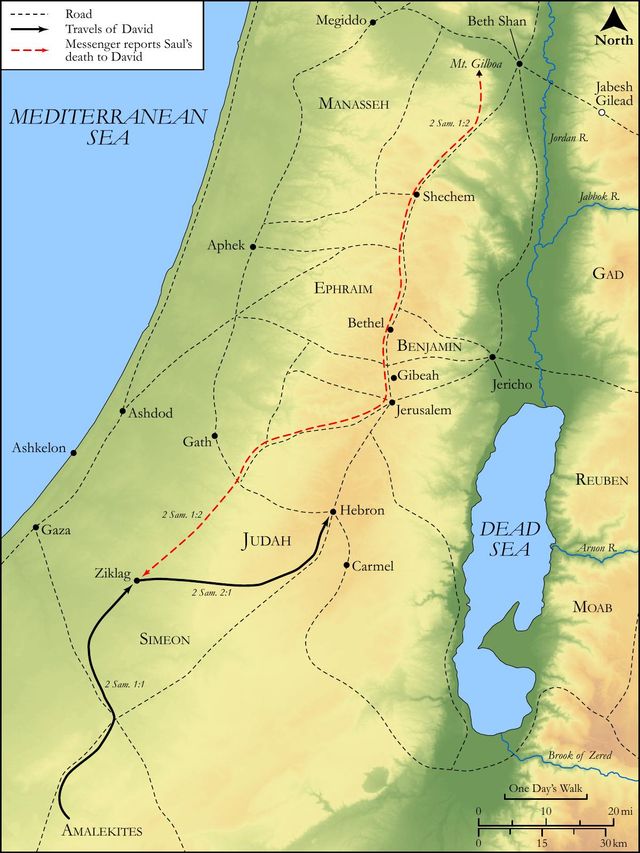
The backdrop for this lament is the catastrophic Battle of Mount Gilboa, a decisive engagement between Israel and the Philistines that resulted in a crushing defeat for Israel and the tragic deaths of King Saul and his three sons, including Jonathan. This period represented a time of acute vulnerability for the nascent Israelite monarchy, with the Philistines posing a relentless and existential threat. In Israel and among the nations round about, the practice of public lamentation for fallen leaders and esteemed warriors was a deeply ingrained and culturally significant custom. These laments often involved professional mourners and prescribed rituals designed to express collective grief, honor the deceased, and acknowledge national loss. However, David's spontaneous and deeply heartfelt lament, as captured in this verse, transcends mere custom, reflecting a genuine, personal sorrow that resonated profoundly with the national tragedy, underscoring the severity of Israel's loss. The phrase "high places" specifically refers to the elevated terrain of Mount Gilboa, the very site of the battle, emphasizing the public, visible, and ignominious nature of their fall.
Key Themes
ShowHideThis verse powerfully contributes to several overarching and enduring themes woven throughout the books of Samuel. Firstly, it emphatically underscores the theme of profound grief and lamentation, illustrating that even mighty leaders are not immune to sorrow and that expressing lament is a biblically validated and necessary response to tragedy. David's repeated, anguished exclamation, "How are the mighty fallen!" (2 Samuel 1:19, 2 Samuel 1:27), vividly highlights the shock, disbelief, and devastation at the sudden loss of Israel's strength and leadership. Secondly, it powerfully emphasizes the transience of earthly power and the fragility of human life, as even the anointed king and his valiant son tragically succumb to the fortunes of war. This serves as a stark, sobering reminder that all human glory, strength, and achievements are ultimately fleeting, subject to the vicissitudes of life and the sovereign will of God. Finally, and perhaps most poignantly, the specific and tender mention of Jonathan highlights the theme of extraordinary friendship and covenant loyalty. David's unique bond with Jonathan, forged in a covenant of deep affection and mutual commitment (1 Samuel 20:17), is portrayed as surpassing even the love of women (2 Samuel 1:26), emphasizing the unparalleled depth, purity, and enduring nature of their remarkable relationship.
Exposition and Analysis
ShowHideKey Word Analysis
ShowHideThis term denotes powerful individuals, warriors, heroes, or champions. It signifies those of great strength, courage, and exceptional skill in battle. In this context, it specifically refers to King Saul and Prince Jonathan, who were renowned figures in Israel's military and leadership. Their "fall" is thus not merely a physical death, but the catastrophic collapse of Israel's primary protectors and leaders, signifying a profound national and spiritual loss.
A primitive root meaning "to fall, lie down, fail." Here, it conveys a sense of sudden, violent, and irreversible collapse or overthrow. It is not a mere stumble but a complete and devastating defeat, emphasizing the shock, finality, and utter devastation of their demise. The repetition of this verb throughout David's lament amplifies the overwhelming sense of tragedy and loss.
Meaning an elevation or height. This word carries a dual significance. Literally, it refers to elevated ground or hills, specifically Mount Gilboa where the battle took place. Metaphorically, it signifies a position of prominence, honor, or power. Jonathan, as a prince and a leading warrior, occupied a "high place" in Israelite society and military command. His death "in thine high places" thus emphasizes both the literal battlefield where he fell and the tragic downfall from his esteemed and honorable position.
Verse Breakdown
ShowHide"How are the mighty fallen in the midst of the battle!"
This opening exclamation is a powerful rhetorical question that conveys profound shock, overwhelming sorrow, and utter disbelief. The "mighty" refers collectively to King Saul and Prince Jonathan, and by extension, other valiant Israelite warriors who perished. The phrase vividly captures the unexpected and devastating nature of their defeat, highlighting the inherent vulnerability of even the most powerful in the face of war. It immediately establishes a tone of deep lamentation for the national catastrophe.
"O Jonathan, [thou wast] slain in thine high places."
This clause marks a poignant shift from a general lament for the fallen to a deeply personal and specific cry for Jonathan. The direct address ("O Jonathan") powerfully underscores David's unique and intense grief for his beloved friend, distinguishing it from the broader national mourning. The phrase "slain in thine high places" reiterates the tragic irony of a valiant prince, a man of high standing and valor, meeting his end on the very ground where he was expected to triumph, or from the very position of honor he held. It emphasizes the profound personal cost of the battle for David, who mourns Jonathan more acutely and tenderly than even the king.
Literary Devices
ShowHideThe verse employs several powerful literary devices to convey its profound sorrow and emotional depth. The opening phrase, "How are the mighty fallen!", is a classic example of a rhetorical question, not intended to elicit an answer but to express overwhelming dismay, grief, and disbelief. It functions as a lamentation formula, a traditional poetic device used to mourn great loss, which is strategically repeated throughout the broader "Song of the Bow" (2 Samuel 1:19, 2 Samuel 1:27). The direct address to Jonathan ("O Jonathan") is a poignant instance of apostrophe, allowing David to speak directly to his deceased friend, thereby intensifying the personal and emotional impact of the lament and drawing the listener into David's private grief. The phrase "slain in thine high places" carries a powerful irony and deep pathos, as Jonathan, a man of high standing, valor, and hope, met his end in a place of expected strength and glory. This juxtaposition of high status with a tragic, ignominious fall amplifies the tragedy, highlighting the unexpected and devastating nature of his demise.
Theological and Thematic Connections
ShowHideThe lament of 2 Samuel 1:25 resonates with deep theological truths concerning human frailty, the transience of earthly power, and the profound nature of grief. It serves as a stark, sobering reminder that even those who are "mighty" in human terms—possessing strength, position, or influence—are ultimately subject to the sovereign will of God and the harsh realities of a fallen world. The tragic fall of Saul and Jonathan underscores the perennial biblical theme that ultimate reliance on human strength, military prowess, or political position is inherently futile and fleeting. God alone is the true, immutable source of enduring strength, security, and ultimate victory, and all human glory is but a transient vapor. David's profound grief, particularly for Jonathan, also highlights the divine design for deep, loyal, and covenantal relationships, even in the face of adversity and political turmoil. The lament validates the universal human experience of sorrow, reminding us that lament is a righteous, biblically affirmed, and necessary response to loss, allowing for the honest expression of pain while simultaneously trusting in God's ultimate, redemptive plan.
Reflection and Application
ShowHideDavid's lament for Saul and Jonathan, particularly the poignant cry of 2 Samuel 1:25, offers profound insights for contemporary reflection and application, challenging our perspectives on grief, power, and relationships. It teaches us the vital importance of acknowledging and processing grief with honesty and vulnerability, even for those with whom we have complex or adversarial relationships. David, despite Saul's relentless attempts on his life, genuinely mourned the king's death, demonstrating a remarkable capacity for compassion and respect that transcends personal grievances and political rivalry. This challenges believers today to cultivate empathy and to lament losses, both personal and communal, with integrity and vulnerability, recognizing the shared humanity in suffering. Furthermore, the "fall of the mighty" serves as a powerful, timeless reminder of the transient and ultimately ephemeral nature of all earthly power, prestige, and even life itself. It calls us to place our ultimate hope, trust, and security not in human strength, worldly achievements, or fleeting accolades, but in the enduring faithfulness and sovereign power of God alone. Finally, David's specific and tender mourning for Jonathan underscores the immeasurable value and divine design of deep, covenantal friendships. In a world often characterized by superficial connections and transactional relationships, this verse encourages us to intentionally invest in loyal, supportive, and self-sacrificial friendships that can sustain us through life's inevitable tragedies, transitions, and triumphs, remembering that true, God-honoring bonds endure beyond temporal circumstances.
Questions for Reflection
ShowHideFAQ
ShowHideWhat is "The Song of the Bow" and why is it significant?
ShowHide"The Song of the Bow" is the title David gives to his lament for Saul and Jonathan, as recorded in 2 Samuel 1:18. It is a profound poetic elegy composed by David upon receiving the devastating news of their deaths at the Battle of Mount Gilboa. Its significance is multifaceted: it powerfully demonstrates David's character as a man of profound loyalty, compassion, and spiritual integrity, even towards his adversary, King Saul; it serves as a public and deeply moving declaration of mourning for the fallen leaders, acknowledging the immense national tragedy; and it marks a pivotal moment in Israel's history, gracefully bridging the tumultuous end of Saul's reign and the providential beginning of David's. The name "Song of the Bow" might refer to Jonathan's renowned skill with the bow, or it could be a reference to the military training David commanded for the people of Judah, perhaps using this song as a teaching tool to inspire courage and lament.
Why did David mourn Saul, considering Saul had tried to kill him multiple times?
ShowHideDavid's profound mourning for Saul, so eloquently expressed in this lament, highlights his remarkable character, his deep respect for God's anointing, and his adherence to divine principles. Despite Saul's relentless pursuit and numerous attempts to kill him, David consistently refused to lay a hand on "the Lord's anointed" (1 Samuel 24:6, 1 Samuel 26:9). His lament reflects genuine sorrow for the king of Israel, recognizing Saul's divinely appointed office and the tragic, ignominious end of his reign. It also underscores David's deep reverence for God's chosen leader, even when that leader was deeply flawed and acted unjustly. Furthermore, the national loss of a king, regardless of personal grievances, was a cause for widespread national mourning, which David, as the incoming king and a man after God's own heart, appropriately led with sincerity and dignity.
Christ-Centered Fulfillment
ShowHideThe lament of 2 Samuel 1:25, with its heart-wrenching cry, "How are the mighty fallen!", finds its ultimate and most profound fulfillment in the person and redemptive work of Jesus Christ. While David mourned the tragic fall of earthly kings and valiant warriors, Christ represents the true "Mighty One" who willingly "fell"—not in defeat or by force, but in ultimate, self-sacrificial love—on the cross. His death was the deepest "fall" imaginable for the eternal Son of God, yet it was a strategic, divinely orchestrated, and redemptive act designed to conquer sin, death, and the power of the devil (Hebrews 2:14-15). Unlike Saul and Jonathan, whose fall was final in human terms, Christ's "fall" led to a glorious and triumphant resurrection, demonstrating His absolute victory over the grave and His ultimate sovereignty (1 Corinthians 15:54-57). Furthermore, David's unparalleled love for Jonathan, described as "passing the love of women," beautifully foreshadows the boundless, self-sacrificial, and covenantal love of Christ for His church, a love so profound that He calls His disciples "friends" (John 15:13-15). In Christ, we find the ultimate High Priest who deeply sympathizes with our weaknesses, sorrows, and losses, having Himself experienced the depths of human grief and suffering (Hebrews 4:15). Thus, while 2 Samuel 1:25 laments an earthly tragedy, it implicitly points to the divine King whose voluntary "fall" brought eternal life, ultimate hope, and everlasting victory to all who believe.