


1 Samuel 20:17
- וַיּוֹסֶףvai·Yo·sefand he repeatedH3254Conj-w ¦ V-Hiphil-ConsecImperf-3msVerb Hiphil Consecutive Imperfect 3rd Singular Masculineוַandיּוֹסֶףhe repeated
- יְהוֹנָתָןye·ho·na·TanJonathanH3083N-proper-mNoun Proper Masculine
- לְהַשְׁבִּיעַle·hash·Bi·a'to make swear an oathH7650Prep-l ¦ V-Hiphil-InfVerb Hiphil Infinitive Constructלְtoהַשְׁבִּיעַmake swear an oath
- אֶת'et<obj.>H853DirObjMParticle Object Indicator
- דָּוִדda·VidDavidH1732N-proper-mNoun Proper Masculine
- בְּאַהֲבָתוֹbe·'a·ha·va·Toin his loveH160Prep-b ¦ N-fsc ¦ 3msNoun Singular Feminine Constructבְּinאַהֲבָתloveוֹhis
- אֹתוֹ'o·To<obj.> himH853DirObjM ¦ 3msParticle Object Indicatorאֹת<obj.>וֹhim
- כִּיkiforH3588PrtParticle Conditional
- אַהֲבַת'a·ha·Vat[the] love ofH160N-fscNoun Singular Feminine Construct
- נַפְשׁוֹnaf·Shohis own selfH5315N-fsc ¦ 3msNoun Singular Feminine Constructנַפְשׁown selfוֹhis
- אֲהֵבוֹ'a·he·Vohe loved himH157V-Qal-Perf-3ms ¦ 3msVerb Qal Perfect 3rd Singular Masculineאֲהֵבhe lovedוֹhim
English is a literal word-by-word gloss of the Hebrew, not the KJV's wording. Why?
This is the original text the KJV's translators worked from — each Hebrew word with its own literal English meaning in this verse, prepared by scholars at Tyndale House, Cambridge. The KJV translates whole sentences, not word by word, so its wording differs: one Hebrew word can become several English words, and the KJV may choose “the LORD” where the gloss reads “Yahweh”. Both are faithful — they answer different questions. For the KJV's own rendering, switch to the KJV text.
Details
See on the biblical-era map
Study this verse
Public-domain commentary
Matthew Henry
From his Commentary on the Whole Bible. Henry comments on passages, not single verses — this entry covers 1 Samuel 20:9–23. His two-level outline is real structure in the source text, so it is rendered as structure.
Here, I. Jonathan protests his fidelity to David in his distress. Notwithstanding the strong confidence David had in Jonathan, yet, because he might have some reason to fear that his father's influence, and his own interest, should make him warp, or grow cool towards him, Jonathan thought it requisite solemnly to renew the professions of his friendship to him (Sa1 20:9): "Far be it from thee to think that I suspect thee of any crime for which I should either slay thee myself or deliver thee to my father; no, if thou hast any jealousy of that, Come let us go into the field (Sa1 20:11), and talk it over more fully." He did not challenge him to the field to fight him for an affront, but to fix him in his friendship. He faithfully promised him that he would let him know how, upon trial, he found his father affected towards him, and would make the matter neither better nor worse than it was. "If there be good towards thee, I will show it thee, that thou mayest be easy (Sa1 20:12), if evil, I will send thee away, that thou mayest be safe" (Sa1 20:13); and thus he would help to deliver him from the evil if it were real and from the fear of evil if it were but imaginary. For the confirmation of his promise he appeals to God, 1. As a witness (Sa1 20:12): "O Lord God of Israel, thou knowest I mean sincerely, and think as I speak." The strength of his passion made the manner of his speaking concise and abrupt. 2. As a judge: "The Lord do so and much more to Jonathan (Sa1 20:13), if I speak deceitfully, or break my word with my friend." He expressed himself thus solemnly that David might be abundantly assured of his sincerity. And thus God has confirmed his promises to us, that we might have strong consolation, Heb 6:17, Heb 6:18. Jonathan adds to his protestations his hearty prayers: "The Lord be with thee, to protect and prosper thee, as he has been formerly with my father, though now he has withdrawn." Thus he imitates his belief that David would be in his father's place, and his good wishes that he might prosper in it better than his father now did.
II.He provides for the entail of the covenant of friendship with David upon his posterity, Sa1 20:14-16.
He engages David to be a friend to his family when he was gone (Sa1 20:15): Thou shalt promise that thou wilt not cut off thy kindness from my house for ever. This he spoke from a natural affection he had to his children, whom he desired it might go well with after his decease, and for whose future welfare he desired to improve his present interest. It also intimates his firm belief of David's advancement, and that it would be in the power of his hand to do a kindness or unkindness to his seed; for, in process of time, the Lord would cut off his enemies, Saul himself was not expected; then "Do not thou cut off thy kindness from my house, nor revenge my father's wrongs upon my children." The house of David must likewise be bound to the house of Jonathan from generation to generation; he made a covenant (Sa1 20:16) with the house of David. Note, True friends cannot but covet to transmit to theirs after them their mutual affections. Thy own friend, and thy father's friend, forsake not. This kindness,
1.He calls the kindness of the Lord, because it is such kindness as God shows to those he takes into covenant with himself; for he is a God to them and to their seed; they are beloved for the fathers' sakes.
2.He secures it by an imprecation (Sa1 20:16): The Lord require it at the hand of David's seed (for of David himself he had no suspicion) if they prove so far David's enemies as to deal wrongfully with the posterity of Jonathan, David's friend. He feared lest David, or some of his, should hereafter be tempted, for the clearing and confirming of their title to the throne, to do by his seed as Abimelech had done by the sons of Gideon (Jdg 9:5), and this he would effectually prevent; but the reason given (Sa1 20:17) why Jonathan was so earnest to have the friendship entailed is purely generous, and has nothing of self in it; it was because he loved him as he loved his own soul, and therefore desired that he and his might be beloved by him. David, though now in disgrace at court and in distress, was as amiable in the eyes of Jonathan as ever he had been, and he loved him never the less for his father's hating him, so pure were the principles on which his friendship was built. Having himself sworn to David, he caused David to swear to him, and (as we read it) to swear again, which David consented to (for he that bears an honest mind does not startle at assurances), to swear by his love to him, which he looked upon as a sacred thing. Jonathan's heart was so much upon it that, when they parted this time, he concluded with a solemn appeal to God: The Lord be between me and thee for ever (Sa1 20:23), that is, "God himself be judge between us and our families for ever, if on either side this league of friendship be violated." It was in remembrance of this covenant that David was kind to Mephibosheth, Sa2 9:7; Sa2 21:7. It will be a kindness to ourselves and ours to secure an interest in those whom God favours and to make his friends ours.
III.He settles the method of intelligence, and by what signs and tokens he would give him notice how his father stood affected towards him.
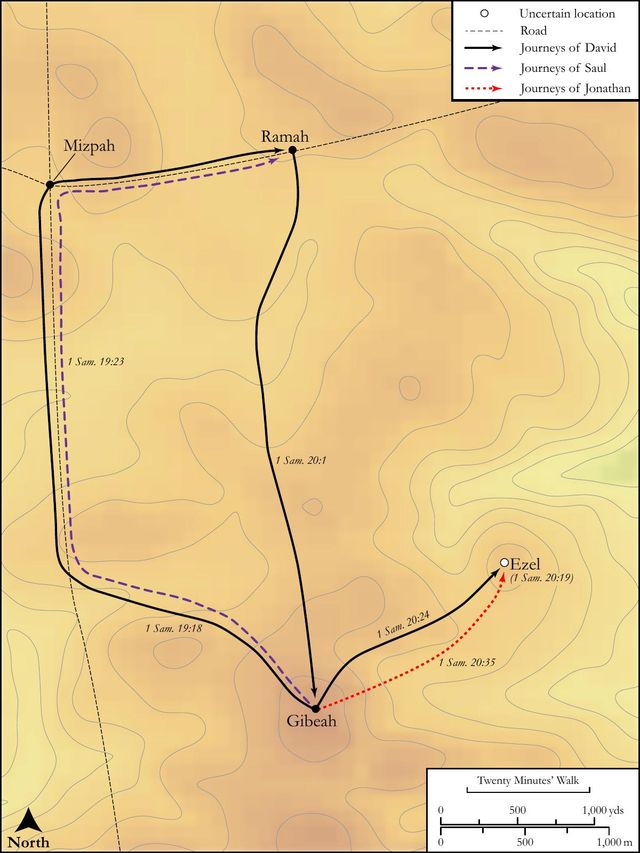
David would be missed the first day, or at least the second day, of the new moon, and would be enquired after, Sa1 20:18. On the third day, by which time he would have returned from Bethlehem, he must be at such a place (Sa1 20:19), and Jonathan would come towards that place with his bow and arrows to shoot for diversion (Sa1 20:20), would send his lad to fetch his arrows, and, if they were shot short of the lad, David must take it for a signal of safety, and not be afraid to show his head (Sa1 20:21); but, if he shot beyond the lad, it was a signal of danger, and he must shift for his safety, Sa1 20:22. This expedient he fixed lest he should not have the opportunity, which yet it proved he had, of talking with David, and making the report by word of mouth.
Continue studying 1 Samuel 20:17 across the web’s major study libraries — every link below opens this exact verse, chapter, or book on the destination site.
Read & Compare
 BibleGatewayThis verse in more than 200 translations and 70 languages.
 Bible.comThe YouVersion reader — hundreds of translations, reading plans, and highlights.
 ESV.orgCrossway's official English Standard Version reader.
 NET BibleThe NET translation with 60,000+ translators' notes on every rendering decision.
 STEP BibleTyndale House's free study tool — original text, vocabulary, and scholarly resources.
 BibliaLogos Bible Software's free web reader.
 USCCBThe New American Bible (Revised Edition) with the U.S. bishops' study notes.
Commentaries
 BibleHub CommentariesDozens of classic commentaries on this verse, gathered on one page.
 StudyLightMore than 100 commentary sets — the largest collection on the web.
 BibleRefPlain-English commentary on what this verse means, verse by verse.
 Enduring WordDavid Guzik's free commentary on this chapter, widely used by Bible teachers.
 Bible Study ToolsVerse commentary alongside Greek and Hebrew study aids.
Original Language & Research
- BibleHub InterlinearThe verse word by word — original language, transliteration, and English.
- BibleHub LexiconEvery word's original-language definition and Strong's entry.
 Blue Letter BibleDeep-study tools — Strong's numbers, concordance, and word studies.
 SefariaThe Hebrew text with Rashi and centuries of Jewish commentary.
Sermons, Hymns & Audio


TrulyRandomVerse is not affiliated with these sites and doesn’t control their content. They’re linked because they’re genuinely useful.
Summary
1 Samuel 20:17 powerfully encapsulates the extraordinary depth of the covenantal love and unwavering devotion between Jonathan, King Saul's son, and David. This verse reaffirms a sacred oath, highlighting Jonathan's remarkable selflessness and profound affection, which transcended political ambition and familial loyalty, establishing a profound benchmark for true friendship in the face of immense personal and national upheaval.
Context
ShowHideLiterary Context
This verse is strategically placed at a pivotal moment within the unfolding narrative of 1 Samuel, immediately following Jonathan's intricate plan to ascertain King Saul's true intentions regarding David. Jonathan has just engaged David in a solemn covenant, appealing to God as a witness and extracting a promise that David would show kindness to his descendants should he ascend to the throne (1 Samuel 20:12-16). The phrase "caused David to swear again" in verse 17 directly references this renewed covenant, solidifying the profound commitment initially established in 1 Samuel 18:3. The broader literary context of 1 Samuel meticulously details Saul's escalating paranoia, jealousy, and murderous intent towards David, whom God had divinely chosen to succeed him. Jonathan's actions here are far more than mere acts of friendship; they represent a deliberate, dangerous intervention to protect David, demonstrating a loyalty that directly opposes his own father's will and his dynastic aspirations, setting the stage for David's eventual rise.
Historical & Cultural Context
In the ancient Near East, covenants were not merely agreements but sacred, binding contracts, often sealed with elaborate oaths and sacrifices, invoking divine witness, and carrying severe consequences for any breach. These could be personal, familial, or national. The idiom "loving one's own soul" (or "life") was a potent expression signifying the highest possible degree of affection, identification, and self-preservation, implying that the well-being of the beloved was as vital and integral as one's own existence. Furthermore, the succession to the throne was almost universally hereditary, making Jonathan's implicit willingness to relinquish his claim for David's sake—a willingness acknowledged and formalized in their covenant—an act of extraordinary self-abnegation and a profound departure from expected royal behavior. This period also marks Israel's transition from a tribal confederacy to an established monarchy, with the tension between divinely appointed leadership and human dynastic ambition serving as a central theme, exemplified by Saul's rejection and David's anointing.
Key Themes
ShowHideThe paramount theme in 1 Samuel 20:17 is unconditional love and covenant loyalty. Jonathan's affection for David is portrayed as the epitome of selfless friendship, transcending personal gain, political expediency, and even familial duty. This profound bond is not merely emotional but is formalized through sacred oaths, underscoring the binding and enduring nature of their commitment. Another significant theme is divine sovereignty versus human ambition. Jonathan, as the rightful heir, willingly aligns himself with God's chosen king, David, rather than clinging to his father's failing reign or his own dynastic prospects. This act powerfully foreshadows David's eventual ascent to the throne and highlights the divine hand in Israel's leadership succession. The verse also subtly introduces the theme of sacrificial devotion, as Jonathan's unwavering love for David ultimately costs him his own potential kingship and, tragically, his life alongside his father. Yet, his legacy endures through David's steadfast faithfulness to their covenant, vividly demonstrated in 2 Samuel 9.
Exposition and Analysis
ShowHideKey Word Analysis
ShowHideThe verb ʼâhab (H157) signifies a deep, abiding, and active affection, transcending mere emotion to imply commitment, loyalty, and a profound desire for the well-being of the beloved. The noun ʼahăbâh (H160) reinforces this concept, denoting the affection itself. In the context of Jonathan and David, this term describes a profound bond that moves beyond superficial friendship into a covenantal relationship, characterized by mutual care and unwavering support, even in the face of extreme adversity and immense personal cost. It is a love that seeks the good of the other above one's own.
In Hebrew thought, nephesh refers to the whole person, the very essence of one's being, encompassing life, vitality, and personality. To love someone "as one's own soul" is the highest possible expression of identification and affection, indicating that Jonathan's concern for David's life, well-being, and destiny was as intense and vital as his concern for his own. It suggests an inseparable bond where the welfare of one is intrinsically linked to the welfare of the other, illustrating a complete empathetic connection.
Verse Breakdown
ShowHide"And Jonathan caused David to swear again,"
This clause highlights the solemn reaffirmation and reinforcement of the covenant between Jonathan and David. The initial covenant was forged in 1 Samuel 18:3, characterized by Jonathan bestowing his royal robe, armor, sword, bow, and belt upon David, symbolizing a transfer of status and a deep personal bond. The act of making David "swear again" (or "take an oath again") underscores the gravity and enduring nature of their commitment, particularly in light of King Saul's escalating hostility and murderous intentions. It signifies a deliberate, formal, and unbreakable pledge of loyalty before God, solidifying their alliance in a time of great peril.
"because he loved him:"
This phrase provides the fundamental and overarching motivation for Jonathan's extraordinary actions. His love for David was not a fleeting sentiment but the profound, driving force behind his protective measures, his willingness to risk his own life, and his forfeiture of a potential royal future. This love is presented as the primary reason for the renewed oath, emphasizing the deep personal, emotional, and spiritual depth of their relationship, demonstrating a love that is selfless and sacrificial.
"for he loved him as he loved his own soul."
This final clause serves as a powerful intensifier, explaining the unparalleled nature of Jonathan's love. It is a superlative expression, indicating that Jonathan's affection for David was as profound, essential, and self-preserving as his love for his own life and very being. This level of love implies complete identification, unwavering devotion, and a prioritization of David's well-being and future above his own dynastic claims or even his own safety. It is a love that transcends typical human relationships, reaching a level of self-sacrificial devotion that borders on the divine in its purity and intensity.
Literary Devices
ShowHideThe verse masterfully employs several potent literary devices to convey the extraordinary depth of Jonathan's love for David. Repetition of the verb "loved" (derived from the Hebrew root ʼahab) three times within this concise verse ("because he loved him: for he loved him as he loved his own soul") serves to powerfully emphasize and underscore the central theme of Jonathan's profound affection. This deliberate repetition creates a rhythmic intensity, impressing upon the reader the singular and overwhelming importance of this emotion as the core motivation for Jonathan's actions. Furthermore, the climactic phrase "as he loved his own soul" functions as a striking simile and a form of hyperbole. It compares Jonathan's love for David to the ultimate human instinct of self-preservation, thereby elevating their bond to an extraordinary, almost unparalleled level of intimacy and identification. This hyperbolic language effectively communicates a love that is selfless, all-encompassing, and deeply identifying, making David's well-being as crucially important as Jonathan's own.
Theological and Thematic Connections
ShowHideThe profound love and covenant between Jonathan and David in 1 Samuel 20:17 serve as a powerful biblical illustration of selfless devotion and unwavering loyalty, echoing deeper theological truths concerning covenant faithfulness. This extraordinary bond, sealed by solemn oath, transcends human ambition, political expediency, and even familial ties, reflecting a divine principle of commitment and fidelity. Jonathan's willingness to relinquish his rightful claim to the throne for David, God's anointed, foreshadows the ultimate submission to God's sovereign plan and the prioritization of His chosen one. Their friendship stands as a testament to the kind of agape love that prioritizes the welfare of the other, even at great personal cost, a concept foundational to biblical ethics and ultimately fulfilled in the person and work of Jesus Christ.
Reflection and Application
ShowHideThe friendship between Jonathan and David, as profoundly encapsulated in 1 Samuel 20:17, offers a timeless and compelling model for authentic, selfless human relationships. In a world often characterized by self-interest, transactional connections, and conditional loyalties, Jonathan's love for David challenges us to cultivate friendships rooted in genuine care, unwavering loyalty, and sacrificial support. His remarkable willingness to prioritize David's well-being, even at the immense expense of his own dynastic future and personal safety, calls us to deeply consider the depth and nature of our own commitments to others. True friendship, as so powerfully exemplified here, involves mutual respect, steadfast encouragement, and a profound readiness to stand with one another through life's most arduous trials, even when it demands significant personal cost. It reminds us that the most profound and enduring bonds are those where we value the other's "soul" as much as our own, reflecting a divine principle of selfless devotion that consistently seeks the highest good of the beloved above all else.
Questions for Reflection
ShowHideFAQ
ShowHideWhy did Jonathan make David swear again, if they had already made a covenant?
ShowHideJonathan caused David to swear again in 1 Samuel 20:17 not because the initial covenant (recorded in 1 Samuel 18:3) was insufficient, but to solemnly reaffirm, deepen, and expand their commitment in the face of escalating and mortal danger. The immediate context of 1 Samuel 20 reveals Jonathan actively attempting to discern King Saul's murderous intentions towards David. The renewed oath, particularly the specific request that David show kindness to Jonathan's descendants (as detailed in 1 Samuel 20:14-16), highlights the extreme gravity of the situation and the enduring, intergenerational nature of their bond. It was a desperate, yet faith-filled, measure to secure David's promise of protection for Jonathan's family, knowing that David was destined for the throne and that his own life, and perhaps his lineage, might be at dire risk under a new king. This "again" signifies a reinforcement and broadening of their covenant, making it even more binding and comprehensive for future generations.
Christ-Centered Fulfillment
ShowHideThe profound, selfless love of Jonathan for David, culminating in a covenant that superseded his own royal claim and dynastic aspirations, serves as a powerful Old Testament shadow pointing to the ultimate Christ-centered fulfillment. Jonathan, the rightful heir to Israel's throne, voluntarily steps aside for David, God's chosen king, embodying a self-emptying love that finds its perfect and most glorious expression in Jesus Christ. Just as Jonathan loved David "as he loved his own soul," so Christ, though "in the form of God, did not count equality with God a thing to be grasped, but emptied himself, by taking the form of a servant, being born in the likeness of men" (Philippians 2:6-7). He laid down His life, not merely for a friend, but for His enemies, demonstrating God's own love for us "while we were still sinners" (Romans 5:8), thereby establishing a new covenant in His blood (Luke 22:20). Jonathan's covenant secured David's kindness for his descendants; Christ's new and eternal covenant secures eternal life, forgiveness of sins, and adoption into God's family for all who believe, demonstrating a love far surpassing even Jonathan's, for "greater love has no one than this, that someone lay down his life for his friends" (John 15:13). Jonathan's self-sacrifice for David's future kingship beautifully prefigures Christ's ultimate sacrifice, which secures not an earthly throne, but an eternal kingdom for His people, making us co-heirs with Him in His glory (Romans 8:17).