


Ezekiel 26:2
Bible text: King James Version (1769 Blayney text) · Public domain
Bible text: King James Version with Strong's numbers · Public domain
Bible text: Berean Standard Bible · Public domain
Bible text: American Standard Version (1901) · Public domain
Bible text: World English Bible, Messianic edition · Public domain
Bible text: Geneva Bible (1599) · Public domain
Bible text: Young's Literal Translation · Public domain
- בֶּןbenO son ofH1121N-mscNoun Singular Masculine Construct
- אָדָם'a·DamhumankindH120N-msNoun Singular Masculine Absolute
- יַעַןYa·'anbecauseH3282ConjConjunction
- אֲשֶׁר'a·SherthatH834RelParticle Relative
- אָמְרָה'A·me·rahit saidH559V-Qal-Perf-3fsVerb Qal Perfect 3rd Singular Feminine
- צֹּרtzorTyreH6865N-properNoun Proper Location
- עַל'alonH5921PrepPreposition
- יְרוּשָׁלִַםye·ru·sha·LimJerusalemH3389N-properNoun Proper Location
- הֶאָחhe·'Achaha!H1889PrtParticle Interjection
- נִשְׁבְּרָהnish·be·Rahit is brokenH7665V-Niphal-Perf-3fsVerb Niphal Perfect 3rd Singular Feminine
- דַּלְתוֹתdal·Tot[the] doors ofH1817N-fpcNoun Plural Feminine Construct
- הָעַמִּיםha·'a·Mimthe peoplesH5971Art ¦ N-mpNoun Plural Masculine Absoluteהָtheעַמִּיםpeoples
- נָסֵבָּהna·Se·bahit has been turned overH5437V-Niphal-Perf-3fsVerb Niphal Perfect 3rd Singular Feminine
- אֵלָי'e·Laito meH413Prep ¦ 1csPrepositionאֵלָtoיme
- אִמָּלְאָה'i·mal·'AhI will be filledH4390V-Niphal-Imperf-1csVerb Niphal Imperfect 1st Singular common gender
- הָחֳרָבָהho·cho·Ra·vahit has been laid wasteH2717V-Hophal-Perf-3fsVerb Hophal Perfect 3rd Singular Feminine
English is a literal word-by-word gloss of the Hebrew, not the KJV's wording. Why?
This is the original text the KJV's translators worked from — each Hebrew word with its own literal English meaning in this verse, prepared by scholars at Tyndale House, Cambridge. The KJV translates whole sentences, not word by word, so its wording differs: one Hebrew word can become several English words, and the KJV may choose “the LORD” where the gloss reads “Yahweh”. Both are faithful — they answer different questions. For the KJV's own rendering, switch to the KJV text.
Details
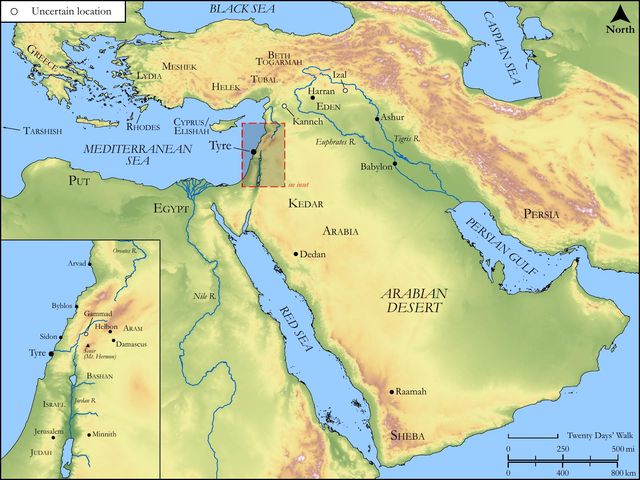
See on the biblical-era map
Study this verse
Public-domain commentary
Matthew Henry
From his Commentary on the Whole Bible. Henry comments on passages, not single verses — this entry covers Ezekiel 26:1–14. His three-level outline is real structure in the source text, so it is rendered as structure.
This prophecy is dated in the eleventh year, which was the year that Jerusalem was taken, and in the first day of the month, but it is not said what month, some think the month in which Jerusalem was taken, which was the fourth month, others the month after; or perhaps it was the first month, and so it was the first day of the year. Observe here,
I.The pleasure with which the Tyrians looked upon the ruins of Jerusalem.
Ezekiel was a great way off, in Babylon, but God told him what Tyrus said against Jerusalem (Eze 26:2): "Aha! she is broken, broken to pieces, that was the gates of the people, to whom there was a great resort and where there was a general rendezvous of all nations, some upon one account and some upon another, and I shall get by it; all the wealth, power, and interest, which Jerusalem had, it is hoped, shall be turned to Tyre, and so now that she is laid waste I shall be replenished." We do not find that the Tyrians had such a hatred and enmity to Jerusalem and the sanctuary as the Ammonites and Edomites had, or were so spiteful and mischievous to the Jews. They were men of business, and of large acquaintance and free conversation, and therefore were not so bigoted, and of such a persecuting spirit, as the narrow souls that lived retired and knew not the world. All their care was to get estates, and enlarge their trade, and they looked upon Jerusalem not as an enemy, but as a rival. Hiram, king of Tyre, was a good friend to David and Solomon, and we do not read of any quarrels the Jews had with the Tyrians; but Tyre promised herself that the fall of Jerusalem would be an advantage to her in respect of trade a commerce, that now she shall have Jerusalem's customers, and the great men from all parts that used to come to Jerusalem for the accomplishing of themselves, and to spend their estates there, will now come to Tyre and spend them there; and whereas many, since the Chaldean army became so formidable in those parts, had retired into Jerusalem, and brought their estates thither for safety, as the Rechabites did, now they will come to Tyre, which, being in a manner surrounded with the sea, will be thought a place of greater strength than Jerusalem, and thus the prosperity of Tyre will rise out of the ruins of Jerusalem. Note, To be secretly pleased with the death or decay of others, when we are likely to get by it, with their fall when we may thrive upon it, is a sin that does most easily beset us, but is not thought to be such a bad thing, and so provoking to God, as really it is. We are apt to say, when those who stand in our light, in our way, are removed, when they break of fall into disgrace, "We shall be replenished now that they are laid waste." But this comes from a selfish covetous principle, and a desire to be placed alone in the midst of the earth, as if we grudged that any should live by us. This comes from a want of that love to our neighbour as to ourselves which the law of God so expressly requires, and from that inordinate love of the world as our happiness which the love of God so expressly forbids. And it is just with God to blast the designs and projects of those who thus contrive to raise themselves upon the ruins of others; and we see they are often disappointed.
II.The displeasure of God against them for it.
The providence of God had done well for Tyrus. Tyrus was a pleasant and wealthy city, and might have continued so if she had, as she ought to have done, sympathized with Jerusalem in her calamities and sent her an address of condolence; but when, instead of that, she showed herself pleased with her neighbour's fall, and perhaps sent an address of congratulation to the conquerors, then God says, Behold, I am against thee, O Tyrus! Eze 26:3. And let her not expect to prosper long if God be against her.
1.God will bring formidable enemies upon her: Many nations shall come against thee, an army made up of many nations, or one nation that shall be as strong as many. Those that have God against them may expect all the creatures against them; for what peace can those have with whom God is at war? They shall come pouring in as the waves of the sea, one upon the neck of another, with an irresistible force. The person is named that shall bring this army upon them - Nebuchadnezzar king of Babylon, a king of kings, that had many kings tributaries to him and dependents on him, besides those that were his captives, Song 2:37, 38. He is that head of gold. He shall come with a vast army, horses and chariots, etc., all land-forces. We do not find that he had any naval force, or any thing wherewith he might attack it by sea, which made the attempt the more difficult, as we find Eze 29:18, where it is called a great service which he served against Tyrus. He shall besiege it in form (Eze 26:8), make a fort, and cast a mount, and (Eze 26:9) shall set engines of war against the walls. His troops shall be so numerous as to raise a dust that shall cover the city, Eze 26:10. They shall make a noise that shall even shake the walls; and they shall shout at every attack, as soldiers do when they enter a city that is broken up; the horses shall prance with so much fury and violence that they shall even tread down the streets though so ever well paved.
2.They shall do terrible execution.
(1.)The enemy shall make themselves masters of all their fortifications, shall destroy the walls and break down the towers, Eze 26:4. For what walls are so strongly built as to be a fence against the judgments of God? Her strong garrisons shall go down to the ground, Eze 26:11. And the walls shall be broken down, Eze 26:12. The city held out a long siege, but it was taken at last.
(2.)A great deal of blood shall be shed: Her daughters who are in the field, the cities upon the continent, which were subject to Tyre as the mother-city, the inhabitants of them shall be slain by the sword, Eze 26:6. The invaders begin with those that come first in their way. And (Eze 26:11) he shall slay thy people with the sword; not only the soldiers that are found in arms, but the burghers, shall be put to the sword, the king of Babylon being highly incensed against them for holding out so long.
(3.)The wealth of the city shall all become a spoil to the conqueror (Eze 26:12): They shall make a prey of the merchandise. It was in hope of the plunder that the city was set upon with so much vigour. See the vanity of riches, that they are kept for the owners to their hurt; they entice and recompense thieves, and not only cease to benefit those who took pains for them and were duly entitled to them, but are made to serve their enemies, who are thereby put into a capacity of doing them so much the more mischief.
(4.)The city itself shall be laid in ruins. All the pleasant houses shall be destroyed (Eze 26:12), such as were pleasantly situated, beautified, and furnished, shall become a heap of rubbish. Let none please themselves too much in their pleasant houses, for they know not how soon they may see the desolation of them. Tyre shall be utterly ruined; the enemy shall not only pull down the houses, but shall carry away the stones and the timber, and shall lay them in the midst of the water, not to be recovered, or ever made use of again. Nay (Eze 26:4), I will scrape her dust from her; not only shall the loose dust be blown away, but the very ground it stands upon shall be torn up by the enraged enemy, carried off, and laid in the midst of the water, Eze 26:12. The foundation is in the dust; that dust shall be all taken away, and then the city must fall of course. When Jerusalem was destroyed it was ploughed like a field, Mic 3:12. But the destruction of Tyre is carried further than that; the very soil of it shall be scraped away, and it shall be made like the top of a rock (Eze 26:4, Eze 26:14), pure rock that has no earth to cover it; it shall only be a place for the spreading of nets (Eze 26:5, Eze 26:14); it shall serve fishermen to dry their nets upon and mend them.
(5.)There shall be a full period to all its mirth and joy (Eze 26:13): I will cause the noise of thy songs to cease. Tyre had been a joyous city (Isa 23:7).; with her songs she had courted customers to deal with her in a way of trade. But now farewell all her profitable commerce and pleasant conversation; Tyre is no more a place either of business or of sport. Lastly, It shall be built no more (Eze 26:14), not built any more as it had been, with such state and magnificence, nor built any more in the same place, within the sea, nor built any where for a long time; the present inhabitants shall be destroyed or dispersed, so that this Tyre shall be no more. For God has spoken it (Eze 26:5, Eze 26:14); and when what he has said is accomplished they shall know thereby that he is the Lord, and not a man that he should lie nor the son of man that he should repent.
Historical interpretation
Historical reception
3 surviving comments on this verse. Each one is dated, so this reads as a timeline rather than a list.
(Chapter 26) And it came to pass in the eleventh year, in the first month, on the first day of the month, the word of the Lord came to me, saying: Son of man, because Tyre (or Sidon) has said of Jerusalem: Aha, the gate of the peoples is broken, it is turned to me, I shall be filled, it has become desolate; therefore thus says the Lord God: Behold, I am against you, Tyre (or Sidon), and I will bring many nations against you, as the sea brings up its waves. And they will break down the walls of Tyre, and destroy its towers, and I will sweep away its dust from it, and make it a shining rock. The drying up of the fishing nets will be in the midst of the sea, for I have spoken, says the Lord God, and it will be a plunder to the nations. Also, her daughters in the field will be killed by the sword, and they will know that I am the Lord. Accordingly, the order of prophecies is woven together. He spoke against the sons of Ammon and Moab and Seir, who are also Edomites, and against the Philistines who are on the coast, and who hold the same boundary on the shore of the sea. After the Philistines, the region of Phoenicia follows, whose metropolis is the city of Tyre, which is called Sor in Hebrew and Syriac. And because Jerusalem was captured, it also rejoiced and insulted, saying: The gates of the peoples are broken, I have the safest harbor, and when they are destroyed, all the multitude turns to me, which was ruled by its authority, and because it is deserted, therefore I will be filled, and whatever was full before will be turned into a wilderness. Therefore, because you have spoken these things and insulted the ruins of Jerusalem, which was destroyed by the judgement of God because of its sins, I will not come against you through messengers or through anyone else, but I myself will be against you, Tyre, and I will cause the Babylonians to rise up like the waves of the sea against you, along with many nations, with which the walls and towers of your city will be destroyed to the point where they will fall to the ground and its dust will be scraped off or blown in various directions, and it will be humiliated to the point where it will be compared to the shiniest rocks. And there will be such great desolation in the once most populous city that fishing nets will be spread out a For I, the Lord, have spoken, and my words cannot be made void, and I will deliver them to be plundered by the nations. Also her daughters, who are in the countryside or in the field, that is, on the coast of Phoenicia, cities and towns, villages and castles, will be killed by the sword: metaphorically, because he called them daughters, he puts the killing by the sword, so that they may know by the end of things that I am the Lord, who commanded these things to happen. According to the tropology, since the Hebrew word Sor is translated into distress, every soul that is occupied with disturbances can be called Sor, which, when she sees Jerusalem being overthrown by the judgment of God for her sins and vices, in which the temple and the vision of peace were, she exults and thinks that the once famous empire of the city is to be transferred to herself. And this is also accepted in conflicting doctrines and in worldly men, when they see a holy man fall through negligence and rejoice and exult, as if their own resurrection were the downfall of others. Therefore the Lord threatens that He Himself will fight against such men and cause many nations, like sea waves, to rise up against them, destroying in them everything that seems most fortified and strong, and thus overturning all their arguments, so that they are reduced to dust. He should also cause the nets and fishing equipment by which the multitude was previously deceived to cease, and to be spread out and dried in the deserted soil of the city, so that other fishermen may take their place, whom the Lord has sent to fish. Moreover, he should cause his daughters, who were previously kept as if in a bridal chamber and were not easily believed by anyone in mystical and more secret teachings, to go forth and be extended in public, and to be cut down with the sword of the Church, so that they may understand that He himself is the Lord, who both temporarily left Jerusalem on account of its sins and destroyed the defenses of Tyre on account of its insolence and joy.
(Verse 35, 36, and following) And I will bring you into a desert of peoples, and there I will judge you face to face. Just as I contended with your fathers in the desert of the land of Egypt, so I will judge you, says the Lord. And I will subject you to my scepter, and I will bring you into the bonds of the covenant, and I will choose from among you the transgressors and the wicked: from their place of residence I will bring them out, and they will not enter the land of Israel, and you will know that I am the Lord. Thus says the Lord: I will do for you who are in Babylon, and now serve idols, what I did for your ancestors in Egypt. I will lead you into the desert of the peoples, and there I will judge you face to face, just as I contended with them in judgment when they came out of Egypt. And after I have judged you, I will subject you to my scepter and rule, and I will make a covenant with you and bring you into your land with the bonds of love, so that bound by my love, you will never be able to depart from me. But I will choose from among you the transgressors and the wicked, who persist in the hardness of their hearts in evil deeds, not for possession, but for rejection. And I will indeed bring them out of the land of their dwelling, so that when they are brought out, they will not enter the land of Israel; but they will perish in various regions. And by the distinction between good and evil, you shall know that I am the Lord, who judges all things. The rest of the discourse hastens, and we briefly go through each point, in order to provide only the meaning to the readers.
(Verse 27, 29 onwards) Therefore speak to the house of Israel, son of man, and tell them: Thus says the Lord God: Moreover, your fathers have blasphemed against me and have treated me with contempt, even as they spurned me. And I brought them into the land that I had lifted my hand to give them ((Vulgate adds: that land)): they saw every high hill and every leafy tree, and there they offered their sacrifices and presented there the irritation of their offerings, and they placed there the fragrance of their sweetness, and they poured out their ((Vulgate is silent on this)) libations there. And I said to them, 'What is the high place to which you are going?' And its name was called the High Place until this day. Therefore speak to the house of Israel, son of man, and say to them, 'Thus says the Lord God: As for your fathers, they have provoked Me to anger by their iniquities, by the fact that they have fallen away from Me. So I brought them into the land that I had lifted My hand in an oath to give them.' They saw every high hill and every leafy tree, and there they offered their sacrifices. They also presented there the provocation of their gifts, and they set there their pleasing aroma, and they poured out there their drink offerings. And I said to them: What is abbana, because you enter there? And they called its name abbana until this day. I wanted, he said, to scatter them in the wilderness, and to give them not good precepts, so that they would sacrifice to idols what they should have offered to me, and consecrate all their first-fruits to them by fire, so that I might kill them and destroy them. But when he says, I wanted, he shows that he did not do what he wanted. And that which follows: 'And they shall know that I am the Lord,' is not found in the Septuagint. For it did not seem fitting to them to know after their destruction that he himself is the Lord. But you, son of man, speak again to them, that is, to the elders of the house of Israel, who have come to inquire of you: Your fathers, from whom you have descended, have also blasphemed against me and held me in contempt; after I brought them into the land which I had given them to possess, they turned against me to provoke me. For when they saw every high hill and leafy tree, they would sacrifice on the mountains and in the groves and thickets, and offer victims to the idols, and pour out libations. And when I saw this, I said to them: What is this, Bama? for it is called high: or why do you enter into such a place which you have chosen for yourselves in all the hills, so that even today these places are called Bamoth, and the ancient error retains its original name? Regarding Bama, which we translate as excelsum, there is an error in the Septuagint edition, where it is written as ἀββανὰ, which does not resonate in the Hebrew language. Bama can mean 'in which' if the two syllables are divided into two words, but in the present context, that sense does not fit. However, wherever it is written in the Books of Kings and Chronicles: 'The people still sacrificed and offered incense on the high places,' Bama in the singular and Bamoth in the plural mean 'high places.'
Continue studying Ezekiel 26:2 across the web’s major study libraries — every link below opens this exact verse, chapter, or book on the destination site.
Read & Compare
 BibleGatewayThis verse in more than 200 translations and 70 languages.
 Bible.comThe YouVersion reader — hundreds of translations, reading plans, and highlights.
 ESV.orgCrossway's official English Standard Version reader.
 NET BibleThe NET translation with 60,000+ translators' notes on every rendering decision.
 STEP BibleTyndale House's free study tool — original text, vocabulary, and scholarly resources.
 BibliaLogos Bible Software's free web reader.
 USCCBThe New American Bible (Revised Edition) with the U.S. bishops' study notes.
Commentaries
 BibleHub CommentariesDozens of classic commentaries on this verse, gathered on one page.
 StudyLightMore than 100 commentary sets — the largest collection on the web.
 BibleRefPlain-English commentary on what this verse means, verse by verse.
 Enduring WordDavid Guzik's free commentary on this chapter, widely used by Bible teachers.
 Bible Study ToolsVerse commentary alongside Greek and Hebrew study aids.
Original Language & Research
- BibleHub InterlinearThe verse word by word — original language, transliteration, and English.
- BibleHub LexiconEvery word's original-language definition and Strong's entry.
 Blue Letter BibleDeep-study tools — Strong's numbers, concordance, and word studies.
 SefariaThe Hebrew text with Rashi and centuries of Jewish commentary.
Sermons, Hymns & Audio


TrulyRandomVerse is not affiliated with these sites and doesn’t control their content. They’re linked because they’re genuinely useful.
Summary
Ezekiel 26:2 initiates a profound prophetic oracle against the ancient Phoenician city of Tyre, revealing the divine impetus for its impending judgment. The verse captures Tyre's malicious and opportunistic reaction to the recent, devastating destruction of Jerusalem, expressing perverse delight and anticipating significant commercial gain from the downfall of its former rival. This declaration of self-serving satisfaction, uttered in the wake of Jerusalem's desolation, provokes God's righteous indignation and sets the stage for a detailed prophecy of Tyre's own comprehensive and irreversible ruin.
Context
ShowHideLiterary Context
This verse marks the precise beginning of a major prophetic oracle against Tyre, a pronouncement that extends through Ezekiel 26 to Ezekiel 28. It immediately follows a series of divine judgments against Israel's more immediate neighbors—Ammon, Moab, Edom, and Philistia—detailed in Ezekiel 25. The strategic placement of this oracle underscores God's universal sovereignty, demonstrating that His authority extends over all nations, not solely over Israel. Furthermore, it highlights His particular attention to the attitudes and actions of those who interact with His covenant people. The extensive and specific nature of the Tyre prophecy, especially when compared to the briefer judgments against other nations, emphasizes its unique significance due to Tyre's immense pride, vast wealth, and its particularly egregious, self-serving response to Jerusalem's fall.
Historical & Cultural Context
The immediate historical backdrop for this prophecy is the catastrophic destruction of Jerusalem in 586 BC by Nebuchadnezzar's Babylonian forces. This event led to the exile of many Jews, including the prophet Ezekiel, and left Jerusalem, once a vibrant political and religious capital, in utter ruins with its Temple demolished. Tyre, a dominant and affluent Phoenician city-state situated on the Mediterranean coast, was globally renowned for its expansive maritime trade networks, highly skilled artisans, and its strategically advantageous location. Culturally, Tyre was a bustling epicenter of commerce, characterized by immense material prosperity, which often fostered a spirit of pride and self-sufficiency among its inhabitants. Historically, Tyre's relationship with Jerusalem had been complex, oscillating between periods of mutually beneficial alliance and trade (e.g., under Solomon) and periods of rivalry. Tyre's reaction, as captured in this verse, is deeply rooted in its commercial opportunism, as it cynically viewed Jerusalem's demise as the elimination of a major competitor and the opening of lucrative new avenues for its own economic enrichment.
Key Themes
ShowHideEzekiel 26:2 powerfully introduces several critical themes that resonate throughout the book of Ezekiel and the broader prophetic corpus. Firstly, it vividly portrays Schadenfreude and Malicious Joy, as Tyre's triumphant "Aha!" expresses a perverse delight in the suffering and devastation of others, particularly God's chosen city. This attitude, a celebration of misfortune, is consistently and vehemently condemned throughout Scripture. Secondly, the verse highlights Economic Opportunism and Covetousness, as Tyre explicitly articulates its intention to "be replenished" by usurping Jerusalem's former trade routes and influence. This reveals a motivation driven purely by insatiable material gain, a theme further elaborated in later chapters detailing Tyre's unparalleled commercial prowess and spiritual hubris, such as in the lament over Tyre's trade in Ezekiel 27. Finally, and most profoundly, the prophecy powerfully demonstrates Divine Sovereignty and Judgment over all nations. God meticulously observes and righteously responds to the moral failings and ungodly attitudes of empires, proving unequivocally that no nation, regardless of its power, wealth, or perceived invincibility, is beyond His jurisdiction or immune to His ultimate justice. The detailed and severe judgment against Tyre, particularly the indictment against its proud prince in Ezekiel 28:1-19, serves as a stark and enduring reminder of God's absolute control over human history and His unwavering commitment to justice.
Exposition and Analysis
ShowHideKey Word Analysis
ShowHideThis recurring prophetic title, literally "son of a human being" (H1121 bên meaning "son" or "human," and H120 ʼâdâm meaning "human being" or "mankind"), emphasizes Ezekiel's humble, mortal nature. Used over ninety times in Ezekiel, it serves to underscore that the profound and authoritative messages he delivers originate not from his own wisdom or power, but directly from God, highlighting the divine source of the prophecy through a human vessel.
This interjection (H1889 heʼâch), directly translated as "aha!" or "ah," signifies a strong expression of malicious triumph, mocking derision, or gloating satisfaction. Tyre's use of this word reveals a perverse delight in Jerusalem's downfall, demonstrating a profound lack of empathy and a celebratory attitude towards the misfortune of a rival, which is a significant basis for God's impending judgment.
The term deleth (H1817) refers to a "door" or "gate," specifically the valve of a door, while ʻam (H5971) denotes "a people" or "nation" as a congregated unit. This phrase collectively describes Jerusalem's former prominence as a vital hub, a "gateway" through which various "peoples" (nations, folk) passed for commerce, pilgrimage, and cultural exchange. Tyre's observation that this significant "gate" is "broken" highlights the city's utter desolation and their opportunistic perception of a commercial vacuum they intend to fill.
Verse Breakdown
ShowHide"Son of man, because that Tyrus hath said against Jerusalem,"
This opening clause immediately establishes the divine speaker (God, communicating through His prophet Ezekiel) and directly identifies the specific cause for the impending prophetic judgment: the precise words and attitudes expressed by the city of Tyre concerning Jerusalem. It underscores God's attentiveness to the utterances and intentions of nations, even those seemingly insignificant in human terms.
"Aha, she is broken [that was] the gates of the people:"
This is Tyre's direct, malicious exclamation. The interjection "Aha!" conveys their triumphant and mocking joy at Jerusalem's destruction. The descriptive phrase "gates of the people" refers to Jerusalem's former status as a significant international hub, a bustling center of commerce, trade, and pilgrimage, a place of access and influence for many. Tyre acknowledges Jerusalem's past glory only to gloat over its current "broken" or shattered state, reveling in its ruin.
"she is turned unto me:"
This clause reveals Tyre's self-serving and opportunistic interpretation of Jerusalem's fall. They presumptuously believe that with Jerusalem's collapse, its former trade routes, commercial influence, and the flow of people and goods would naturally divert towards Tyre, thereby directly benefiting their own economic empire. It signifies a perceived transfer of power and prosperity.
"I shall be replenished, [now] she is laid waste:"
This final clause encapsulates Tyre's ultimate motivation and eager expectation. They anticipate being "replenished" or filled with wealth, resources, and prosperity as a direct consequence of Jerusalem being "laid waste" or desolated. It starkly illustrates Tyre's covetous and self-centered perspective, celebrating another's profound ruin as the direct means to their own material gain and expansion.
Literary Devices
ShowHideEzekiel 26:2 employs several potent literary devices to convey its message with striking impact. The direct address "Son of man" is a clear example of Apostrophe, as God speaks directly to Ezekiel, emphasizing the divine origin and authoritative nature of the prophecy. Tyre's exclamation "Aha!" functions as a powerful Interjection, immediately and viscerally revealing its malicious, triumphant, and gloating attitude. The description of Jerusalem as "the gates of the people" is a sophisticated form of Metonymy, where a characteristic feature (its gates, symbolizing access, commerce, and influence) stands in for the entire city and its vital function as a regional hub. This phrase also subtly carries a degree of Personification, as Jerusalem is implicitly treated as an entity that can be "broken" and whose influence can "turn" to another. Furthermore, there is a profound element of Irony in Tyre's declaration; while they anticipate being "replenished" by Jerusalem's ruin, the subsequent prophecy details their own far more devastating and enduring destruction, making their perceived gain a tragic prelude to their own ultimate and complete loss.
Theological and Thematic Connections
ShowHideEzekiel 26:2 serves as a stark reminder of God's comprehensive justice and His profound intolerance for malicious joy (schadenfreude) and covetous opportunism. Tyre's "Aha!" is not merely a political or economic statement but a grave moral offense against the divine order. It reveals a heart that prioritizes material gain and self-enrichment above empathy, celebrating the suffering of others. This attitude stands in direct contradiction to the biblical call for compassion, solidarity, and righteous conduct, especially towards those who are afflicted or vulnerable. God, as the sovereign ruler of all nations, observes and judges not only overt actions but also the hidden attitudes and intentions of the heart. Tyre's short-sighted pursuit of economic advantage at Jerusalem's expense ultimately leads to its own cataclysmic downfall, powerfully demonstrating that prosperity gained through unrighteousness is fleeting, illusory, and inevitably subject to divine reckoning.
Reflection and Application
ShowHideEzekiel 26:2 calls us to a profound and searching self-examination regarding our attitudes towards the misfortunes, failures, or setbacks of others. In a world often driven by intense competition, self-interest, and the relentless pursuit of advantage, it is alarmingly easy to fall into the subtle trap of celebrating another's downfall if it seemingly benefits our own position or prospects. This verse serves as a powerful and timeless warning against schadenfreude, covetousness, and the pursuit of gain through unrighteous or unfeeling means. It challenges us to actively cultivate a heart of genuine empathy, prompting us to rejoice with those who rejoice and to weep with those who weep, rather than seeking personal advantage from their pain or loss. Furthermore, it serves as a sobering reminder that God sees all—not just our outward actions and public pronouncements, but also the hidden intentions, desires, and secret thoughts of our hearts. True and lasting prosperity, both individually and nationally, is ultimately rooted in righteousness, justice, and faithfulness to God's ways, not in opportunistic exploitation or the celebration of another's ruin. We are called to trust implicitly in God's sovereign provision and to seek His kingdom and His righteousness first, knowing that His ways lead to genuine flourishing and enduring peace, even amidst life's inevitable adversities.
Questions for Reflection
ShowHideFAQ
ShowHideWhy was Tyre so hostile towards Jerusalem, given their historical trade relations?
ShowHideTyre's reaction, as depicted in Ezekiel 26:2, was less about deep-seated, long-standing hostility and more about opportunistic economic pragmatism and a callous disregard for human suffering. While Tyre and Jerusalem had indeed enjoyed periods of alliance and mutually beneficial trade (as seen during the reigns of David and Solomon), Tyre's primary identity was that of a powerful, self-sufficient commercial empire. Jerusalem's devastating destruction by Babylon removed a significant regional competitor and opened up lucrative trade routes and markets that Jerusalem had previously dominated. Tyre's "Aha!" was a cynical celebration of this commercial vacuum, a perverse delight in the prospect of absorbing Jerusalem's former influence and wealth, rather than an expression of long-standing animosity. It revealed a heart driven by profit, willing to celebrate the ruin of others if it meant their own enrichment.
What was the ultimate fate of Tyre as prophesied by Ezekiel?
ShowHideEzekiel's prophecy against Tyre in Ezekiel 26-28 is one of the most remarkably detailed and precisely fulfilled prophecies in the Bible. It foretold a multi-stage, comprehensive destruction. Initially, Nebuchadnezzar of Babylon was prophesied to besiege and destroy the mainland city of Tyre, which he did for an arduous 13 years (586-573 BC). However, the prophecy also spoke of Tyre's complete desolation, its stones being cast into the sea, and its eventual state as a bare rock, a place for the spreading of nets. This more complete and enduring destruction was famously fulfilled by Alexander the Great in 332 BC. During his seven-month siege of the island city of Tyre, Alexander built a massive causeway from the mainland to the island, literally using the rubble, timber, and stones of the old mainland city to construct it. This act effectively cast Tyre's "stones" into the sea, allowing him to conquer the formidable island fortress. This unparalleled historical fulfillment underscores the precision, authority, and divine origin of God's prophetic word.
Christ-Centered Fulfillment
ShowHideEzekiel 26:2, with Tyre's malicious joy and covetous opportunism at Jerusalem's desolation, stands in profound and stark contrast to the person and redemptive work of Jesus Christ. While Tyre delighted in Jerusalem's ruin for its own material gain, Jesus, the true Son of Man, wept openly over Jerusalem, lamenting its impending destruction and spiritual blindness (Luke 19:41). His heart was filled with divine compassion and sorrow, not schadenfreude or self-interest. Tyre sought to be "replenished" by the downfall of others, but Christ, though infinitely rich in divine glory, for our sakes became poor, that we through His poverty might be made eternally rich (2 Corinthians 8:9). His kingdom is not built on economic exploitation, the defeat of rivals, or the accumulation of earthly wealth, but on radical, self-sacrificial love, boundless grace, and perfect righteousness. The concept of Jerusalem as "the gates of the people" finds its ultimate, spiritual fulfillment in Christ, who declares Himself to be the true "gate" (John 10:9) through whom all, regardless of nation, social status, or past sin, may enter into salvation, abundant life, and eternal fellowship with God. The judgment against Tyre, a city consumed by pride and greed, foreshadows the ultimate judgment against all who reject God's ways and delight in unrighteousness, highlighting the eternal security and true, incorruptible prosperity found only in the righteous and everlasting kingdom of Christ, whose gates are always open to those who seek Him (Revelation 21:25).