


Joshua 19:29
Bible text: King James Version (1769 Blayney text) · Public domain
Bible text: King James Version with Strong's numbers · Public domain
Bible text: Berean Standard Bible · Public domain
Bible text: American Standard Version (1901) · Public domain
Bible text: World English Bible, Messianic edition · Public domain
Bible text: Geneva Bible (1599) · Public domain
Bible text: Young's Literal Translation · Public domain
- וְשָׁבve·Shavand it turns backH7725Conj-w ¦ V-Qal-ConsecPerf-3msVerb Qal Consecutive Perfect 3rd Singular Masculineוְandשָׁבit turns back
- הַגְּבוּלha·ge·Vulthe borderH1366Art ¦ N-msNoun Singular Masculine Absoluteהַtheגְּבוּלborder
- הָרָמָהha·ra·Mah<the> RamahH7414Art ¦ N-properNoun Proper Locationהָ<the>רָמָהRamah
- וְעַדve·'adand toH5704Conj-w ¦ PrepPrepositionוְandעַדto
- עִיר'ir[the] city ofH5892N-fscNoun Singular Feminine Construct
- מִבְצַרmiv·tzarfortification ofH4013N-mscNoun Singular Masculine Construct
- צֹרTzorTyreH6865N-properNoun Proper Location
- וְשָׁבve·Shavand it turns backH7725Conj-w ¦ V-Qal-ConsecPerf-3msVerb Qal Consecutive Perfect 3rd Singular Masculineוְandשָׁבit turns back
- הַגְּבוּלha·ge·Vulthe borderH1366Art ¦ N-msNoun Singular Masculine Absoluteהַtheגְּבוּלborder
- חֹסָהcho·SahHosahH2621N-properNoun Proper Location
- וְהָיוּve·yih·yuand they areH1961Conj-w ¦ V-Qal-ConsecPerf-3cpVerb Qal Consecutive Perfect 3rd Plural common genderוְandהָיוּthey are
- תֹצְאֹתָיוto·tze·'o·Tavits extremitiesH8444N-fpc ¦ 3msNoun Plural Feminine Constructתֹצְאֹתָיextremitiesוits
- הַיָּמָּהhai·Ya·mahthe sea towardsH3220Art ¦ N-ms ¦ SfxNoun Singular Masculine Absoluteהַtheיָּמָּseaהtowards
- מֵחֶבֶלme·Che·velfrom [the] regionH2256Prep-m ¦ N-csNoun Singular common gender Absoluteמֵfromחֶבֶל[the] region
- אַכְזִיבָה'akh·Zi·vahAczib towardsH392N-proper ¦ SfxNoun Proper LocationאַכְזִיבָAczibהtowards
English is a literal word-by-word gloss of the Hebrew, not the KJV's wording. Why?
This is the original text the KJV's translators worked from — each Hebrew word with its own literal English meaning in this verse, prepared by scholars at Tyndale House, Cambridge. The KJV translates whole sentences, not word by word, so its wording differs: one Hebrew word can become several English words, and the KJV may choose “the LORD” where the gloss reads “Yahweh”. Both are faithful — they answer different questions. For the KJV's own rendering, switch to the KJV text.
Details
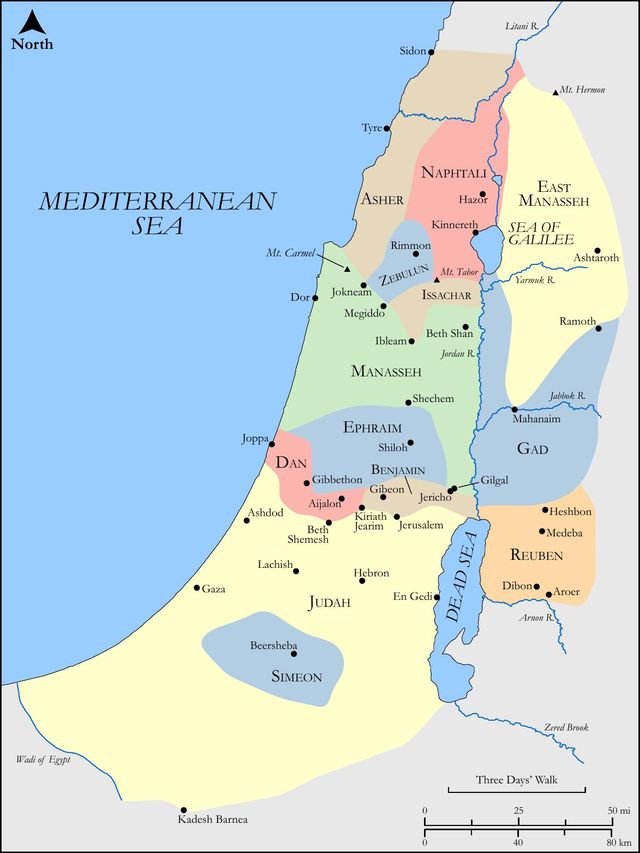
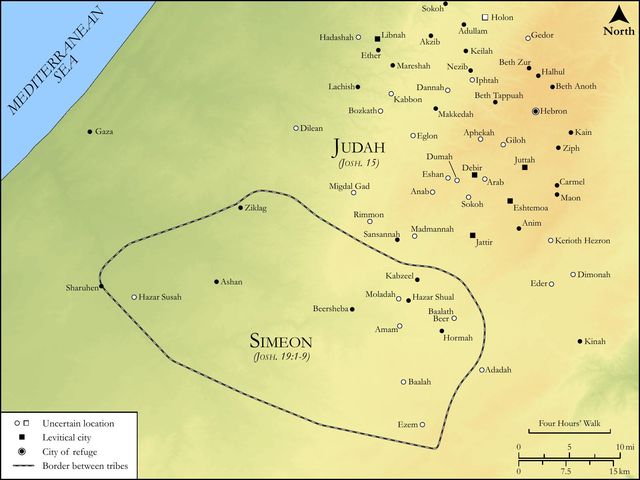
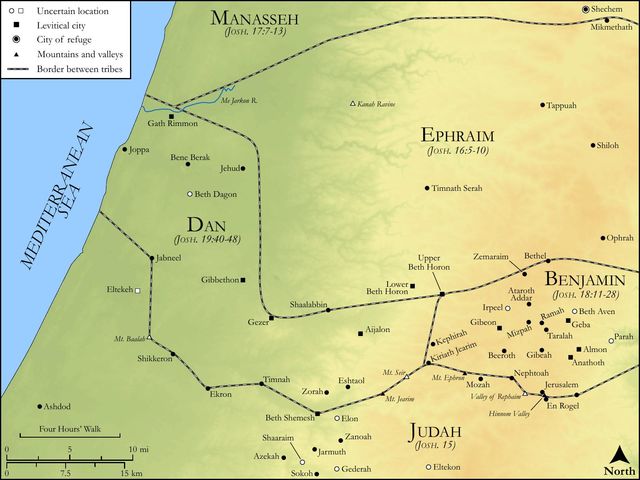
See on the biblical-era maps
Study this verse
Public-domain commentary
Matthew Henry
From his Commentary on the Whole Bible. Henry comments on passages, not single verses — this entry covers Joshua 19:24–31.
The lot of Asher lay upon the coast of the great sea. We read not of any famous person of this tribe but Anna the prophetess, who was a constant resident in the temple at the time of our Saviour's birth, Luk 2:36. Nor were there many famous places in this tribe. Aphek (mentioned Jos 19:30) was the place near which Benhadad was beaten by Ahad, Kg1 20:30. But close adjoining to this tribe were the celebrated sea-port towns of Tyre and Sidon, which we read so much of. Tyre is called here that strong city (Jos 19:29), but Bishop Patrick thinks it was not the same Tyre that we read of afterwards, for that was built on an island; this old strong city was on the continent. And it is conjectured by some that into these two strong-holds, Sidon and Tzor, or Tyre, many of the people of Canaan fled and took shelter when Joshua invaded them.
Continue studying Joshua 19:29 across the web’s major study libraries — every link below opens this exact verse, chapter, or book on the destination site.
Read & Compare
 BibleGatewayThis verse in more than 200 translations and 70 languages.
 Bible.comThe YouVersion reader — hundreds of translations, reading plans, and highlights.
 ESV.orgCrossway's official English Standard Version reader.
 NET BibleThe NET translation with 60,000+ translators' notes on every rendering decision.
 STEP BibleTyndale House's free study tool — original text, vocabulary, and scholarly resources.
 BibliaLogos Bible Software's free web reader.
 USCCBThe New American Bible (Revised Edition) with the U.S. bishops' study notes.
Commentaries
 BibleHub CommentariesDozens of classic commentaries on this verse, gathered on one page.
 StudyLightMore than 100 commentary sets — the largest collection on the web.
 BibleRefPlain-English commentary on what this verse means, verse by verse.
 Enduring WordDavid Guzik's free commentary on this chapter, widely used by Bible teachers.
 Bible Study ToolsVerse commentary alongside Greek and Hebrew study aids.
Original Language & Research
- BibleHub InterlinearThe verse word by word — original language, transliteration, and English.
- BibleHub LexiconEvery word's original-language definition and Strong's entry.
 Blue Letter BibleDeep-study tools — Strong's numbers, concordance, and word studies.
 SefariaThe Hebrew text with Rashi and centuries of Jewish commentary.
Sermons, Hymns & Audio


TrulyRandomVerse is not affiliated with these sites and doesn’t control their content. They’re linked because they’re genuinely useful.
Summary
Joshua 19:29 meticulously details a specific segment of the northern boundary for the tribe of Asher's inheritance, tracing its precise course through significant geographical markers such as Ramah, the formidable city of Tyre, Hosah, and extending westward to the Mediterranean Sea near Achzib. This verse is part of the comprehensive account of land distribution among the Israelite tribes, underscoring God's unwavering faithfulness in fulfilling His ancient covenant promises by providing a tangible, divinely appointed territory for His people.
Context
ShowHideLiterary Context
Joshua 19:29 is situated within the extensive and detailed record of the land allotments to the Israelite tribes, specifically focusing on the inheritance granted to the tribe of Asher (Joshua 19:24-31). Following the triumphant conquest of Canaan under Joshua's leadership, the land was systematically divided by lot among the twelve tribes, a process understood as divinely guided and fulfilling God's long-standing promises to Abraham's descendants. The preceding chapters (Joshua 13-19) meticulously outline the boundaries and cities assigned to each tribe, emphasizing geographical precision. This particular verse contributes to the meticulous cartography of Asher's northern frontier, illustrating the practical outworking of divine promise and the establishment of Israel's national identity. The highly detailed nature of these boundary descriptions underscores the legal, theological, and historical significance of the land as a direct gift from God.
Historical & Cultural Context
The division of Canaan marked a pivotal transition for Israel, moving them from a nomadic people to a settled nation with a distinct territorial identity. The allocation of land by lot, overseen by Joshua and Eleazar the priest, was a sacred act, believed to reflect God's direct will and ensure equitable distribution. This process was foundational to Israel's social, economic, and religious life. The mention of cities like Tyre is highly significant. Tyre was a prominent Phoenician city-state, renowned for its immense wealth, maritime trade, and formidable fortifications. Its inclusion within Asher's allotted territory signifies God's intention for Israel to fully possess the land, including these powerful strongholds. However, the historical reality, as later recounted in Judges 1:31, reveals that the tribes, including Asher, often failed to dispossess the indigenous inhabitants of such well-fortified cities, leading to ongoing challenges, cultural assimilation, and spiritual compromise.
Key Themes
ShowHideThis verse, along with the entire section on tribal allotments, powerfully conveys several foundational themes. Firstly, Divine Provision and Fulfillment is paramount; God meticulously fulfills His promise to Abraham (see Genesis 12:7) and Moses (as outlined in Numbers 34:2) by providing a specific, tangible inheritance for each tribe. This demonstrates God's faithfulness to His covenant. Secondly, Geographical Precision is evident in the explicit naming of places like Ramah, Tyre, Hosah, and Achzib, showcasing the exactness of the land division and the meticulous nature of God's plans. The term "coast" (Hebrew: gᵉbûwl) refers not merely to the seashore but to the precisely surveyed boundary line itself, emphasizing the precise demarcation of tribal lands. Lastly, the designation of Tyre as a "strong city" subtly introduces the theme of Challenges of Possession. While the land was divinely given, its full possession required active faith, obedience, and military engagement from the Israelites, a task Asher, unfortunately, did not fully complete, as later narratives in the book of Judges reveal.
Exposition and Analysis
ShowHideKey Word Analysis
ShowHideMeaning "a cord (as twisted), i.e. (by implication) a boundary; by extension the territory inclosed." This word emphasizes the precise, surveyed nature of the tribal boundaries. It signifies not merely a geographical feature but a divinely ordained and legally recognized demarcation, highlighting the meticulous care with which God allotted the land. The "coast" here is the border line itself, not just the seashore.
Meaning "a fortification, castle, or fortified city; figuratively, a defender." When applied to Tyre, this term underscores the city's formidable defenses, its strategic importance as a major Phoenician port, and its significant commercial and military power. This description subtly foreshadows the immense difficulty Asher would face in fully conquering this territory, a challenge they ultimately did not overcome, leading to a partial fulfillment of their inheritance.
Meaning "deceitful (in the sense of a winter-torrent which fails in summer)." The name of this coastal city, "deceitful" or "lie," carries a poignant irony within the narrative of Asher's inheritance. While the text itself does not explicitly draw a connection, the name serves as a subtle, perhaps unintentional, commentary on the unfulfilled promise of complete possession due to Asher's failure to fully dispossess the inhabitants of their allotted territory, including this very region. It stands as a silent reminder of the tribe's lack of faith and obedience.
Verse Breakdown
ShowHide"And [then] the coast turneth to Ramah"
This clause initiates the description of the boundary's course, indicating a change in direction as it moves towards the settlement of Ramah. This Ramah is likely a specific location within the northern territory of Asher, distinct from other places with the same name, serving as a precise landmark in the tribal demarcation.
"and to the strong city Tyre;"
The boundary line continues its winding path, now encompassing the powerful Phoenician city of Tyre. Its designation as a "strong city" immediately highlights its formidable nature, implying the significant challenge it would present to Asher's full possession of their God-given inheritance.
"and the coast turneth to Hosah;"
The boundary once again shifts direction, now extending towards Hosah, another identifiable location within Asher's northern territory. This further details the precise geographical limits, emphasizing the thoroughness of the land survey.
"and the outgoings thereof are at the sea from the coast to Achzib:"
This final phrase describes the boundary's ultimate western reach. It indicates that the border extends to the Mediterranean Sea, with its westernmost point or "outgoings" being from the main boundary line towards the coastal city of Achzib. This confirms Asher's designated access to the sea and the full extent of their western border.
Literary Devices
ShowHideThe primary literary device employed in Joshua 19:29, and indeed throughout the land allocation chapters, is Geographical Precision. The meticulous listing of towns, specific boundary points, and natural features serves to emphasize the literal fulfillment of God's promises and the tangible, verifiable nature of the inheritance. This detailed cartography also functions as a form of Legal Documentation, solidifying the tribal claims to their divinely appointed territories. The Repetition of phrases like "the coast turneth" (or similar directional indicators in the broader context) provides a rhythmic cadence that underscores the deliberate, surveyed, and unalterable nature of these boundaries. Furthermore, the inclusion of "the strong city Tyre" can be seen as a subtle form of Foreshadowing. While presented as part of the inheritance, the descriptor "strong" hints at the future struggles and eventual failure of Asher to fully dispossess the inhabitants, a theme explicitly addressed in the subsequent narratives of the book of Judges.
Theological and Thematic Connections
ShowHideJoshua 19:29, though seemingly a dry geographical detail, is profoundly theological. It stands as a testament to God's unwavering faithfulness, meticulous care, and sovereign power in fulfilling His ancient covenant promises to Israel. The precise demarcation of land, down to specific cities and winding boundaries, illustrates that God's provision is not vague but concrete, exact, and thoroughly planned. This inheritance was a tangible expression of His covenant love and a foundational element for Israel's identity as a nation set apart for Him. However, the mention of "the strong city Tyre" also subtly introduces the crucial theme of human responsibility in possessing divine promises. While God provides the inheritance, the full enjoyment of it often requires active faith, obedience, and perseverance in overcoming obstacles. Asher's subsequent failure to fully dispossess the inhabitants of Tyre and other coastal cities serves as a cautionary tale: divine promise does not negate human responsibility, and partial obedience leads to partial blessing.
Reflection and Application
ShowHideThe detailed geographical descriptions in Joshua, including Joshua 19:29, might initially appear distant from contemporary spiritual life, yet they hold enduring and profound lessons for believers today. They serve as a powerful reminder that God is a God of precision, faithfulness, and unwavering promise-keeping. Just as He meticulously planned and delivered a physical inheritance to ancient Israel, He has, in Christ, provided an even greater spiritual inheritance for believers today—a reality far surpassing any earthly territory. This spiritual inheritance, however, much like Asher's physical one, often requires active "possession" through diligent faith, courageous obedience, and perseverance. We are called to walk in the fullness of what God has graciously given us, confronting spiritual strongholds and not shrinking back from the challenges that inevitably arise in living out our faith. This verse encourages us to trust implicitly in God's specific provision for our lives, to recognize the spiritual battles we must engage in, and to press forward in taking hold of the rich spiritual blessings and divine callings He has placed before us, confident that He has already equipped us with everything we need for life and godliness.
Questions for Reflection
ShowHideFAQ
ShowHideWhat is the significance of such detailed geographical descriptions in the Bible, like Joshua 19:29?
ShowHideThese detailed geographical descriptions are profoundly significant for several reasons. Firstly, they underscore God's absolute faithfulness in meticulously fulfilling His covenant promises to Abraham and his descendants, providing them with a specific, tangible land. This precision serves as legal documentation, solidifying Israel's claim to the land as a divine gift and demonstrating the literal fulfillment of prophecy. Secondly, it firmly grounds the biblical narrative in real-world geography, making the historical events verifiable and demonstrating the concrete nature of God's work in history. Finally, these details highlight God's meticulous nature and His concern for every aspect of His people's lives, from national boundaries to individual inheritances, reinforcing the overarching theme of divine order and provision throughout the book of Joshua.
Why is "the strong city Tyre" mentioned if the tribe of Asher did not fully conquer it?
ShowHideThe mention of "the strong city Tyre" within Asher's inheritance highlights a crucial tension that runs through the book of Joshua and is fully explored in the subsequent book of Judges. God allotted Tyre to Asher, signifying His divine intention for the tribe to fully dispossess its inhabitants and claim the territory. However, as Judges 1:31 later reveals, Asher, along with several other tribes, failed to drive out the inhabitants of Tyre and other Phoenician cities. This serves as a subtle foreshadowing of Israel's partial obedience and the long-term, detrimental consequences of their failure to fully obey God's command to dispossess all the Canaanites. It emphasizes that while God's promises are absolutely sure and His provision is complete, their full realization often depends on human faith, obedience, and active engagement with the divine mandate.
Christ-Centered Fulfillment
ShowHideWhile Joshua 19:29 describes a physical land inheritance with precise boundaries and formidable challenges, its deepest and ultimate fulfillment is found in Christ. The promised land of Canaan, with its meticulous divisions and the struggles inherent in possessing it, serves as a powerful type and shadow of the spiritual inheritance believers receive in Christ—a new covenant reality that transcends geographical limits and earthly territories. Just as God meticulously provided a physical dwelling and inheritance for Israel, He has, in Christ, provided an eternal dwelling and a spiritual inheritance that is "imperishable, undefiled, and unfading, kept in heaven" for us (1 Peter 1:4). The "strong city Tyre" within Asher's inheritance, which they failed to fully possess, powerfully foreshadows the spiritual strongholds and battles believers face in the new covenant. Though our ultimate victory and spiritual inheritance are secured in Christ's finished work on the cross, we are called to actively "possess" our spiritual inheritance by walking in the Spirit, dismantling spiritual strongholds through prayer and faith (Ephesians 6:12 and 2 Corinthians 10:4). Christ Himself is the ultimate fulfillment of God's promise of rest and inheritance, not in a physical land, but in His very person, offering us full access to God's presence and all spiritual blessings in the heavenly realms (Hebrews 4:9-10 and Ephesians 1:3).