


Numbers 34:2
Bible text: King James Version (1769 Blayney text) · Public domain
Bible text: King James Version with Strong's numbers · Public domain
Bible text: Berean Standard Bible · Public domain
Bible text: American Standard Version (1901) · Public domain
Bible text: World English Bible, Messianic edition · Public domain
Bible text: Geneva Bible (1599) · Public domain
Bible text: Young's Literal Translation · Public domain
- צַוtzavcommandH6680V-Piel-Imp-2msVerb Piel Imperative 2nd Singular Masculine
- אֶת'et<obj.>H853DirObjMParticle Object Indicator
- בְּנֵיbe·Nei[the] people ofH1121N-mpcNoun Plural Masculine Construct
- יִשְׂרָאֵלYis·ra·'ElIsraelH3478N-properNoun Proper Location
- וְאָמַרְתָּve·'a·mar·Taand you will sayH559Conj-w ¦ V-Qal-ConsecPerf-2msVerb Qal Consecutive Perfect 2nd Singular Masculineוְandאָמַרְתָּyou will say
- אֲלֵהֶם'a·le·Hemto themH413Prep ¦ 3mpPreposition Definiteאֲלֵtoהֶםthem
- כִּיkiifH3588PrtParticle Conditional
- אַתֶּם'a·TemyouH859Pro-2mpPronoun Personal 2nd Plural Masculine
- בָּאִיםba·'Im[are] about to goH935V-Qal-Prtcpl-mpVerb Qal Participle Plural Masculine Absolute
- אֶל'elintoH413PrepPreposition
- הָאָרֶץha·'A·retzthe landH776Art ¦ N-fsNoun Singular Feminine Absoluteהָtheאָרֶץland
- כְּנָעַןke·Na·'anCanaanH3667N-properNoun Proper Location
- זֹאתzotthisH2063PrtParticle Demonstrative
- הָאָרֶץha·'A·retz[is] the landH776Art ¦ N-fsNoun Singular Feminine Absoluteהָ[is] theאָרֶץland
- אֲשֶׁר'a·SherwhichH834RelParticle Relative
- תִּפֹּלti·Polit will fallH5307V-Qal-Imperf-3fsVerb Qal Imperfect 3rd Singular Feminine
- לָכֶםla·Khemto <the> youPrep-l ¦ 2mpSuffix Personal 2nd Plural Masculineלָto <the>כֶםyou
- בְּנַחֲלָהbe·na·cha·Lah<in> an inheritanceH5159Prep-b ¦ N-fsNoun Singular Feminine Absoluteבְּ<in>נַחֲלָהan inheritance
- אֶרֶץ'E·retz[the] land ofH776N-fscNoun Singular Feminine Construct
- כְּנַעַןke·Na·'anCanaanH3667N-properNoun Proper Location
- לִגְבֻלֹתֶיהָlig·vu·lo·Tei·hato its bordersH1367Prep-l ¦ N-fpc ¦ 3fsNoun Plural Feminine Constructלִtoגְבֻלֹתֶיbordersהָits
English is a literal word-by-word gloss of the Hebrew, not the KJV's wording. Why?
This is the original text the KJV's translators worked from — each Hebrew word with its own literal English meaning in this verse, prepared by scholars at Tyndale House, Cambridge. The KJV translates whole sentences, not word by word, so its wording differs: one Hebrew word can become several English words, and the KJV may choose “the LORD” where the gloss reads “Yahweh”. Both are faithful — they answer different questions. For the KJV's own rendering, switch to the KJV text.
Details
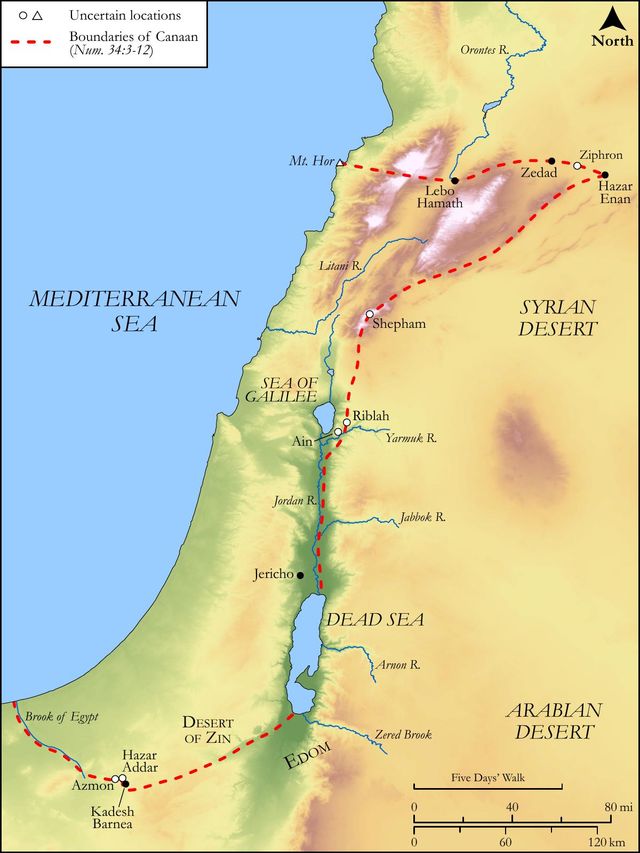
See on the biblical-era map
Study this verse
Continue studying Numbers 34:2 across the web’s major study libraries — every link below opens this exact verse, chapter, or book on the destination site.
Read & Compare
 BibleGatewayThis verse in more than 200 translations and 70 languages.
 Bible.comThe YouVersion reader — hundreds of translations, reading plans, and highlights.
 ESV.orgCrossway's official English Standard Version reader.
 NET BibleThe NET translation with 60,000+ translators' notes on every rendering decision.
 STEP BibleTyndale House's free study tool — original text, vocabulary, and scholarly resources.
 BibliaLogos Bible Software's free web reader.
 USCCBThe New American Bible (Revised Edition) with the U.S. bishops' study notes.
Commentaries
 BibleHub CommentariesDozens of classic commentaries on this verse, gathered on one page.
 StudyLightMore than 100 commentary sets — the largest collection on the web.
 BibleRefPlain-English commentary on what this verse means, verse by verse.
 Enduring WordDavid Guzik's free commentary on this chapter, widely used by Bible teachers.
 Bible Study ToolsVerse commentary alongside Greek and Hebrew study aids.
Original Language & Research
- BibleHub InterlinearThe verse word by word — original language, transliteration, and English.
- BibleHub LexiconEvery word's original-language definition and Strong's entry.
 Blue Letter BibleDeep-study tools — Strong's numbers, concordance, and word studies.
 SefariaThe Hebrew text with Rashi and centuries of Jewish commentary.
Sermons, Hymns & Audio


TrulyRandomVerse is not affiliated with these sites and doesn’t control their content. They’re linked because they’re genuinely useful.
Summary
Numbers 34:2 introduces a foundational divine mandate to the children of Israel, meticulously outlining the precise geographical boundaries of the land of Canaan. This verse serves as the authoritative preamble to the upcoming tribal divisions, emphasizing that this territory is not merely a conquest but a sacred and perpetual inheritance divinely bestowed upon them. It profoundly underscores God's unwavering faithfulness, meticulous planning, and sovereign power in fulfilling centuries-old covenant promises to His chosen people as they stand on the threshold of entering their divinely appointed dwelling place.
Context
ShowHideLiterary Context
Numbers 34:2 is strategically placed within a pivotal section of the book of Numbers (chapters 33-36), which meticulously details Israel's final preparations for entering and settling the Promised Land. The preceding chapters chronicle the arduous wilderness wanderings and the enumeration of the new generation in Numbers 26, signaling a shift from a nomadic existence to the establishment of a settled nation. Numbers 33:50-56 provides the immediate backdrop, where God commands Israel to dispossess the inhabitants of Canaan and divide the land by lot. Numbers 34 then elaborates on the precise geographical limits of this inheritance, setting the stage for the subsequent chapters that address practicalities like cities for the Levites and laws concerning daughters' inheritance, thereby forming a comprehensive legal and administrative framework for Israel's life in the land, highlighting God's meticulous provision and foresight.
Historical & Cultural Context
Historically, the Israelites were at a critical juncture, transitioning from forty years of divine judgment and nomadic purification in the wilderness to becoming a settled, agricultural society in Canaan. This land was not an arbitrary acquisition but the specific territory promised to Abraham, Isaac, and Jacob centuries earlier, a central and non-negotiable component of the Abrahamic covenant. In Israel, land ownership was paramount, serving as the bedrock of identity, tribal cohesion, economic stability, and social status. The precise demarcation of borders, as detailed in this chapter, was a common, albeit often contentious, practice in the region. However, for Israel, these boundaries were uniquely established under divine mandate, crucial for preventing inter-tribal disputes and ensuring each family's long-term security and the perpetuation of their God-given inheritance.
Key Themes
ShowHideThis verse contributes significantly to several overarching themes woven throughout Numbers and the Pentateuch. Firstly, it powerfully illustrates Divine Faithfulness and Fulfillment. The "land of Canaan" represents the tangible culmination of God's unwavering promises, demonstrating His steadfast commitment to His covenant people despite their past rebellions and failures. Secondly, the concept of the land as an Inheritance (Hebrew: nachalah) is central, emphasizing that Israel's possession was a gracious gift from God, received by divine decree rather than earned through merit or conquest alone. This highlights God's sovereign grace and His initiative in providing for His people. Thirdly, the detailed instruction regarding "coasts" or "boundaries" underscores Divine Order and Specificity. God's meticulous planning for the land's division reflects His desire for harmony, justice, and clarity among the tribes, preventing future conflict and establishing a stable society rooted in His divine blueprint. This theme resonates with God's precise instructions for the construction of the Tabernacle in Exodus 25-31 and the intricate legal framework presented in Leviticus.
Exposition and Analysis
ShowHideKey Word Analysis
ShowHideThe verb "command" (צוה, tsâvâh') signifies a divine imperative, a direct and authoritative instruction from God. It emphasizes that the subsequent details about the land's boundaries are not suggestions or human deliberations, but a non-negotiable decree from the ultimate sovereign. This highlights the divine origin and binding nature of the instructions, requiring absolute obedience from Moses and the children of Israel.
The Hebrew term "inheritance" (נַחֲלָה, nachălâh') is profoundly significant. It denotes a possession, typically land, received as a gift or legacy, often passed down through generations. For Israel, this was a direct endowment from God, emphasizing His sovereign grace and covenant faithfulness rather than their own merit or conquest. It established a perpetual, divinely sanctioned claim to the land, distinct from mere territorial acquisition, underscoring God's role as the ultimate granter of their dwelling place.
The KJV translation "coasts" for (גְּבֻלָה, gᵉbûwlâh') is somewhat archaic and can be misleading. While it can refer to coastal regions, in this context, it more accurately translates to "its borders" or "its boundaries." This word emphasizes the precise and clearly defined demarcation of the land, indicating God's desire for order, clarity, and the prevention of future disputes among the tribes regarding their allotted territories. It signifies the meticulous detail of God's provision.
Verse Breakdown
ShowHide"Command the children of Israel, and say unto them,"
This opening phrase establishes the divine authority and directness of the message. It is a clear, unambiguous imperative from God to Moses, who is then to relay it to the entire nation. This sets a tone of absolute obedience and divine sovereignty over the land's distribution, emphasizing that the instructions are not open for debate or human modification.
"When ye come into the land of Canaan;"
This clause sets the temporal and geographical context for the divine command. It acknowledges the future entry into Canaan as a certainty, not a mere possibility, reflecting God's foreknowledge and unwavering commitment to His promises. It also identifies the specific, promised territory that is the subject of the divine command, linking it directly to the ancient covenant.
"(this [is] the land that shall fall unto you for an inheritance, [even] the land of Canaan with the coasts thereof:)"
This parenthetical statement serves as a crucial clarification and theological declaration. It defines the nature of their possession—it is an "inheritance," a divinely gifted legacy, not merely a conquered territory. The repetition of "the land of Canaan" underscores its identity and importance, while "with the coasts thereof" emphasizes that this inheritance includes its precisely defined and delimited boundaries, ensuring a clear and orderly distribution among the tribes and preventing future territorial conflicts.
Literary Devices
ShowHideThe verse employs several significant literary devices to convey its profound message. The most prominent is Divine Command, which frames the entire passage as an authoritative decree from God. This device underscores His sovereignty and the non-negotiable nature of His instructions, emphasizing that the distribution of the land is by divine will. The use of Repetition is also evident in the phrase "the land of Canaan," which appears twice within the short verse. This repetition serves to emphasize the specific, promised territory, reinforcing its identity and significance as the tangible object of God's covenant faithfulness and the central focus of the divine directive. Furthermore, the Parenthesis "(this [is] the land that shall fall unto you for an inheritance, [even] the land of Canaan with the coasts thereof:)" functions as a crucial explanatory interjection. It clarifies the theological nature of the land (as an inheritance) and highlights the meticulous detail of its boundaries, providing essential context and theological weight to the subsequent geographical descriptions.
Theological and Thematic Connections
ShowHideNumbers 34:2 stands as a powerful testament to God's unwavering faithfulness and the precise fulfillment of His ancient promises. The land of Canaan, first pledged to Abraham in Genesis 12:7, is now on the verge of being possessed by his descendants, demonstrating that God's word is reliable across generations and that His plans are meticulously brought to fruition. This verse underscores the concept of the land as a divine gift, an inheritance, rather than a reward for Israel's merit or a mere military conquest. It highlights God's meticulous care for His people, providing not just a general promise but a detailed blueprint for their future security, identity, and flourishing within the land. This divine precision in establishing physical boundaries foreshadows God's desire for order, clarity, and justice in all aspects of His people's lives, both individually and corporately, ensuring harmony and preventing chaos.
Reflection and Application
ShowHideNumbers 34:2 offers profound insights for contemporary believers, revealing the character of a God who is both faithful and meticulously detailed in His provision. Just as God meticulously planned and faithfully provided a physical inheritance for Israel, He has prepared a spiritual inheritance for those who are in Christ. This verse reminds us that God's promises are not vague aspirations but concrete realities, meticulously planned and faithfully executed in His perfect timing. The divine emphasis on precise boundaries, even for a physical land, serves as a powerful metaphor for the importance of clear boundaries in our own lives—spiritual, moral, and relational. God's design for order and clarity provides security and prevents confusion, guiding us into the "good works, which God prepared beforehand, that we should walk in them" (Ephesians 2:10). We are called to steward the gifts, callings, and spiritual "territory" God has given us with similar intentionality and respect for His divine blueprint, trusting that His plans for us are purposeful and precise, leading us into the fullness of the "inheritance" He has allotted for our lives. As we face new seasons or challenges, we can draw immense confidence from God's meticulous care for Israel, knowing He guides our steps into the spiritual blessings prepared for us.
Questions for Reflection
ShowHideFAQ
ShowHideWhy was God so specific about the land's boundaries?
ShowHideGod's specificity regarding the land's boundaries in Numbers 34 was crucial for several interconnected reasons, demonstrating His divine character and practical wisdom. Firstly, it underscored His absolute faithfulness to the ancient promises made to Abraham, Isaac, and Jacob (e.g., Genesis 15:18), showing that the land was a tangible, divinely designated gift, not an arbitrary territory. This precision validated the covenant. Secondly, precise boundaries were essential for preventing future disputes and conflicts among the twelve tribes as they settled and divided the land. In Israel, land ownership was foundational to identity, livelihood, and social stability, and clear demarcation ensured order, justice, and peace. Finally, these detailed instructions highlighted God's meticulous planning and sovereignty, establishing a divinely ordered society that would live according to His covenant within a defined geographical space, distinct from the surrounding nations. This precision reflects God's character as a God of order, not of chaos, as seen in the detailed instructions for the Tabernacle in Exodus 25-31 and the intricate laws given in the Pentateuch.
What does "inheritance" mean in this context, and how is it different from conquest?
ShowHideIn the context of Numbers 34:2, "inheritance" (Hebrew: nachălâh) signifies a possession received as a gift or legacy, often passed down through generations. For Israel, the land of Canaan was primarily a divine endowment, a fulfillment of God's covenant promise to their forefathers. While Israel would indeed engage in military conquest to dispossess the Canaanite inhabitants, the underlying theological reality was that the land was already theirs by divine decree and promise. It was not something they earned through their military prowess or merit, nor was it merely a prize of war, but a gracious gift from God. This distinction is vital: conquest was the means by which they took possession, but inheritance was the basis of their right to the land. This highlights God's sovereign grace and faithfulness, emphasizing that their right to the land stemmed from His promise, not their performance. This understanding is key to grasping the nature of God's blessings, which are often gifts of grace rather than earned rewards, as seen in the ultimate spiritual inheritance believers receive in Christ (Ephesians 1:11).
Christ-Centered Fulfillment
ShowHideNumbers 34:2, with its profound focus on the physical land of Canaan as a divinely appointed inheritance with meticulously defined boundaries, finds its ultimate and spiritual fulfillment in Jesus Christ. The earthly inheritance of Canaan, a place of rest, blessing, and covenant fulfillment for Israel, serves as a powerful type and shadow of the greater, eternal inheritance secured for believers in Christ. Just as God promised a physical land to Abraham's descendants, He has promised a heavenly inheritance to all who are in Christ, a "better country, that is, a heavenly one" for which Abraham himself longed, as described in Hebrews 11:16. Jesus, the true and greater Joshua, leads His people not into a temporal land, but into the ultimate spiritual rest and eternal dwelling place with God, a "Sabbath-rest that remains for the people of God" (Hebrews 4:9). Through His atoning sacrifice and resurrection, Christ has not only secured our access to this glorious inheritance but has also become our inheritance itself, for in Him "we have obtained an inheritance" (Ephesians 1:11). The meticulous boundaries of Canaan foreshadow the perfect order, security, and eternal nature of God's kingdom, where Christ reigns supreme, ensuring that all God's promises find their resounding "Yes" and "Amen" in Him (2 Corinthians 1:20), leading us into an everlasting dwelling place with Him.