


Numbers 34:1
Bible text: King James Version (1769 Blayney text) · Public domain
Bible text: Berean Standard Bible · Public domain
Bible text: American Standard Version (1901) · Public domain
Bible text: World English Bible, Messianic edition · Public domain
Bible text: Geneva Bible (1599) · Public domain
Bible text: Young's Literal Translation · Public domain
- וַיְדַבֵּרvay·da·Berand he spokeH1696Conj-w ¦ V-Piel-ConsecImperf-3msVerb Piel Consecutive Imperfect 3rd Singular Masculineוַandיְדַבֵּרhe spoke
- יְהוָהYah·wehYahwehH3068N-properNoun Proper Title
- אֶל'eltoH413PrepPreposition
- מֹשֶׁהmo·ShehMosesH4872N-proper-mNoun Proper Masculine
- לֵּאמֹרle·Mor<to> sayingH559Prep-l ¦ V-Qal-InfVerb Qal Infinitive Constructלֵּ<to>אמֹרsaying
English is a literal word-by-word gloss of the Hebrew, not the KJV's wording. Why?
This is the original text the KJV's translators worked from — each Hebrew word with its own literal English meaning in this verse, prepared by scholars at Tyndale House, Cambridge. The KJV translates whole sentences, not word by word, so its wording differs: one Hebrew word can become several English words, and the KJV may choose “the LORD” where the gloss reads “Yahweh”. Both are faithful — they answer different questions. For the KJV's own rendering, switch to the KJV text.
Details
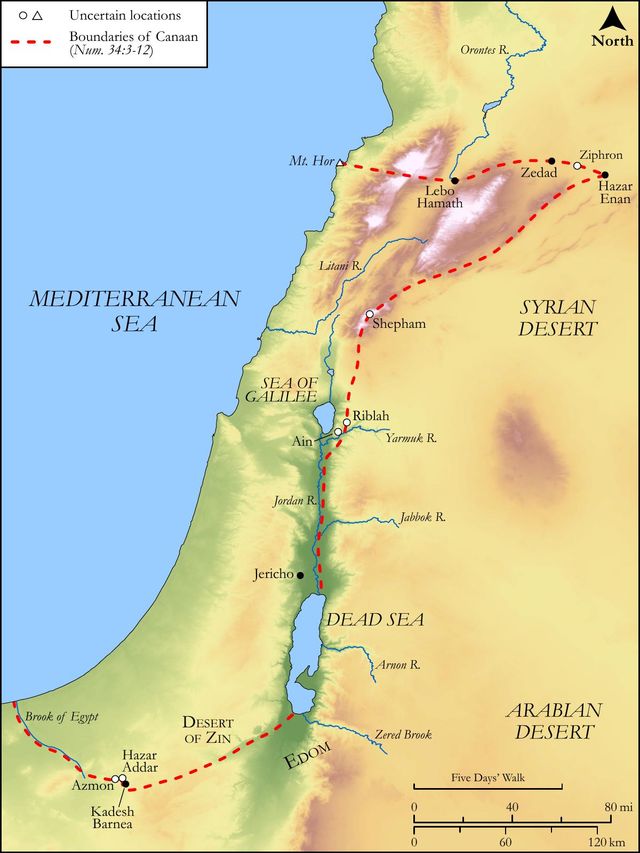
See on the biblical-era map
Study this verse
Continue studying Numbers 34:1 across the web’s major study libraries — every link below opens this exact verse, chapter, or book on the destination site.
Read & Compare
 BibleGatewayThis verse in more than 200 translations and 70 languages.
 Bible.comThe YouVersion reader — hundreds of translations, reading plans, and highlights.
 ESV.orgCrossway's official English Standard Version reader.
 NET BibleThe NET translation with 60,000+ translators' notes on every rendering decision.
 STEP BibleTyndale House's free study tool — original text, vocabulary, and scholarly resources.
 BibliaLogos Bible Software's free web reader.
 USCCBThe New American Bible (Revised Edition) with the U.S. bishops' study notes.
Commentaries
 BibleHub CommentariesDozens of classic commentaries on this verse, gathered on one page.
 StudyLightMore than 100 commentary sets — the largest collection on the web.
 BibleRefPlain-English commentary on what this verse means, verse by verse.
 Enduring WordDavid Guzik's free commentary on this chapter, widely used by Bible teachers.
 Bible Study ToolsVerse commentary alongside Greek and Hebrew study aids.
Original Language & Research
- BibleHub InterlinearThe verse word by word — original language, transliteration, and English.
- BibleHub LexiconEvery word's original-language definition and Strong's entry.
 Blue Letter BibleDeep-study tools — Strong's numbers, concordance, and word studies.
 SefariaThe Hebrew text with Rashi and centuries of Jewish commentary.
Sermons, Hymns & Audio


TrulyRandomVerse is not affiliated with these sites and doesn’t control their content. They’re linked because they’re genuinely useful.
Summary
Numbers 34:1 serves as the authoritative divine preamble to a crucial section of the Book of Numbers, signaling the direct communication from God to Moses regarding the precise geographical boundaries of the land of Canaan. This verse introduces the detailed instructions for Israel's promised inheritance, underscoring God's meticulous foresight and unwavering faithfulness in preparing His people for their settled nationhood and the fulfillment of His ancient covenant promises.
Context
ShowHideLiterary Context
Numbers 34:1 marks a pivotal transition within the book, following nearly forty years of wilderness wandering and preceding the detailed instructions for the division of the Promised Land. The preceding chapters (Numbers 26-33) have focused on the second census, laws of inheritance for daughters, and a review of Israel's journey from Egypt, culminating in the final stages of preparation for entry into Canaan. This verse, with its classic introductory formula, sets apart the subsequent verses (Numbers 34:2-12), which meticulously delineate the borders of the land, and the appointment of leaders to oversee its division (Numbers 34:16-29). It functions as a divine heading, emphasizing the divine origin and absolute authority of the geographical and administrative details that follow, which are essential for the orderly settlement of the twelve tribes in their divinely appointed territory.
Historical & Cultural Context
The Israelites stood on the plains of Moab, poised to cross the Jordan River and enter Canaan, a land promised to their ancestors centuries earlier. After the generation that rebelled at Kadesh-Barnea had died in the wilderness, a new generation was ready to claim their inheritance. In Israel, precise land boundaries were crucial for national identity, economic stability, and preventing inter-tribal or international conflict. The LORD had granted the land to Abraham's seed, and here, the detailed, divinely ordained boundaries for Israel underscored God's absolute sovereignty over the land and His people's unique right to it. This was not merely a human territorial claim but a divine bestowal, fulfilling the covenant made with Abraham in Genesis 15:18 and ensuring the secure establishment of His chosen nation.
Key Themes
ShowHideThe introduction "And the LORD spake unto Moses, saying" immediately highlights Divine Authority and Revelation. This formula, pervasive throughout the Pentateuch, asserts that the subsequent instructions are not human decrees but direct, unadulterated commands from the sovereign God, conveyed through His chosen mediator, Moses. This emphasizes God's active involvement in the minute details of His people's lives and future. Furthermore, the verse initiates the theme of Fulfillment of Promise, as the detailed land boundaries are a tangible step towards the realization of God's ancient covenant with Abraham, Isaac, and Jacob, concerning the land of Canaan as an eternal inheritance (e.g., Genesis 12:7). Finally, it underscores Order, Preparation, and Inheritance. God's provision of exact boundaries before the conquest and settlement demonstrates His desire for order and His foresight in preparing His people for their new life. These divine instructions would prevent future disputes among the tribes and with neighboring nations, clearly defining Israel's divinely granted territory and ensuring the orderly distribution of their promised inheritance.
Exposition and Analysis
ShowHideKey Word Analysis
ShowHideThis is the Tetragrammaton (H3068), the personal, covenant name of God, often rendered "Jehovah" or "Yahweh." Its use here emphasizes that the speaker is the self-Existent or Eternal God, the faithful covenant partner of Israel. This is not a generic deity, but the God who delivered Israel from Egypt and made a covenant with them at Sinai, reinforcing the divine authority and trustworthiness of the instructions that follow.
The verb דָּבַר (H1696, dâbar) implies a direct, articulate, and often detailed communication. When used of God, it signifies an authoritative utterance, a command, or a revelation that carries the full weight of His will. It is not merely a thought or a suggestion, but a spoken word intended to be heard and obeyed, highlighting the active and intentional nature of God's engagement with His people.
Moses (H4872, Môsheh), whose name etymologically means "drawing out (of the water)," referring to his rescue from the Nile, is consistently presented as God's chosen prophet and mediator. His unique privilege to receive direct communication from the LORD underscores the legitimacy and divine authority of the instructions. He is the divinely appointed conduit through whom God's will is revealed to the entire nation of Israel, marking him as the central figure in the giving of the Law and the organization of the people.
Verse Breakdown
ShowHide"¶ And the LORD spake"
This opening phrase immediately establishes the divine initiative and the ultimate source of the subsequent detailed instructions. The paragraph marker (¶) in the KJV, though a later editorial addition, visually reinforces that a new, distinct, and significant section of divine revelation is commencing. It signals that what follows is not human counsel or historical narrative, but a direct utterance from the sovereign God of Israel, initiating a new phase of His covenant dealings.
"unto Moses, saying,"
This clause identifies the specific human recipient of God's word and the precise mode of communication. God's word is directed personally to Moses, who then acts as the divinely appointed messenger to the people. The phrase "saying" indicates that the following content is the direct speech or command of the LORD, transmitted verbatim through Moses, emphasizing the precision, clarity, and absolute authority of the revelation.
Literary Devices
ShowHideNumbers 34:1 primarily employs Formulaic Language and acts as a Narrative Transition. The phrase "And the LORD spake unto Moses, saying" is a recurring literary device throughout the Pentateuch, serving as a signature introduction to divine commands, laws, or revelations. Its repetition establishes a consistent pattern, immediately signaling to the reader that the subsequent text carries the highest authority—it is the direct word of God. This formula acts as a Divine Attestation, validating the origin and supreme importance of the content that follows. As a Narrative Transition, this brief verse effectively pivots the narrative from the Israelites' wilderness journey and preparations to the specific, practical details of their future life in the Promised Land. It sets the stage for the meticulous geographical descriptions and administrative appointments that will define Israel's inheritance, marking a significant shift from the past to the future, from wandering to settled existence.
Theological and Thematic Connections
ShowHideThis seemingly simple introductory verse carries profound theological weight. It affirms God's active involvement in the minute details of His people's lives, demonstrating His meticulous care and unwavering faithfulness to His covenant promises. The fact that the LORD Himself speaks to define the boundaries of the land underscores His sovereignty over all creation and history. He is not a distant deity but one who engages directly with His chosen people, providing clear guidance for their inheritance and future. This divine communication establishes order, prevents chaos, and ensures the fulfillment of His ancient word, reminding us that God's plans are precise and His promises are sure.
Reflection and Application
ShowHideNumbers 34:1, though dealing with ancient land boundaries, speaks powerfully to the nature of God and our walk with Him today. It reminds us that our God is a God of order, precision, and faithfulness. Just as He meticulously defined the inheritance for ancient Israel, He provides clear guidance and principles for our lives through His Word, the Bible. This verse calls us to cultivate a posture of attentive listening, recognizing that when God speaks, whether through direct command or through the unfolding narrative of Scripture, His words carry divine authority and are for our ultimate good and the fulfillment of His purposes. It encourages us to trust in His foresight, knowing that He has a plan for our "inheritance" in Christ, providing the necessary "boundaries" and guidance for a life lived in accordance with His will, preventing spiritual disarray and ensuring our flourishing within His divine design.
Questions for Reflection
ShowHideFAQ
ShowHideWhy is such a short verse given its own chapter in some translations?
ShowHideThe chapter and verse divisions found in modern Bibles were not part of the original Hebrew or Greek manuscripts. They were later additions, introduced by scholars (Stephen Langton for chapters in the 13th century, Robert Estienne for verses in the 16th century) to facilitate reference, study, and theological discussion. Numbers 34:1 is a prime example of a verse that functions as a distinct heading or introduction to a new, significant block of material (the detailed land boundaries). While short, its theological and literary function as an authoritative divine declaration initiating a crucial section warranted its placement as the beginning of a new chapter, highlighting its pivotal role in the narrative flow and the divine origin of the following instructions.
What is the significance of "The LORD spake unto Moses, saying" as a recurring phrase throughout the Pentateuch?
ShowHideThis formulaic phrase is of immense theological and literary significance. It serves as a powerful and consistent declaration of divine authority. Each time it appears (e.g., Exodus 25:1, Leviticus 1:1, Numbers 1:1), it signals that the subsequent content is not human wisdom, tradition, or legal precedent, but a direct, unmediated revelation from God Himself. It underscores the divine origin of the Law, the commands, and the instructions given to Israel, establishing their absolute binding nature and distinguishing them from human decrees. It also highlights Moses' unique role as God's chosen prophet and mediator, through whom God communicates His will to His people.
Christ-Centered Fulfillment
ShowHideWhile Numbers 34:1 speaks of a physical land inheritance, its underlying themes find their ultimate fulfillment in Jesus Christ. Just as the LORD "spake" to Moses, defining the boundaries of Israel's promised land, God has "spoken" to us definitively through His Son, Jesus, who is the very Word of God made flesh. Jesus, the ultimate mediator of a new and better covenant, reveals the full scope of God's will and the nature of our spiritual inheritance. The physical land of Canaan, with its divinely appointed boundaries, foreshadows the boundless spiritual inheritance believers receive in Christ—an inheritance that is not geographical but eternal, encompassing every spiritual blessing in the heavenly places. Through Christ, we are granted access to God's kingdom, becoming heirs of God and co-heirs with Christ, a promise secured not by human conquest but by His perfect sacrifice and resurrection. The meticulous care God showed in defining Israel's land reflects His even greater precision and faithfulness in providing our salvation and eternal dwelling place in Him, ensuring that His ultimate promise of eternal life is fully realized for all who believe.