


Numbers 34:3
Bible text: King James Version (1769 Blayney text) · Public domain
Bible text: King James Version with Strong's numbers · Public domain
Bible text: Berean Standard Bible · Public domain
Bible text: American Standard Version (1901) · Public domain
Bible text: World English Bible, Messianic edition · Public domain
Bible text: Geneva Bible (1599) · Public domain
Bible text: Young's Literal Translation · Public domain
- וְהָיָהve·ha·Yahand it will beH1961Conj-w ¦ V-Qal-ConsecPerf-3msVerb Qal Consecutive Perfect 3rd Singular Masculineוְandהָיָהit will be
- לָכֶםla·Khemof youPrep-l ¦ 2mpSuffix Personal 2nd Plural Masculineלָofכֶםyou
- פְּאַתpe·'at[the] side ofH6285N-fscNoun Singular Feminine Construct
- נֶגֶבNe·gev[the] southH5045N-msNoun Singular Masculine Absolute
- מִמִּדְבַּרmi·mid·barfrom [the] wilderness ofH4057Prep-m ¦ N-mscNoun Singular Masculine Constructמִfromמִּדְבַּר[the] wilderness of
- צִןtzinZinH6790N-properNoun Proper Location
- עַל'alonH5921PrepPreposition
- יְדֵיye·Dei[the] hands ofH3027N-cdcNoun Dual common gender Construct
- אֱדוֹם'e·DomEdomH123N-proper-mNoun Proper Masculine
- וְהָיָהve·ha·Yahand it will beH1961Conj-w ¦ V-Qal-ConsecPerf-3msVerb Qal Consecutive Perfect 3rd Singular Masculineוְandהָיָהit will be
- לָכֶםla·Khemof youPrep-l ¦ 2mpSuffix Personal 2nd Plural Masculineלָofכֶםyou
- גְּבוּלge·Vulborder ofH1366N-mscNoun Singular Masculine Construct
- נֶגֶבNe·gev[the] southwardH5045N-msNoun Singular Masculine Absolute
- מִקְצֵהmik·Tzehfrom [the] end ofH7097Prep-m ¦ N-mscNoun Singular Masculine Constructמִfromקְצֵה[the] end of
- יָםyom[the] Sea ofH3220N-mscNoun Singular Masculine Construct
- הַמֶּלַחha·Me·lach<the> SaltH4417Art ¦ N-msNoun Singular Masculine Absoluteהַ<the>מֶּלַחSalt
- קֵדְמָהKe·de·maheast -wardH6924N-ms ¦ SfxNoun Singular Masculine Absoluteקֵדְמָeastה-ward
English is a literal word-by-word gloss of the Hebrew, not the KJV's wording. Why?
This is the original text the KJV's translators worked from — each Hebrew word with its own literal English meaning in this verse, prepared by scholars at Tyndale House, Cambridge. The KJV translates whole sentences, not word by word, so its wording differs: one Hebrew word can become several English words, and the KJV may choose “the LORD” where the gloss reads “Yahweh”. Both are faithful — they answer different questions. For the KJV's own rendering, switch to the KJV text.
Details
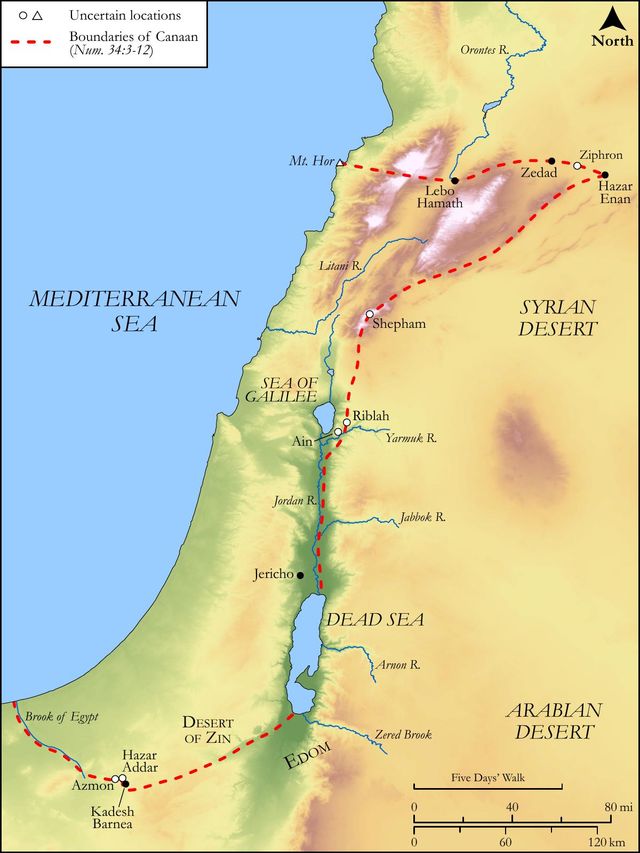
See on the biblical-era map
Study this verse
Historical interpretation
Historical reception
1 surviving comment on this verse from the historical church.
The most salt sea: The lake of Sodom, otherwise called the Dead Sea.
Continue studying Numbers 34:3 across the web’s major study libraries — every link below opens this exact verse, chapter, or book on the destination site.
Read & Compare
 BibleGatewayThis verse in more than 200 translations and 70 languages.
 Bible.comThe YouVersion reader — hundreds of translations, reading plans, and highlights.
 ESV.orgCrossway's official English Standard Version reader.
 NET BibleThe NET translation with 60,000+ translators' notes on every rendering decision.
 STEP BibleTyndale House's free study tool — original text, vocabulary, and scholarly resources.
 BibliaLogos Bible Software's free web reader.
 USCCBThe New American Bible (Revised Edition) with the U.S. bishops' study notes.
Commentaries
 BibleHub CommentariesDozens of classic commentaries on this verse, gathered on one page.
 StudyLightMore than 100 commentary sets — the largest collection on the web.
 BibleRefPlain-English commentary on what this verse means, verse by verse.
 Enduring WordDavid Guzik's free commentary on this chapter, widely used by Bible teachers.
 Bible Study ToolsVerse commentary alongside Greek and Hebrew study aids.
Original Language & Research
- BibleHub InterlinearThe verse word by word — original language, transliteration, and English.
- BibleHub LexiconEvery word's original-language definition and Strong's entry.
 Blue Letter BibleDeep-study tools — Strong's numbers, concordance, and word studies.
 SefariaThe Hebrew text with Rashi and centuries of Jewish commentary.
Sermons, Hymns & Audio


TrulyRandomVerse is not affiliated with these sites and doesn’t control their content. They’re linked because they’re genuinely useful.
Summary
Numbers 34:3 meticulously delineates a crucial segment of the southern boundary of the land of Canaan, providing precise geographical markers from the Wilderness of Zin, along the border of Edom, and extending to the southernmost point of the Salt Sea (Dead Sea) eastward. This verse is an integral component of God's comprehensive instructions for the division of the Promised Land among the Israelite tribes, underscoring His divine precision and unwavering faithfulness in fulfilling His ancient covenant promises by establishing clear, unambiguous territorial inheritances.
Context
ShowHideLiterary Context
Numbers 34:3 is situated within a highly detailed geographical description of the Promised Land's boundaries, encompassing Numbers 34:1-12. This section immediately follows the enumeration of the Israelites' wilderness journeys and encampments in Numbers 33, signaling their imminent entry into Canaan. The preceding verses, Numbers 34:1-2, establish God's direct command to Moses regarding the land's division by lot among the tribes. This divine mandate sets the stage for the meticulous boundary specifications that follow, emphasizing the divine authority behind the land's allocation and its profound significance as a fulfillment of covenantal promises, ensuring that the inheritance is clearly defined and undisputed.
Historical & Cultural Context
At this juncture, the Israelites stood on the threshold of a new era, transitioning from nomadic wanderers to a settled nation. The precise definition of borders was not merely a geographical exercise but a fundamental act of nation-building, crucial for establishing national identity, security, and preventing future territorial disputes among the tribes and with neighboring peoples. The "Wilderness of Zin" was a known, arid region, significant for its association with Kadesh-Barnea, a pivotal site in Israel's wilderness narrative (Numbers 13:21). Edom, the land of Esau's descendants, was a distinct and often antagonistic neighbor, making the clear demarcation of this border vital for Israel's security. The "Salt Sea" (Dead Sea) served as an unmistakable natural landmark, its "outmost coast eastward" providing a clear corner point for the southern boundary. This detailed mapping defines a national territory, but here, it is divinely ordained, emphasizing God's sovereignty over the land and its people.
Key Themes
ShowHideThis verse powerfully contributes to several overarching themes within Numbers and the broader Pentateuch. Primarily, it highlights Divine Faithfulness—God's unwavering commitment to fulfilling His ancient covenant promise to Abraham, Isaac, and Jacob regarding the land (Genesis 15:18). The meticulous detail of the borders is a tangible manifestation of this faithfulness, demonstrating that God's word is precise and reliable. Secondly, it underscores God's nature as a God of Order and Structure. The precise boundaries eliminate ambiguity and provide a secure foundation for the nascent nation, reflecting God's desire for an ordered society and a clear framework for His people's existence. Finally, the verse speaks to the theme of Inheritance. The land is presented as a divine gift, a tangible inheritance for Israel, signifying their unique relationship with God and their special place among the nations. This inheritance is not earned but freely given, a testament to God's grace and provision, as seen in the broader context of the land's distribution in Joshua 13-19.
Exposition and Analysis
ShowHideKey Word Analysis
ShowHideRefers to the Wilderness of Zin (H6790), an arid, rocky region in the southern part of the Promised Land, bordering Edom. It was a significant geographical marker in Israel's wilderness journey, notably associated with Kadesh-Barnea, a key stopping point and site of important events, including the sending of the spies (Numbers 13:21) and Miriam's death (Numbers 20:1). Its inclusion here precisely defines the starting point of the southern border.
Meaning "hand," but used here figuratively to denote a "side," "border," or "edge." In the context of "coast of Edom," it refers to the western flank or boundary adjacent to the territory inhabited by the Edomites. This usage emphasizes the precise line being drawn along the natural or political features, indicating proximity and shared boundary.
Meaning "extremity," "end," or "border." This term specifies the furthest point or termination of a geographical feature. When combined with "of the salt sea eastward," it precisely defines the southernmost extremity of the Dead Sea, marking a clear and unambiguous corner of the southern border, leaving no doubt about the exact demarcation.
Verse Breakdown
ShowHide"Then your south quarter shall be from the wilderness of Zin along by the coast of Edom,"
This clause establishes the initial segment of the southern boundary. "Your south quarter" refers to the southern portion of the land allocated to Israel. The starting point is the Wilderness of Zin, a known desert region. From there, the border extends "along by the coast of Edom," indicating that the boundary runs parallel to or abuts the western side of the territory of Edom, the descendants of Esau. This defines the southwestern extent of the Promised Land, clearly separating Israel's future inheritance from their often-antagonistic neighbor.
"and your south border shall be the outmost coast of the salt sea eastward:"
This second clause completes the definition of the southern border. It specifies that the boundary continues to the "outmost coast" (the southernmost extremity) of the Salt Sea (Dead Sea), which lies to the east. This precise geographical marker indicates that the southern border runs from the Wilderness of Zin, along Edom, and then turns eastward to terminate at the southern tip of the Dead Sea. This forms a clear, divinely ordained, and naturally discernible line, providing an unmistakable landmark for the land's inheritance.
Literary Devices
ShowHideThe primary literary device employed in Numbers 34:3, and indeed throughout the entire boundary description in Numbers 34, is Precision and Geographical Detail. The language is highly specific, naming distinct natural landmarks like the "Wilderness of Zin," "coast of Edom," and "Salt Sea," leaving no room for ambiguity regarding the divinely appointed territory. This meticulous detail serves to underscore the divine authority and the certainty of God's promise, demonstrating His absolute control and intentionality in providing the land. The Repetition of "south quarter" and "south border" emphasizes the singular focus on this particular boundary line, reinforcing its importance in the overall land distribution. Furthermore, the use of Topographical Language transforms what could be a dry list into a vivid mental map, grounding the abstract promise of land in concrete, identifiable features, making the divine promise tangible and real.
Theological and Thematic Connections
ShowHideNumbers 34:3, with its precise delineation of the southern border, serves as a powerful testament to God's meticulous care and unwavering faithfulness in fulfilling His covenant promises. It demonstrates that God's promises are not vague assurances but concrete realities, detailed down to geographical specifics. This precision reflects God's character as a God of order who provides clear boundaries and secure inheritances for His people, ensuring stability and preventing confusion. The land itself was a tangible expression of God's covenant loyalty to Abraham and his descendants, a physical space where Israel could live out their calling as God's chosen people. This divine blueprint for their national existence underscores the principle that God's provisions are always exact and sufficient for His purposes, providing a secure foundation for their identity and future.
Reflection and Application
ShowHideWhile Numbers 34:3 describes ancient geographical boundaries, its underlying principles offer profound spiritual insights for believers today. Just as God meticulously defined the physical inheritance for Israel, He provides a spiritual inheritance and clear guidance for His people in Christ. This reminds us that God is a God of order and precision, caring deeply about the details of our lives and providing clear boundaries for our spiritual journey. Our inheritance in Christ is secure and precisely defined, not by physical borders but by the boundless grace and truth of God's Word. We are called to live within the "boundaries" of His will, trusting in His meticulous plan and unwavering commitment to His promises. This verse encourages us to find security and direction in God's divine blueprint for our lives, knowing that He has carefully defined the scope of our blessings, responsibilities, and the path to true flourishing, ensuring that our spiritual inheritance is as certain and well-defined as Israel's physical one.
Questions for Reflection
ShowHideFAQ
ShowHideWhy was it so important for God to give such detailed geographical instructions for the land's borders?
ShowHideIt was critically important for several reasons. First, it was a direct fulfillment of God's ancient covenant promises to Abraham, Isaac, and Jacob (Genesis 15:18) to give their descendants a specific land. The precision underscored God's faithfulness and the certainty of His word. Second, detailed borders were essential for establishing a stable national identity and preventing future territorial disputes among the twelve tribes themselves, as well as with surrounding nations like Edom. Clear boundaries provided security, defined the extent of their inheritance, and minimized ambiguity, reflecting God's nature as a God of order and structure, ensuring a peaceful and secure possession of their divine gift.
Christ-Centered Fulfillment
ShowHideNumbers 34:3, in its precise delineation of the earthly inheritance for Israel, foreshadows the far greater and eternal inheritance that believers receive in Christ. While Israel was given a physical land with defined borders, the New Testament reveals that our ultimate inheritance is not a geographical location but a spiritual reality found in the person of Jesus Christ. He is the true "Promised Land" in whom all the promises of God find their "Yes" and "Amen" (2 Corinthians 1:20). Just as God meticulously defined Israel's earthly boundaries, Christ defines the boundless scope of our spiritual blessings and eternal life, securing for us an "inheritance that is imperishable, undefiled, and unfading, kept in heaven for you" (1 Peter 1:4). Through His atoning work, Jesus has brought us into a new covenant relationship where we are "heirs of God and fellow heirs with Christ" (Romans 8:17), receiving not merely a piece of land, but the very Spirit of God as a down payment of our glorious future (Ephesians 1:13-14). Thus, the earthly precision of Numbers 34:3 points to the divine certainty of our spiritual inheritance, fully realized and secured in our Savior, Jesus Christ, who has opened the way to an eternal dwelling with God.