


Numbers 34:4
Bible text: King James Version (1769 Blayney text) · Public domain
Bible text: King James Version with Strong's numbers · Public domain
Bible text: Berean Standard Bible · Public domain
Bible text: American Standard Version (1901) · Public domain
Bible text: World English Bible, Messianic edition · Public domain
Bible text: Geneva Bible (1599) · Public domain
Bible text: Young's Literal Translation · Public domain
- וְנָסַבve·na·Savand it will turnH5437Conj-w ¦ V-Niphal-ConsecPerf-3msVerb Niphal Consecutive Perfect 3rd Singular Masculineוְandנָסַבit will turn
- לָכֶםla·Khemof youPrep-l ¦ 2mpSuffix Personal 2nd Plural Masculineלָofכֶםyou
- הַגְּבוּלha·ge·Vulthe borderH1366Art ¦ N-msNoun Singular Masculine Absoluteהַtheגְּבוּלborder
- מִנֶּגֶבmi·Ne·gevfrom [the] southH5045Prep-m ¦ N-msNoun Singular Masculine Absoluteמִfromנֶּגֶב[the] south
- לְמַעֲלֵהle·ma·'a·Lehto [the] ascent ofH4610Prep-l ¦ N-properNoun Proper Locationלְtoמַעֲלֵה[the] ascent of
- עַקְרַבִּים'ak·ra·BimscorpionsH4610N-properNoun Proper Location
- וְעָבַרve·'A·varand it will pass onH5674Conj-w ¦ V-Qal-ConsecPerf-3msVerb Qal Consecutive Perfect 3rd Singular Masculineוְandעָבַרit will pass on
- צִנָהTzi·nahZin towardsH6790N-proper ¦ SfxNoun Proper LocationצִנָZinהtowards
- וְהָיוּve·ha·yahand they will beH1961Conj-w ¦ V-Qal-ConsecPerf-3cpVerb Qal Consecutive Perfect 3rd Plural common genderוְandהָיוּthey will be
- תּוֹצְאֹתָיוtotz·'o·Tavits extremitiesH8444N-fpc ¦ 3msNoun Plural Feminine Constructתּוֹצְאֹתָיextremitiesוits
- מִנֶּגֶבmi·Ne·gevfrom [the] southH5045Prep-m ¦ N-msNoun Singular Masculine Absoluteמִfromנֶּגֶב[the] south
- לְקָדֵשׁle·ka·Deshof KadeshH6947Prep-l ¦ N-properNoun Proper LocationלְofקָדֵשׁKadesh
- בַּרְנֵעַbar·Ne·a'BarneaH6947N-properNoun Proper Location
- וְיָצָאve·ya·Tza'and it will go outH3318Conj-w ¦ V-Qal-ConsecPerf-3msVerb Qal Consecutive Perfect 3rd Singular Masculineוְandיָצָאit will go out
- חֲצַרcha·tzarHazarH2692N-properNoun Proper Location
- אַדָּר'a·DarAddarH2692N-properNoun Proper Location
- וְעָבַרve·'a·Varand it will pass onH5674Conj-w ¦ V-Qal-ConsecPerf-3msVerb Qal Consecutive Perfect 3rd Singular Masculineוְandעָבַרit will pass on
- עַצְמֹנָה'atz·Mo·nahAzmon towardsH6111N-proper ¦ SfxNoun Proper LocationעַצְמֹנָAzmonהtowards
English is a literal word-by-word gloss of the Hebrew, not the KJV's wording. Why?
This is the original text the KJV's translators worked from — each Hebrew word with its own literal English meaning in this verse, prepared by scholars at Tyndale House, Cambridge. The KJV translates whole sentences, not word by word, so its wording differs: one Hebrew word can become several English words, and the KJV may choose “the LORD” where the gloss reads “Yahweh”. Both are faithful — they answer different questions. For the KJV's own rendering, switch to the KJV text.
Details
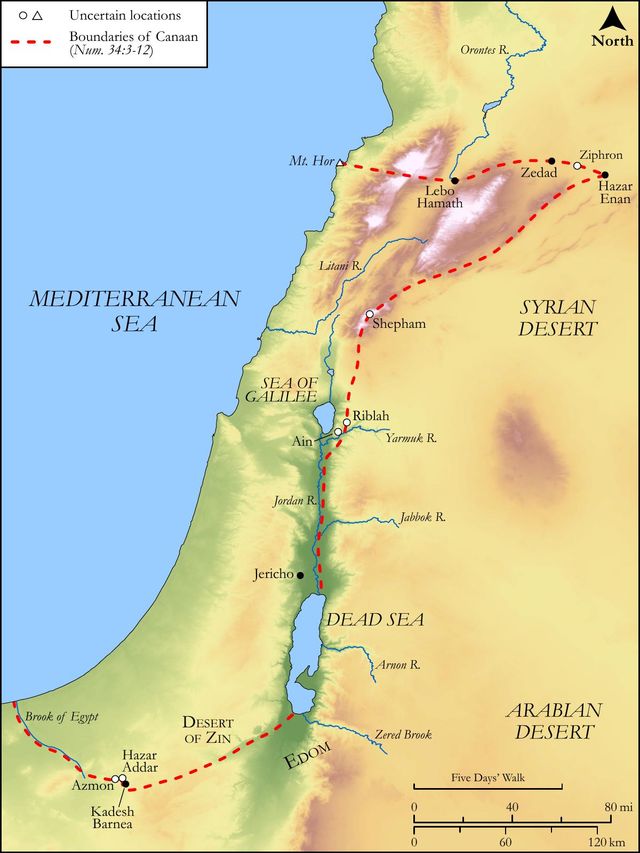
See on the biblical-era map
Study this verse
Historical interpretation
Historical reception
1 surviving comment on this verse from the historical church.
The Scorpion: A mountain so called from having a great number of scorpions.
Continue studying Numbers 34:4 across the web’s major study libraries — every link below opens this exact verse, chapter, or book on the destination site.
Read & Compare
 BibleGatewayThis verse in more than 200 translations and 70 languages.
 Bible.comThe YouVersion reader — hundreds of translations, reading plans, and highlights.
 ESV.orgCrossway's official English Standard Version reader.
 NET BibleThe NET translation with 60,000+ translators' notes on every rendering decision.
 STEP BibleTyndale House's free study tool — original text, vocabulary, and scholarly resources.
 BibliaLogos Bible Software's free web reader.
 USCCBThe New American Bible (Revised Edition) with the U.S. bishops' study notes.
Commentaries
 BibleHub CommentariesDozens of classic commentaries on this verse, gathered on one page.
 StudyLightMore than 100 commentary sets — the largest collection on the web.
 BibleRefPlain-English commentary on what this verse means, verse by verse.
 Enduring WordDavid Guzik's free commentary on this chapter, widely used by Bible teachers.
 Bible Study ToolsVerse commentary alongside Greek and Hebrew study aids.
Original Language & Research
- BibleHub InterlinearThe verse word by word — original language, transliteration, and English.
- BibleHub LexiconEvery word's original-language definition and Strong's entry.
 Blue Letter BibleDeep-study tools — Strong's numbers, concordance, and word studies.
 SefariaThe Hebrew text with Rashi and centuries of Jewish commentary.
Sermons, Hymns & Audio


TrulyRandomVerse is not affiliated with these sites and doesn’t control their content. They’re linked because they’re genuinely useful.
Summary
Numbers 34:4 meticulously details a crucial segment of the southern border of the land of Canaan, outlining its geographical course from the ascent of Akrabbim through the Wilderness of Zin, touching Kadeshbarnea, and extending to Hazaraddar and Azmon. This verse is part of a larger divine decree (Numbers 34:1-12) providing precise boundaries for the inheritance God promised to the Israelites, underscoring His faithfulness and the certainty of His covenant fulfillment as they prepared to enter the Promised Land after decades of wilderness wandering.
Context
ShowHideLiterary Context
Numbers 34:4 is embedded within a highly descriptive passage (Numbers 34:1-12) that delineates the precise boundaries of the land of Canaan which the Lord commanded the Israelites to possess. This chapter marks a significant shift in the book of Numbers, moving from the Israelites' wilderness journey and the laws governing their community to the practical details of their future settlement. Following the census and instructions for dividing the land by lot (Numbers 26:52-56), this detailed geographical survey serves as a divine land deed, providing an unambiguous definition of their God-given territory. It precedes the appointment of specific leaders responsible for the land's distribution (Numbers 34:16-29), emphasizing the divine authority and meticulous planning behind Israel's inheritance. The attention to detail here reinforces the seriousness of God's covenant promises and His active involvement in the practical aspects of His people's lives.
Historical & Cultural Context
The setting for Numbers 34 is the plains of Moab, east of the Jordan River, as the generation of Israelites who rebelled at Kadeshbarnea had died off, and their descendants stood poised to enter Canaan. For Israel, land ownership and defined borders were paramount, secured through divine grant and conquest. The meticulous description of boundaries in this passage reflects the cultural importance of clear territorial claims, preventing future disputes among the tribes and with neighboring peoples. Geographical features like "ascent of Akrabbim" (Scorpion Pass) and "Zin" (a wilderness) served as natural, often formidable, markers. Kadeshbarnea, specifically mentioned, held immense historical significance as the site of Israel's initial rebellion and subsequent forty-year wandering, as recounted in Numbers 13 and Numbers 14. Its inclusion in the border description not only provides a clear geographical reference but also subtly reminds the new generation of the consequences of disobedience and the renewed opportunity for obedience.
Key Themes
ShowHideThe meticulous delineation of the southern border in Numbers 34:4 contributes to several overarching themes in the book of Numbers and the Pentateuch. Firstly, it powerfully illustrates Divine Precision and Fulfillment. God's covenant promise to Abraham regarding the land (see Genesis 15:18-21) is not a vague notion but a specific, tangible reality, now being fulfilled with exact geographical coordinates. This highlights God's unwavering faithfulness and the certainty of His word. Secondly, the passage underscores the theme of Inheritance and Possession. The land of Canaan is presented not merely as conquered territory but as a divine gift, an inheritance from the Lord to His chosen people. The boundaries are divinely set to establish a clear and secure possession, emphasizing Israel's unique status and God's provision for their flourishing. Finally, the detailed instructions reflect God's commitment to Order and Structure. Divine plans are characterized by clarity and precision. The specific delineation of borders was essential for preventing internal tribal disputes and providing a clear framework for their settlement, governance, and the establishment of a holy nation in the land God had prepared for them. This divine blueprint for their future life in the land demonstrates God's sovereign hand in every detail of Israel's existence.
Exposition and Analysis
ShowHideKey Word Analysis
ShowHideMeaning "Steep of Scorpions" or "Ascent of Scorpions," this term refers to a specific geographical feature, likely a steep, rugged, and arid mountainous pass. Its inclusion in the border description indicates a natural, formidable, and easily recognizable landmark in the desolate landscape, serving as a clear boundary marker due to its distinct and challenging terrain, as it is an "elevation" or "acclivity."
This refers to the Wilderness of Zin, a desolate desert region located south of Canaan and west of the Arabah. It is described as a "crag," emphasizing its rugged and barren nature. It was a significant and often harsh environment where the Israelites spent considerable time during their wilderness wanderings. Its mention here anchors the border within a well-known, albeit barren, geographical expanse, connecting the promised land to the Israelites' recent past.
A pivotal oasis and encampment site, central to Israel's wilderness experience, meaning "Kadesh of (the) Wilderness of Wandering." It was from Kadeshbarnea that the twelve spies were dispatched into Canaan, and where the Israelites' rebellion led to their prolonged forty-year wandering. Its inclusion in the border description highlights its strategic and historical importance as a landmark on the southern frontier of the promised inheritance.
Verse Breakdown
ShowHide"And your border shall turn from the south to the ascent of Akrabbim"
This clause initiates the description of the southern boundary, indicating a directional change from a general southern starting point towards a specific, recognizable landmark. The "ascent of Akrabbim" marks the southeastern corner or a significant turning point of the border, signifying a shift in its trajectory as it moves westward.
"and pass on to Zin"
Following the ascent of Akrabbim, the border continues its course through the Wilderness of Zin. This indicates that a significant portion of the southern boundary would traverse this desolate desert region, utilizing its natural features as part of the divinely appointed demarcation. The verb "pass on" (H5674, ʻâbar) emphasizes the transition and movement of the boundary line through this area.
"and the going forth thereof shall be from the south to Kadeshbarnea"
This phrase clarifies and reinforces the southern extent of the border, specifically linking it to Kadeshbarnea. It suggests that Kadeshbarnea itself, or its immediate vicinity, served as a key point on the southern boundary, a landmark that the border "goes forth" (H8444, tôwtsâʼâh, meaning "exit" or "boundary") or extends to from its more easterly points within the Wilderness of Zin. This further emphasizes the precise nature of the boundary's "outgoings."
"and shall go on to Hazaraddar, and pass on to Azmon"
These final geographical markers further delineate the westward progression of the southern border. Hazaraddar and Azmon are specific locations that complete this segment, demonstrating the thoroughness and precision of the divine survey. Their inclusion underscores that the border was not vaguely defined but meticulously traced through a series of identifiable points, ensuring clarity for future possession. The repeated verbs "go on" (H3318, yâtsâʼ, "to go out") and "pass on" (H5674, ʻâbar, "to cross over") reinforce the continuous and deliberate tracing of the boundary.
Literary Devices
ShowHideThe primary literary device employed in Numbers 34:4, and indeed throughout the entire border description (Numbers 34:1-12), is Topography/Geography. The text is a highly detailed geographical survey, meticulously naming specific landmarks, wildernesses, and directional turns to define the precise boundaries of the Promised Land. This detailed mapping serves to underscore the divine precision and the tangible reality of God's promise. Furthermore, the use of Specificity and Precision is evident in the naming of each point ("ascent of Akrabbim," "Zin," "Kadeshbarnea," "Hazaraddar," "Azmon"), leaving no ambiguity about the extent of the inheritance. This precision reflects God's orderly nature and His commitment to fulfilling His word with exactness. The repeated use of verbs of movement and progression such as "turn," "pass on," and "go on" creates a sense of a linear, defined boundary, reinforcing the Repetition of the border's trajectory. This consistent linguistic pattern emphasizes the methodical and deliberate nature of the divine demarcation.
Theological and Thematic Connections
ShowHideNumbers 34:4, with its meticulous geographical detail, powerfully underscores God's unwavering faithfulness to His covenant promises. The land, first promised to Abraham (Genesis 15:18), is now being precisely defined for his descendants, demonstrating that God's word is reliable and His plans are concrete. This divine precision in mapping out the physical inheritance foreshadows the certainty of God's spiritual promises. Just as Israel was given a secure, defined territory, believers today are given a secure, spiritual inheritance in Christ, marked by divine boundaries and certain possession. The emphasis on specific landmarks also highlights God's active involvement in the practical realities of His people's lives, providing order and preventing disputes. This attention to detail speaks to a God who is intimately concerned with every aspect of His creation and His people's well-being, ensuring their security and blessing within the parameters He establishes.
Reflection and Application
ShowHideNumbers 34:4, though a geographical description from ancient times, offers profound insights for contemporary believers. It reminds us that God is a God of precision, order, and unwavering faithfulness. Just as He meticulously defined the boundaries of Israel's inheritance, He has also established clear spiritual and moral boundaries for our lives. These divine parameters are not meant to restrict us but to protect us, guide us, and lead us into the fullness of the "promised land" of abundant life in Christ. Understanding and respecting these boundaries—whether in our relationships, finances, or personal conduct—is crucial for walking in God's will and experiencing His blessings. Furthermore, this verse serves as a powerful reminder that God's promises are concrete and certain. We can trust that every promise He has made, whether concerning salvation, provision, or His return, will be fulfilled with the same divine precision seen in the ancient borders of Canaan. Our spiritual inheritance in Christ is as real and secure as the land was for Israel, a gift from a faithful God who keeps His word to the smallest detail.
Questions for Reflection
ShowHideFAQ
ShowHideWhy is so much detail given to geographical borders in the Bible, especially in Numbers 34:4?
ShowHideThe meticulous detail given to geographical borders, as seen in Numbers 34:4, is crucial for several reasons. Firstly, it underscores the divine fulfillment of promises. God had promised Abraham and his descendants a specific land (e.g., Genesis 15:18), and these detailed descriptions prove that God's word is not vague but precise and tangible. Secondly, it served a practical and legal purpose. Clear boundaries were essential for preventing disputes among the twelve tribes of Israel as they divided their inheritance, and for defining their national territory against surrounding peoples. In Israel, land ownership was paramount, and detailed land deeds were common, as when Jeremiah bought the field of Hanameel and "subscribed the evidence, and sealed it, and took witnesses." This passage functions as a divine land deed. Lastly, it highlights God's orderly and sovereign nature. God is not chaotic; His plans are well-defined and executed with precision, demonstrating His control over history and geography. The inclusion of historically significant sites like Kadeshbarnea also connects the future possession of the land to Israel's past experiences and God's ongoing guidance.
Christ-Centered Fulfillment
ShowHideWhile Numbers 34:4 describes a physical inheritance for ancient Israel, its ultimate fulfillment and spiritual significance are found in Christ. The Promised Land, with its divinely ordained boundaries, serves as a powerful type and shadow of the secure and eternal inheritance that believers possess in Jesus. Just as Israel's land was a gift of grace, so too is our spiritual inheritance, not earned by works but freely given through faith in Christ. The meticulous precision of the ancient borders foreshadows the absolute certainty and security of our "inheritance in the saints in light," as described in Colossians 1:12. Jesus is the true "Promised Land," the one in whom all of God's promises find their "Yes" and "Amen" (see 2 Corinthians 1:20). Through His atoning work, He has secured for us not merely a temporary physical dwelling, but an eternal dwelling with God, a heavenly country (as longed for in Hebrews 11:16). The boundaries of this spiritual inheritance are defined by the boundless grace of God and the finished work of Christ, leading us into a rest that transcends any earthly territory (compare Hebrews 4:1-11). Ultimately, the detailed land descriptions point to the perfect and secure new heavens and new earth, where God will dwell with His people, and there will be no more curse, only perfect peace and everlasting possession (foreseen in Revelation 21:1-4).