


Genesis 14:3
Bible text: King James Version (1769 Blayney text) · Public domain
Bible text: Berean Standard Bible · Public domain
Bible text: American Standard Version (1901) · Public domain
Bible text: World English Bible, Messianic edition · Public domain
Bible text: Geneva Bible (1599) · Public domain
Bible text: Young's Literal Translation · Public domain
- כָּלkolallH3605N-mscNoun Singular Masculine Construct
- אֵלֶּה'e·lehtheseH428PrtParticle Demonstrative
- חָבְרוּcha·ve·Ruthey joined togetherH2266V-Qal-Perf-3cpVerb Qal Perfect 3rd Plural common gender
- אֶל'eltoH413PrepPreposition
- עֵמֶק'E·mek[the] valley ofH6010N-mscNoun Singular Masculine Construct
- הַשִּׂדִּיםha·si·Dim<the> SiddimH7708Art ¦ N-properNoun Proper Locationהַ<the>שִּׂדִּיםSiddim
- הוּאhu'thatH1931Pro-3msPronoun Personal 3rd Singular Masculine
- יָםyam[is] [the] Sea ofH3220N-mscNoun Singular Masculine Construct
- הַמֶּלַחha·Me·lach<the> SaltH4417Art ¦ N-msNoun Singular Masculine Absoluteהַ<the>מֶּלַחSalt
English is a literal word-by-word gloss of the Hebrew, not the KJV's wording. Why?
This is the original text the KJV's translators worked from — each Hebrew word with its own literal English meaning in this verse, prepared by scholars at Tyndale House, Cambridge. The KJV translates whole sentences, not word by word, so its wording differs: one Hebrew word can become several English words, and the KJV may choose “the LORD” where the gloss reads “Yahweh”. Both are faithful — they answer different questions. For the KJV's own rendering, switch to the KJV text.
Details
See on the biblical-era maps


Study this verse
Public-domain commentary
Matthew Henry
From his Commentary on the Whole Bible. Henry comments on passages, not single verses — this entry covers Genesis 14:1–12. His three-level outline is real structure in the source text, so it is rendered as structure.
We have here an account of the first war that ever we read of in scripture, which (though the wars of the nations make the greatest figure in history) we should not have had the history of if Abram and Lot had not been concerned in it. Now, concerning this war, we may observe,
I.The parties engaged in it.
The invaders were four kings, two of them no less than kings of Shinar and Elam (that is, Chaldea and Persia), yet probably not the sovereign princes of those great kingdoms in their own persons, but either officers under them, or rather the heads and leaders of some colonies which came out of those great nations, and settled themselves near Sodom, but retained the names of the countries from which they had their origin. The invaded were the kings of five cities that lay near together in the plain of Jordan, namely, Sodom, Gomorrah, Admah, Zeboiim, and Zoar. Four of them are named, but not the fifth, the king of Zoar or Bela, either because he was much more mean and inconsiderable or because he was much more wicked and inglorious than the rest, and worthy to be forgotten.
II.The occasion of this war was the revolt of the five kings from under the government of Chedorlaomer.
Twelve years they served him. Small joy they had of their fruitful land, while thus they were tributaries to a foreign power, and could not call what they had their own. Rich countries are a desirable prey, and idle luxurious countries are an easy prey, to growing greatness. The Sodomites were the posterity of Canaan whom Noah had pronounced a servant to Shem, from whom Elam descended; thus soon did that prophecy begin to e fulfilled. In the thirteenth year, beginning to be weary of their subjection, they rebelled, denied their tribute, and attempted to shake off the yoke and retrieve their ancient liberties. In the fourteenth year, after some pause and preparation, Chedorlaomer, in conjunction with his allies, set himself to chastise and reduce the rebels, and, since he could not have it otherwise, to fetch his tribute from them on the point of his sword. Note, Pride, covetousness, and ambition, are the lusts from which wars and fightings come. To these insatiable idols the blood of thousands has been sacrificed.
III.The progress and success of the war.
The four kings laid the neighbouring countries waste and enriched themselves with the spoil of them (Gen 14:5-7), upon the alarm of which it had been the wisdom of the king of Sodom to submit, and desire conditions of peace; for how could he grapple with an enemy thus flushed with victory? But he would rather venture the utmost extremity than yield, and it sped accordingly. Quos Deus destruet eos dementat - Those whom God means to destroy he delivers up to infatuation.
1.The forces of the king of Sodom and his allies were routed; and, it should seem, many of them perished in the slime-pits who had escaped the sword, Gen 14:10. In all places we are surrounded with deaths of various kinds, especially in the field of battle.
2.The cities were plundered, Gen 14:11. All the goods of Sodom, and particularly their stores and provisions of victuals, were carried off by the conquerors. Note, When men abuse the gifts of a bountiful providence to gluttony and excess, it is just with God, and his usual way, by some judgment or other to strip them of that which they have so abused, Hos 2:8, Hos 2:9.
3.Lot was carried captive, Gen 14:12. They took Lot among the rest, and his goods. Now Lot may here be considered,
(1.)As sharing with his neighbours in this common calamity. Though he was himself a righteous man, and (which is here expressly noticed) Abram's brother's son, yet he was involved with the rest in all this trouble. Note, All things come alike to all, Ecc 9:2. The best of men cannot promise themselves an exemption from the greatest troubles in this life; neither from our own piety nor our relation to those that are the favourites of heaven will be our security, when God's judgments are abroad. Note, further, Many an honest man fares the worse for his wicked neighbours. It is therefore our wisdom to separate ourselves, or at least to distinguish ourselves, from them (Co2 6:17), and so deliver ourselves, Rev 18:4.
(2.)As smarting for the foolish choice he made of a settlement here. This is plainly intimated when it is said, They took Abram's brother's son, who dwelt in Sodom. So near a relation of Abram should have been a companion and disciple of Abram, and should have abode by his tents; but, if he choose to dwell in Sodom, he must thank himself if he share in Sodom's calamities. Note, When we go out of the way of our duty we put ourselves from under God's protection, and cannot expect that the choices which are made by our lusts should issue to our comfort. Particular mention is made of their taking Lot's goods, those goods which had occasioned his contest with Abram and his separation from him. Note, It is just with God to deprive us of those enjoyments by which we have suffered ourselves to be deprived of our enjoyment of him.
Historical interpretation
Historical reception
1 surviving comment on this verse from the historical church.
(Chapter 14, Verse 3) And the king of Bale, which is Segor. All these agreed in the valley of Salsam, which is the Dead Sea. Bale in the Hebrew language is called κατάποσις, which means swallowing. Therefore, the Hebrews report that in another place in the Scriptures it is called Salisa, and again it is said to be μόσχον τριετίζουσαν, which means a three-year-old calf, because it was indeed swallowed up by the third movement of the earth (1 Samuel 9:4; Isaiah 15:5). And from that time, since Sodom and Gomorrah, Adama and Seboim were destroyed by divine fire, it is called that little one. Indeed, Segor is transferred to a small place called Zoara in the Syriac language. The Valley of Salt, as it is written in this same book, in which there were previously pits of bitumen, after the wrath of God and the rain of sulfur, was turned into the Dead Sea, which is called by the Greeks λίμνη Ἀσφαλτῖτις, that is, the lake of bitumen.
Continue studying Genesis 14:3 across the web’s major study libraries — every link below opens this exact verse, chapter, or book on the destination site.
Read & Compare
 BibleGatewayThis verse in more than 200 translations and 70 languages.
 Bible.comThe YouVersion reader — hundreds of translations, reading plans, and highlights.
 ESV.orgCrossway's official English Standard Version reader.
 NET BibleThe NET translation with 60,000+ translators' notes on every rendering decision.
 STEP BibleTyndale House's free study tool — original text, vocabulary, and scholarly resources.
 BibliaLogos Bible Software's free web reader.
 USCCBThe New American Bible (Revised Edition) with the U.S. bishops' study notes.
Commentaries
 BibleHub CommentariesDozens of classic commentaries on this verse, gathered on one page.
 StudyLightMore than 100 commentary sets — the largest collection on the web.
 BibleRefPlain-English commentary on what this verse means, verse by verse.
 Enduring WordDavid Guzik's free commentary on this chapter, widely used by Bible teachers.
 Bible Study ToolsVerse commentary alongside Greek and Hebrew study aids.
Original Language & Research
- BibleHub InterlinearThe verse word by word — original language, transliteration, and English.
- BibleHub LexiconEvery word's original-language definition and Strong's entry.
 Blue Letter BibleDeep-study tools — Strong's numbers, concordance, and word studies.
 SefariaThe Hebrew text with Rashi and centuries of Jewish commentary.
Sermons, Hymns & Audio


TrulyRandomVerse is not affiliated with these sites and doesn’t control their content. They’re linked because they’re genuinely useful.
Summary
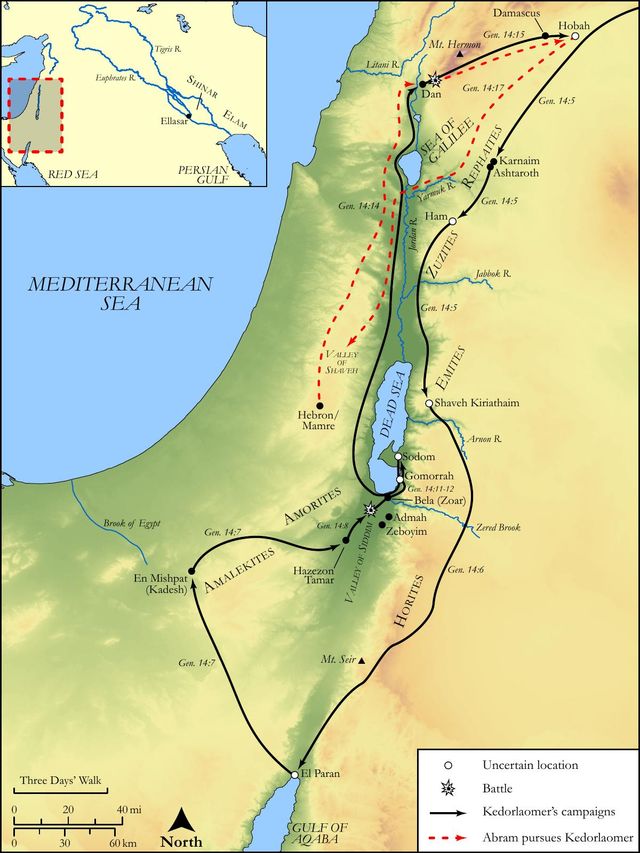
The narrative precisely identifies the geographical location where the five rebellious city-kings of the plain united their forces to confront the eastern coalition, establishing the "vale of Siddim" as synonymous with "the salt sea," known today as the Dead Sea. This crucial detail grounds the narrative of the War of the Kings in a specific, identifiable historical and geographical setting, providing vital context for understanding the subsequent events involving Abram and the unfolding of God's redemptive plan amidst human conflict.
Context
ShowHideLiterary Context
This verse is an integral and explanatory detail within the broader narrative of the "War of the Kings" in Genesis 14. It immediately follows the introduction of the five rebellious kings of the plain—Sodom, Gomorrah, Admah, Zeboiim, and Bela (Zoar)—who had served Chedorlaomer for twelve years but revolted in the thirteenth, as described in Genesis 14:1-2. Verse 3 serves to geographically pinpoint the strategic assembly point of these five kings, setting the stage for the dramatic confrontation with the invading eastern kings. This precise geographical identification is crucial for the reader to visualize the battleground and understand the subsequent capture of Lot, Abram's nephew, detailed in Genesis 14:11-12, which then triggers Abram's heroic rescue mission.
Historical & Cultural Context
The period described in Genesis 14 reflects the geopolitical realities of the early second millennium BCE. It was an era characterized by powerful city-states and regional empires, where service and tribute were common, and rebellion often led to punitive military campaigns. The "kings" mentioned were likely rulers of relatively small city-states or tribal confederations. The "vale of Siddim," before its transformation, was a fertile plain, rich in bitumen pits (Genesis 14:10), making it a valuable agricultural and resource-rich area. The wealth of cities like Sodom and Gomorrah, situated in this plain, made them attractive targets for imperial powers like Chedorlaomer. The identification of this valley with the "Salt Sea" indicates a significant geographical shift, likely due to the later catastrophic events of Genesis 19, which transformed the once-fertile plain into the desolate, highly saline body of water known today as the Dead Sea.
Key Themes
ShowHideGenesis 14:3 contributes to several key themes within the broader biblical narrative. Firstly, it underscores the historical and geographical grounding of biblical events. The Bible consistently roots its narratives in real places and times, reinforcing its claim to historical accuracy. Secondly, it highlights the theme of divine sovereignty amidst human conflict. Even in a seemingly secular account of regional warfare, God's providential hand is at work, orchestrating events that will directly impact Abram, the bearer of the covenant promises. The conflict in the vale of Siddim ultimately leads to Abram's demonstration of faith and power, foreshadowing the greater spiritual battles to come. Thirdly, the identification of the vale with the "Salt Sea" subtly foreshadows the theme of divine judgment against sin, particularly against the wickedness of Sodom and Gomorrah, whose destruction would dramatically alter this very landscape, as recorded in Genesis 19:24-25.
Exposition and Analysis
ShowHideKey Word Analysis
ShowHideA primitive root meaning "to join" (literally or figuratively), "to be compact," "to couple together," or "to league." In this context, it signifies the act of forming a united front or alliance. The five kings of the plain "leagued" or "confederated" their forces, indicating a strategic military alliance against their common oppressor. This word emphasizes the deliberate act of unification for a specific purpose—war.
Derived from a root meaning "to be deep," this noun refers to a "vale" or "broad depression," often a valley or low plain. It describes a geographical feature, typically a fertile area between hills or mountains. The "vale of Siddim" thus denotes a specific low-lying plain, which, prior to its desolation, was likely a productive and habitable region, suitable for the establishment of prosperous cities.
From a root meaning "to pulverize" or "to dissolve," this noun refers to "salt" (as easily pulverized and dissolved). Its use here in "the salt sea" highlights the distinctive characteristic of this body of water: its extreme salinity, which makes it inhospitable to most life. This term is crucial for identifying the "vale of Siddim" with the Dead Sea, emphasizing its unique geological and chemical properties.
Verse Breakdown
ShowHide"All these were joined together"
This clause refers to the five kings of the plain—the king of Sodom, the king of Gomorrah, the king of Admah, the king of Zeboiim, and the king of Bela (Zoar)—who had previously been introduced as having rebelled against Chedorlaomer. The phrase emphasizes their unified action, indicating a deliberate military alliance formed to resist the eastern invaders. It sets the stage for a collective confrontation.
"in the vale of Siddim"
This specifies the precise geographical location of their assembly. The "vale" (Hebrew ʻêmeq) suggests a low-lying plain or valley, likely fertile and suitable for battle formations. The name "Siddim" itself is of uncertain etymology, possibly relating to "fields" or "plains," reinforcing the idea of an open area. This detail provides a concrete setting for the impending conflict.
"which is the salt sea"
This crucial parenthetical statement identifies the "vale of Siddim" with the "Salt Sea," universally recognized as the Dead Sea. This identification is highly significant. It tells the reader that by the time the text was written, the once-existing "vale of Siddim" had either been submerged or transformed into the highly saline body of water. This connection not only anchors the narrative geographically but also subtly foreshadows the future destruction of the cities of the plain, which would dramatically alter the landscape and contribute to the Dead Sea's formation or expansion.
Literary Devices
ShowHideThe verse primarily employs Apposition and Geographical Realism. Apposition is evident in the phrase "the vale of Siddim, which is the salt sea," where "the salt sea" serves to identify and clarify what "the vale of Siddim" is. This literary technique provides a crucial geographical anchor for the reader, linking an ancient place name to a well-known landmark. This also contributes to the Geographical Realism of the narrative, grounding the biblical account in tangible, identifiable locations. By providing such precise geographical details, the text enhances its credibility and historical verisimilitude. Furthermore, the mention of the "salt sea" carries a subtle element of Foreshadowing and Symbolism. Given the later destruction of Sodom and Gomorrah, the "salt sea" becomes a powerful symbol of divine judgment and desolation, hinting at the fate awaiting the wicked cities of the plain situated within or near this very valley.
Theological and Thematic Connections
ShowHideGenesis 14:3, though seemingly a simple geographical detail, profoundly contributes to the Bible's overarching theological narrative. It underscores the divine commitment to grounding sacred history in real-world geography and human events, reinforcing the reliability of Scripture. The precise identification of the "vale of Siddim" with the "Salt Sea" demonstrates that God's plan unfolds not in mythical realms, but within the tangible realities of human history and geography. This detail highlights the intersection of human agency (the kings' rebellion and alliance) with divine sovereignty, as these events ultimately serve to bring Abram into prominence and advance the covenant promises. The transformation of a fertile valley into a desolate salt sea also serves as an enduring testament to the consequences of sin and the reality of divine judgment, a theme that reverberates throughout the Old Testament and finds its ultimate expression in Christ.
Reflection and Application
ShowHideEven seemingly minor geographical details in Scripture, such as the identification of the Vale of Siddim, serve to root the divine narrative firmly in human history and real places. This verse reminds us that biblical events are not abstract tales but occurred in specific, identifiable locations, involving real people and real conflicts. Understanding these precise details enriches our comprehension of the narrative and reinforces the Bible's reliability as a historical document. For the modern reader, this encourages a deeper trust in God's interaction with humanity, demonstrating that His sovereign plan unfolds within the tangible realities of our world. It invites us to consider how God works through the "valleys" and conflicts of our own lives and societies, shaping events for His ultimate purposes. Just as the physical landscape was transformed, our spiritual landscapes can be transformed by God's judgment and grace, leading us to seek His purposes in our own historical contexts.
Questions for Reflection
ShowHideFAQ
ShowHideWhy is the "vale of Siddim" also called the "Salt Sea" in Genesis 14:3?
ShowHideThe identification of the "vale of Siddim" with the "Salt Sea" (the Dead Sea) in Genesis 14:3 suggests a significant geographical transformation or a contemporary understanding of the region by the time the text was written. Originally, the Vale of Siddim was likely a fertile plain, suitable for the wealthy cities of the plain, characterized by bitumen pits (Genesis 14:10). Its later equation with the highly saline Dead Sea indicates that by the time of the biblical writer, this once-fertile area had either become significantly more saline due to natural geological processes or, more powerfully, had undergone the dramatic desolation associated with the destruction of Sodom and Gomorrah (Genesis 19:24-25). This catastrophic event transformed parts of the valley into a desolate, salt-laden body of water. This dual naming thus highlights both the evolving nature of the landscape and the profound, lasting impact of divine judgment on the region.
Christ-Centered Fulfillment
ShowHideWhile Genesis 14:3 primarily provides geographical context for a historical conflict, it implicitly points to Christ as the ultimate victor over the powers of this world and the one who establishes a new, eternal kingdom. The "War of the Kings" in the Vale of Siddim, though a physical battle, foreshadows the spiritual warfare in which Christ engaged and triumphed over sin and death. Just as Abram, a type of Christ, intervened to rescue Lot and restore order, Christ, the true King, entered the world's conflict to deliver humanity from bondage and bring about a new creation. His victory over the "rulers and authorities" of darkness (Colossians 2:15) far surpasses any earthly military triumph. The desolation of the Salt Sea, a symbol of judgment against sin, finds its ultimate answer in Christ, who bore the judgment for humanity's sin on the cross (2 Corinthians 5:21). Through Him, a new spiritual landscape is forged, where the barrenness of sin is replaced by the flourishing life of God's kingdom (John 10:10). His kingdom is not bound by earthly geography or subject to the rise and fall of human empires, but is eternal and righteous, fulfilling the promises made to Abraham in a spiritual and universal sense, culminating in a new heavens and a new earth where there is no more sea of desolation, but a river of life (Revelation 21:1; Revelation 22:1).