


Numbers 34:12
Bible text: King James Version (1769 Blayney text) · Public domain
Bible text: Berean Standard Bible · Public domain
Bible text: American Standard Version (1901) · Public domain
Bible text: World English Bible, Messianic edition · Public domain
Bible text: Geneva Bible (1599) · Public domain
Bible text: Young's Literal Translation · Public domain
- וְיָרַדve·ya·Radand it will go downH3381Conj-w ¦ V-Qal-ConsecPerf-3msVerb Qal Consecutive Perfect 3rd Singular Masculineוְandיָרַדit will go down
- הַגְּבוּלha·ge·Vulthe borderH1366Art ¦ N-msNoun Singular Masculine Absoluteהַtheגְּבוּלborder
- הַיַּרְדֵּנָהhai·yar·De·nahthe Jordan towardsH3383Art ¦ N-proper ¦ SfxNoun Proper LocationהַtheיַּרְדֵּנָJordanהtowards
- וְהָיוּve·ha·Yuand they will beH1961Conj-w ¦ V-Qal-ConsecPerf-3cpVerb Qal Consecutive Perfect 3rd Plural common genderוְandהָיוּthey will be
- תוֹצְאֹתָיוtotz·'o·Tavits extremitiesH8444N-fpc ¦ 3msNoun Plural Feminine Constructתוֹצְאֹתָיextremitiesוits
- יָםyam[the] Sea ofH3220N-mscNoun Singular Masculine Construct
- הַמֶּלַחha·Me·lach<the> SaltH4417Art ¦ N-msNoun Singular Masculine Absoluteהַ<the>מֶּלַחSalt
- זֹאתzoTthisH2063PrtParticle Demonstrative
- תִּהְיֶהtih·Yehit will beH1961V-Qal-Imperf-3fsVerb Qal Imperfect 3rd Singular Feminine
- לָכֶםla·Khemof youPrep-l ¦ 2mpSuffix Personal 2nd Plural Masculineלָofכֶםyou
- הָאָרֶץha·'A·retzthe landH776Art ¦ N-fsNoun Singular Feminine Absoluteהָtheאָרֶץland
- לִגְבֻלֹתֶיהָlig·vu·lo·Tei·hato its bordersH1367Prep-l ¦ N-fpc ¦ 3fsNoun Plural Feminine Constructלִtoגְבֻלֹתֶיbordersהָits
- סָבִיבsa·Vivall aroundH5439N-csNoun Singular common gender Absolute
English is a literal word-by-word gloss of the Hebrew, not the KJV's wording. Why?
This is the original text the KJV's translators worked from — each Hebrew word with its own literal English meaning in this verse, prepared by scholars at Tyndale House, Cambridge. The KJV translates whole sentences, not word by word, so its wording differs: one Hebrew word can become several English words, and the KJV may choose “the LORD” where the gloss reads “Yahweh”. Both are faithful — they answer different questions. For the KJV's own rendering, switch to the KJV text.
Details
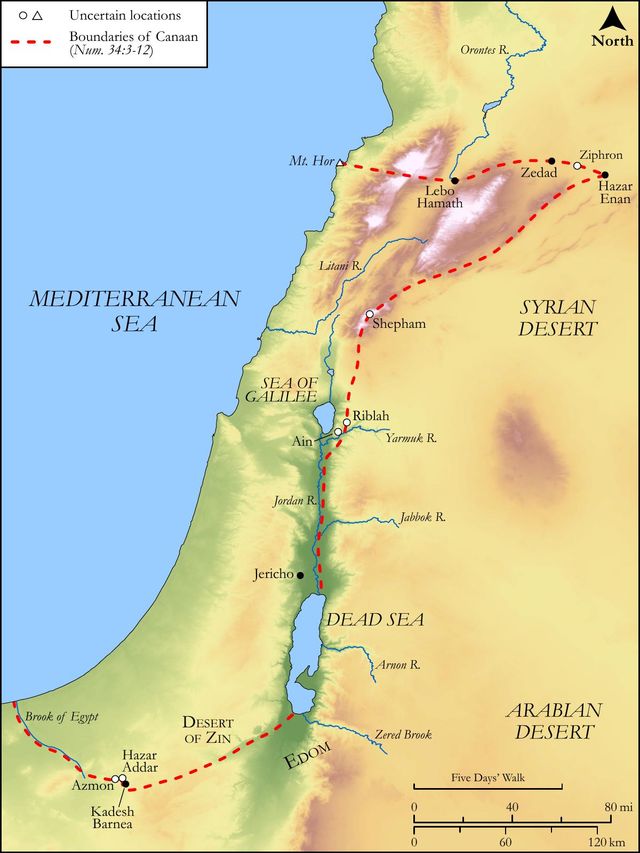
See on the biblical-era map
Study this verse
Continue studying Numbers 34:12 across the web’s major study libraries — every link below opens this exact verse, chapter, or book on the destination site.
Read & Compare
 BibleGatewayThis verse in more than 200 translations and 70 languages.
 Bible.comThe YouVersion reader — hundreds of translations, reading plans, and highlights.
 ESV.orgCrossway's official English Standard Version reader.
 NET BibleThe NET translation with 60,000+ translators' notes on every rendering decision.
 STEP BibleTyndale House's free study tool — original text, vocabulary, and scholarly resources.
 BibliaLogos Bible Software's free web reader.
 USCCBThe New American Bible (Revised Edition) with the U.S. bishops' study notes.
Commentaries
 BibleHub CommentariesDozens of classic commentaries on this verse, gathered on one page.
 StudyLightMore than 100 commentary sets — the largest collection on the web.
 BibleRefPlain-English commentary on what this verse means, verse by verse.
 Enduring WordDavid Guzik's free commentary on this chapter, widely used by Bible teachers.
 Bible Study ToolsVerse commentary alongside Greek and Hebrew study aids.
Original Language & Research
- BibleHub InterlinearThe verse word by word — original language, transliteration, and English.
- BibleHub LexiconEvery word's original-language definition and Strong's entry.
 Blue Letter BibleDeep-study tools — Strong's numbers, concordance, and word studies.
 SefariaThe Hebrew text with Rashi and centuries of Jewish commentary.
Sermons, Hymns & Audio


TrulyRandomVerse is not affiliated with these sites and doesn’t control their content. They’re linked because they’re genuinely useful.
Summary
Numbers 34:12 meticulously defines the eastern boundary of the land of Canaan, the divine inheritance promised to the Israelites, specifying its course along the Jordan River and its termination at the Salt Sea (Dead Sea). This verse concludes a comprehensive divine survey of Israel's future territory, underscoring God's unwavering faithfulness, sovereign precision, and the tangible reality of His covenant promises to provide a secure and divinely demarcated homeland for His people.
Context
ShowHideLiterary Context
Numbers 34:12 serves as the concluding geographical marker in God's detailed instructions to Moses regarding the precise boundaries of the land of Canaan, which the Israelites were poised to inherit. The chapter systematically outlines the four cardinal borders: beginning with the southern boundary (Numbers 34:3-5), progressing to the western border along the Great Sea (Numbers 34:6), then the northern limits (Numbers 34:7-9), and finally, this verse completes the description by defining the eastern frontier. This meticulous demarcation follows the census and the divine mandate for land distribution by lot among the tribes (Numbers 26:52-56; 33:54). The specificity of these boundaries was not merely administrative; it was crucial for establishing clear tribal identities, preventing future territorial disputes, and tangibly affirming the divine promise of a homeland, setting the stage for the narrative of conquest and settlement in the book of Joshua.
Historical & Cultural Context
At the time these divine instructions were delivered, the Israelites were encamped on the plains of Moab, on the cusp of entering the Promised Land after forty years of wilderness wandering. Among the nations, land ownership and clearly defined territorial boundaries were paramount, often serving as a primary source of conflict and a symbol of national identity and security. By providing such precise geographical markers—the Jordan River and the Salt Sea (Dead Sea) being prominent and undeniable natural landmarks—God not only demonstrated His sovereign control over the land but also provided a clear, divinely sanctioned basis for Israel's claim to it. This precision would have been indispensable for the tribal leaders and subsequent generations in establishing their dominion, ensuring stability, and transitioning from a nomadic existence to a settled, divinely appointed nation.
Key Themes
ShowHideNumbers 34:12 profoundly contributes to several overarching themes within the book of Numbers and the Pentateuch as a whole. Primarily, it powerfully illustrates God's divine faithfulness in fulfilling His covenant promises, particularly the land promise made to Abraham in Genesis 15:18. The meticulous detail underscores that this inheritance was not a matter of chance or human endeavor, but a precise, divinely ordained gift. Secondly, it emphasizes the theme of inheritance and possession, as the land was the tangible expression of God's blessing and the secure place where Israel would dwell as His chosen people. The defined boundaries represented a secure dwelling place, foreshadowing the ultimate rest and spiritual inheritance God provides. Thirdly, the concept of divine order and provision is vividly evident; God, as the ultimate sovereign, meticulously defines the boundaries, ensuring clarity, stability, and preventing future disputes among the tribes. This reflects His wisdom in governance and His comprehensive care for His people, a theme further emphasized in Joshua 21:45, which declares that not one word of God's good promises failed.
Exposition and Analysis
ShowHideKey Word Analysis
ShowHideThis term (H1366) signifies a fixed, defined boundary, limit, or the territory enclosed by such a limit. Its pervasive use throughout Numbers 34 emphasizes the precise and unalterable nature of the land God was granting to Israel. It speaks to a divine demarcation, not merely a suggestion but a decreed limit, establishing sovereignty and preventing ambiguity in possession. The repetition reinforces the certainty of the divine gift.
This proper noun (H3383) refers to Jarden, the principal river of Palestine, meaning "a descender." As a prominent and unmistakable natural landmark, its inclusion as a boundary marker provides an undeniable and universally recognized eastern limit for the promised land. Its geographical reality anchors the divine promise in concrete, verifiable terms, making the boundaries clear to all.
This word (H3220) denotes a large body of water, specifically here, the Salt Sea. Derived from an unused root meaning "to roar," it references the tumultuous nature of large waters. The specific mention of the "Salt Sea" (Hebrew, melach H4417, "salt," combined with yâm) reinforces the literal and tangible nature of the land promised to Israel, leaving no room for misinterpretation of its eastern extent. This unique and unmistakable geographical feature serves as a definitive termination point.
Verse Breakdown
ShowHide"And the border shall go down to Jordan"
This clause describes the northern segment of the eastern boundary. It indicates that the border, after traversing the northern limits of the land, would descend along the course of the Jordan River. This "going down" implies following the river's valley from north to south, forming a natural and unmistakable demarcation line on the eastern side of the territory, serving as a significant geographical and historical divide.
"and the goings out of it shall be at the salt sea"
This specifies the southern termination point of the eastern border. The phrase "goings out" (Hebrew, tôwtsâʼâh H8444) refers to the definitive end, exit, or outflow, indicating where the boundary line definitively concludes. Here, it means the Jordan River's confluence with the Salt Sea, marking the southernmost extreme of the eastern frontier. This precise endpoint leaves no ambiguity about the full extent of the land's eastern reach.
"this shall be your land with the coasts thereof round about"
This concluding declaration serves as a powerful divine affirmation of the entire territory described in Numbers 34. "This shall be your land" is a statement of divine gift, ownership, and irrevocable promise. "With the coasts thereof round about" summarizes the comprehensive nature of the entire boundary description, emphasizing that the land, with its fully defined and secure perimeter, is now officially designated as Israel's inheritance. It underscores the completeness and security of the divinely apportioned territory, leaving no part undefined.
Literary Devices
ShowHideThe primary literary device at play in Numbers 34:12, and indeed throughout the entire chapter, is Geographical Precision and Verifiable Realism. The text meticulously details specific, identifiable geographical landmarks such as the Jordan River and the Salt Sea to define the boundaries. This highly specific language grounds the divine promise in a tangible, verifiable reality, leaving no room for ambiguity or metaphorical interpretation of the land. The use of Divine Affirmation in "this shall be your land" acts as a powerful decree, solidifying the legal and theological claim of Israel to the territory. There is also an element of Repetition in the consistent focus on "border," "land," and their precise definitions throughout the chapter, reinforcing the central theme of a divinely granted and clearly defined inheritance. This repetition instills confidence in the certainty of God's promise.
Theological and Thematic Connections
ShowHideNumbers 34:12, as part of God's meticulous delineation of the promised land, serves as a profound testament to His unwavering faithfulness and sovereign control. The physical boundaries of Canaan were not arbitrary but were precisely ordained by God, demonstrating His absolute commitment to fulfilling the covenant promises made to Abraham, Isaac, and Jacob. This tangible inheritance was a foundational aspect of Israel's identity as God's chosen people, providing them with a secure dwelling place where they could live in covenant relationship with Him. The precision of these boundaries also speaks to God's orderly character, ensuring clarity and preventing disputes among the tribes, thereby establishing a stable foundation for their national existence. This historical fulfillment of a physical promise serves as a powerful assurance of God's reliability concerning His spiritual promises to all believers.
Reflection and Application
ShowHideNumbers 34:12, with its emphasis on God's precise and faithful fulfillment of His land promise to Israel, offers profound lessons for contemporary believers. Just as God meticulously defined the boundaries of their physical inheritance, He has also provided clear spiritual boundaries and promises for our lives in Christ. This passage encourages us to trust in the certainty and specificity of God's Word, knowing that His plans for us are equally detailed and sure. It reminds us that our spiritual inheritance in Christ is real and secure, offering a true "land" of rest, purpose, and blessing. We are called to live within the "coasts thereof round about" that God has established through His commandments and principles, finding security and flourishing within His divine order. This passage invites us to reflect on the nature of God's promises—how they are both comprehensive and meticulously fulfilled, providing a firm foundation for our faith and a reliable guide for our lives, assuring us that His Word is always true and His provision complete.
Questions for Reflection
ShowHideFAQ
ShowHideWhy was it so important for God to define the boundaries so precisely?
ShowHideGod's precise definition of the boundaries was crucial for several reasons. Firstly, it demonstrated His absolute faithfulness in fulfilling His covenant promise to Abraham, Isaac, and Jacob to give their descendants a specific, identifiable land (Genesis 15:18). Secondly, it provided a clear, divinely sanctioned basis for Israel's claim to the territory, preventing future disputes among the tribes and with neighboring nations. This precision ensured peace and stability within their inheritance. Thirdly, it established a strong sense of national identity and security for the Israelites, transitioning them from a nomadic existence to a settled people with a divinely defined homeland. This meticulous detail underscores God's orderly nature and His comprehensive care for His people's well-being and stability.
What is the significance of the "Salt Sea" (Dead Sea) in this context?
ShowHideThe "Salt Sea," universally recognized today as the Dead Sea, is significant because it is an unmistakable and prominent geographical landmark. Its extreme salinity, unique geological features, and position as the lowest point on earth make it an undeniable and fixed point of reference. By naming such a distinct feature, God ensured that the eastern boundary of the promised land was clear, tangible, and verifiable, leaving no room for ambiguity or misinterpretation. This reinforces the literal and concrete nature of God's promise of a physical land to Israel, demonstrating His commitment to a real, physical inheritance.
Does this physical land promise have any relevance for believers today?
ShowHideAbsolutely. While the physical land promise was specifically for ancient Israel, it carries profound spiritual and theological relevance for believers today. It serves as a powerful illustration of God's faithfulness to His promises, assuring us that He will also fulfill His spiritual promises to us, including salvation, eternal life, and our spiritual inheritance in Christ (Ephesians 1:11-14). The land also typified the "rest" God provides for His people (Hebrews 4:9), which finds its ultimate fulfillment in Christ. Moreover, God's provision of clear boundaries for Israel reminds us that He also sets wise and beneficial "boundaries" for our lives through His Word, within which we find true freedom, security, and blessing.
Christ-Centered Fulfillment
ShowHideWhile Numbers 34:12 meticulously defines the physical boundaries of the land promised to Israel, its ultimate fulfillment and spiritual significance are found in Jesus Christ. The land of Canaan, with its secure borders and promise of rest, served as a profound type or shadow of the greater spiritual inheritance and eternal rest that God provides in Christ. Jesus Himself declares, "Come to me, all who labor and are heavy laden, and I will give you rest," offering a spiritual dwelling place and security far transcending any earthly territory. Through His atoning work, Christ has secured for believers an unshakable inheritance in the heavenly realms, making us "fellow citizens with the saints and members of the household of God" and "heirs according to the promise" of Abraham through faith. The precise boundaries of Canaan foreshadow the certainty and security of our spiritual position in Christ, where we are "in Him" and have "every spiritual blessing in the heavenly places". Ultimately, the promise of a land culminates not in a geographical territory, but in the New Creation, where God dwells eternally with His people, a reality described in Revelation 21:1-4, where there are no earthly boundaries, but the boundless, glorious presence of God Himself.