


Joshua 21:45
Bible text: King James Version (1769 Blayney text) · Public domain
Bible text: Berean Standard Bible · Public domain
Bible text: American Standard Version (1901) · Public domain
Bible text: World English Bible, Messianic edition · Public domain
Bible text: Geneva Bible (1599) · Public domain
Bible text: Young's Literal Translation · Public domain
- לֹאlo'notH3808NegParticle Negative
- נָפַלna·Falit fellH5307V-Qal-Perf-3msVerb Qal Perfect 3rd Singular Masculine
- דָּבָרda·Vara wordH1697N-msNoun Singular Masculine Absolute
- מִכֹּלmi·Kolfrom everyH3605Prep-m ¦ N-mscNoun Singular Masculine Constructמִfromכֹּלevery
- הַדָּבָרha·da·Var<the> wordH1697Art ¦ N-msNoun Singular Masculine Absoluteהַ<the>דָּבָרword
- הַטּוֹבha·Tov<the> goodH2896Art ¦ Adj-msAdjective Singular Masculine Absoluteהַ<the>טּוֹבgood
- אֲשֶׁר'a·SherwhichH834RelParticle Relative
- דִּבֶּרdi·Berhe had spokenH1696V-Piel-Perf-3msVerb Piel Perfect 3rd Singular Masculine
- יְהוָהYah·wehYahwehH3068N-properNoun Proper Title
- אֶל'eltoH413PrepPreposition
- בֵּיתbeit[the] house ofH1004N-mscNoun Singular Masculine Construct
- יִשְׂרָאֵלYis·ra·'ElIsraelH3478N-properNoun Proper Location
- הַכֹּלha·Kol<the> everythingH3605Art ¦ N-msNoun Singular Masculine Absoluteהַ<the>כֹּלeverything
- בָּאBa'it cameH935V-Qal-Perf-3msVerb Qal Perfect 3rd Singular Masculine
English is a literal word-by-word gloss of the Hebrew, not the KJV's wording. Why?
This is the original text the KJV's translators worked from — each Hebrew word with its own literal English meaning in this verse, prepared by scholars at Tyndale House, Cambridge. The KJV translates whole sentences, not word by word, so its wording differs: one Hebrew word can become several English words, and the KJV may choose “the LORD” where the gloss reads “Yahweh”. Both are faithful — they answer different questions. For the KJV's own rendering, switch to the KJV text.
Details
See on the biblical-era maps
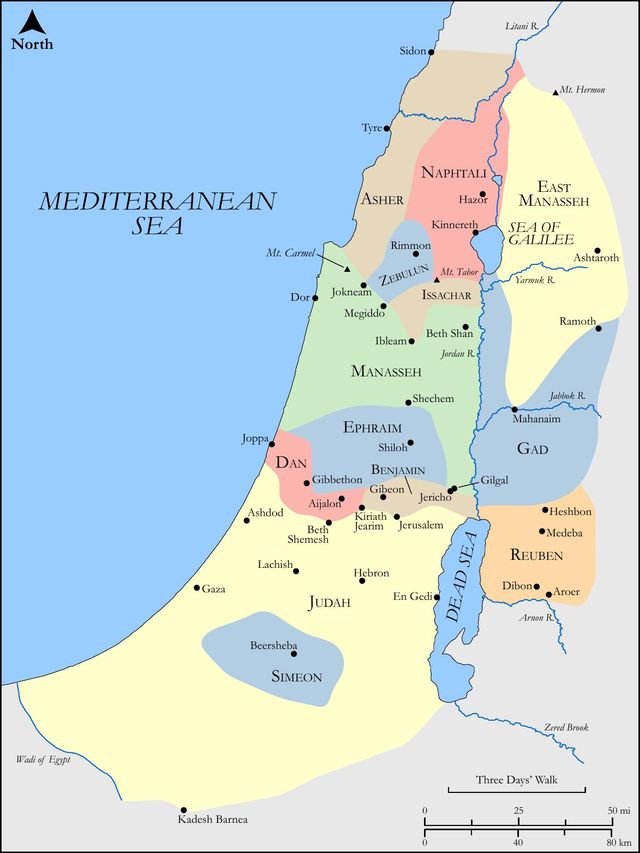
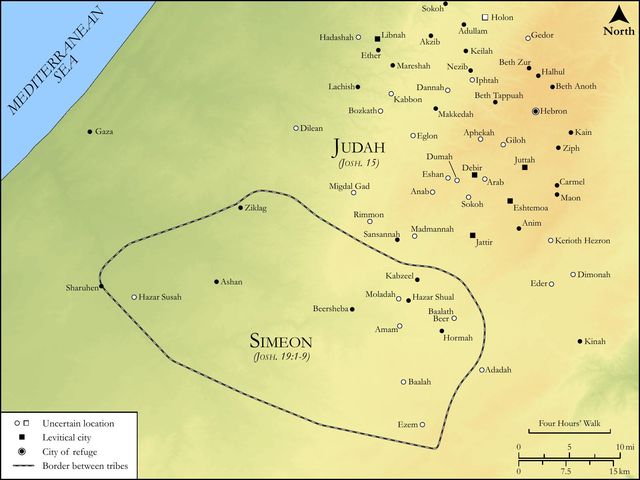
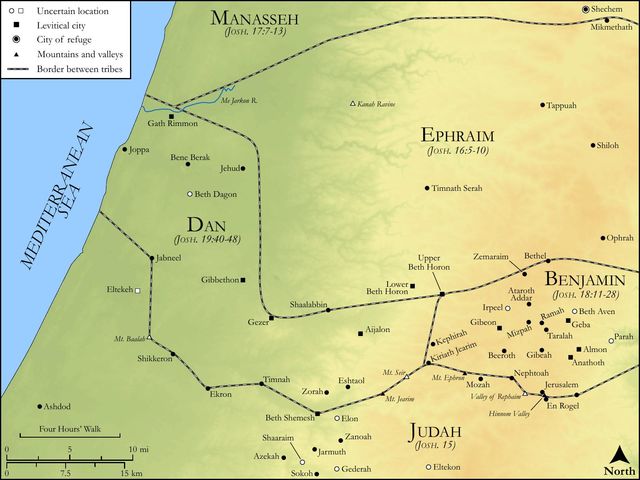
Study this verse
Public-domain commentary
Matthew Henry
From his Commentary on the Whole Bible. Henry comments on passages, not single verses — this entry covers Joshua 21:43–45. His two-level outline is real structure in the source text, so it is rendered as structure.
We have here the conclusion of this whole matter, the foregoing history summed up, and, to make it appear the more bright, compared with the promise of which it was the full accomplishment. God's word and his works mutually illustrate each other. The performance makes the promise appear very true and the promise makes the performance appear very kind.
I.God had promised to give the seed of Abraham the land of Canaan for a possession, and now at last he performed this promise (Jos 21:43):
They possessed it, and dwelt therein. Though they had often forfeited the benefit of that promise, and God had long delayed the performance of it, yet at last all difficulties were conquered, and Canaan was their own. And the promise of the heavenly Canaan is as sure to all God's spiritual Israel, for it is the promise of him that cannot lie.
II.God had promised to give them rest in that land, and now they had rest round about, rest from the fatigues of their travel through the wilderness (which tedious march, perhaps, was long in their bones), rest from their wars in Canaan, and the insults which their enemies there had at first offered them. They now dwelt, not only in habitations of their own, but those quiet and peaceable ones; though there were Canaanites that remained, yet none that had either strength or spirit to attack them, nor so much as give them an alarm. This rest continued till they by their own sin and folly put thorns into their own beds and their own eyes.
III.God had promised to give them victory and success in their wars, and this promise likewise was fulfilled:
There stood not a man before them, Jos 21:44. They had the better in every battle, and which way soever they turned their forces they prospered. It is true there were Canaanites now remaining in many parts of the land, and such as afterwards made head against them, and became very formidable. But,
1.As to the present remains of the Canaanites, they were no contradiction to the promise, for God had said he would not drive them out all at once, but by little and little, Exo 23:30. They had now as much in their full possession as they had occasion for and as they had hands to manage, so that the Canaanites only kept possession of some of the less cultivated parts of the country against the beasts of the field, till Israel, in process of time, should become numerous enough to replenish them.
2.As to the after prevalency of the Canaanites, that was purely the effect of Israel's cowardice and slothfulness, and the punishment of their sinful inclination to the idolatries and other abominations of the heathen, whom the Lord would have cast out before them but that they harboured and indulged them. So that the foundation of God stands sure. Israel's experience of God's fidelity is here upon record, and is an acquittance under their hands to the honour of God, the vindication of his promise which had been so often distrusted, and the encouragement of all believers to the end of the world: There failed not any good thing, no, nor aught of any good thing (so full is it expressed), which the Lord had spoken unto the house of Israel, but in due time all came to pass, Jos 21:45. Such an acknowledgment as this, here subscribed by Joshua in the name of all Israel, we afterwards find made by Solomon, and all Israel did in effect say Amen to it, Kg1 8:56. The inviolable truth of God's promise, and the performance of it to the utmost, are what all the saints have been ready to bear their testimony to; and, if in any thing the performance has seemed to come short, they have been as ready to own that they themselves must bear all the blame.
Continue studying Joshua 21:45 across the web’s major study libraries — every link below opens this exact verse, chapter, or book on the destination site.
Read & Compare
 BibleGatewayThis verse in more than 200 translations and 70 languages.
 Bible.comThe YouVersion reader — hundreds of translations, reading plans, and highlights.
 ESV.orgCrossway's official English Standard Version reader.
 NET BibleThe NET translation with 60,000+ translators' notes on every rendering decision.
 STEP BibleTyndale House's free study tool — original text, vocabulary, and scholarly resources.
 BibliaLogos Bible Software's free web reader.
 USCCBThe New American Bible (Revised Edition) with the U.S. bishops' study notes.
Commentaries
 BibleHub CommentariesDozens of classic commentaries on this verse, gathered on one page.
 StudyLightMore than 100 commentary sets — the largest collection on the web.
 BibleRefPlain-English commentary on what this verse means, verse by verse.
 Enduring WordDavid Guzik's free commentary on this chapter, widely used by Bible teachers.
 Bible Study ToolsVerse commentary alongside Greek and Hebrew study aids.
Original Language & Research
- BibleHub InterlinearThe verse word by word — original language, transliteration, and English.
- BibleHub LexiconEvery word's original-language definition and Strong's entry.
 Blue Letter BibleDeep-study tools — Strong's numbers, concordance, and word studies.
 SefariaThe Hebrew text with Rashi and centuries of Jewish commentary.
Sermons, Hymns & Audio


TrulyRandomVerse is not affiliated with these sites and doesn’t control their content. They’re linked because they’re genuinely useful.
Summary
Joshua 21:45 stands as a profound declaration of Yahweh's absolute faithfulness, serving as a triumphant capstone to the account of Israel's conquest and settlement of the Promised Land. It unequivocally affirms that every single promise, every "good thing" God had spoken concerning the land, the inheritance, and the security of His people, was brought to complete and perfect fruition. This verse encapsulates the divine integrity and the unwavering reliability of God's covenant word, assuring the reader that His purposes for Israel were meticulously fulfilled, leaving no promise unaccomplished.
Context
ShowHideLiterary Context
Joshua 21:45 concludes a significant section of the Book of Joshua (chapters 13-21) dedicated to the detailed division of the land among the twelve tribes of Israel. Following the initial military campaigns (chapters 1-12), this section meticulously records the allocation of territories, the establishment of cities of refuge, and crucially, the provision for the Levitical cities. The verse immediately precedes a summary statement about the Lord giving Israel rest from all their enemies (as seen in Joshua 21:44) and functions as a grand theological conclusion to the entire land distribution narrative. It emphasizes that the complex and intricate process of settlement was entirely a fulfillment of God's prior declarations, looking back to the promises made to the patriarchs and forward to the reality of Israel's possession. This verse provides a divine stamp of approval on the preceding narrative, affirming that the chaotic and often challenging events were all part of a sovereign plan.
Historical & Cultural Context
This verse is set at a pivotal moment in Israel's history—the transition from nomadic wandering and military conquest to settled existence in Canaan. Having escaped Egyptian bondage and endured forty years in the wilderness, the Israelites were now establishing themselves in the land promised to Abraham, Isaac, and Jacob centuries earlier (see Genesis 12:7). The process of conquest was challenging, involving numerous battles against formidable Canaanite inhabitants. For Israel, land ownership was intrinsically linked to identity, security, and divine favor. The successful acquisition and distribution of the land, despite the immense obstacles, served as irrefutable proof of Yahweh's unique power and His unwavering commitment to His covenant people, distinguishing Him from the unreliable deities of surrounding nations. This historical fulfillment would have resonated deeply with a people whose identity was so tied to the land.
Key Themes
ShowHideJoshua 21:45 powerfully underscores several foundational theological themes central to the Pentateuch and the Deuteronomistic History. Foremost is the theme of God's Faithfulness. The verse declares that God is perfectly reliable, keeping every word He has spoken, demonstrating His unchangeable character (as seen in Deuteronomy 7:9). This directly relates to the theme of Covenant Fulfillment, as the possession of the land was a primary component of the Abrahamic covenant. Furthermore, it highlights Divine Sovereignty, affirming that God is in complete control of history, orchestrating events to bring His purposes to pass, regardless of human limitations or opposition. Finally, the verse emphasizes the Efficacy and Power of God's Word; when the Lord speaks, His word is not idle but active, accomplishing precisely what He intends, a truth echoed in Isaiah 55:11. The concept of "rest" (מְנוּחָה, mĕnûḥâ) found in the preceding verse is also a key theme, signifying the completion of God's promise of security and peace in the land.
Exposition and Analysis
ShowHideKey Word Analysis
ShowHideThis verb literally means "to fall" or "to drop." In the context of "failed not ought," it is used in the negative to convey the absolute absence of any lapse, deficiency, or unfulfillment. It emphasizes that not a single promise or detail of God's word concerning the land and its settlement was left undone; everything stood firm and was accomplished without exception. This highlights God's perfect reliability and steadfastness.
This adjective describes something as beneficial, pleasant, prosperous, or excellent. When combined with "thing" (dâbâr), it refers to every positive, advantageous, and gracious promise God had declared for Israel. This encompasses the land itself, the victories over enemies, the peace and security, and the specific allocations to each tribe and the Levites, signifying the comprehensive nature of God's benevolent provision.
This primitive root signifies a deliberate, authoritative, and intentional declaration. It's not a casual utterance but a divine pronouncement, underscoring the divine origin and the binding nature of the promises. What God "spoke" was not mere suggestion or possibility, but a certain decree, guaranteed to come to pass due to His sovereign will and power.
Verse Breakdown
ShowHide"There failed not ought of any good thing"
This opening clause employs a strong double negative ("failed not ought") to emphatically state the absolute completeness and certainty of God's actions. It means that not even the smallest part of God's promises—specifically, every beneficial provision and blessing—went unfulfilled. Every single detail of His gracious word was brought to pass without exception or deficiency.
"which the LORD had spoken unto the house of Israel"
This phrase identifies both the divine author of the promises and their specific recipients. "The LORD" (Yahweh, H3068) is the covenant God of Israel, highlighting His personal and unwavering commitment. "The house of Israel" (H1004, H3478) refers to the entire nation, the descendants of Jacob, emphasizing the corporate nature of the covenant and the collective experience of God's faithfulness.
"all came to pass"
This concluding declaration serves as a definitive affirmation of the preceding statement. It reiterates the totality of the fulfillment, leaving no room for doubt or partial completion. "All" signifies that every promise, whether great or small, general or specific, was perfectly executed according to God's divine plan and timing, demonstrating His omnipotence and truthfulness.
Literary Devices
ShowHideJoshua 21:45 functions primarily as a Summary Statement and a profound Theological Declaration. As a summary, it encapsulates the entire narrative of conquest and land distribution, providing a conclusive theological interpretation of these events. It employs Hyperbole or extreme affirmation through its emphatic double negative ("failed not ought") to underscore the absolute and perfect fulfillment of God's word, leaving no room for partiality or deficiency. The verse also serves as an Affirmation of Divine Character, specifically highlighting God's faithfulness, truthfulness, and omnipotence as central attributes. By stating that "all came to pass," it utilizes Conclusive Language to seal the narrative, presenting the outcome as undeniable proof of God's reliability. This makes the verse inherently Doxological, serving as a praise report to God for His steadfast covenant-keeping.
Theological and Thematic Connections
ShowHideJoshua 21:45 serves as a monumental testament to the unwavering faithfulness of God, a theme that reverberates throughout the entire biblical narrative. It stands as a historical anchor, demonstrating that the God who made promises to Abraham, Isaac, and Jacob centuries earlier is the very same God who meticulously brought those promises to fruition in the land of Canaan. This verse powerfully counters any notion of divine forgetfulness or inability, establishing God's perfect integrity and His commitment to His covenant word. It teaches us that God's promises are not ultimately conditional on human performance, but on His own unchangeable character. This historical fulfillment provides a bedrock for future trust, assuring believers that what God has spoken, He will surely accomplish, whether in the grand sweep of redemptive history or in the intimate details of individual lives.
Reflection and Application
ShowHideJoshua 21:45 offers profound encouragement and a firm foundation for faith in the life of every believer. In a world characterized by broken promises, shifting sands, and human unreliability, this verse stands as an immovable rock, declaring the absolute trustworthiness of God. It reminds us that the same God who faithfully led Israel through the wilderness, empowered them in conquest, and meticulously fulfilled every detail of His promises regarding the land, is the same God who is at work in our lives today. We can rest assured that His promises concerning salvation, provision, guidance, and His ultimate plan for redemption in Christ are utterly dependable. This truth should inspire us to deepen our trust in His word, to stand firm in times of doubt or adversity, and to patiently wait for the full manifestation of His purposes, knowing that what He has promised, He will surely perform. It calls us to live with confident expectation, knowing that our God is a God who keeps His word.
Questions for Reflection
ShowHideFAQ
ShowHideDid Israel truly conquer all the land as God promised, given that some areas remained unconquered?
ShowHideWhile Joshua 21:45 declares that "all came to pass," it's important to understand this statement from a theological perspective, not a purely military one. The "rest" and "good thing" refer to the provision of the land and the cessation of major, organized resistance, signifying that Israel had secured a sufficient foothold and the capacity to possess the entire inheritance God had promised. The land was theirs by divine decree and initial conquest, and the remaining inhabitants were largely scattered pockets of resistance or areas that required further, ongoing tribal effort to fully dispossess (as seen in Judges 1). The verse emphasizes God's faithfulness in providing the opportunity and the means for full possession, rather than an immediate, total, and effortless eradication of all enemies. The failure to fully dispossess was often due to Israel's own lack of faith or obedience, not God's unfaithfulness (see Judges 2:20-23).
Christ-Centered Fulfillment
ShowHideWhile Joshua 21:45 celebrates the historical fulfillment of God's promises to Israel concerning the land, its ultimate and most profound fulfillment is found in Jesus Christ. The "good things" God promised to Israel, though significant, were but shadows of the infinitely greater spiritual realities and eternal blessings secured through Christ. The "rest" Israel found in Canaan, though real, was incomplete and temporary, foreshadowing the true and eternal rest found only in Christ (as expounded in Hebrews 4:8-10). Just as every promise to ancient Israel "failed not ought," so too "all the promises of God in Him are Yes, and in Him Amen" (2 Corinthians 1:20). Jesus is the ultimate "good thing" God has spoken, the one through whom all of God's redemptive purposes are perfectly accomplished (Matthew 5:17). In Him, believers receive not just a physical land, but an eternal inheritance (Ephesians 1:11), not just rest from physical enemies, but peace with God (Romans 5:1), and not just a covenant written on stone, but a new covenant written on the heart by the Spirit (Jeremiah 31:33). Joshua 21:45, therefore, stands as a powerful prophetic echo, assuring us that God's final and greatest "good thing"—the full and glorious establishment of His kingdom through Christ—will likewise "all come to pass" without fail (Revelation 21:3-4).