


Joshua 22:1
Bible text: King James Version (1769 Blayney text) · Public domain
Bible text: Berean Standard Bible · Public domain
Bible text: American Standard Version (1901) · Public domain
Bible text: World English Bible, Messianic edition · Public domain
Bible text: Geneva Bible (1599) · Public domain
Bible text: Young's Literal Translation · Public domain
- אָז'azthenH227AdvAdverb
- יִקְרָאyik·Ra'he summonedH7121V-Qal-Imperf-3msVerb Qal Imperfect 3rd Singular Masculine
- יְהוֹשֻׁעַye·ho·Shu·a'JoshuaH3091N-proper-mNoun Proper Masculine
- לָראוּבֵנִיlo·r·'u·ve·Ni<to> the Reubenite[s]H7206Prep-l ¦ N-msNoun Gentilic Singular Masculine Absoluteלָ<to> theראוּבֵנִיReubenite[s]
- וְלַגָּדִיve·la·ga·Diand <to> the Gadite[s]H1425Conj-w ¦ Prep-l ¦ N-msNoun Gentilic Singular Masculine Absoluteוְandלַ<to> theגָּדִיGadite[s]
- וְלַחֲצִיve·la·cha·Tziand <to> [the] half ofH2677Conj-w ¦ Prep-l ¦ N-mscNoun Singular Masculine Constructוְandלַ<to>חֲצִי[the] half of
- מַטֵּהma·Teh[the] tribe ofH4294N-mscNoun Singular Masculine Construct
- מְנַשֶּׁהme·na·ShehManassehH4519N-proper-mNoun Proper Masculine
English is a literal word-by-word gloss of the Hebrew, not the KJV's wording. Why?
This is the original text the KJV's translators worked from — each Hebrew word with its own literal English meaning in this verse, prepared by scholars at Tyndale House, Cambridge. The KJV translates whole sentences, not word by word, so its wording differs: one Hebrew word can become several English words, and the KJV may choose “the LORD” where the gloss reads “Yahweh”. Both are faithful — they answer different questions. For the KJV's own rendering, switch to the KJV text.
Details
See on the biblical-era map
Study this verse
Historical interpretation
Historical reception
1 surviving comment on this verse from the historical church.
After these things Jesus [Joshua] assembles the sons of Reuben and the sons of Gad and the half-tribe of Manasseh, who had served as soldiers with him to overcome the foes of the Israelites, and he dismisses them to go to their inheritance with certain gifts given to them, as it is written. Whereby this seems to indicate the mystery that “when the fullness of the nations will come in,” they receive from the Lord Jesus what was promised to them, those who had been taught and instructed by Moses and who by prayers and entreaties brought aid to us who are placed in the contest. They have not yet “attained the promises,” waiting so that our calling might also be fulfilled, as the apostle says. But now at last with the gifts they receive from Jesus they may attain the perfection that had been deferred for them so that each one may dwell in peace with every war and every battle ceasing.
Continue studying Joshua 22:1 across the web’s major study libraries — every link below opens this exact verse, chapter, or book on the destination site.
Read & Compare
 BibleGatewayThis verse in more than 200 translations and 70 languages.
 Bible.comThe YouVersion reader — hundreds of translations, reading plans, and highlights.
 ESV.orgCrossway's official English Standard Version reader.
 NET BibleThe NET translation with 60,000+ translators' notes on every rendering decision.
 STEP BibleTyndale House's free study tool — original text, vocabulary, and scholarly resources.
 BibliaLogos Bible Software's free web reader.
 USCCBThe New American Bible (Revised Edition) with the U.S. bishops' study notes.
Commentaries
 BibleHub CommentariesDozens of classic commentaries on this verse, gathered on one page.
 StudyLightMore than 100 commentary sets — the largest collection on the web.
 BibleRefPlain-English commentary on what this verse means, verse by verse.
 Enduring WordDavid Guzik's free commentary on this chapter, widely used by Bible teachers.
 Bible Study ToolsVerse commentary alongside Greek and Hebrew study aids.
Original Language & Research
- BibleHub InterlinearThe verse word by word — original language, transliteration, and English.
- BibleHub LexiconEvery word's original-language definition and Strong's entry.
 Blue Letter BibleDeep-study tools — Strong's numbers, concordance, and word studies.
 SefariaThe Hebrew text with Rashi and centuries of Jewish commentary.
Sermons, Hymns & Audio


TrulyRandomVerse is not affiliated with these sites and doesn’t control their content. They’re linked because they’re genuinely useful.
Summary
Joshua 22:1 marks a profound turning point in Israel's post-conquest history, depicting Joshua's formal convocation of the Transjordanian tribes—the Reubenites, Gadites, and the half-tribe of Manasseh. This summons signifies the successful culmination of their arduous military service in the conquest of Canaan, fulfilling a solemn commitment made years prior to their brethren and to Yahweh. It sets the stage for their return to their inherited territories east of the Jordan River, underscoring critical themes of covenant fidelity, the enduring unity of the twelve tribes, and the completion of a significant phase in Israel's establishment within the Promised Land.
Context
ShowHideLiterary Context
Joshua 22:1 initiates a pivotal transition within the book of Joshua, shifting the narrative focus from the successful conquest and meticulous land division (covered in Joshua 1-21) to the complex challenges of maintaining national and religious unity. Chapters Joshua 1-12 detail the military campaigns that secured the land, while Joshua 13-21 meticulously describe the allocation of territories among the Israelite tribes, culminating in Joshua 21:43-45 which summarizes God's complete faithfulness in granting Israel rest and fulfilling every promise. Joshua 22:1 immediately follows this summary of divine fidelity, setting the scene for the formal dismissal of the Reubenites, Gadites, and the half-tribe of Manasseh, whose unique arrangement to settle east of the Jordan was established with Moses in Numbers 32 and reiterated by Joshua in Joshua 1:12-18. The subsequent narrative in Joshua 22:10-34 vividly portrays the misunderstanding and near-conflict arising from their construction of an altar, highlighting the ever-present need for clear communication and unwavering commitment to Yahweh's prescribed worship to preserve national cohesion.
Historical & Cultural Context
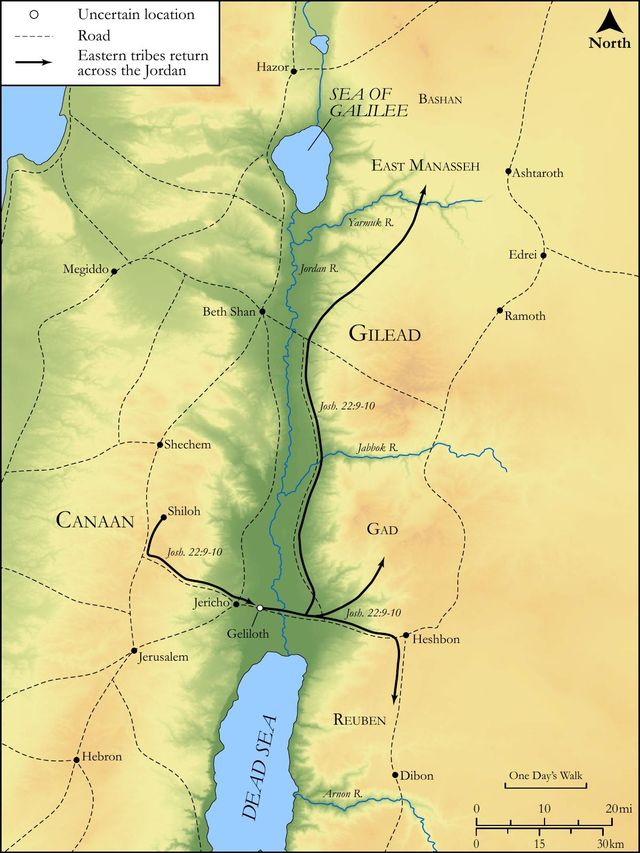
The events of Joshua unfold in the immediate aftermath of the Exodus and the forty years of wilderness wandering, placing them in the generation that entered Canaan (approximately 1400-1200 BC). During this era, Israel was transitioning from a nomadic confederation into a settled nation, establishing its presence amidst the established Canaanite city-states. The concept of tribal identity and the inheritance of specific land was not merely a matter of geography but was deeply interwoven with their covenant relationship with Yahweh, forming the bedrock of their national and religious identity. The Jordan River served as a significant geographical boundary, often carrying symbolic weight. The Transjordanian tribes' decision to settle on the eastern side, made prior to the main conquest, was contingent upon a solemn oath to participate actively in the conquest of the western side first. This oath represented a critical cultural and religious commitment, binding them to the broader Israelite confederation. Joshua's formal summons and subsequent dismissal would have been a public, official act, akin to a military discharge ceremony, recognizing their fulfilled service and formally releasing them to their respective homes.
Key Themes
ShowHideThis verse powerfully contributes to several overarching theological and narrative themes found throughout Joshua and the Pentateuch. Primarily, it exemplifies the Fulfillment of Covenant and Promise, as the Transjordanian tribes meticulously honor their commitment to fight alongside their brethren, mirroring God's own unwavering faithfulness in fulfilling His promises to Israel concerning the land, as explicitly stated in Joshua 21:43-45. Secondly, it underscores the vital theme of National Unity and Solidarity among the twelve tribes, emphasizing that despite geographical separation, they remained one people under God, united by a common purpose and a shared covenant. Their active participation in the arduous conquest was a tangible demonstration of this profound unity. Lastly, the verse highlights Joshua's Leadership, showcasing his role as the divinely appointed successor to Moses, exercising the necessary authority to dismiss troops, offer counsel, and maintain order within the nascent nation, thereby reflecting the divine charge entrusted to him in Joshua 1:6-9.
Exposition and Analysis
ShowHideKey Word Analysis
ShowHideFrom the Hebrew root H7121, qârâʼ denotes more than a simple invitation; it signifies a formal summons, a proclamation, or a convocation. In this context, it highlights Joshua's authoritative act of assembling these specific tribes for a significant, public address. This "calling" marks a formal conclusion to their shared military campaign and their official release from service, underscoring the gravity and importance of the occasion.
From the Hebrew H7206, Rᵉʼûwbênîy is a patronymic term referring to the descendants of Reuben, the eldest son of Jacob. Its specific mention here, alongside the Gadites and the half-tribe of Manasseh, serves to identify the unique group of tribes whose inheritance lay east of the Jordan River. Their individual and collective mention emphasizes their distinct identity within Israel while simultaneously affirming their integral role in the unified conquest of the land.
From the Hebrew H2677, chêtsîy literally means "the half or middle." In the phrase "half tribe of Manasseh," it precisely delineates that only a portion of the tribe of Manasseh, not the entire tribal entity, had settled on the Transjordanian side. This detail is crucial for understanding the geographical distribution of Israel's tribes and the unique arrangement that necessitated their participation in the western conquest before returning to their designated eastern inheritance.
Verse Breakdown
ShowHide"Then Joshua called"
This opening phrase establishes Joshua's decisive leadership and initiative at a critical juncture in Israel's history. The temporal adverb "Then" indicates a progression, following the successful completion of the land's division and the fulfillment of God's promises. Joshua, acting as the divinely appointed leader, takes the necessary step to formally address these specific tribes, signifying the culmination of their shared military endeavor and the transition to a new phase of national life focused on settling and maintaining the land.
"the Reubenites, and the Gadites, and the half tribe of Manasseh"
This precise enumeration identifies the specific tribal groups being summoned. Their collective summons underscores their unique status as the tribes whose inheritance lay outside the primary land of Canaan west of the Jordan River. Their presence and the act of being called out signify the fulfillment of their long-standing pledge to their fellow Israelites, a testament to their faithfulness and the enduring unity of the twelve tribes despite their geographical separation.
Literary Devices
ShowHideJoshua 22:1 functions primarily as a Narrative Transition, marking a distinct and significant shift in the book's overarching narrative from the themes of conquest and land distribution to the subsequent challenges of maintaining national and religious unity within the newly settled Israel. The verse employs Enumeration by explicitly listing the three specific tribal entities—the Reubenites, the Gadites, and the half-tribe of Manasseh—thereby drawing specific attention to their unique identity and their collective participation in the preceding military campaigns. This enumeration also serves as a subtle reminder to the reader of the long-standing covenant and commitment these tribes made regarding their involvement in the conquest. Furthermore, the act of "calling" itself, as performed by Joshua, powerfully highlights the theme of Leadership and Authority, underscoring Joshua's divinely appointed role in orchestrating the final stages of Israel's settlement and his responsibility for the well-being and order of the nascent nation.
Theological and Thematic Connections
ShowHideJoshua 22:1 resonates deeply with the broader biblical narrative of covenant faithfulness and the profound importance of keeping one's word. The formal dismissal of the Transjordanian tribes, following their loyal and arduous service, stands as a powerful testament to the integrity of both the tribes in fulfilling their solemn vow and of Joshua in acknowledging their invaluable contribution and releasing them. This pivotal act emphasizes that unwavering obedience to God's commands and steadfast faithfulness to human commitments are not merely optional virtues but are foundational pillars for a thriving community and for cultivating a right relationship with the divine. It subtly foreshadows the ongoing challenge for Israel to remain united and faithful to Yahweh, even as they settle into their distinct tribal inheritances. The remarkable unity displayed in their shared military effort serves as an enduring model for the solidarity and mutual support required to maintain the spiritual and national identity of God's chosen people.
Reflection and Application
ShowHideJoshua 22:1 offers profound and enduring lessons for contemporary believers regarding integrity, the sanctity of commitment, and the immense strength found in corporate unity. The unwavering faithfulness of the Reubenites, Gadites, and the half-tribe of Manasseh in diligently fulfilling their arduous military service, despite their homes being situated across the Jordan, challenges us to deeply consider our own commitments. Are we as diligent and steadfast in honoring our vows, whether they are made to God, to our family, or to our community? This passage serves as a powerful reminder that true integrity is not merely demonstrated in the act of making promises, but far more significantly, in the unwavering resolve to see them through to completion, even when such faithfulness demands considerable personal sacrifice or prolonged, strenuous effort. Furthermore, the remarkable solidarity displayed by these tribes in fighting for the entire nation underscores the vital and indispensable importance of unity within the body of Christ. Our individual callings, unique gifts, and diverse circumstances, though varied, are ultimately meant to serve the common good and collectively advance the kingdom of God. We are called to bear one another's burdens, to support each other in times of need, and to work together with a unified purpose, thereby reflecting the harmonious and singular mission of God's people in the world.
Questions for Reflection
ShowHideFAQ
ShowHideWhy were the Reubenites, Gadites, and half-tribe of Manasseh dismissed separately?
ShowHideThese tribes had a unique and distinct arrangement whereby they received their inheritance on the east side of the Jordan River. This decision was made during Moses' leadership, as meticulously recorded in Numbers 32. However, they made a solemn vow to join the other tribes in the conquest of Canaan (west of the Jordan) before returning to their own land. Joshua's formal dismissal in Joshua 22:1 formally acknowledges the complete fulfillment of this vow and releases them from their military obligations, allowing them to return to their homes. Their separate dismissal highlights their distinct geographical inheritance while simultaneously affirming their integral and indispensable role in the unified Israelite nation.
What was the significance of their service in the conquest?
ShowHideThe service of the Transjordanian tribes was profoundly significant for several compelling reasons. First, it powerfully demonstrated their faithfulness to their covenant vow made to Moses and their brethren, thereby reinforcing the paramount importance of integrity and keeping one's word within the Israelite community, a principle emphasized in passages like Deuteronomy 23:21. Second, their active participation ensured national unity and solidarity during a critical and formative period for Israel. Despite having their land already secured, they fought valiantly alongside the other tribes, signifying that Israel was truly one people with a common purpose under God, not merely a disparate collection of independent tribal entities. This unity was absolutely crucial for the successful and complete conquest of the Promised Land, as detailed throughout Joshua 1-12.
Christ-Centered Fulfillment
ShowHideJoshua 22:1, while a historical account of a tribal dismissal, subtly yet profoundly points to Christ in its underlying themes of faithfulness, fulfillment, and unity. Joshua, as the divinely appointed leader who successfully brings Israel into their promised rest and inheritance, serves as a powerful type of Christ, the greater Joshua who leads His people into an eternal rest and an imperishable inheritance. Just as the Transjordanian tribes faithfully fulfilled their commitment to fight alongside their brethren, Christ perfectly fulfilled all righteousness and every divine promise, not for His own benefit, but for the sake of our eternal inheritance, ultimately securing our everlasting dwelling place. His perfect obedience, even unto death on the cross, is the ultimate act of faithfulness, as profoundly articulated in Philippians 2:8. The unity of Israel, though often imperfectly maintained, beautifully foreshadows the perfect and unbreakable unity found in the body of Christ, the Church, where believers from every tribe, tongue, and nation are gathered into one family through His reconciling work, as vividly described in Ephesians 2:14-16. Christ is the one who "calls" His disciples, not to a temporary military campaign, but to an eternal mission of making disciples of all nations, promising His abiding presence until the very end of the age, as stated in Matthew 28:19-20. He is the ultimate fulfillment of all God's promises, the one who brings His people into their true and everlasting inheritance, a rest far greater and more glorious than any earthly land, as promised in Hebrews 4:9-10.