


Joshua 22:2
Bible text: King James Version (1769 Blayney text) · Public domain
Bible text: Berean Standard Bible · Public domain
Bible text: American Standard Version (1901) · Public domain
Bible text: World English Bible, Messianic edition · Public domain
Bible text: Geneva Bible (1599) · Public domain
Bible text: Young's Literal Translation · Public domain
- וַיֹּאמֶרvai·Yo·merand he saidH559Conj-w ¦ V-Qal-ConsecImperf-3msVerb Qal Consecutive Imperfect 3rd Singular Masculineוַandיֹּאמֶרhe said
- אֲלֵיהֶם'a·lei·Hemto themH413Prep ¦ 3mpPreposition Definiteאֲלֵיtoהֶםthem
- אַתֶּם'a·TemyouH859Pro-2mpPronoun Personal 2nd Plural Masculine
- שְׁמַרְתֶּםshe·mar·Temyou have keptH8104V-Qal-Perf-2mpVerb Qal Perfect 2nd Plural Masculine
- אֵת'et<obj.>H853DirObjMParticle Object Indicator
- כָּלkolallH3605N-msNoun Singular Masculine Absolute
- אֲשֶׁר'a·SherthatH834RelParticle Relative
- צִוָּהtzi·Vahhe commandedH6680V-Piel-Perf-3msVerb Piel Perfect 3rd Singular Masculine
- אֶתְכֶם'et·Khem<obj.> youH853DirObjM ¦ 2mpParticle Object Indicatorאֶתְ<obj.>כֶםyou
- מֹשֶׁהmo·ShehMosesH4872N-proper-mNoun Proper Masculine
- עֶבֶד'E·ved[the] servant ofH5650N-mscNoun Singular Masculine Construct
- יְהוָהYah·wehYahwehH3068N-properNoun Proper Title
- וַתִּשְׁמְעוּva·tish·me·'Uand you have listenedH8085Conj-w ¦ V-Qal-ConsecImperf-2mpVerb Qal Consecutive Imperfect 2nd Plural Masculineוַandתִּשְׁמְעוּyou have listened
- בְקוֹלִיve·ko·Lito my voiceH6963Prep-b ¦ N-msc ¦ 1csNoun Singular Masculine Constructבְtoקוֹלִvoiceיmy
- לְכֹלle·Kholto allH3605Prep-l ¦ N-msNoun Singular Masculine Absoluteלְtoכֹלall
- אֲשֶׁר'a·SherthatH834RelParticle Relative
- צִוִּיתִיtzi·Vi·tiI have commandedH6680V-Piel-Perf-1csVerb Piel Perfect 1st Singular common gender
- אֶתְכֶם'et·Khem<obj.> youH853DirObjM ¦ 2mpParticle Object Indicatorאֶתְ<obj.>כֶםyou
English is a literal word-by-word gloss of the Hebrew, not the KJV's wording. Why?
This is the original text the KJV's translators worked from — each Hebrew word with its own literal English meaning in this verse, prepared by scholars at Tyndale House, Cambridge. The KJV translates whole sentences, not word by word, so its wording differs: one Hebrew word can become several English words, and the KJV may choose “the LORD” where the gloss reads “Yahweh”. Both are faithful — they answer different questions. For the KJV's own rendering, switch to the KJV text.
Details
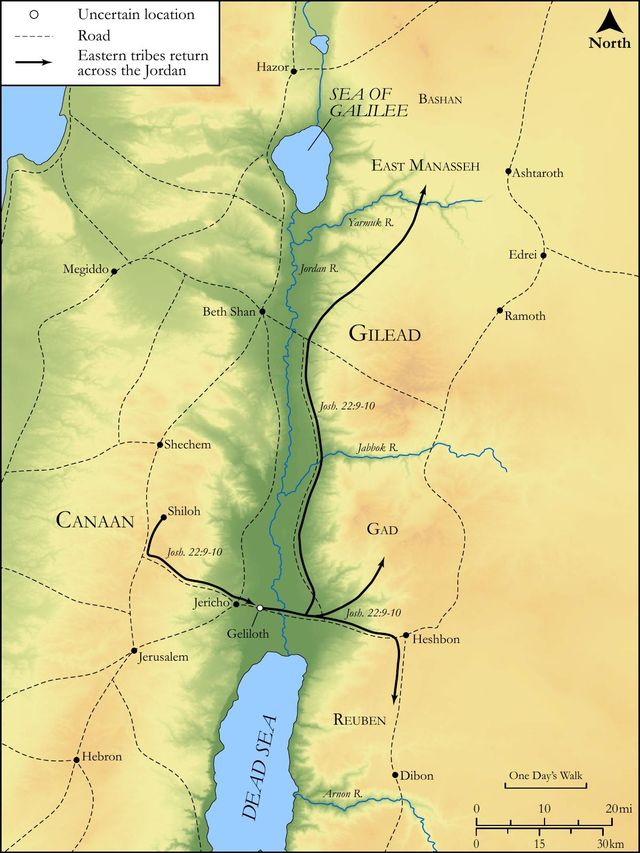
See on the biblical-era map
Study this verse
Historical interpretation
Historical reception
1 surviving comment on this verse from the historical church.
After these things Jesus [Joshua] assembles the sons of Reuben and the sons of Gad and the half-tribe of Manasseh, who had served as soldiers with him to overcome the foes of the Israelites, and he dismisses them to go to their inheritance with certain gifts given to them, as it is written. Whereby this seems to indicate the mystery that “when the fullness of the nations will come in,” they receive from the Lord Jesus what was promised to them, those who had been taught and instructed by Moses and who by prayers and entreaties brought aid to us who are placed in the contest. They have not yet “attained the promises,” waiting so that our calling might also be fulfilled, as the apostle says. But now at last with the gifts they receive from Jesus they may attain the perfection that had been deferred for them so that each one may dwell in peace with every war and every battle ceasing.
Continue studying Joshua 22:2 across the web’s major study libraries — every link below opens this exact verse, chapter, or book on the destination site.
Read & Compare
 BibleGatewayThis verse in more than 200 translations and 70 languages.
 Bible.comThe YouVersion reader — hundreds of translations, reading plans, and highlights.
 ESV.orgCrossway's official English Standard Version reader.
 NET BibleThe NET translation with 60,000+ translators' notes on every rendering decision.
 STEP BibleTyndale House's free study tool — original text, vocabulary, and scholarly resources.
 BibliaLogos Bible Software's free web reader.
 USCCBThe New American Bible (Revised Edition) with the U.S. bishops' study notes.
Commentaries
 BibleHub CommentariesDozens of classic commentaries on this verse, gathered on one page.
 StudyLightMore than 100 commentary sets — the largest collection on the web.
 BibleRefPlain-English commentary on what this verse means, verse by verse.
 Enduring WordDavid Guzik's free commentary on this chapter, widely used by Bible teachers.
 Bible Study ToolsVerse commentary alongside Greek and Hebrew study aids.
Original Language & Research
- BibleHub InterlinearThe verse word by word — original language, transliteration, and English.
- BibleHub LexiconEvery word's original-language definition and Strong's entry.
 Blue Letter BibleDeep-study tools — Strong's numbers, concordance, and word studies.
 SefariaThe Hebrew text with Rashi and centuries of Jewish commentary.
Sermons, Hymns & Audio


TrulyRandomVerse is not affiliated with these sites and doesn’t control their content. They’re linked because they’re genuinely useful.
Summary
Joshua 22:2 records a pivotal moment of commendation from Joshua to the tribes of Reuben, Gad, and the half-tribe of Manasseh. After years of faithful military service assisting their brethren in the conquest of Canaan, Joshua publicly acknowledges their unwavering obedience to both the commands given through Moses and his own directives. This verse marks their formal release to return to their inheritance east of the Jordan River, celebrating their integrity, covenant fidelity, and commitment to the unity of the Israelite nation.
Context
ShowHideLiterary Context
This verse is strategically placed at a significant juncture in the book of Joshua, following the detailed accounts of land distribution (chapters 13-21) and preceding the potentially divisive altar controversy (Joshua 22:10-34). Joshua's address in Joshua 22:1-9 serves as a formal and public dismissal of the eastern tribes—Reuben, Gad, and the half-tribe of Manasseh—who had fulfilled their solemn oath to fight alongside the other tribes until the land west of the Jordan was subdued. This commendation not only affirms their covenant loyalty but also sets the stage for the narrative's immediate concern: ensuring the continued unity and spiritual fidelity of the entire Israelite confederation, even as geographical separation becomes a reality. It underscores the importance of adherence to divine law and leadership, a theme central to the book's theological message.
Historical & Cultural Context
The historical setting is the conclusion of Israel's conquest of Canaan, a campaign that likely spanned approximately seven years, as implied by passages like Joshua 11:23 and Joshua 14:15. Years earlier, as detailed in Numbers 32 and reiterated by Moses in Deuteronomy 3:18-20, these eastern tribes had made a solemn vow. They pledged to cross the Jordan River with their armed men and assist their brethren in the conquest of Canaan before returning to their allotted inheritance on the eastern side. This agreement was a binding covenantal obligation in Israel, where the law of Moses forbade a man to break his word and the keeping of a public oath was paramount to honor, reputation, and social cohesion. Their faithful adherence, despite the prolonged separation from their families and the inherent dangers of warfare, demonstrated remarkable integrity and tribal solidarity, reflecting deeply on their character and commitment to the broader Israelite community.
Key Themes
ShowHideJoshua's address in this verse powerfully reinforces several major themes that resonate throughout the book of Joshua and the broader Pentateuch. Foremost among these is Obedience to Divine Command and Righteous Leadership. The eastern tribes' actions exemplify the blessings and integrity that flow from wholehearted submission to God's will, as communicated through His chosen leaders, Moses and Joshua. This echoes the foundational principle articulated in Deuteronomy 28:1-14, where obedience leads to abundant blessings. Another prominent theme is Covenant Faithfulness. Their unwavering commitment to the initial agreement, even through arduous years of conflict and separation, highlights the critical importance of honoring one's word and maintaining loyalty within the covenant community. Furthermore, the verse underscores the theme of National Unity and Solidarity. The eastern tribes' willingness to sacrifice their immediate settlement and endure hardship for the common good of all Israel solidified the bond between the tribes, demonstrating that true unity extends beyond geographical proximity and requires mutual support. Finally, Joshua's commendation itself reinforces the theme of Affirming Godly Leadership and Service, as he publicly acknowledges the immense contribution and faithfulness of his people, setting a precedent for leadership that recognizes and celebrates faithful service.
Exposition and Analysis
ShowHideKey Word Analysis
ShowHideThis verb, H8104 (שָׁמַר), means "to keep," "to guard," "to observe," or "to diligently attend to." It implies more than passive adherence; it suggests an active, careful, and conscious effort to uphold, preserve, and protect the commands. The tribes didn't merely follow the rules; they guarded them, demonstrating a deep respect for the authority from which these directives originated and a commitment to their preservation.
The verb, H8085 (שָׁמַע), signifies "to hear," "to listen," and, crucially, "to obey." In Hebrew thought, true hearing is inextricably linked with action. To "hear" God's word means to respond to it in obedience, not just to intellectually grasp it. Here, it emphasizes that the eastern tribes not only received Joshua's instructions but actively implemented them, reflecting a complete and active compliance born of trust and commitment to their leader and the divine will he represented.
The verb, H6680 (צָוָה), means "to command," "to charge," or "to give orders." It denotes authority and the issuance of binding directives. The repetition of "commanded" (first by Moses, then by Joshua) underscores the authoritative nature of the instructions given, highlighting that the tribes' obedience was to divinely sanctioned leadership and divine law, making their actions a direct response to God's will.
Verse Breakdown
ShowHide"And said unto them,"
This opening phrase indicates Joshua's direct, personal address to the eastern tribes. It signifies a formal and public acknowledgment, lending weight and solemnity to his words of commendation. This is a moment of official dismissal and blessing, delivered by the nation's revered leader.
"Ye have kept all that Moses the servant of the LORD commanded you,"
Joshua first references the commands given through Moses, emphasizing the continuity of divine authority. The title "Moses the servant of the LORD" is foundational, establishing the divine origin and binding nature of the Mosaic Law and the specific instructions regarding the conquest and tribal obligations (e.g., Numbers 32). The phrase "kept all" highlights the comprehensive and unwavering nature of their obedience to the entirety of God's revealed will, leaving no room for selective adherence.
"and have obeyed my voice in all that I commanded you:"
This clause extends the commendation to their obedience to Joshua's direct leadership. It acknowledges their loyalty and submission to his specific commands during the military campaign, fulfilling the pledge they made to him in Joshua 1:16-18). The parallel structure with the previous clause ("all that Moses... commanded" and "all that I commanded") underscores that their obedience was complete, embracing both the foundational law delivered by Moses and the specific, timely directives of their current leader, demonstrating a unified and disciplined commitment to God's plan.
Literary Devices
ShowHideJoshua's address in this verse employs several effective literary devices that enhance its impact and meaning. The primary device is Commendation or Affirmation, where Joshua, as the respected and divinely appointed leader, formally praises and validates the actions of the eastern tribes. This public acknowledgment serves to reinforce positive behavior, strengthen the bonds within the community, and provide a model of faithfulness. There is also clear Parallelism in the structure of the verse, specifically a synonymous parallelism between "all that Moses the servant of the LORD commanded you" and "all that I commanded you." This repetition emphasizes the comprehensive and consistent nature of their obedience, showing their faithfulness to both foundational divine law and the specific directives of their immediate leader, highlighting a seamless continuity of authority. Furthermore, Joshua's words function as a powerful Rhetorical Device, specifically an appeal to Ethos. By leveraging his own authority and moral standing as the leader who successfully brought Israel into the land, Joshua's affirmation carries significant weight, not only celebrating the tribes' past actions but also implicitly encouraging their continued faithfulness and unity as they return to their inheritance, setting a standard for future generations.
Theological and Thematic Connections
ShowHideJoshua 22:2 stands as a profound testament to the biblical principle that obedience is a cornerstone of faithfulness and a prerequisite for blessing within God's covenant. The eastern tribes' diligent adherence to the commands of both Moses and Joshua powerfully illustrates that true faith is not merely intellectual assent but active, comprehensive submission to divine will and divinely appointed authority. This verse highlights the deep connection between integrity, promise-keeping, and the flourishing of God's people. Their actions underscore the vital importance of unity and selfless service within the community of faith, demonstrating that genuine solidarity requires individuals and groups to prioritize the collective good over immediate personal comfort or gain. The commendation itself serves as a model for how godly leaders should affirm and encourage their followers, recognizing the sacrifices and contributions made in service to God's overarching purposes and the well-being of the covenant people.
Reflection and Application
ShowHideJoshua's commendation to the eastern tribes provides a timeless blueprint for living a life of integrity and faithfulness in the eyes of God and others. Their commitment to a promise made years prior, enduring hardship, separation, and danger for the good of the whole nation, challenges us to deeply examine our own walk with God. Are we people of our word, not just when it's convenient or easy, but especially when it demands significant personal sacrifice, perseverance, and delayed gratification? This passage calls believers to a deep and consistent obedience to God's Word, recognizing that true spiritual growth and maturity are often found in the daily, humble, and comprehensive act of following His commands, whether directly from Scripture or through the guidance of godly spiritual authority. Furthermore, it reminds us of the vital role of unity and selfless service within the body of Christ. Just as the eastern tribes fought for their brethren, we are called to bear one another's burdens, support our spiritual leaders, and prioritize the collective flourishing and mission of the church over individual comfort or preferences. Finally, Joshua's act of affirmation teaches us the profound power of encouragement; acknowledging and celebrating the faithfulness and contributions of others can build up the community, inspire continued devotion, and foster a culture of mutual respect and love.
Questions for Reflection
ShowHideFAQ
ShowHideWhy was Joshua's commendation of the eastern tribes so significant?
ShowHideJoshua's commendation was profoundly significant for several reasons. Firstly, it served as a public validation of the eastern tribes' integrity and faithfulness, affirming that they had honored a solemn vow made years earlier (Numbers 32). This official recognition prevented potential schism or resentment, reinforcing the national unity of Israel at a critical transitional moment. Secondly, it highlighted the successful completion of a major phase of God's plan for Israel—the conquest and initial settlement of the Promised Land. By acknowledging their arduous, multi-year military service, Joshua underscored the collective effort and divine blessing that had brought them to this point. It was a moment of national affirmation, a powerful example of obedience leading to fulfillment, and a public declaration of a promise kept.
What does "Moses the servant of the LORD" imply about the commands mentioned in this verse?
ShowHideThe title "Moses the servant of the LORD" is highly significant and carries deep theological weight. It implies that the commands given by Moses were not merely human directives but originated directly from God Himself. As God's chosen intermediary, prophet, and lawgiver, Moses delivered divine law and instructions with unparalleled authority. Therefore, when Joshua states that the eastern tribes "kept all that Moses the servant of the LORD commanded you," he is essentially affirming that they obeyed God's commands. This elevates the significance of their obedience, framing it as faithfulness to Yahweh, the ultimate authority, and not merely to a human leader. It reinforces the continuity of God's covenant and His unchanging expectations for His people across generations, establishing a direct link between the Mosaic Law and the ongoing life of Israel.
Christ-Centered Fulfillment
ShowHideJoshua 22:2, with its emphasis on complete and unwavering obedience to both divinely given law and divinely appointed leadership, finds its ultimate and perfect fulfillment in the person and work of Jesus Christ. While the eastern tribes demonstrated commendable, though imperfect, obedience to Moses and Joshua, Jesus perfectly embodied the ideal of submission to the Father's will. The New Testament consistently portrays Christ as the obedient Son who "did not please himself" but lived solely to honor God (Romans 15:3), and who "learned obedience through what he suffered" (Hebrews 5:8). His entire life, from His incarnation to His sacrificial death on the cross, was a seamless act of perfect obedience, culminating in His submission to the Father's command to lay down His life for the redemption of humanity (John 10:18). Where Israel often faltered in keeping the commands of Moses, Jesus perfectly "kept" and "obeyed" every command of the Law, fulfilling its righteous requirements and becoming the "one man's obedience" through whom "the many will be made righteous" (Romans 5:19). For believers today, our call to obedience is no longer primarily to a written code as a means of salvation, but to Christ Himself, empowered by the indwelling Holy Spirit to walk in His footsteps, living out the love and faithfulness He exemplified (John 15:10; 1 Peter 1:2). He is the true and greater Joshua, leading His people into their eternal inheritance through His perfect obedience.