


Deuteronomy 3:16
Bible text: King James Version (1769 Blayney text) · Public domain
Bible text: King James Version with Strong's numbers · Public domain
Bible text: Berean Standard Bible · Public domain
Bible text: American Standard Version (1901) · Public domain
Bible text: World English Bible, Messianic edition · Public domain
Bible text: Geneva Bible (1599) · Public domain
Bible text: Young's Literal Translation · Public domain
- וְלָרֻאוּבֵנִיve·la·ru·'u·ve·Niand to the Reubenite[s]H7206Conj-w ¦ Prep-l ¦ N-msNoun Gentilic Singular Masculine Absoluteוְandלָto theרֻאוּבֵנִיReubenite[s]
- וְלַגָּדִיve·la·ga·Diand to the Gadite[s]H1425Conj-w ¦ Prep-l ¦ N-msNoun Gentilic Singular Masculine Absoluteוְandלַto theגָּדִיGadite[s]
- נָתַתִּיna·Ta·tiI gaveH5414V-Qal-Perf-1csVerb Qal Perfect 1st Singular common gender
- מִןminfromH4480PrepPreposition
- הַגִּלְעָדha·gil·'Ad<the> GileadH1568Art ¦ N-properNoun Proper Locationהַ<the>גִּלְעָדGilead
- וְעַדve·'adand toH5704Conj-w ¦ PrepPrepositionוְandעַדto
- נַחַלNa·chal[the] wadi ofH5158N-mscNoun Singular Masculine Construct
- אַרְנֹן'ar·NonArnonH769N-properNoun Proper Location
- תּוֹךְTokh[the] middle ofH8432N-mscNoun Singular Masculine Construct
- הַנַּחַלha·Na·chalthe wadiH5158Art ¦ N-msNoun Singular Masculine Absoluteהַtheנַּחַלwadi
- וּגְבֻלu·ge·Vuland a borderH1366Conj-w ¦ N-msNoun Singular Masculine Absoluteוּandגְבֻלa border
- וְעַדve·'Adand toH5704Conj-w ¦ PrepPrepositionוְandעַדto
- יַבֹּקya·BokJabbokH2999N-properNoun Proper Location
- הַנַּחַלha·Na·chalthe wadiH5158Art ¦ N-msNoun Singular Masculine Absoluteהַtheנַּחַלwadi
- גְּבוּלge·Vul[is] [the] border ofH1366N-mscNoun Singular Masculine Construct
- בְּנֵיbe·Nei[the] people ofH1121N-mpcNoun Plural Masculine Construct
- עַמּוֹןa·MonAmmonH5983N-proper-mNoun Proper Masculine
English is a literal word-by-word gloss of the Hebrew, not the KJV's wording. Why?
This is the original text the KJV's translators worked from — each Hebrew word with its own literal English meaning in this verse, prepared by scholars at Tyndale House, Cambridge. The KJV translates whole sentences, not word by word, so its wording differs: one Hebrew word can become several English words, and the KJV may choose “the LORD” where the gloss reads “Yahweh”. Both are faithful — they answer different questions. For the KJV's own rendering, switch to the KJV text.
Details
See on the biblical-era maps
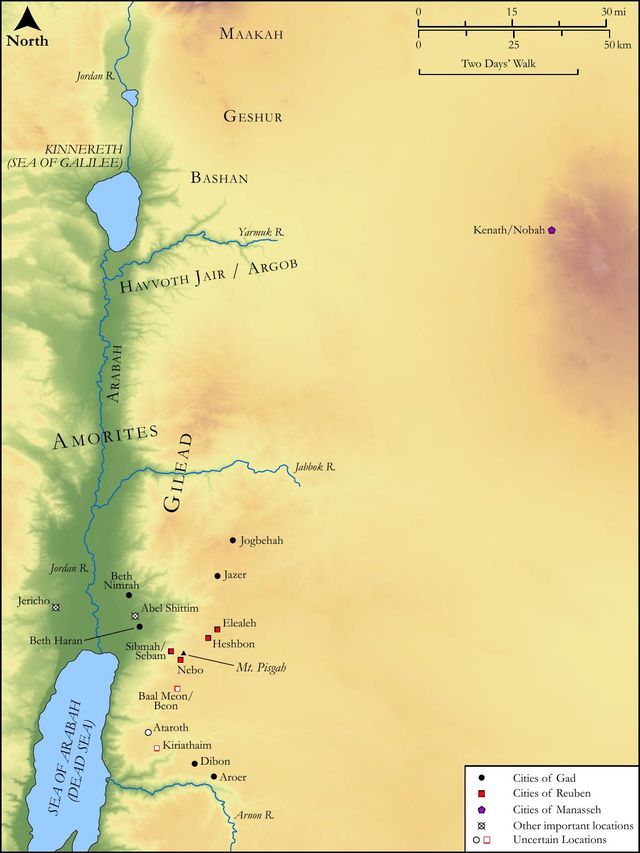
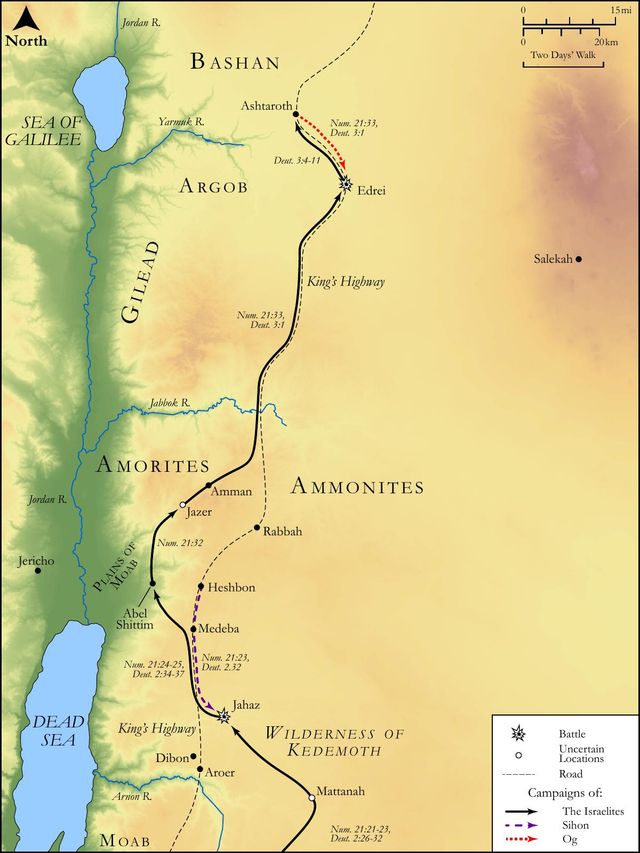
Study this verse
Public-domain commentary
Matthew Henry
From his Commentary on the Whole Bible. Henry comments on passages, not single verses — this entry covers Deuteronomy 3:12–20.
Having shown how this country which they were now in was conquered, in these verses he shows how it was settled upon the Reubenites, Gadites, and half the tribe of Manasseh, which we had the story of before, Num. 32. Here is the rehearsal. 1. Moses specifies the particular parts of the country that were allotted to each tribe, especially the distribution of the lot to the half tribe of Manasseh, the subdividing of which tribe is observable. Joseph was divided into Ephraim and Manasseh; Manasseh was divided into one half on the one side Jordan and the other half on the other side: that on the east side Jordan was again divided into two great families, which had their several allotments: Jair, Deu 3:14, Machir, Deu 3:15. And perhaps Jacob's prediction of the smallness of that tribe was now accomplished in these divisions and subdivisions. Observe that Bashan is here called the land of the giants, because it had been in their possession, but Og was the last of them. These giants, it seems, had lost their country, and were rooted out of it sooner than any of their neighbours; for those who, presuming upon their strength and stature, had their hand against every man, had every man's hand against them, and went down slain to the pit, though they were the terror of the mighty in the land of the living. 2. He repeats the condition of the grant which they had already agreed to, Deu 3:18-20. That they should send a strong detachment over Jordan to lead the van in the conquest of Canaan, who should not return to their families, at least not to settle (though for a time they might retire thither into winter quarters, at the end of a campaign), till they had seen their brethren in as full possession of their respective allotments as they themselves were now in of theirs. They must hereby be taught not to look at their own things only, but at the things of others, Phi 2:4. It ill becomes an Israelite to be selfish, and to prefer any private interest before the public welfare. When we are rest we should desire to see our brethren at rest too, and should be ready to do what we can towards it; for we are not born for ourselves, but are members one of another. A good man cannot rejoice much in the comforts of his family unless withal he sees peace upon Israel, Psa 128:6.
Continue studying Deuteronomy 3:16 across the web’s major study libraries — every link below opens this exact verse, chapter, or book on the destination site.
Read & Compare
 BibleGatewayThis verse in more than 200 translations and 70 languages.
 Bible.comThe YouVersion reader — hundreds of translations, reading plans, and highlights.
 ESV.orgCrossway's official English Standard Version reader.
 NET BibleThe NET translation with 60,000+ translators' notes on every rendering decision.
 STEP BibleTyndale House's free study tool — original text, vocabulary, and scholarly resources.
 BibliaLogos Bible Software's free web reader.
 USCCBThe New American Bible (Revised Edition) with the U.S. bishops' study notes.
Commentaries
 BibleHub CommentariesDozens of classic commentaries on this verse, gathered on one page.
 StudyLightMore than 100 commentary sets — the largest collection on the web.
 BibleRefPlain-English commentary on what this verse means, verse by verse.
 Enduring WordDavid Guzik's free commentary on this chapter, widely used by Bible teachers.
 Bible Study ToolsVerse commentary alongside Greek and Hebrew study aids.
Original Language & Research
- BibleHub InterlinearThe verse word by word — original language, transliteration, and English.
- BibleHub LexiconEvery word's original-language definition and Strong's entry.
 Blue Letter BibleDeep-study tools — Strong's numbers, concordance, and word studies.
 SefariaThe Hebrew text with Rashi and centuries of Jewish commentary.
Sermons, Hymns & Audio


TrulyRandomVerse is not affiliated with these sites and doesn’t control their content. They’re linked because they’re genuinely useful.
Summary
Deuteronomy 3:16 precisely delineates the territorial allocation made by Moses to the tribes of Reuben and Gad on the eastern side of the Jordan River. This verse, situated within Moses's valedictory address recounting Israel's journey and God's faithfulness, specifies the boundaries of their inheritance: extending from the region of Gilead south to the river Arnon, encompassing half of its valley, and further defined by the river Jabbok, which marked the border with the Ammonites. It underscores the meticulous nature of divine provision and the orderly fulfillment of God's covenant promises regarding the land, even before the main conquest of Canaan.
Context
ShowHideLiterary Context
Deuteronomy 3:16 is woven into the fabric of Moses's grand historical retrospect, which forms the initial section of the book of Deuteronomy (chapters 1-3). Moses, standing on the cusp of the Promised Land, is recounting the significant events of the Exodus generation, particularly the decisive victories over Sihon, king of the Amorites, and Og, king of Bashan. These conquests made the Transjordanian territory available for settlement. This specific verse details the distribution of this newly acquired land to the tribes of Reuben, Gad, and the half-tribe of Manasseh, fulfilling a request first recorded in Numbers 32. Moses's reiteration of this allocation in Deuteronomy serves multiple purposes: it emphasizes the divine authority behind the land distribution, highlights the tangible fulfillment of God's covenant promises concerning the land before Israel's entry into Canaan proper, and establishes a foundational historical precedent for the subsequent conquest and division of land west of the Jordan under Joshua. It also reinforces Moses's role as the divinely appointed mediator of God's will.
Historical & Cultural Context
The allocation of land east of the Jordan represented Israel's first major territorial acquisition, a significant milestone in their journey. The tribes of Reuben and Gad, possessing substantial herds, recognized the fertile pasturelands of Gilead and Bashan as ideal for their livestock, leading to their initial request for this territory, as detailed in Numbers 32:1-5. This request was granted on the condition that their fighting men would accompany the other tribes across the Jordan to participate in the conquest of Canaan. Natural features like rivers (e.g., the Arnon and Jabbok) frequently served as recognized political and geographical boundaries between peoples and kingdoms. The explicit mention of the "children of Ammon" highlights the geopolitical realities of the time, where tribal and national identities were intrinsically linked to clearly defined territories and borders. Moses's precise delineation of these boundaries was crucial for establishing the distinct identity of the tribes, preventing future disputes over land, and affirming the legal and divine basis of their inheritance in the eyes of both Israel and surrounding nations.
Key Themes
ShowHideThis verse powerfully contributes to several overarching themes central to Deuteronomy and the broader Pentateuch. Firstly, it underscores Divine Provision and the Fulfillment of Promise. The tangible giving of land, even before the full conquest, is a concrete demonstration of God's unwavering faithfulness to His covenant with Abraham, Isaac, and Jacob, promising them a land (Genesis 12:7). This act proves that God's word is reliable and His promises are concretely realized in history. Secondly, it highlights Tribal Inheritance and Orderly Distribution. The meticulous detailing of geographical boundaries reflects God's orderly nature and the profound importance of clear, divinely sanctioned divisions for the peace, identity, and stability of His people. This established a critical precedent for the later, extensive land distribution under Joshua (Joshua 13:8-12). Thirdly, it emphasizes Moses's Leadership and Mediation. Moses, as God's chosen leader, is explicitly stated as the one who "gave" this land, acting as the divine instrument in executing God's plan for Israel and distributing their inheritance. This act further solidifies his authority and crucial role in mediating God's will to the people before his impending departure.
Exposition and Analysis
ShowHideKey Word Analysis
ShowHideFrom a primitive root, this verb signifies to give, used with a wide latitude of application including to put, make, appoint, bestow, or grant. In Deuteronomy 3:16, Moses states "I gave," indicating his direct action in distributing the land. However, this act is understood as divinely authorized and executed, emphasizing that Moses is God's instrument in bestowing the promised inheritance upon the tribes of Reuben and Gad. It highlights the active and purposeful nature of God's provision through His chosen leader.
Properly meaning "a cord (as twisted)," this word implies a boundary line. By extension, it refers to the territory enclosed by such a boundary. In this verse, "border" is used twice to precisely define the limits of the allocated land, first in relation to the river Arnon and then explicitly stating the river Jabbok as the "border of the children of Ammon." This term underscores the legal, geographical, and political demarcation of the land, establishing clear limits for Israel's inheritance and its relationship with neighboring peoples.
Derived from a root meaning "to build," this term primarily means "son" but is used in the widest sense to denote offspring, descendants, or members of a group, nation, or family. Here, "children of Ammon" refers to the Ammonite people, the descendants of Ammon (Lot's son). Its inclusion clarifies that the Jabbok River served as the boundary separating the Israelite territory from the land belonging to this distinct neighboring nation, emphasizing the specific and recognized limits of Israel's inheritance.
Verse Breakdown
ShowHide"And unto the Reubenites and unto the Gadites I gave"
This opening clause immediately establishes the beneficiaries of the land allocation and the agent of the distribution. Moses, as the speaker, declares his direct action ("I gave"), but this is understood within the broader context of his divine commission. It signifies that this land grant is not arbitrary but is a divinely sanctioned act, fulfilling God's promise to Israel through His chosen leader. The specific naming of the tribes highlights the individual and collective nature of God's provision to His people.
"from Gilead even unto the river Arnon half the valley"
This phrase specifies the geographical extent of the initial portion of the territory. "Gilead" refers to the general region, indicating the northern starting point or general area from which the inheritance extends. The southern limit is clearly defined as the "river Arnon," a significant natural boundary. The crucial addition "half the valley" likely refers to the deep gorge of the Arnon River, indicating that the tribes received control over the strategic and fertile areas along this major waterway, not just the land up to its banks.
"and the border even unto the river Jabbok"
This clause further delineates the boundaries of the allocated land, indicating that the territory also extended to the river Jabbok. This identifies another prominent geographical marker, likely defining the eastern or northern reach of their land. The use of "border" here emphasizes the distinct and defined nature of this boundary, creating a clear and defensible limit for their inheritance.
"[which is] the border of the children of Ammon;"
This parenthetical clarification, while an interpretive addition by the KJV translators for clarity, accurately reflects the geopolitical reality. It explicitly identifies the river Jabbok as the precise boundary line with the Ammonite people. This detail is vital for understanding the precise limits of Israel's divinely given inheritance, ensuring that their territory was clearly demarcated and respected the established territories of neighboring nations, preventing encroachment and future conflict.
Literary Devices
ShowHideDeuteronomy 3:16 primarily employs Geographical Precision as a key literary device. The meticulous naming of specific and well-known landmarks—Gilead, the Arnon, and the Jabbok—grounds the historical account in tangible, verifiable reality. This detailed mapping emphasizes the literal fulfillment of God's promise of land and reinforces the authenticity and historical veracity of the narrative. Furthermore, the verse demonstrates Authoritative Declaration, as Moses's direct statement, "I gave," underscores his divinely appointed role in executing God's will. This lends immense weight and finality to the land distribution, emphasizing that it is a decree from God through His mediator. The clear and repeated use of the term "border" (Hebrew: gᵉbûwl) functions as a form of Legalistic Language, highlighting the formal, binding, and divinely sanctioned nature of the territorial allocation, establishing clear and indisputable claims for the tribes.
Theological and Thematic Connections
ShowHideDeuteronomy 3:16 stands as a powerful testament to God's unwavering faithfulness to His covenant promises. The physical land given to Reuben and Gad is a tangible expression of God's commitment to His people, fulfilling the ancient promise made to Abraham that his descendants would inherit a land (Genesis 12:7). This act of divine provision highlights that God's promises are not abstract ideals but are concretely realized in history, providing security, identity, and a place of belonging for His chosen nation. The precise demarcation of boundaries also speaks to God's orderly nature and His desire for peace and clear identity among His people, preventing disputes and establishing a stable foundation for their national life. This physical inheritance foreshadows the spiritual inheritance believers receive in Christ, a secure and eternal dwelling.
Reflection and Application
ShowHideDeuteronomy 3:16, while detailing an ancient land distribution, offers profound and enduring insights for contemporary believers. It serves as a powerful reminder of God's unwavering faithfulness to His promises across generations. Just as He meticulously provided a physical inheritance for Israel, demonstrating His precision and care, He remains faithful to His spiritual promises for us, providing for our needs and securing our eternal inheritance in Christ. This verse encourages us to cultivate a deep trust in God's sovereign provision, recognizing that His plans are always precise, purposeful, and ultimately for our good. Furthermore, the clear demarcation of tribal lands can be seen as a metaphor for the importance of recognizing and respecting God-given boundaries in our own lives—whether in relationships, responsibilities, personal conduct, or even our understanding of spiritual truth. Living within these divinely established parameters brings order, peace, and blessing, protecting us from chaos and conflict. It also calls us to be diligent and grateful stewards of the spiritual and material resources God has entrusted to us, understanding that our "inheritance" comes with both privilege and responsibility.
Questions for Reflection
ShowHideFAQ
ShowHideWhy did the tribes of Reuben and Gad settle east of the Jordan, rather than crossing into Canaan proper?
ShowHideThe tribes of Reuben and Gad, along with half the tribe of Manasseh, possessed a great number of livestock. As they traversed the Transjordanian region, they observed that the land east of the Jordan (specifically Gilead and Bashan) was exceptionally well-suited for grazing and pasturage. They therefore requested this territory from Moses before the main conquest of Canaan. Moses initially expressed concern that this request might discourage the other tribes from crossing the Jordan. However, he ultimately agreed on the condition that their fighting men would still cross the Jordan with the other tribes and actively participate in the conquest of the land of Canaan first, before returning to their inheritance east of the Jordan. This significant agreement is detailed in Numbers 32 and reaffirmed in Deuteronomy, highlighting both their unique needs and their commitment to the national endeavor.
What is the significance of the rivers Arnon and Jabbok as boundaries?
ShowHideRivers frequently served as natural, prominent, and recognized geographical and political boundaries between different peoples, kingdoms, and territories. The Arnon River formed a significant natural southern border for the Israelite territory east of the Jordan, effectively separating it from the land of Moab. The Jabbok River, located further north, marked another crucial boundary, specifically distinguishing Israelite territory from that of the Ammonites. These rivers were well-known landmarks, providing clear, defensible, and often internationally recognized lines of demarcation for the tribal inheritances. Their mention underscores the precise and legal nature of the land allocation, ensuring clarity regarding Israel's divinely given territory and helping to prevent future disputes with neighboring nations by establishing undisputed limits.
Christ-Centered Fulfillment
ShowHideWhile Deuteronomy 3:16 describes a physical land inheritance, it profoundly foreshadows the spiritual inheritance and ultimate fulfillment found in Jesus Christ. The meticulous provision of land to Reuben and Gad by divine decree points to God's ultimate plan to provide a secure and eternal dwelling for His people. Just as the land was a gift and a place of physical rest for Israel, Christ Himself is our true inheritance and the source of our eternal rest, a rest that remains for the people of God (Hebrews 4:9-10). The "borders" of the land, carefully delineated by Moses, can be seen as a type of the secure boundaries of God's spiritual kingdom, into which believers are brought through Christ, rescued from the domain of darkness and transferred into the kingdom of His beloved Son (Colossians 1:13). The faithfulness of God in delivering on His promise of land to Israel finds its ultimate and most glorious expression in the New Covenant, where believers are made "heirs of God and co-heirs with Christ" (Romans 8:17), receiving not merely a physical territory but an eternal kingdom and every spiritual blessing "in heavenly places in Christ" (Ephesians 1:3). Through Christ, we inherit not a piece of land, but the very presence and promises of God Himself, a far richer and more enduring possession.