


2 Samuel 24:5
Bible text: King James Version (1769 Blayney text) · Public domain
Bible text: Berean Standard Bible · Public domain
Bible text: American Standard Version (1901) · Public domain
Bible text: World English Bible, Messianic edition · Public domain
Bible text: Geneva Bible (1599) · Public domain
Bible text: Young's Literal Translation · Public domain
- וַיַּעַבְרוּvai·ya·'av·Ruand they passed overH5674Conj-w ¦ V-Qal-ConsecImperf-3mpVerb Qal Consecutive Imperfect 3rd Plural Masculineוַandיַּעַבְרוּthey passed over
- אֶת'et<obj.>H853DirObjMParticle Object Indicator
- הַיַּרְדֵּןhai·yar·Denthe JordanH3383Art ¦ N-properNoun Proper LocationהַtheיַּרְדֵּןJordan
- וַיַּחֲנוּvai·ya·cha·Nuand they encampedH2583Conj-w ¦ V-Qal-ConsecImperf-3mpVerb Qal Consecutive Imperfect 3rd Plural Masculineוַandיַּחֲנוּthey encamped
- בַעֲרוֹעֵרva·'a·ro·'Erat AroerH6177Prep-b ¦ N-properNoun Proper LocationבַatעֲרוֹעֵרAroer
- יְמִיןye·Min[the] south ofH3225N-fscNoun Singular Feminine Construct
- הָעִירha·'Irthe cityH5892Art ¦ N-fsNoun Singular Feminine Absoluteהָtheעִירcity
- אֲשֶׁר'a·SherwhichH834RelParticle Relative
- בְּתוֹךְbe·tokh[is] in [the] middle ofH8432Prep-b ¦ N-mscNoun Singular Masculine Constructבְּ[is] inתוֹךְ[the] middle of
- הַנַּחַלha·Na·chalthe wadiH5158Art ¦ N-msNoun Singular Masculine Absoluteהַtheנַּחַלwadi
- הַגָּדha·Gad<the> GadH1410Art ¦ N-properNoun Proper Locationהַ<the>גָּדGad
- וְאֶלve·'eland toH413Conj-w ¦ PrepPrepositionוְandאֶלto
- יַעְזֵרya'·ZerJazerH3270N-properNoun Proper Location
English is a literal word-by-word gloss of the Hebrew, not the KJV's wording. Why?
This is the original text the KJV's translators worked from — each Hebrew word with its own literal English meaning in this verse, prepared by scholars at Tyndale House, Cambridge. The KJV translates whole sentences, not word by word, so its wording differs: one Hebrew word can become several English words, and the KJV may choose “the LORD” where the gloss reads “Yahweh”. Both are faithful — they answer different questions. For the KJV's own rendering, switch to the KJV text.
Details
See on the biblical-era maps
Study this verse
Continue studying 2 Samuel 24:5 across the web’s major study libraries — every link below opens this exact verse, chapter, or book on the destination site.
Read & Compare
 BibleGatewayThis verse in more than 200 translations and 70 languages.
 Bible.comThe YouVersion reader — hundreds of translations, reading plans, and highlights.
 ESV.orgCrossway's official English Standard Version reader.
 NET BibleThe NET translation with 60,000+ translators' notes on every rendering decision.
 STEP BibleTyndale House's free study tool — original text, vocabulary, and scholarly resources.
 BibliaLogos Bible Software's free web reader.
 USCCBThe New American Bible (Revised Edition) with the U.S. bishops' study notes.
Commentaries
 BibleHub CommentariesDozens of classic commentaries on this verse, gathered on one page.
 StudyLightMore than 100 commentary sets — the largest collection on the web.
 BibleRefPlain-English commentary on what this verse means, verse by verse.
 Enduring WordDavid Guzik's free commentary on this chapter, widely used by Bible teachers.
 Bible Study ToolsVerse commentary alongside Greek and Hebrew study aids.
Original Language & Research
- BibleHub InterlinearThe verse word by word — original language, transliteration, and English.
- BibleHub LexiconEvery word's original-language definition and Strong's entry.
 Blue Letter BibleDeep-study tools — Strong's numbers, concordance, and word studies.
 SefariaThe Hebrew text with Rashi and centuries of Jewish commentary.
Sermons, Hymns & Audio


TrulyRandomVerse is not affiliated with these sites and doesn’t control their content. They’re linked because they’re genuinely useful.
Summary
2 Samuel 24:5 meticulously details the initial movements of Joab and his officers as they commence King David's controversial census of Israel. This verse marks the geographical starting point of their extensive journey, describing their passage across the Jordan River into the Transjordan region, specifically pitching camp in Aroer, near a wadi in the territory of Gad, and subsequently moving toward Jazer. It sets the stage for the comprehensive, yet ultimately sinful, enumeration of David's fighting men, an act that displeased the Lord and led to severe consequences for the nation.
Context
ShowHideLiterary Context
This verse is situated at the very beginning of the final chapter of 2 Samuel, which recounts David's decision to conduct a census of Israel and Judah. Following a period of God's anger against Israel (though the specific reason is not stated, 2 Samuel 24:1), David is prompted to command this census. Despite the strong objections and warnings from his loyal general, Joab, who recognized the potential spiritual and practical dangers of such an act (2 Samuel 24:3), David insists. Verse 5, therefore, is not merely a geographical note but the textual initiation of this ill-fated enterprise, detailing the first steps of Joab's arduous nine-month journey to enumerate the fighting men of Israel. It immediately precedes the description of the full circuit Joab's team made across the land, highlighting the meticulous, yet misguided, nature of David's command that culminates in the final tally and subsequent divine judgment in 2 Samuel 24:9-16.
Historical & Cultural Context
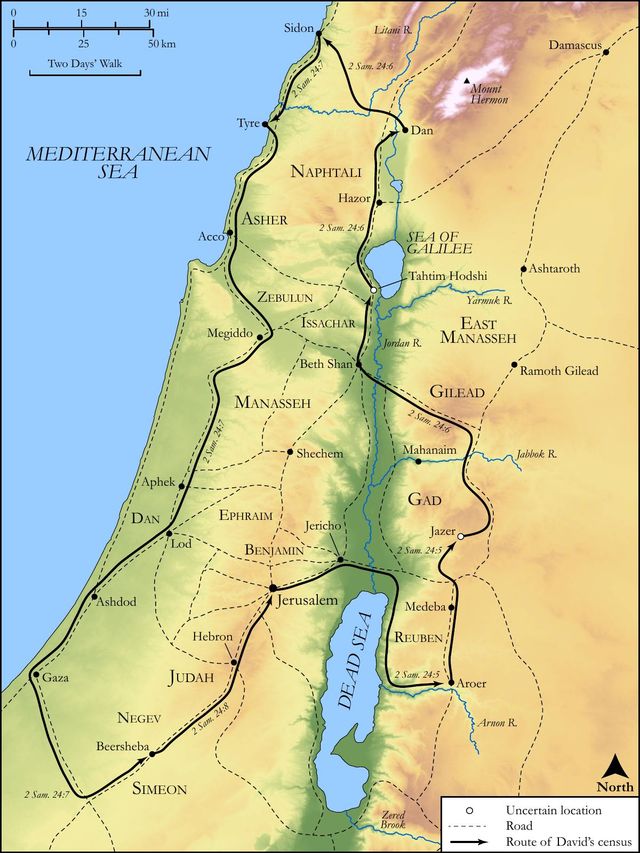
Censuses in Israel and among the nations were typically conducted for military conscription, taxation, or land distribution. While the Mosaic Law allowed for censuses under specific conditions (e.g., Numbers 1:2-3), David's census here appears to be motivated by pride, a desire to boast in his military strength rather than relying on God's power and provision. The geographical locations mentioned—Aroer, the River of Gad (referring to a wadi or stream in the territory of Gad), and Jazer—are all in the Transjordan region, east of the Jordan River. This area was primarily settled by the tribes of Reuben, Gad, and the half-tribe of Manasseh. Aroer, likely the city on the Arnon River, marked the southern boundary of the Israelite territory in Transjordan, indicating that Joab began his count from the southernmost point of David's dominion east of the Jordan, before proceeding northward and then westward across the Jordan. This detailed itinerary underscores the comprehensive scope David intended for his census.
Key Themes
ShowHideThe meticulous geographical detail in 2 Samuel 24:5 contributes to several key themes within the broader narrative of 2 Samuel 24. Firstly, it emphasizes the geographical precision and historical grounding of the biblical account, demonstrating the vastness of David's kingdom and the thoroughness with which the census was executed. Secondly, it highlights the scope of the census, revealing David's ambition to count every eligible man across all tribal territories, from the southern Transjordan to the northern reaches of Israel. Thirdly, it subtly underscores Joab's reluctant obedience and military discipline; despite his explicit moral and practical reservations about the census, he dutifully carries out his king's controversial order. Most importantly, this verse serves as the tangible beginning of an act rooted in human pride and self-reliance, contrasting sharply with the principle of divine trust that should characterize God's people. This contrast ultimately leads to the severe consequences detailed later in the chapter, demonstrating the gravity of sin and the importance of seeking God's will above all else.
Exposition and Analysis
ShowHideKey Word Analysis
ShowHideA primitive root meaning "to cross over." This word signifies a transition, both literal and figurative. Here, it denotes the physical act of crossing the Jordan River, marking the commencement of Joab's journey from the western side of the Jordan (Canaan proper) to the eastern side (Transjordan). It implies movement, progression, and the initiation of a new phase in the census operation.
A primitive root meaning "to incline" or "to decline," but specifically "to pitch a tent" or "to encamp." This word describes the act of setting up a temporary dwelling or military camp. Its use here indicates that Aroer was not merely passed through, but served as a significant stop or base of operations where Joab's forces established themselves to begin the enumeration process in the Transjordan region.
The name of a place, meaning "nudity of situation." This is a specific city, likely the one situated on the northern bank of the Arnon River, which was a significant boundary marker for the territory of Reuben and Gad. Its mention as the initial encampment point signifies the southernmost part of the Transjordan region included in the census, indicating a systematic and comprehensive approach to enumeration.
Verse Breakdown
ShowHide"And they passed over Jordan"
This phrase describes the act of Joab and his officers crossing the Jordan River. This geographical shift is significant, as it marks their movement from the main Israelite territories west of the Jordan into the Transjordan region, which was settled by the tribes of Reuben, Gad, and the half-tribe of Manasseh. It signifies the physical commencement of the census operation in these eastern territories.
"and pitched in Aroer"
Following their crossing, Joab's forces established their camp in Aroer. The act of "pitching" implies a deliberate stop and setting up a base, indicating that Aroer was their initial operational hub for the census. This city, strategically located, served as the starting point for their comprehensive survey of David's kingdom.
"on the right side of the city that [lieth] in the midst of the river of Gad"
This highly specific geographical descriptor serves to precisely identify the Aroer intended, as there were multiple places by that name. "On the right side" (Hebrew yâmîyn) often refers to the south or east, depending on the orientation, further pinpointing its location. "In the midst of the river of Gad" refers to Aroer's position relative to a specific wadi or seasonal stream within the tribal territory of Gad. This detail ensures clarity for the ancient reader, distinguishing this Aroer from others and providing a precise starting coordinate for the census.
"and toward Jazer"
This concluding phrase indicates the general direction of their subsequent travel or the next major area they intended to cover. After establishing their presence and likely commencing their count in Aroer, their route would lead them northward towards Jazer, another significant city in Gad's territory. This demonstrates the progressive and systematic nature of the census, covering one region before moving to the next.
Literary Devices
ShowHideThe primary literary device at play in 2 Samuel 24:5 is Geographical Detail. The meticulous naming of specific locations—Jordan, Aroer, the River of Gad, and Jazer—serves to ground the narrative firmly in historical reality, lending credibility to the account of David's census. This precision is not merely descriptive but also contributes to Narrative Progression, signaling the actual commencement of the census operation after the command was given. The detailed itinerary underscores the comprehensive and extensive nature of the task, highlighting the sheer scale of David's kingdom and the administrative effort involved. Furthermore, by initiating the census with such specific geographical markers, the text subtly employs Foreshadowing. The very act of meticulously counting and mapping the kingdom, despite its inherent sinfulness, sets the stage for the divine judgment that will follow, emphasizing that God's judgment is precise and affects the very people and land being enumerated. The detailed mapping also highlights the Irony of David's effort: he seeks to quantify his strength, but this very act reveals his spiritual weakness and leads to a reduction, not an increase, in his people.
Theological and Thematic Connections
ShowHide2 Samuel 24:5, while seemingly a mere geographical detail, serves as the tangible manifestation of a profound theological tension: the human tendency to rely on visible strength and resources versus unwavering trust in God's invisible power and provision. David's census, initiated here, represents a shift from a posture of faith, where God alone fights his battles, to one of self-sufficiency, where the king seeks to quantify his military might. This act, though meticulously executed by Joab's team across the land, was fundamentally flawed in its motive, reflecting a lack of faith that invited divine displeasure. The detailed mapping of the kingdom for human accounting purposes stands in stark contrast to God's sovereign knowledge of His people, who are known by Him intimately, not by a numerical tally. This episode underscores that even diligent and comprehensive human endeavors, if not rooted in righteous motives and divine command, can lead to calamitous outcomes, revealing the spiritual danger of pride and the necessity of humility before God.
Reflection and Application
ShowHideThe detailed account of Joab's journey in 2 Samuel 24:5, marking the beginning of David's ill-fated census, offers a powerful lesson on the intersection of human action, motivation, and divine will. It reminds us that even highly organized, diligent, and seemingly productive endeavors can be deeply flawed if their underlying motive is pride, self-reliance, or a lack of trust in God. We are often tempted to "take a census" in our own lives—counting our achievements, resources, connections, or followers—believing that our security and success depend on these quantifiable metrics. This verse challenges us to examine the "why" behind our actions: Are we building our kingdom or God's? Are we trusting in our own strength and numbers, or in the limitless power and provision of the Almighty? True security and blessing come not from what we can count, but from the unquantifiable grace and faithfulness of God. Our diligence should be directed towards discerning and obeying His will, even when it seems counter-intuitive or requires us to relinquish control and trust Him alone.
Questions for Reflection
ShowHideFAQ
ShowHideWhy was David's census considered a sin?
ShowHideDavid's census was considered a sin not because the act of counting people was inherently wrong (the Mosaic Law permitted censuses for military or administrative purposes, as seen in Numbers 1), but because of the underlying motive and circumstances. The text in 2 Samuel 24:1 states that "the anger of the Lord was again kindled against Israel, and he incited David against them to say, 'Go, number Israel and Judah.'" The parallel account in 1 Chronicles 21:1 explicitly states that "Satan stood against Israel and incited David to number Israel." This indicates that David's decision was influenced by a malevolent force, tapping into a weakness or pride within him. The sin likely stemmed from a desire to rely on his own military strength and numbers rather than on God's power and provision, or perhaps to boast in the size of his kingdom, demonstrating a lack of faith and a spirit of self-sufficiency that displeased God.
What is the significance of the specific locations mentioned (Aroer, River of Gad, Jazer)?
ShowHideThe specific mention of Aroer, the River of Gad, and Jazer in 2 Samuel 24:5 serves several important purposes. Firstly, it lends historical accuracy and geographical grounding to the narrative, confirming that the biblical account is rooted in real places and events. These locations were well-known in ancient Israel, particularly in the Transjordan region. Secondly, it highlights the comprehensive scope of David's census. By starting in Aroer (likely the one on the Arnon River, marking the southern boundary of Israelite territory in Transjordan) and moving towards Jazer, the text shows that Joab's team systematically covered the entire breadth of David's kingdom, leaving no area uncounted. This meticulous detail underscores the thoroughness of the operation, which, paradoxically, was part of its sinful nature as it reflected a misplaced trust in human organization and numbers.
Christ-Centered Fulfillment
ShowHideThe detailed account of David's census, initiated in 2 Samuel 24:5, serves as a poignant contrast to the perfect reign of Jesus Christ. David, despite being a man after God's own heart, succumbed to the temptation of pride, seeking to quantify his strength and rely on human numbers rather than divine power. This act of self-sufficiency led to God's judgment and a devastating plague upon Israel (2 Samuel 24:15). In stark contrast, Jesus, the true King of Israel, never needed to count His army or rely on human might. His kingdom is "not of this world" (John 18:36), built not on military strength or numerical superiority, but on truth, grace, and sacrificial love. He did not come to number His subjects for earthly dominion but to lay down His life for them, knowing each one by name as the Good Shepherd knows His sheep (John 10:14). While David's census brought judgment, Christ's perfect obedience and ultimate sacrifice on the cross brought forgiveness and salvation for all who believe, demonstrating that true power and victory are found not in human strength, but in divine weakness and humility (Philippians 2:8). He is the one who truly gathers His people, not through a census, but through the Spirit, drawing them into an eternal kingdom that will never be shaken (Hebrews 12:28).