


Numbers 32:3
- עֲטָרוֹתa·ta·RotAtarothH5852N-properNoun Proper Location
- וְדִיבֹןve·di·Vonand DibonH1769Conj-w ¦ N-properNoun Proper LocationוְandדִיבֹןDibon
- וְיַעְזֵרve·ya'·Zerand JazerH3270Conj-w ¦ N-properNoun Proper LocationוְandיַעְזֵרJazer
- וְנִמְרָהve·nim·Rahand NimrahH5247Conj-w ¦ N-properNoun Proper LocationוְandנִמְרָהNimrah
- וְחֶשְׁבּוֹןve·chesh·Bonand HeshbonH2809Conj-w ¦ N-properNoun Proper LocationוְandחֶשְׁבּוֹןHeshbon
- וְאֶלְעָלֵהve·'el·'a·Lehand ElealehH500Conj-w ¦ N-properNoun Proper LocationוְandאֶלְעָלֵהElealeh
- וּשְׂבָםu·se·Vamand SebamH7643Conj-w ¦ N-properNoun Proper LocationוּandשְׂבָםSebam
- וּנְבוֹu·ne·Voand NeboH5015Conj-w ¦ N-properNoun Proper LocationוּandנְבוֹNebo
- וּבְעֹןu·ve·'Onand BeonH1194Conj-w ¦ N-properNoun Proper LocationוּandבְעֹןBeon
English is a literal word-by-word gloss of the Hebrew, not the KJV's wording. Why?
This is the original text the KJV's translators worked from — each Hebrew word with its own literal English meaning in this verse, prepared by scholars at Tyndale House, Cambridge. The KJV translates whole sentences, not word by word, so its wording differs: one Hebrew word can become several English words, and the KJV may choose “the LORD” where the gloss reads “Yahweh”. Both are faithful — they answer different questions. For the KJV's own rendering, switch to the KJV text.
Details
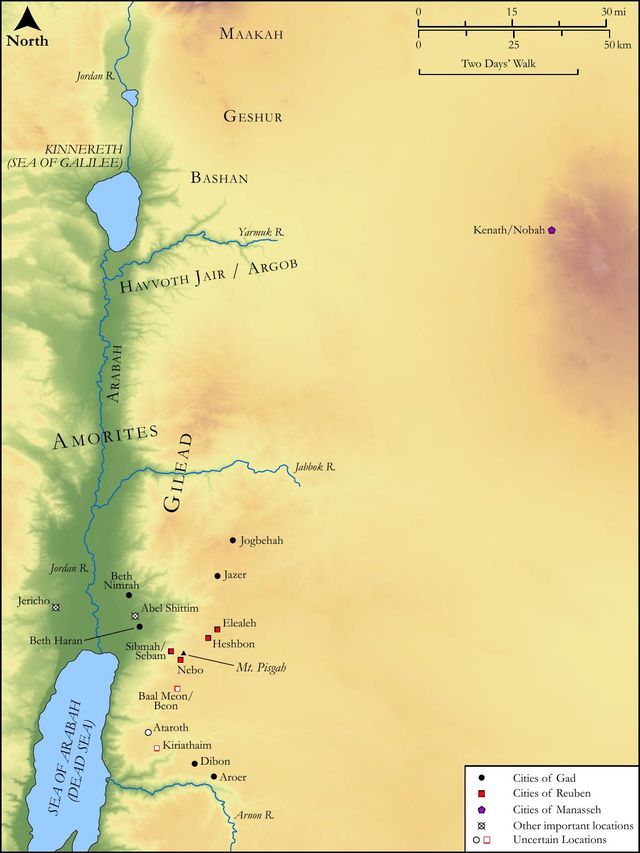
See on the biblical-era map
Study this verse
Continue studying Numbers 32:3 across the web’s major study libraries — every link below opens this exact verse, chapter, or book on the destination site.
Read & Compare
 BibleGatewayThis verse in more than 200 translations and 70 languages.
 Bible.comThe YouVersion reader — hundreds of translations, reading plans, and highlights.
 ESV.orgCrossway's official English Standard Version reader.
 NET BibleThe NET translation with 60,000+ translators' notes on every rendering decision.
 STEP BibleTyndale House's free study tool — original text, vocabulary, and scholarly resources.
 BibliaLogos Bible Software's free web reader.
 USCCBThe New American Bible (Revised Edition) with the U.S. bishops' study notes.
Commentaries
 BibleHub CommentariesDozens of classic commentaries on this verse, gathered on one page.
 StudyLightMore than 100 commentary sets — the largest collection on the web.
 BibleRefPlain-English commentary on what this verse means, verse by verse.
 Enduring WordDavid Guzik's free commentary on this chapter, widely used by Bible teachers.
 Bible Study ToolsVerse commentary alongside Greek and Hebrew study aids.
Original Language & Research
- BibleHub InterlinearThe verse word by word — original language, transliteration, and English.
- BibleHub LexiconEvery word's original-language definition and Strong's entry.
 Blue Letter BibleDeep-study tools — Strong's numbers, concordance, and word studies.
 SefariaThe Hebrew text with Rashi and centuries of Jewish commentary.
Sermons, Hymns & Audio


TrulyRandomVerse is not affiliated with these sites and doesn’t control their content. They’re linked because they’re genuinely useful.
Summary
Numbers 32:3 presents a precise enumeration of nine specific towns—Ataroth, Dibon, Jazer, Nimrah, Heshbon, Elealeh, Shebam, Nebo, and Beon—all located in the fertile Transjordanian region. This detailed listing forms an integral part of the petition brought by the tribes of Reuben and Gad to Moses, Eleazar, and the other Israelite leaders. Having thoroughly assessed the suitability of these lands for their extensive livestock, these tribes expressed their desire to inherit this territory east of the Jordan River, rather than crossing into Canaan with the rest of the congregation, thereby initiating a significant negotiation concerning tribal inheritance, communal responsibility, and the fulfillment of God's covenant promises.
Context
ShowHideLiterary Context
Numbers 32:3 is situated at a critical juncture in the book of Numbers, immediately following Israel's decisive victories over Sihon, king of the Amorites, and Og, king of Bashan. The Israelites are encamped on the plains of Moab, poised on the brink of entering the long-promised land of Canaan. The preceding verses (Numbers 32:1-2) establish the premise: the tribes of Reuben and Gad possess "a very great multitude of cattle" and find the newly conquered Transjordanian lands, particularly the regions of Jazer and Gilead, exceptionally well-suited for grazing. Their request to settle here, rather than crossing the Jordan with the other tribes, initially elicits Moses' severe disapproval, as he fears it will replicate the faithless discouragement seen during the disastrous spy report at Kadesh-Barnea. The meticulous listing of these specific towns in verse 3 serves to underscore the concrete and well-considered nature of their proposal and their thorough assessment of the land's potential. The subsequent narrative in Numbers 32:4-42 details the ensuing negotiation, which ultimately leads to a conditional compromise wherein Reuben and Gad agree to fight alongside their brethren for the conquest of Canaan before returning to their Transjordanian inheritance.
Historical & Cultural Context
The events described in Numbers 32 unfold on the eastern side of the Jordan River, in territory recently wrested from the Amorite kings. This region, known as Transjordan, was characterized by its fertile plains, rich pastures, and strategic highlands, offering a stark contrast to the more mountainous and agriculturally diverse terrain of Canaan proper. For the semi-nomadic and pastoralist Israelites, land was not merely a geographical space but the tangible manifestation of God's covenant promise, intrinsically linked to tribal identity, economic stability, and spiritual well-being. The "very great multitude of cattle" (Numbers 32:1) belonging to Reuben and Gad highlights their economic reliance on livestock, making the availability of extensive pastureland a paramount concern. Many of the cities listed, such as Heshbon, were significant regional centers, and Nebo is famously the mountain from which Moses would later view the Promised Land before his death, as recorded in Deuteronomy 34:1. The tribes' request thus reflects a practical response to their immediate needs within the broader context of the national mission.
Key Themes
ShowHideNumbers 32:3, despite being a simple enumeration, contributes significantly to several overarching themes prevalent throughout the Pentateuch. Firstly, it prominently features the theme of Land and Inheritance, showcasing the Israelites' deep-seated desire for the fulfillment of God's covenant promise of land, even as some tribes sought a pragmatic, immediate inheritance outside the primary designated territory of Canaan. Secondly, it highlights the inherent tension between Individual/Tribal Needs versus Corporate Responsibility. The tribes' focus on their substantial livestock and the perceived suitability of the Transjordanian lands initially threatened the unity and shared commitment essential for the conquest of Canaan. Moses' strong reaction underscores the critical importance of national solidarity and unwavering obedience to the divine mandate for the entire community. Thirdly, the passage subtly introduces the theme of Consequences of Choices. While the request was ultimately granted under specific conditions, the subsequent history of the Transjordanian tribes often saw them more exposed to external threats and cultural assimilation, illustrating that even seemingly practical decisions can have profound and long-term implications for both spiritual and physical security. This narrative serves as a nuanced exploration of discernment between God's full will and convenient alternatives.
Exposition and Analysis
ShowHideKey Word Analysis
ShowHideA town located in the territory later assigned to Gad, though initially sought by Reuben. Its name is derived from the Hebrew word for "crowns," potentially indicating its strategic importance, elevated position, or a prominent feature resembling a crown. It is mentioned again as one of the cities rebuilt by the Gadites in Numbers 32:34.
A significant Moabite city that was later allocated to the tribe of Reuben. It is also referred to as Dibon-Gad in Numbers 32:34 and is historically renowned for the discovery of the Mesha Stele (Moabite Stone), which provides valuable extra-biblical insights into its history and significance. Its inclusion in this list highlights its strategic location and the fertility of its surrounding lands.
This refers to both a city and a prominent mountain peak situated in Moab. Mount Nebo holds immense biblical significance as the vantage point from which Moses was permitted to view the Promised Land before his death, as detailed in Deuteronomy 34:1-4. Its mention in Numbers 32:3 signifies its geographical prominence within the Transjordan region and its association with the borderlands of the Amorite kingdom.
Verse Breakdown
ShowHide"Ataroth, and Dibon, and Jazer, and Nimrah"
This initial quartet of towns represents the core of the desired territory. Ataroth and Dibon were strategically important cities, while Jazer and Nimrah (likely identifiable with Beth-Nimrah, mentioned in Numbers 32:36) were renowned for their fertile pasturelands within the region of Gilead. The specific naming of these places by the tribes of Reuben and Gad demonstrates their meticulous reconnaissance and identification of the most desirable locations for their extensive pastoral economy, underscoring the practical and economic motivations driving their request.
"and Heshbon, and Elealeh, and Shebam"
Heshbon was a major Amorite capital, which Israel had recently conquered under Moses' leadership, as recounted in Numbers 21:26. Its inclusion in the list emphasizes the strategic value and established infrastructure of the newly acquired territory. Elealeh and Shebam (also known as Sibmah, noted for its agricultural bounty in Isaiah 16:8-9) were celebrated for their agricultural fertility, particularly their vineyards, indicating the overall richness of the land beyond mere pasturage. These names further solidify the tribes' comprehensive assessment of the region's diverse resources.
"and Nebo, and Beon"
Nebo, encompassing both a city and a mountain, held significant geographical and historical importance, serving as a landmark in the borderlands and offering strategic vantage points. Beon (likely an abbreviation for Baal-Meon, as seen in Numbers 32:38) was another prominent city in the region, historically associated with the worship of Baal, thereby indicating its pre-Israelite pagan heritage. The inclusion of these final two names completes the detailed inventory of the desired territories, underscoring the tribes' specific, well-defined, and substantial request for a significant portion of the Transjordan.
Literary Devices
ShowHideThe primary literary device employed in Numbers 32:3 is Listing or Cataloguing. The verse presents a precise and exhaustive enumeration of nine specific towns and regions: Ataroth, Dibon, Jazer, Nimrah, Heshbon, Elealeh, Shebam, Nebo, and Beon. This detailed cataloguing serves to emphasize the concrete and tangible nature of the request made by the tribes of Reuben and Gad. It highlights their thorough assessment of the Transjordanian territory and the specific, highly desirable locations they had identified as suitable for their large herds and settlements. The very specificity of the names lends a profound sense of realism and immediacy to the narrative, grounding the abstract concept of "land" in identifiable, known places. Furthermore, this Geographical Specificity underscores the practical, economic, and strategic considerations that heavily influenced the tribes' decision, implicitly contrasting with the more abstract divine promise of the "land of Canaan." The act of listing these names also subtly introduces an element of Foreshadowing, as the subsequent history of these Transjordanian tribes, often vulnerable to invasion due to their frontier location, is implicitly set in motion by this foundational choice of settlement.
Theological and Thematic Connections
ShowHideNumbers 32:3, though a seemingly simple list of place names, carries profound theological and thematic significance for understanding the dynamics of God's covenant with Israel and the inherent challenges of communal life. It brings to the forefront the tension between a divinely appointed corporate mission—the conquest and settlement of the Promised Land west of the Jordan—and the pragmatic desires of individual tribes. The request of Reuben and Gad highlights that even within a sacred journey directed by God, human preferences, economic considerations, and immediate perceived advantages can potentially divert attention from the ultimate divine purpose. This passage teaches that true inheritance is not merely geographical or material but fundamentally involves a commitment to God's larger, overarching plan for His people. The negotiation that follows demonstrates the critical importance of unity, mutual responsibility, and shared sacrifice within the covenant community, where personal gain must sometimes be deferred or integrated for the sake of the collective good and the advancement of God's kingdom. The very act of naming these places underscores the tangible nature of the land promise and the tribes' deep-seated desire to secure their portion, even if it meant a path different from the one initially envisioned for the entire nation.
Reflection and Application
ShowHideThe detailed list of towns in Numbers 32:3, while appearing mundane, serves as a powerful invitation for us to reflect on the choices we make when confronted with opportunities that seem immediately advantageous but might subtly diverge from God's broader calling for our lives or for our spiritual community. The tribes of Reuben and Gad perceived immediate, tangible benefits in the fertile Transjordan, a "good land" perfectly suited for their extensive herds. This narrative prompts us to honestly consider whether our pursuit of personal comfort, security, or convenience ever causes us to settle for less than God's full, intended inheritance for us, or to compromise our commitment to the collective mission of the church. Discerning God's will often involves a delicate balance between our practical needs and spiritual foresight, recognizing that true and lasting blessing flows from aligning our deepest desires with His sovereign purposes. The wise compromise reached in Numbers 32, where these tribes agreed to actively participate in the conquest of Canaan first, serves as a timeless reminder of the paramount importance of fulfilling our obligations to the body of Christ and prioritizing the advancement of God's kingdom, even when it demands personal sacrifice or delayed gratification. Our choices, much like those of the Transjordanian tribes, can have profound long-term consequences, shaping our spiritual trajectory and our vulnerability to worldly pressures.
Questions for Reflection
ShowHideFAQ
ShowHideWhy were these specific towns mentioned in Numbers 32:3?
ShowHideThese towns were meticulously mentioned because they represented the heart of the fertile pasturelands in the Transjordan region, which the tribes of Reuben and Gad had identified as exceptionally ideal for their "very great multitude of cattle" (Numbers 32:1). The specific listing demonstrated the thoroughness of their assessment and the concrete, well-defined nature of their request. Many of these cities, like Heshbon, were significant regional centers previously conquered by Israel, and their strategic and agricultural value made them highly desirable for immediate settlement. The enumeration underscored the precise land they wished to inherit, thereby setting the stage for their crucial negotiation with Moses and the other Israelite leaders.
What happened to the tribes who settled east of the Jordan?
ShowHideThe tribes of Reuben, Gad, and the half-tribe of Manasseh did indeed settle east of the Jordan after faithfully fulfilling their promise to help conquer Canaan. They returned to their inheritance as recorded in Joshua 22:1-9. While they initially prospered, their geographical location on the frontier made them inherently more vulnerable to external invasions from the east (e.g., Moabites, Ammonites, Arameans, Assyrians). Historically, they were often among the first Israelite tribes to be attacked and carried into exile, as vividly seen in the Assyrian deportations described in 1 Chronicles 5:26. This increased vulnerability is often interpreted as a long-term consequence of their choice to settle outside the primary land of Canaan, illustrating the spiritual principle that even seemingly practical choices can have lasting implications for security and spiritual well-being.
Was the request of Reuben and Gad considered wrong by God or Moses?
ShowHideMoses' initial reaction to the request was indeed one of intense anger and profound concern, as he feared it would discourage the rest of the Israelites from entering Canaan, echoing the disastrous episode at Kadesh-Barnea. He perceived it as a potential act of faithlessness and a threat to national unity. However, the request itself was not inherently wrong, as the land was indeed conquered territory that God had allowed them to possess. The core issue was their desire to settle before fulfilling their corporate responsibility to help conquer the rest of the Promised Land. Once they committed to fighting alongside their brethren until the conquest was complete (Numbers 32:16-32), Moses granted their request. This compromise highlights that while their initial priority might have been misplaced, their willingness to fulfill their obligations made their request acceptable, demonstrating God's grace and the vital importance of communal unity and shared purpose.
Christ-Centered Fulfillment
ShowHideThe detailed listing of towns in Numbers 32:3, representing a desired earthly inheritance, finds its ultimate and profound fulfillment in Jesus Christ. The tribes of Reuben and Gad sought a specific physical land for their temporal prosperity and the flourishing of their flocks, a "good land" for their immediate needs. Yet, the New Testament reveals that for believers, our true "land" and enduring inheritance are not geographical but spiritual and eternal, found exclusively and completely in Jesus Christ. He is the ultimate "good land" in whom we discover perfect rest, abundant provision, and unshakable security. Just as the Israelites were led by God to a promised earthly land, Christ leads His people to a "better country, that is, a heavenly one" (Hebrews 11:16). Our inheritance as New Covenant believers is no longer tied to a specific patch of earth but to "every spiritual blessing in the heavenly places in Christ" (Ephesians 1:3). The inherent tension between immediate gratification and a greater, future promise, so vividly evident in the narrative of Numbers 32, is perfectly resolved in Christ, who calls us to willingly lay down earthly pursuits and perceived gains for the surpassing worth of knowing Him (Philippians 3:8). He is the true Shepherd who leads His flock not merely to green pastures in a physical land, but to eternal life and abundant spiritual sustenance, embodying the ultimate fulfillment of God's promise of rest, belonging, and an everlasting inheritance for His people.