


Isaiah 16:8
- כִּיkiforH3588PrtParticle Conditional
- שַׁדְמוֹתshad·mOt[the] fields ofH7709N-fpcNoun Plural Feminine Construct
- חֶשְׁבּוֹןchesh·BonHeshbonH2809N-properNoun Proper Location
- אֻמְלָל'um·Lalit has witheredH535V-Pual-Perf-3msVerb Pual Perfect 3rd Singular Masculine
- גֶּפֶןGe·fen[the] vine[s] ofH1612N-cscNoun Singular common gender Construct
- שִׂבְמָהsiv·MahSibmahH7643N-properNoun Proper Location
- בַּעֲלֵיba·'a·Leirulers ofH1167N-mpcNoun Plural Masculine Construct
- גוֹיִםgo·YimnationsH1471N-mpNoun Plural Masculine Absolute
- הָלְמוּhal·Muthey have struck downH1986V-Qal-Perf-3cpVerb Qal Perfect 3rd Plural common gender
- שְׂרוּקֶּיהָse·ru·Kei·haits choice grapesH8291Adj-mpc ¦ 3fsAdjective Plural Masculine Constructשְׂרוּקֶּיchoice grapesהָits
- עַד'adtoH5704PrepPreposition
- יַעְזֵרya'·ZerJazerH3270N-properNoun Proper Location
- נָגָעוּna·Ga·'uthey reachedH5060V-Qal-Perf-3cpVerb Qal Perfect 3rd Plural common gender
- תָּעוּTa·'uthey wanderedH8582V-Qal-Perf-3cpVerb Qal Perfect 3rd Plural common gender
- מִדְבָּרmid·Bar[the] wildernessH4057N-msNoun Singular Masculine Absolute
- שְׁלֻחוֹתֶיהָshe·Lu·cho·Tei·haits shootsH7976N-fpc ¦ 3fsNoun Plural Feminine Constructשְׁלֻחוֹתֶיshootsהָits
- נִטְּשׁוּni·te·Shuthey were spread outH5203V-Niphal-Perf-3cpVerb Niphal Perfect 3rd Plural common gender
- עָבְרוּ'A·ve·ruthey passed overH5674V-Qal-Perf-3cpVerb Qal Perfect 3rd Plural common gender
- יָםYam[the] seaH3220N-msNoun Singular Masculine Absolute
English is a literal word-by-word gloss of the Hebrew, not the KJV's wording. Why?
This is the original text the KJV's translators worked from — each Hebrew word with its own literal English meaning in this verse, prepared by scholars at Tyndale House, Cambridge. The KJV translates whole sentences, not word by word, so its wording differs: one Hebrew word can become several English words, and the KJV may choose “the LORD” where the gloss reads “Yahweh”. Both are faithful — they answer different questions. For the KJV's own rendering, switch to the KJV text.
Details
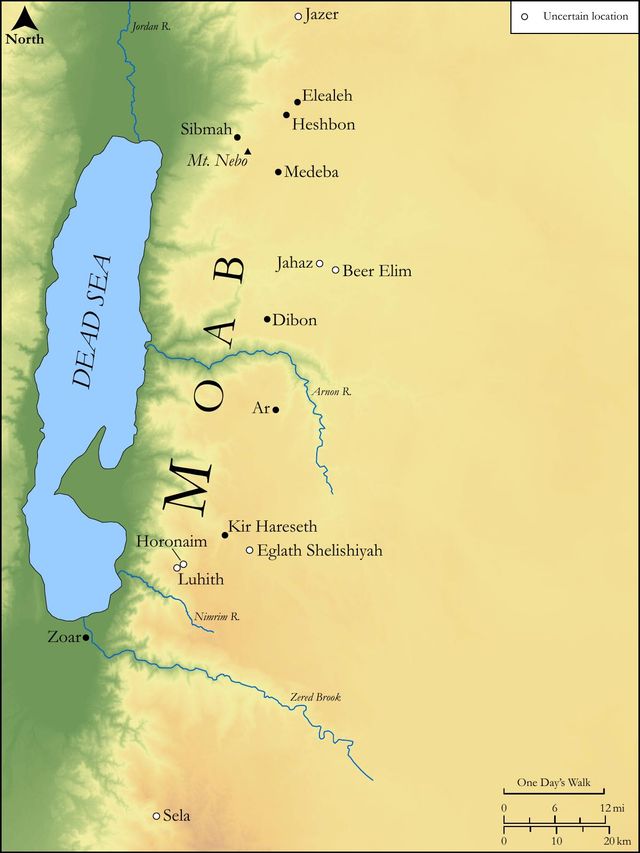
See on the biblical-era map
Study this verse
Public-domain commentary
Matthew Henry
From his Commentary on the Whole Bible. Henry comments on passages, not single verses — this entry covers Isaiah 16:6–14. His four-level outline is real structure in the source text, so it is rendered as structure.
Here we have, I. The sins with which Moab is charged, Isa 16:6. The prophet seems to check himself for going about to give good counsel to the Moabites, concluding they would not take the advice he gave them. He told them their duty (whether they would hear or whether they would forbear), but despairs of working any good upon them; he would have healed them, but they would not be healed. Those that will not be counselled cannot be helped. Their sins were, 1. Pride. This is most insisted upon; for perhaps there are more precious souls ruined by pride than by any one lust whatsoever. The Moabites were notorious for this: "We have heard in both ears of the pride of Moab; it is what all their neighbours cry out shame upon them for. He is very proud; the body of the nation is so, forgetting the baseness of their origin and the brand of infamy fastened upon them by that law of God which forbade a Moabite to enter into the congregation of the Lord for ever, Deu 23:3. We have heard of his haughtiness and his pride. It is not the rash and rigid censure of one of two concerning them, but it is the character which all that know them will give of them. They are a proud people, and therefore they will not take good counsel when it is given them. They think themselves too wise to be advised; therefore they will not take example by Hezekiah to do justly and love mercy. They scorn to make him their pattern, for they think themselves able to teach him. They are proud, and therefore will not be subject to God himself nor regard the warnings he gives them. The wicked, in the pride of his countenance, will not seek after God. They are proud, and therefore will not entertain and protect God's outcasts; they scorn to have any thing to do with them." But this is not all: - 2. "We have heard of his wrath too (for those that are very proud are commonly very passionate), particularly his wrath against the people of God, whom therefore he will rather persecute than protect. 3. It is with his lies that he gains the gratifications of his pride and his passion; but his lies shall not be so; he shall not compass his proud and angry projects as he hoped he should." Some read it, His haughtiness, his pride, and his wrath, are greater than his strength. "We know that, if we lay at his mercy, we should find no mercy with him, but he has not power equal to his malice. His pride draws down ruin upon him; for it is the preface to destruction, and he has not strength to ward it off."
II.The sorrows with which Moab is threatened (Isa 16:7):
Therefore shall Moab howl for Moab. All the inhabitants shall bitterly lament the ruin of their country. They shall complain one to another: Every one shall howl in despair, and not one shall either see any cause or have any heart to encourage his friend. Observe,
1.The causes of this sorrow.
(1.)The destruction of their cities: For the foundations of Kir-haraseth shall you mourn. That great and strong city, which had held out against a mighty force (Kg2 3:25), should now be levelled with the ground, either burnt or broken down, and its foundations stricken, bruised and broken (so the word signifies); they shall howl when they see their splendid cities turned into ruinous heaps.
(2.)The desolation of their country. Moab was famous for its fields and vineyards; but those shall all be laid waste by the invading army, Isa 16:8, Isa 16:10. See,
[1.]What a fruitful pleasant country they had, as the garden of the Lord, Gen 13:10. It was planted with choice and noble vines, with principal plants, which reached even to Jazer, a city in the tribe of Gad. The luxuriant branches of their vines wandered, and wound themselves along the ranges on which they were spread, even through the wilderness of Moab. There were vineyards there. Nay, they were stretched out, and went even to the sea, the Dead Sea: the best grapes grew in their hedge-rows.
[2.]How merry and pleasant they had been in it. Many a time they had shouted for their summer fruits, and for their harvest, as the country people sometimes do with us when they have cut down all their corn. They had had joy and gladness in their fields and vineyards, singing and shouting at the treading of their grapes. Nothing is said of their praising God for their abundance, and giving him the glory of it. If they had made it the matter of their thanksgiving, they might still have had it the food and fuel of their lusts; see therefore,
[3.]How they should be stripped of all. "The fields shall languish, all the fruits of them being carried away or trodden down; they cannot now enrich their owners as they have done, and therefore they languish. The soldiers, called here the lords of the heathen, shall break down all the plants, though they were principal plants, the choicest that could be got. Now the shouting for the enjoyment of the summer fruits has fallen, and is turned into howling for the loss of them. The joy of harvest has ceased; there is no more singing, no more shouting, for the treading out of wine. They have not what they have had to rejoice in, nor have they a disposition to rejoice; the ruin of their country has marred their mirth." Note, First, God can easily change the note of those that are most addicted to mirth and pleasure, can soon turn their laughter into mourning and their joy into heaviness. Secondly, Joy in God is, upon this account, far better than the joy of harvest, that it is what we cannot be robbed of, Psa 4:6, Psa 4:7. Destroy the vines and the fig-trees, and you make all the mirth of a carnal heart to cease, Hos 2:11, Hos 2:12. But a gracious soul can rejoice in the Lord as the God of its salvation even when the fig-tree does not blossom and there is no fruit in the vine, Hab 3:17, Hab 3:18. In God therefore let us always rejoice with a holy triumph, and in other things let us always rejoice with a holy trembling, rejoice as though we rejoiced not.
2.The concurrence of the prophet with them in this sorrow: "I will with weeping bewail Jazer, and the vine of Sibmah, and look with a compassionate concern upon the desolations of such a pleasant country. I will water thee with my tears, O Heshbon! and mingle them with thy tears;" nay (Isa 16:11), it appears to be an inward grief: My bowels shall sound like a harp for Moab; it should make such an impression upon him that he should feel an inward trembling, like that of the strings of a harp when it is played upon. It well becomes God's prophets to acquaint themselves with grief; the great prophet did so. The afflictions of the world, as well as those of the church, should be afflictions to us. See Isa 15:5.
III.In the close of the chapter we have,
1.The insufficiency of the gods of Moab, the false gods, to help them, Isa 16:12. "Moab shall be soon weary of the high place. He shall spend his spirits and strength in vain in praying to his idols; they cannot help him, and he shall be convinced that they cannot." It is seen that it is to no purpose to expect any relief from the high places on earth; it must come from above the hills. Men are generally so stupid that they will not believe, till they are made to see, the vanity of idols and of all creature-confidences, nor will come off from them till they are made weary of them. But, when he is weary of his high places, he will not go, as he should, to God's sanctuary, but to his sanctuary, to the temple of Chemosh, the principal idol of Moab (so it is generally understood); and he shall pray there to as little purpose, and as little to his own case and satisfaction, as he did in his high places; for, whatever honours idolaters give to their idols, they do not thereby make them at all the better able to help them. Whether they are the dii majorum gentium - gods of the higher order, or minorum - of the lower order, they are alike the creatures of men's fancy and the work of men's hands. Perhaps it may be meant of their coming to God's sanctuary. When they found they could have no succours from their own high places some of them would come to the temple of God at Jerusalem, to pray there, but in vain; he will justly send them back to the gods whom they have served, Jdg 10:14.
2.The sufficiency of the God of Israel, the only true God, to make good what he had spoken against them.
(1.)The thing itself was long since determined (Isa 16:13): This is the word, this is the thing, that the Lord has spoken concerning Moab, since the time that he began to be so proud, and insolent, and abusive to God's people. The country was long ago doomed to ruin; this was enough to give an assurance of it that it is the word which the Lord has spoken; and, as he will never unsay what he has spoken, so all the power of hell and earth cannot gainsay it, or obstruct the execution of it.
(2.)Now it was made known when it should be done. The time was before fixed in the counsel of God, but now it was revealed: The Lord has spoken that it shall be within three years, Isa 16:14. It is not for us to know, or covet to know, the times and the seasons, any further than God has thought fit to make them known, and so far we may and must take notice of them. See how God makes known his mind by degrees; the light of divine revelation shone more and more, and so does the light of divine grace in the heart. Observe,
[1.]The sentence passed upon Moab: The glory of Moab shall be contemned, that is, it shall be contemptible, when all those things they have gloried in shall come to nothing. Such is the glory of this world, so fading and uncertain, admired awhile, but soon slighted. Let that therefore which will soon be contemptible in the eyes of others be always contemptible in our eyes in comparison with the far more exceeding weight of glory. It was the glory of Moab that their country was very populous and their forces were courageous; but where is her glory when all that great multitude is in a manner swept away, some by one judgment and some by another, and the little remnant that is left shall be very small and feeble, not able to bear up under their own griefs, much less to make head against their enemies' insults? Let not therefore the strong glory in their strength nor the many in their numbers.
[2.]The time fixed for the execution of this sentence: Within three years, as the years of a hireling, that is, at the three years' end exactly, for a servant that is hired for a certain term keeps account to a day. Let Moab know that her ruin is very near, and prepare accordingly. Fair warning is given, and with it space to repent, which if they had improved, as Nineveh did, we have reason to think the judgments threatened would have been prevented.
Historical interpretation
Historical reception
2 surviving comments on this verse. Each one is dated, so this reads as a timeline rather than a list.
(Verse 8.) Since the suburbs of Heshbon are deserted: a vineyard of Sibmah. Between Heshbon and Sibmah, there are barely five hundred steps, and by way of metaphor, the vineyard signifies the desolation of the entire province.
The scourges of the Lord against the nations have fallen. He keeps the translation that he had begun, showing the kings of the nations who had devastated Moab, all the villages and castles laid waste.
They came as far as Jazer: they wandered in the desert: its branches were left behind: they crossed the sea. Understand the scourge and branches of its people, the fugitives: and the crossing of the sea, the captivity in Babylon, of which we will read later, the burden of the desert sea.
(Verse 6 and following) We have heard the pride of Moab: he is very proud. His pride, and his arrogance, and his indignation, are greater than his strength. Therefore Moab shall wail unto Moab, every one shall wail: to them that rejoice on the walls of the cooked brick, speak concerning his wounds: for the suburbs of Heshbon are desolate, the vine of Sibmah. LXX: We have heard the insolence of Moab: he is very contemptuous: his pride, and his insult, and his fury are not like your divine prophecy: Moab will not wail like this: indeed everyone in Moab will wail: concerning the inhabitants of Dibon you will meditate: and you will not be confounded: the fields of Heshbon will mourn for the vine of Sibmah. It is clear from the obscurities in this passage, as it can hardly be read, how involved it is according to the Septuagint interpreters. Let us therefore speak according to the Hebrew, which is the custom of the Scriptures, that after they have relieved the despair of the human mind with glad news, they may again warn and deter those who are negligent and unwilling to repent with the threat of punishment, lest the goodness of God harden our hearts. Let us present just one example of this matter. In the 144th Psalm we read: The Lord is sweet to all, and his mercy is upon all his works. And after a little while: The Lord sustains all who fall, and raises up all who are cast down. The eyes of all look to you, O Lord, and you give them food in due season. And when he had finished, the Lord kept all who loved him; lest he make the listener negligent, he added: And he will destroy all sinners. Therefore, after the Antichrist and his parent, the devil, who trampled upon the whole earth, have been consumed, it is prophesied that a throne is to be prepared in mercy, and he who will sit in the tabernacle of David, from the person of the saints who have been saved from Moab, and through their experience have learned his pride, the prophet speaks: You have heard the pride of Moab, or rather, the injury, as the Septuagint translated. For who among heretics is not arrogant? They despise the simplicity of the Church and treat its people like brute animals. They are so filled with pride and arrogance that they arm themselves against the Creator, attacking His prophets as if they were challenging the authority of the Gospel. In which the Savior says, 'All who came before me were thieves and robbers' (John 10:8). They even dare to call Moses, the servant of God, a murderer, and they slander Joshua, the son of Nun, as if he were a bloodthirsty man, despite his great holiness that caused the sun and moon to stand still at his command. They also call David, from whose lineage Christ was born (Matthew 1), a murderer and adulterer, without considering his repentance and gentleness which are compared to the mercy of God. But although he may be proud and arrogant, and although he may rejoice in his madness: nevertheless he dares more than his strength allows. Therefore Moab shall howl unto Moab, that is to say, one shall cry out against another: all the diversities, of heretics and of secular wisdom, shall roar against themselves, when they shall be in torments (III Kings VI). For this reason, those who have walls built not with squared stones, from which the Temple was built; and so polished, that the sound of hammer and axe has not been heard in the house of God, O masters of the Church, or you who have been saved from the error of Moab, announce your wounds, with which you have been wounded by the javelins of heretics. For all their thoughts, which Esebon signifies, do not pertain to the habitation of the Lord's city, of which it is written: The streams of the river make the city of God glad (Ps. 45:5); but they are suburban, so that they may be thought to pertain to the city of the Lord: these suburbs are deserted, without divine protection, or burned by divine fire, especially the vineyard of Sabama, which signifies raising up to a height, because it strives to rise up high and build its tower of pride up to heaven. However, what is stated in the Septuagint is not found in the Hebrew text of the inhabitants of Deseth; but instead it is read as Ares (), which means a tile or a fired brick.
Continue studying Isaiah 16:8 across the web’s major study libraries — every link below opens this exact verse, chapter, or book on the destination site.
Read & Compare
 BibleGatewayThis verse in more than 200 translations and 70 languages.
 Bible.comThe YouVersion reader — hundreds of translations, reading plans, and highlights.
 ESV.orgCrossway's official English Standard Version reader.
 NET BibleThe NET translation with 60,000+ translators' notes on every rendering decision.
 STEP BibleTyndale House's free study tool — original text, vocabulary, and scholarly resources.
 BibliaLogos Bible Software's free web reader.
 USCCBThe New American Bible (Revised Edition) with the U.S. bishops' study notes.
Commentaries
 BibleHub CommentariesDozens of classic commentaries on this verse, gathered on one page.
 StudyLightMore than 100 commentary sets — the largest collection on the web.
 BibleRefPlain-English commentary on what this verse means, verse by verse.
 Enduring WordDavid Guzik's free commentary on this chapter, widely used by Bible teachers.
 Bible Study ToolsVerse commentary alongside Greek and Hebrew study aids.
Original Language & Research
- BibleHub InterlinearThe verse word by word — original language, transliteration, and English.
- BibleHub LexiconEvery word's original-language definition and Strong's entry.
 Blue Letter BibleDeep-study tools — Strong's numbers, concordance, and word studies.
 SefariaThe Hebrew text with Rashi and centuries of Jewish commentary.
Sermons, Hymns & Audio


TrulyRandomVerse is not affiliated with these sites and doesn’t control their content. They’re linked because they’re genuinely useful.
Summary
Isaiah 16:8 presents a profound lament over the catastrophic desolation of Moab, focusing intensely on the destruction of its famed agricultural regions. The prophet vividly depicts the withering of the fertile fields of Heshbon and the ruin of the prized vineyards of Sibmah, whose extensive branches once symbolized Moab's widespread prosperity and influence, even reaching across the sea. This powerful imagery underscores the comprehensive nature of the impending divine judgment, executed through foreign powers, which will strip Moab of its economic foundation, its source of national joy, and its cherished identity.
Context
ShowHideLiterary Context
Isaiah 16:8 is an integral part of a larger prophetic oracle against Moab, found in Isaiah chapters 15 and 16. This section functions as a lament, expressing deep sorrow over the impending destruction of a neighboring nation, despite its historical antagonism towards Israel. The preceding verses in Isaiah 16 describe Moab's desperate, yet ultimately futile, plea for refuge and its characteristic pride, which seals its fate. The imagery of agricultural ruin in verse 8 serves as a direct and vivid consequence of the divine judgment announced throughout this oracle, emphasizing the complete reversal of Moab's once-flourishing state. The lament transitions from general desolation to specific details of economic collapse, setting the stage for the final declaration of Moab's downfall and the specific timeline given in Isaiah 16:14.
Historical & Cultural Context
Moab was an ancient kingdom situated east of the Dead Sea, renowned for its fertile plains, particularly the regions around Heshbon and Sibmah. These areas were celebrated for their rich vineyards and abundant harvests, making agriculture the cornerstone of Moab's economy and a potent symbol of its national identity and prosperity. The phrase "her branches are stretched out, they are gone over the sea" highlights the extensive reach and fame of Moabite wine, suggesting its export and renown even in distant lands, possibly across the Mediterranean or the Dead Sea. Historically, Moab frequently found itself in conflict with Israel, and its pride, idolatry, and hostility were often condemned by the prophets, as seen in Numbers 22-24. The "lords of the heathen" mentioned in the verse likely refer to invading armies, such as the Assyrians or Babylonians, whom God would use as instruments of His judgment to bring about this widespread desolation, fulfilling prophecies of divine retribution against nations that opposed His will and exalted themselves.
Key Themes
ShowHideThis verse powerfully contributes to several key themes within the book of Isaiah and broader biblical prophecy. Firstly, it highlights the Devastation of Prosperity, showing how what was once a source of national pride and wealth—the "fields of Heshbon" and "vine of Sibmah"—will "languish" and be "broken down." This reversal underscores the transient nature of earthly security and material abundance when divorced from divine favor, a theme echoed in Proverbs 11:28. Secondly, the passage emphasizes Divine Judgment, where "the lords of the heathen" act as agents, but the ultimate orchestrator of Moab's ruin is God Himself, responding to Moab's persistent pride and arrogance (Isaiah 16:6). This illustrates God's sovereignty over all nations, using even pagan empires to execute His righteous decrees, as seen elsewhere in Isaiah 10:5-7. Finally, the imagery of destruction reaching "unto Jazer" and branches stretching "over the sea" conveys the Widespread Ruin and thoroughness of the desolation, demonstrating that no part of Moab's cherished identity or influence would escape the judgment, foreshadowing the complete destruction of nations that defy God, as described in Jeremiah 48.
Exposition and Analysis
ShowHideKey Word Analysis
ShowHideMeaning "to droop; by implication to be sick, to mourn; languish, be weak, wax feeble." This word vividly portrays the state of the once-fertile fields, not merely being destroyed but actively withering and dying, as if afflicted by a debilitating disease. It evokes a sense of deep sorrow and irreversible decline, reflecting the emotional and economic impact of the loss on the Moabite people.
Meaning "a vine (as twining), especially the grape; vine, tree." This term is central to the agricultural imagery, representing the very essence of Moab's prosperity and the source of its famed wine. The destruction of the "vine of Sibmah" signifies an attack on the core of Moab's economic and cultural identity, striking at the heart of its national pride.
Meaning "a grapevine; principal plant." This refers to a superior quality of vine, specifically a "choice vine" or "noble vine" (as rendered in other translations). The breaking down of these "principal plants" emphasizes that the destruction is not merely superficial but targets the very best and most valuable assets of Moab, signifying a complete and utter loss of its pride, wealth, and status.
Verse Breakdown
ShowHide"For the fields of Heshbon languish, [and] the vine of Sibmah:"
This opening clause immediately establishes a tone of lament and profound devastation. Heshbon and Sibmah were renowned for their agricultural bounty, particularly their vineyards, which were a source of national pride and economic stability. The verb "languish" (H535) suggests a slow, painful decay rather than sudden destruction, emphasizing the deep suffering inflicted upon the land and its inhabitants. The pairing of fields and vines highlights the comprehensive nature of the agricultural ruin, affecting both general crops and specific, prized produce.
"the lords of the heathen have broken down the principal plants thereof,"
This identifies the agents of destruction: foreign rulers and their armies ("lords of the heathen," H1167, H1471). The phrase "broken down" (H1986) implies a forceful, violent, and deliberate act of destruction, not merely neglect. The specific target, "the principal plants" (H8291), indicates that the choicest, most valuable vines—symbols of Moab's elite wealth and pride—are being systematically destroyed, ensuring a thorough and lasting economic collapse.
"they are come [even] unto Jazer, they wandered [through] the wilderness:"
This describes the geographical extent of the devastation, confirming its widespread nature. Jazer was another significant city in Moabite territory, indicating that the invaders' destructive reach extended far into the land. The phrase "wandered through the wilderness" (H4057, H8582) can be interpreted in two ways: either the relentless, unhindered advance of the invaders through even desolate areas, or the displacement of Moab's inhabitants, forced to wander in desolation and despair, stripped of their homes and livelihoods.
"her branches are stretched out, they are gone over the sea."
This clause powerfully underscores the former glory and far-reaching fame of Moab's vineyards. The "branches" (H7976) metaphorically represent the widespread renown and extensive export of Moabite wine, signifying its international recognition and trade. The idea that they "are gone over the sea" (H3220, H5674) emphasizes that Moab's produce was known and traded internationally, making its present utter destruction all the more poignant and emphasizing the complete fall from its former prominence and influence.
Literary Devices
ShowHideIsaiah 16:8 is rich with Imagery, painting a vivid and sorrowful picture of agricultural destruction that serves as a powerful Symbolism for national ruin. The "fields of Heshbon" and "vine of Sibmah" are not merely literal crops but represent Moab's prosperity, joy, and national identity, making their destruction a direct assault on the nation's very being. The Personification of the fields "languishing" imbues the land with a sense of suffering and decay, making the devastation more visceral and empathetic. The phrase "principal plants" employs Synecdoche, where a part (the choicest vines) stands for the whole (Moab's entire agricultural wealth and pride), emphasizing the quality and significance of what is lost. The description of branches stretching "over the sea" uses Hyperbole to emphasize the extraordinary fame and extensive reach of Moab's produce, thereby intensifying the tragedy of its complete and widespread destruction. The overall tone of the passage is one of Lament, a mournful expression of profound sorrow over a catastrophic loss, characteristic of prophetic judgment oracles that grieve over the consequences of sin.
Theological and Thematic Connections
ShowHideIsaiah 16:8 powerfully illustrates the biblical principle that earthly prosperity and national strength, no matter how extensive or renowned, are ultimately transient and subject to divine sovereignty. Moab's famed vineyards and fertile fields, symbols of its pride and security, are depicted as utterly vulnerable to God's righteous judgment. This passage underscores that God uses various instruments, even "the lords of the heathen"—pagan empires—to accomplish His purposes, demonstrating His absolute control over the rise and fall of nations. It serves as a stark reminder that persistent pride, idolatry, and rebellion against God inevitably lead to desolation, challenging any nation or individual to place their ultimate trust not in fleeting material wealth or human power, but in the enduring faithfulness and righteous character of the Almighty, whose kingdom alone is eternal.
Reflection and Application
ShowHideIsaiah 16:8 calls us to a profound self-examination regarding where we place our security and identity. Just as Moab's pride was inextricably tied to its material abundance and agricultural renown, we too can easily become complacent, deriving our sense of worth and stability from possessions, achievements, societal status, or even national strength. This verse serves as a sobering reminder that all earthly foundations are temporary and susceptible to decay or destruction, ultimately unable to provide lasting security. It challenges us to consider what truly "languishes" in our own lives—perhaps our spiritual vitality, our relationships, our commitment to God, or our pursuit of eternal values—when we prioritize fleeting comforts and worldly successes over eternal truths. The passage encourages us to cultivate a posture of humility and radical dependence on God, recognizing that true and lasting joy, security, and fruitfulness come only from Him. It also prompts us to reflect on the broader implications of national sin and the reality of divine judgment, urging us to pray for our nations and to live righteously as individuals, understanding that God's justice extends over all.
Questions for Reflection
ShowHideFAQ
ShowHideWhy is Moab's agricultural prosperity so central to this prophecy?
ShowHideMoab's agricultural prosperity, particularly its vineyards in Heshbon and Sibmah, was not just an economic fact but a deep source of national pride, joy, and security. By targeting these specific elements, the prophecy in Isaiah 16:8 underscores the comprehensive and deeply personal nature of the impending judgment. It signifies that the very foundation of Moab's identity and well-being would be utterly destroyed, turning its source of celebration and self-reliance into a profound cause for lament. This emphasis makes the judgment more poignant and complete, illustrating that God's judgment strikes at the heart of a nation's misplaced trust in worldly glory.
Who are "the lords of the heathen" and what is their role in this prophecy?
ShowHide"The lords of the heathen" (H1167, H1471) refers to foreign rulers and their armies, typically powerful empires of the time such as Assyria or later Babylon. In biblical prophecy, these nations, though pagan and often hostile to Israel, are frequently portrayed as instruments in God's hand. As seen in Isaiah 10:5, God uses them, even unknowingly, to execute His divine judgment against other nations, including Moab, for their pride, idolatry, and opposition to His will. They are the physical agents of destruction, but God is the ultimate sovereign orchestrator of the events, demonstrating His absolute control over human history and the destinies of nations.
What does it mean that the branches "are gone over the sea"?
ShowHideThe phrase "her branches are stretched out, they are gone over the sea" is a powerful image indicating the widespread fame and extensive reach of Moab's agricultural produce, especially its renowned wine. It suggests that Moabite wine was not only consumed locally but was exported and celebrated in distant lands, possibly across the Dead Sea or even the Mediterranean. This detail emphasizes the magnitude of Moab's former glory, influence, and economic success, making the subsequent description of its utter desolation all the more tragic and complete. It highlights that even its most celebrated and far-reaching assets would be destroyed, leaving nothing untouched by the judgment and underscoring the completeness of its downfall.
Christ-Centered Fulfillment
ShowHideIsaiah 16:8, while detailing the judgment upon Moab's earthly prosperity and pride, ultimately points to a greater reality fulfilled in Christ. The lament over the "languishing" fields and "broken down" vines of Moab foreshadows the transient nature of all earthly kingdoms and their fleeting glories, contrasting sharply with the eternal and unshakable kingdom of God established through Jesus. Where Moab's "principal plants" were destroyed, Christ declares Himself to be the true vine, from whom all spiritual fruitfulness flows, a vine that will never languish or be broken down. His kingdom is not built on perishable agricultural wealth, human power, or national pride, but on divine righteousness and an eternal covenant. The judgment on Moab for its pride and rebellion finds its ultimate resolution in Christ, who bore the full weight of God's judgment against sin on the cross, offering redemption and reconciliation to all who believe. Through Him, believers are grafted into a new, eternal "vine" that yields imperishable fruit, receiving an inheritance that is imperishable, undefiled, and unfading, kept in heaven. Thus, the devastation of Moab's earthly kingdom serves as a stark reminder of the necessity of turning from reliance on worldly things to finding true and lasting hope in the sovereign reign of Christ, the King of an everlasting kingdom whose dominion knows no end (Daniel 7:14).