


Isaiah 16:11
Bible text: King James Version (1769 Blayney text) · Public domain
Bible text: Berean Standard Bible · Public domain
Bible text: American Standard Version (1901) · Public domain
Bible text: World English Bible, Messianic edition · Public domain
Bible text: Geneva Bible (1599) · Public domain
Bible text: Young's Literal Translation · Public domain
- עַל'althere-H5921PrepPreposition
- כֵּןken-foreH3651AdvAdverb
- מֵעַיme·'Aimy inward partsH4578N-mpc ¦ 1csNoun Plural Masculine Constructמֵעַinward partsיmy
- לְמוֹאָבle·mo·'Avfor MoabH4124Prep-l ¦ N-properNoun Proper LocationלְforמוֹאָבMoab
- כַּכִּנּוֹרka·ki·Norlike <the> harpH3658Prep-k ¦ N-msNoun Singular Masculine Absoluteכַּlike <the>כִּנּוֹרharp
- יֶהֱמוּye·he·Muthey make a soundH1993V-Qal-Imperf-3mpVerb Qal Imperfect 3rd Plural Masculine
- וְקִרְבִּיve·kir·Biand my inner beingH7130Conj-w ¦ N-msc ¦ 1csNoun Singular Masculine Constructוְandקִרְבִּinner beingיmy
- לְקִירle·Kirfor KirH7025Prep-l ¦ N-properNoun Proper LocationלְforקִירKir
- חָרֶשׂCha·resHeresH7025N-properNoun Proper Location
English is a literal word-by-word gloss of the Hebrew, not the KJV's wording. Why?
This is the original text the KJV's translators worked from — each Hebrew word with its own literal English meaning in this verse, prepared by scholars at Tyndale House, Cambridge. The KJV translates whole sentences, not word by word, so its wording differs: one Hebrew word can become several English words, and the KJV may choose “the LORD” where the gloss reads “Yahweh”. Both are faithful — they answer different questions. For the KJV's own rendering, switch to the KJV text.
Details
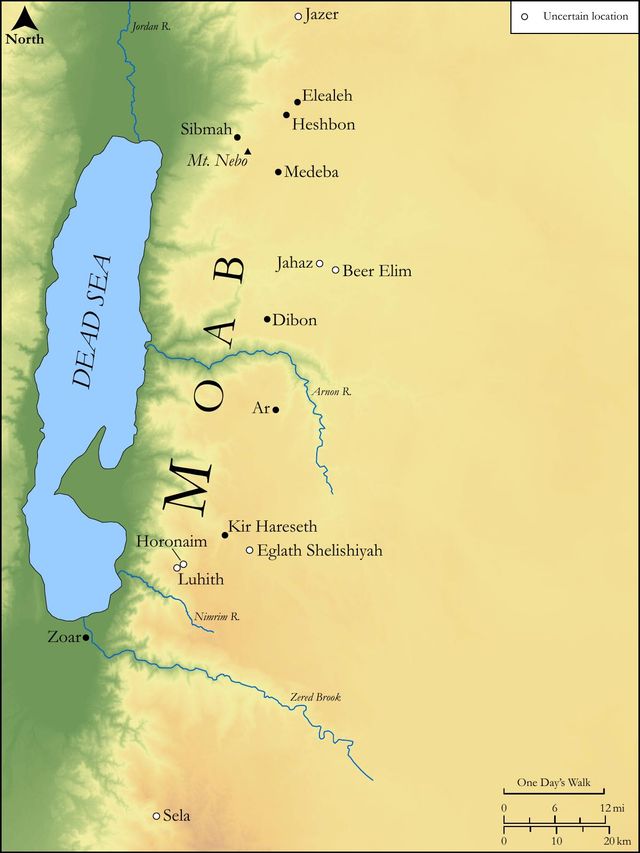
See on the biblical-era map
Study this verse
Public-domain commentary
Matthew Henry
From his Commentary on the Whole Bible. Henry comments on passages, not single verses — this entry covers Isaiah 16:6–14. His four-level outline is real structure in the source text, so it is rendered as structure.
Here we have, I. The sins with which Moab is charged, Isa 16:6. The prophet seems to check himself for going about to give good counsel to the Moabites, concluding they would not take the advice he gave them. He told them their duty (whether they would hear or whether they would forbear), but despairs of working any good upon them; he would have healed them, but they would not be healed. Those that will not be counselled cannot be helped. Their sins were, 1. Pride. This is most insisted upon; for perhaps there are more precious souls ruined by pride than by any one lust whatsoever. The Moabites were notorious for this: "We have heard in both ears of the pride of Moab; it is what all their neighbours cry out shame upon them for. He is very proud; the body of the nation is so, forgetting the baseness of their origin and the brand of infamy fastened upon them by that law of God which forbade a Moabite to enter into the congregation of the Lord for ever, Deu 23:3. We have heard of his haughtiness and his pride. It is not the rash and rigid censure of one of two concerning them, but it is the character which all that know them will give of them. They are a proud people, and therefore they will not take good counsel when it is given them. They think themselves too wise to be advised; therefore they will not take example by Hezekiah to do justly and love mercy. They scorn to make him their pattern, for they think themselves able to teach him. They are proud, and therefore will not be subject to God himself nor regard the warnings he gives them. The wicked, in the pride of his countenance, will not seek after God. They are proud, and therefore will not entertain and protect God's outcasts; they scorn to have any thing to do with them." But this is not all: - 2. "We have heard of his wrath too (for those that are very proud are commonly very passionate), particularly his wrath against the people of God, whom therefore he will rather persecute than protect. 3. It is with his lies that he gains the gratifications of his pride and his passion; but his lies shall not be so; he shall not compass his proud and angry projects as he hoped he should." Some read it, His haughtiness, his pride, and his wrath, are greater than his strength. "We know that, if we lay at his mercy, we should find no mercy with him, but he has not power equal to his malice. His pride draws down ruin upon him; for it is the preface to destruction, and he has not strength to ward it off."
II.The sorrows with which Moab is threatened (Isa 16:7):
Therefore shall Moab howl for Moab. All the inhabitants shall bitterly lament the ruin of their country. They shall complain one to another: Every one shall howl in despair, and not one shall either see any cause or have any heart to encourage his friend. Observe,
1.The causes of this sorrow.
(1.)The destruction of their cities: For the foundations of Kir-haraseth shall you mourn. That great and strong city, which had held out against a mighty force (Kg2 3:25), should now be levelled with the ground, either burnt or broken down, and its foundations stricken, bruised and broken (so the word signifies); they shall howl when they see their splendid cities turned into ruinous heaps.
(2.)The desolation of their country. Moab was famous for its fields and vineyards; but those shall all be laid waste by the invading army, Isa 16:8, Isa 16:10. See,
[1.]What a fruitful pleasant country they had, as the garden of the Lord, Gen 13:10. It was planted with choice and noble vines, with principal plants, which reached even to Jazer, a city in the tribe of Gad. The luxuriant branches of their vines wandered, and wound themselves along the ranges on which they were spread, even through the wilderness of Moab. There were vineyards there. Nay, they were stretched out, and went even to the sea, the Dead Sea: the best grapes grew in their hedge-rows.
[2.]How merry and pleasant they had been in it. Many a time they had shouted for their summer fruits, and for their harvest, as the country people sometimes do with us when they have cut down all their corn. They had had joy and gladness in their fields and vineyards, singing and shouting at the treading of their grapes. Nothing is said of their praising God for their abundance, and giving him the glory of it. If they had made it the matter of their thanksgiving, they might still have had it the food and fuel of their lusts; see therefore,
[3.]How they should be stripped of all. "The fields shall languish, all the fruits of them being carried away or trodden down; they cannot now enrich their owners as they have done, and therefore they languish. The soldiers, called here the lords of the heathen, shall break down all the plants, though they were principal plants, the choicest that could be got. Now the shouting for the enjoyment of the summer fruits has fallen, and is turned into howling for the loss of them. The joy of harvest has ceased; there is no more singing, no more shouting, for the treading out of wine. They have not what they have had to rejoice in, nor have they a disposition to rejoice; the ruin of their country has marred their mirth." Note, First, God can easily change the note of those that are most addicted to mirth and pleasure, can soon turn their laughter into mourning and their joy into heaviness. Secondly, Joy in God is, upon this account, far better than the joy of harvest, that it is what we cannot be robbed of, Psa 4:6, Psa 4:7. Destroy the vines and the fig-trees, and you make all the mirth of a carnal heart to cease, Hos 2:11, Hos 2:12. But a gracious soul can rejoice in the Lord as the God of its salvation even when the fig-tree does not blossom and there is no fruit in the vine, Hab 3:17, Hab 3:18. In God therefore let us always rejoice with a holy triumph, and in other things let us always rejoice with a holy trembling, rejoice as though we rejoiced not.
2.The concurrence of the prophet with them in this sorrow: "I will with weeping bewail Jazer, and the vine of Sibmah, and look with a compassionate concern upon the desolations of such a pleasant country. I will water thee with my tears, O Heshbon! and mingle them with thy tears;" nay (Isa 16:11), it appears to be an inward grief: My bowels shall sound like a harp for Moab; it should make such an impression upon him that he should feel an inward trembling, like that of the strings of a harp when it is played upon. It well becomes God's prophets to acquaint themselves with grief; the great prophet did so. The afflictions of the world, as well as those of the church, should be afflictions to us. See Isa 15:5.
III.In the close of the chapter we have,
1.The insufficiency of the gods of Moab, the false gods, to help them, Isa 16:12. "Moab shall be soon weary of the high place. He shall spend his spirits and strength in vain in praying to his idols; they cannot help him, and he shall be convinced that they cannot." It is seen that it is to no purpose to expect any relief from the high places on earth; it must come from above the hills. Men are generally so stupid that they will not believe, till they are made to see, the vanity of idols and of all creature-confidences, nor will come off from them till they are made weary of them. But, when he is weary of his high places, he will not go, as he should, to God's sanctuary, but to his sanctuary, to the temple of Chemosh, the principal idol of Moab (so it is generally understood); and he shall pray there to as little purpose, and as little to his own case and satisfaction, as he did in his high places; for, whatever honours idolaters give to their idols, they do not thereby make them at all the better able to help them. Whether they are the dii majorum gentium - gods of the higher order, or minorum - of the lower order, they are alike the creatures of men's fancy and the work of men's hands. Perhaps it may be meant of their coming to God's sanctuary. When they found they could have no succours from their own high places some of them would come to the temple of God at Jerusalem, to pray there, but in vain; he will justly send them back to the gods whom they have served, Jdg 10:14.
2.The sufficiency of the God of Israel, the only true God, to make good what he had spoken against them.
(1.)The thing itself was long since determined (Isa 16:13): This is the word, this is the thing, that the Lord has spoken concerning Moab, since the time that he began to be so proud, and insolent, and abusive to God's people. The country was long ago doomed to ruin; this was enough to give an assurance of it that it is the word which the Lord has spoken; and, as he will never unsay what he has spoken, so all the power of hell and earth cannot gainsay it, or obstruct the execution of it.
(2.)Now it was made known when it should be done. The time was before fixed in the counsel of God, but now it was revealed: The Lord has spoken that it shall be within three years, Isa 16:14. It is not for us to know, or covet to know, the times and the seasons, any further than God has thought fit to make them known, and so far we may and must take notice of them. See how God makes known his mind by degrees; the light of divine revelation shone more and more, and so does the light of divine grace in the heart. Observe,
[1.]The sentence passed upon Moab: The glory of Moab shall be contemned, that is, it shall be contemptible, when all those things they have gloried in shall come to nothing. Such is the glory of this world, so fading and uncertain, admired awhile, but soon slighted. Let that therefore which will soon be contemptible in the eyes of others be always contemptible in our eyes in comparison with the far more exceeding weight of glory. It was the glory of Moab that their country was very populous and their forces were courageous; but where is her glory when all that great multitude is in a manner swept away, some by one judgment and some by another, and the little remnant that is left shall be very small and feeble, not able to bear up under their own griefs, much less to make head against their enemies' insults? Let not therefore the strong glory in their strength nor the many in their numbers.
[2.]The time fixed for the execution of this sentence: Within three years, as the years of a hireling, that is, at the three years' end exactly, for a servant that is hired for a certain term keeps account to a day. Let Moab know that her ruin is very near, and prepare accordingly. Fair warning is given, and with it space to repent, which if they had improved, as Nineveh did, we have reason to think the judgments threatened would have been prevented.
Historical interpretation
Historical reception
2 surviving comments on this verse. Each one is dated, so this reads as a timeline rather than a list.
(Verse 11) On this account, my belly will sound like a lyre for Moab, and my inward parts like a wall of cooked bricks. It is not to be understood as a chant of joy for the prophet, through which he rejoices that the enemies of the people of Israel have been made captive, but rather, he says, with affection and deep sorrow of heart, that he mourns the formerly mighty city that has been destroyed.
(Verse 11 onward) Upon this, my belly will sound like a lyre to Moab: and my bowels will be like a wall of baked bricks. And when it becomes clear that Moab has labored in vain, he will enter his sanctuaries to pray, but he will not prevail. This is the word that the Lord spoke to Moab from that time on. The error of Moab has been destroyed; indeed, false joy has turned into mourning and tears. My belly, the prophet, who is composed like a lyre with musical skill, and who, conceived in the fear of God, has produced many children, so that there is no string that does not produce its sound, will resonate the lament of Moab, who is repenting: and all my bowels will be like a wall of baked bricks, as Theodotius interpreted it as a wall scattered. For all the defenses of opposites, in which they previously trusted, will be destroyed and will fall. These, however, are the bowels and inner parts of the prophet, about which David also said in the Psalm: Bless the Lord, O my soul, and let all my innards proclaim his holy name (Psalm 102, 1). For just as a lyre does not emit a vocal sound and harmonious, if at least one string is broken; similarly, the spiritual belly of the prophet, if one string of virtues is lacking in it, will not be able to resound sweet melody; nor proclaim with all its innards against the brick wall. It is also the opinion of the philosophers to cling to virtues; and the Apostle James says that if one is lacking one virtue, all virtues are lacking in that person. But when he realizes that he has labored in vain in the lofty doctrines which he once believed, he will enter into his own holy things, not those things which are inherently holy, but those things which he erroneously thought were holy, and he will not be able to find help. Perhaps, in the desert of error and falsehood, he will attempt to enter into the holy Church, to make it his own, and to pray and beseech, but he will not prevail. For we cannot immediately, as we wish, attain perfect virtue. And this is what it means: That word which the Lord spoke to Moab from that time, with the introductory statement in which he said, the word against Moab, or the burden, let us understand it as the conclusion, so that what he began there, he may complete here. From that time, however, we should understand from when he began to speak to him, that everything he said is one word of God, that is, one sentence. Moreover, according to the Septuagint version, we can explain the prophet's innermost thoughts being renewed by God, and him being ashamed, that is, Moab, and entering into the altars, and the things that are made by hand, so that we may say that the prophet's innermost thoughts are always renewed, and made stronger by God, so that their adversaries may be confounded, and they may understand that the things made by human hand are useless, and do not contribute to salvation.
Continue studying Isaiah 16:11 across the web’s major study libraries — every link below opens this exact verse, chapter, or book on the destination site.
Read & Compare
 BibleGatewayThis verse in more than 200 translations and 70 languages.
 Bible.comThe YouVersion reader — hundreds of translations, reading plans, and highlights.
 ESV.orgCrossway's official English Standard Version reader.
 NET BibleThe NET translation with 60,000+ translators' notes on every rendering decision.
 STEP BibleTyndale House's free study tool — original text, vocabulary, and scholarly resources.
 BibliaLogos Bible Software's free web reader.
 USCCBThe New American Bible (Revised Edition) with the U.S. bishops' study notes.
Commentaries
 BibleHub CommentariesDozens of classic commentaries on this verse, gathered on one page.
 StudyLightMore than 100 commentary sets — the largest collection on the web.
 BibleRefPlain-English commentary on what this verse means, verse by verse.
 Enduring WordDavid Guzik's free commentary on this chapter, widely used by Bible teachers.
 Bible Study ToolsVerse commentary alongside Greek and Hebrew study aids.
Original Language & Research
- BibleHub InterlinearThe verse word by word — original language, transliteration, and English.
- BibleHub LexiconEvery word's original-language definition and Strong's entry.
 Blue Letter BibleDeep-study tools — Strong's numbers, concordance, and word studies.
 SefariaThe Hebrew text with Rashi and centuries of Jewish commentary.
Sermons, Hymns & Audio


TrulyRandomVerse is not affiliated with these sites and doesn’t control their content. They’re linked because they’re genuinely useful.
Summary
Isaiah 16:11 presents a deeply moving and visceral expression of the prophet Isaiah's profound lament over the impending desolation of Moab. Despite Moab's historical antagonism toward Israel, the prophet's "bowels" and "inward parts" are depicted as trembling and resonating with grief, akin to the mournful sound of a harp. This verse encapsulates a divine sorrow accompanying judgment, revealing a compassionate heart that grieves even for those facing God's righteous wrath, thereby underscoring the universal reach of God's sovereignty and the prophet's empathetic identification with suffering.
Context
ShowHideLiterary Context
This verse is strategically placed within a larger prophetic oracle against Moab, spanning Isaiah chapters 15 and 16. The preceding verses detail the widespread destruction and flight of the Moabite people, describing their cities laid waste, their vineyards destroyed, and their cries ascending to God. Specifically, Isaiah 15:5 mentions the heart crying out for Moab, setting the emotional stage for the prophet's intensely personal lament in verse 11. The oracle initiates with a sudden, overwhelming judgment, portraying Moab's demise as swift and complete, highlighting the futility of human strength against divine decree. The prophet's lament here serves not as an endorsement of Moab's actions but as a profound reflection of the sorrow that accompanies God's righteous judgment, even upon nations outside the covenant people. The shift from the general lament of the people to the prophet's personal anguish intensifies the emotional impact and theological significance.
Historical & Cultural Context
Moab was an ancient kingdom situated east of the Dead Sea, serving as both a neighbor and frequent adversary of Israel. Their relationship was complex, marked by periods of conflict, such as the account in 2 Kings 3, and occasional peaceful interactions, exemplified by Ruth, a Moabitess who became an ancestress of King David. The oracle against Moab likely reflects a period of significant geopolitical instability, particularly the expansionist policies of the Assyrian Empire, a common threat to many nations during Isaiah's ministry in the 8th century BCE. The mention of "Kirharesh" (also known as Kir-hareseth or Kir-heres) refers to a major fortified city in Moab, indicating that the judgment would be comprehensive, affecting even their strongest defenses. Culturally, expressions of deep sorrow involving the "bowels" or "inward parts" were common in Hebrew thought, signifying profound emotional distress, compassion, or empathy, much like the "heart" or "gut" in modern English.
Key Themes
ShowHideThe primary themes conveyed in Isaiah 15-16 and particularly underscored in Isaiah 16:11 include the Sovereignty of God over all Nations, demonstrating unequivocally that no kingdom, however strong or defiant, is beyond His divine judgment and ultimate control. Another crucial theme is Prophetic Empathy and Divine Compassion, as the prophet's profound sorrow for Moab mirrors, in a human sense, God's own lament over the necessary consequences of sin and rebellion, even for those outside His covenant people, as powerfully illustrated in Hosea 11:8. The verse also vividly highlights the Humanity of the Prophet, portraying Isaiah not merely as a detached messenger of divine decree but as a deeply feeling individual who genuinely grieves over the suffering of others, even those considered enemies. This personal anguish underscores the gravity of the judgment and the universal impact of sin, inviting readers to consider the depth of feeling involved in God's dealings with humanity.
Exposition and Analysis
ShowHideKey Word Analysis
ShowHideFrom an unused root likely meaning "to be soft," this term, used in the plural, refers literally to the intestines or abdomen. Figuratively, as used here, it denotes the seat of deep sympathy, compassion, or profound emotion, akin to the "heart" in English. The prophet's "bowels" are stirred, indicating a visceral, gut-wrenching sorrow that affects him to his very core, a physical manifestation of deep emotional distress.
A primitive root meaning "to make a loud sound," often implying a great commotion, tumult, or moan. When applied to the "bowels," it vividly conveys an internal trembling, a deep, resonant groan or vibration of anguish. It suggests not merely a feeling of sadness, but a physical, almost audible, manifestation of intense internal distress, a turbulent inner churning.
Derived from a root meaning "to twang," this refers to a stringed musical instrument, specifically a harp or lyre. The imagery of the harp here is crucial. While harps can produce joyful melodies, they are also capable of mournful, trembling, and plaintive sounds. The comparison suggests a sorrow that is not silent but resonates, vibrating with a mournful, almost musical, quality, indicative of profound lamentation and a deep, sustained wail of grief.
Verse Breakdown
ShowHide"Wherefore my bowels shall sound like an harp for Moab,"
This opening clause establishes the prophet's intensely personal and profound emotional response to the impending judgment upon Moab. The "bowels," understood as the seat of deep emotion, are depicted as physically "sounding" or vibrating with anguish. The simile "like an harp" vividly portrays this internal tremor as a mournful, resonant lament, a deep, sorrowful vibration that emanates from the very core of his being, specifically directed "for Moab," the object of God's severe judgment. This indicates a deep, sympathetic identification with the suffering of even an adversarial nation.
"and mine inward parts for Kirharesh."
This second clause functions as a powerful example of synonymous parallelism, reinforcing and intensifying the sentiment of the first. "Mine inward parts" (Hebrew, qereb') serves as a near synonym for "bowels," emphasizing the totality and depth of the prophet's internal anguish. By specifically naming "Kirharesh," a prominent fortified city in Moab, the prophet underscores the comprehensive nature of the devastation and the specific focus of his lament, highlighting that the sorrow extends to the very heart of Moabite strength, population, and cultural identity. The repetition emphasizes the overwhelming and inescapable nature of the impending doom.
Literary Devices
ShowHideIsaiah 16:11 is rich in Imagery and Figurative Language, powerfully conveying the prophet's emotional state. The central device is a Simile, comparing the prophet's internal anguish to the "sound" of a "harp." This comparison evokes a sense of deep, vibrating, and mournful lament, suggesting a sorrow that is not static but dynamically resonates within him. The use of "bowels" and "inward parts" is a powerful Metonymy or Synecdoche, where the inner organs represent the entirety of one's deepest emotions and visceral reactions, emphasizing the physical manifestation of profound grief. This is also an example of Personification, as the prophet's internal organs are described as actively "sounding" or vibrating with emotion. Furthermore, the verse employs Synonymous Parallelism, where the second clause ("and mine inward parts for Kirharesh") echoes and intensifies the meaning of the first ("my bowels shall sound like an harp for Moab"), creating a balanced yet emotionally charged expression of profound grief that deepens the pathos and impact of the prophetic message.
Theological and Thematic Connections
ShowHideIsaiah 16:11 offers a profound theological insight into the nature of divine judgment and the empathetic response it can evoke. It challenges a simplistic view of judgment as merely punitive, revealing that even God's righteous decrees can be accompanied by a profound sorrow, a sentiment mirrored in the prophet's own anguish. This verse underscores that God's justice is not devoid of compassion, even for those who stand in opposition to Him. The prophet's lament for Moab, a nation often hostile to Israel, demonstrates a universal scope of empathy that transcends national or covenantal boundaries, reflecting a divine heart that grieves over the consequences of sin for all humanity. This prophetic sorrow serves as a model for believers to cultivate compassion, even for adversaries, and to mourn over the brokenness and suffering in the world, recognizing that all nations are ultimately accountable to the sovereign God and that His heart is grieved by the necessity of judgment.
Reflection and Application
ShowHideIsaiah 16:11 calls us to a deeper understanding of empathy, particularly in the face of suffering, even when that suffering is a consequence of divine judgment. The prophet's visceral grief for Moab, a historical adversary, challenges us to expand the boundaries of our compassion beyond our immediate circles, families, or nations. It reminds us that while God is just and righteous in His judgments, they are often accompanied by a profound sorrow, a divine lament over the brokenness of creation and the devastating consequences of sin. This verse encourages us to cultivate a heart that is deeply moved by the distress of others, to mourn with those who mourn, and to recognize the universal impact of sin and the pervasive need for God's mercy. It prompts us to consider how we respond to news of global suffering or the plight of those we might deem "outsiders" or even "enemies." Do our "bowels sound like a harp" with genuine lament, or are we quick to dismiss or judge? Ultimately, this passage invites us to reflect God's own compassionate heart in a world groaning under the weight of sin and its consequences, urging us to be agents of His comfort and grace.
Questions for Reflection
ShowHideFAQ
ShowHideWhat does "my bowels shall sound like an harp" mean in Isaiah 16:11?
ShowHideThis vivid phrase is a Hebrew idiom expressing intense, visceral emotional distress, particularly deep sorrow, grief, or compassion. In ancient Hebrew thought, the "bowels" (and "inward parts") were considered the literal seat of profound emotion and deep-seated feelings, much like how we use "heart" or "gut feeling" today. The comparison to a "harp" suggests a trembling, vibrating, and mournful sound, indicating that the prophet's internal anguish is so profound it feels like a resonant, sorrowful melody. It signifies a gut-wrenching, almost physical, manifestation of lament over the impending destruction of Moab, a deep internal churning of grief.
Why would Isaiah, an Israelite prophet, lament for Moab, a nation often hostile to Israel?
ShowHideIsaiah's lament for Moab highlights a crucial aspect of prophetic ministry and divine character: compassion and God's universal sovereignty. While Moab was indeed often an adversary of Israel, the prophets frequently demonstrated a broader concern for justice and the well-being of all nations, recognizing God's ultimate dominion over the entire world. This lament shows that God's judgment, while righteous and necessary, is not devoid of sorrow, and His prophets often shared in that divine grief. It underscores the universal nature of sin's consequences and the profound empathy that a true servant of God should possess, even for those outside their immediate covenant or community. It reflects God's own sorrow over the need for judgment, as powerfully seen in passages like Hosea 11:8, where God expresses His reluctance to give up Ephraim despite their rebellion.
Christ-Centered Fulfillment
ShowHideThe profound, visceral lament of Isaiah for Moab in Isaiah 16:11 finds its ultimate and most perfect fulfillment in the person of Jesus Christ. Just as Isaiah's "bowels" sounded with grief over the judgment of a rebellious nation, so too did Christ embody divine sorrow over the sin and suffering of all humanity. We see this in His weeping over Jerusalem, lamenting their rejection of God's grace and their impending desolation, as recorded in Luke 19:41-44, where His tears reveal a divine heart broken over human rebellion. His agony in Gethsemane, where His soul was "very sorrowful, even to death" (Matthew 26:38), reveals a depth of internal anguish far surpassing any human prophet's, as He contemplated the full weight of the world's sin. On the cross, Christ bore not just the physical pain but the full weight of God's righteous judgment against sin, experiencing the ultimate separation from the Father, crying out, "My God, my God, why have you forsaken me?" (Matthew 27:46). Through His suffering and sacrifice, Jesus entered into and ultimately conquered the very sorrow and judgment that Isaiah lamented. He is the Lamb of God who takes away the sin of the world (John 1:29), offering redemption and comfort to all nations, fulfilling the hope that emerges from the depths of prophetic lament and inviting all to find solace in His compassionate sacrifice.