


Matthew 26:38
Bible text: King James Version (1769 Blayney text) · Public domain
Bible text: Berean Standard Bible · Public domain
Bible text: American Standard Version (1901) · Public domain
Bible text: World English Bible, Messianic edition · Public domain
Bible text: Geneva Bible (1599) · Public domain
Bible text: Young's Literal Translation · Public domain
- ΤότεToteThenG5119ADVAdverb
- λέγειlegeiHe saysG3004V-PAI-3SVerb Present Active Indicative 3rd Singular
- αὐτοῖςautoisto themG846P-DPMPersonal pronoun Dative Plural Masculine
- περίλυπόςperiluposVery sorrowfulG4036A-NSFAdjective Nominative Singular Feminine
- ἐστινestinisG1510V-PAI-3SVerb Present Active Indicative 3rd Singular
- ἡhētheG3588T-NSFDefinite article Nominative Singular Feminine
- ψυχήpsuchēsoulG5590N-NSFNoun Nominative Singular Feminine
- μουmouof MineG3165P-1GSPersonal pronoun Genitive 1st Singular
- ἕωςhe'ōsuntilG2193PREPPreposition
- θανάτου·thanatoudeathG2288N-GSMNoun Genitive Singular Masculine
- μείνατεmeinatedo remainG3306V-AAM-2PVerb Aorist Active Imperative 2nd Plural
- ὧδεhōdehereG5602ADVAdverb
- καὶkaiandG2532CONJConjunction
- γρηγορεῖτεgrēgoreitedo watchG1127V-PAM-2PVerb Present Active Imperative 2nd Plural
- μετ᾽met᾽withG3326PREPPreposition
- ἐμοῦemouMeG1473S-1SGSNPossessive pronoun Genitive 1st Person Singular Neuter
English is a literal word-by-word gloss of the Greek, not the KJV's wording. Why?
This is the original text the KJV's translators worked from — each Greek word with its own literal English meaning in this verse, prepared by scholars at Tyndale House, Cambridge. The KJV translates whole sentences, not word by word, so its wording differs: one Greek word can become several English words, and the KJV may choose “charity” where the gloss reads “love”. Both are faithful — they answer different questions. For the KJV's own rendering, switch to the KJV text.
Details
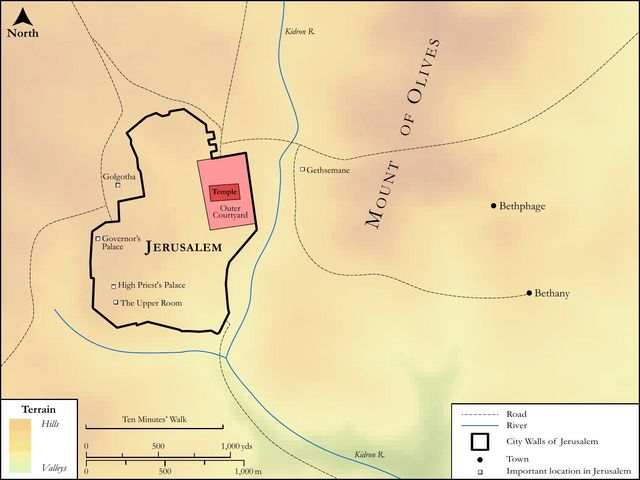
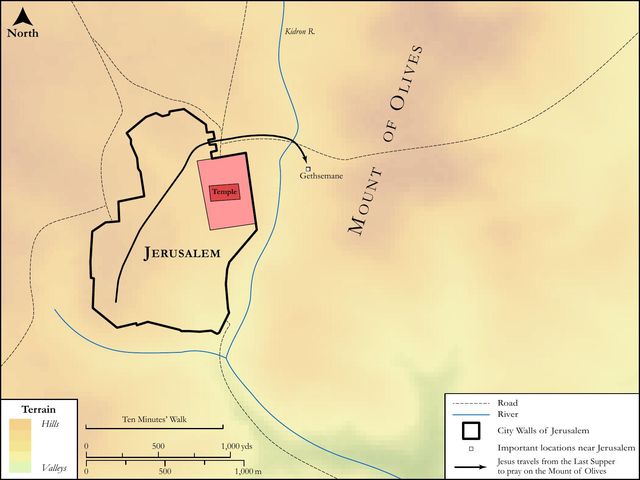
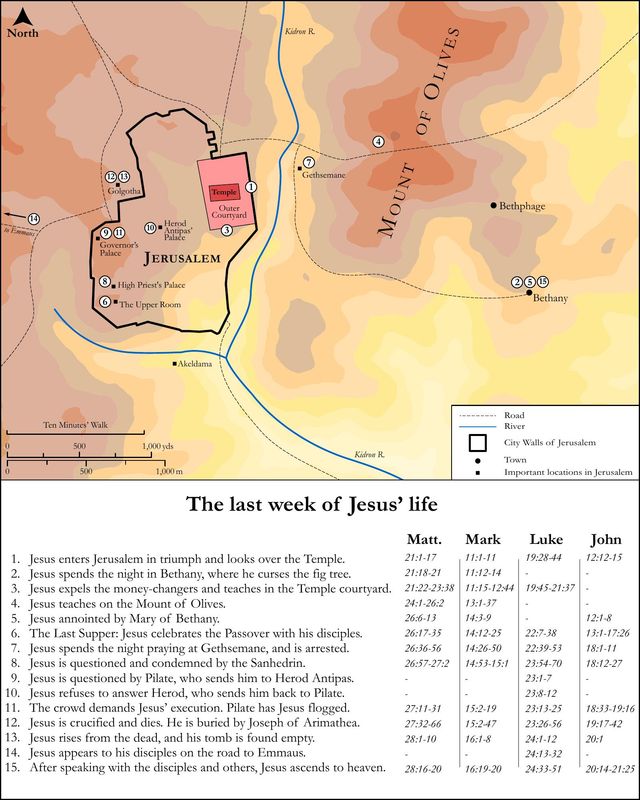
See on the biblical-era maps
Study this verse
Historical interpretation
Six Centuries of Reception
17 surviving comments on this verse. Each one is dated, so this reads as a timeline rather than a list.
Select a marker to jump to its quote. Markers stagger vertically where authors wrote within a few decades of each other.
"My soul," says He, "is exceeding sorrowful, even unto death; " and "the bread that I will give is my flesh, (which I will give) for the life of the world.
He sometimes also fled from violence Himself, but for the same reason as had led Him to command the apostles to do so: that is, He wanted to fulfil His ministry of teaching; and when it was finished, I do not say He stood firm, but He had no desire even to get from His Father the aid of hosts of angels: finding fault, too, with Peter's sword. He likewise acknowledged, it is true, that His "soul was troubled, even unto death," and the flesh weak; with the design, (however,) first of all, that by having, as His own, trouble of soul and weakness of the flesh, He might show you that both the substances in Him were truly human; lest, as certain persons have now brought it in, you might be led to think either the flesh or the soul of Christ different from ours; and then, that, by an exhibition of their states, you might be convinced that they have no power at all of themselves without the spirit.
For He showed to what belongs (the incidents of) being destroyed, thrown down, and kept down-even to that to which it also appertains to be lifted and raised up again; although He was at the same time bearing about with Him "a soul that was trembling even unto death," but which did not fall through death, because even the Scripture informs us that "He spoke of His body.
Or otherwise; My soul is sorrowful even unto death; as much as to say, Sorrow is begun in me, but not to endure for ever, but only till the hour of death; that when I shall die for sin, I shall die also to all sorrow, whose beginnings only are in me. Tarry ye here, and watch with me; as much as to say, The rest I bade sit yonder as weak, removing them from this struggle; but you I have brought hither as being stronger, that ye may toil with me in watching and prayer. But abide you here, that every man may stay in his own rank and station; since all grace, however great, has its superior.
“Stay here and keep watch with me.” It is as though Jesus had said, “Although I told the other disciples to ‘sit here while I go and pray’ but brought you three along with me, I don’t want you to come any further, for you are not yet able. So, stay here keeping watch as I keep watch, knowing that the others were commanded to sit over there because they are weaker and need to be protected from this agony. [But] I have brought you who are stronger with me to labor with me in watching and praying. Nevertheless, you remain here, that each one stand firm in the state of his calling,for every grace (however great it may be) has a superior.” What Jesus meant when he said “remain here” is explained by what was said next: “going a little farther, he fell on his face.” Therefore let us remain where Jesus commanded us to remain, as the apostle also admonished: “Everyone should remain in the state in which he was called.” And let us do everything in our power to keep watch with him who “neither slumbers nor sleeps, who keeps Israel.”
These words, He began to be sorrowful and very heavy, are interpreted by heretics that fear of death assailed the Son of God, being (as they allege) neither begotten from eternity, nor existing in the Father's infinite substance, but produced out of nothing by Him who created all things; and that hence He was liable to anguish of grief, and fear of death. And He who can fear death can also die; and He who can die, though He shall exist after death, yet is not eternal through Him who begot Him in past time. Had these faith to receive the Gospels, they would know that the Word was in the beginning God, and from the beginning with God, and that the eternity of Him who begets and Him who is begotten is one and the same. But if the assumption of flesh infected with its natural infirmity the virtue of that incorruptible substance, so that it became subject to pain, and shrinking from death, it would also become thereby liable to corruption, and thus its immortality being changed into fear, that which is in it is capable of at some time ceasing to be. But God ever is without measure of time, and such as He is, He continues to be eternally. Nothing then in God can die, nor can God have any fear springing out of Himself.
(de Trin. x. 10.) I suppose that there are some who offer here no other cause of His fear than His passion and death. I ask those who think thus, whether it stands with reason that He should have feared to die, who banished from the Apostles all fear of death, and exhorted them to the glory of martyrdom? How can we suppose Him to have felt pain and grief in the sacrament of death, who rewards with life those who die for Him? And what pangs of death could He fear, who came to death of the free choice of His own power? And if His Passion was to do Him honour, how could the fear of His Passion make Him sorrowful?
(in loc.) Since then we read that the Lord was sorrowful, let us discover the causes of His agony. He had forewarned them all that they would be offended, and Peter that he would thrice deny his Lord; and taking him and James and John, He began to be sorrowful. Therefore He was not sorrowful till He took them, but all His fear began after He had taken them; so that His agony was not for Himself, but for them whom He had taken.
Then he said, “My soul is sad, even to death.” Did he say, My soul is sad because of death? Certainly not. For if death were the reason for his fear, he certainly ought to have said so. But the reason for his fear lies elsewhere. Actually we have no indication, since the reason for what begins in another person may differ from what it is at the end. He had just said before, “You will all fall away this night because of me.” He knew that they would be frightened, that they would run away and deny knowing him. And since blasphemy against the Holy Spirit is forgiven neither here nor in eternity, he feared they might deny that he is God, once they looked upon him beaten and spat upon and crucified. This was the reason that prompted Peter, who, in betraying Christ, denied him in this way: “I do not know the man,” for anything said against the Son of man will be forgiven. Christ is therefore sad even to death. So it is not death itself but the process of death that is feared, for after his death the faith of the believers would be strengthened by the power of the resurrection.
(ill. Luc. 22:43.) He is sorrowful, yet not Himself, but His soul; not His Wisdom, not His divine Substance, but His soul, for He took upon Him my soul, and my body.
Because they clung to Him inseparably, therefore He saith, "Tarry ye here, while I go away and pray." For it was usual with Him to pray apart from them. And this He did teaching us in our prayers, to prepare silence for ourselves and great retirement.
And He takes with Him the three, and saith unto them, "my soul is exceeding sorrowful, even unto death." Wherefore doth He not take all with Him? That they might not be cast down; but these He taketh that had been spectators of His glory.
[I suppose also that Peter fell into these words through ambition and boastfulness. And they had disputed at supper which of them should be greatest, whence we see that the love of empty glory disturbed them much. And so to deliver him from such passions, Christ withdrew His aid from him. Moreover observe how after the resurrection, taught by his fall he speaks to Christ more humbly, and does not any more resist His words. All this his fall wrought for him; for before he had attributed all to himself, when he ought rather to have said, I will not deny Thee if Thou succour me with Thy aid. But afterwards he shows that every thing is to be ascribed to God; Why look ye so earnestly upon us, as though by our own power and holiness we had made this man to walk?]q (Act 3:12.) Hence then we learn the great doctrine, that man's wish is not enough, unless he enjoys Divine support.
(Hom. Ixxxiii.) He says, Sit ye here, while I go and pray yonder, because the disciples adhered inseparably to Christ; but it was His practice to pray apart from them, therein teaching us to study quiet and retirement for our prayers.
Gethsemane is interpreted, 'The rich valley;' and there He bade His disciples sit a little while, and wait His return whilst He prayed alone for all.
(non. occ.) But we say that passible man was so taken by God the Son, that His Deity remained impassible. Indeed the Son of God suffered, not by imputation but actually, all that Scripture testifies, in respect of that part of Him which could suffer, viz. in respect of the substance that He had taken on Him.
The Lord therefore sorrowed not from fear of suffering, for for this cause He had come that He should suffer, and had rebuked Peter for his fearfulness; (Matt. 14:31.) but for the wretched Judas, for the offence of the rest of the Apostles, for the rejection and reprobation of the Jewish nation, and the overthrow of unhappy Jerusalem.
Our Lord therefore sorrowed to prove the reality of the Man which He had taken upon Him; but that passion might bear no sway in His mind, He began to be sorrowful by pro-passion;s for it is one thing to be sorrowful, and another to be very sorrowful.
He is sorrowful not because of death, but unto death, until He has set the Apostles free by His Passion. Let those who imagine Jesus to have taken an irrational soul, say how it is that He is thus sorrowful, and knows the season of His sorrow, for though the brute animals have sorrow, yet they know neither the causes of it, nor the time for which it must endure.
Or the sleep which He would have them forego is not bodily rest, for which at this critical time there was no room, but mental torpor, the sleep of unbelief.
(Verse 38.) Then he said to them, My soul is sorrowful, even to death; wait here, and watch with me. The soul is saddened and not, however, by death, but is saddened even unto death, until he frees his apostles by his suffering. And what he commanded: wait here, and watch with me, he does not forbid sleep, the time of which was not imminent with danger, but he forbids sleep of unfaithfulness, and dulness of mind. Therefore, let those who suspect that Jesus took on an irrational soul declare how he could be saddened and know the time of sadness. Although even dumb animals die, they do not know the reasons or the time until which they must be saddened.
What we said before about Christ’s suffering and what took place before it is also brought out in this chapter. It shows that the Lord, to test the fidelity of the human nature he had taken on, truly felt sorrowful. However, lest the suffering in his soul be overwhelming, he began to feel sorrowful over the events taking place just before his suffering. For it is one thing to feel sorrowful and another thing to begin to feel sorrowful. But he felt sorrowful, not because he feared the suffering that lay ahead and because he had scolded Peter for his timidity but because of the most unfortunate Judas and the falling away of all the apostles and the rejection by the Jewish people and the overturning of woeful Jerusalem. Jonah too became sad when the plant or ivy had withered, unwilling to have his booth disappear.
(Lib. 83. Quæst. q. 80.) We have the narratives of the Evangelists, by which we know that Christ was both born of the Blessed Virgin Mary, was seized by the Jews, scourged, crucified, put to death, and buried in a tomb, all which cannot be supposed to have taken place without a body, and not even the maddest will say that these things are to be understood figuratively, when they are told by men who wrote what they remembered to have happened. These then are witnesses that He had a body, as those affections which cannot be without mind prove Him to have had a mind, and which we read in the accounts of the same Evangelists, that Jesus wondered, was angry, was sorrowful.
(de. Civ. Dei, xiv. 9.) Since then these things are related in the Evangelists, they are not surely false, but as when He willed He became Man, so likewise when He willed He took into His human soul these passions for the sake of adding assurance to the dispensation. We indeed have these passions by reason of the weakness of our human nature; not so the Lord Jesus, whose weakness was of power.
The Evangelist had said a little above, that when they had sung an hymn they went out to the mount of Olives; to point out the part of the mount to which they took their way, he now adds, Then came Jesus with them to a garden called Gethsemane.
He had accepted the disciples' faith and the devotedness of their will, but He foresaw that they would be troubled and scattered abroad, and therefore bade them sit still in their places; for to sit belongs to one at ease, but they would be grievously troubled that they should have denied Him. In what fashion He went forward it describes, And taking with him Peter and the two sons of Zebedee, he began to be sorrowful and very heavy; the same to whom He had shown His glory in the mount.
By this place are overthrown the Manichæans, who said that He took an unreal body; and those also who said that He had not a real soul, but His Divinity in place of a soul1
(de. Fid. Orth. iii. 24.) But seeing that prayer is the sending up the understanding to God, or the asking of God things fitting, how did the Lord pray? For His understanding needed not to be lifted up to God, having been once united hypostatically to God the Word. Neither could He need to ask of God things fitting, for the One Christ is both God and Man. But giving in Himself a pattern to us, He taught us to ask of God, and to lift up our minds to Him. As He took on Him our passions, that by triumphing over them Himself, He might give us also the victory over them, so now He prays to open to us the way to that lifting up to God, to fulfil for us all righteousness, to reconcile His Father to us, to pay honour to Him as the First Cause, and to show that He is not against God.
(Fid. Orth. iii. 23.) Or otherwise; All things which have not yet been brought into existence by their Maker have a natural desire of existence, and naturally shun non-existence. God the Word then, having been made Man, had this desire, through which He desired food, drink, and sleep, by which life is supported, and naturally used them, and contrariwise shunned the things that are destructive of life. Hence in the season of His Passion which He endured voluntarily, He had the natural fear and sorrow for death. For there is a natural fear wherewith the soul shrinks from separation from the body, by reason of that close sympathy implanted from the first by the Maker of all things.
(Fid. Orth. iii. 20.) Wherefore the passions of our nature were in Christ both by nature and beyond nature. By nature, because He left His flesh to suffer the things incidental to it; beyond nature, because these natural emotions did not in Him precede the will. For in Christ nothing befel of compulsion, but all was voluntary; with His will He hungered, with His will He feared, or was sorrowful. Here His sorrow is declared, Then saith he unto them, My soul is sorrowful even unto death.
Luke says, To the mount of Olives, (Luke 22:39.) and John, Went forth over the brook Cedron, where was a garden, (John 18:1.) which is the same as this Gethsemane, and is a place where He prayed at the foot of mount Olivet, where is a garden, and a Church now builtr
When the Lord prayed in the mountain, He taught us to make supplication for heavenly things; when He prays in the garden, He teaches us to study humility in our prayer. And beautifully, as He draws near His Passion, does He pray in the 'valley of fatness,' showing that through the valley of humility, and the richness of charity, He took upon Him death for our sakes. The practical instruction which we may also learn from this is, that we should not suffer our heart to dry up from the richness of charity.
Continue studying Matthew 26:38 across the web’s major study libraries — every link below opens this exact verse, chapter, or book on the destination site.
Read & Compare
 BibleGatewayThis verse in more than 200 translations and 70 languages.
 Bible.comThe YouVersion reader — hundreds of translations, reading plans, and highlights.
 ESV.orgCrossway's official English Standard Version reader.
 NET BibleThe NET translation with 60,000+ translators' notes on every rendering decision.
 STEP BibleTyndale House's free study tool — original text, vocabulary, and scholarly resources.
 BibliaLogos Bible Software's free web reader.
 USCCBThe New American Bible (Revised Edition) with the U.S. bishops' study notes.
Commentaries
 BibleHub CommentariesDozens of classic commentaries on this verse, gathered on one page.
 StudyLightMore than 100 commentary sets — the largest collection on the web.
 BibleRefPlain-English commentary on what this verse means, verse by verse.
 Enduring WordDavid Guzik's free commentary on this chapter, widely used by Bible teachers.
 Bible Study ToolsVerse commentary alongside Greek and Hebrew study aids.
Original Language & Research
- BibleHub InterlinearThe verse word by word — original language, transliteration, and English.
- BibleHub LexiconEvery word's original-language definition and Strong's entry.
 Blue Letter BibleDeep-study tools — Strong's numbers, concordance, and word studies.
 CNTR CollationThe earliest Greek manuscripts of this verse, collated letter by letter.
Sermons, Hymns & Audio


TrulyRandomVerse is not affiliated with these sites and doesn’t control their content. They’re linked because they’re genuinely useful.
Summary
In the Garden of Gethsemane, just hours before His crucifixion, Jesus Christ reveals the profound depth of His emotional and spiritual anguish to His inner circle—Peter, James, and John. His declaration, "My soul is exceeding sorrowful, even unto death," lays bare His full humanity and the immense spiritual burden He was carrying, as He invites His closest disciples to share in His vigil and prayerful watchfulness during this critical hour.
Context
ShowHideLiterary Context
This verse is situated immediately after the Last Supper, where Jesus instituted the new covenant and prophesied Peter's denial, and just before His arrest and trial. Having sung a hymn, Jesus leads His disciples to the Garden of Gethsemane on the Mount of Olives. He instructs most of the disciples to sit, but takes Peter, James, and John deeper into the garden. This intimate moment of vulnerability and spiritual struggle serves as a prelude to His fervent prayer where He wrestles with the Father's will, asking if "this cup" might pass from Him, yet ultimately submitting to the divine plan. It underscores the immense pressure and spiritual battle Jesus faced as He prepared to bear the sins of humanity.
Historical & Cultural Context
The Mount of Olives, and specifically the Garden of Gethsemane (meaning "oil press"), was a familiar retreat for Jesus and His disciples, a place of quiet contemplation and prayer. For a Jew in distress, pouring out one's soul to God was a common and deeply ingrained practice, often accompanied by physical prostration. The concept of "sorrow unto death" would have resonated with Old Testament expressions of profound despair, where emotional distress could feel physically debilitating or even life-threatening, as seen in figures like Job or David. This setting highlights Jesus' adherence to Jewish custom while simultaneously elevating the spiritual stakes of His unique suffering.
Key Themes
ShowHideThis pivotal moment in Gethsemane contributes significantly to several overarching themes in Matthew's Gospel and the broader biblical narrative. First, it powerfully demonstrates Jesus' full humanity and vulnerability, showing that He genuinely experienced overwhelming sorrow and distress, not as a stoic deity but as one who fully empathizes with human pain and suffering, as described in Hebrews 4:15. Second, the "exceeding sorrowful" state points to the immense weight of atonement and the spiritual burden of facing the cross, bearing the sins of the world, and enduring the Father's wrath. This highlights the horrific nature of sin and the immeasurable cost of redemption. Finally, Jesus' request to "tarry ye here, and watch with me" reveals His need for companionship and spiritual vigilance, even in His unique suffering, echoing the call for disciples to be alert and prayerful, a theme Jesus reiterates in Matthew 26:41.
Exposition and Analysis
ShowHideKey Word Analysis
ShowHideMeaning "grieved all around" or "intensely sad." This word conveys an overwhelming, pervasive sadness that envelops the entire being, suggesting a profound emotional and spiritual distress that leaves no part untouched. It is a sorrow that surrounds and saturates.
Referring to physical death or, figuratively, a state of extreme peril or despair. Here, "unto death" emphasizes the severity of Jesus' anguish, indicating a sorrow so profound and debilitating that it threatened His very life or brought Him to the brink of collapse, both emotionally and potentially physically.
Meaning "to keep awake," "be vigilant," or "stay alert." This command is not merely a request for physical presence but for spiritual attentiveness, prayerful support, and a shared awareness of the gravity of the moment. It implies a readiness to endure and resist temptation.
Verse Breakdown
ShowHide"Then saith he unto them,"
This introductory phrase sets the scene, indicating a direct address from Jesus to His chosen three disciples (Peter, James, and John) whom He had taken further into the garden. It marks the beginning of His raw, personal confession of anguish.
"My soul is exceeding sorrowful, even unto death:"
Here, Jesus expresses the depth of His inner turmoil. "My soul" (Greek psychḗ) refers to His innermost being, His mind, emotions, and will. The phrase "exceeding sorrowful" (Greek perílypos) emphasizes an overwhelming, all-encompassing grief. The addition "even unto death" (Greek héōs thanátou) highlights the extreme intensity of this sorrow, suggesting it was so profound that it threatened His very life, pushing Him to the brink of physical and emotional collapse. This is not hyperbole but a genuine expression of existential agony.
"tarry ye here, and watch with me."
This is Jesus' direct instruction and plea to His disciples. "Tarry ye here" (Greek ménō hōde) is a command to remain in that specific spot, indicating a need for their close proximity. "And watch with me" (Greek kaí grēgoreúō metá emoû) is a call for spiritual vigilance and companionship in prayer. Jesus desired their active, prayerful presence and support, not merely their physical company, as He faced the spiritual battle ahead.
Literary Devices
ShowHideMatthew 26:38 employs several powerful literary devices to convey the intensity of Jesus' experience. The phrase "exceeding sorrowful, even unto death" functions as Hyperbole, not in the sense of exaggeration, but to convey an extreme, almost unbearable degree of emotional and spiritual suffering. While not literally dying at that moment, the sorrow was so profound it felt life-threatening. The use of "My soul" (Greek psychḗ) can be seen as a form of Synecdoche, where the part (soul) represents the whole person, emphasizing that His entire being was engulfed in this anguish. Furthermore, the scene itself is rich in Symbolism: Gethsemane, the "oil press," symbolizes the crushing pressure Jesus endured. His call to "watch" serves as a Metaphor for spiritual alertness and prayerful engagement, extending beyond mere physical wakefulness to a deeper, shared vigilance against the spiritual forces at play. This moment also serves as Foreshadowing, hinting at the ultimate physical death and spiritual abandonment Jesus would soon experience on the cross.
Theological and Thematic Connections
ShowHideThis verse offers a profound glimpse into the theological reality of the Incarnation and the nature of Christ's atoning work. It underscores that Jesus was fully human, not just appearing to suffer, but genuinely experiencing the depths of human anguish, a sorrow intensified by the unique burden of bearing the world's sin. This Gethsemane agony was a crucial part of His redemptive work, demonstrating the immeasurable cost of our salvation and God's profound empathy for human suffering. It reveals that the path to redemption was not easy or detached, but fraught with immense spiritual and emotional struggle, making His victory all the more glorious and His High Priestly intercession all the more compassionate.
Reflection and Application
ShowHideMatthew 26:38 provides a powerful and deeply relatable image of Jesus in His raw humanity, offering profound lessons for believers today. It normalizes profound sorrow and distress, even for those in deepest communion with God. Jesus, the Son of God, experienced overwhelming grief, demonstrating that it is not a sign of spiritual weakness to feel pain, to express it, or to seek comfort and support from trusted companions. This passage invites us to bring our own deepest sorrows and anxieties before God, knowing that our Savior understands and empathizes with our suffering. Furthermore, understanding the depth of Jesus' agony in Gethsemane should immeasurably deepen our appreciation for the salvation He secured. It was not a casual act, but one wrought with immense spiritual and emotional agony, highlighting the horrific nature of sin and the unfathomable love that bore its weight. Finally, Jesus' call to "watch" serves as an enduring reminder for believers to remain spiritually vigilant, prayerful, and supportive of one another, especially in times of trial and temptation, standing with Christ not only in comfort but also in His suffering and His mission.
Questions for Reflection
ShowHideFAQ
ShowHideWhy did Jesus ask His disciples to "watch with me" if He was facing a unique spiritual battle only He could endure?
ShowHideJesus' request for His disciples to "watch with me" was not an indication that He needed their help to overcome the spiritual battle, which was uniquely His to bear. Rather, it highlights His full humanity and His desire for companionship and prayerful solidarity in His deepest hour of need. Just as any human in profound distress might seek the comforting presence of loved ones, Jesus sought the support of His closest friends. Their "watching" was meant to be a shared vigil of prayer and spiritual alertness, preparing them for the trials ahead and demonstrating their faithfulness, even though they ultimately failed to remain awake. It was an invitation to participate in the spiritual gravity of the moment, to be present with Him in His suffering, and to learn the importance of vigilance in the face of temptation, as He later admonishes them in Matthew 26:41.
Christ-Centered Fulfillment
ShowHideMatthew 26:38, with Jesus' profound anguish in Gethsemane, serves as a pivotal moment in the unfolding drama of Christ's redemptive work, deeply rooted in Old Testament prophecy and culminating in the New Testament's declaration of His atoning sacrifice. This scene fulfills the prophetic suffering of the Messiah, particularly echoing the "suffering servant" passages in Isaiah 53, where it is foretold that He would be "a man of sorrows, and acquainted with grief." Jesus' "exceeding sorrowful, even unto death" is not merely human despair but the sinless Son of God beginning to bear the crushing weight of humanity's sin, experiencing the spiritual separation from the Father that was the essence of the "cup" He prayed to have removed (Matthew 26:39). This Gethsemane agony foreshadows His ultimate sacrifice on the cross, where He truly became sin for us (2 Corinthians 5:21), demonstrating the infinite cost of redemption. His willingness to endure such sorrow, even to the point of feeling death's shadow, underscores His perfect obedience to the Father's will, an obedience that makes Him the source of eternal salvation for all who believe (Hebrews 5:8-9). Thus, Gethsemane is not just a display of Jesus' humanity, but a vital step in His divine mission to overcome sin and death, establishing Him as our empathetic High Priest who understands our weaknesses (Hebrews 4:15) and the victorious Lamb of God who takes away the sin of the world (John 1:29).