


Jeremiah 27:6
- וְעַתָּהve·'a·Tahand nowH6258Conj-w ¦ AdvAdverbוְandעַתָּהnow
- אָנֹכִי'a·no·KhiIH595Pro-1csPronoun Personal 1st Singular common gender
- נָתַתִּיna·Ta·tiI giveH5414V-Qal-Perf-1csVerb Qal Perfect 1st Singular common gender
- אֶת'et<obj.>H853DirObjMParticle Object Indicator
- כָּלkolallH3605N-mscNoun Singular Masculine Construct
- הָאֲרָצוֹתha·'a·ra·Tzotthe landsH776Art ¦ N-fpNoun Plural Feminine Absoluteהָtheאֲרָצוֹתlands
- הָאֵלֶּהha·'E·leh<the> theseH428Art ¦ PrtParticle Demonstrativeהָ<the>אֵלֶּהthese
- בְּיַדbe·Yadin [the] hand ofH3027Prep-b ¦ N-cscNoun Singular common gender Constructבְּinיַד[the] hand of
- נְבוּכַדְנֶאצַּרne·vu·khad·ne·TzarNebuchadnezzarH5019N-proper-mNoun Proper Masculine
- מֶלֶךְMe·lekh[the] king ofH4428N-mscNoun Singular Masculine Construct
- בָּבֶלba·VelBabylonH894N-properNoun Proper Location
- עַבְדִּי'av·Dimy servantH5650N-msc ¦ 1csNoun Singular Masculine Constructעַבְדִּservantיmy
- וְגַםve·Gamand alsoH1571Conj-w ¦ AdvAdverbוְandגַםalso
- אֶת'et<obj.>H853DirObjMParticle Object Indicator
- חַיַּתchai·Yat[the] animal[s] ofH2416N-fscNoun Singular Feminine Construct
- הַשָּׂדֶהha·sa·Dehthe fieldH7704Art ¦ N-msNoun Singular Masculine Absoluteהַtheשָּׂדֶהfield
- נָתַתִּיna·Ta·tiI giveH5414V-Qal-Perf-1csVerb Qal Perfect 1st Singular common gender
- לוֹloto <the> himPrep-l ¦ 3msSuffix Personal 3rd Singular Masculineלto <the>וֹhim
- לְעָבְדוֹle·'a·ve·Doto serve himH5647Prep-l ¦ V-Qal-Inf ¦ 3msVerb Qal Infinitive Constructלְtoעָבְדserveוֹhim
English is a literal word-by-word gloss of the Hebrew, not the KJV's wording. Why?
This is the original text the KJV's translators worked from — each Hebrew word with its own literal English meaning in this verse, prepared by scholars at Tyndale House, Cambridge. The KJV translates whole sentences, not word by word, so its wording differs: one Hebrew word can become several English words, and the KJV may choose “the LORD” where the gloss reads “Yahweh”. Both are faithful — they answer different questions. For the KJV's own rendering, switch to the KJV text.
Details
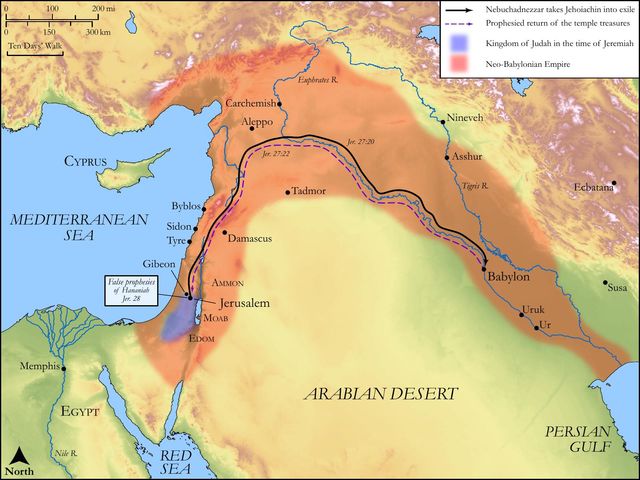
See on the biblical-era map
Study this verse
Public-domain commentary
Matthew Henry
From his Commentary on the Whole Bible. Henry comments on passages, not single verses — this entry covers Jeremiah 27:1–11. His two-level outline is real structure in the source text, so it is rendered as structure.
Some difficulty occurs in the date of this prophecy. This word is said to come to Jeremiah in the beginning of the reign of Jehoiakim (Jer 27:1), and yet the messengers, to whom he is to deliver the badges of servitude, are said (Jer 27:3) to come to Zedekiah king of Judah, who reigned not till eleven years after the beginning of Jehoiakim's reign. Some make it an error of the copy, and think that it should be read (Jer 27:1), In the beginning of the reign of Zedekiah, for which some negligent scribe, having his eye on the title of the foregoing chapter, wrote Jehoiakim. And, if one would admit a mistake any where, it should be here, for Zedekiah is mentioned again (Jer 27:12), and the next prophecy is dated the same year, and said to be in the beginning of the reign of Zedekiah, Jer 28:1. Dr. Lightfoot solves it thus: In the beginning of Jehoiakim's reign Jeremiah is to make these bonds and yokes, and to put them upon his own neck, in token of Judah's subjection to the king of Babylon, which began at that time; but he is to send them to the neighbouring kings afterwards in the reign of Zedekiah, of whose succession to Jehoiakim, and the ambassadors sent to him, mention is made by way of prediction.
I.Jeremiah is to prepare a sign of the general reduction of all these countries into subjection to the king of Babylon (Jer 27:2):
Make thee bonds and yokes, yokes with bonds to fasten them, that the beast may not slip his neck out of the yoke. Into these the prophet must put his own neck to make them taken notice of as a prophetic representation; for every one would enquire, What is the meaning of Jeremiah's yokes? We find him with one on, Jer 28:10. Hereby he intimated that he advised them to nothing but what he was resolved to do himself; for he was not one of those that bind heavy burdens on others, which they themselves will not touch with one of their fingers. Ministers must thus lay themselves under the weight and obligation of what they preach to others.
II.He is to send this, with a sermon annexed to it, to all the neighbouring princes; those are mentioned (Jer 27:3) that lay next to the land of Canaan. It should seem, there was a treaty of alliance on foot between the king of Judah and all those other kings. Jerusalem was the place appointed for the treaty. Thither they all sent their plenipotentiaries; and it was agreed that they should bind themselves in a league offensive and defensive, to stand by one another, in opposition to the growing threatening greatness of the king of Babylon, and to reduce his exorbitant power. They had great confidence in their strength thus united, and were ready to call themselves the high allies; but, when the envoys were returning to their respective masters with the ratification of this treaty, Jeremiah gives each of them a yoke to carry to his master, to signify to him that he must either by consent or by compulsion become a servant to the king of Babylon, let him choose which he will. In the sermon upon this sign,
1.God asserts his own indisputable right to dispose of kingdoms as he pleases, Jer 27:5. He is the Creator of all things; he made the earth at first, established it, and it abides: it is still the same, though one generation passes away and another comes. He still by a continued creation produces man and beast upon the ground, and it is by his great power and outstretched arm. His arm has infinite strength, though it be stretched out. Upon this account he may give and convey a property and dominion to whomsoever he pleases. As he hath graciously given the earth to the children of men in general (Psa 115:16), so he give to each his share of it, be it more or less. Note, Whatever any have of the good things of this world, it is what God sees fit to give them; we ourselves should therefore be content, though we have ever so little, and not envy any their share, though they have ever so much.
2.He publishes a grant of all these countries to Nebuchadnezzar. Know all men by these presents. Sciant praesentes et futuri - Let those of the present and those of the future age know. "This is to certify to all whom it may concern that I have given all these lands, with all the wealth of them, into the hands of the king of Babylon; even the beasts of the field, whether tame or wild, have I given to him, parks and pastures; they are all his own." Nebuchadnezzar was a proud wicked man, an idolater; and yet God, in his providence, gives him this large dominion, these vast possessions. Note, The things of this world are not the best things, for God often gives the largest share of them to bad men, that are rivals with him and rebels against him. He was a wicked man, and yet what he had he had by divine grant. Note, Dominion is not founded in grace. Those that have not any colourable title to eternal happiness may yet have a justifiable title to their temporal good things. Nebuchadnezzar is a very bad man, and yet God calls him his servant, because he employed him as an instrument of his providence for the chastising of the nations, and particularly his own people; and for his service therein he thus liberally repaid him. Those whom God makes use of shall not lose by him; much more will he be found the bountiful rewarder of all those that designedly and sincerely serve him.
3.He assures them that they should all be unavoidably brought under the dominion of the king of Babylon for a time (Jer 27:7): All nations, all these nations and many others, shall serve him, and his son, and his son's son. His son was Evil-merodach, and his son's son Belshazzar, in whom his kingdom ceased: then the time of reckoning with his land came, when the tables were turned, and many nations and great kings, incorporated into the empire of the Medes and Persians, served themselves of him, as before, Jer 25:14. Thus Adonibezek was trampled upon himself, as he had trampled on other kings.
4.He threatens those with military execution that stood out and would not submit to the king of Babylon (Jer 27:8): That nation that will not put their neck under his yoke I will punish with sword and famine, with one judgment after another, till it is consumed by his hand. Nebuchadnezzar was very unjust and barbarous in invading the rights and liberties of his neighbours thus, and forcing them into a subjection to him; yet God had just and holy ends in permitting him to do so, to punish these nations for their idolatry and gross immoralities. Those that would not serve the God that made them were justly made to serve their enemies that sought to ruin them.
5.He shows them the vanity of all the hopes they fed themselves with, that they should preserve their liberties, Jer 27:9, Jer 27:10. These nations had their prophets too, that pretended to foretell future events by the stars, or by dreams, or enchantments; and they, to please their patrons, and because they would themselves have it so, flattered them with assurances that they should not serve the king of Babylon. Thus they designed to animate them to a vigorous resistance; and, though they had no ground for it, they hoped hereby to do them service. But he tells them that it would prove to their destruction; for by resisting they would provoke the conqueror to deal severely with them, to remove them, and drive them out into a miserable captivity, in which they should all be lost and buried in oblivion. Particular prophecies against these nations that bordered on Israel severally, the ruin of which is here foretold in the general, we shall meet with, ch. 48 and 49, and Eze. 25, which had the same accomplishment with this here. Note, When God judges he will overcome.
6.He puts them in a fair way to prevent their destruction by a quiet and easy submission, Jer 27:11. The nations that will be content to serve the king of Babylon, and pay him tribute for seventy years (ten apprenticeships), those will I let remain still in their own land. Those that will bend shall not break. Perhaps the dominion of the king of Babylon may bear no harder upon them than that of their own kings had done. It is often more a point of honour than true wisdom to prefer liberty before life. It is not mentioned to the disgrace of Issachar that because he saw rest was good, and the land pleasant, that he might peaceably enjoy it, he bowed his shoulder to bear, and became a servant to tribute (Gen 49:14, Gen 49:15), as these are here advised to do: Serve the king of Babylon and you shall till the land and dwell therein. Some would condemn this as the evidence of a mean spirit, but the prophet recommends it as that of a meek spirit, which yields to necessity, and by a quiet submission to the hardest turns of Providence makes the best of bad: it is better to do so than by struggling to make it worse.
- Levius fit patientia
Quicquid corrigere est nefas.
- Hor.
- When we needs must bear,
Enduring patience makes the burden light.
- Creech.
Many might have prevented destroying providences by humbling themselves under humbling providences. It is better to take up a lighter cross in our way than to pull a heavier on our own head.
Historical interpretation
Historical reception
2 surviving comments on this verse. Each one is dated, so this reads as a timeline rather than a list.
(Verse 6, 7.) Now therefore I have given all these lands into the hand of my servant Nebuchadnezzar, the king of Babylon: and the beasts of the field I have also given him to serve him. And all nations shall serve him, and his son, and his son's son. How then is Israel in a state of misery, when compared to him, Nebuchadnezzar, the servant of God? It is written in the Gospel: The world was made through him, and the world did not know him. He came to his own, and his own people did not receive him. (John 1:10). Therefore, the creator rightly hands over his creation to whom he wishes. Moreover, even the devil, in whose likeness Nebuchadnezzar preceded, confesses: all these things have been handed over to me. And what he has brought in: Moreover, I have also given him the beasts of the field to serve him, or rather we should understand all kinds of animals; for indeed, both man and those things that are subject to them are handed over to them; or certainly, let us accept that wild beasts are also savage tribes, in that they also serve, whereas previously they did not know how to serve. But his son, and the son of his son, according to the Hebrew, is called Belshazzar and Evil-Merodach, about whom Daniel writes.
Until the time comes for its land and itself. So that the kingdom of Nebuchadnezzar would not be thought to be everlasting, it is said that it will be taken by the Medes and Persians. For this is what it means: Until the time comes for its land and itself. But this is not included in the Septuagint.
And many nations and great kings shall serve him. It is not said, all: for this empire properly belongs to Christ, even though it is not read according to Symmachus: And many nations and great kings shall serve him; but many nations and great kings shall subject themselves to him in servitude, so that he himself may also serve the Medes and Persians, to whom all nations had previously served. This is what we have put from the Hebrew: I have given him that they may serve him, and all nations shall serve him, and his son, and his grandson, until the time of his land and himself come: and in servitude when many nations and great kings shall subject themselves, it is not read in the Septuagint (as we have already said) edition.
We have long felt that God is angry, yet we do not try to appease him. It is our sins that make the barbarians strong. It is our vices that vanquish Rome’s soldiers. As if there were here too little material for carnage, civil wars have made almost greater havoc among us than the swords of foreign foes. Miserable must those Israelites have been compared with whom Nebuchadnezzar was called God’s servant. Unhappy too are we who are so displeasing to God that he uses the fury of the barbarians to execute his wrath against us. Still, when Hezekiah repented, 185, Assyrians were destroyed in one night by a single angel. When Jehosaphat sang the praises of the Lord, the Lord gave his worshiper the victory. Again, when Moses fought against Amalek, it was not with the sword but with prayer that he prevailed. Therefore, if we wish to be lifted up, we must first prostrate ourselves.
Continue studying Jeremiah 27:6 across the web’s major study libraries — every link below opens this exact verse, chapter, or book on the destination site.
Read & Compare
 BibleGatewayThis verse in more than 200 translations and 70 languages.
 Bible.comThe YouVersion reader — hundreds of translations, reading plans, and highlights.
 ESV.orgCrossway's official English Standard Version reader.
 NET BibleThe NET translation with 60,000+ translators' notes on every rendering decision.
 STEP BibleTyndale House's free study tool — original text, vocabulary, and scholarly resources.
 BibliaLogos Bible Software's free web reader.
 USCCBThe New American Bible (Revised Edition) with the U.S. bishops' study notes.
Commentaries
 BibleHub CommentariesDozens of classic commentaries on this verse, gathered on one page.
 StudyLightMore than 100 commentary sets — the largest collection on the web.
 BibleRefPlain-English commentary on what this verse means, verse by verse.
 Enduring WordDavid Guzik's free commentary on this chapter, widely used by Bible teachers.
 Bible Study ToolsVerse commentary alongside Greek and Hebrew study aids.
Original Language & Research
- BibleHub InterlinearThe verse word by word — original language, transliteration, and English.
- BibleHub LexiconEvery word's original-language definition and Strong's entry.
 Blue Letter BibleDeep-study tools — Strong's numbers, concordance, and word studies.
 SefariaThe Hebrew text with Rashi and centuries of Jewish commentary.
Sermons, Hymns & Audio


TrulyRandomVerse is not affiliated with these sites and doesn’t control their content. They’re linked because they’re genuinely useful.
Summary
Jeremiah 27:6 powerfully articulates God's absolute and unchallengeable sovereignty over all nations and creation, revealing His divine purpose in raising up Nebuchadnezzar, the king of Babylon, as His chosen instrument of judgment. Through the prophet Jeremiah, God explicitly declares that He Himself has "given all these lands" and even "the beasts of the field" into Nebuchadnezzar's formidable power, designating the pagan monarch as "my servant." This profound statement underscores that even the most formidable earthly powers operate entirely under the direct, sovereign will of the Almighty, fulfilling His specific plan for the chastisement of disobedient nations, including Judah.
Context
ShowHideLiterary Context
Jeremiah 27:6 is situated within a crucial prophetic oracle (Jeremiah 27-28) delivered early in the reign of King Zedekiah of Judah (circa 597 BC). This oracle is famously symbolized by Jeremiah's act of wearing a wooden yoke, which he commands the ambassadors from surrounding nations—Edom, Moab, Ammon, Tyre, and Sidon—to also wear, signifying their inevitable submission to Nebuchadnezzar. The message of this chapter directly confronts the prevailing false prophets who were promising swift deliverance from Babylonian subjugation and urging rebellion against Babylon. Jeremiah's declaration here, that God Himself has "given" these lands to Nebuchadnezzar, serves as the divine basis for the command to submit, establishing Babylon's dominance not as a mere geopolitical shift but as a divinely orchestrated judgment. The verse sets the stage for the dramatic confrontation with Hananiah, the false prophet, who breaks Jeremiah's yoke, only for Jeremiah to prophesy a heavier yoke of iron, reinforcing the unalterable and comprehensive nature of God's decree. The broader context of Jeremiah's prophecies consistently calls for submission to God's judgment, often through foreign powers, as a path to eventual restoration, contrasting sharply with the nationalistic fervor for rebellion.
Historical & Cultural Context
The early 6th century BC was a period of immense geopolitical upheaval in the ancient Near East, dominated by the meteoric rise of the Neo-Babylonian Empire under Nebuchadnezzar II. Following the collapse of the Assyrian Empire and the decline of Egypt, Babylon emerged as the preeminent world power. Judah, strategically located at the crossroads of major trade routes and imperial ambitions, found itself precariously caught between these empires, often attempting to forge alliances with Egypt against Babylon—a policy consistently condemned by Jeremiah as futile and contrary to God's will. King Zedekiah's reign was characterized by intense internal political factions: those advocating for submission to Babylon (aligned with Jeremiah's prophecy) and those pushing for rebellion, often encouraged by false prophets and the deceptive hope of Egyptian intervention. Culturally, the idea of Yahweh referring to a pagan, idol-worshipping conqueror like Nebuchadnezzar as "my servant" would have been deeply shocking and offensive to many in Judah. This designation profoundly challenges their ethnocentric understanding of God's work, highlighting God's transcendence over human categories and His sovereign ability to use any instrument, even an ungodly one, to achieve His purposes of judgment and discipline.
Key Themes
ShowHideJeremiah 27:6 powerfully articulates several core themes central to the book of Jeremiah and broader biblical theology. Foremost is Divine Sovereignty over Nations, demonstrating God's absolute control over human history and the destinies of empires. He is not a passive observer but an active orchestrator, raising up and bringing down kings and kingdoms according to His will, as seen throughout the prophetic literature, such as in Daniel 2:21 where it is declared that God "removes kings and sets up kings." A striking theme is the designation of Nebuchadnezzar as God's "Servant." This term (Hebrew: ‘ebed) does not imply moral approval or personal piety but signifies a functional role as an instrument of God's specific purpose—in this case, the chastisement of Judah and surrounding nations for their idolatry and rebellion against the covenant. This concept is echoed elsewhere in Scripture, such as God referring to Cyrus, the Persian king, as His "anointed" (Messiah) in Isaiah 45:1, despite Cyrus not knowing the Lord. Finally, the verse highlights Universal Dominion and Judgment, as God's delegated authority to Nebuchadnezzar extends not only over "all these lands" (peoples and territories) but even over "the beasts of the field." This signifies the comprehensive and inescapable nature of the impending judgment, illustrating the totality of God's power and the extent to which He uses even the natural world to accomplish His will, as further articulated in Jeremiah 25:9-11.
Exposition and Analysis
ShowHideKey Word Analysis
ShowHideThis primitive root is remarkably versatile, encompassing a wide range of applications from "to give" in a literal sense to "to appoint," "to assign," "to put," or "to bestow." In Jeremiah 27:6, its active voice ("have I given") profoundly underscores God's direct, intentional, and sovereign action. It is not merely that Nebuchadnezzar took these lands by his own formidable military might, but that God Himself, as the ultimate dispenser of all authority and dominion, actively bestowed this power upon him. This highlights God's initiative and absolute control over historical events, emphasizing His role as the ultimate giver of all rule and dominion.
While literally referring to the physical hand, yâd is one of the most frequently used Hebrew words, employed metaphorically in a vast variety of applications to denote power, authority, control, dominion, or means. To give something "into the hand of" someone signifies placing it under their complete authority and control, often implying a comprehensive and irresistible dominion. Here, it vividly portrays the transfer of ultimate power over nations and even nature from God to Nebuchadnezzar, making it unequivocally clear that Nebuchadnezzar's formidable might and conquests were not inherent to him but were divinely delegated and empowered.
Derived from the primitive root ʻâbad (to work, to serve, to be in bondage), ʻebed denotes one who serves or is in a state of service or bondage. While often used for faithful individuals in covenant with God (e.g., Abraham, Moses, David), its application to Nebuchadnezzar is purely functional and instrumental. It does not imply personal piety, moral approval, or a covenant relationship with Yahweh. Instead, it signifies that Nebuchadnezzar, despite his paganism, idolatry, and ruthless nature, was an unwitting instrument in God's hands, unconsciously or unwillingly fulfilling a specific divine purpose—that of executing God's judgment upon disobedient nations. This usage powerfully illustrates God's ability to employ anyone, regardless of their personal character or faith, to achieve His sovereign and righteous will.
Verse Breakdown
ShowHide"And now have I given all these lands"
This opening clause immediately establishes the divine speaker ("I," referring to Yahweh, the God of Israel) as the active agent and the ultimate source of all authority. The phrase "all these lands" refers specifically to Judah and the surrounding nations whose ambassadors were present before Jeremiah (Edom, Moab, Ammon, Tyre, Sidon), indicating the comprehensive and inescapable scope of God's decree. It emphasizes that the impending subjugation is not merely a consequence of geopolitical power shifts or human ambition but a direct, intentional act of God's sovereign will, a divinely ordained judgment.
"into the hand of Nebuchadnezzar the king of Babylon, my servant"
This identifies the specific instrument God has chosen to execute His will: Nebuchadnezzar, the powerful and formidable king of the Neo-Babylonian Empire. The phrase "into the hand of" signifies the transfer of complete authority, dominion, and control over these territories and peoples. Most strikingly, God refers to this pagan, idolatrous monarch as "my servant." This designation is pivotal, highlighting that Nebuchadnezzar's immense power and his role in conquering these nations are not by his own might alone, but are divinely ordained, empowered, and directed for God's specific purposes of judgment and discipline against those who have rebelled against Him.
"and the beasts of the field have I given him also to serve him"
This final clause extends the scope of Nebuchadnezzar's divinely delegated dominion beyond human kingdoms and territories to include "the beasts of the field." This can be understood both literally, implying control over the natural resources and the very environment of the conquered lands, and metaphorically, emphasizing the absolute and total nature of the dominion God has granted him. It underscores the profound extent of God's sovereignty, demonstrating that His control encompasses not only human affairs, political powers, and the destinies of nations but also the created order itself, all of which are subject to His ultimate will and can be marshaled to fulfill His purposes of judgment and restoration.
Literary Devices
ShowHideJeremiah 27:6 employs several potent literary devices to convey its profound theological message regarding God's absolute sovereignty. The most prominent is Divine Fiat/Declaration, where God directly states His sovereign action ("And now have I given...") as the ultimate cause of events, thereby establishing His unchallengeable authority and initiative in human history. The designation of Nebuchadnezzar as "my servant" is a powerful Metaphor or Figurative Language, as it is not a term of endearment, personal relationship, or covenant fidelity, but rather a functional title signifying an instrument used for a specific divine purpose. This unexpected application of the term to a pagan king creates a striking contrast that emphasizes God's ability to work through any means or agent, regardless of their personal character or allegiance. Furthermore, the inclusion of "the beasts of the field" alongside "all these lands" can be seen as Merism, a literary device where two contrasting or encompassing parts are used to represent the whole (i.e., everything from human kingdoms to the natural world). This serves to emphasize the totality and comprehensiveness of the dominion granted to Nebuchadnezzar, suggesting that absolutely everything, from human societies to the created order, is subject to God's control and can be marshaled for His purposes. The phrase "into the hand of" is a common Idiom in Hebrew, signifying power and control, reinforcing the idea of delegated authority.
Theological and Thematic Connections
ShowHideJeremiah 27:6 stands as a profound testament to God's absolute and unwavering sovereignty over all creation and human history. It reveals that even the rise and fall of empires, seemingly driven by human ambition, military might, and geopolitical forces, are ultimately under the meticulous orchestration of the Almighty. God is not merely reacting to events but actively shaping them, using even ungodly rulers as instruments for His divine purposes of judgment, discipline, and the advancement of His overarching plan. This truth challenges human pride and self-sufficiency, reminding us that no earthly power can operate outside of God's ultimate permission and design. It underscores the biblical principle that all authority, whether acknowledged or not, ultimately derives from God, and He can use any means to accomplish His righteous will, even if those means involve suffering or the subjugation of His own people as a corrective measure. The verse affirms that God is the true King of kings, and His dominion is universal, extending even to the natural world.
Reflection and Application
ShowHideThe profound truth embedded in Jeremiah 27:6 offers immense stability and perspective for believers navigating a world often characterized by political turmoil, social unrest, and seemingly chaotic global events. It calls us to look beyond immediate circumstances and recognize the sovereign hand of God at work, even when His methods are mysterious, involve suffering, or entail the rise of leaders and nations we might deem unrighteous. This verse encourages a deep trust in God's ultimate control, providing comfort that He is still on the throne, orchestrating all things according to His wise and perfect plan, even when it is difficult to comprehend. It challenges us to discern God's purposes in history, rather than merely reacting to headlines, and fosters a posture of humble submission to His will, even when it involves personal or national hardship, or the humbling of proud nations. Ultimately, it invites us to pray for leaders, knowing that their authority is ultimately derived from God, and to live faithfully, confident that God will accomplish His redemptive purposes, whether through willing or unwilling agents.
Questions for Reflection
ShowHideFAQ
ShowHideDoes calling Nebuchadnezzar "my servant" imply God approved of his actions or character?
ShowHideNo, the designation of Nebuchadnezzar as "my servant" (Hebrew: ‘ebed) in Jeremiah 27:6 does not imply God's moral approval of his character, his idolatry, or his ruthless actions. Instead, it is a purely functional or instrumental title. God is declaring that Nebuchadnezzar is serving as His chosen instrument to accomplish a specific divine purpose: the judgment and discipline of Judah and surrounding nations for their disobedience and idolatry. God is sovereign over all nations and can use anyone, regardless of their personal faith or moral standing, to achieve His will. This is similar to how God later refers to Cyrus, the pagan king of Persia, as His "anointed" (Messiah) in Isaiah 45:1, not because Cyrus was a follower of Yahweh, but because he was divinely appointed to fulfill a specific task—allowing the Jewish exiles to return and rebuild the temple.
If God gave Nebuchadnezzar power, does that mean people should not resist oppressive rulers?
ShowHideJeremiah 27:6 primarily emphasizes God's ultimate sovereignty over all earthly powers and His use of them for His purposes of judgment and discipline. It is a theological declaration about God's control, not a blanket command against all forms of resistance to oppressive rulers in every context. While the Bible does teach submission to governing authorities as ordained by God (e.g., Romans 13:1-7), this submission is generally understood within the framework of authorities acting as God's ministers for good and not demanding what violates God's law. When rulers demand what God forbids or forbid what God commands, the apostles teach that "We must obey God rather than human beings" (Acts 5:29). Jeremiah's specific message here was about Judah's need to submit to the divinely ordained judgment through Babylon, rather than resisting and incurring further wrath. It calls for discernment of God's hand in history and submission to His specific will, which may or may not involve passive acceptance depending on the particular circumstances and divine directives.
Christ-Centered Fulfillment
ShowHideJeremiah 27:6, with its declaration of God's sovereign delegation of power to a pagan king for the purpose of judgment, finds its ultimate and glorious fulfillment in the person and work of Jesus Christ. While Nebuchadnezzar was a temporary, earthly ruler wielding power for a limited period of temporal chastisement, Christ is the eternal King of kings and Lord of lords (Revelation 19:16), to whom "all authority in heaven and on earth has been given" by the Father (Matthew 28:18). Nebuchadnezzar was God's "servant" of judgment, an instrument to bring about a temporal chastisement; Christ is the ultimate "Suffering Servant" (Isaiah 53) who came not to condemn the world, but to save it (John 3:17). The dominion over "all these lands" and "the beasts of the field" granted to Nebuchadnezzar foreshadows Christ's absolute and comprehensive dominion over all creation, including nature itself, as powerfully demonstrated when He calmed the storm with a word (Mark 4:39) and when He declared that even the birds of the air and lilies of the field are under God's care (Matthew 6:26-28). Ultimately, the judgment enacted through Nebuchadnezzar points forward to the final, perfect judgment that will be administered by Christ, to whom the Father has entrusted all judgment (John 5:22). Thus, Jeremiah 27:6, while revealing God's control over earthly powers for judgment, ultimately points to the greater, redemptive, and eternal reign of the Messiah, Jesus, who perfectly fulfills God's will and establishes an everlasting kingdom of righteousness and peace (Isaiah 9:6-7).