


Jeremiah 27:5
Bible text: King James Version (1769 Blayney text) · Public domain
Bible text: King James Version with Strong's numbers · Public domain
Bible text: Berean Standard Bible · Public domain
Bible text: American Standard Version (1901) · Public domain
Bible text: World English Bible, Messianic edition · Public domain
Bible text: Geneva Bible (1599) · Public domain
Bible text: Young's Literal Translation · Public domain
- אָנֹכִי'a·no·KhiIH595Pro-1csPronoun Personal 1st Singular common gender
- עָשִׂיתִי'a·Si·tiI madeH6213V-Qal-Perf-1csVerb Qal Perfect 1st Singular common gender
- אֶת'et<obj.>H853DirObjMParticle Object Indicator
- הָאָרֶץha·'A·retzthe earthH776Art ¦ N-fsNoun Singular Feminine Absoluteהָtheאָרֶץearth
- אֶת'et<obj.>H853DirObjMParticle Object Indicator
- הָאָדָםha·'a·Dam<the> humankindH120Art ¦ N-msNoun Singular Masculine Absoluteהָ<the>אָדָםhumankind
- וְאֶתve·'Etand <obj.>H853Conj-w ¦ DirObjMParticle Object Indicatorוְandאֶת<obj.>
- הַבְּהֵמָהha·be·he·Mahthe animal[s]H929Art ¦ N-fsNoun Singular Feminine Absoluteהַtheבְּהֵמָהanimal[s]
- אֲשֶׁר'a·SherwhichH834RelParticle Relative
- עַל'al[are] onH5921PrepPreposition
- פְּנֵיpe·Nei[the] surface ofH6440N-mpcNoun Plural Masculine Construct
- הָאָרֶץha·'A·retzthe earthH776Art ¦ N-fsNoun Singular Feminine Absoluteהָtheאָרֶץearth
- בְּכֹחִיbe·kho·Chiby my powerH3581Prep-b ¦ N-msc ¦ 1csNoun Singular Masculine Constructבְּbyכֹחִpowerיmy
- הַגָּדוֹלha·ga·Dol<the> greatH1419Art ¦ Adj-msAdjective Singular Masculine Absoluteהַ<the>גָּדוֹלgreat
- וּבִזְרוֹעִיu·viz·ro·'Iand by my armH2220Conj-w ¦ Prep-b ¦ N-csc ¦ 1fsNoun Singular common gender Constructוּandבִbyזְרוֹעִarmיmy
- הַנְּטוּיָהha·ne·tu·Yah<the> outstretchedH5186Art ¦ V-Qal-PassPrtcpl-fsVerb Qal Participle Passive Singular Feminine Absoluteהַ<the>נְּטוּיָהoutstretched
- וּנְתַתִּיהָu·ne·ta·Ti·haand I give itH5414Conj-w ¦ V-Qal-ConsecPerf-1cs ¦ 3fsVerb Qal Consecutive Perfect 1st Singular common genderוּandנְתַתִּיI giveהָit
- לַאֲשֶׁרla·'a·Sherto [those] whomH834Prep-l ¦ RelParticle Relativeלַtoאֲשֶׁר[those] whom
- יָשַׁרya·Sharit is pleasingH3474V-Qal-Perf-3msVerb Qal Perfect 3rd Singular Masculine
- בְּעֵינָיbe·'ei·Naiin my viewH5869Prep-b ¦ N-fdc ¦ 1csNoun Dual Feminine Constructבְּinעֵינָviewיmy
English is a literal word-by-word gloss of the Hebrew, not the KJV's wording. Why?
This is the original text the KJV's translators worked from — each Hebrew word with its own literal English meaning in this verse, prepared by scholars at Tyndale House, Cambridge. The KJV translates whole sentences, not word by word, so its wording differs: one Hebrew word can become several English words, and the KJV may choose “the LORD” where the gloss reads “Yahweh”. Both are faithful — they answer different questions. For the KJV's own rendering, switch to the KJV text.
Details
See on the biblical-era map
Study this verse
Public-domain commentary
Matthew Henry
From his Commentary on the Whole Bible. Henry comments on passages, not single verses — this entry covers Jeremiah 27:1–11. His two-level outline is real structure in the source text, so it is rendered as structure.
Some difficulty occurs in the date of this prophecy. This word is said to come to Jeremiah in the beginning of the reign of Jehoiakim (Jer 27:1), and yet the messengers, to whom he is to deliver the badges of servitude, are said (Jer 27:3) to come to Zedekiah king of Judah, who reigned not till eleven years after the beginning of Jehoiakim's reign. Some make it an error of the copy, and think that it should be read (Jer 27:1), In the beginning of the reign of Zedekiah, for which some negligent scribe, having his eye on the title of the foregoing chapter, wrote Jehoiakim. And, if one would admit a mistake any where, it should be here, for Zedekiah is mentioned again (Jer 27:12), and the next prophecy is dated the same year, and said to be in the beginning of the reign of Zedekiah, Jer 28:1. Dr. Lightfoot solves it thus: In the beginning of Jehoiakim's reign Jeremiah is to make these bonds and yokes, and to put them upon his own neck, in token of Judah's subjection to the king of Babylon, which began at that time; but he is to send them to the neighbouring kings afterwards in the reign of Zedekiah, of whose succession to Jehoiakim, and the ambassadors sent to him, mention is made by way of prediction.
I.Jeremiah is to prepare a sign of the general reduction of all these countries into subjection to the king of Babylon (Jer 27:2):
Make thee bonds and yokes, yokes with bonds to fasten them, that the beast may not slip his neck out of the yoke. Into these the prophet must put his own neck to make them taken notice of as a prophetic representation; for every one would enquire, What is the meaning of Jeremiah's yokes? We find him with one on, Jer 28:10. Hereby he intimated that he advised them to nothing but what he was resolved to do himself; for he was not one of those that bind heavy burdens on others, which they themselves will not touch with one of their fingers. Ministers must thus lay themselves under the weight and obligation of what they preach to others.
II.He is to send this, with a sermon annexed to it, to all the neighbouring princes; those are mentioned (Jer 27:3) that lay next to the land of Canaan. It should seem, there was a treaty of alliance on foot between the king of Judah and all those other kings. Jerusalem was the place appointed for the treaty. Thither they all sent their plenipotentiaries; and it was agreed that they should bind themselves in a league offensive and defensive, to stand by one another, in opposition to the growing threatening greatness of the king of Babylon, and to reduce his exorbitant power. They had great confidence in their strength thus united, and were ready to call themselves the high allies; but, when the envoys were returning to their respective masters with the ratification of this treaty, Jeremiah gives each of them a yoke to carry to his master, to signify to him that he must either by consent or by compulsion become a servant to the king of Babylon, let him choose which he will. In the sermon upon this sign,
1.God asserts his own indisputable right to dispose of kingdoms as he pleases, Jer 27:5. He is the Creator of all things; he made the earth at first, established it, and it abides: it is still the same, though one generation passes away and another comes. He still by a continued creation produces man and beast upon the ground, and it is by his great power and outstretched arm. His arm has infinite strength, though it be stretched out. Upon this account he may give and convey a property and dominion to whomsoever he pleases. As he hath graciously given the earth to the children of men in general (Psa 115:16), so he give to each his share of it, be it more or less. Note, Whatever any have of the good things of this world, it is what God sees fit to give them; we ourselves should therefore be content, though we have ever so little, and not envy any their share, though they have ever so much.
2.He publishes a grant of all these countries to Nebuchadnezzar. Know all men by these presents. Sciant praesentes et futuri - Let those of the present and those of the future age know. "This is to certify to all whom it may concern that I have given all these lands, with all the wealth of them, into the hands of the king of Babylon; even the beasts of the field, whether tame or wild, have I given to him, parks and pastures; they are all his own." Nebuchadnezzar was a proud wicked man, an idolater; and yet God, in his providence, gives him this large dominion, these vast possessions. Note, The things of this world are not the best things, for God often gives the largest share of them to bad men, that are rivals with him and rebels against him. He was a wicked man, and yet what he had he had by divine grant. Note, Dominion is not founded in grace. Those that have not any colourable title to eternal happiness may yet have a justifiable title to their temporal good things. Nebuchadnezzar is a very bad man, and yet God calls him his servant, because he employed him as an instrument of his providence for the chastising of the nations, and particularly his own people; and for his service therein he thus liberally repaid him. Those whom God makes use of shall not lose by him; much more will he be found the bountiful rewarder of all those that designedly and sincerely serve him.
3.He assures them that they should all be unavoidably brought under the dominion of the king of Babylon for a time (Jer 27:7): All nations, all these nations and many others, shall serve him, and his son, and his son's son. His son was Evil-merodach, and his son's son Belshazzar, in whom his kingdom ceased: then the time of reckoning with his land came, when the tables were turned, and many nations and great kings, incorporated into the empire of the Medes and Persians, served themselves of him, as before, Jer 25:14. Thus Adonibezek was trampled upon himself, as he had trampled on other kings.
4.He threatens those with military execution that stood out and would not submit to the king of Babylon (Jer 27:8): That nation that will not put their neck under his yoke I will punish with sword and famine, with one judgment after another, till it is consumed by his hand. Nebuchadnezzar was very unjust and barbarous in invading the rights and liberties of his neighbours thus, and forcing them into a subjection to him; yet God had just and holy ends in permitting him to do so, to punish these nations for their idolatry and gross immoralities. Those that would not serve the God that made them were justly made to serve their enemies that sought to ruin them.
5.He shows them the vanity of all the hopes they fed themselves with, that they should preserve their liberties, Jer 27:9, Jer 27:10. These nations had their prophets too, that pretended to foretell future events by the stars, or by dreams, or enchantments; and they, to please their patrons, and because they would themselves have it so, flattered them with assurances that they should not serve the king of Babylon. Thus they designed to animate them to a vigorous resistance; and, though they had no ground for it, they hoped hereby to do them service. But he tells them that it would prove to their destruction; for by resisting they would provoke the conqueror to deal severely with them, to remove them, and drive them out into a miserable captivity, in which they should all be lost and buried in oblivion. Particular prophecies against these nations that bordered on Israel severally, the ruin of which is here foretold in the general, we shall meet with, ch. 48 and 49, and Eze. 25, which had the same accomplishment with this here. Note, When God judges he will overcome.
6.He puts them in a fair way to prevent their destruction by a quiet and easy submission, Jer 27:11. The nations that will be content to serve the king of Babylon, and pay him tribute for seventy years (ten apprenticeships), those will I let remain still in their own land. Those that will bend shall not break. Perhaps the dominion of the king of Babylon may bear no harder upon them than that of their own kings had done. It is often more a point of honour than true wisdom to prefer liberty before life. It is not mentioned to the disgrace of Issachar that because he saw rest was good, and the land pleasant, that he might peaceably enjoy it, he bowed his shoulder to bear, and became a servant to tribute (Gen 49:14, Gen 49:15), as these are here advised to do: Serve the king of Babylon and you shall till the land and dwell therein. Some would condemn this as the evidence of a mean spirit, but the prophet recommends it as that of a meek spirit, which yields to necessity, and by a quiet submission to the hardest turns of Providence makes the best of bad: it is better to do so than by struggling to make it worse.
- Levius fit patientia
Quicquid corrigere est nefas.
- Hor.
- When we needs must bear,
Enduring patience makes the burden light.
- Creech.
Many might have prevented destroying providences by humbling themselves under humbling providences. It is better to take up a lighter cross in our way than to pull a heavier on our own head.
Historical interpretation
Historical reception
1 surviving comment on this verse from the historical church.
(Verse 5.) I made the earth and man, and the animals that are on the face of the earth, by my great strength and by my outstretched arm, and I gave it to him whom it pleased in my eyes. Although this Scripture speaks anthropomorphically, how can we humans speak and understand: nevertheless, the strength of God and his arm is the one about whom the Apostle speaks: Christ is the power of God and the wisdom of God (1 Corinthians 1:24). And Isaiah says: Lord, who has believed our report? and to whom has the arm of the Lord been revealed? (Isaiah 53:1) John the Evangelist also writes: All things were made through him, and without him nothing was made. (John 1:3) David also speaks in his song: By the word of the Lord the heavens were made, and all their host by the breath of his mouth. (Psalm 33:6) And when he says, I have given her to him whom it pleased me, it signifies that all things are given to the human race through the grace of God. I, he says, made the earth, and man, and animals (Psalm 35). The reverse order. In Genesis, indeed, animals are created first, and the last is man (Genesis 1), but here it names man first, and afterwards those things that are subject to man.
Continue studying Jeremiah 27:5 across the web’s major study libraries — every link below opens this exact verse, chapter, or book on the destination site.
Read & Compare
 BibleGatewayThis verse in more than 200 translations and 70 languages.
 Bible.comThe YouVersion reader — hundreds of translations, reading plans, and highlights.
 ESV.orgCrossway's official English Standard Version reader.
 NET BibleThe NET translation with 60,000+ translators' notes on every rendering decision.
 STEP BibleTyndale House's free study tool — original text, vocabulary, and scholarly resources.
 BibliaLogos Bible Software's free web reader.
 USCCBThe New American Bible (Revised Edition) with the U.S. bishops' study notes.
Commentaries
 BibleHub CommentariesDozens of classic commentaries on this verse, gathered on one page.
 StudyLightMore than 100 commentary sets — the largest collection on the web.
 BibleRefPlain-English commentary on what this verse means, verse by verse.
 Enduring WordDavid Guzik's free commentary on this chapter, widely used by Bible teachers.
 Bible Study ToolsVerse commentary alongside Greek and Hebrew study aids.
Original Language & Research
- BibleHub InterlinearThe verse word by word — original language, transliteration, and English.
- BibleHub LexiconEvery word's original-language definition and Strong's entry.
 Blue Letter BibleDeep-study tools — Strong's numbers, concordance, and word studies.
 SefariaThe Hebrew text with Rashi and centuries of Jewish commentary.
Sermons, Hymns & Audio


TrulyRandomVerse is not affiliated with these sites and doesn’t control their content. They’re linked because they’re genuinely useful.
Summary
Jeremiah 27:5 stands as a profound declaration of God's absolute and unchallengeable sovereignty over all creation and the affairs of humanity. Through the prophet Jeremiah, the Lord asserts His singular role as the Creator of the earth, mankind, and all living creatures, emphasizing that this act of creation was accomplished by His immense power and irresistible might. Furthermore, the verse unequivocally states God's prerogative to distribute dominion and authority among nations and rulers according to His divine wisdom and sovereign will, underscoring that no earthly power exists outside His ultimate control and purposeful design.
Context
ShowHideLiterary Context
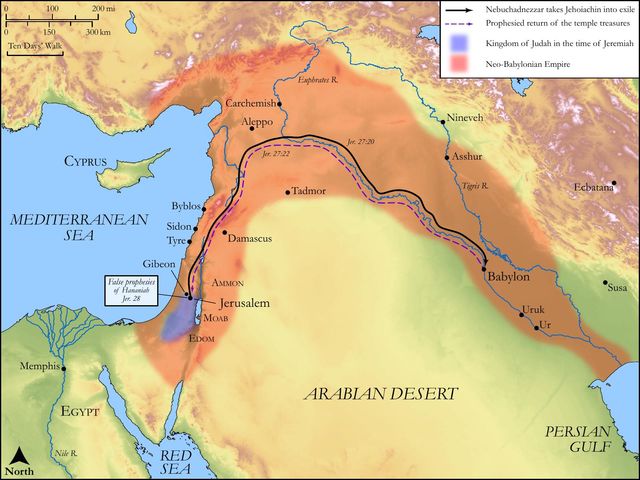
Jeremiah 27 is situated within a series of prophetic messages delivered by Jeremiah during the tumultuous reign of King Zedekiah of Judah (c. 597-586 BC). This specific chapter is marked by a powerful symbolic act: Jeremiah is commanded to wear a yoke, signifying the impending servitude of Judah and surrounding nations to Nebuchadnezzar, King of Babylon. The message is not exclusively for Zedekiah but is also directed to ambassadors from Edom, Moab, Ammon, Tyre, and Sidon, who had convened in Jerusalem, likely to forge an alliance against the rising Babylonian power. Jeremiah's message, including the foundational declaration in verse 5, serves as a divine counter-narrative to their rebellious plots, asserting that submission to Babylon is not merely a political necessity but a divinely ordained act of God's judgment and sovereign will. This emphatic declaration of God's universal dominion provides the theological bedrock for the subsequent command to submit to the Babylonian yoke.
Historical & Cultural Context
The late 7th and early 6th centuries BC were a period of unprecedented geopolitical upheaval among the nations. The Neo-Babylonian Empire, under the formidable Nebuchadnezzar II, had decisively eclipsed both Assyria and Egypt, establishing itself as the dominant world power. Judah, a small kingdom precariously positioned between these giants, struggled desperately to retain its independence. Following the first Babylonian siege of Jerusalem in 597 BC, King Jehoiachin was exiled to Babylon, and Zedekiah was installed as a puppet king. Despite this, a strong pro-Egyptian faction persisted within Jerusalem and among neighboring states, advocating for open rebellion against Babylon. Jeremiah's prophecy directly confronts this widespread political resistance, asserting that Babylon's ascendancy is not a mere geopolitical accident but rather an instrument in the hands of the sovereign God. Culturally, the prevailing understanding of deities often confined their power to specific lands or peoples; however, Jeremiah's message radically elevates Yahweh as the supreme God, whose dominion extends over all nations and their destinies.
Key Themes
ShowHideJeremiah 27:5 powerfully contributes to several overarching themes pervasive in the book of Jeremiah and broader biblical theology. Firstly, it underscores the absolute sovereignty of God over creation and history. God is not merely a national deity but the universal Creator and controller of all things, from the smallest beast to the greatest empire. This theme is foundational to comprehending God's justice and judgment throughout Jeremiah, exemplified by His designation of Babylon as His "servant" to execute punishment upon Judah and other nations, as seen in Jeremiah 25:9. Secondly, the verse highlights divine providence, asserting that even seemingly chaotic or oppressive historical events are integral components of God's deliberate and purposeful plan. The rise and fall of empires are not random occurrences but are meticulously orchestrated by God according to His will, a truth echoed in Daniel 2:21. Thirdly, Jeremiah 27:5 implicitly calls for humility and submission to God's revealed will, even when that will entails hardship or submission to an earthly oppressor. Resisting God's ordained path, even when it involves a pagan king, is unequivocally presented as rebellion against God Himself.
Exposition and Analysis
ShowHideKey Word Analysis
ShowHideThis verb (H6213) signifies "to do or make, in the broadest sense and widest application." In the context of creation, it denotes God's active, intentional, and comprehensive work in bringing the earth, humanity, and all animal life into existence. It emphasizes not only the initial act of creation but also God's ongoing work in shaping and maintaining His creation. This word highlights God's power as the ultimate artisan and architect of reality, whose creative acts establish His inherent right to govern.
Derived from a root meaning "to be firm," kôach (H3581) refers to vigor, force, might, or strength. It denotes the inherent ability and capacity of God to execute His will without hindrance or opposition. When applied to God's creative acts and His control over nations, it speaks to His irresistible and unassailable might, a power that transcends all earthly limitations and opposition. It represents the raw, unyielding energy by which God accomplishes His purposes, making His decrees immutable.
This word (H2220) literally refers to the arm or foreleg, but figuratively, it represents force, might, or strength. When paired with "outstretched" (Hebrew, nâṭâh' - H5186), it forms a powerful idiom, "outstretched arm," which is a recurring biblical motif. While often associated with God's acts of deliverance (e.g., the Exodus from Egypt), here it signifies His active, manifest, and irresistible power in establishing and controlling nations. It underscores that God's authority is not merely conceptual but actively demonstrated through powerful intervention in human affairs, whether for salvation or judgment, indicating a direct and forceful exertion of divine will.
Verse Breakdown
ShowHide"I have made the earth, the man and the beast that [are] upon the ground"
This opening clause unequivocally asserts God's identity as the sole and supreme Creator. It encompasses the entire terrestrial realm – the physical world ("earth"), humanity ("man"), and all animal life ("beast"). This foundational statement establishes God's inherent right to govern and dispose of His creation as He sees fit, as His ownership is rooted in His singular, unassisted creative act. It sets the stage for His subsequent claim of universal dominion.
"by my great power and by my outstretched arm"
This phrase explains the means by which God accomplished creation and continues to exercise control. "Great power" refers to His inherent, limitless, and inexhaustible might, while "outstretched arm" is a potent anthropomorphic idiom signifying His active, irresistible, and direct intervention in the affairs of all creation. It conveys the idea of a force that cannot be resisted or turned back, emphasizing the effortlessness and absolute effectiveness of God's sovereign will in bringing about His purposes.
"and have given it unto whom it seemed meet unto me"
This concluding clause pivots from God's creative power to His divine providence and governance over human history. "It" refers broadly to the created order, specifically the dominion over nations, their territories, and their rulers. The phrase "unto whom it seemed meet unto me" highlights God's absolute discretion, infinite wisdom, and sovereign prerogative in distributing authority and establishing rulers. It implies that God's decisions are based on His perfect judgment and ultimate purpose, independent of human merit, preference, or understanding, and that His assignments of power are righteous and fitting in His sight, even when they appear contrary to human expectations.
Literary Devices
ShowHideJeremiah 27:5 is rich in literary devices that amplify its profound theological message. The most prominent is Anthropomorphism, seen in the phrase "my outstretched arm." While God is spirit and has no physical body, this imagery attributes a human characteristic (an arm) to Him to convey His active, powerful, and direct involvement in both creation and governance. This device makes God's immense power relatable and understandable to human readers. Closely related is the Idiom "outstretched arm," which is a well-established biblical phrase signifying irresistible might and decisive action, particularly in acts of creation, deliverance, or judgment. The entire verse functions as a powerful Divine Declaration or Assertion, where God Himself speaks directly, using the first-person pronoun "I," to underscore the undeniable truth and inherent authority of His claims. This direct address lends immense weight, finality, and unchallengeable authority to the pronouncement of His absolute sovereignty over all things.
Theological and Thematic Connections
ShowHideJeremiah 27:5 serves as a theological cornerstone, asserting God's absolute sovereignty not only over creation but also over the entire course of human history and the destinies of nations. This declaration is crucial for understanding the broader prophetic message of Jeremiah, as it grounds the seemingly harsh command to submit to Babylon in the unassailable truth of God's universal dominion. It challenges any humanistic or nationalistic view that would place human will, political power, or national pride above the divine, reminding us that all authority is delegated by God and ultimately serves His overarching purposes. The verse emphatically emphasizes that God's actions are never arbitrary or capricious but are always "meet" (fitting, right, appropriate) in His perfect wisdom, even when they involve hardship or the elevation of pagan rulers, thereby affirming His righteous and purposeful governance over all things.
Reflection and Application
ShowHideIn a world often characterized by political turmoil, shifting global powers, and a pervasive sense of human helplessness in the face of complex international events, Jeremiah 27:5 offers a profound anchor for faith and a challenging call to perspective. It reminds us that behind the daily headlines, the intricate machinations of human leaders, and the rise and fall of empires, there is a sovereign God who remains firmly on the throne, orchestrating all things according to His eternal and unchangeable purpose. This foundational truth should inspire deep trust, knowing that our ultimate hope and security are not found in earthly governments, political ideologies, or human strategies, but in the God who made the earth by His great power and gives dominion to whomever He pleases. It calls us to cultivate a posture of profound humility, recognizing that our personal plans and desires, however well-intentioned, are ultimately subservient to His overarching will. Furthermore, it encourages us to view world events not merely through a secular or political lens, but through the lens of God's active and purposeful involvement, seeking to discern His hand and His righteous purposes even in the most challenging and perplexing circumstances, and to faithfully pray for those in authority, knowing that their power is derived from Him.
Questions for Reflection
ShowHideFAQ
ShowHideDoes Jeremiah 27:5 imply that God is responsible for all evil or oppressive regimes in history?
ShowHideJeremiah 27:5 declares God's ultimate sovereignty and His prerogative to give authority "unto whom it seemed meet unto me." This means that no ruler or nation comes to power without God's permission or appointment, even if they are pagan or oppressive. God uses all things, including the actions of wicked rulers, to accomplish His ultimate purposes, whether for judgment, discipline, or the advancement of His kingdom. However, this does not mean God approves of or causes the evil acts committed by these regimes. He permits them within His sovereign plan, often as a consequence of human sin or as a means to bring about repentance and justice. God remains holy and just, even when He uses imperfect or sinful instruments to achieve His will, as seen when He used the Chaldeans (Babylonians) to punish Judah in Habakkuk 1:5-11.
What does "seemed meet unto me" reveal about God's character?
ShowHideThe phrase "seemed meet unto me" (KJV) or "is right in my eyes" (ESV) emphasizes God's absolute wisdom, righteousness, and sovereign discretion. It reveals that God's decisions are not arbitrary, capricious, or subject to human opinion or counsel. Instead, they are rooted in His perfect nature—His infinite wisdom, justice, and goodness. What "seems meet" to God is always what is fitting, proper, and ultimately serves His righteous and loving purposes, even if humans cannot fully comprehend them at the time. It underscores His unchallengeable authority and His status as the ultimate moral standard and judge, whose judgments are always just and whose purposes are always good.
Christ-Centered Fulfillment
ShowHideJeremiah 27:5, with its powerful declaration of God's sovereign creation and His absolute control over all earthly dominion, finds its ultimate and most profound fulfillment in the person and redemptive work of Jesus Christ. While the Old Testament verse speaks of God giving authority "unto whom it seemed meet," the New Testament reveals that all authority in heaven and on earth has been definitively given to the resurrected Christ, as He Himself declares in Matthew 28:18. Jesus, as the eternal Word of God, is not merely an instrument of God's power but is Himself the divine agent through whom all things were made and by whom all things are sustained, as affirmed in John 1:3 and Colossians 1:16-17. The "outstretched arm" of God, which created the world and established kingdoms, is perfectly embodied in Christ, who demonstrates divine power over creation, disease, and death, and who ultimately disarmed the spiritual rulers and authorities through His triumph on the cross, as described in Colossians 2:15. Thus, the seemingly arbitrary distribution of power in Jeremiah 27:5 culminates in the perfect, righteous, and eternal reign of the Son, to whom all nations will ultimately bow, as every knee will one day confess His Lordship, according to Philippians 2:9-11. He is the true and everlasting King whom God has appointed to rule forever, ensuring that God's sovereign plan for all creation and humanity is perfectly realized through Him, ushering in the kingdom of the world that has become the kingdom of our Lord and of His Christ (Revelation 11:15).