


Jeremiah 27:4
Bible text: King James Version (1769 Blayney text) · Public domain
Bible text: Berean Standard Bible · Public domain
Bible text: American Standard Version (1901) · Public domain
Bible text: World English Bible, Messianic edition · Public domain
Bible text: Geneva Bible (1599) · Public domain
Bible text: Young's Literal Translation · Public domain
- וְצִוִּיתָve·tzi·vi·Taand you will commandH6680Conj-w ¦ V-Piel-ConsecPerf-2msVerb Piel Consecutive Perfect 2nd Singular Masculineוְandצִוִּיתָyou will command
- אֹתָם'o·Tam<obj.> themH853DirObjM ¦ 3mpParticle Object Indicatorאֹתָ<obj.>םthem
- אֶל'eltoH413PrepPreposition
- אֲדֹנֵיהֶם'a·do·nei·Hemtheir mastersH113N-mpc ¦ 3mpNoun Plural Masculine Constructאֲדֹנֵיmastersהֶםtheir
- לֵאמֹרle·Mor<to> sayingH559Prep-l ¦ V-Qal-InfVerb Qal Infinitive Constructלֵ<to>אמֹרsaying
- כֹּהkohthusH3541AdvAdverb
- אָמַר'a·Marhe saysH559V-Qal-Perf-3msVerb Qal Perfect 3rd Singular Masculine
- יְהוָהYah·wehYahwehH3068N-properNoun Proper Title
- צְבָאוֹתtze·va·'Otof hostsH6635N-fpNoun Plural Feminine Absolute
- אֱלֹהֵי'e·lo·Hei[the] God ofH430N-mpcNoun Plural Masculine Construct
- יִשְׂרָאֵלYis·ra·'ElIsraelH3478N-properNoun Proper Location
- כֹּהkohthusH3541AdvAdverb
- תֹאמְרוּto·me·Ruyou will sayH559V-Qal-Imperf-2mpVerb Qal Imperfect 2nd Plural Masculine
- אֶל'eltoH413PrepPreposition
- אֲדֹנֵיכֶם'a·Do·nei·Khemyour mastersH113N-mpc ¦ 2mpNoun Plural Masculine Constructאֲדֹנֵיmastersכֶםyour
English is a literal word-by-word gloss of the Hebrew, not the KJV's wording. Why?
This is the original text the KJV's translators worked from — each Hebrew word with its own literal English meaning in this verse, prepared by scholars at Tyndale House, Cambridge. The KJV translates whole sentences, not word by word, so its wording differs: one Hebrew word can become several English words, and the KJV may choose “the LORD” where the gloss reads “Yahweh”. Both are faithful — they answer different questions. For the KJV's own rendering, switch to the KJV text.
Details
See on the biblical-era map
Study this verse
Public-domain commentary
Matthew Henry
From his Commentary on the Whole Bible. Henry comments on passages, not single verses — this entry covers Jeremiah 27:1–11. His two-level outline is real structure in the source text, so it is rendered as structure.
Some difficulty occurs in the date of this prophecy. This word is said to come to Jeremiah in the beginning of the reign of Jehoiakim (Jer 27:1), and yet the messengers, to whom he is to deliver the badges of servitude, are said (Jer 27:3) to come to Zedekiah king of Judah, who reigned not till eleven years after the beginning of Jehoiakim's reign. Some make it an error of the copy, and think that it should be read (Jer 27:1), In the beginning of the reign of Zedekiah, for which some negligent scribe, having his eye on the title of the foregoing chapter, wrote Jehoiakim. And, if one would admit a mistake any where, it should be here, for Zedekiah is mentioned again (Jer 27:12), and the next prophecy is dated the same year, and said to be in the beginning of the reign of Zedekiah, Jer 28:1. Dr. Lightfoot solves it thus: In the beginning of Jehoiakim's reign Jeremiah is to make these bonds and yokes, and to put them upon his own neck, in token of Judah's subjection to the king of Babylon, which began at that time; but he is to send them to the neighbouring kings afterwards in the reign of Zedekiah, of whose succession to Jehoiakim, and the ambassadors sent to him, mention is made by way of prediction.
I.Jeremiah is to prepare a sign of the general reduction of all these countries into subjection to the king of Babylon (Jer 27:2):
Make thee bonds and yokes, yokes with bonds to fasten them, that the beast may not slip his neck out of the yoke. Into these the prophet must put his own neck to make them taken notice of as a prophetic representation; for every one would enquire, What is the meaning of Jeremiah's yokes? We find him with one on, Jer 28:10. Hereby he intimated that he advised them to nothing but what he was resolved to do himself; for he was not one of those that bind heavy burdens on others, which they themselves will not touch with one of their fingers. Ministers must thus lay themselves under the weight and obligation of what they preach to others.
II.He is to send this, with a sermon annexed to it, to all the neighbouring princes; those are mentioned (Jer 27:3) that lay next to the land of Canaan. It should seem, there was a treaty of alliance on foot between the king of Judah and all those other kings. Jerusalem was the place appointed for the treaty. Thither they all sent their plenipotentiaries; and it was agreed that they should bind themselves in a league offensive and defensive, to stand by one another, in opposition to the growing threatening greatness of the king of Babylon, and to reduce his exorbitant power. They had great confidence in their strength thus united, and were ready to call themselves the high allies; but, when the envoys were returning to their respective masters with the ratification of this treaty, Jeremiah gives each of them a yoke to carry to his master, to signify to him that he must either by consent or by compulsion become a servant to the king of Babylon, let him choose which he will. In the sermon upon this sign,
1.God asserts his own indisputable right to dispose of kingdoms as he pleases, Jer 27:5. He is the Creator of all things; he made the earth at first, established it, and it abides: it is still the same, though one generation passes away and another comes. He still by a continued creation produces man and beast upon the ground, and it is by his great power and outstretched arm. His arm has infinite strength, though it be stretched out. Upon this account he may give and convey a property and dominion to whomsoever he pleases. As he hath graciously given the earth to the children of men in general (Psa 115:16), so he give to each his share of it, be it more or less. Note, Whatever any have of the good things of this world, it is what God sees fit to give them; we ourselves should therefore be content, though we have ever so little, and not envy any their share, though they have ever so much.
2.He publishes a grant of all these countries to Nebuchadnezzar. Know all men by these presents. Sciant praesentes et futuri - Let those of the present and those of the future age know. "This is to certify to all whom it may concern that I have given all these lands, with all the wealth of them, into the hands of the king of Babylon; even the beasts of the field, whether tame or wild, have I given to him, parks and pastures; they are all his own." Nebuchadnezzar was a proud wicked man, an idolater; and yet God, in his providence, gives him this large dominion, these vast possessions. Note, The things of this world are not the best things, for God often gives the largest share of them to bad men, that are rivals with him and rebels against him. He was a wicked man, and yet what he had he had by divine grant. Note, Dominion is not founded in grace. Those that have not any colourable title to eternal happiness may yet have a justifiable title to their temporal good things. Nebuchadnezzar is a very bad man, and yet God calls him his servant, because he employed him as an instrument of his providence for the chastising of the nations, and particularly his own people; and for his service therein he thus liberally repaid him. Those whom God makes use of shall not lose by him; much more will he be found the bountiful rewarder of all those that designedly and sincerely serve him.
3.He assures them that they should all be unavoidably brought under the dominion of the king of Babylon for a time (Jer 27:7): All nations, all these nations and many others, shall serve him, and his son, and his son's son. His son was Evil-merodach, and his son's son Belshazzar, in whom his kingdom ceased: then the time of reckoning with his land came, when the tables were turned, and many nations and great kings, incorporated into the empire of the Medes and Persians, served themselves of him, as before, Jer 25:14. Thus Adonibezek was trampled upon himself, as he had trampled on other kings.
4.He threatens those with military execution that stood out and would not submit to the king of Babylon (Jer 27:8): That nation that will not put their neck under his yoke I will punish with sword and famine, with one judgment after another, till it is consumed by his hand. Nebuchadnezzar was very unjust and barbarous in invading the rights and liberties of his neighbours thus, and forcing them into a subjection to him; yet God had just and holy ends in permitting him to do so, to punish these nations for their idolatry and gross immoralities. Those that would not serve the God that made them were justly made to serve their enemies that sought to ruin them.
5.He shows them the vanity of all the hopes they fed themselves with, that they should preserve their liberties, Jer 27:9, Jer 27:10. These nations had their prophets too, that pretended to foretell future events by the stars, or by dreams, or enchantments; and they, to please their patrons, and because they would themselves have it so, flattered them with assurances that they should not serve the king of Babylon. Thus they designed to animate them to a vigorous resistance; and, though they had no ground for it, they hoped hereby to do them service. But he tells them that it would prove to their destruction; for by resisting they would provoke the conqueror to deal severely with them, to remove them, and drive them out into a miserable captivity, in which they should all be lost and buried in oblivion. Particular prophecies against these nations that bordered on Israel severally, the ruin of which is here foretold in the general, we shall meet with, ch. 48 and 49, and Eze. 25, which had the same accomplishment with this here. Note, When God judges he will overcome.
6.He puts them in a fair way to prevent their destruction by a quiet and easy submission, Jer 27:11. The nations that will be content to serve the king of Babylon, and pay him tribute for seventy years (ten apprenticeships), those will I let remain still in their own land. Those that will bend shall not break. Perhaps the dominion of the king of Babylon may bear no harder upon them than that of their own kings had done. It is often more a point of honour than true wisdom to prefer liberty before life. It is not mentioned to the disgrace of Issachar that because he saw rest was good, and the land pleasant, that he might peaceably enjoy it, he bowed his shoulder to bear, and became a servant to tribute (Gen 49:14, Gen 49:15), as these are here advised to do: Serve the king of Babylon and you shall till the land and dwell therein. Some would condemn this as the evidence of a mean spirit, but the prophet recommends it as that of a meek spirit, which yields to necessity, and by a quiet submission to the hardest turns of Providence makes the best of bad: it is better to do so than by struggling to make it worse.
- Levius fit patientia
Quicquid corrigere est nefas.
- Hor.
- When we needs must bear,
Enduring patience makes the burden light.
- Creech.
Many might have prevented destroying providences by humbling themselves under humbling providences. It is better to take up a lighter cross in our way than to pull a heavier on our own head.
Historical interpretation
Historical reception
1 surviving comment on this verse from the historical church.
(Verse 3, 4.) And you shall put them on your shoulder, and send them to the king of Edom, and to the king of Moab, and to the king of the sons of Ammon, and to the king of Tyre, and to the king of Sidon, by the hand of messengers who came to Jerusalem to King Zedekiah of Judah. And you shall command them to speak to their masters: Thus says the Lord of hosts, the God of Israel. You shall say this to your masters. The past vision was given at the beginning to the prophet of the reign of Joachim, son of Josiah, king of Judah. But these things happened under Zedekiah, who was the last ruler of Jerusalem, and under whom the city was captured and destroyed. And Jeremiah was commanded to put chains, or wooden yokes called "Mutoth" in Hebrew, around his neck and send them to the kings of Edom, Moab, Ammon, Tyre, and Sidon, through the messengers who had come to Zedekiah. And he was to instruct his messengers to announce that they should serve King Nebuchadnezzar and listen to what the following prophecy says. And so that perhaps the ambassadors and kings of those nations would respond, why do you not command this to your people? It also speaks similar things to King Zedekiah, and to the priests and prophets. This passage is always understood allegorically (by Origen), and fleeing from the truth, it interprets the heavenly Jerusalem, that its inhabitants should willingly take on bodies and descend into Babylon, that is, the confusion of this world which is placed in evil, and serve the Babylonian king, undoubtedly the devil. But if they refuse to do this, they will by no means bear heavy burdens; instead, they will perish by the sword, and by famine, and by pestilence; and they will not become men, but demons. He said this so that his defenders do not accuse us of slander. However, let us follow a simple and true history, so that we are not entangled in certain clouds and deceptions.
Continue studying Jeremiah 27:4 across the web’s major study libraries — every link below opens this exact verse, chapter, or book on the destination site.
Read & Compare
 BibleGatewayThis verse in more than 200 translations and 70 languages.
 Bible.comThe YouVersion reader — hundreds of translations, reading plans, and highlights.
 ESV.orgCrossway's official English Standard Version reader.
 NET BibleThe NET translation with 60,000+ translators' notes on every rendering decision.
 STEP BibleTyndale House's free study tool — original text, vocabulary, and scholarly resources.
 BibliaLogos Bible Software's free web reader.
 USCCBThe New American Bible (Revised Edition) with the U.S. bishops' study notes.
Commentaries
 BibleHub CommentariesDozens of classic commentaries on this verse, gathered on one page.
 StudyLightMore than 100 commentary sets — the largest collection on the web.
 BibleRefPlain-English commentary on what this verse means, verse by verse.
 Enduring WordDavid Guzik's free commentary on this chapter, widely used by Bible teachers.
 Bible Study ToolsVerse commentary alongside Greek and Hebrew study aids.
Original Language & Research
- BibleHub InterlinearThe verse word by word — original language, transliteration, and English.
- BibleHub LexiconEvery word's original-language definition and Strong's entry.
 Blue Letter BibleDeep-study tools — Strong's numbers, concordance, and word studies.
 SefariaThe Hebrew text with Rashi and centuries of Jewish commentary.
Sermons, Hymns & Audio


TrulyRandomVerse is not affiliated with these sites and doesn’t control their content. They’re linked because they’re genuinely useful.
Summary
Jeremiah 27:4 inaugurates a pivotal divine mandate delivered through the prophet Jeremiah to the envoys of various nations gathered in Jerusalem. This verse powerfully asserts the absolute authority of the message's sender—"the LORD of hosts, the God of Israel"—commanding these foreign representatives to convey God's precise and authoritative word directly to their respective kings. It sets the immutable stage for a declaration of divine sovereignty over all earthly powers, revealing God's active orchestration of geopolitical events and the impending subjugation of these nations to Babylon, all to fulfill His predetermined purposes.
Context
ShowHideLiterary Context
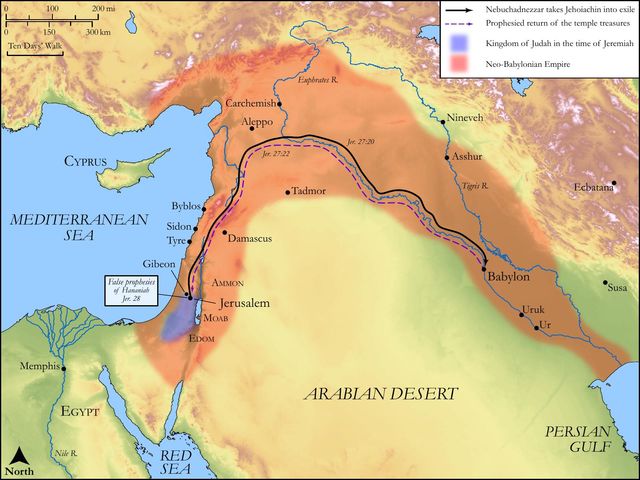
Jeremiah 27:4 serves as the authoritative opening of a significant prophetic oracle that spans Jeremiah 27-28. This chapter immediately follows a series of prophecies against various foreign nations (as seen in Jeremiah 25) and Jeremiah's personal struggles and laments (detailed in Jeremiah 26). The specific narrative context of chapter 27 involves the presence of envoys from Edom, Moab, Ammon, Tyre, and Sidon in Jerusalem, who were likely conspiring with King Zedekiah of Judah to form an alliance against the formidable and rising power of Babylon. In response to this political maneuvering, God commands Jeremiah to craft yokes and send them to these kings, symbolizing their inevitable and divinely ordained submission to Nebuchadnezzar. Verse 4 initiates the direct divine message that these envoys are to relay, emphatically stating that the words are not Jeremiah's own, but an authoritative utterance from the Almighty, thereby setting the tone for the entire message of submission that follows in Jeremiah 27:5-11.
Historical & Cultural Context
The historical backdrop for Jeremiah 27 is the early reign of King Zedekiah (c. 597-586 BCE), a period characterized by intense geopolitical instability and a desperate struggle for regional autonomy. Babylon, under the formidable leadership of Nebuchadnezzar, had firmly established its dominance after decisively defeating Egypt at Carchemish (605 BCE) and subsequently conquering Judah, leading to the first significant deportation of Judahites in 597 BCE. Despite this subjugation, some nations, including Judah, harbored persistent hopes of throwing off the Babylonian yoke. The gathering of these foreign envoys in Jerusalem indicates a concerted effort to forge a military coalition aimed at resisting Babylonian hegemony. Culturally, the act of a prophet delivering a message to foreign dignitaries on behalf of their deity was a profoundly powerful statement among the nations, where national gods were typically believed to control only their respective territories. The message from "the God of Israel" to pagan kings asserted a universal claim of sovereignty, directly challenging the prevailing polytheistic worldview and the political ambitions of these nations.
Key Themes
ShowHideThis verse powerfully introduces and reinforces several key themes central to the book of Jeremiah and broader biblical theology. Firstly, Divine Sovereignty is paramount, as the unequivocal declaration "Thus saith the LORD of hosts, the God of Israel" immediately establishes God's absolute and unchallenged control over all nations and their destinies. It highlights that even powerful empires like Babylon are mere instruments in His hands, fulfilling His divine purpose, a theme profoundly echoed in Daniel 4:17. Secondly, Prophetic Authority is robustly reinforced through the repetitive divine speech formula, "Thus saith the LORD," which validates the message as a direct, unquestionable utterance from God, demanding immediate attention and obedience. This underscores the prophet's crucial role as a divine messenger, not a political advisor or strategist. Lastly, the broader context of Jeremiah 27 reveals the overarching theme of Submission to God's Will, even when it involves humbling and seemingly adverse circumstances like subjugation to a foreign power. God was meticulously orchestrating these events, and resistance would only lead to greater suffering, emphasizing that true wisdom and peace lie in aligning with God's sovereign and immutable plan.
Exposition and Analysis
ShowHideKey Word Analysis
ShowHideThis primitive root (H6680) signifies an intensive act of constituting or enjoining, meaning "to appoint" or "to give a charge." It implies a definitive, authoritative directive, not merely a suggestion or request. In this context, it highlights the divine imperative behind Jeremiah's mission—he is not merely advising, but delivering a non-negotiable, divinely ordained command from God, which demands precise and immediate execution.
This term (H113) refers to a sovereign, controller, lord, or owner. Here, it specifically denotes the kings of the surrounding nations to whom the envoys are to report. The profound irony is that while these earthly rulers are "masters" in their respective realms, they are ultimately subject to the true and supreme "Master," the LORD of hosts, whose absolute command is being delivered to them, underscoring God's ultimate authority over all human power structures.
This powerful divine title combines the personal, covenantal name of God (H3068, YHWH, "the Self-Existent or Eternal") with "hosts" (H6635, tsâbâʼ), which refers to a mass of persons (or figuratively, things), especially an army or organized body. It signifies God's absolute power and authority as the supreme commander of all heavenly and earthly forces, including celestial armies, the stars, and even human armies. Coupled with "the God of Israel," it underscores that the covenant God of Israel is simultaneously the universal sovereign, extending His unparalleled authority over all nations and their rulers.
Verse Breakdown
ShowHide"And command them to say unto their masters"
This opening clause immediately establishes the divine origin and mandatory nature of the message. Jeremiah is explicitly instructed to "command" the foreign envoys, emphasizing the urgency, authority, and non-negotiable character of the word they are to deliver. The message is not for Jeremiah to soften, interpret, or modify, but to be relayed precisely and without alteration to their respective kings ("masters"), highlighting the direct chain of divine communication.
"Thus saith the LORD of hosts, the God of Israel;"
This is the quintessential prophetic formula, serving as an unimpeachable declaration of divine authority and authenticity. "Thus saith" (Hebrew: koh ʼâmar) is the standard opening for a direct word from God, leaving no doubt about the message's infallible source. The double title, "the LORD of hosts, the God of Israel," powerfully asserts God's universal sovereignty (as "LORD of hosts," the supreme commander of all creation) and His particular, intimate covenant relationship with Israel (as "the God of Israel"). This combination profoundly underscores that the God who chose Israel and made a covenant with them is not merely a tribal deity but the supreme, universal ruler of all nations, whose will extends far beyond His chosen people.
"Thus shall ye say unto your masters;"
This repetition of the command to "say unto your masters" serves as a powerful emphasis and reinforcement of the divine imperative. It highlights the directness, precision, and fidelity required in the transmission of God's word. The envoys are not merely passive recipients but active, mandated conduits of a divine decree, reiterating that the message is specifically for their kings and demands their immediate attention and absolute obedience. The divine insistence on this repetition underscores the gravity and non-negotiable nature of the message.
Literary Devices
ShowHideJeremiah 27:4 primarily employs Repetition and the Divine Speech Formula to underscore its central message of divine authority and the binding nature of God's word. The phrase "And command them to say unto their masters... Thus shall ye say unto your masters;" features a clear Repetition of the command to "say," reinforcing the imperative nature of the message and the precise fidelity required in its transmission. This repetition serves to emphasize the directness and non-negotiable character of God's decree. The Divine Speech Formula ("Thus saith the LORD") is a hallmark of prophetic literature, immediately signaling that the following words are not human opinion or political counsel but a direct, authoritative utterance from God Himself. This formula elevates the message above mere human discourse, imbuing it with irrefutable divine backing and demanding unquestioning obedience. Furthermore, the use of the majestic and compound title "LORD of hosts, the God of Israel" functions as a powerful form of Appellation, highlighting God's dual identity as both the universal sovereign and the covenant God, thereby asserting His unparalleled authority over both His chosen people and all other nations.
Theological and Thematic Connections
ShowHideJeremiah 27:4 is a profound theological statement on God's absolute and unchallengeable sovereignty over all creation, specifically including the rise and fall of nations and the destinies of their rulers. It unequivocally dispels any notion of human autonomy or self-determination in geopolitical affairs, asserting that even the most powerful kings and empires are ultimately mere instruments in God's hands, fulfilling His divine purposes. The message delivered through Jeremiah demonstrates that God's overarching plan is unfolding precisely according to His divine will, and any resistance to that will, even by formidable foreign powers, is ultimately futile and self-destructive. This verse calls all humanity, from the highest rulers to the common person, to humbly acknowledge God's supreme authority and to align their lives with His purposes, recognizing that true peace, stability, and prosperity come from submission to His divine decree.
Reflection and Application
ShowHideJeremiah 27:4 stands as a timeless and profoundly relevant reminder that God remains sovereign over all earthly powers and political landscapes, regardless of how chaotic, unpredictable, or unjust they may seem from a human perspective. In an age marked by shifting global alliances, economic uncertainties, political upheavals, and social unrest, this verse encourages believers to place their ultimate trust not in human leaders, national strength, or strategic alliances, but in the unchanging, all-powerful "LORD of hosts, the God of Israel." It challenges us to recognize that God can and does use any circumstance, any nation, or any ruler—even those who do not acknowledge Him or who act contrary to His revealed will—to accomplish His ultimate, redemptive purposes. This truth should inspire both profound humility and unwavering confidence: humility, in recognizing our limited understanding and control over the vast sweep of history; and confidence, in knowing that God's overarching plan for redemption, justice, and the establishment of His kingdom is always unfolding, meticulously and irresistibly. Our primary calling, like Jeremiah's, is to listen for and obey God's authoritative word, trusting that His commands, even when difficult or counter-intuitive, are always for our ultimate good and His eternal glory.
Questions for Reflection
ShowHideFAQ
ShowHideWhat is the significance of the phrase "LORD of hosts, the God of Israel" in this context?
ShowHideThe phrase "LORD of hosts, the God of Israel" (Hebrew: YHWH Sabaoth, Elohei Yisrael) is profoundly significant and deliberate. "LORD of hosts" (YHWH Sabaoth) emphasizes God's universal sovereignty, omnipotence, and unmatched power as the supreme commander of all heavenly and earthly armies and forces. It declares His absolute authority over all creation and all nations. "The God of Israel" simultaneously highlights His unique, intimate, and covenant relationship with Israel, His chosen people. By combining these two majestic titles, the verse asserts that the God who chose Israel and made a covenant with them is not merely a tribal deity, but the supreme, universal ruler whose authority extends over all peoples, including the pagan kings to whom this message is addressed. This combination underscores that even these foreign "masters" are ultimately subject to the God of Israel, who orchestrates global events according to His divine and sovereign plan, as powerfully seen in Isaiah 40:23.
Why did God command Jeremiah to deliver such a direct message to foreign kings through their envoys?
ShowHideGod commanded Jeremiah to deliver this direct and uncompromising message to foreign kings through their envoys for several crucial reasons: primarily, to unequivocally demonstrate His absolute sovereignty over all nations and to reveal His divine plan for the region. At this time, these nations were actively attempting to form an alliance against Babylon, thereby resisting God's divinely ordained instrument for judgment and discipline upon Judah and the surrounding nations. By sending this message, God was directly intervening in geopolitical affairs, asserting that Babylon's rise to power was not a mere historical accident or human endeavor but an integral part of His sovereign will. The message of submission, powerfully symbolized by the yokes Jeremiah was also instructed to send, was a divine decree for these nations to accept Babylonian rule, warning that resistance would inevitably lead to severe and devastating consequences. This act served as a powerful prophetic sign, leaving no doubt that the events unfolding were under the direct and meticulous control of the "LORD of hosts," who raises up and brings down kingdoms according to His perfect purpose, as clearly illustrated in Daniel 2:21.
Christ-Centered Fulfillment
ShowHideJeremiah 27:4, with its profound emphasis on divine authority, universal sovereignty, and the absolute nature of God's spoken word, finds its ultimate and perfect fulfillment in the person and work of Jesus Christ. While Jeremiah was a faithful messenger delivering God's authoritative command to earthly kings, Jesus is the very embodiment of that divine authority and the living Word of God made flesh. He is the "LORD of hosts" who condescended to dwell among humanity, the one through whom "all things were created, in heaven and on earth, visible and invisible, whether thrones or dominions or rulers or authorities—all things were created through him and for him" (Colossians 1:16). The command given to the envoys in Jeremiah 27:4, demanding submission to God's ordained instrument, powerfully foreshadows the universal dominion of Christ, who, after His triumphant resurrection, declared, "All authority in heaven and on earth has been given to me" (Matthew 28:18). Just as the nations were commanded to submit to God's will through the temporary dominion of Babylon, so too are all nations now called to submit to the eternal and benevolent reign of Christ, the true King of kings and Lord of lords (Revelation 19:16). The prophetic word delivered by Jeremiah, though powerful and divinely inspired, was a shadow of the living Word, Jesus Christ, who is the ultimate and complete revelation of God's will and the one to whom every knee will one day bow and every tongue confess that He is Lord, to the glory of God the Father (Philippians 2:10-11).