


Daniel 2:38
Bible text: King James Version (1769 Blayney text) · Public domain
Bible text: King James Version with Strong's numbers · Public domain
Bible text: Berean Standard Bible · Public domain
Bible text: American Standard Version (1901) · Public domain
Bible text: World English Bible, Messianic edition · Public domain
Bible text: Geneva Bible (1599) · Public domain
Bible text: Young's Literal Translation · Public domain
- וּבְכָלu·ve·Kholand over allH3606Conj-w ¦ Prep-b ¦ N-csNoun Singular common gender Absoluteוּandבְoverכָלall
- דִּיdithatH1768ConjConjunction
- דָיְרִיןda·'a·rin[are] dwellingH1753V-Peal-Prtcpl-mpVerb Peal Participle Plural Masculine Absolute
- בְּנֵיbe·nei[the] sons ofH1247N-mpcNoun Plural Masculine Construct
- אֲנָשָׁא'A·na·sha'<the> humankindH606N-cs ¦ ArtNoun Singular common gender Definiteאֲנָשָׁ<the>אhumankind
- חֵיוַתchei·Vat[the] animal[s] ofH2423N-fscNoun Singular Feminine Construct
- בָּרָאba·Ra'field theH1251N-cs ¦ ArtNoun Singular common gender Definiteבָּרָfieldאthe
- וְעוֹףve·'ofand [the] bird[s] ofH5776Conj-w ¦ N-cscNoun Singular common gender Constructוְandעוֹף[the] bird[s] of
- שְׁמַיָּאshe·mai·Ya'heavens theH8065N-mp ¦ ArtNoun Plural Masculine Definiteשְׁמַיָּheavensאthe
- יְהַבye·Havhe has givenH3052V-Peal-Perf-3msVerb Peal Perfect 3rd Singular Masculine
- בִּידָךְbi·Dakhin your handH3028Prep-b ¦ N-csc ¦ 2msNoun Singular common gender Constructבִּinידָhandךְyour
- וְהַשְׁלְטָךְve·hash·le·Takhand he has made ruler youH7981Conj-w ¦ V-Hiphil-Perf-3ms ¦ 2msVerb Hiphil Perfect 3rd Singular Masculineוְandהַשְׁלְטָhe has made rulerךְyou
- בְּכָלְּהוֹןbe·kha·le·Honover all of themH3606Prep-b ¦ N-csc ¦ 3mpNoun Singular common gender Constructבְּoverכָלְּall ofהוֹןthem
- אַנְתְּ'an·tahyouH607Pro-2msPronoun Personal 2nd Singular Masculine
- הוּאHu'[are] itH1932Pro-3msPronoun Personal 3rd Singular Masculine
- רֵאשָׁהre·Shah'head theH7217N-cs ¦ ArtNoun Singular common gender Definiteרֵאשָׁheadהthe
- דִּיdiofH1768ConjConjunction
- דַהֲבָאda·ha·Va'<the> goldH1722N-cs ¦ ArtNoun Singular common gender Definiteדַהֲבָ<the>אgold
English is a literal word-by-word gloss of the Hebrew, not the KJV's wording. Why?
This is the original text the KJV's translators worked from — each Hebrew word with its own literal English meaning in this verse, prepared by scholars at Tyndale House, Cambridge. The KJV translates whole sentences, not word by word, so its wording differs: one Hebrew word can become several English words, and the KJV may choose “the LORD” where the gloss reads “Yahweh”. Both are faithful — they answer different questions. For the KJV's own rendering, switch to the KJV text.
Details
See on the biblical-era map
Study this verse
Public-domain commentary
Matthew Henry
From his Commentary on the Whole Bible. Henry comments on passages, not single verses — this entry covers Daniel 2:31–45. His three-level outline is real structure in the source text, so it is rendered as structure.
Daniel here gives full satisfaction to Nebuchadnezzar concerning his dream and the interpretation of it. That great prince had been kind to this poor prophet in his maintenance and education; he had been brought up at the king's cost, preferred at court, and the land of his captivity had hereby been made much easier to him than to others of his brethren. And now the king is abundantly repaid for all the expense he had been at upon him; and for receiving this prophet, though not in the name of a prophet, he had a prophet's reward, such a reward as a prophet only could give, and for which that wealthy mighty prince was now glad to be beholden to him. Here is,
I.The dream itself, Dan 2:31, Dan 2:45.
Nebuchadnezzar perhaps was an admirer of statues, and had his palace and gardens adorned with them; however, he was a worshipper of images, and now behold a great image is set before him in a dream, which might intimate to him what the images were which he bestowed so much cost upon, and paid such respect to; they were mere dreams. The creatures of fancy might do as well to please the fancy. By the power of imagination he might shut his eyes, and represent to himself what forms he thought fit, and beautify them at his pleasure, without the expense and trouble of sculpture. This was the image of a man erect: It stood before him, as a living man; and, because those monarchies which were designed to be represented by it were admirable in the eyes of their friends, the brightness of this image was excellent; and because they were formidable to their enemies, and dreaded by all about them, the form of this image is said to be terrible; both the features of the face and the postures of the body made it so. But that which was most remarkable in this image was the different metals of which it was composed - the head of gold (the richest and most durable metal), the breast and arms of silver (the next to it in worth), the belly and sides (or thighs) of brass, the legs of iron (still baser metals), and lastly the feet part of iron and part of clay. See what the things of this world are; the further we go in them the less valuable they appear. In the life of a man youth is a head of gold, but it grows less and less worthy of our esteem; and old age is half clay; a man is then as good as dead. It is so with the world; later ages degenerate. The first age of the Christian church, of the reformation, was a head of gold; but we live in an age that is iron and clay. Some allude to this in the description of a hypocrite, whose practice is not agreeable to his knowledge. He has a head of gold, but feet of iron and clay: he knows his duty, but does it not. Some observe that in Daniel's visions the monarchies were represented by four beasts (ch. 7), for he looked upon that wisdom from beneath, by which they were turned to be earthly and sensual, and a tyrannical power, to have more in it of the beast than of the man, and so the vision agreed with his notions of the thing. But to Nebuchadnezzar, a heathen prince, they were represented by a gay and pompous image of a man, for he was an admirer of the kingdoms of this world and the glory of them. To him the sight was so charming that he was impatient to see it again. But what became of this image? The next part of the dream shows it to us calcined, and brought to nothing. He saw a stone cut out of the quarry by an unseen power, without hands, and this stone fell upon the feet of the image, that were of iron and clay, and broke them to pieces; and then the image must fall of course, and so the gold, and silver, and brass, and iron, were all broken to pieces together, and beaten so small that they became like the chaff of the summer threshing-floors, and there were not to be found any the least remains of them; but the stone cut out of the mountain became itself a great mountain, and filled the earth. See how God can bring about great effects by weak and unlikely causes; when he pleases a little one shall become a thousand. Perhaps the destruction of this image of gold, and silver, and brass, and iron, might be intended to signify the abolishing of idolatry out of the world in due time. The idols of the heathen are silver and gold, as this image was, and they shall perish from off the earth and from under these heavens, Jer 10:11.; Isa 2:18. And whatever power destroys idolatry is in the ready way to magnify and exalt itself, as this stone, when it had broken the image to pieces, became a great mountain.
II.The interpretation of this dream.
Let us now see what is the meaning of this. It was from God, and therefore from him it is fit that we take the explication of it. It should seem, Daniel had his fellows with him, and speaks for them as well as for himself, when he says, We will tell the interpretation, Dan 2:36. Now,
1.This image represented the kingdoms of the earth that should successively bear rule among the nations and have influence on the affairs of the Jewish church. The four monarchies were not represented by four distinct statues, but by one image, because they were all of one and the same spirit and genius, and all more or less against the church. It was the same power, only lodged in four different nations, the two former lying eastward of Judea, the two latter westward.
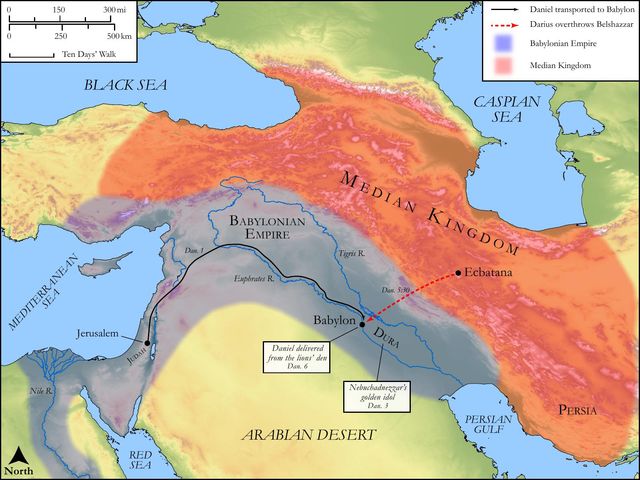
(1.)The head of gold signified the Chaldean monarchy, which was now in being (Dan 2:37, Dan 2:38): Thou, O king! art (or rather, shalt be) a king of kings, a universal monarch, to whom many kings and kingdoms shall be tributaries; or, Thou art the highest of kings on earth at this time (as a servant of servants is the meanest servant); thou dost outshine all other kings. But let him not attribute his elevation to his own politics or fortitude. No; it is the God of heaven that has given thee a kingdom, power, and strength, and glory, a kingdom that exercises great authority, stands firmly, and shines brightly, acts by a puissant army with an arbitrary power. Note, The greatest of princes have no power but what is given them from above. The extent of his dominion is set forth (Dan 2:38), that wheresoever the children of men dwell, in all the nations of that part of the world, he was ruler over them all, over them and all that belonged to them, all their cattle, not only those which they had a property in, but those that were ferae naturae - wild, the beasts of the field and the fowls of the heaven. He was lord of all the woods, forests, and chases, and none were allowed to hunt or fowl without his leave. Thus "thou art the head of gold; thou, and thy son, and thy son's son, for seventy years." Compare this with Jer 25:9, Jer 25:11, especially Jer 27:5-7. There were other powerful kingdoms in the world at this time, as that of the Scythians; but it was the kingdom of Babylon that reigned over the Jews, and that began the government which continued in the succession here described till Christ's time. It is called a head, for its wisdom, eminency, and absolute power, a head of gold for its wealth (Isa 14:4); it was a golden city. Some make this monarchy to begin in Nimrod, and so bring into it all the Assyrian kings, about fifty monarchs in all, and compute that it lasted above 1600 years. But it had not been so long a monarchy of such vast extent and power as is here described, nor any thing like it; therefore others make only Nebuchadnezzar, Evil-merodach, and Belshazzar, to belong to this head of gold; and a glorious high throne they had, and perhaps exercised a more despotic power than any of the kings that went before them. Nebuchadnezzar reigned forty-five years current, Evil-merodach twenty-three years current, and Belshazzar three. Babylon was their metropolis, and Daniel was with them upon the spot during the seventy years.
(2.)The breast and arms of silver signified the monarchy of the Medes and Persians, of which the king is told no more than this, There shall arise another kingdom inferior to thee (Dan 2:39), not so rich, powerful, or victorious. This kingdom was founded by Darius the Mede and Cyrus the Persian, in alliance with each other, and therefore represented by two arms, meeting in the breast. Cyrus was himself a Persian by his father, a Mede by his mother. Some reckon that this second monarchy lasted 130 years, others 204 years. The former computation agrees best with the scripture chronology.
(3.)The belly and thighs of brass signified the monarchy of the Grecians, founded by Alexander, who conquered Darius Codomannus, the last of the Persian emperors. This is the third kingdom, of brass, inferior in wealth and extent of dominion to the Persian monarchy, but in Alexander himself it shall by the power of the sword bear rule over all the earth; for Alexander boasted that he had conquered the world, and then sat down and wept because he had not another world to conquer.
(4.)The legs and feet of iron signified the Roman monarchy. Some make this to signify the latter part of the Grecian monarchy, the two empires of Syria and Egypt, the former governed by the family of the Seleucidae, from Seleucus, the latter by that of the Lagidae, from Ptolemaeus Lagus; these they make the two legs and feet of this image: Grotius, and Junius, and Broughton, go this way. But it has been the more received opinion that it is the Roman monarchy that is here intended, because it was in the time of that monarchy, and when it was at its height, that the kingdom of Christ was set up in the world by the preaching of the everlasting gospel. The Roman kingdom was strong as iron (Dan 2:40), witness the prevalency of that kingdom against all that contended with it for many ages. That kingdom broke in pieces the Grecian empire and afterwards quite destroyed the nation of the Jews. Towards the latter end of the Roman monarchy it grew very weak, and branched into ten kingdoms, which were as the toes of these feet. Some of these were weak as clay, others strong as iron, Dan 2:42. Endeavours were used to unite and cement them for the strengthening of the empire, but in vain: They shall not cleave one to another, Dan 2:43. This empire divided the government for a long time between the senate and the people, the nobles and the commons, but they did not entirely coalesce. There were civil wars between Marius and Sylla, Caesar and Pompey, whose parties were as iron and clay. Some refer this to the declining times of that empire, when, for the strengthening of the empire against the irruptions of the barbarous nations, the branches of the royal family intermarried; but the politics had not the desired effect, when the day of the fall of that empire came.
2.The stone cut out without hands represented the kingdom of Jesus Christ, which should be set up in the world in the time of the Roman empire, and upon the ruins of Satan's kingdom in the kingdoms of the world. This is the stone cut out of the mountain without hands, for it should be neither raised nor supported by human power or policy; no visible hand should act in the setting of it up, but it should be done invisibly the Spirit of the Lord of hosts. This was the stone which the builders refused, because it was not cut out by their hands, but it has now become the head-stone of the corner.
(1.)The gospel-church is a kingdom, which Christ is the sole and sovereign monarch of, in which he rules by his word and Spirit, to which he gives protection and law, and from which he receives homage and tribute. It is a kingdom not of this world, and yet set up in it; it is the kingdom of God among men.
(2.)The God of heaven was to set up this kingdom, to give authority to Christ to execute judgment, to set him as King upon his holy hill of Zion, and to bring into obedience to him a willing people. Being set up by the God of heaven, it is often in the New Testament called the kingdom of heaven, for its original is from above and its tendency is upwards.
(3.)It was to be set up in the days of these kings, the kings of the fourth monarchy, of which particular notice is taken (Luk 2:1), That Christ was born when, by the decree of the emperor of Rome, all the world was taxed, which was a plain indication that that empire had become as universal as any earthly empire ever was. When these kings are contesting with each other, and in all the struggles each of the contending parties hopes to find its own account, God will do his own work and fulfil his own counsels. These kings are all enemies to Christ's kingdom, and yet it shall be set up in defiance of them.
(4.)It is a kingdom that knows no decay, is in no danger of destruction, and will not admit any succession or revolution. It shall never be destroyed by any foreign force invading it, as many other kingdoms are; fire and sword cannot waste it; the combined powers of earth and hell cannot deprive either the subjects of their prince or the prince of his subjects; nor shall this kingdom be left to other people, as the kingdoms of the earth are. As Christ is a monarch that has no successor (for he himself shall reign for ever), so his kingdom is a monarchy that has no revolution. The kingdom of God was indeed taken from the Jews and given to the Gentiles (Mat 21:43), but still it was Christianity that ruled, the kingdom of the Messiah. The Christian church is still the same; it is fixed on a rock, much fought against, but never to be prevailed against, by the gates of hell.
(5.)It is a kingdom that shall be victorious over all opposition. It shall break in pieces and consume all those kingdoms, as the stone cut out of the mountain without hands broke in pieces the image, Dan 2:44, Dan 2:45. The kingdom of Christ shall wear out all other kingdoms, shall outlive them, and flourish when they are sunk with their own weight, and so wasted that their place knows them no more. All the kingdoms that appear against the kingdom of Christ shall be broken with a rod of iron, as a potter's vessel, Psa 2:9. And in the kingdoms that submit to the kingdom of Christ tyranny, and idolatry, and every thing that is their reproach, shall, as far as the gospel of Christ gets ground, be broken. The day is coming when Jesus Christ shall have put down all rule, principality, and power, and have made all his enemies his footstool; and then this prophecy will have its full accomplishment, and not till then, Co1 15:24, Co1 15:25. Our savior seems to refer to this (Mat 21:44), when, speaking of himself as the stone set at nought by the Jewish builders, he says, On whomsoever this stone shall fall, it will grind him to powder.
(6.)It shall be an everlasting kingdom. Those kingdoms of the earth that had broken in pieces all about them at length came, in their turn, to be in like manner broken; but the kingdom of Christ shall break other kingdoms in pieces and shall itself stand for ever. His throne shall be as the days of heaven, his seed, his subjects, as the stars of heaven, not only so innumerable, but so immutable. Of the increase of Christ's government and peace there shall be no end. The Lord shall reign for ever, not only to the end of time, but when time and days shall be no more, and God shall be all in all to eternity.
III.Daniel having thus interpreted the dream, to the satisfaction of Nebuchadnezzar, who gave him no interruption, so full was the interpretation that he had no question to ask, and so plain that he had no objection to make, he closes all with a solemn assertion,
1.Of the divine original of this dream: The great God (so he calls him, to express his own high thoughts of him, and to beget the like in the mind of this great king) has made known to the king what shall come to pass hereafter, which the gods of the magicians could not do. And thus a full confirmation was given to that great argument which Isaiah had long before urged against idolaters, and particularly the idolaters of Babylon, when he challenged the gods they worshipped to show things that are to come hereafter, that we may know that you are gods (Isa 41:23), and by this proved the God of Israel to be the true God, that he declares the end from the beginning, Isa 46:10.
2.Of the undoubted certainty of the things foretold by this dream. He who makes known these things is the same that has himself designed and determined them, and will by his providence effect them; and we are sure that his counsel shall stand, and cannot be altered, and therefore the dream is certain and the interpretation thereof sure. Note, Whatever God has made known we may depend upon.
Historical interpretation
Historical reception
1 surviving comment on this verse from the historical church.
Verse 38. "Now thou art the head of gold." "The head of gold," he says "is thou, O king." By this statement it is clear that the first empire, the Babylonian, is compared to the most precious metal, gold.
Continue studying Daniel 2:38 across the web’s major study libraries — every link below opens this exact verse, chapter, or book on the destination site.
Read & Compare
 BibleGatewayThis verse in more than 200 translations and 70 languages.
 Bible.comThe YouVersion reader — hundreds of translations, reading plans, and highlights.
 ESV.orgCrossway's official English Standard Version reader.
 NET BibleThe NET translation with 60,000+ translators' notes on every rendering decision.
 STEP BibleTyndale House's free study tool — original text, vocabulary, and scholarly resources.
 BibliaLogos Bible Software's free web reader.
 USCCBThe New American Bible (Revised Edition) with the U.S. bishops' study notes.
Commentaries
 BibleHub CommentariesDozens of classic commentaries on this verse, gathered on one page.
 StudyLightMore than 100 commentary sets — the largest collection on the web.
 BibleRefPlain-English commentary on what this verse means, verse by verse.
 Enduring WordDavid Guzik's free commentary on this chapter, widely used by Bible teachers.
 Bible Study ToolsVerse commentary alongside Greek and Hebrew study aids.
Original Language & Research
- BibleHub InterlinearThe verse word by word — original language, transliteration, and English.
- BibleHub LexiconEvery word's original-language definition and Strong's entry.
 Blue Letter BibleDeep-study tools — Strong's numbers, concordance, and word studies.
 SefariaThe Hebrew text with Rashi and centuries of Jewish commentary.
Sermons, Hymns & Audio


TrulyRandomVerse is not affiliated with these sites and doesn’t control their content. They’re linked because they’re genuinely useful.
Summary
Daniel 2:38 marks a pivotal moment in the interpretation of King Nebuchadnezzar's prophetic dream, unequivocally identifying him and his Neo-Babylonian Empire as the "head of gold." This verse powerfully declares that Nebuchadnezzar's vast and unparalleled dominion over all humanity, the beasts of the field, and the fowls of the heaven was not a product of his own might or strategic genius, but a direct, sovereign bestowal from the Most High God. It establishes Babylon as the preeminent, most glorious, and wealthiest kingdom in the divinely ordained succession of world empires, setting the stage for the unfolding of God's prophetic timeline for human history.
Context
ShowHideLiterary Context
Daniel 2:38 is the crucial interpretive key within the broader narrative of Daniel chapter 2, directly following Daniel's miraculous recounting of King Nebuchadnezzar's forgotten dream (Daniel 2:31-35). Having established his divine authority by revealing the dream itself, Daniel now transitions into its profound meaning, beginning with the identification of Nebuchadnezzar's kingdom. This verse serves as the interpretive anchor, linking the first and most splendid part of the colossal statue to the reigning monarch and his empire. It sets the hierarchical and chronological framework for the subsequent interpretation of the statue's lesser metallic components (silver, bronze, iron, and clay), each representing a successive world empire. The verses immediately preceding describe the terrifying, composite image, while those immediately following (Daniel 2:39-40) detail the lesser kingdoms that would follow Babylon, emphasizing a decline in glory but an increase in strength or complexity.
Historical & Cultural Context
The historical backdrop for Daniel 2:38 is the zenith of the Neo-Babylonian Empire under the formidable reign of Nebuchadnezzar II (605-562 BC). Babylon, during this period, was indeed a city of legendary splendor and immense wealth, a true marvel of its day. Its architectural achievements, such as the Hanging Gardens (counted among the traditional Seven Wonders) and the magnificent Ishtar Gate, were testaments to its opulence and engineering prowess. Militarily, Nebuchadnezzar's empire was the dominant power of his day, having decisively conquered major kingdoms, including Judah, and exiled its elite, among whom was Daniel. The choice of "gold" as the symbol for Babylon was profoundly fitting, reflecting its unparalleled riches, the vast treasures amassed from its conquests, and its perceived invincibility and glory. This historical reality underscores the divine message: even such an overwhelmingly powerful and glorious empire was merely a temporary instrument in God's sovereign hand, a truth that would have been humbling for Nebuchadnezzar and reassuring for the exiled Israelites.
Key Themes
ShowHideThe verse unequivocally declares that Nebuchadnezzar's vast dominion was not achieved by human strength or strategic genius alone but was a direct grant from God. The repeated phrases "hath he given into thine hand" and "hath made thee ruler" underscore that all earthly authority, even that of the most formidable kings and empires, is ultimately derived from the Creator. This theme is central to the entire book of Daniel, consistently emphasizing that God is the one who "[removes] kings and [sets] up kings" (Daniel 2:21). It serves as a foundational theological truth: human history, with its rise and fall of nations, is under divine orchestration, not random chance or solely human will. The direct declaration, "Thou [art] this head of gold," unequivocally identifies Nebuchadnezzar and, by extension, his powerful Neo-Babylonian Empire, as the first and most splendid of the great world powers prophesied in the dream. Gold, as the most precious and glorious metal, perfectly symbolizes Babylon's unparalleled wealth, military dominance, and cultural glory during its zenith. This identification is crucial for understanding the subsequent prophetic timeline and the nature of the kingdoms that would follow. Daniel 2:38 lays the groundwork for understanding the succession of world empires that would follow Babylon, represented by the other materials of the statue. It initiates a detailed prophetic timeline of global powers, moving from gold to silver, bronze, and iron, culminating not in another human kingdom but in God's eternal kingdom. This progression is further detailed in subsequent verses, such as when Daniel interprets the "breast and arms of silver" and "belly and thighs of bronze" (Daniel 2:39) and the "legs of iron" (Daniel 2:40), all of which are subject to the ultimate, divine kingdom.
Exposition and Analysis
ShowHideKey Word Analysis
ShowHideThis Aramaic term (H1722) refers to the precious metal, gold. In the context of Daniel 2:38, it serves as a potent symbol for the unparalleled wealth, splendor, and perceived invincibility of the Neo-Babylonian Empire under Nebuchadnezzar. Gold was the most valuable and coveted metal in that day, perfectly representing the zenith of human power, opulence, and glory that Babylon achieved, making it the preeminent kingdom of its era.
The Aramaic word (H3028) for "hand" carries the profound connotation of power, means, or direction. When Daniel declares that God "hath he given into thine hand," it signifies that Nebuchadnezzar's vast dominion was not merely a result of his own military might, strategic genius, or political prowess, but a direct bestowal of authority and power from a higher, divine source. This emphasizes God's active and sovereign role in establishing and empowering earthly rulers, even those who do not acknowledge Him.
This Aramaic verb (H7981) means "to dominate" or "to govern," implying absolute and comprehensive authority. The phrase "hath made thee ruler over them all" underscores the complete and unquestioned dominion God granted Nebuchadnezzar over all aspects of creation—humanity, wild beasts, and birds—within his vast empire. It highlights the extensive nature of God's delegated authority to the Babylonian king, demonstrating that even the most powerful human monarch is ultimately a steward of divine power.
Verse Breakdown
ShowHide"And wheresoever the children of men dwell"
This clause establishes the universal scope of Nebuchadnezzar's divinely appointed dominion, indicating that his authority extended over all inhabited lands known to him. It emphasizes the vastness of his empire and the comprehensive nature of the power God had bestowed, encompassing all human populations within his sphere of influence.
"the beasts of the field and the fowls of the heaven hath he given into thine hand"
This expands the scope of Nebuchadnezzar's authority beyond humanity to include the entire animal kingdom. It echoes the original dominion granted to humanity in creation (e.g., Genesis 1:28), but here it is specifically delegated to Nebuchadnezzar as a sign of his extraordinary, divinely sanctioned power. The phrase "given into thine hand" reinforces the idea of a direct, intentional divine grant, not a power seized by human might alone.
"and hath made thee ruler over them all"
This clause reiterates and consolidates the preceding statements, emphasizing the comprehensive and absolute nature of the authority Nebuchadnezzar possessed. It confirms that his rule was not partial or limited but extended over all aspects of the created order within his realm, a profound testament to God's complete and meticulous control over earthly affairs, even through pagan kings.
"Thou [art] this head of gold"
This is the climactic and interpretive declaration of the verse, directly identifying Nebuchadnezzar (and by extension, his Neo-Babylonian Empire) as the "head of gold" from the dream's colossal statue. This metaphor signifies that Babylon was the first, most glorious, and most powerful of the successive world empires prophesied, unparalleled in its wealth, splendor, and dominance, thereby setting the standard for the prophetic timeline.
Literary Devices
ShowHideDaniel 2:38 employs several powerful literary devices to convey its profound message and underscore the divine origin of its interpretation. Central to the verse is Symbolism, where "gold" serves as a potent symbol for the Neo-Babylonian Empire. Gold, being the most precious, lustrous, and enduring metal, perfectly represents Babylon's immense wealth, its formidable military might, and its perceived unparalleled glory during Nebuchadnezzar's reign. This symbolism immediately establishes Babylon as the preeminent kingdom in the prophetic sequence. Furthermore, the phrase "Thou [art] this head of gold" functions as a direct Metaphor, equating Nebuchadnezzar himself with the golden head of the statue, thereby personifying the empire's attributes in its ruler and making the identification strikingly clear. The entire verse also serves as a Divine Pronouncement, delivered by Daniel as God's chosen messenger. The authoritative tone and the explicit declaration of God's direct involvement ("hath he given," "hath made thee ruler") underscore the absolute sovereignty of God over human kingdoms, transforming a pagan king's disturbing dream into a profound theological statement about God's control over history.
Theological and Thematic Connections
ShowHideDaniel 2:38 profoundly illustrates the foundational biblical truth of divine sovereignty over all earthly powers. It teaches that no human ruler or empire, no matter how mighty, glorious, or seemingly autonomous, operates outside the ultimate control and decree of God. Nebuchadnezzar, the most powerful king of his time, is explicitly told that his vast dominion was a gift from the Most High, not a product of his own strength or ingenuity. This truth offers immense comfort and perspective to believers across generations, reminding us that God is actively involved in history, raising up and bringing down nations, kings, and empires according to His eternal purposes. It challenges the human tendency to deify political power or to despair in the face of seemingly insurmountable earthly forces, redirecting our gaze to the one true Sovereign who orchestrates all things for His glory and the good of His people.
Reflection and Application
ShowHideDaniel 2:38 serves as a profound anchor for our understanding of God's unwavering control over human history. In a world often characterized by political upheaval, shifting powers, and the rise and fall of nations, this verse provides a comforting and steadying truth: even the most formidable earthly empires and their rulers are ultimately instruments in the hand of a sovereign God. For us, this means we can trust in God's overarching plan, even when circumstances seem chaotic or beyond human control. It calls us to profound humility, recognizing that any authority, influence, or success we possess is ultimately a stewardship from God, to be used for His purposes, not our own glory. Furthermore, it encourages us to invest our deepest allegiances and hopes not in fleeting earthly kingdoms, which are destined to pass away, but in the eternal, unshakable kingdom of God, which alone will endure. This perspective frees us from the anxieties of temporal power struggles and empowers us to live with purpose, knowing that God is working all things for His glory and the ultimate establishment of His righteous reign.
Questions for Reflection
ShowHideFAQ
ShowHideWhy is Babylon, and specifically Nebuchadnezzar, identified as the "head of gold" in the dream?
ShowHideNebuchadnezzar's Babylon was identified as the "head of gold" due to its unparalleled wealth, military dominance, and cultural splendor during his reign. It was the preeminent world power of its time, having conquered vast territories and amassed immense riches. Gold, being the most precious and glorious metal, perfectly symbolized this era of Babylonian supremacy, setting a high standard for the subsequent, lesser kingdoms in the prophetic vision. This identification highlights Babylon's unique position as the first and most magnificent of the Gentile world empires in God's prophetic timeline.
Does God's granting of dominion to Nebuchadnezzar imply that Nebuchadnezzar was a righteous king or favored by God in a spiritual sense?
ShowHideNo, God's granting of dominion to Nebuchadnezzar does not imply His approval of the king's character, his pagan religion, or his often brutal methods. Instead, it highlights God's absolute and unchallengeable sovereignty over all nations and rulers, whether righteous or unrighteous. God uses various instruments, even those hostile to Him or unaware of His purposes, to accomplish His divine will and unfolding plan in history. This is a recurring theme in Scripture, where God raises up and brings down kings as part of His sovereign orchestration (e.g., Isaiah 45:1).
How does this prophecy of the "head of gold" relate to other biblical prophecies of empires?
ShowHideThe "head of gold" prophecy in Daniel 2:38 is foundational for understanding the broader sweep of prophetic history in the Bible, particularly within the book of Daniel itself. It establishes the first in a sequence of world empires, which are later paralleled and expanded upon in subsequent visions. For example, the four beasts in Daniel 7 and the ram and goat in Daniel 8 provide additional details and perspectives on these same Gentile world powers. These prophecies collectively trace the trajectory of Gentile dominion, from Babylon through Persia, Greece, and Rome, ultimately culminating not in another human kingdom, but in the establishment of God's eternal and indestructible kingdom.
Christ-Centered Fulfillment
ShowHideWhile Daniel 2:38 speaks of Nebuchadnezzar's divinely granted, albeit temporary, dominion as the "head of gold," it ultimately serves as a profound foreshadowing of the eternal and universal reign of Jesus Christ. Nebuchadnezzar's authority, though vast and glorious for its time, was limited by time, geography, and human mortality, a mere earthly shadow of true, ultimate sovereignty. In stark contrast, the "stone cut out without hands" that strikes the statue's feet and grows to fill the whole earth (Daniel 2:34 and Daniel 2:44) is universally understood as a messianic prophecy. This stone represents Christ and His indestructible, everlasting kingdom, which will utterly dismantle all human empires and endure forever. Unlike Nebuchadnezzar, who received delegated authority over a portion of creation, Jesus Christ possesses all authority in heaven and on earth (Matthew 28:18), being the Creator and Sustainer of all things (Colossians 1:16). His dominion is not merely over "beasts of the field and fowls of the heaven" but over every principality, power, might, and dominion (Ephesians 1:20-22), and His kingdom, though inaugurated spiritually, will ultimately fill the entire earth, bringing all things under His glorious and righteous rule (Revelation 11:15). Thus, the temporary "head of gold" points forward to the permanent, supreme, and infinitely more glorious "King of kings and Lord of lords" (Revelation 19:16).