


Daniel 4:22
Bible text: King James Version (1769 Blayney text) · Public domain
Bible text: King James Version with Strong's numbers · Public domain
Bible text: Berean Standard Bible · Public domain
Bible text: American Standard Version (1901) · Public domain
Bible text: World English Bible, Messianic edition · Public domain
Bible text: Geneva Bible (1599) · Public domain
Bible text: Young's Literal Translation · Public domain
- אַנְתְּ'an·tah[is] youH607Pro-2msPronoun Personal 2nd Singular Masculine
- הוּאhu'itH1932Pro-3msPronoun Personal 3rd Singular Masculine
- מַלְכָּאmal·Ka'king OH4430N-cs ¦ ArtNoun Singular common gender DefiniteמַלְכָּkingאO
- דִּיdiwhoH1768ConjConjunction
- רְבַיתre·Vaityou have grown greatH7236V-Peal-Perf-2msVerb Peal Perfect 2nd Singular Masculine
- וּתְקֵפְתְּu·te·Ke·fetand you have grown strongH8631Conj-w ¦ V-Qal-Perf-2msVerb Qal Perfect 2nd Singular Masculineוּandתְקֵפְתְּyou have grown strong
- וּרְבוּתָךְu·re·vu·Takhand your greatnessH7238Conj-w ¦ N-fsc ¦ 2msNoun Singular Feminine Constructוּandרְבוּתָgreatnessךְyour
- רְבָתre·Vatit has grown greatH7236V-Peal-Perf-3fsVerb Peal Perfect 3rd Singular Feminine
- וּמְטָתu·me·Tatand it has reachedH4291Conj-w ¦ V-Qal-Perf-3fsVerb Qal Perfect 3rd Singular Feminineוּandמְטָתit has reached
- לִשְׁמַיָּאlish·mai·Ya'to heavens theH8065Prep-l ¦ N-mp ¦ ArtNoun Plural Masculine Definiteלִtoשְׁמַיָּheavensאthe
- וְשָׁלְטָנָךְve·shal·ta·Nakhand your dominionH7985Conj-w ¦ N-csc ¦ 2msNoun Singular common gender Constructוְandשָׁלְטָנָdominionךְyour
- לְסוֹףle·Sof[is] to [the] endH5491Prep-l ¦ N-cscNoun Singular common gender Constructלְ[is] toסוֹף[the] end
- אַרְעָא'ar·'A'earth theH772N-cs ¦ ArtNoun Singular common gender Definiteאַרְעָearthאthe
English is a literal word-by-word gloss of the Hebrew, not the KJV's wording. Why?
This is the original text the KJV's translators worked from — each Hebrew word with its own literal English meaning in this verse, prepared by scholars at Tyndale House, Cambridge. The KJV translates whole sentences, not word by word, so its wording differs: one Hebrew word can become several English words, and the KJV may choose “the LORD” where the gloss reads “Yahweh”. Both are faithful — they answer different questions. For the KJV's own rendering, switch to the KJV text.
Details
See on the biblical-era map
Study this verse
Public-domain commentary
Matthew Henry
From his Commentary on the Whole Bible. Henry comments on passages, not single verses — this entry covers Daniel 4:19–27. His two-level outline is real structure in the source text, so it is rendered as structure.
We have here the interpretation of Nebuchadnezzar's dream; and when once it is applied to himself, and it is declared that he is the tree in the dream (Mutato nomine de te fabula narratur - Change but the name, the fable speaks of thee), when once it is said, Thou art the man, there needs little more to be said for the explication of the dream. Out of his own mouth he is judged; so shall his doom be, he himself has decided it. The thing was so plain that Daniel, upon hearing the dream, was astonished for one hour, Dan 4:19. He was struck with amazement and terror at so great a judgment coming upon so great a prince. His flesh trembled for fear of God. He was likewise struck with confusion when he found himself under a necessity of being the man that must bring to the king these heavy tidings, which, having received so many favours from the king, he had rather he should have heard from any one else; so far is he from desiring the woeful day that he dreads it, and the thoughts of it trouble him. Those that come after the ruined sinner are said to be astonished at his day, as those that went before, and saw it coming (as Daniel here), were affrighted, Job 18:20.
I.The preface to the interpretation is a civil compliment which, as a courtier, he passes upon the king.
The king observed him to stand as one astonished, and, thinking he was loth to speak out for fear of offending him, he encouraged him to deal plainly and faithfully with him; Let not the dream, nor the interpretation thereof, trouble thee. This he speaks either,
1.As one that sincerely desired to know this truth. Note, Those that consult the oracles of God must be ready to receive them as they are, whether they be for them or against them, and must accordingly give their ministers leave to be free with them. Or,
2.As one that despised the truth, and set it at defiance. When we see how regardless he was of this warning afterwards we are tempted to think that this was his meaning; "Let it not trouble thee, for I am resolved it shall not trouble me; nor will I lay it to heart." But, whether he have any concern for himself or no, Daniel is concerned for him, and therefore wishes, "The dream be to those that hate thee. Let the ill it bodes light on the head of thy enemies, not on thy head." Though Nebuchadnezzar was an idolater, a persecutor, and an oppressor of the people of God, yet he was, at present, Daniel's prince; and therefore, though Daniel foresees, and is now going to foretell, ill concerning him, he dares not wish ill to him.
II.The interpretation itself is only a repetition of the dream, with application to the king.
"As for the tree which thou sawest flourishing (Dan 4:20, Dan 4:21), it is thou, O king!" Dan 4:22. And willing enough would the king be to hear this (as, before, to hear, Thou art the head of gold), but for that which follows. He shows the king his present prosperous state in the glass of his own dream; "Thy greatness has grown and reaches as near to heaven as human greatness can do, and thy dominion is to the end of the earth," Dan 2:37, Dan 2:38. "As for the doom passed upon the tree (Dan 4:23), it is the decree of the Most High, which comes upon my lord the king," Dan 4:24. He must not only be deposed from his throne, but driven from men, and being deprived of his reason, and having a beast's heart given him, his dwelling shall be with the beasts of the field, and with them he shall be a fellow-commoner: he shall eat grass as oxen, and, like them, lie out all weathers, and be wet with the dew of heaven, and this till seven times pass over him, that is, seven years; and then he shall know that the Most High rules, and when he is brought to know and own this he shall be restored to his dominion again (Dan 4:26): "Thy kingdom shall be sure unto thee, shall remain as firm as the stump of the tree in the ground, and thou shalt have it, after thou shalt have known that the heavens do rule." God is here called the heavens, because it is in heaven that he has prepared his throne (Psa 103:19), thence he beholds all the sons of men, Psa 33:13. The heavens, even the heavens, are the Lord's; and the influence which the visible heavens have upon this earth is intended as a faint representation of the dominion the God of heaven has over this lower world; we are said to sin against heaven, Luk 15:18. Note, Then only we may expect comfortably to enjoy our right in, and government of, both ourselves and others, when we dutifully acknowledge God's title to, and dominion over, us and all we have.
III.The close of the interpretation is the pious counsel which Daniel, as a prophet, gave the king, Dan 4:27.
Whether he appeared concerned or not at the interpretation of the dream, a word of advice would be very seasonable - if careless, to awaken him, if troubled, to comfort him; and it is not inconsistent with the dream and the interpretation of it, for Daniel knew not but it might be conditional, like the prediction of Nineveh's destruction. Observe,
1.How humbly he gives his advice, and with what tenderness and respect: "O king! let my counsel be acceptable unto thee; take it in good part, as coming from love, and well-meant, and let it not be misinterpreted." Note, Sinners need to be courted to their own good, and respectfully entreated to do well for themselves. The apostle beseeches men to suffer the word of exhortation, Heb 13:22. We think it a good point gained if people will be persuaded to take good counsel kindly; nay, if they will take it patiently.
2.What his advice is. He does not counsel him to enter into a course of physic, for the preventing of the distemper in his head, but to break off a course of sin that he was in, to reform his life. He wronged his own subjects, and dealt unfairly with his allies; and he must break off this by righteousness, by rendering to all their due, making amends for wrong done, and not triumphing over right with might. He had been cruel to the poor, to God's poor, to the poor Jews; and he must break off this iniquity by showing mercy to those poor, pitying those oppressed ones, setting them at liberty or making their captivity easy to them. Note, It is necessary, in repentance, that we not only cease to do evil, but learn to do well, not only do no wrong to any, but do good to all.
3.What the motive is with which he backs this advice: If it may be a lengthening of thy tranquility. Though it should not wholly prevent the judgment, yet by this means a reprieve may be obtained, as by Ahab's humbling himself, Kg1 21:29. Either the trouble may be the longer before it comes or the shorter when it does come; yet he cannot assure him of this, but it may be, it may prove so. Note, The mere probability of preventing a temporal judgment is inducement enough to a work so good in itself as the leaving off of our sins and reforming of our lives, much more the certainty of preventing our eternal ruin. "That will be a healing of thy error" (so some read it); "thus the quarrel will be taken up, and all will be well again."
Continue studying Daniel 4:22 across the web’s major study libraries — every link below opens this exact verse, chapter, or book on the destination site.
Read & Compare
 BibleGatewayThis verse in more than 200 translations and 70 languages.
 Bible.comThe YouVersion reader — hundreds of translations, reading plans, and highlights.
 ESV.orgCrossway's official English Standard Version reader.
 NET BibleThe NET translation with 60,000+ translators' notes on every rendering decision.
 STEP BibleTyndale House's free study tool — original text, vocabulary, and scholarly resources.
 BibliaLogos Bible Software's free web reader.
 USCCBThe New American Bible (Revised Edition) with the U.S. bishops' study notes.
Commentaries
 BibleHub CommentariesDozens of classic commentaries on this verse, gathered on one page.
 StudyLightMore than 100 commentary sets — the largest collection on the web.
 BibleRefPlain-English commentary on what this verse means, verse by verse.
 Enduring WordDavid Guzik's free commentary on this chapter, widely used by Bible teachers.
 Bible Study ToolsVerse commentary alongside Greek and Hebrew study aids.
Original Language & Research
- BibleHub InterlinearThe verse word by word — original language, transliteration, and English.
- BibleHub LexiconEvery word's original-language definition and Strong's entry.
 Blue Letter BibleDeep-study tools — Strong's numbers, concordance, and word studies.
 SefariaThe Hebrew text with Rashi and centuries of Jewish commentary.
Sermons, Hymns & Audio


TrulyRandomVerse is not affiliated with these sites and doesn’t control their content. They’re linked because they’re genuinely useful.
Summary
Daniel 4:22 serves as the direct, unequivocal interpretation of King Nebuchadnezzar's troubling dream, revealing that the magnificent, towering tree he witnessed in his vision symbolizes none other than the king himself. This pivotal verse powerfully describes Nebuchadnezzar's unparalleled growth in power and influence, his immense strength, and the vast, far-reaching dominion of his Babylonian empire, thereby establishing the precise subject of the divine message that foretells his impending humbling and eventual restoration.
Context
ShowHideLiterary Context
This verse is central to the narrative of Daniel 4, which recounts King Nebuchadnezzar's second significant dream and its divinely inspired interpretation by the prophet Daniel. The chapter opens with Nebuchadnezzar's personal testimony, reflecting on a dream that deeply disturbed him, a dream of a colossal tree reaching to heaven, providing shelter and sustenance for all creatures, only to be decreed for felling by a "holy watcher" from heaven. After his own wise men failed to provide an interpretation, Daniel, renowned for his spiritual insight and God-given ability to interpret dreams (as demonstrated in Daniel 2), was summoned. Daniel 4:22 immediately follows Daniel's initial description of the dream's imagery and directly applies the symbolism of the great tree to Nebuchadnezzar himself, establishing the king's immense power and global influence as the precise subject of the divine message. The verses that follow (e.g., Daniel 4:23-26) then detail the impending judgment and the reason for it, making Daniel 4:22 the pivotal point of identification and the foundation for the prophecy's unfolding.
Historical & Cultural Context
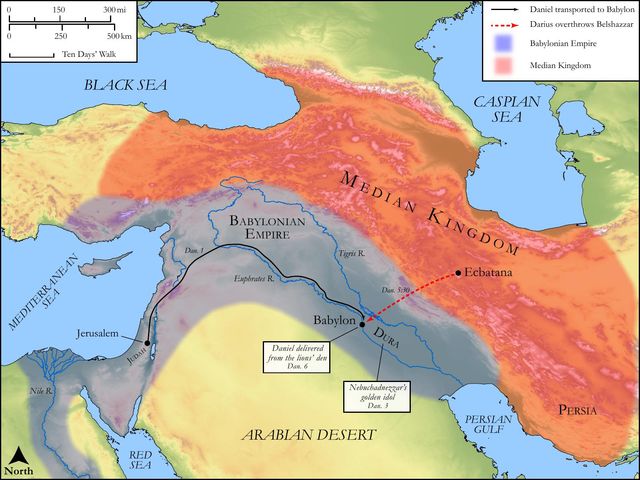
King Nebuchadnezzar II, who reigned from approximately 605–562 BC, was arguably the most powerful and successful monarch of the Neo-Babylonian Empire. His reign marked a golden age of significant territorial expansion, monumental construction projects (including the famed Ishtar Gate and the Hanging Gardens of Babylon), and cultural flourishing, making Babylon the preeminent city of the ancient Near East. The description of his "greatness...reacheth unto heaven, and thy dominion to the end of the earth" is not mere hyperbole but accurately reflects the historical reality of his vast empire, which stretched from Egypt in the southwest to Mesopotamia in the northeast, encompassing a significant portion of the then-known world. In ancient Near Eastern cultures, kings often claimed divine favor, were sometimes considered divine themselves, or were seen as the earthly representatives of the gods. Their power was frequently depicted in grandiose terms, such as a mighty tree, a towering mountain, or a cosmic pillar. This cultural backdrop helps us understand why Nebuchadnezzar's pride became such a central issue; his self-perception aligned with the common royal ideology of his time, which often neglected the ultimate sovereignty of a transcendent God who alone holds true dominion.
Key Themes
ShowHideDaniel 4:22 contributes significantly to several overarching themes within the book of Daniel and the broader biblical narrative. Firstly, it highlights the theme of Divine Sovereignty over Human Kingdoms. While acknowledging Nebuchadnezzar's immense earthly power and dominion, the verse implicitly sets the stage for the dramatic revelation that even such a mighty king's reign is ultimately subject to God's control, a theme explicitly stated in Daniel 4:17. Secondly, it introduces the theme of Human Pride and Humiliation. Nebuchadnezzar's "greatness" and "dominion" are presented as facts, but the subsequent narrative reveals how this unchecked power, coupled with a lack of acknowledgment of God's role, led to profound hubris, necessitating divine intervention to humble him. This serves as a potent cautionary tale against self-exaltation, echoing similar warnings throughout Scripture (e.g., Proverbs 16:18). Thirdly, the verse foreshadows the Temporary Nature of Earthly Power. Despite its vastness, Nebuchadnezzar's empire, like all human empires, was destined to pass, contrasting sharply with God's eternal and indestructible kingdom, a truth powerfully articulated in Daniel 2:44.
Exposition and Analysis
ShowHideKey Word Analysis
ShowHideThis Aramaic verb (H7236), corresponding to the Hebrew רָבָה, signifies an increase in any respect—quantity, size, or dignity. In Daniel 4:22, its repetition ("art grown" and "is grown") emphatically underscores Nebuchadnezzar's exceptional development, not merely in physical stature but, more importantly, in the expansion of his power, influence, and imperial stature. It speaks to the immense scale of his rise and the flourishing of his empire, mirroring the growth of the great tree in his dream.
This Aramaic verb (H4291) means "to arrive," "extend," or "happen." Here, it vividly portrays the extensive reach of Nebuchadnezzar's greatness. The phrase "reacheth unto heaven" is a hyperbolic expression indicating an extraordinary, almost boundless, height and influence, suggesting that his renown and power were universally acknowledged and seemingly without limit, touching the very heavens themselves, a realm typically associated with divine authority.
Derived from the root שְׁלֵט (to rule), this Aramaic noun (H7985) refers to empire, authority, or concrete power. It underscores the vast territorial and political control Nebuchadnezzar exercised. The phrase "to the end of the earth" further amplifies the scope of his rule, signifying that his authority extended over the entire known world, making him the supreme earthly ruler of his time, a king whose word held sway across nations.
Verse Breakdown
ShowHide"It [is] thou, O king, that art grown and become strong:"
Daniel directly addresses Nebuchadnezzar, removing any ambiguity about the dream's subject. The language of "grown and become strong" directly connects the king to the image of the mighty tree, signifying his personal and imperial development into a formidable and powerful ruler. This clause establishes the identity of the dream's central figure, setting the stage for the interpretation of his vast influence and the subsequent divine message concerning his pride.
"for thy greatness is grown, and reacheth unto heaven,"
This clause elaborates on the nature of Nebuchadnezzar's growth, specifically attributing it to his "greatness." This "greatness" encompasses his immense power, wealth, reputation, and the sheer scale of his imperial success. The hyperbole "reacheth unto heaven" emphasizes the extraordinary, almost divine, scale of his stature and renown, suggesting a level of influence and recognition that was unparalleled in the ancient world, seemingly touching the very abode of God.
"and thy dominion to the end of the earth."
This final phrase defines the geographical and political scope of Nebuchadnezzar's power. "Dominion" refers to his imperial authority and rule, while "to the end of the earth" signifies the vast territorial extent of his empire. It communicates that his authority was not merely symbolic but extended practically across the entire known world, making him the supreme earthly sovereign, whose decrees and military might were felt far and wide.
Literary Devices
ShowHideDaniel 4:22 makes effective use of several literary devices to convey its profound message. The primary device is Metaphor, where King Nebuchadnezzar is directly identified with the great tree from his dream. This metaphor powerfully illustrates his immense growth, strength, and the widespread nature of his dominion. The tree, with its height, shade, and provision, symbolizes the king's protective and sustaining, albeit ultimately temporary, role over his vast empire. Hyperbole is also prominently employed in the phrases "reacheth unto heaven" and "to the end of the earth." These exaggerations emphasize the extraordinary, almost boundless, scale of Nebuchadnezzar's power and influence, conveying a sense of universal recognition and control that transcends normal human limitations, hinting at his inflated self-perception. Furthermore, the verse uses Foreshadowing, as this description of immense human power and ambition, reaching "unto heaven," subtly hints at the hubris that will inevitably lead to Nebuchadnezzar's downfall, setting the stage for the subsequent divine judgment and humbling described later in the chapter.
Theological and Thematic Connections
ShowHideDaniel 4:22, while affirming Nebuchadnezzar's immense earthly power and influence, simultaneously lays the groundwork for the profound theological truth that all human authority, no matter how vast or impressive, is ultimately subordinate to God's supreme and absolute sovereignty. The king's greatness, though described as reaching "unto heaven" and extending "to the end of the earth," is still a created and therefore limited greatness, granted and sustained by a higher power. This verse serves as a powerful reminder that human dominion is always provisional and subject to divine will, setting up the dramatic demonstration of God's power to humble the proud and exalt the humble later in the chapter. It highlights the biblical principle that true authority flows from God alone, and any attempt by humanity to claim absolute power or glory apart from Him is an act of pride that will ultimately be brought low.
Reflection and Application
ShowHideDaniel 4:22 offers a potent mirror for self-reflection in an age often characterized by ambition, the pursuit of power, and the celebration of individual achievement. It prompts us to consider the ultimate source of our own "greatness" or accomplishments, whether in personal influence, professional success, material possessions, or even spiritual giftedness. Like Nebuchadnezzar, it is perilously easy to attribute our achievements solely to our own strength, wisdom, or effort, forgetting the divine hand that enables, sustains, and ultimately grants all things. This verse serves as a profound caution against the perils of pride and self-exaltation, reminding us that true humility involves acknowledging God as the ultimate source of all power, blessing, and opportunity. It challenges us to hold our achievements loosely, recognizing their temporary nature and the supreme, enduring sovereignty of God over all aspects of our lives. Living in light of this truth fosters profound gratitude, humble dependence, and a right perspective on our place in God's grand and eternal design.
Questions for Reflection
ShowHideFAQ
ShowHideWas Nebuchadnezzar's "greatness" truly a bad thing in itself?
ShowHideNot inherently. The verse itself describes his greatness as a factual reality, a reflection of his historical power and dominion. The issue was not the greatness itself, but Nebuchadnezzar's attitude towards it and his failure to acknowledge its divine source. His unchecked pride and self-exaltation, epitomized by his boast in Daniel 4:30 ("Is not this great Babylon, that I have built... by the might of my power and for the honour of my majesty?"), were the profound problems. God is not against human flourishing, leadership, or even vast empires, but He vehemently opposes pride and those who take His glory for themselves (as stated in Isaiah 42:8). The dream and its interpretation were a direct, divine warning intended to humble him before his hubris led to his inevitable downfall.
Christ-Centered Fulfillment
ShowHideWhile Daniel 4:22 describes the unparalleled, yet ultimately temporary and divinely-granted, dominion of an earthly king, it powerfully foreshadows the ultimate and eternal dominion of Jesus Christ. Nebuchadnezzar's greatness "reacheth unto heaven, and thy dominion to the end of the earth," but this was a finite, human-achieved, and divinely-permitted power that would eventually be stripped away. In stark contrast, Christ's dominion is not merely vast but absolute, inherent, and everlasting. He is the true King whose "greatness" is not granted but intrinsic, for He is God incarnate, the Creator and Sustainer of all things. The New Testament consistently portrays Jesus as the one to whom "all authority in heaven and on earth has been given" (Matthew 28:18). His "dominion" truly extends "to the end of the earth" and beyond, encompassing all creation, for "by Him all things were created... and in Him all things hold together" (Colossians 1:16-17). Unlike Nebuchadnezzar, whose pride led to a dramatic humiliation, Christ's profound humility and perfect obedience, even to death on a cross, led to His ultimate exaltation, where "every knee should bow... and every tongue confess that Jesus Christ is Lord, to the glory of God the Father" (Philippians 2:9-11). Thus, Daniel 4:22, by showcasing the pinnacle of human power and its inherent limitations, magnifies the boundless and eternal reign of the King of kings, Jesus Christ, who alone holds true and unending dominion.