


2 Samuel 1:21
Bible text: King James Version (1769 Blayney text) · Public domain
Bible text: King James Version with Strong's numbers · Public domain
Bible text: Berean Standard Bible · Public domain
Bible text: American Standard Version (1901) · Public domain
Bible text: World English Bible, Messianic edition · Public domain
Bible text: Geneva Bible (1599) · Public domain
Bible text: Young's Literal Translation · Public domain
- הָרֵיha·ReiO mountainsH2022N-mpcNoun Plural Masculine Construct
- בַגִּלְבֹּעַva·gil·Bo·a'in <the> GilboaH1533Prep-b ¦ N-properNoun Proper Locationבַin <the>גִּלְבֹּעַGilboa
- אַל'almay notH408NegParticle Negative
- טַלtaldewH2919N-msNoun Singular Masculine Absolute
- וְאַלve·'aland may notH408Conj-w ¦ NegParticle Negativeוְandאַלmay not
- מָטָרma·TarrainH4306N-msNoun Singular Masculine Absolute
- עֲלֵיכֶם'a·lei·Khem[be] on youH5921Prep ¦ 2mpPreposition Definiteעֲלֵי[be] onכֶםyou
- וּשְׂדֵיu·se·Deiand fields ofH7704Conj-w ¦ N-mpcNoun Plural Masculine Constructוּandשְׂדֵיfields of
- תְרוּמֹתte·ru·MotcontributionsH8641N-fpNoun Plural Feminine Absolute
- כִּיkiforH3588PrtParticle Conditional
- שָׁםshamthereH8033AdvAdverb
- נִגְעַלnig·'Alit was defiledH1602V-Niphal-Perf-3msVerb Niphal Perfect 3rd Singular Masculine
- מָגֵןma·Gen[the] shield ofH4043N-mscNoun Singular Masculine Construct
- גִּבּוֹרִיםgi·bo·Rim[the] mighty [ones]H1368N-mpNoun Plural Masculine Absolute
- מָגֵןma·Gen[the] shield ofH4043N-mscNoun Singular Masculine Construct
- שָׁאוּלsha·'UlSaulH7586N-proper-mNoun Proper Masculine
- בְּלִיbe·LinotH1097N-mscNoun Singular Masculine Construct
- מָשִׁיחַma·Shi·ach[was] anointedH4899N-msNoun Singular Masculine Absolute
- בַּשָּׁמֶןba·Sha·menwith <the> oilH8081Prep-b ¦ N-msNoun Singular Masculine Absoluteבַּwith <the>שָּׁמֶןoil
English is a literal word-by-word gloss of the Hebrew, not the KJV's wording. Why?
This is the original text the KJV's translators worked from — each Hebrew word with its own literal English meaning in this verse, prepared by scholars at Tyndale House, Cambridge. The KJV translates whole sentences, not word by word, so its wording differs: one Hebrew word can become several English words, and the KJV may choose “the LORD” where the gloss reads “Yahweh”. Both are faithful — they answer different questions. For the KJV's own rendering, switch to the KJV text.
Details
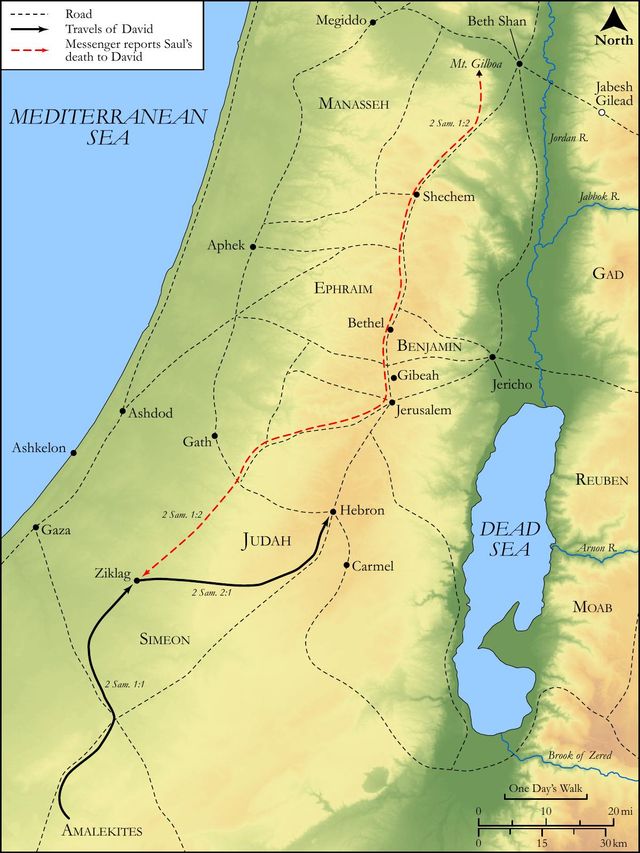
See on the biblical-era maps

Study this verse
Public-domain commentary
Matthew Henry
From his Commentary on the Whole Bible. Henry comments on passages, not single verses — this entry covers 2 Samuel 1:17–27. His four-level outline is real structure in the source text, so it is rendered as structure.
When David had rent his clothes, mourned, and wept, and fasted, for the death of Saul, and done justice upon him who made himself guilty of it, one would think he had made full payment of the debt of honour he owed to his memory; yet this is not all: we have here a poem he wrote on that occasion; for he was a great master of his pen as well as of his sword. By this elegy he designed both to express his own sorrow for this great calamity and to impress the like on the minds of others, who ought to lay it to heart. The putting of lamentations into poems made them, 1. The more moving and affecting. The passion of the poet, or singer, is, by this way, wonderfully communicated to the readers and hearers. 2. The more lasting. Thus they were made, not only to spread far, but to continue long, from generation to generation. Those might gain information by poems that would not read history. Here we have,
I.The orders David gave with this elegy (Sa2 1:18):
He bade them teach the children of Judah (his own tribe, whatever others did) the use of the bow, either.
1.The bow used in war. Not but that the children of Judah knew how to use the bow (it was so commonly used in war, long before this, that the sword and bow were put for all weapons of war, Gen 48:22), but perhaps they had of late made more use of slings, as David in killing Goliath, because cheaper, and David would have them now to see the inconvenience of these (for it was the archers of the Philistines that bore so hard upon Saul, Sa1 21:3), and to return more generally to the use of the bow, to exercise themselves in this weapon, that they might be in a capacity to avenge the death of their prince upon the Philistines, and to outdo them at their own weapon. It was a pity but those that had such good heads and hearts as the children of Judah should be well armed. David hereby showed his authority over and concern for the armies of Israel, and set himself to rectify the errors of the former reign. But we find that the companies which had now come to David to Ziklag were armed with bows (Ch1 12:2); therefore,
2.Some understand it either of some musical instrument called a bow (to which he would have the mournful ditties sung) or of the elegy itself: He bade them teach the children of Judah Kesheth, the bow, that is, this song, which was so entitled for the sake of Jonathan's bow, the achievements of which are here celebrated. Moses commanded Israel to learn his song (Deu 31:19), so David his. Probably he bade the Levites teach them. It is written in the book of Jasher, there it was kept upon record, and thence transcribed into this history. That book was probably a collection of state-poems; what is said to be written in that book (Jos 10:13) is also poetical, a fragment of an historical poem. Even songs would be forgotten and lost if they were not committed to writing, that best conservatory of knowledge.
II.The elegy itself.
It is not a divine hymn, nor given by inspiration of God to be used in divine service, nor is there any mention of God in it; but it is a human composition, and therefore was inserted, not in the book of Psalms (which, being of divine original, is preserved), but in the book of Jasher, which, being only a collection of common poems, is long since lost. This elegy proves David to have been,
1.A man of an excellent spirit, in four things: -
(1.)He was very generous to Saul, his sworn enemy. Saul was his father-in-law, his sovereign, and the anointed of the Lord; and therefore, though he had done him a great deal of wrong, David does not wreak his revenge upon his memory when he is in his grave; but like a good man, and a man of honour,
[1.]He conceals his faults; and, though there was no preventing their appearance in his history, yet they should not appear in this elegy. Charity teaches us to make the best we can of every body and to say nothing of those of whom we can say no good, especially when they are gone. De mortuis nil nisi bonum - Say nothing but good concerning the dead. We ought to deny ourselves the satisfaction of making personal reflections upon those who have been injurious to us, much more drawing their character thence, as if every man must of necessity be a bad man that has done ill by us. Let the corrupt part of the memory be buried with the corrupt part of the man - earth to earth, ashes to ashes; let the blemish be hidden and a veil drawn over the deformity.
[2.]He celebrates that which was praiseworthy in him. He does not commend him for that which he was not, says nothing of his piety or fidelity. Those funeral commendations which are gathered out of the spoils of truth are not at all to the praise of those on whom they are bestowed, but very much the dispraise of those who unjustly misplace them. But he has this to say in honour of Saul himself, First, That he was anointed with oil (Sa2 1:21), the sacred oil, which signified his elevation to, and qualification for, the government. Whatever he was otherwise, the crown of the anointing oil of his God was upon him, as is said of the high priest (Lev 21:12), and on that account he was to be honoured, because God, the fountain of honour, had honoured him. Secondly, That he was a man of war, a mighty man (Sa2 1:19-21), that he had often been victorious over the enemies of Israel and vexed them whithersoever he turned, Sa1 14:47. His sword returned not empty, but satiated with blood and spoil, Sa2 1:22. His disgrace and fall at last must not make his former successes and services to be forgotten. Though his sun set under a cloud, time was when it shone brightly. Thirdly, That take him with Jonathan he was a man of a very agreeable temper, that recommended himself to the affections of his subjects (Sa2 1:23): Saul and Jonathan were lovely and pleasant. Jonathan was always so, and Saul was so as long as he concurred with him. Take them together, and in the pursuit of the enemy, never were men more bold, more brave; they were swifter than eagles and stronger than lions. Observe, Those that were most fierce and fiery in the camp were no less sweet and lovely in the court, as amiable to the subject as they were formidable to the foe; a rare combination of softness and sharpness they had, which makes any man's temper very happy. It may be understood of the harmony and affection that for the most part subsisted between Saul and Jonathan: they were lovely and pleasant one to another, Jonathan a dutiful son, Saul an affectionate father; and therefore dear to each other in their lives, and in their death they were not divided, but kept close together in the stand they made against the Philistines, and fell together in the same cause. Fourthly, That he had enriched his country with the spoils of conquered nations, and introduced a more splendid attire. When they had a king like the nations, they must have clothes like the nations; and herein he was, in a particular manner, obliging to his female subjects, Sa2 1:24. The daughters of Israel he clothed in scarlet, which was their delight.
(2.)He was very grateful to Jonathan, his sworn friend. Besides the tears he shed over him, and the encomiums he gives of him in common with Saul, he mentions him with some marks of distinction (Sa2 1:25): O Jonathan! thou wast slain in thy high places! which (compared with Sa2 1:19) intimates that he meant him by the beauty of Israel, which, he there says, was slain upon the high places. He laments Jonathan as his particular friend (Sa2 1:26): My brother, Jonathan; not so much because of what he would have been to him if he had lived, very serviceable no doubt in his advancement to the throne and instrumental to prevent those long struggles which, for want of his assistance, he had with the house of Saul (had this been the only ground of his grief it would have been selfish), but he lamented him for what he had been: "Very pleasant hast thou been unto me; but that pleasantness is now over, and I am distressed for thee." He had reason to say that Jonathan's love to him was wonderful; surely never was the like, for a man to love one who he knew was to take the crown over his head, and to be so faithful to his rival: this far surpassed the highest degree of conjugal affection and constancy. See here,
[1.]That nothing is more delightful in this world than a true friend, that is wise and good, that kindly receives and returns our affection, and is faithful to us in all our true interests.
[2.]That nothing is more distressful than the loss of such a friend; it is parting with a piece of one's self. It is the vanity of this world that what is most pleasant to us we are most liable to be distressed in. The more we love the more we grieve.
(3.)He was deeply concerned for the honour of God; for this is what he has an eye to when he fears lest the daughters of the uncircumcised, that are out of covenant with God, should triumph over Israel, and the God of Israel, Sa2 1:20. Good men are touched in a very sensible part by the reproaches of those that reproach God.
(4.)He was deeply concerned for the public welfare. It was the beauty of Israel that was slain (Sa2 1:19) and the honour of the public that was disgraced: The mighty have fallen (this is three times lamented, Sa2 1:19, Sa2 1:25, Sa2 1:27), and so the strength of the people is weakened. Public losses are most laid to heart by men of public spirit. David hoped God would make him instrumental to repair those losses and yet laments them.
2.A man of a fine imagination, as well as a wise and holy man. The expressions are all excellent, and calculated to work upon the passions.
(1.)The embargo he would fain lay upon Fame is elegant (Sa2 1:20): Tell it not in Gath. It grieved him to the heart to think that it would be proclaimed in the cities of the Philistines, and that they would insult over Israel upon it, and the more in remembrance of the triumphs of Israel over them formerly, when they sang, Saul has slain his thousands; for this would now be retorted.
(2.)The curse he entails on the mountains of Gilboa, the theatre on which this tragedy was acted: Let there be no dew upon you, nor fields of offerings, Sa2 1:21. This is a poetical strain, like that of Job, Let the day perish wherein I was born. Not as if David wished that any part of the land of Israel might be barren, but, to express his sorrow for the thing, he speaks with a seeming indignation at the place. Observe,
[1.]How the fruitfulness of the earth depends upon heaven. The worst thing he could wish to the mountains of Gilboa was barrenness and unprofitableness to man: those are miserable that are useless. It was the curse Christ pronounced on the fig-tree, Never fruit grow on thee more, and that took effect - the fig-tree withered away: this, on the mountains of Gilboa, did not. But, when he wished them barren, he wished there might be no rain upon them; and, if the heavens be brass, the earth will soon be iron.
[2.]How the fruitfulness of the earth must therefore be devoted to heaven, which is intimated in his calling the fruitful fields fields of offerings. Those fruits of their land that were offered to God were the crown and glory of it: and therefore the failure of the offerings is the saddest consequent of the failure of the corn. See Joe 1:9. To want that wherewith we should honour God is worse than to want that wherewith we should sustain ourselves. This is the reproach David fastens upon the mountains of Gilboa, which, having been stained with royal blood, thereby forfeited celestial dews. In this elegy Saul had a more honourable interment than that which the men of Jabesh-Gilead gave him.
Historical interpretation
Historical reception
2 surviving comments on this verse. Each one is dated, so this reads as a timeline rather than a list.
Therefore, nature has justly bestowed judgment upon those places where patricide would occur by depriving them of the gift of her bounty, so that by the condemnation of an innocent land, she might reveal the great punishments that await the guilty. Therefore, both the elements themselves and human beings are condemned because of the wickedness. Finally, David, in the mountains where Jonathan was killed along with his father, desired the punishment of perpetual sterility, saying: O mountains of Gilboa, may neither dew nor rain fall upon you, you mountains of death.
What a virtuous action was that when David wished rather to spare the king his enemy, though he could have injured him! How useful, too, it was, for it helped him when he succeeded to the throne. For all learned to observe faith in their king and not to seize the kingdom but to fear and reverence him. Thus, what is virtuous was preferred to what was useful, and then usefulness followed from what was virtuous. But that he spared him was a small matter; he also grieved for him when slain in war and mourned for him with tears, saying, “You mountains of Gilboa, let neither dew nor rain fall upon you; you mountains of death, for there the shield of the mighty is cast away, the shield of Saul. It is not anointed with oil but with the blood of the wounded and the fat of the warriors. The bow of Jonathan turned not back, and the sword of Saul returned not empty. Saul and Jonathan were lovely and very dear, inseparable in life, and in death they were not divided. They were swifter than eagles, they were stronger than lions. You daughters of Israel, weep over Saul, who clothed you in scarlet with your ornaments, who put on gold upon your apparel. How are the mighty fallen in the midst of the battle! Jonathan was wounded even to death. I am distressed for you, my brother Jonathan; very pleasant have you been to me. Your love came to me like the love of women. How have the mighty fallen and the longed-for weapons perished!” What mother could weep thus for her only son as he wept here for his enemy? Who could follow his benefactor with such praise as that with which he followed the man who plotted against his life? How affectionately he grieved, with what deep feeling he bewailed him! The mountains dried up at the prophet’s curse, and a divine power filled the judgment of him who spoke it. Therefore the elements themselves paid the penalty for witnessing the king’s death.
Continue studying 2 Samuel 1:21 across the web’s major study libraries — every link below opens this exact verse, chapter, or book on the destination site.
Read & Compare
 BibleGatewayThis verse in more than 200 translations and 70 languages.
 Bible.comThe YouVersion reader — hundreds of translations, reading plans, and highlights.
 ESV.orgCrossway's official English Standard Version reader.
 NET BibleThe NET translation with 60,000+ translators' notes on every rendering decision.
 STEP BibleTyndale House's free study tool — original text, vocabulary, and scholarly resources.
 BibliaLogos Bible Software's free web reader.
 USCCBThe New American Bible (Revised Edition) with the U.S. bishops' study notes.
Commentaries
 BibleHub CommentariesDozens of classic commentaries on this verse, gathered on one page.
 StudyLightMore than 100 commentary sets — the largest collection on the web.
 BibleRefPlain-English commentary on what this verse means, verse by verse.
 Enduring WordDavid Guzik's free commentary on this chapter, widely used by Bible teachers.
 Bible Study ToolsVerse commentary alongside Greek and Hebrew study aids.
Original Language & Research
- BibleHub InterlinearThe verse word by word — original language, transliteration, and English.
- BibleHub LexiconEvery word's original-language definition and Strong's entry.
 Blue Letter BibleDeep-study tools — Strong's numbers, concordance, and word studies.
 SefariaThe Hebrew text with Rashi and centuries of Jewish commentary.
Sermons, Hymns & Audio


TrulyRandomVerse is not affiliated with these sites and doesn’t control their content. They’re linked because they’re genuinely useful.
Summary
David's poignant lament in 2 Samuel 1:21, a core component of "The Song of the Bow," articulates profound grief and national shame following Israel's catastrophic defeat and the deaths of King Saul and his son Jonathan on Mount Gilboa. This verse expresses David's heartfelt curse upon the battlefield, wishing it perpetual barrenness, and mourns the ignominious end of Saul, whose shield, a potent symbol of his royal authority and divine anointing, was disgracefully abandoned. It powerfully encapsulates the tragic consequences of Israel's military rout and the poignant loss of its anointed king.
Context
ShowHideLiterary Context
This verse is a pivotal moment within David's elegy, famously titled "The Song of the Bow" (2 Samuel 1:18), composed immediately after he receives the devastating news of Saul and Jonathan's deaths from an Amalekite messenger (2 Samuel 1:1-16). The preceding narrative vividly portrays David's intense sorrow, marked by tearing his clothes and weeping (2 Samuel 1:11-12). The lament itself commences in 2 Samuel 1:19, establishing a solemn tone of national mourning and deep personal grief. Verse 21 specifically directs David's anguish towards the geographical site of the tragedy, Mount Gilboa, and the symbolic disgrace of Saul's demise, setting the stage for David's more intimate and heartfelt eulogy for Jonathan in the subsequent verses (2 Samuel 1:25-26). The entire song serves as a profound testament to David's character, showcasing his capacity to honor Saul despite their protracted conflict and to profoundly mourn his beloved friend.
Historical & Cultural Context
The battle on Mount Gilboa, meticulously recounted in 1 Samuel 31, represents a catastrophic military defeat for Israel at the hands of the Philistines, their enduring adversaries. Mount Gilboa, strategically situated in the Jezreel Valley, was a critical battleground. The death of a king in battle, particularly one who had been divinely anointed, was perceived as an unparalleled national calamity. A king's shield transcended its function as mere armor; it was a potent emblem of his strength, protection, and sovereign authority. For it to be "vilely cast away" implied not merely defeat, but utter humiliation, a complete abandonment of valor, and a profound disgrace. The sacred ritual of anointing with oil was foundational to Israelite kingship, signifying divine selection and empowerment, as vividly illustrated by Samuel's anointing of Saul. David's lament skillfully taps into the deep cultural understanding of these symbols, thereby amplifying the tragedy and its national implications.
Key Themes
ShowHideDavid's lament in 2 Samuel 1:21 contributes significantly to several overarching themes woven throughout the books of Samuel. Firstly, it powerfully underscores the theme of profound grief and lament as a natural and righteous human response to both national tragedy and personal loss, exemplified by David's raw emotion and his composition of this elegy. Secondly, it highlights the shame and disgrace of defeat, particularly for an anointed king, vividly symbolized by the "vilely cast away" shield. This speaks to the loss of honor and perceived divine favor that accompanied Saul's tragic end, a direct consequence of his persistent disobedience detailed throughout 1 Samuel. Finally, the verse subtly yet powerfully points to the divinely orchestrated transition of kingship from Saul to David. While genuinely mourning Saul, the narrative simultaneously prepares the audience for David's ascendance, a divinely ordained plan that would ultimately culminate in the Davidic Covenant and the establishment of an enduring dynasty.
Exposition and Analysis
ShowHideKey Word Analysis
ShowHideThis refers to the specific mountain range in Palestine where the decisive and devastating battle between Israel and the Philistines occurred, leading to the deaths of King Saul and his sons. David's curse upon Gilboa—"no dew, neither let there be rain... nor fields of offerings"—is a profound act of symbolic desolation. It expresses a wish for perpetual barrenness and sorrow upon the very ground where such a national tragedy unfolded, reflecting the depth of his anguish and seeking to strip the land of its natural blessings as a perpetual memorial to the ignominy suffered there.
Derived from the primitive root H1602, meaning "to detest; by implication, to reject; abhor, fail, lothe, vilely cast away." This word conveys a profound sense of defilement, contempt, or disgust. It signifies more than just the discarding of Saul's shield; it implies that it was treated with utter disdain, as something detestable or polluted. This emphasizes the extreme humiliation and disgrace of the defeat, suggesting that the very symbol of royal power and protection was rendered worthless and abhorrent on the battlefield.
This phrase refers to the sacred ritual of anointing (from H4899, mâshîyach, "anointed"), typically performed by a prophet, which consecrated individuals—especially kings, priests, or prophets—for divine service. Saul was initially anointed by Samuel (1 Samuel 10:1). To say his shield was cast away "as though he had not been anointed with oil" is deeply ironic and tragic. It implies that in the moment of his death, the divine favor and authority that his anointing signified seemed utterly nullified or forgotten, highlighting the tragic failure of his reign and the ignominious manner of his death.
Verse Breakdown
ShowHide"Ye mountains of Gilboa, let there be no dew, neither let there be rain, upon you, nor fields of offerings:"
David directly addresses the mountains of Gilboa, employing apostrophe to personify them. His curse is a vivid and emotional expression of grief and anger, wishing for the complete cessation of natural blessings (dew, rain) that sustain life and agriculture. "Fields of offerings" likely refers to fields that produce grain for peace offerings or firstfruits, thus wishing for a cessation of fertility and, by extension, the means of worship and sustenance from that place. This is a powerful symbolic act of mourning, marking Gilboa as a place of perpetual desolation due to the national tragedy it witnessed.
"for there the shield of the mighty is vilely cast away, the shield of Saul,"
This clause provides the explicit reason for David's curse. The "shield of the mighty" refers to the shield of a valiant warrior, specifically identified as "the shield of Saul." The phrase "vilely cast away" (from the Hebrew root gâʻal, meaning to detest or abhor) powerfully underscores the profound disgrace and humiliation of the defeat. It implies that the very symbol of the king's strength and protection was not merely lost, but discarded with contempt or defiled, reflecting the utter rout and ignominy suffered by Israel's forces.
"as though he had not been anointed with oil."
This poignant concluding phrase highlights the tragic irony of Saul's end. As God's anointed king, Saul held a sacred and divinely sanctioned office. Yet, his shield was treated as if he were an ordinary, unanointed man, stripped of all royal dignity and divine favor. This reflects not only the Philistine's contempt but also the perceived abandonment of Saul by God, a consequence of his persistent disobedience that had led to the departure of the Spirit of the Lord from him (1 Samuel 16:14). It underscores the depth of his fall from grace and the ignominious conclusion of his reign.
Literary Devices
ShowHideDavid's lament in 2 Samuel 1:21 masterfully employs several powerful literary devices to convey its profound emotion and theological significance. The most prominent is Apostrophe, where David directly addresses the inanimate "mountains of Gilboa," imbuing them with a sense of culpability for the tragedy and cursing them as if they could hear and suffer. This personification intensely amplifies the emotional weight of the lament. Hyperbole is evident in the wish for "no dew, neither rain," and "no fields of offerings," an exaggerated curse of perpetual barrenness that underscores the depth of David's sorrow and the immense magnitude of the national disaster. Symbolism is richly interwoven throughout the verse: the "shield" symbolizes Saul's kingship, his strength, and his role as protector, its "vile" abandonment representing the utter disgrace of his defeat. The "anointing with oil" symbolizes divine election and favor, its apparent nullification highlighting the tragic end of a king who had lost God's Spirit. Finally, a profound sense of Irony pervades the verse, as the king who was once God's anointed, chosen to protect Israel, dies in such a way that his shield is treated as though he never held that sacred status, emphasizing the tragic consequences of his disobedience and spiritual decline.
Theological and Thematic Connections
ShowHideThis verse, steeped in David's profound lament, offers significant theological insights into the nature of kingship, divine sovereignty, and the devastating consequences of disobedience. It portrays the tragic end of Saul's reign not merely as a military defeat, but as a symbolic stripping away of the dignity and divine favor once bestowed upon God's anointed. Despite Saul's personal failings and God's rejection of his dynasty, David, God's chosen successor, still mourns the loss of the Lord's anointed, demonstrating profound respect for the sacred office even when the man holding it had fallen. This highlights the complex interplay of human agency and divine decree, where God's ultimate plan unfolds even through tragedy and human failure. The curse on Gilboa also speaks to the profound spiritual impact of national calamity, where even the land itself is seen to bear the mark of sin and sorrow, reflecting the deep interconnectedness between human actions and the created order in biblical thought.
Reflection and Application
ShowHideDavid's lament over Saul and Jonathan on Mount Gilboa offers a powerful and enduring model for processing profound grief and national sorrow. It reminds us that lament is not a sign of weakness or a lack of faith, but rather a deeply human and biblically affirmed response to loss, even when that loss involves complex or flawed figures. David's profound willingness to mourn Saul, despite their tumultuous and often hostile relationship, underscores the importance of honoring the office and the inherent sacredness of human life. This passage challenges us to consider thoughtfully how we respond to moments of public and personal tragedy, encouraging us to acknowledge the pain, express sorrow authentically, and seek God's perspective and comfort even amidst devastating circumstances. Furthermore, Saul's tragic end serves as a sobering reminder of the severe consequences of disobedience and the potential for even divinely appointed individuals to fall from grace when they persistently stray from God's revealed will. It prompts us to examine our own lives, ensuring that our actions consistently align with our calling and that we remain faithful and obedient to the Lord, lest our own "shields"—our integrity, our purpose, our spiritual effectiveness—be "vilely cast away" through spiritual compromise, rebellion, or neglect.
Questions for Reflection
ShowHideFAQ
ShowHideWhy does David curse the mountains of Gilboa?
ShowHideDavid curses the mountains of Gilboa as a symbolic act of profound grief and national mourning. Gilboa was the literal site of Israel's devastating defeat by the Philistines and the tragic deaths of King Saul and his sons, including David's beloved friend Jonathan. By wishing for no dew, rain, or fields of offerings, David is expressing a deep desire for the land itself to reflect the desolation and shame of what occurred there. It's a poetic and emotional outcry, marking the place as perpetually barren and cursed due to the immense tragedy and disgrace it witnessed, rather than a literal expectation of meteorological change.
What is the significance of "the shield of the mighty is vilely cast away"?
ShowHideThe shield of a king or mighty warrior was a powerful symbol of his strength, protection, and royal authority in Israel. To have it "vilely cast away" (from the Hebrew root gâʻal, meaning defiled, loathed, or rejected) signifies an utterly ignominious defeat and profound disgrace. It's not merely that Saul's shield was lost, but that it was treated with contempt, suggesting a complete rout where the king's very emblem of power was abandoned in shame. This highlights the depth of Israel's humiliation and the tragic, undignified end of Saul's reign, emphasizing the perceived abandonment of valor and divine favor.
What does "as though he had not been anointed with oil" imply about Saul's death?
ShowHideThis phrase adds a layer of tragic irony and theological depth to David's lament. Saul had been divinely chosen and consecrated as king through the sacred ritual of anointing with oil by the prophet Samuel (1 Samuel 10:1). The anointing signified God's Spirit resting upon him and His divine favor. However, due to Saul's repeated disobedience and rebellion against God's commands, the Spirit of the Lord had departed from him (1 Samuel 16:14). David's lament implies that Saul's death was so undignified and inglorious that it seemed to nullify his sacred status as the Lord's anointed. It underscores the tragic consequences of his unfaithfulness and the perceived abandonment by God, leaving him to die like any common, unanointed man, stripped of his divine protection and regal dignity.
Christ-Centered Fulfillment
ShowHide2 Samuel 1:21, with its lament over the fallen king and the disgraced shield, finds its ultimate Christ-centered fulfillment in the perfect kingship and redemptive sacrifice of Jesus. Saul, Israel's first anointed king, tragically failed to uphold his divine calling, leading to a shameful death on Gilboa where his shield was "vilely cast away," symbolizing a kingship that ultimately could not deliver or protect its people. This tragic end highlights humanity's desperate need for a true, enduring King. In stark contrast, Jesus, the true Anointed One (Messiah), did not have His "shield" cast away in disgrace; rather, He willingly laid down His life on the cross, not in defeat, but in ultimate victory over sin and death (Philippians 2:8). While Saul's anointing seemed nullified by his failure, Christ's anointing is eternally affirmed through His resurrection and ascension, establishing a kingdom that will never end (Luke 1:33). The barrenness wished upon Gilboa for its role in Israel's defeat is profoundly overcome by the life-giving Spirit of Christ, who brings spiritual fruitfulness and abundant life to all who believe (Galatians 5:22-23). Thus, Saul's tragic end serves as a powerful foreshadowing of the necessity of Christ's perfect reign, where the true King offers not a cast-away shield, but eternal salvation, an unshakeable kingdom, and an everlasting covenant.