


1 Samuel 10:1
Bible text: King James Version (1769 Blayney text) · Public domain
Bible text: King James Version with Strong's numbers · Public domain
Bible text: Berean Standard Bible · Public domain
Bible text: American Standard Version (1901) · Public domain
Bible text: World English Bible, Messianic edition · Public domain
Bible text: Geneva Bible (1599) · Public domain
Bible text: Young's Literal Translation · Public domain
- וַיִּקַּחvai·yi·Kachand he tookH3947Conj-w ¦ V-Qal-ConsecImperf-3msVerb Qal Consecutive Imperfect 3rd Singular Masculineוַandיִּקַּחhe took
- שְׁמוּאֵלshe·mu·'ElSamuelH8050N-proper-mNoun Proper Masculine
- אֶת'et<obj.>H853DirObjMParticle Object Indicator
- פַּךְpakh[the] flask ofH6378N-mscNoun Singular Masculine Construct
- הַשֶּׁמֶןha·She·men<the> oilH8081Art ¦ N-msNoun Singular Masculine Absoluteהַ<the>שֶּׁמֶןoil
- וַיִּצֹקvai·yi·Tzokand he poured [it]H3332Conj-w ¦ V-Qal-ConsecImperf-3msVerb Qal Consecutive Imperfect 3rd Singular Masculineוַandיִּצֹקhe poured [it]
- עַל'alonH5921PrepPreposition
- רֹאשׁוֹro·Shohis headH7218N-msc ¦ 3msNoun Singular Masculine Constructרֹאשׁheadוֹhis
- וַיִּשָּׁקֵהוּvai·yi·sha·Ke·huand he kissed himH5401Conj-w ¦ V-Qal-ConsecImperf-3ms ¦ 3msVerb Qal Consecutive Imperfect 3rd Singular Masculineוַandיִּשָּׁקֵhe kissedהוּhim
- וַיֹּאמֶרvai·Yo·merand he saidH559Conj-w ¦ V-Qal-ConsecImperf-3msVerb Qal Consecutive Imperfect 3rd Singular Masculineוַandיֹּאמֶרhe said
- הֲלוֹאha·Lo'¿ In-H3808Interrog ¦ NegParticle Negativeהֲ¿לוֹאIn-
- כִּיkideedH3588PrtParticle Conditional
- מְשָׁחֲךָme·sha·cha·Khahe has anointed youH4886V-Qal-Perf-3ms ¦ 2msVerb Qal Perfect 3rd Singular Masculineמְשָׁחֲhe has anointedךָyou
- יְהוָהYah·wehYahwehH3068N-properNoun Proper Title
- עַל'aloverH5921PrepPreposition
- נַחֲלָתוֹna·cha·la·Tohis inheritanceH5159N-fsc ¦ 3msNoun Singular Feminine Constructנַחֲלָתinheritanceוֹhis
- לְנָגִידle·na·Gidto rulerH5057Prep-l ¦ N-msNoun Singular Masculine Absoluteלְtoנָגִידruler
- לְנָגִידle·na·Gidto rulerH5057Prep-l ¦ N-csNoun Singular common gender Absoluteלְtoנָגִידruler
- עַל'aloverH5921PrepPreposition
- עַמּוֹa·Mohis peopleH5971N-csc ¦ 3msNoun Singular common gender Constructעַמּpeopleוֹhis
- עַל'aloverH5921PrepPreposition
- יִשְׂרָאֵלYis·ra·'Elof IsraelH3478N-properNoun Proper Location
- וְאַתָּהve·'a·Tahand youH859Conj-w ¦ Pro-2msPronoun Personal 2nd Singular Masculineוְandאַתָּהyou
- תַעְצֹרta'·Tzorshe will retainH6113V-Qal-Imperf-3fsVerb Qal Imperfect 3rd Singular Feminine
- בְּעַםbe·'Amamong a peopleH5971Prep-b ¦ N-csNoun Singular common gender Absoluteבְּamongעַםa people
- יְהוָהYah·wehYahwehH3068N-properNoun Proper Title
- וְאַתָּהve·'a·Tahand youH859Conj-w ¦ Pro-2msPronoun Personal 2nd Singular Masculineוְandאַתָּהyou
- תוֹשִׁיעֶנּוּto·shi·'E·nuyou deliver himH3467V-Hiphil-Imperf-2ms ¦ 3msVerb Hiphil Imperfect 2nd Singular Masculineתוֹשִׁיעֶyou deliverנּוּhim
- מִיַּדmi·Yadfrom [the] hand ofH3027Prep-m ¦ N-cscNoun Singular common gender Constructמִfromיַּד[the] hand of
- אֹיְבָיו'o·ye·Vavits enemiesH341V-Qal-Prtcpl-mp ¦ 3msVerb Qal Participle Plural Masculine Constructאֹיְבָיenemiesוits
- מִסָּבִיבmi·sa·Vivfrom round aboutH5439Prep-m ¦ N-csNoun Singular common gender Absoluteמִfromסָּבִיבround about
- וְזֶהve·zehand thisH2088Conj-w ¦ PrtParticle Demonstrativeוְandזֶהthis
- לְךָle·Khaof youPrep-l ¦ 2msSuffix Personal 2nd Singular Masculineלְofךָyou
- הָאוֹתha·'ot[will be] the signH226Art ¦ N-csNoun Singular common gender Absoluteהָ[will be] theאוֹתsign
- מְשָׁחֲךָme·sha·cha·Khahe has anointed youH4886V-Qal-Perf-3ms ¦ 2msVerb Qal Perfect 3rd Singular Masculineמְשָׁחֲhe has anointedךָyou
- יְהוָהYah·wehYahwehH3068N-properNoun Proper Title
English is a literal word-by-word gloss of the Hebrew, not the KJV's wording. Why?
This is the original text the KJV's translators worked from — each Hebrew word with its own literal English meaning in this verse, prepared by scholars at Tyndale House, Cambridge. The KJV translates whole sentences, not word by word, so its wording differs: one Hebrew word can become several English words, and the KJV may choose “the LORD” where the gloss reads “Yahweh”. Both are faithful — they answer different questions. For the KJV's own rendering, switch to the KJV text.
Details
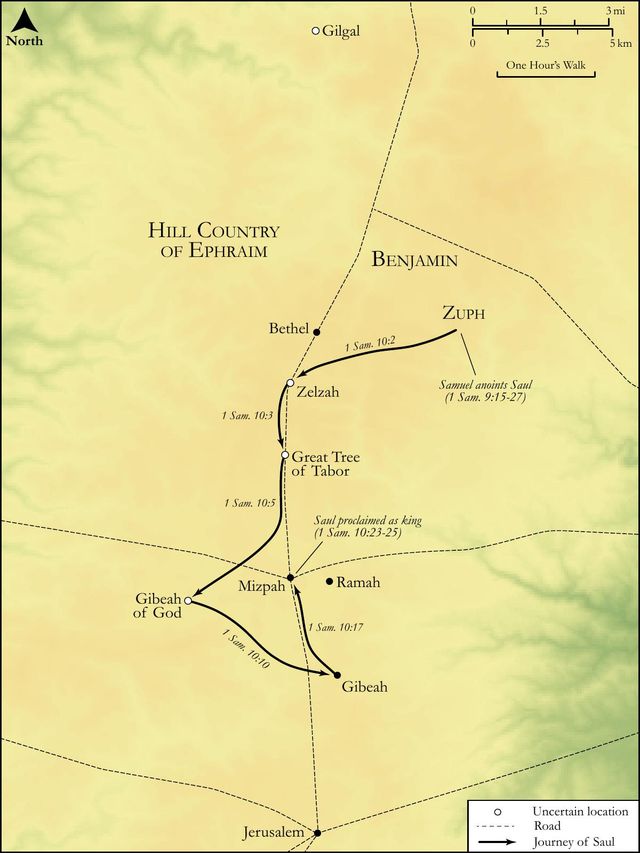
See on the biblical-era map
Study this verse
Public-domain commentary
Matthew Henry
From his Commentary on the Whole Bible. Henry comments on passages, not single verses — this entry covers 1 Samuel 10:1–8. His three-level outline is real structure in the source text, so it is rendered as structure.
Samuel is here executing the office of a prophet, giving Saul full assurance from God that he should be king, as he was afterwards, according to these prophecies which went before of him.
I.He anointed him and kissed him, Sa1 10:1.
This was not done in a solemn assembly, but it was done by divine appointment, which made up the want of all external solemnities, nor was it ever the less valid for its being done in private, under a hedge, or, as the Jews say, by a fountain. God's institutions are great and honourable, though the circumstances of their administration be ever so mean and despicable.
1.Samuel, by anointing Saul, assured him that it was God's act to make him king: Is it not because the Lord hath anointed thee? And, in token of that, the high priest was anointed to his office, to signify the conferring of those gifts upon him that were requisite for the discharge of its duties, and the same was intimated in the anointing of kings; for whom God calls he qualifies, and suitable qualifications furnish good proof of a commission. These sacred unctions, then used, pointed at the great Messiah, or anointed one, the king of the church, and high priest of our profession, who was anointed with the oil of the Spirit, not by measure, but without measure, and above all the priests and princes of the Jewish church. It was common oil, no doubt, which Samuel used, and we read not of his blessing it or praying over it. But it was only a vial of oil that he anointed him with, the vessel brittle, because his kingdom would soon be cracked and broken, and the quantity small, because he had but little of the Spirit conferred upon him to what David had, who was therefore anointed with a horn of oil, as were Solomon and Jehu with a box of oil.
2.By kissing him, he assured him of his own approbation of the choice, not only his consent to it, but his complacency in it, though it abridged his power and eclipsed his glory and the glory of his family. "God has anointed thee," says Samuel, "to be king, and I am satisfied and very well pleased, in pledge of which take this kiss." It was likewise a kiss of homage and allegiance; hereby he not only owns him to be king, but his king, and in this sense we are commanded to kiss the Son, Psa 2:12. God has anointed him, and therefore we must thus acknowledge him and do homage to him. In Samuel's explication of the ceremony, he reminds him,
(1.)Of the nature of the government to which he is called. He was anointed to be a captain, a commander indeed, which bespeaks honour and power, but a commander in war, which bespeaks care, and toil, and danger.
(2.)Of the origin of it: The Lord hath anointed thee. By him he ruled, and therefore must rule for him, in dependence on him, and with an eye to his glory.
(3.)Of the end of it. It is over his inheritance, to take care of that, protect it, and order all the affairs of it for the best, as a steward whom a great man sets over his estate, to manage it for his service and give an account of it to him.
II.For his further satisfaction he gives him some signs, which should come to pass immediately, this very day; and they were such as would not only confirm the word of Samuel in general, and prove him a true prophet, but would confirm this word to Saul in particular, that he should be king.
1.He should presently meet with some that would bring him intelligence from home of the care his father's house was in concerning him, Sa1 10:2. These he would meet hard by Rachel's sepulchre. The first place Samuel directed him to was a sepulchre, the sepulchre of one of his ancestors, for Rachel died in travail with Benjamin; there he must read a lecture of his own mortality, and now that he had a crown in his eye must think of his grave, in which all his honour would be laid in the dust. Here two men would meet him, perhaps sent on purpose to look after him, and would tell him the asses were found, and his father was in pain concerning him, saying, What shall I do for my son? He would reckon it happened well that he met with these messengers; and it is good to eye Providence in favourable conjunctures (though the matter be minute) and to be encouraged to trust it in greater matters.
2.He should next meet with others going to Bethel, where, it should seem, there was a high place for religious worship, and these men were bringing their sacrifices thither, Sa1 10:3, Sa1 10:4. It was a token for good to one that was designed for the government of Israel, wherever he came, to meet with people going to worship God. It is supposed that those kids and loaves, and the bottle of wine which the three men had with them, were designed for sacrifice, with the meat-offerings and drink-offerings that were to attend the sacrifice; yet Samuel tells Saul that they will give him two of their loaves, and he must take them. Such a present would look to us now like the relieving of a beggar. Saul must hereafter remember the time when he received alms, and must therefore be humble and charitable to the poor. But perhaps it would then be construed a fit present for a prince; and, as such, Saul must receive it, the first present that was brought to him, by such as knew not what they did, nor why they did it, but God put it into their hearts, which made it the more fit to be a sign to him. These two loaves, which were the first tribute paid to this newly-anointed king, might serve for an admonition to him not to spend the wealth of his crown in luxury, but still to be content with plain food. Bread is the staff of life.
3.The most remarkable sign of all would be his joining with a company of prophets that he should meet with, under the influence of a spirit of prophecy, which should at that time come upon him. What God works in us by his Spirit serves much more for the confirming of faith than any thing wrought for us by his providence. He here (Sa1 10:5, Sa1 10:6) tells him,
(1.)Where this would happen: At the hill of God, where there was a garrison of the Philistines, which is supposed to be near Gibeah, his own city, for there was the Philistines' garrison, Sa1 13:3. Perhaps it was one of the articles of Samuel's agreement with them that they should have a garrison there, or, rather, after they were subdued in the beginning of his time they got ground again, so far as to force this garrison into that place, and thence God raised up the man that should chastise them. There was a place that was called the hill of God, because of one of the schools of the prophets built upon it; and such respect did even Philistines themselves pay to religion that a garrison of their soldiers suffered a school of God's prophets to live peaceably by them, and did not only not dislodge them, but not restrain nor disturb the public exercises of their devotion.
(2.)Upon what occasion; he should meet a company of prophets with music before them, prophesying, and with them he should join himself. These prophets were not (as it should seem) divinely inspired to foretel things to come, nor did God reveal himself to them by dreams and visions, but they employed themselves in the study of the law, in instructing their neighbours, and in the acts of piety, especially in praising God, wherein they were wonderfully assisted and enlarged by the Spirit of God. It was happy for Israel that they had not only prophets, but companies of prophets, who gave them good instructions and set them good examples, and helped very much to keep up religion among them. Now the word of the Lord was not precious, as it had been when Samuel was first raised up, who had been instrumental in founding these colleges, or religious houses, whence, it is probable, the synagogues took their rise. What a pity was it that Israel should be weary of the government of such a man, who though he had not, as a man of war, expelled the Philistines, yet (which was a greater kindness to Israel) had, as a man of God, settled the schools of the prophets! Music was then used as a proper means to dispose the mind to receive the impressions of the good Spirit, as it did Elisha's, Kg2 3:15. But we have no reason to look for the same benefit by it now, unless we saw it as effectual as it was then in Saul's case, to drive away the evil spirit. These prophets had been at the high place, probably offering sacrifice, and now they came back singing psalms. We should come from holy ordinances with our hearts greatly enlarged in holy joy and praise. See Psa 138:5. Saul should find himself strongly moved to join with them, and should be turned thereby into another man from what he had been while he lived in a private capacity. The Spirit of God, by his ordinances, changes men, wonderfully transforms them; Saul, by praising God in the communion of saints, became another man, but whether a new man or no may be questioned.
III.He directs him to proceed in the administration of his government as Providence should lead him, and as Samuel should advise him.
1.He must follow Providence in ordinary cases (Sa1 10:7): "Do as occasion shall serve thee. Take such measures as thy own prudence shall direct thee." But,
2.In an extraordinary strait that would hereafter befal him at Gilgal, and would be the most critical juncture of all, when he would have special need of divine aids, he must wait for Samuel to come to him, and must tarry seven days in expectation of him, Sa1 10:8. How his failing in this matter proved his fall we find afterwards, Sa1 13:11. It was now a plain intimation to him that he was upon his good behaviour, and, though a king, must act under the direction of Samuel, and do as he should order him. The greatest of men must own themselves in subjection to God and his word.
Historical interpretation
Five Centuries of Reception
4 surviving comments on this verse. Each one is dated, so this reads as a timeline rather than a list.
Select a marker to jump to its quote. Markers stagger vertically where authors wrote within a few decades of each other.
And of all people, we Christians alone are those who … celebrate the mystery and are anointed there with the unspeakable chrism from a horn, as David (was anointed), not from an earthen vessel, he says, as (was) Saul, who held converse with the evil demon of carnal concupiscence.
Furthermore, whenever someone had to be chosen and anointed, the grace of the Spirit would wing its way down and the oil would run on the forehead of the elect. Prophets fulfilled these ministries.
And he kissed him, etc. And he united the figures of prophecy to the truth of the gospel and the grace of faith to the decrees of the long-desired peace of the law, and said: Behold, God, your God, has anointed you with the oil of exultation above your companions, to ask of him, and he will give you the nations as your inheritance, and the ends of the earth as your possession (Psalm XLIV).
(I Kings X) Samuel took a flask of oil, etc. John took the grace of the Holy Spirit to be preached, and testified that all its fullness rests in Christ, saying: "I saw the Spirit descending as a dove from heaven, and it abode upon Him" (Matthew III; Mark I). And well did he pour it out, for "your name is oil poured out" (Song of Solomon I).
Continue studying 1 Samuel 10:1 across the web’s major study libraries — every link below opens this exact verse, chapter, or book on the destination site.
Read & Compare
 BibleGatewayThis verse in more than 200 translations and 70 languages.
 Bible.comThe YouVersion reader — hundreds of translations, reading plans, and highlights.
 ESV.orgCrossway's official English Standard Version reader.
 NET BibleThe NET translation with 60,000+ translators' notes on every rendering decision.
 STEP BibleTyndale House's free study tool — original text, vocabulary, and scholarly resources.
 BibliaLogos Bible Software's free web reader.
 USCCBThe New American Bible (Revised Edition) with the U.S. bishops' study notes.
Commentaries
 BibleHub CommentariesDozens of classic commentaries on this verse, gathered on one page.
 StudyLightMore than 100 commentary sets — the largest collection on the web.
 BibleRefPlain-English commentary on what this verse means, verse by verse.
 Enduring WordDavid Guzik's free commentary on this chapter, widely used by Bible teachers.
 Bible Study ToolsVerse commentary alongside Greek and Hebrew study aids.
Original Language & Research
- BibleHub InterlinearThe verse word by word — original language, transliteration, and English.
- BibleHub LexiconEvery word's original-language definition and Strong's entry.
 Blue Letter BibleDeep-study tools — Strong's numbers, concordance, and word studies.
 SefariaThe Hebrew text with Rashi and centuries of Jewish commentary.
Sermons, Hymns & Audio


TrulyRandomVerse is not affiliated with these sites and doesn’t control their content. They’re linked because they’re genuinely useful.
Summary
1 Samuel 10:1 marks the foundational moment of Israel's monarchy, as the prophet Samuel, acting under divine instruction, privately anoints Saul with oil, consecrating him as the first king. This sacred act, sealed with a kiss and a prophetic declaration, signifies God's direct selection and empowerment of Saul to be "captain over his inheritance," establishing the divine legitimacy of his rule and setting the precedent for leadership within God's covenant people.
Context
ShowHideLiterary Context
This verse is the climactic moment following Israel's persistent demand for a king "like all the nations" in 1 Samuel 8, a request that God, through Samuel, reluctantly grants while warning of its consequences. The preceding chapter, 1 Samuel 9, details the seemingly coincidental yet divinely orchestrated encounter between Saul, a humble Benjamite searching for lost donkeys, and Samuel, who had already been divinely informed of Saul's impending arrival and destiny. The private anointing in 1 Samuel 10:1 serves as the initial, intimate divine commissioning, preceding Saul's public confirmation by lot at Mizpah in 1 Samuel 10:17-27 and his subsequent military victory over the Ammonites, which solidifies his popular support in 1 Samuel 11. This sequence underscores that Saul's authority originates from God's sovereign choice, not from popular acclaim.
Historical & Cultural Context
The practice of anointing with oil was a deeply significant ritual in Israel from the consecration of Aaron and his sons, signifying consecration, dedication, or the setting apart of individuals for special, often sacred, roles. Kings, priests, and sometimes prophets were anointed, symbolizing divine blessing, prosperity, and the impartation of authority or divine enablement. The oil, typically olive oil, was a precious commodity. The act of kissing, as performed by Samuel, was not merely a greeting but a powerful gesture of homage, allegiance, and a seal of agreement or blessing, often employed in covenants or the installation of rulers. Israel's unique position as God's "inheritance" (Deuteronomy 4:20) meant that their king, unlike those of surrounding nations, was intended to be God's vice-regent, ruling on His behalf and accountable to His covenant laws. This anointing, therefore, integrated a common cultural practice into a distinctly covenantal and theological framework, underscoring the divine nature of Israelite kingship.
Key Themes
ShowHideThis pivotal verse profoundly articulates several enduring themes. Foremost is Divine Sovereignty and Appointment, demonstrating that despite Israel's human desire for a king, God retains ultimate control, choosing and appointing Saul according to His divine purpose. The Sacredness of Anointing is powerfully conveyed as a ritual act of consecration, setting Saul apart for a divine office and signifying the impartation of authority and divine empowerment, a practice that foreshadows the greater "Anointed One" to come. Furthermore, the concept of Leadership as Stewardship is central, particularly through the phrase "captain over his inheritance." This identifies Israel as God's treasured possession and defines the king's role not as an autonomous ruler but as a faithful caretaker and protector on God's behalf. This understanding of leadership as a sacred trust, accountable to God, is foundational. Finally, Prophetic Validation is highlighted, as Samuel, God's divinely appointed prophet, serves as the indispensable agent confirming Saul's kingship, thereby legitimizing the new monarchical structure in the eyes of the people and ensuring its alignment with God's overarching will.
Exposition and Analysis
ShowHideKey Word Analysis
ShowHideThis primitive root means "to rub with oil," specifically in a ritualistic sense, implying consecration and setting apart for a sacred purpose. It is the verbal root from which the noun māšîaḥ (Messiah) is derived. Thus, Saul is literally a "messiah" in the sense of being divinely appointed and consecrated for his royal office. This act signifies divine empowering and authorization, marking a person as chosen by God and endowed with His Spirit for a specific task.
This term denotes a commander, chief, or prince, often implying one who is divinely designated or occupies a position of leadership. A nâgîyd is not merely a military leader but a civil or religious authority figure. This emphasizes that Saul's role extends beyond military command to encompass governance and leadership over God's people, underscoring his divinely sanctioned authority and responsibility for the nation's well-being.
This word refers to something inherited, a possession, or patrimony. In this context, it specifically designates Israel as God's cherished possession. It powerfully reminds both Saul and the people that the nation belongs to the Lord, not to the king. Saul is not given ownership but stewardship over God's treasured people, making his authority derivative and ultimately accountable to God, who is the true owner of Israel.
Verse Breakdown
ShowHide"Then Samuel took a vial of oil, and poured [it] upon his head,"
This clause describes the central, symbolic action of the verse. Samuel, acting as God's direct representative, performs the ritual anointing. The pouring of oil on the head was a recognized act of consecration in Israel, as in the anointing of Aaron's head, signifying divine selection, blessing, and the impartation of authority and divine enablement. The "vial" (pak) suggests a small, intimate container, emphasizing the private, divinely initiated nature of this initial commissioning, distinct from any public acclamation.
"and kissed him,"
This act is more than a mere greeting; it is a profound gesture of allegiance, submission, and prophetic blessing. In Scripture, a kiss could signify homage, loyalty, or blessing, as in "Kiss the Son," said of the LORD's anointed. Samuel's kiss confirms his acceptance of Saul's divine appointment, acknowledges Saul's new status as king, and serves as a prophetic endorsement of his God-given authority, signifying a bond of loyalty and respect.
"and said, [Is it] not because the LORD hath anointed thee [to be] captain over his inheritance?"
This is Samuel's authoritative prophetic declaration, revealing the divine mandate behind the anointing. The rhetorical question serves to emphasize that Saul's kingship is not a result of human desire or chance, but a direct, sovereign act of Yahweh. The crucial terms "captain" (nâgîyd) and "his inheritance" (nachălâh) define Saul's role: he is a divinely appointed leader, not an absolute monarch, and his rule is over Israel, which fundamentally belongs to God. This statement establishes the theological foundation for Saul's authority and the nature of his profound responsibility to shepherd God's people on God's behalf.
Literary Devices
ShowHideThe verse is rich with significant literary devices. Symbolism is paramount, with the "vial of oil" profoundly representing divine consecration, blessing, and the impartation of God's Spirit, setting Saul apart for a sacred office. The "kiss" symbolizes allegiance, prophetic endorsement, and the sealing of a divine covenant between God's prophet and His chosen king. There is a subtle Irony in the contrast between Saul's humble, ordinary task of searching for lost donkeys and his sudden, divinely orchestrated elevation to the highest office in the land, highlighting God's unexpected choices and sovereign hand in human affairs. Furthermore, the anointing serves as powerful Foreshadowing, not only of Saul's subsequent reign and the establishment of the Israelite monarchy but, more profoundly, of the future line of kings, culminating in David, and ultimately pointing to the true and ultimate "Anointed One," the Messiah, who would perfectly fulfill the roles of prophet, priest, and king. The concluding rhetorical question ("Is it not because the LORD hath anointed thee...") functions as a Didactic Statement, unequivocally asserting the divine origin of Saul's authority and the theological basis for the monarchy.
Theological and Thematic Connections
ShowHideThe anointing of Saul in 1 Samuel 10:1 stands as a profound theological declaration on divine sovereignty and the intrinsic nature of leadership within God's covenant. It powerfully illustrates that even when human desires appear to deviate from God's initial ideal (the demand for a king "like all the nations"), God remains meticulously in control, working His overarching purposes through and even in response to human choices. Saul's anointing underscores that all legitimate authority, particularly over God's people, originates solely from God. This act sets a foundational precedent for the Israelite monarchy, where the king was intended to be God's faithful representative, ruling justly and righteously over "His inheritance." This sacred act of anointing, signifying divine selection and empowerment, links Saul to a venerable lineage of divinely appointed individuals, from the patriarchs to priests and prophets, and critically points forward to the ultimate Anointed One, who would perfectly embody divine kingship.
Reflection and Application
ShowHideThe anointing of Saul serves as a timeless and powerful reminder that God is intimately involved in raising up leaders in every sphere of life, often in unexpected ways and sometimes even in response to flawed human desires. For believers today, this truth calls us to recognize that all authority, whether in civil government, the workplace, or especially within the church, ultimately derives from God. This recognition should compel us to pray diligently for our leaders, to respect the offices they hold, and to strive to discern God's hand in their appointment, even when their character or decisions may fall short of divine ideals. Furthermore, Saul's anointing as "captain over his inheritance" profoundly highlights the immense responsibility inherent in leadership, particularly within the community of faith. Those entrusted with influence are called to be faithful stewards of God's people and resources, leading with unwavering integrity, profound humility, and an absolute dependence on divine guidance. Our leadership, like Saul's, is always a stewardship, never an entitlement, and is ultimately accountable to the One who grants the authority. This perspective encourages us to seek God's will in all our endeavors, remembering that our ultimate purpose is to serve His kingdom and His beloved people.
Questions for Reflection
ShowHideFAQ
ShowHideWhy was Saul anointed with oil, and what did it symbolize?
ShowHideSaul was anointed with oil by Samuel as a deeply significant symbolic act of consecration and divine appointment. In Israel, anointing with oil was a sacred practice for setting apart individuals for special, often sacred, offices, particularly kings, priests, and sometimes prophets. The oil itself symbolized divine blessing, the impartation of the Holy Spirit, and the transfer of legitimate authority. It signified that Saul was not merely chosen by human will, but was divinely selected by God, empowered by His Spirit, and set apart for the specific purpose of leading Israel as their first king. This act made his kingship legitimate in the eyes of God and, consequently, in the eyes of the people.
Why was this anointing done privately, and not publicly?
ShowHideThe anointing in 1 Samuel 10:1 was a private, intimate act, preceding Saul's public confirmation at Mizpah in 1 Samuel 10:17-27. This private anointing emphasized that Saul's selection was first and foremost a divine initiative, a direct revelation from God to Samuel, rather than a popular election or a human-initiated process. It established his authority from God's perspective before it was ratified by the people. This sequence highlights God's sovereign choice and provided Saul with personal instruction and prophetic signs, as detailed in 1 Samuel 10:2-8, preparing him for his future public role and the immense challenges he would face.
Christ-Centered Fulfillment
ShowHideThe anointing of Saul in 1 Samuel 10:1, while marking the inauguration of Israel's monarchy, ultimately serves as a profound pointer to the ultimate Anointed One, Jesus Christ. The very Hebrew word for "anointed" (māšaḥ) is the root of "Messiah," and its Greek equivalent is Christos, from which we derive "Christ." Saul, as the first "anointed" king, foreshadows Jesus, who perfectly fulfills the multifaceted roles of King, Prophet, and Priest. Unlike Saul, whose anointing was for a temporal reign and whose obedience ultimately faltered, Jesus was anointed by the Holy Spirit without measure (John 3:34), not with physical oil but with the Spirit at His baptism (Matthew 3:16-17), for an eternal and unshakeable kingdom. He is the true and perfect "Captain" (nâgîyd) over God's ultimate "inheritance," which is not merely the ancient nation of Israel, but the Church, His redeemed people drawn from every tribe, tongue, and nation (Ephesians 1:11-14). Jesus, the Christ, perfectly shepherds His people, not as a fallible human king, but as the divine Son of God, establishing a kingdom that will never end (Luke 1:33) and providing the perfect leadership, salvation, and eternal reign that Saul could only dimly prefigure.